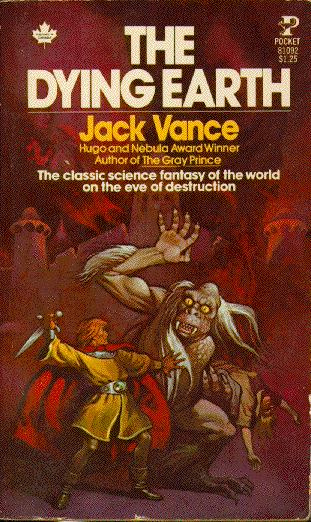
 Do you remember those creepy-weird montages from those old 60s and 70s era Disney movies? The ones like Dumbo, or The Three Caballeros–or heck, the entire thing of Fantasia–where all these weird kaleidoscopic shapes and psychedelic colors just move in and out of each other in twisted, convulsing ways? Well, guess what? Jack Vance’s The Dying Earth is like one of those montages in written form, and I loved it.
I picked up this book in order to familiarize myself a little better with the Sword & Planet subgenre, which I’d like to write in (as you may remember … my WIP is currently on hold, but I’d like to pick it up again soon). This one is a lot different from the Princess of Mars series, with an eerie apocalyptic feel, arcane magic and forbidden knowledge, weird, monstrous creatures, and above all else, a decidedly un-Disney fairy-tale feel that pervades the book with doom and danger.
If you’re looking for straight-up Science Fiction, you’re better off looking elsewhere. This book is even more fantastic than Ray Bradbury’s stuff, and while there’s a little bit of a sci-fi dressing thrown in, there really is no scientific justification for anything. The basic premise is that the Earth is dying, meaning that the sun is growing dimmer and dimmer and will soon go completely out. The last few people eking out an existence on this planet are mostly wizards and witches, each one intent on building their own little empire and cheating or stealing from everyone else. There are a few pure-hearted souls, but the world is completely lawless, and the only way to survive is through magic or brute force.
The chapters are really more like interconnected short stories, where each one stands on its own, and yet may feature a recurring character, or be set in the same place as another. There were only six chapters in the version I read (the 1977 Pocket Book edition), which makes me wonder if I missed any. If I did, I would definitely like to read them, because the stories were absolutely mesmerizing!
Because I read this book to get a feel for the sub-genre, I’m going to list some of the things I really enjoyed about it. Here they are:
- The fairy-tale story structure. None of the chapters started out with “there once was a …” but it certainly felt like they did. Each character started off with a quest or dilemma, and then went on a journey of some sort where they faced trials, made friends, and defeated enemies in order to attain some sort of boon at the end.
- Lots and lots of world-breaking magic. Seriously. One of the guys sets out on his journey with a spell that basically keeps him from any danger whatsoever, so long as he stays on “the path.” Since he really has no idea where he’s going, “the path” is basically any path he chooses to travel. Since all the rest of the magic is just as world-breaking, you have no idea what could happen next. There’s always a sense that anything could happen.
- An elevated sense of diction. The characters don’t speak like we do, they speak like people from the 18th or 19th centuries, with words like “thus,” “whence,” “wherefore,” and grammatical structures like “I know not,” and “half yet remains.” It’s not just the characters, either–the whole book is like that. It really adds to the fantastic, otherworldly feel.
- Lots of contrasting extremes. The demons are truly perverse and sadistic, with death and brutality on every other page. At the same time, though, the moments of beauty and love are just as great. My favorite line from the whole book, which practically made me cry, is “My brain is whole! I see–I see the world!” If I explained it any more, it would be a spoiler.
- High adventure. LOTS and LOTS of high adventure. There isn’t a viewpoint character in the book who doesn’t leave home to go on some sort of quest through all sorts of wild and creepy dangers. Every character is seeking something, and not in a “meh” kind of way–they are so wholly focused on what they’re seeking that they put their very lives in peril just to obtain it. Almost all the romance is rescue-romance, of the pulpiest possible kind. It’s awesome.
There are more, but those are the big things. Overall, I’d say that this book is about 50% Fantasy, 30% Horror, and 20% Science Fiction, with none of the more modern conventions of any of those genres. It was first published in 1950, but it feels a lot closer to Robert E. Howard and Jules Verne than J.R.R. Tolkien and Arthur C. Clarke. If you’re looking for a good spec-fic throwback with lots of magic and adventure, this is a great one to check out.
