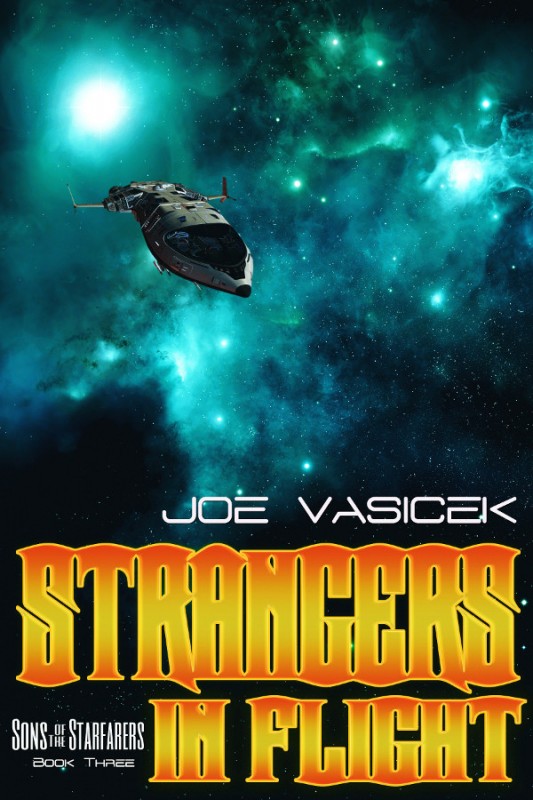
The Search for Belonging in Strangers in Flight

What does it mean to belong when everything familiar has been stripped away? Strangers in Flight is a character-driven science fiction and space opera novel about people who survive catastrophe, only to discover that survival alone isn’t enough. Set amid war, displacement, and life on the interstellar frontier, and against the backdrop of an ongoing interstellar conflict in the Sons of the Starfarers series, the novel asks a simple but painful question: how do you build a sense of home when you wake up alone in a universe that no longer knows who you are?

Where the Idea Came From

The idea for this theme grew out of thinking about what it would be like to lose not just your home, but your entire cultural and social world overnight. In the author’s note, I talk about wanting to explore loneliness at an extreme scale: being the sole survivor of a people, waking into a future where everyone who shaped your identity is gone. Science fiction gave me the space to externalize that loneliness—to turn it into a literal universe of strangers. I was especially interested in what happens after the escape—when the danger passes, but the isolation remains—and how belonging has to be rebuilt from nothing.

How The Search for Belonging Shapes the Story

Belonging is the emotional engine that drives Strangers in Flight. Reva’s struggle is not just physical survival or escape from enemies, but the deeper shock of cultural and personal dislocation. She wakes into a galaxy that doesn’t share her language, her customs, or her assumptions about the body, privacy, and trust. Her choices throughout the story are shaped by the question of whether belonging is even possible—or whether survival requires emotional withdrawal. That tension—between isolation and connection—echoes throughout the wider conflict of the series, where entire peoples are being displaced by war.

Isaac’s journey mirrors this from the opposite direction. Though he has a ship, a profession, and a place in the wider conflict of the Sons of the Starfarers series, he is also profoundly isolated—adrift on the frontier, defined more by what he avoids than what he commits to. When these two characters come together, the story treats belonging not as instant comfort, but as something forged through mutual risk, responsibility, and choice. These decisions ripple outward, shaping the story’s conflicts and setting the tone for the relationships that continue across the series.

What The Search for Belonging Says About Us

At a time when many people feel disconnected even while surrounded by others, Strangers in Flight frames belonging as a fundamental human need rather than a luxury. The novel suggests that loneliness is not just emotional pain, but a condition that makes us vulnerable—to despair, exploitation, and moral compromise. If you’ve ever felt out of place, unseen, or unmoored after loss or change, this story treats that experience with seriousness and empathy. At the same time, it offers a quiet hope: belonging doesn’t require shared origins or perfect understanding. It begins when people choose to care for one another, even when doing so is inconvenient, risky, or costly.

Why This Theme Matters to Me

This theme matters to me because I’ve always been drawn to stories about people on the margins—exiles, refugees, wanderers, and survivors—who have to decide whether connection is still worth the risk after loss. I wanted to write a story that takes loneliness seriously without becoming cynical, and that treats belonging not as something we passively receive, but something we actively build. That question—how people find one another in the aftermath of upheaval—runs throughout the Sons of the Starfarers series. For me, Strangers in Flight is ultimately about the hope that even in a vast and lonely universe, belonging can still be found—sometimes in the most unexpected places.

Where to Get the Book

Related Posts and Pages

Explore the series index for Sons of the Starfarers.

Return to the book page for Strangers in Flight.
Is Strangers in Flight for you?

The Sons of the Starfarers series is a character-focused science fiction saga about exile, loyalty, and survival on the edges of interstellar war. Strangers in Flight (Sons of the Starfarers: Book 3) is a military science fiction adventure story about survival on the run—when one wrong jump can put you back in the hands of people who own the corridors. It delivers starship tension, cultural collision, and the slow, earned shift from “I’m alone” to “we’re in this together”—when survival starts depending on someone else.

What Kind of Reader Will Love Strangers in Flight?

If you love…

  • space opera / military-flavored SF where the danger feels immediate and personal (pirates, patrols, docking bays, and narrow escapes)
  • character-driven adventure about loyalty, grief, and the determination to keep going when everything gets taken from you
  • fish-out-of-water culture shock with real emotional weight (language barriers, customs clashes, trying to belong in a world that isn’t yours)
  • unlikely partners / found connection—two strangers forced to trust each other under pressure
  • resourceful protagonists who solve problems under confinement and constant surveillance

…then Strangers in Flight is probably your kind of story.

What You’ll Find Inside

This book follows Isaac—an outworld starfarer trying to stay alive and get free—and Reva, the once-mysterious “henna girl,” now awake and thrust into a hostile culture where even basic norms (language, clothing, privacy) don’t match her own. The mood is tense and kinetic, with a constant undercurrent of grief, disorientation, and stubborn hope. The style leans fast-paced and adventure-forward, with close-up emotional stakes and the feeling that every safe place is temporary.

What Makes Strangers in Flight Different

Instead of drawing out its central mystery across the entire series, Strangers in Flight brings a long-teased character fully into the story and allows her to actively shape its direction. It’s here where Reva (the mysterious cryosleep survivor from the first book) becomes a full character whose choices reshape the direction of the story. The book also leans hard into culture as conflict—not just politics and lasers, but the intimate friction of norms, taboos, and translation (and what it costs to adapt without losing yourself). And at its core, it’s about two people helping each other endure different kinds of captivity—external and internal—until they aren’t strangers anymore.

What You Won’t Find

You won’t find a slow, meditative “slice-of-life in space” book here—this one is built to keep the overarching series moving and to keep the tension tight. Also: while the story includes a culture with different norms around privacy and modesty, and moments of uncomfortable attention from antagonistic men, it treats the situation as a real complication and source of vulnerability rather than as eroticized content.

Why I Think You Might Love It

When I hit Book 3, this story stopped feeling like “the next installment” and started feeling like the bridge that revealed how the series could become what it wanted to be. I didn’t want Reva’s mystery to dominate everything, so I made a choice that changed the whole series: I brought her fully onstage, let her become real, and let the plot grow out of who she is—sharp, resourceful, and carrying a kind of loss that’s harder to outrun than any ship. And in a strange way, that’s what I hope lands for you as a reader: the idea that sometimes the best way to survive your own crisis is to help someone else survive theirs—until “strangers” quietly becomes “we.”

Where to Get the Book

Related Posts and Pages

Explore the Sons of the Starfarers series index.

Return to the book page for Strangers in Flight.

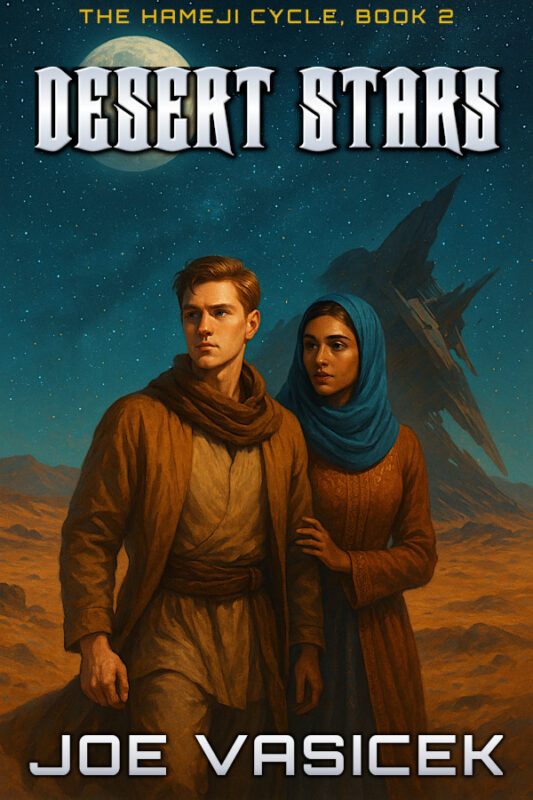
Is Desert Stars for You?

Desert Stars is a character-driven science fiction novel—and the second book in The Hameji Cycle—about displacement, faith, and choosing home in a universe being torn apart by interstellar war. It blends intimate desert-scale storytelling with sweeping galactic stakes, following ordinary people who must decide who they are when their world—and their future—can no longer be taken for granted.

This is a story about pilgrimage and exile, love tested by catastrophe, and the quiet heroism of holding on to what matters when everything else is stripped away.

What Kind of Reader Will Love Desert Stars?

If you love…

  • character-driven science fiction that prioritizes relationships, moral choice, and inner conflict
  • stories of refugees, exile, and found family set against large-scale wars
  • science fiction that treats faith, tradition, and culture seriously rather than cynically
  • slow-burn romance grounded in shared hardship and mutual trust
  • frontier worlds, desert cultures, and “small people in big events” storytelling
  • science fiction that blends space opera scale with intimate, human-scale storytelling

…then Desert Stars is probably your kind of story.

What You’ll Find Inside

At the heart of Desert Stars is Jalil, a desert-raised young man caught between the life he knows and the wider galaxy he barely understands. As war spreads and entire worlds are destroyed, Jalil and Mira are forced into a refugee journey that is part pilgrimage, part flight for survival, and part reckoning with what “home” really means.

The tone is reflective and emotionally grounded, punctuated by moments of intense danger and loss. The pacing alternates between quiet, human-scale scenes—conversations under the stars, hard choices made in private—and sudden, devastating reminders of the larger war closing in. The style leans hopeful without being naïve, and tragic without becoming bleak.

What Makes Desert Stars Different

While Desert Stars shares DNA with classic space opera, it resists the usual power fantasies and chosen-one narratives. The focus isn’t on saving the galaxy, but on saving people—and sometimes not even that is possible. Readers who enjoy the reflective, culture-forward science fiction of authors like Ursula K. Le Guin or character-focused space opera in the vein of Lois McMaster Bujold may find a familiar rhythm here.

Unlike many military or political science fiction novels, this story centers cultural identity, spiritual longing, and the cost of leaving one world behind for another. It also treats faith as a lived, motivating force rather than a background detail or a flaw to be outgrown.

Readers who enjoy the quieter, more contemplative side of science fiction—where worldbuilding emerges naturally through character and culture—will find this book especially resonant.

What You Won’t Find

You won’t find grimdark cynicism, graphic cruelty for shock value, or characters who abandon their moral center for easy wins. This isn’t a nonstop action thriller, nor is it a satire of belief or tradition.

If you’re primarily looking for snarky antiheroes, relentless combat, or stories that dismiss faith as naïve or obsolete, this may not be the right fit.

Why I Think You Might Love It

I wrote Desert Stars at a time when I was wrestling with questions of identity, belief, and what it means to re-enter the world after a period of deep spiritual focus. That tension—between the sacred and the practical, between inherited tradition and an uncertain future—ended up at the heart of this story.

If you’ve ever felt caught between worlds, unsure whether the life you came from can survive the life you’re moving into, I think you’ll recognize something true here. This is a book about choosing to belong—even when belonging comes at a cost.

Where to Get the Book

Related Posts and Pages

Explore the series index for The Hameji Cycle.

Return to the book page for Desert Stars.







