Racing along

Ugh, why do I always stay up until 2am?  And then I don’t get up until ten.  Man, I need a job–either that, or more self discipline.

Just a quick post before I hit the sack.  I’m making excellent progress with the revision of Mercenary Savior, regularly hitting between 7k and 8k per day.  Most of that is polishing work, which tends to go fast, but I’m also rearranging a few chapters, deleting scenes and putting others in a different order.

One thing that’s surprised me a lot so far is how much I’ve managed to cut.  The first draft, which I wrote on MS word, was about 135k–which runs around 145k by open office’s (flawed) word count method.  The second draft was about the same, the third a little shorter, and the fourth around 120k by open office’s algorithm. By then, I thought it was as lean as I could get it–but no, that’s not the case.  It’s all for the best, though; a 100k word novel isn’t nearly as daunting as a 145k monster, especially in science fiction.

Anyhow, today I got some feedback from C.A. Jacobs, a friend from World Fantasy (which she mailed to me…from HAWAII…), and I’m thinking I ought to change the title of this work. She suggested something like “The Fall of Karduna,” but the book is more about the individual characters than the world, so I’m thinking of something like “Saving Stella,” or even reverting back to “Bringing Stella Home.” Any thoughts?

In unrelated news, a ton of job opportunities have been opening up recently.  I interviewed for a position with the BYU Political Science department on Monday, and I’ve got another interview with a local marketing company Friday.  My sister also says that her work needs a new cook, so that could be good if the other stuff falls through.  And as for phone delivery, I’ve got until the 17th to keep up with that.

So, life is good.  Writing-wise, I’m having a very productive revision of one of my better works.  Job-wise, a lot of promising options seem to be popping up.  Social-wise, I’m doing pretty well, too; Utah is a great place to make new friends.

Oh, and English 318 starts TOMORROW!  Holy crap, I am excited!!

gnight

Wolverton interview and more

The interview with Dave Wolverton was a resounding success!  We had a fascinating conversation about science fiction and the gospel, his latest book In The Company of Angels, self-publishing, the English 318 class at BYU and the profound impact it’s had on the LDS writing community, and much, much more.

On that, I suppose I should disclose my full reasons for going down to St George and meeting with Dave.  I’m putting together an article for the December 2010 issue of Mormon Artist, where I hope to give a brief history of BYU’s “class that wouldn’t die” and explore the impact that it’s had on both the LDS writing community and on mainstream sf&f.

The “class that wouldn’t die” was the group of students who signed up for the first English 318R science fiction creative writing class at BYU, back in ’78 (I think it was ’78…gotta check that).  After the semester was over, the students banded together through forming a writing group, which they called “Xenobia.”

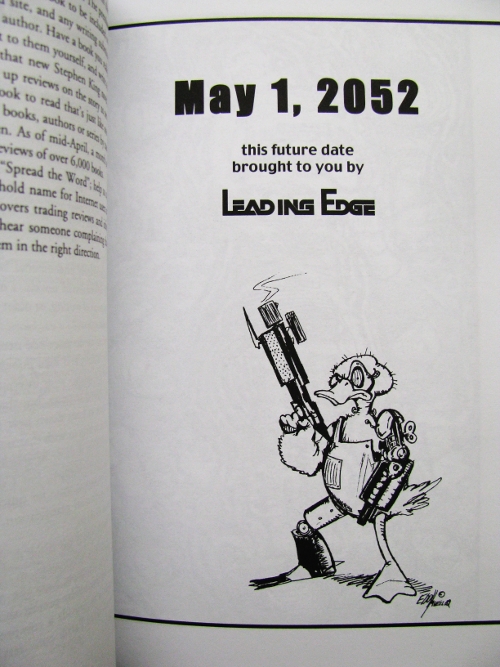
They didn’t stop there, however.  As Xenobia grew and matured, the students decided to form other organizations designed to help new writers (especially sf&f writers) improve their craft and build their writing careers.  Specifically, they founded Quark, BYU’s science fiction and fantasy club; Leading Edge, a student-run magazine that gives written feedback to every story submitted; and LTUE, an annual science fiction and fantasy symposium (like a convention, only no costumes).

These organizations, as well as the 318 class, led directly to the explosion of LDS writers in science fiction and fantasy.  Several bestselling LDS authors, including Stephanie Meyers, Brandon Sanderson, and Dan Wells (among many others) can trace the launch of their careers back to this class.  In turn, these authors are having a tremendous impact on mainstream sf&f literature.

The article is slated to come out in next December’s issue of Mormon Artist Magazine, just in time for LTUE 2011 (which I hope to attend).  Right now, I’m in the research phase, meeting with some really amazing people and gathering some fascinating stories.  This article is going to be awesome.

In parting, let me share one of the more interesting things Dave said in the interview.  As we talked about all these amazing resources available for sf&f writers in Utah valley, I asked him why this happened in this community and not elsewhere.

His answer was extremely insightful: for many writers, the mentality is that once you break in, you have to close the gate behind you.  It’s something of a zero-sub game, where people horde their ideas, compete with each other to break in, etc.

Not so in the LDS community.  As Latter-day Saints, we have a deep-set mentality of helping each other and building each other up.  That’s exactly what happened with the “class that wouldn’t die”–they did everything they could to foster other writers.  The proliferation of Latter-day Saints in mainstream sf&f is a direct result of this.

That’s Dave’s take on it, anyway.  It will be interesting to hear what others think.

Oh, and FYI, Mormon Artist is 100% volunteer run and free, so when the article and interview come out, you won’t have to pay anything to read them.  I’ll certainly provide links on this blog–stay tuned!

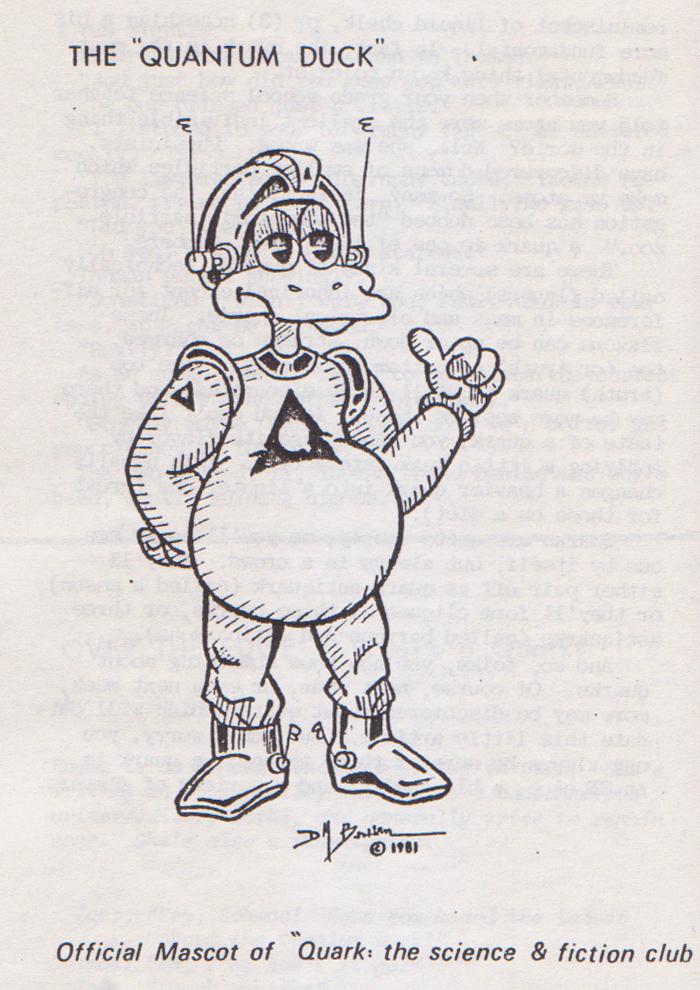
And as one final note, check out this piece of Xenobia history: the original Quantum Duck, as featured in the first issue of The Leading Edge.  Why a quantum duck, you ask?  Because that’s where the club’s name came from: a bumper sticker that said: BEWARE THE QUANTUM DUCK THAT GOES ‘QUARK,’ ‘QUARK’!

An interesting concept

Last night, I was hanging out with a friend of mine and a couple of girls in the apartment complex where I currently live.  We got to talking about books, and one of the girls said something really interesting:

Every book needs to have one thing that the main character knows that the reader doesn’t know, and one thing that the reader knows that the main character doesn’t know; otherwise, it’s too boring.

That’s a fascinating concept.  I know that both things are important, but I’ve never connected them together.

When the reader knows something that the main character doesn’t, it can make for great suspense.  A good example of this is this scene from Xenogears, when the characters are trying to hunt down a monster in the sewers (skip to 6:37):

It’s harder to pull off having the characters withhold information from the readers, but it can be done. I think a good example of this is the scene from Star Wars V: The Empire Strikes Back when the Millenium Falcon arrives at Bespin and C3PO gets shot:

Granted, nothing really vital is withheld here, since by this point Master Yoda has seen Luke’s friends in danger, and Bobba Fett has clearly followed them to Bespin–but the audience still doesn’t know exactly what’s going on, and so it creates suspense.

In terms of Orson Scott Card’s MICE quotient, this would definitely fall under the “information” component of stories. In Brandon Sanderson’s class (and in my own reading), I’ve focused a lot on character, setting (milieu), and plot (event), but I haven’t thought a lot about information.

I wonder how my own novels measure up to this principle. Let’s see…

In Genesis Earth, there are a lot of things that Michael and the reader doesn’t know, but not much that one knows and the other doesn’t. There are, however, quite a few things that Terra knows that the reader doesn’t. Those all come out in the middle, though. In terms of information withheld from the reader, I suppose you could count Terra’s feelings for Michael, in the buildup before the climax, but that’s about it.

In Mercenary Savior, the reader knows a TON of stuff that James doesn’t know–it’s a major source of the suspense in that novel. In terms of things the characters know that the reader doesn’t, there’s much less, but I can think of a few things Danica knows that are kept mysterious until a key climax. Those aren’t foreshadowed until maybe 50 or 100 pages before the reveal, but I suppose it still counts.

Thinking WAY back to my first practice novel, Ashes of the Starry Sea (which I will probably never publish), there is, again, a TON of stuff the reader knows that the characters don’t. Basically, every character is clueless in some crucial way, and the resulting comedy of errors drives the plot. In terms of information withheld from the reader, though, there’s not as much. There is a point where Ian runs off without an explanation, but I’m not sure if that’s just my own poor writing. I could probably pull it off in a revision, but I don’t know when or if that will ever happen.

So yeah, I suppose I’ve done that in my own writing. I suppose it’s much easier to do this in third person, however–Genesis Earth is entirely in first person, and there isn’t anything Michael thinks about that the reader doesn’t see. He is an unreliable narrator at times, but he’s not the character withholding the information–and if he was, I don’t think it would have worked very well.

In any case, it’s a very interesting principle. I’ll have to keep it in mind.

Quark has a new writing VP

That’s right; her board name is Jimmy and she’s basically doing it the same way I did it–by jumping in the deep end first.  Joined quark last semester, went to a few writing meetings, and pow!  Writing VP.

Anyways, we had some interesting conversations after the last writing group meeting of the semester.  Basically, I think I convinced her to set daily writing goals the same way Aneeka convinced me.  She also decided to start a writing blog, so if you get a chance, you should check it out!  It’s called Dragons, Dirt & Bones, after the quote by G. K. Chesterton:

Fairytales are more than true–not because they tell us that dragons exist, but because they tell us that dragons can be beaten.

The funny thing is that we met each other two years ago and both totally forgot about it.  She was a high school junior visiting BYU, and came to Brandon Sanderson’s English 318 class.  She remembers bookstore guy…and one of the writers whom the others in the writing group mercilessly ripped on.  Guess who that was?

In unrelated news, I am no longer homeless but am currently unemployed.  Dropped off a business card at Pioneer Book, though–told them I could help if they need extra work for the move.  Who knows, maybe that will lead to something.

I will probably end up getting a generic summer job, then upgrade to something more semi-permanent (and resume friendly) by August.  I’ll probably stay in Utah, using my writing and editing skills in some capacity.  I’d like to work as a grant writer for BYU, but they’re still under a hiring freeze.  Once that lifts, though, there are going to be a ton of job openings.

My primary plan is still to make my living as a published author, and I’m very optimistic about that working out.  Before the end of next week, I want to have Genesis Earth sent out to at least five new places.  My goal for Mercenary Savior is to finish draft 3.0 by CONduit at the end of May, but I will probably polish the first three chapters and start sending it out before then.

In the meantime, the real world awaits.  Scary, I know, but at least I’m graduating debt free, with a roof over my head, friends and family close by, and lots of exciting possibilities for the future.  I think things will turn out well.

Quick post from Provo

This is going to be quick, because it’s late at night and I want to get some sleep.

I made it to Provo.  I’m currently staying with an old roommate, sleeping on his couch.  To do: find a job and a place to live.  Fortunately, I’ve just about got the second one secured.

I talked with the editors at Leading Edge today, and they told me they’ve been having problems with the buy function on their website.  If you tried to buy a copy of issue 58 (the one with my story) before this month, they probably lost your address.  Don’t worry, they voided the purchase, but if you want a copy you’ll have to go through the process again.  Sorry for the hassle.

Wrote the last academic paper of my undergraduate college career today.  The last freaking paper. Hooray!

I dropped in to English 318 tonight, and a couple of Sanderson fans got engaged in front of the whole class.  It was pretty cool, not the least because they were cosplaying at the same time.  Good luck, Mi’chelle!  May you and your future husband have a wonderful life together!

Thanks for all the feedback on the new title.  I think I’m going to stick with it.  It’s weird to call the book by a different name after working on it for so long under the other title, but I think Mercenary Savior works much better.

Looked up Westercon today and found out it’s only $60.  Thinking seriously about going.  Should I?  Is anyone else planning on going?

To do tomorrow: get cap and gown, complete and file taxes, sign a spring/summer contract, meet up with old supervisors/professors in pursuit of a job, go to a bonfire and have a good time.

My mom always got depressed with to do lists; she always felt daunted when she saw all the tasks she needed to accomplish.  To counteract this, she made a “tasks accomplished” list at the end of the day to make her feel better.  So, on that note:

Accomplished: finished all Washington Seminar coursework, attended English 318 and obtained leads for Mormon Artist article, attended Leading Edge and caught up with the slushies, got a date for next Friday (totally unrelated), submitted Genesis Earth to an agent, wrote +2.2k in Mercenary Savior.

Not bad.  Now, if you’ll excuse me, I’m going to crash for the night.

Goodbye DC

So I have some crazy, unbelievable news to share: I got fired from my internship, under disputed circumstances.  That’s right: fired from my unpaid internship four weeks before it was scheduled to end.

The exact reasons for the termination were never made completely clear to me, but I suspect politics played a significant role and that’s all I’m going to say about it here.  If you want to know more, please contact me privately.

Fortunately, the Washington Seminar people have agreed to let me get credit for my academic work–which means that I’ll be able to graduate.  I’ve been sent home early, but I can still pass the class with a C/C-.

Oh well.  In some ways, this kind of sucks, but in other ways, it’s a blessing in disguise.  I learned everything that I needed to learn from my internship: that I don’t want to pursue a career in government or policy making.

Government work is long, hard, and very intensive.  It also involves office politics, sitting behind a desk, and fighting entrenched bureaucracies.  It’s not the kind of career that allows time for family, let alone writing.  And the payoff?  The common refrain I heard was that the work was “interesting.” Not “meaningful,” “life-changing,” “personally enriching,” or any of that–just “interesting.”

Nope.  Not for me.

I also learned that the kind of people who are attracted to Washington DC are not the kind of people I feel very comfortable around.  Generally speaking, Washington DC tends to attract people who are ambitious, self-absorbed, arrogant, loud, poor listeners, opinionated, and oblivious of the people around them.  This certainly wasn’t true of everyone, both at the institute and at the Barlow center, but I found they were the exceptions to the rule.

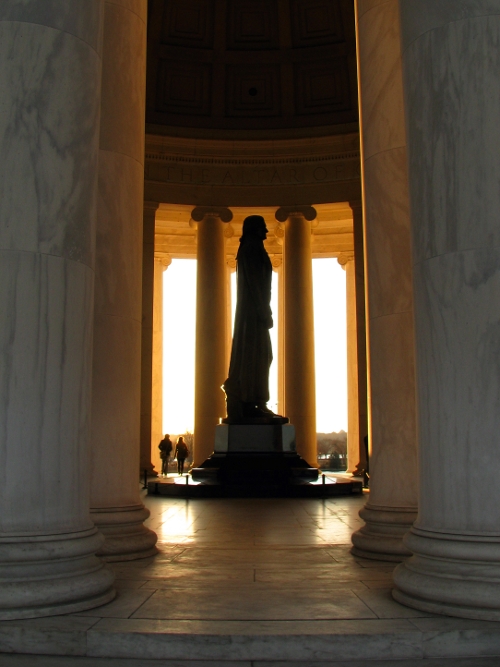
I will say a few positive things, though.  DC has some excellent museums and monuments–the best of any I’ve seen anywhere else.  In particular, I found the FDR memorial, the Portrait Gallery, and the science and innovation exhibit at the American History Museum particularly moving.

In terms of people, ironically, the ones that struck me as most sincere and genuine were all politicians.  In particular, I was struck by Congressman Matheson and Senator Bennett.  I’m not sure if I would vote for either of them–it depends on their stance on the issues–but they both struck me as intelligent, well meaning, good people.

I will also say that my respect for the military went up significantly.  After hearing so many people spout of so much self-important hot air about this or that political issue, it was remarkably refreshing to see people who were willing to put their lives on the line for their country.  To any servicemen reading this, thank you for all you do.  I have nothing but the deepest respect and admiration for you.

My experience in the Barlow center was generally quite positive.  I had an excellent roommate and made quite a few friends.  I’m sorry if I seemed kind of aloof most of the time–it’s probably because I was miserable for other reasons and didn’t realize it.  I’m looking forward to seeing everyone again back in Provo.

So, what’s the plan now?  Finish the academic side of things ASAP, then head back to Utah.  I’ve got a lot of old friends I want to catch up with before the summer, not to mention the last couple English 318 classes.  That’s one thing I sorely missed this semester–English 318.  Beyond that, I don’t quite know–a lot of things are still in the air.  I’m confident, however, that whatever happens, it will be for the best.

Thoughts on writing characters

A couple months ago, I was listening to one of my personal recordings of Brandon Sanderson’s English 318 lectures from last  year’s class.  The topic was writing characters.

Brandon outlined several techniques for making characters sympathetic.  He also outlined how to round them out: give them flaws and handicaps, as well as little quirks to make them unique and memorable.

However, I couldn’t help thinking that something was missing in his formulation.

Before I continue, let me say that I’m not disparaging or criticizing Brandon Sanderson’s abilities to write compelling, well-rounded characters.  As his novel Mistborn shows, writing characters is one of his strengths.

At the same time, I feel that the “checklist” approach to writing characters can be dangerously counter-productive.  Too often, characters in sub-par novels feel like a patchwork of characteristics and personality traits, not like actual, real people.

When I asked Brandon about this, he said that his techniques should be seen as tools, not as fundamentals.  He then went on to say that the most important thing to keep in mind is the character’s motivations–why they want what they want.  Beyond that, you just have to tweak the character until they fit into their role.

After thinking about it for some time, I came to the conclusion that the best way to write characters is to keep two essential rules in mind:

Rule #1: Every character is the hero of their own story.

Rule #2: Every story is composed of three parts: beginning, middle, and end.

The first rule is straightforward: every character sees their life as a story in which they are the main character.  This is because all of us, as human beings, view our own lives in this way.  We may look at other people and consider them nothing but extras in the story of our life, but they certainly do not think of themselves in this way.

To apply this rule, however, we need to understand what it exactly means to be the hero of one’s own story.  We can only understand this when we realize that a story is composed of three basic parts: beginning, middle, and end (or, as we see ourselves: past, present, and future).

Every hero has an origin and a destiny.  Without these, they don’t have a story; they don’t have a beginning and they can’t have a meaningful end.  This is why the hero cycle begins with the miraculous birth and ends with ascension and apotheosis.

Writers should keep this in mind as they sketch their characters.  If you don’t know where your character came from–who their parents are, where they  grew up, what were their major formative experiences, etc–your characters are going to fall flat because they’re just extras in someone else’s story; they have no story of their own.

Likewise, your characters need to have a destiny.  If you’re a discovery writer (like me), this might be harder because you don’t know, from the outset, where everyone’s going to end up.  Keep in mind, though, that rule #1 applies to the story the characters tell themselves just as much as the story you’re telling the reader.

Each character’s individual story is like a thread, which the writer weaves together with other threads to form a beautiful tapestry.  That tapestry is the novel; without the individual characters’ stories, the work would feel week, shallow–threadbare.

Of course, it’s not always possible (or a good idea) to reveal everything about every character.  It’s also not always possible to outline every character in great depth–not without catching “worldbuilder’s disease.” Instead, the rules of worldbuilding should apply–only use 10% of your worldbuilding in the actual story, no info dumps, etc.

I don’t think that’s a comprehensive theory of character just yet, but I think it’s a step closer to one.  If you have any ideas or suggestions of your own, please do share.

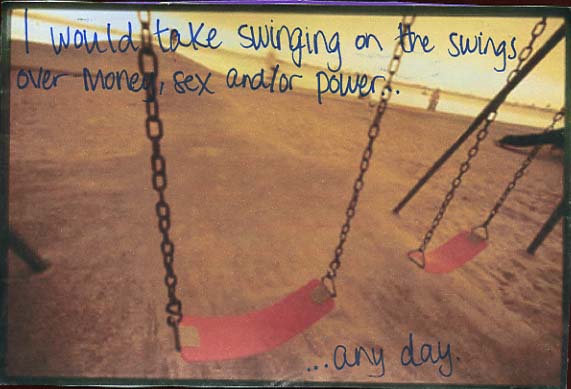
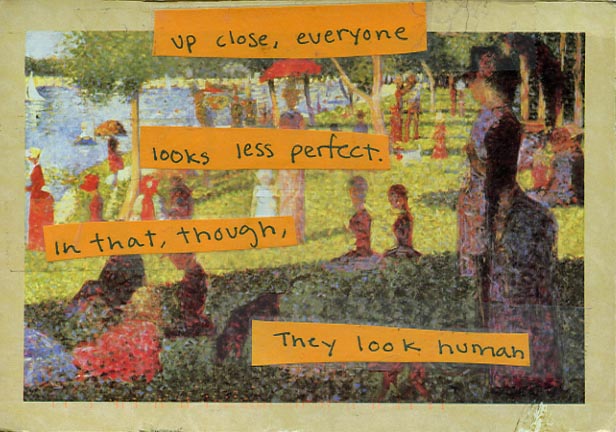
Image courtesy Postsecret

Genesis Earth pitch and other assorted thoughts on writing

Today I got together with Charlie after her work and discussed how to pitch my novel Genesis Earth.  We did it in the following way: I took a few minutes to explain what the book was about, while she wrote down the words that stood out and excited her.  Later, I took the words and worked out a thirty second pitch for it.

It was HARD!  I spent nearly two hours after meeting with her just to write out a stupid four or five sentence blurb!  Selling your work is totally different from producing it.  Anyway, here’s what I came up with:

Michael has never set foot on Earth, but it haunts him as much as the legacy of his parents.  So when his parents build the first artificial, traversable wormhole, he sets out with his mission partner, Terra, to explore the Earthlike planet on the other side.  They arrive only to discover an empty, abandoned world and an unresponsive ghost ship advancing towards them.  When Terra’s schizoid tendencies threaten her mental stability, they both must learn to trust each other in order to confront the mysteries of the new universe–and the personal insecurities that keep them from what they truly desire.

I have that down to 29.6 seconds.  I should probably cut it shorter, but as it is it only has about half of the words that Charlie wrote down.  If I cut it any more, I’m afraid it just won’t make sense.

It’s a start, though, and talking with Charlie helped me out tremendously.  I realized that when I’m selling this stuff, I need to focus on the characters.  Sure, all the worldbuilding stuff is interesting, but it’s not what hooks the reader.  If all you’ve got is thirty seconds, don’t cut to the chase–and don’t give a synopsis!  Synopsis =/= pitch!

Charlie was exhausted, so as we talked, she started ranting in a way that can be described as bluntly honest.  Interestingly enough, most of what she said was actually quite helpful, not only for Genesis Earth, but also for my other projects.

The most helpful thing she mentioned was that when you’re writing characters, you often have to pick out their distinctive character traits and consciously overemphasize them.  If you don’t, the reader might not pick up on it and find your characters stale and boring.  While I hate melodrama and try to keep my novels free of it, I also need to keep my characters interesting.  It’s a fine line to walk, but one that you can’t avoid.

She also said that it’s very easy for protagonists to be more boring than the main characters.  I think this is probably because we rely on formulas and cliches when we’re starting out, since that’s much less risky than breaking the rules we don’t yet fully understand.  The protagonist is the character closest to the trope, while the side characters can do what they want without threatening the integrity of the story.  

Charlie said that because it’s so easy to fall into the trap of a boring protagonist, you need to consciously choose the traits that are interesting about that character and work them into the story as much as possible.  I realized, as she said that, that my main protagonist for Hero in Exile is, indeed, a boring character.  I need to pick out the things that make him interesting and consciously work those into his character.

This got me to think about planning.  I’ve found that if I try to outline a novel when I set out to write the rough draft, I end up telling a completely different story.  However, if I try to write a second draft without an outline, I have a hard time keeping things straight and fixing all the stuff I missed while discovery writing the first draft.

(I’m really upset now, because I was going to mention something that I need to foreshadow in the next revision of Genesis Earth, but…I totally forgot what it was!  GAH!!!  That’s what I get for not outlining!)

Charlie then started to rant about some of our writing friends, and how she would never listen to criticism on her writing from someone she considered to be an inferior writer to herself.

That part was…interesting.  While I agree 110% that arguing with criticism is a sign of a poor writer, I don’t think it’s especially useful to rank writers in terms of “good” or “bad.” I would like to believe that I can learn something from everybody, and not just what not to do.  Perhaps that’s optimistic, but I think it’s also practical–I’ve found that a bloated ego can shoot you in the foot six ways to Sunday before you even know what’s going on.  I’ve found that not just through one unfortunate experience, but through several.

Brandon Sanderson said something very interesting in the last email he sent out to his English 318 class: he said that in New York, editors and agents don’t rank manuscripts by “good” and “bad,” they rank them by how much work they think it needs to be publishable.  There is a distinction between the two, just as there’s a distinction between recognizing something that works really well and something that follows the rules.  

That’s about all I have the time for now.  I’ve got to get to bed.  Late night internet == bad idea.

Miscellaneous news updates

I’m so bad at writing catchy titles for my blog posts.  CORRECTION: I can come up with catchy, sexy, exciting titles for my blog posts, it’s just that the first one that comes to mind is always dull and uninteresting.  Well, too bad.  To quote my mother: “suffer!”

Item One: State of the summer plans

Real quick: still haven’t heard back from the guys at JABberwocky.  I’m starting to think their either really disorganized (not out of the realm of possibility), or they’ve picked someone for the internship and it’s not much of a priority for them to get back to me.  I’ll email them tomorrow or Friday and ask what’s going on; probably I’ll stay in Provo, at least for spring.  But you know what?  I’m actually okay with that.

Lately, I’ve been staying at my sister’s apartment, hanging out with her and her husband, and spending most of the day at the HBLL writing (and chatting with Charlie, who seems to be perpetually bored at her nine-to-five job).  Should I end up staying in Provo, I don’t think that’s going to  change much.  I might work a couple part-time and/or temp jobs, and definitely attend a few cons and writers’ conferences, but that’s about it.

Oh, and maybe go on a random road trip every once and a while.  Fun! 🙂

Item Two: State of Genesis Earth

The rewrite is coming along very well!  I’m over 80% finished now and I think it’s getting better.  Incrementally, certainly, and there remains a lot of room for improvement, but at least it’s headed in the right direction.

I’ll probably write a different blog post on this, but I got Brandon’s comments back on the first three chapters (I submitted those for the final) and his comments were…interesting.  Helpful, certainly, but a lot more negative than I thought they would be.  Basically, he got really confused in chapter 2, and that ruined it for him.  I’ve got to completely overhaul a couple of those scenes to make sure they’re clear.  Fortunately, he really liked chapter 1, so if I can fix chapter 2 in the same way I fixed chapter 1, I think I’ll be in business.

Item Three: Other projects

With all this free time, now that school’s out, I think I should take on another writing project.  Back in the fall, I tried to do this and utterly failed at it, but now that I’ve got the time I think I can manage.  The question is, which project should I choose to work on first?

Option 1: Bringing Estella Home

Summary: When their home system is conquered by the ruthless Hameji barbarian warfleet, James leaves his home and sets out to rescue his older brother and sister, who have been captured and enslaved.  Little does he know, his brother is being turned into a Hameji killing machine and his sister has become one of the Hameji overlord’s personal concubines.

This is the most recent project.  It’s about half finished, but it needs some major revision work before I can comfortably continue where I left off.  It’s got a lot of action, but it’s also pretty dark and tragic.  Not a happy space opera, that’s for sure.

Option 2: Hero in Exile

Summary: Tristen (lamest name ever–I’m totally going to change his name if/when I pick up this project again) fell from the sky in an escape pod when he was only eight years old and was raised in the desert of Nova Gaia by a clan of desert tribesmen.  When he sets out with Mira, the chieftain’s daughter, for the legendary Temple of a Thousand Suns to ask the keepers of the Holy Archives of the Earth of Legend about his true parentage, he has no idea of the disparity, depravity, and danger he will meet in the world outside the small, isolated community of local tribesmen–or of the corruption and intrigue within.

I started this one in the fall, planned it out extensively, and then, halfway through…realizing I was writing a completely different story.  If I pick up this project, I have virtually no idea where I’ll end up with it.  However, it’s a fun space opera with a lot of action and a fair amount of romance (unlike Bringing Estella Home which has virtually zero romance.  No, slaves and concubines don’t count).

Option 3: The Phoenix of Nova Terra

Summary: When Ian finds himself stranded on a distant planet, the only thing he wants is to meet up with the rest of his crew and go home.  Little does he know, the native humans already venerate him as their chosen savior and their king has selected his daughter to be his wife.  When his journey takes deep into the forbidden lands, from which no-one has ever returned alive, Ian begins to uncover the secrets of this long-lost world, and the alien artifacts that will forever alter the paradigm of galactic human civilization–for its good or its destruction.

Gosh, how do you write a paragraph summary for a 168,000 word epic?  This is the first complete rough draft of a novel that I’ve written, and it is HUGE.  It spans dozens of worlds, six separate civilizations (including one alien and one AI), seven or eight viewpoint characters, and a friggin boatload of internal and external conflicts.  INSANE.  What’s more, it requires a lot of work–the rough draft was REALLY bad.  But you know what?  It might be kind of fun to try out.  It’s definitely a very fun, very positive story, with lots of intrigue and lots of romance.

So, the question is: which one should I pick up first?  Which ones should I work on this summer?  I’ll probably only be able to do two, plus Genesis Earth; which ones should I choose?

Item Four: Looking for Beta readers


This last item is pretty brief: I’m about to finish up with the Genesis Earth rewrite, and I need some beta readers to help out with it.  I’ve already got about a dozen people or so, but it wouldn’t hurt to have some more.  I’m looking for as much criticism and feedback as you can give me–anything helpful, including specific problems as well as your broader, overall impressions.  

Who wants to help out that can read this story by the end of May?  I really appreciate it!  Email me or post a comment if you want in (but please don’t ask to read it unless I already know you from real life).

Aaaaand…this post is almost 1,100 words long.  Yikes!  See y’all around!

(images courtesy Inkygirl: Daily Diversions for Writers)
This sucks and I’m a horrible writer

It’s getting really, really hard for me not to believe that statement, especially as I finish up with the middle part of this novel.  I’m starting to realize that I made a whole bunch of mistakes pages and pages ago, and that the climaxes just aren’t working without everything set up right.

I know, cognitively, that it’s mostly just psychological and that this book probably isn’t as bad as I think it is, but I’m finding it hard to convince myself of that.  I got to the climax of part II yesterday, and it was…not what I’d had in my head.  That’s probably what’s frustrating me the most.  If I can’t write down the story as I have it in my head, what does that mean?  It either means I’m a terrible writer, or that I didn’t get the setup right (or both…gah!).

So…where do I go from here?  Throwing out the entire story isn’t an option–I’m not going to allow myself to do that.  I could, however, put it on the back burner for a while, let it simmer…or I could do or die and finish the 1.0 draft, no matter how crappy it turns out.  I suppose that would accomplish something for my self esteem, but is that the way to best serve the story?

Fortunately, this past week we talked about revision in English 318.  Listening to my recording of the class gave me a few ideas.  I could make a list of known problems, with their fixes, and continue as if I’d already made them.  I think I did that a few times with The Phoenix of Nova Terra, but I don’t know how I feel about that now.  I could probably make it work…

The main issue is that I feel very, very distant from this book.  A month ago, I was immersed in the thing, writing over a thousand words each day, just chugging it out.  Now, for various reasons, other things have come up and drawn away my attention, so I don’t feel that I’m really in this world anymore.  I feel like I’m more of an outsider, writing for the sake of writing rather than trying to tell this story the way it wants to be told.  I can’t really remember what I wrote a hundred pages ago, despite that big sheet of butcher paper up in my closet.

Another thing that complicates all of this is that I’m really, really excited about the other novel, Genesis Earth. I’ve gotten back comments from most of my alpha readers, and I’m all but chomping at the bit to start working on it again.  If I had nothing else going on, no pressing obligations or assignments, with the enthusiasm I have for this project I could probably finish the second draft in a week, and the third draft the week after that.

So…what’s next?

Well, I think I’m going to start the revision on Genesis Earth today or tomorrow.  When I was this enthused about revising Pheonix, I decided to wait and finish Genesis Earth instead, and the enthusiasm for that project died down surprisingly fast.  Better to start now than wait until I’ve got the free time but struggle with motivation.

In the meantime, I’m going to finish the current chapter of Bringing Estella Home and let it rest for a bit.  I’ll probably reread what I’ve got from the beginning, make a few revision notes, perhaps an outline of sorts–try to figure out what’s wrong, what I need to change to make it work.  I’ll restrain myself from actually making those revisions (though I did that, mid-draft, for Genesis Earth, and it turned out alright…sort of), but once I feel I’m sufficiently “into” the story again, I’ll get back to work and finish the 1.0 draft.  Hopefully, I’ll be able to do all that before the end of May.

The trouble here is that I’ll probably end up writing the first draft of this novel and revising the other one at the same time…something I tried last September and failed miserably.  However, by the time all of this is finished, inshallah school will be over and I won’t have to worry about it.  Things are looking really good for me to get an internship in NYC, which makes me think I should drop my Spring classes and just take it easy for a month before I start (as for housing, that’s a whole other conundrum…).

Gah!  Writing is complicated.  Is this something I want to do for the rest of my life?  Something I can do?  I don’t know.  I really don’t know.  I just have to keep on writing through this depressing pessimism and trust that it will pass.

As a side note, I took the title of this post from a Writing Excuses episode some time ago; here is the link to that episode, in case you want to hear it.