Reading Resolution Update: June

My 2022 reading resolution: Read or DNF every novel that has won a Hugo or a Nebula award, and acquire all the good ones.

This is the last one of these resolution updates that I’m going to post here on this blog. I’ve only got three books left now: Falling Free by Lois McMaster Bujold (1989 Nebula), A Fire Upon the Deep by Vernor Vinge (1993 Hugo), and Doomsday Book by Connie Willis (1993 Hugo and Nebula). Since I already own all of those, I’ll probably finish reading them by the end of July, and the only other books I need to acquire to finish the resolution are Way Station by Clifford D. Simak (1964 Hugo), Rainbows End by Vernor Vinge (2007 Hugo), and Powers by Ursula K. Le Guin (2009 Nebula).

I will, however, do an in-depth study of the final results and post them here. There should be some interesting trends, and hopefully my own reading preferences will provide some useful insights, though really those preferences say more about me than they do about these books. Reading tastes are very subjective, so I’m sure there are a lot of good and brilliant people who love some of these books that I’ve passed on, and vice versa. But maybe sharing my own reading preferences will help others to develop their own, and if that helps to encourage more reading, that would be great.

One of the major insights that I’ve already discovered is that the best predictor that I will not like a book is if it won a Nebula without winning a Hugo. In a post last month, I speculated as to why that may be. I’ve already expanded my Hugo/Nebula award spreadsheet to include all of the nominated books as well, but I’ve blacked out the Nebula nominated books and will probably skip most of them. After all, if there’s something about the Nebula books that rubs me the wrong way, maybe I can get more use from that award by using it as a “do not read” list rather than a recommended reading list.

I’m also branching out to the Dragons and Goodreads Choice award-winning books, starting with the most recent ones and working my way back. The really neat thing about Goodreads Choice is that they post how many votes each top-20 book got in each category, and how many votes were cast in each category overall, so it’s very easy to quantify and rank each book. For example, in the science fiction category, Project Hail Mary by Andy Weir won first place in 2021 with 92,831 votes out of 281,584, or a 32.97% plurality. That is the largest plurality that any book has ever won in that category, so either Project Hail Mary is a damned good book, or all the other books really sucked—and I tend to think it’s the former, which is why I’m reading it now.

The Dragons are very different, but I haven’t read enough of them to notice any trends or form any opinions. However, there are some indications that the Dragons are the anti-Hugos/Nebulas, and to some lesser extent the anti-Goodreads Choice Awards, which seem to swing more toward the Hugo/Nebula crowd, even if most of the Hugo and Nebula nominated books only typically get between 5% and <1% of the vote. To gather more data, I’ve decided not to skip any of the Hugo/Nebula books that placed in the Goodreads Choice Award, especially since 2015 when the Sad Puppies schism really shook things up in the science fiction book world. So it will be interesting to see which of these books I think are worth reading and owning, and which ones I think aren’t.

So in short, now that I’ve (just about) read all of the Hugo and Nebula winning books, I’m going to move on to the Hugo (but not Nebula) nominated books, the Dragons, and the Goodreads Choice winners and nominees. But I’m not going to set a deadline, or hold myself to reading all of them. Rather, I’m just going to take it as a starting point, and instead set a goal of 100 pages per day, reading whatever strikes my fancy.

Books that I read and plan to or have already acquired

  • Hyperion by Dan Simmons (1990 Hugo)

Books that I did not finish

  • Startide Rising by David Brin (1984 Hugo and Nebula)
  • The Uplift War by David Brin (1988 Hugo)
  • To Say Nothing of the Dog by Connie Willis (1999 Hugo)
  • A Deepness in the Sky by Vernor Vinge (2000 Hugo)
  • Darwin’s Radio by Greg Bear (2001 Nebula)
  • Jonathan Strange & Mr. Norell by Susanna Clarke (2005 Hugo)
  • A Master of Djinn by P. Djeli Clark (2022 Nebula)
Reading Resolution Update: May

My 2022 reading resolution: Read or DNF every novel that has won a Hugo or a Nebula award, and acquire all the good ones.

When I first got the idea for this new year’s resolution six months ago, I was reading maybe 30-60 pages every other day, with no real goal or direction. My wife and I had already decided to change our routine so we could read in bed for an hour before going to sleep, but we weren’t very good at keeping to that routine.

I set this goal because I knew that I needed to read more books—specifically, books in my genre. So I decided: why not set my sights high and aim for the best of the best? Not that I still believe that the Hugos and Nebulas represent the best of SF&F, but at one point I did genuinely believe that, or acted as if I did, which amounts to the same thing. So why not aim to read them all?

I thought it would take a lot longer to get this far, but here it is, June already, and I’ve almost read them all. When I started, I’d read only 36 out of 110 books. I did find a few new-to-me books that were really fantastic, but most of them were books I didn’t like. However, in a weird sort of way that actually helped me to read more, because it helped me to better understand my own tastes. So when I hit a small reading slump in March-April, I was able to branch out and read some books that I did enjoy, which helped to keep the momentum strong.

Several things have helped me to read a lot more over the course of this challenge:

First, having a reading list really helped. It provided me with a long-term, measurable goal that I could use to keep track of my progress. For me, that was highly motivational.

Second, DNFing early and often, and skipping to the last chapter before marking it as DNF. Often, I would find confirmation in the last chapter that I had indeed made the right choice not to read the rest of it. This taught me to trust my own judgment and to better understand my own tastes, which reaped dividends later.

Third, learning how to read in a way that worked with my own ADHD, not against it. This helped me to turn a great weakness, which had foiled my previous resolutions to read more books, into an advantage. But it required developing a better accountability system, which brings us to…

Fourth, using a reading log to track my progress. I got this idea from my wife, who is very good with spreadsheets. I know it doesn’t work for everyone to track everything down to how many pages per day you need to read of each book you’re currently reading, but for me, it really worked. Finally…

Fifth, starting a reading journal to track my own progress and record my own thoughts and impressions about what I’m reading. This is a topic that deserves its own blog post, but I’ve been doing it for a couple of months now, and I find that it really helps me to get a lot more out of what I read, as well as motivating me to read more. Among other things, I keep track of which books I read and DNF each month, my impressions of each book after reading or DNFing it, and any quotes from what I’m reading that stand out as being particularly memorable.

At the rate that I’m going, I will probably achieve this resolution (or at least the reading part of it) before the end of June. It might take a little more time to finish the Uplift Trilogy if I don’t DNF it, but I’ll certainly have finished before the end of the year. Consequently, I’m already drawing up other reading lists for awards like the Dragons and Goodread’s Choice, but I’m still trying to figure out exactly how I want to proceed. Most likely, I will expand those lists to include nominees, but also pick and choose which ones to read.

In any case, here are all of the Hugo and Nebula award-winning books I read or DNFed in May:

Books that I read and plan to or have already aquired

  • The Speed of Dark by Elizabeth Moon (2004 Nebula)
  • Powers by Ursula K. Le Guin (2009 Nebula)
  • All Clear by Connie Willis (2011 Hugo and Nebula)
  • Blackout by Connie Willis (2011 Hugo and Nebula) (Technically I read this one in April and listed it under “Books that I read and don’t plan to acquire,” but after giving the sequel a chance I’ve decided to move it up here. Really, they should all be one book.)

Books that I read and don’t plan to acquire

  • The Terminal Experiment by Robert J. Sawyer (1996 Nebula)

Books that I did not finish

  • Timescape by Gregory Benford (1981 Nebula)
  • No Enemy but Time by Michael Bishop (1983 Nebula)
  • The Falling Woman by Pat Murphy (1988 Nebula)
  • Slow River by Nicola Griffith (1997 Nebula)
  • The Quantum Rose by Catherine Asaro (2002 Nebula)
  • Hominids by Robert J. Sawyer (2003 Hugo)
  • Paladin of Souls by Lois McMaster Bujold (2004 Hugo and 2005 Nebula)
  • Seeker by Jack McDevitt (2007 Nebula)
  • The Graveyard Book by Neil Gaiman (2009 Hugo)
  • Among Others by Jo Walton (2012 Hugo and Nebula)
  • Uprooted by Naomi Novik (2016 Nebula)

Total books remaining: 11 out of 111 (currently reading 5 and listening to 1).

An interesting personal discovery

I just made a very interesting personal discovery, gleaned from the data on my reading of the Hugo and Nebula winning books. Of the 110 novels that have won either award, I have now read all but 16 of them, which is enough data to get some reprentative results.

One of the best predictors that I will DNF a book is whether the author is a childless woman. Of the 18 books written by childless women, I have DNFed all but three of them (Downbelow Station by C.J. Cherryh, which I read years ago and would probably DNF today, and Network Effect by Martha Wells, which is a genuinely entertaining read, and Jonathan Strange & Mr. Norell by Susanna Clarke, which I haven’t read yet). For childless men, it’s a little bit more of a crapshoot: of the 31 books written by childless men, I’ve DNFed 16 of them and read 11, but only 6 of those are books I thought were worth owning.

Conversely, one of the best predictors that I will enjoy a book is whether the author is a mother. Of the 20 books written by mothers, I have DNFed only 6 of them and read 8, all of which I think are worth owning. Of the six remaining books that I haven’t read yet, I will almost certainly finish four of them, and may finish all six. The only book by an author I haven’t already read and enjoyed is The Speed of Dark by Elizabeth Moon, which I am currently reading and will probably finish next week.

For fathers, it’s more of a mixed bag. Of the 40 books written by fathers, I have DNFed 19 of them and read 16 (12 of which I think are worth owning). Of the five that I haven’t read yet, I’ll probably DNF at least one or two, so it’s safe to assume that there’s only a 50/50 chance I’ll enjoy a book if it’s written by a father, a little better than if it’s written by a childless man but not by much.

So there’s something about female authors that makes me much more likely to enjoy their books if they’ve decided to have children, and much less likely to enjoy them if they haven’t.

But I have to couch this discovery by saying “one of the best,” because so far, the best predictor that I will DNF a book is whether it won a Nebula without also winning a Hugo. Of the 31 books that have only won the Nebula, I have DNFed a whopping 23 and finished only 3 of them, none of which I thought was worth owning. Of the remaining five, however, I will probably finish at least another three of them, and all are books that I will probably decide are worth owning (Falling Free by Lois McMaster Bujold, The Speed of Dark by Elizabeth Moon, and Powers by Ursula K. Le Guin—all of them written by mothers). If that is the case, then the child-rearing status of the author (provided that she’s a woman) will indeed be the best predictor as to whether I’ll enjoy the book.

As for the decade in which the book came out, I’m slightly more likely to enjoy it if it was written between the mid-40s (counting retro-Hugos) and the mid-60s. From the mid-60s through the 70s, I thought almost all of the award-winning books were terrible (the only exceptions were Dune by Frank Herbert, which is more a creation of the early 60s, and The Left Hand of Darkness and The Dispossessed by Ursula K. Le Guin).

I haven’t yet read all of the books that came out in the 80s and 90s, but it generally looks like a 50/50 split, slightly favoring books from the mid-80s and disfavoring books from the late 90s. For the 00s, there isn’t enough data right now to say one way or the other. It’s the one decade left where most of the Hugo and Nebula award-winning books are still on my TBR.

But starting in 2010, the books all seem to become terrible again. The only exceptions are Blackout and All Clear by Connie Willis (whose heyday for the awards was really more in the 80s and 90s), The Three-Body Problem by Cixin Liu (a Chinese author who isn’t caught up in all of the culture war baggage here in the West), and The Network Effect by Martha Wells, which once again seems to be the exception that proves the rule.

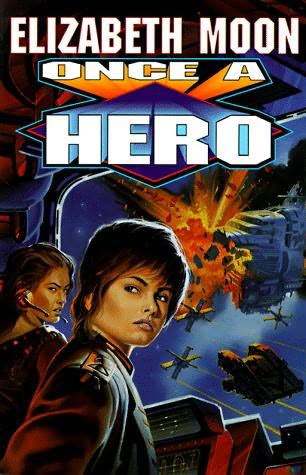
Once a Hero by Elizabeth Moon

Esmay Suiza never asked to be a hero.  All she wanted was to leave her dysfunctional home and join the navy.  But after surviving a mutiny and leading her spaceship to a most unlikely victory, everyone seems to be showering her with unwanted attention–or worse, examining her files for signs of command potential.

No, all she wants is to disappear–and now that her family has offered her a generous inheritance on her home world of Altiplano, she finds herself tempted to leave the stars behind and settle down for a while.

Little does she know, her family has hidden secrets from her–secrets from her past, which have the power to undo and destroy her.  Unfortunately, being a hero has a price–and the trauma of combat has already unearthed things from her subconscious than she cannot keep buried any longer.

This was my first time reading Elizabeth Moon, and I enjoyed it quite a bit.  Moon is extremely good at portraying a complex, believable military culture; she was a Lieutenant in the Marines, and definitely knows how to do military SF right.

My favorite part of the book was the descriptions of Altiplano, and Esmay’s experience returning to her homeworld of Altiplano.  Elizabeth Moon does an excellent job of creating a captivating world and transporting the reader there.  I fell in love with Altiplano almost instantly–not only with the planet itself, but the culture and the people, the whole society.  Excellent job.

Elizabeth Moon also does an excellent job developing her characters and giving them believable internal conflicts.  The way she portrays Esmay’s PTSD is quite striking, and very interesting.  Her struggles feel very real, and important too.  I think this novel helped me to better understand those who suffer from similar traumatic experiences, and that was very meaningful.

Storywise, however, I had a few minor issues, most of them having to do with the plot.  Things dragged a bit in the middle; when Esmay left her homeworld, I lost a sense of progression and felt that she was just wandering around.

When the antagonists came in–basically, a hostile army trying to capture her ship–I felt that Esmay solved her problems too easily, without any real try-fail cycles.  It gave me the sense that Esmay was some kind of superhero girl–not quite a Mary Sue, but toeing the line.

And Esmay’s love interest…I didn’t really get into him at all.  He seemed like a stereotypical damsel in distress, except with the sexes reversed.  I heard once that in good romance stories, the girl readers want to be the female protagonist, and the guy readers want to be the male protagonist.  Yeah…call me a chauvinist, but I never really wanted to be that guy.

I hate to be too critical, though, because Elizabeth Moon’s writing is quite good.  She has an excellent grasp of character, and her ability to transport her readers to another time and place more than makes up for her shortcomings with plot and story structure.  Also, I get the sense that this isn’t her best work.

In any case, if you’re a fan of military SF, you’ll probably enjoy this book.  I enjoyed it, and I will certainly be reading more Elizabeth Moon in the future.