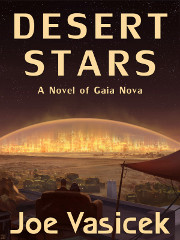
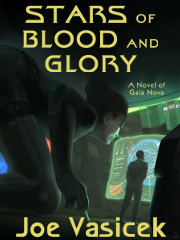
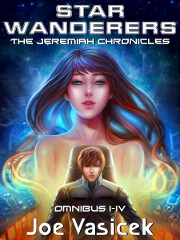
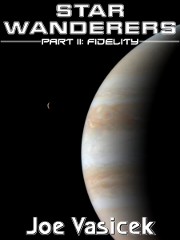
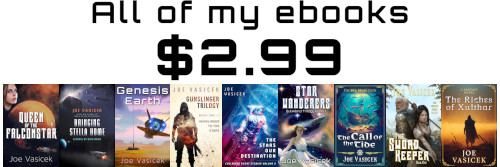
All my ebooks $2.99 until August 3st!

For about the last year, I’ve been running periodic $2.99 sales on all my ebooks every two months or so. No special announcements or promotions, just a price drop from $4.99 for the novel-length books, down to $2.99 (this does not include my book bundles, which are all $9.99).

Interestingly, even with very little promotion, and the lower royalties due to the price decrease, I have found that my sales and revenue actually increase every time I run one of these sales. But the boost only lasts for about two weeks before falling back again, and I have to wait about two months before I can get a similar boost.

However, since I could do a better job promoting these things, I figured it’s worth promoting on my blog. From now until the end of August, all of my $4.99 ebooks are now $2.99 across all ebook retailers. You can pick them up wherever you get your ebooks, but if you get them from my online store, the files are yours to keep (none of this licensing vs. digital ownership nonsense). Check it out!

Here’s my new pricing strategy

A few weeks ago, I had an impression that I needed to revisit my overall pricing strategy, not just for ebooks but for audiobooks too. So I sent out a few feelers, trying to see how other indie authors are pricing their books, and also ran a reader survey (thank you to everyone who participated in that, by the way!)

After all of that, I’ve put together a new pricing strategy that I will probably keep over the next few years, inflation notwithstanding. It’s not that much different from what I was doing before, but it is worth sharing with you, especially if you’re on a tight budget and you want to know the best way to pick up my books. So let’s go through each format, and I’ll share my plans.

Paperbacks

Until now, I’ve basically just been pricing all my paperbacks at a flat $14.99 USD, with equivalent price points in each of the major currencies. For shorter books, this meant that I took a hefty profit. For longer books, a hefty loss.

Moving forward, as I move to distribute all of my titles through Ingram via Draft2Digital, I am going to price my paperback titles such that I take at least a $2 profit through wide distribution. For most titles, this means they will fall somewhere in the $12.99 to $15.99 range. Some of the larger books may go as high as $18.99. This does not include shipping costs.

As always, if you purchase a paperback on my store, I will sign and personalize them for free if that is what you want me to do. Not all of them are up yet, but I hope to get them all up there over the next few weeks.

Audiobooks

Until now, I’ve been pricing my audiobooks on the lower end of the price range that human-narrated audiobooks can command, which means that most of them were either $8.99 or $16.99. That was just the list price, though, and I frequently ran month-long sales where they were all discounted to $2.99. And of course, if the ebook was already free, I also made the audiobook free.

But this was before AI-narrated audiobooks began to come out on the major platforms in large numbers. Now, it looks like one of the biggest trends in the book world is the explosion of AI-narrated audiobooks. I forget which podcast I heard it on, but some industry experts are predicting that within 10 months, most of the audiobook market will consist of AI-narrated audiobooks.

Obviously, it costs much less to produce an AI-narrated audiobook vs. a human narrated audiobook. In fact, without AI, none of my titles would be available in audiobook format, since they are all AI-narrated. And after asking around some of the author communities I follow, it appears that most authors are pricing their AI-narrated audiobooks closer to their ebooks, rather than their human-narrated audiobooks.

What was more surprising to me was to learn that of the readers who took my reader survey, those who listen to audiobooks felt fairly strongly that an AI-narrated audiobook shouldn’t cost more than the ebook. So it’s not just the authors who are driving this trend, but the readers as well.

With that in mind, and the data I gathered on ebook pricing points, I have decided to make the list price of all of my digital books, whether ebooks or AI-narrated audiobooks, priced at $4.99 moving forward. That’s just the list price, though: occasionally, I will run a $2.99 sale, where either all my audiobooks or all of my ebooks are discounted to the $2.99 price. And for certain titles, like my Sons of the Starfarers books, I plan to keep them on a $2.99 sale permanently, since it’s a nine book series and that’s what they were priced at before. Also, if the ebook is free, so is the audiobook.

And as always, if you buy an audiobook from my online store, you automatically get the ebook free as well.

Ebooks

Before, I used to price my ebooks at either $2.99, $3.99, or $4.99, depending on the book. In general, first-in-series books were permanently at $2.99, while the later books were all at $4.99.

Moving forward, however, I plan to keep all of my ebooks (except for the Sons of the Starfarers books) priced at $4.99, regardless of where they fall in the series, though I will occasionally run $2.99 sales across the board.

(The exception to all of this is box sets, which I plan to keep at $9.99. At this time, I only do box sets for the ebooks, and I don’t want to price those so low that they undercut my regular titles. I may discount them during a $2.99 sale, but I haven’t yet decided on how much.)

My goal with this is to make it so that price isn’t a factor in deciding which book to buy next. If they’re all the same price, then it shouldn’t make much of a difference—and if $4.99 is too much for your budget, then you can just wait until I run the next $2.99 sale, which should happen approximately every third month or so.

As always, you can get $1 off of the ebook with the coupon code “buy direct” when you purchase it from my store. This only applies to $4.99 books, however—if the book is currently on sale for $2.99, the coupon does not apply.

$2.99 sale November-December 2024

With all of that said, I am currently running a $2.99 sale on all of my ebooks and audiobooks, from now to the end of 2024. If you’ve wanted to read my books in ebook or audiobook format, but have ever balked at the price, now is a great time to pick them up! I have somewhere north of 20 novels out right now, and in the coming months, I plan to publish a lot more (which is another reason to run $2.99 sales, so that my readers don’t have to spend upwards of $100 to read all of my books).
Print vs. Ebook vs. Audiobook: Pros and Cons

Print

Pros:

  • A printed book is a hard, physical copy that cannot be altered, edited, deleted, revoked, remotely accessed, or otherwise tampered with by a third party who does not have physical access to the book.
  • The reading experience is totally private. Governments, corporations, and other third parties cannot easily know about what you read or how you read it.
  • Marginalia is easier with a print copy. All you need is a pencil and maybe some tabs or sticky notes.
  • It is easier to flip through a print book than any other book format. Much better for reference.
  • Print books are fantastic for sharing and borrowing. You don’t need any devices, permissions, or anything. Just take it off the shelf and put it into the borrower’s hands.
  • Does not require any sort of power source or electricity to read. Works perfectly fine when the power is down.
  • Print books can be quite collectible, and some are worth quite a lot, depending on first editions, cover art, etc.
  • You can get your copy signed by the author(s), which is always fun. It also makes the book more collectible.
  • When you finish reading the book, you have a totem or artifact to commemorate the reading experience.
  • The books that you choose to put on a public shelf can be a way of expressing yourself: your tastes, opinions, and any fandoms or communities to which you belong.
  • Used copies are typically very cheap, even for bestsellers and signed copies, and with enough patience and resourcefulness they are not too difficult to find.

Cons:

  • Because they exist in the physical world, print books take up space, and can be quite heavy and bulky.
  • Print books are prone to damage from things like water, mold, food, drink, fire, blood, parasites, etc.
  • Even though you don’t need electricity to read a printed book, you do need some kind of light source.
  • Print books are easy to lose, especially if you loan them out. A portion of the people who borrow your books will invariably lose them or forget to return them.
  • Because of their bulkiness, it is difficult to transport books, especially in large quantities. Even a single book has limited portability, especially if it is a hardback.
  • If you want to borror a printed book from the library, you have to go to the library to get it.
  • Print books are not text-searchable.
  • Print book$ can be quite expen$ive to buy new, e$pecially the hardback edition$.

Ebook

Pros:

  • Ebooks are the most portable format, by far.
  • The file size is tiny, typically just a few megabytes.
  • You can read an ebook on almost any digital device.
  • You can read ebooks in the dark, especially with an ereader that has a backlight. This makes it possible to read in bed when your spouse/partner is asleep.
  • Fonts are adjustable, so if you need large print to read, you can do that with any ebook.
  • It is very easy to borrow an ebook from the library. All you need is a library account and an internet connection.
  • Footnotes can be hyperlinked, so they don’t take up space on the bottom of the page (or worse, interrupt the narration).
  • You can easily save comments, highlights, notes, etc, and share them all with your friends.
  • Marginalia is not permanent with ebooks, nor does it mar or deface the book.
  • It’s easy to look up unfamiliar words using the ereader device’s (or app’s) dictionary.
  • If you’re reading something potentially embarassing, people in your immediate vicinity can’t tell.
  • Ebooks are length agnostic, meaning that the reading experience is the same for a short story as it is for a novel. No having to lug around a bulky chihuahua-killing doorstop of a tome. You can read a massive million-plus word box set just as easily as a pamphlet.
  • Indie books are typically very cheap, and you can fill up your ereader with free books quite easily.
  • With enough patience and a keen eye for good deals, you can even buy traditionally published ebooks at a good price.
  • Ebooks are text-searchable.

Cons:

  • Ebooks require a power source. While most ereader batteries hold a charge for quite a while, you do eventually need to recharge them.
  • While you don’t need an internet connection to read an ebook, you do require internet to download it to your device.
  • Legally speaking, when you purchase an ebook, you’re actually just licensing it and don’t technically own it.
  • Ebooks can be changed remotely by third parties, or even deleted and removed from your device.
  • Privacy is a potential issue with ebooks, as third parties can see what you’re reading, and corporate entities can—and often do—gather data on your reading behavior.
  • PDFs and images are clunky and difficult to read, at least on some devices.
  • Bad formatting is much more of an issue ebooks, and can actually make the book unreadable.
  • It is a lot more difficult to flip through an ebook.
  • Traditionally publi$hed ebook$ are ridiculou$ly expen$ive.
  • Sifting through all of the crappy self-published ebooks to find the few good ones can be quite a challenge.

Audiobook

Pros:

  • Unlike print books and ebooks, which require your eyeballs to read, you can listen to an audiobook while your attention is focused elsewhere.
  • Because listening is a more passive activity than reading, you don’t need to concentrate as much to listen to an audiobook as you do to read a print book or ebook.
  • It’s easier to get through (most) longer or more difficult books in audio than it is in print or ebook format.
  • Borrowing audiobooks from the library is easy: all you need is an account and reliable internet.
  • Audiobooks are as portable as your smartphone, tablet, or other device that you use to listen to them.
  • Audiobooks can fit reading into the interstitial spaces of your day, such as when you are commuting or doing chores. Time that would otherwise be spent in mindless activity can now be used to fit in your reading time, making it possible to read a lot more books.

Cons:

  • Audiobook file sizes are enormous. It’s difficult to fit a sizeable library of audiobooks on a single device.
  • It is almost impossible to browse or “flip through” an audiobook, so they aren’t great for reference and good luck if you ever lose your place.
  • Marginalia is difficult with audiobooks. Most apps allow you to take little audio clips, but it’s still quite clunky.
  • Just like ebooks, audiobooks can be altered or deleted by remote third parties.
  • Just like ebooks, privacy is a potential issue, with third parties gathering and selling data on your reading behavior.
  • Just like ebooks, you don’t technically own your audiobook. What you’ve purchased is the license, not the copy itself.
  • Audiobooks are much more temporally constrained. You can listen on 2x speed and higher, but that isn’t the same as skimming or speed-reading.
  • Because the reading experience is more passive, audiobooks tend to be more forgetable than print/ebooks.
  • A bad narrator or performance can kill an audiobook, much more than a bad presentation kills a print/ebook.
  • Because it requires less mental concentration, the reading experience is not as deep with an audiobook as with an ebook, and you may have difficulty recalling details.
  • Mo$$t audiobook$$ are ridiculou$$ly expen$$ive, even more $$o than traditionally publi$$hed ebook$$.

Did I miss any?

Pros and Cons: Print Books vs. Ebooks vs. Audiobooks

One of the long-term things I want to do is build a home library. Last weekend, I started cataloging my books and putting together plans for how to do that. I’m sure I’ll be posting more about that in the future, but the big question at the start of it was this:

What are the advantages and disadvantages of each book format?

So I spent some time thinking about it, as well as browsing the internet to get other people’s thoughts and perspectives. There are three major formats for books now: print, ebook, and audio. Here, as best as I can tell, are the major pros and cons with each:

Print Books

Pros:

  • Ownership. If it’s physically in your possession, then you are the undisputed owner of that book.
  • No screens, batteries, or power requirements. Does not require a device to use.
  • Easy to share with others (though there is a risk that they won’t return it! See ownership above).
  • High visibility. Because of this, print books can be symbols of status or social reputation. They also are much harder to ignore once you put them in a TBR pile.

Cons:

  • Space intensive. You have to find a place for them.
  • Heavy, especially when boxed in large numbers.
  • Prone to damage, such as water damage, parasites, etc.
  • Requires shelving to properly store and display.

Ebooks

Pros:

  • Portability. Fits onto your everyday carry (EDC) device, such as a phone or tablet, as well as a dedicated ereader.
  • Requires very little storage space, both physically (on a device) and digitally (small file sizes).
  • Cheap, at least for indie published books.
  • Can read more easily at night, depending on the device.
  • Privacy. It’s easier to hide an ebook from people than it is to hide a print book, or even an audiobook.

Cons:

  • Ownership is ambiguous at best. Do you own your ebook files outright, or do you own a license to use the files? Can Amazon (or whatever site you bought the ebooks from) remove the books from your device at their discretion? It’s been done before!
  • Requires a screen or device to use.
  • Difficult (though not impossible) to share. There is a kindle lending library, but I’ve never used it, and in the handful of instances where I’ve tried, I eventually gave up trying to figure it out. Copying and sideloading is possible, but tricky. Much easier to pull a print book off the shelf and hand it to somebody.

Audiobooks

Pros:

  • Can listen while doing other things, especially driving or mindless chores.
  • Can also fit into the little gaps in your schedule, turning time that would otherwise be wasted into reading time.
  • Listening is a more passive exercise than reading. This can be a con as well as a pro.
  • Fits easily onto a phone or other EDC device, giving it many of the same portability advantages of ebooks.

Cons:

  • Takes longer to read. You can speed up the narration, but it’s not as easy or efficient as skimming a book.
  • More expensive than the other formats. An exception might be for rare or out-of-print books that aren’t available in digital.
  • Larger files, which take up more storage space. You can easily keep a large library of ebooks on one device, but you’d need a server or a dedicated hard drive to do the same with a large library of audiobooks.
  • Ownership is ambiguous. See above.

What are your thoughts? Let me know!

Thoughts on Clean Reader

cleanreaderIn case you haven’t heard, there’s a new app in the book world that is stirring up quite a bit of controversy. It’s called Clean Reader and it basically goes through an ebook and filters out the profanity, with settings for “clean,” “cleaner,” and “squeaky clean.” It was designed by the parents of a teenager who expressed dismay at finding profanity in an otherwise clean book.

The response from authors has been vociferous. Chuck Wendig (WARNING: Chuck uses so much profanity, he probably deserves a Clean Reader filter setting of his own) predictably came down hard against it, as well as Joanne Harris, the author of Chocolat. Over on KBoards, there’s an ongoing thread of indie authors slamming it as a denial of artistic expression, as a copyright violation, as malicious censorship—basically, the whole gamut. Interestingly, though, Cory Doctorow came out in defense of it.

Personally, this app reminds me a lot of CleanFlicks, a movie rental place here in Utah that edited out objectionable content such as sex, violence, and profanity. I watched the edited version of Zombieland while I was in college, and while I enjoyed it, it was… short. CleanFlicks did a lot of business, right up until the US Supreme Court shut it down.

While I can see why some writers would hate this app, I actually sympathize more with the readers. Living in Utah, I know a lot of people (some of them in my own family—hi Kate!) who are exactly the kind of people for whom Clean Reader was made. And much like Cory Doctorow, I think that their right to control their own reading experience trumps the writer’s right to freedom of expression.

The act of reading is fundamentally a collaborative experience. Until someone opens a book and reads it, that book is just symbols on a page, or bytes of data on a storage device. Meaning is only generated through the act of reading—in a very real sense, the story is created by the reader just as much as by the writer. As much as we writers like to think of ourselves as free to write whatever we want, without readers, that freedom counts for very little. And that’s exactly the way it should be.

A lot of writers are making fun of Clean Reader on the basis that the very premise is flawed—that filtering out profanity won’t do anything to clean a fundamentally dirty story. But while that’s true of some books, I do think there’s a middle ground where the app can give some value.

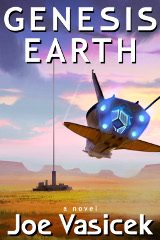
For example, my first novel Genesis Earth is a mostly clean science fiction adventure romance with a few tense moments where the characters use a mild level of profanity. As a writer, it didn’t feel right to have my characters say “darn” instead of “damn,” or “crap” instead of “shit.” Sanitizing the book on that level would have kicked most readers right out of the story. But if a reader who is sensitive to that use of language wants to read a filtered version of Genesis Earth, the story is not going to be fundamentally changed by filtering out those words.

Probably the biggest objection to Clean Reader is that it enforces or promotes a censorship regime that many writers find objectionable. Of course, most of the people who make that argument probably have no idea what “censorship” really entails, just like the people who throw out accusations like “socialist,” “sexist,” “racist,” etc. But putting that can of worms aside, is it right for people to use apps like this—say, parents of young children—to control what other people read?

I am a diehard libertarian, but I actually think that beneath a certain age, parents do have a right to censorship. As legal guardians of their children, parents have a right and a responsibility to raise them as they see fit. If you don’t allow parents to censor what their children are exposed to, then you’re basically saying that society as a whole should raise them, or (God forbid!) the government. I think that’s a horrible idea. Children should be raised by the people who are closest to them, and responsible parents/guardians should be free to raise their children as they (and only they) see fit.

So I’m actually rather supportive of the Clean Reader app. I personally wouldn’t use it, either for myself or for my children, but if other readers do then I have no objection to that. Writers should be free to write whatever they want, and readers should be free to read whatever they want, however they want to read it.

G is for Genre

Are there certain genres that indie writers should write in if they want to be successful? Are there other genres that they should avoid?

This is one of those pieces of common wisdom that really irks me, and not just because I write in a genre (science fiction) that isn’t as mainstream or popular as others. I think it’s a myth that you have to write in a “hot” genre in order to have success, especially if you’re an indie author. Here’s why:

1. You don’t have to be a bestseller to be an indie success.

This is something that Hugh Howie repeats all the time: that the true success stories in self-publishing aren’t the mega bestsellers like him or Bella Andre or H.M. Ward or Amanda Hocking, but the thousands and thousands of little guys who are carving out a comfortable space for themselves in this new world of publishing. You don’t have to be a huge bestseller to make a living as an indie writer–you can do quite well for yourself with a small but dedicated fan base.

I’m sure there are some people whose personal definition of success includes the kind of fame and recognition that comes along with being a bestseller. That’s fine–everyone has to define what ‘success’ means for themselves, based on their own personal goals and dreams. But being a bestseller is definitely not the baseline, at least for an indie writer.

2. Ebooks and epublishing have opened exciting new opportunities for niche genres.

Before epublishing, you needed a fairly extensive infrastructure to bring a book to market. Besides designing the book, you had to pay for printing, pay for shipping, pay for distribution and marketing to bookstores, pay for returns and remainders … the list goes on and on. Consequently, it was harder for niche genres to really get a foothold.

With ebooks, the economics of publishing have been flipped on their head. The marginal cost of producing another ebook is zero–digital content can be copied endlessly at virtually no cost. Shipping costs are also zero, and global distribution is as easy as uploading the book to Amazon’s servers–again, at zero cost.

Because of this, there’s room now for niche genres with much smaller readerships to actually turn a profit. And that’s what we’re seeing–an explosion of all sorts of niche, specialty, and experimental new genres. Books no longer have to be just like the Latest Big Thing (only different) in order to earn back their costs. There’s room for everyone in the new world of publishing.

3. It’s better to write what you love than to write what you think will sell.

The two aren’t always mutually exclusive, of course. Maybe you love a variety of genres, so that you’d be equally satisfied writing romance as you would writing something more niche like Amish vampire steampunk. But if all you’re doing is chasing the money, chances are that your heart won’t be in it nearly as much as it would if you were writing what you love. And if your heart isn’t in it, you won’t be able to bring that creative passion to the project that readers really love.

When I wrote Star Wanderers, I was following my passion. It was a science fiction story unlike any I’d either written or read, but I followed it where it took me without worrying whether it would sell. The genre description that best fits that series would probably be romantic frontier space opera–definitely a niche. But because I was passionate about it, the books were able to find readers who share that passion and touch them in ways that other books hadn’t. And guess what? Those are my best selling books.

There is a business side to publishing, but there is also an artistic side. You’ve got to be true to both. If your inner artist thrives on the challenge of chasing the market, great–go for it. But if doing that feels like you’re being unfaithful to your creative vision, you’ll probably write a better book if you strive to be authentic. And ultimately, I think that authenticity has a lot more to do with a book’s success than the genre it’s written in.

Readers are far, far more diverse than we give them credit. So long as you can write well and tell a good story, you can find success no matter which genre you write in.

Publishing is as easy as the Irish Tinwhistle

David Gaughran has another excellent blog post up, this time about publishing in general and something that most newbies don’t realize when they first start out.  From his post:

I’m saying that when a newbie has been convinced that self-publishing is hard or expensive the chances of them falling into the clutches of a third-party which will result in a poor outcome increase exponentially. Because they’ll take any kind of deal, or sign up with any fly-by-night outfit, or engage one of the vanity presses masquerading as a self-publishing company.

So we need to get the message out. Yes, writing is hard, but these third parties will give you no help there. And yes, marketing can be tricky, but that’s probably going to fall on you no matter what path you choose.

Publishing, on the other hand, is easy.

I’ve found this to be exactly the case, and it’s one of the reasons why I’ve decided to stick with the indie publishing path.

Publishing is easy.  Publishing is fun, in fact.  There’s a lot of hair-pulling when you first start out, but once you get over the initial learning curve, it’s a blast.  These people selling “self-publishing packages” are almost all scammers, especially if they’re charging more than $1,000.

Marketing is an aspect of this business that currently eludes me.  Even so, I’m still doing all right.  I’ve been making a profit since 2012, and I’m currently about halfway to making a full-time living at this.  With the whims of the market, that could change at any moment, but there’s still a lot of room for things to go up so I’m not too worried.

As for writing, well, that’s probably always going to be hard.  I tend to self-edit a lot as I write, so hopefully nanowrimo will help me out with that.  Once you’ve found your voice and gotten the basics of your craft, you have to learn to let go and let the story happen, which is something I struggle with.

Right now, I’m having a hard time with putting out a consistent word count.  That’s probably the hardest part of taking the indie path–keeping yourself from getting spread too thin.  I’m trying to get print versions of the Star Wanderers novellas out on Amazon (Outworlder is already out!  Get it here!), so that’s taking a fair amount of time and energy, even though I’m taking it slow.  Really, though, I wonder how much of it is just fear or self-doubt or other writerly angst that pops up from time to time.  It’s a constant struggle.

But publishing?  Publishing is easy.  Give me a manuscript, and I can turn it into a fully functional, well formatted ebook in less than an hour.  For a print book, I can do the typesetting and cover design over a long weekend if I’ve got nothing else going on.  Easily.  And from there, it’s just a matter of uploading to Amazon / Smashwords / wherever, filling out the metadata fields, and clicking the button that says “publish.”

There is nothing about the technical aspects of publishing that a writer can’t learn how to do for himself.  If you can publish a blog, you can publish an ebook.  The only reason to pay someone to do it for you is if the opportunity cost of taking the time to learn is too high, which is only really the case if you’re a highly paid professional at something else and writing isn’t your main career.  Even so, it’s not hard to find someone (like me!) who can do a good job for $50 or less.

It’s kind of like the Irish tinwhistle.  Sure, you can pay through the nose for a limited edition collector’s piece (which probably has a very generic sound), but the best ones cost less than $20 and look like they’ve been used as a doorstop for a while.  The quality of the sound does not correlate at all with the price–in fact, you’re more likely to get a better instrument if you don’t pay through the nose.  You can even make your own!

In fact, there are a lot of similarities between self-publishing and playing the Irish tinwhistle.  You can teach yourself how to do it, pick up tips and tricks by hanging out with other unwashed, self-taught musicians, learn all sorts of tunes or make up your own, and play it any way you like.  You can play for pennies in the park, beers in a pub, or go for gold and hit the big time.

Dang–now I really want to get back into Irish music again!  One dream at a time, Joe–one dream at a time.

But yeah, publishing is easy–not to mention, fun!

Do you like your chapters named or numbered?

There’s an interesting article linked on The Passive Voice blog about the importance of a table of contents, especially in ebooks.  The article is geared mostly for non-fiction, which is a whole different beast from novels and novellas, but the discussion on TPV got me thinking: for ebooks, is it better to name chapters or to merely number them?

In the comments section on TPV, Jamie makes an interesting point:

With e-books in particular I think there needs to be more care taken with the TOC. I can easily find my place with a print book even without a book mark, but with an e-reader, it’s possible to lose your place very easily, and “loc 4950″ is not going to be committed to my memory banks. I know what happens in the chapter titled “His Grace of Avon Takes Command of the Game,” but I’m not sure if that was chapter 16 or 15 “loc 1730″ or what. I won’t remember the number.

For organizational purposes for my own use I title my chapters, and I believe that readers will appreciate that habit, too, and will be more forgiving if they use the Look Inside feature and see those headers vs. if they just see “1, 2, 3.”

I try to make sure the titles are enticing and pique the curiosity of anyone who would see them in a TOC. They’re not spoilers, because unless you’ve made it to the end of the previous chapter, you’ll likely have no idea what the next chapter’s title is referring to (and if it is obvious, it simply increases the suspense/curiosity). The titles Makes Sense in Context (TM).

When I first learned how to make an ebook, the concept of a table of contents for a novel seemed pretty weird.  I was used to reading print books, which you can flip through much easier and find what you’re looking for just from the feel of the pages.  But with ebooks, obviously that’s much different.  A table of contents is more than just a list of chapters, it’s an important navigational tool that can’t be overlooked.

But if chapter hyperlinks are perhaps the only way to flip through the middle of the book, does that mean that merely numbering the chapters is insufficient?  I have to admit, the concept of naming each chapter seems a bit old-fashioned, but the technology has changed and as writers, we need to change with it.

In the context of a hyperlinked table of contents, numbers are practically meaningless.  They can even be quite ugly, if there’s a huge list of them that sprawls beyond the screen.  Chapter titles can sprawl even more, but they at least provide some idea of what lies on the other side of the link.

I’ve done it both ways.  For example, the table of contents for Genesis Earth looks like this:

Table of Contents

Copyright Page
Table of Contents

The Wormhole | The Mission | Terra | Cryothaw | The Ghost Ship | Trust and Deception | Betrayal and Discovery | Arrival | First Contact | Call and Answer | Earth | Rescue | Emotion and Reason | Planetfall | The Natives | Origin and Destiny | A New Genesis | Epilogue

Author’s Note | Acknowledgments

Most of the chapter titles are pretty mysterious, but I was kind of going for that.  And in any case, is it possible to make them completely unambiguous without spoiling key parts of the story?  It seems like the art of naming chapters is much subtler and more complex than you’d think at a first glance.

In contrast, the table of contents for Desert Stars looks like this:

Table of Contents

Copyright Page
Table of Contents

Prologue
Book I: Dome and Desert
1 | 2 | 3 | 4 | 5 | 6 | 7 | 8 | 9 | 10
Book II: Sand and Stars

11 | 12 | 13 | 14 | 15 | 16 | 17 | 18 | 19 | 20 | 21 | 22

Author’s Note | Acknowledgments

I kept the numbers for the chapters, but divided the novel into two sections or “books” and listed the numbered chapters as minimally as possible, to save space.  I suppose it looks all right, but as a guide to navigating the book, I’m not sure how useful it is–not to mention how hard it can be to click on a hyperlink that’s only one character long, especially on a touchscreen.

For Journey to Jordan, there were so many entries that I didn’t bother listing them all in the table of contents.  Instead, I divided each part into sections based on location, then listed the locations in the table of contents and the posts/chapters at the head of each section, complete with hyperlinks.

As a side note, it’s actually pretty amazing how internal hyperlinks can change the experience of the book.  For one thing, it opens up all sorts of possibilities for alternate endings and “Choose Your Own Adventure” type stories.  Is it possible to list a chapter in the <manifest> without including it in the <spine>?  I don’t think it is (at least, not in a well-formatted ebook), but if you could find a way to do that, you could add all sorts of hidden content and Easter eggs …

In any case, for my shorter Star Wanderers novellas, I think I actually prefer numbered chapters.  The stories are short enough that the numbered subdivisions still have meaning, and the chapter lists aren’t long enough to look too cluttered.  Besides, I’ve already started the series in this particular format so I think it will be better to keep it this way.

But for future books and future series … I don’t know.  What do you think?  Are ebook chapters better off named or numbered?

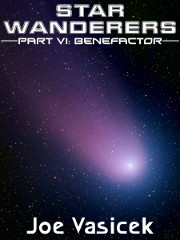
SW-VI: BENEFACTOR is now out on Amazon, Smashwords, and Kobo!

SW-VI (thumb)That’s right!  My latest book, Star Wanderers: Benefactor (Part VI) is now available on Amazon, Smashwords, and Kobo!  It’s $2.99, but for the next couple of days until the end of June, you can get it for $1.49 from Smashwords with the summer promotion code.

This one took a long time to write, especially for a novella, but I’m very satisfied with the result.  It shows the events of Fidelity from Jakob’s point of view, really diving into his character and exploring his background as a star wanderer who settled down and now struggles to take care of his family.  There are overtones of an impending conflict between the Outworlders and the Gaian Empire, which I plan to make a major part of the overworld story arc, and some new characters introduced as well.

Here’s the teaser:

IN A COLD AND LONELY UNIVERSE, A SIMPLE ACT OF GRACE CAN RESONATE ACROSS WORLDS.

An outworlder is nothing if not fiercely independent, and Jakob is no exception. But ever since he brought his family of starbound refugees to Alpha Oriana, he’s felt increasingly powerless. With the recent Imperial takeover and rumors of job cuts at the dockyards, it’s only a matter of time before they’re forced to move on—again.

When a young man and woman with an unusual story show up from his wife’s homeworld, he takes them in, if for no other reason than that they remind him of a time when he was young and still in love. Ever since he sent his sons away, his marriage has been a nightmare—but all he wanted was to give them a chance at a better life out among the stars. Whether or not that was a mistake, his wife has never forgiven him for it.

In the face of so many challenges, it’s not clear how long the family can hold together, but Jakob will sacrifice everything before he asks for help—even if the only way out lies through an open airlock.

Star Wanderers: Benefactor (Part VI) should be up on Barnes & Noble shortly, as well as Drivethru Fiction and All Romance eBooks.  In a couple of weeks, it should be out on iTunes, Sony, and Diesel as well.  If you want to add it to your Goodreads library, you can find it here.

Thanks guys!  I’m heading out on a short backpacking trip this weekend, but I’ll be back in a couple of days with more updates.  Later!

July Smashwords sale–all books 50% off!

swlogoEvery summer, Smashwords does a sale in which authors can enroll their books.  This year, I’ve enrolled all of mine at 50% off, so all of them are under $2.50.  Check it out!

thumb (Genesis Earth)Genesis Earth
A boy and a girl on a voyage to an alien star.
Price: $4.95 $2.48

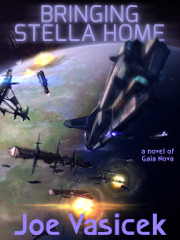
thumb 2 (Bringing Stella Home)Bringing Stella Home
He’ll go to the ends of the galaxy to save his brother and sister.
Price: $4.95 $2.48

thumb (Desert Stars)Desert Stars
A tale of adventure and romance from the fringes of an interstellar empire that has forgotten its holiest legend: the story of Earth.
Price: $4.95 $2.48

thumb (Stars of Blood and Glory)Stars of Blood and Glory
The only hope for the last free stars now lies on the path of blood and glory.
Price: $4.95 $2.48

SW-TJC (thumb)Star Wanderers: The Jeremiah Chronicles (I-IV)
He wanders the stars in search of a home. Instead, he got a girl without one.
Price: $4.99 $2.49

Star Wanderers II (thumb)Star Wanderers: Fidelity (Part II)
Is fidelity worth the price of freedom? Can love take root beyond the stars?
Price: $.99 free!

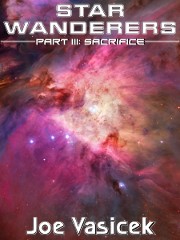
Star Wanderers III (thumb)Star Wanderers: Sacrifice (Part III)
She gave up everything to wander the stars with him. Now, he must do the same.
Price: $2.99 $1.49

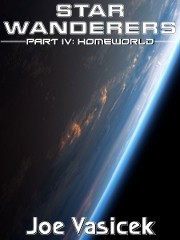
Star Wanderers IV (thumb)Star Wanderers: Homeworld (Part IV)
They’ve finally found a world to call home. But first, they have to fight for it.
Price: $2.99 $1.49

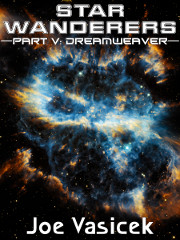
SW-V Dreamweaver (thumb)Star Wanderers: Dreamweaver (Part V)
He saved her from death, but to save him, she must command the power of dreams.
Price: $2.99 $1.49

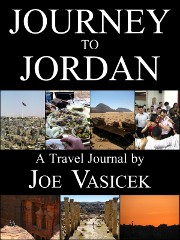
thumb (Journey to Jordan)Journey to Jordan
Travels of a young Mormon writer to Jordan, Egypt, and the Holy Land.
Price: $2.99 $1.49

thumb (Decision LZ1527)Decision LZ1527
A boy, a girl, and a whole crew of matchmakers.
Price: $.99 free!

One of the great things about Smashwords is that these prices are the same throughout the world–no extra surcharge for international sales.  So if you live outside the United States and don’t have a US bank account, these are the best prices you’re going to find.

These books will remain 50% off on Smashwords through the month of July.  Just use the coupon code SSW50 to get the discount. Smashwords does accept Paypal, so you don’t have to sign up for an account or share your credit card information to purchase.

If you’ve been meaning to check out some of these books but haven’t gotten around to it, this is a great way to try them out.  And if you want to sample them first, the first 15% to 25% is available on each book’s Smashword’s page.

Enjoy! 😀