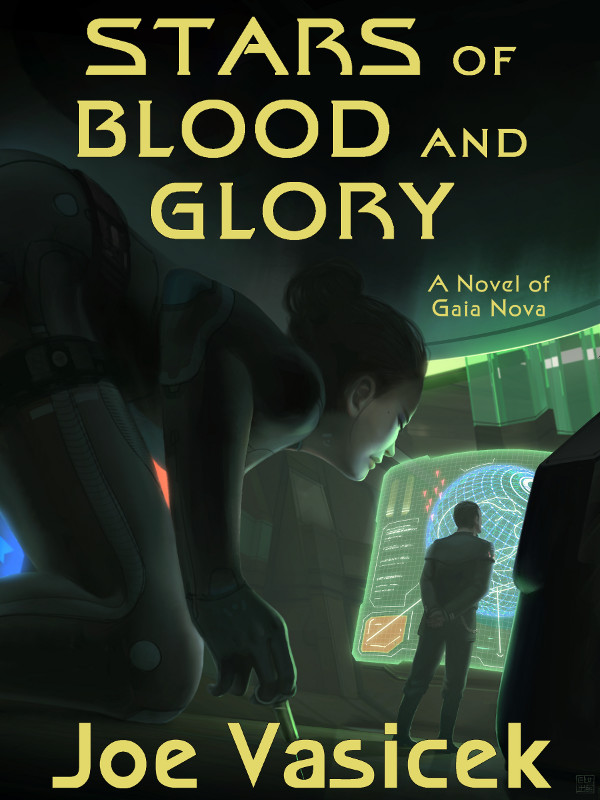
So I’ve been playing around with AI art…

Note: this post originally appeared in my newsletter, but I was so excited about it that I decided to post it here too. Enjoy!

So my wife is getting a PhD in computer science, which means that she’s on the cutting edge of research into things like language learning and topic models and other techy stuff that I don’t totally understand.

A couple of weeks ago, she downloaded Stable Diffusion, an open source text-to-image program that creates AI art, kind of like Dall-E and Midjourney. Besides playing with it herself, she thought it might be useful for me to create my own cover art. So for the last two or three days, I’ve been playing around with it, and the results are absolutely amazing!
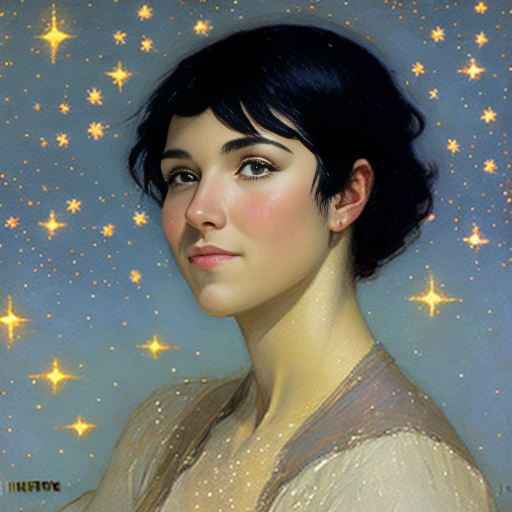
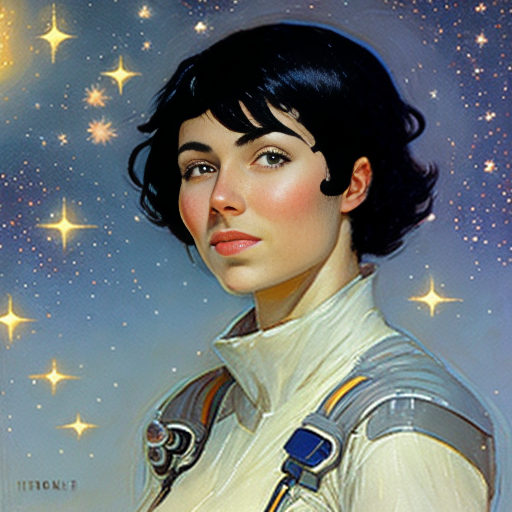
These were some of my first attempts. I’ve forgotten what the prompt was: I think it was something like “a spunky young woman with short black hair, surrounded by stars, in the style of Frank Frazetta and Minerva Teichert.” The difference between the first one and the second one was adding “in space.”

I also tried inputting a couple of paragraphs straight from my novel, including a lengthy description of this character, but the results were… uncanny. These AI art programs tend to do better if you give them short descriptions with only a handful of details.

The next day, I played around with it some more, and came up with this one:
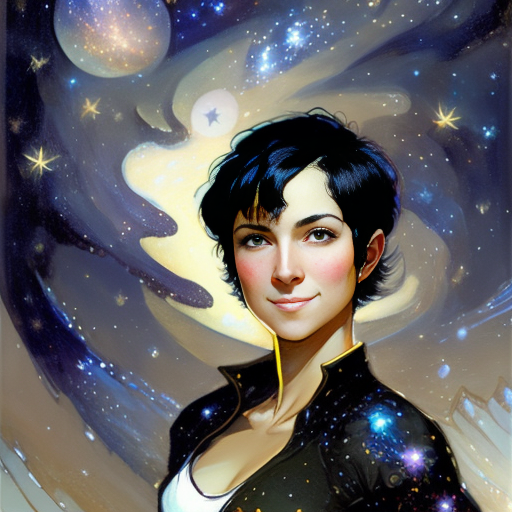
The secret sauce for this one was adding “Minerva Teichert” and “Baen Books.” Who is Minerva Teichert? She’s a famous Latter-day Saint painter from the early 20th century who paid for her son’s tuition to Brigham Young University in original paintings, many of which are still on display in the BYU Museum of Art and the Joseph Smith Memorial building.

As you can see, there are still some weird artifacts to this piece, such as the stars on the character’s jacket. That’s the tricky part with AI art: if you look at it closely, you’ll find something weirdly uncanny, like a hand with seven fingers, or a person with three arms. The steepest part of the learning curve has to do with removing these uncanny bits, either by giving better starting prompts, or by tweaking it in subsequent iterations.
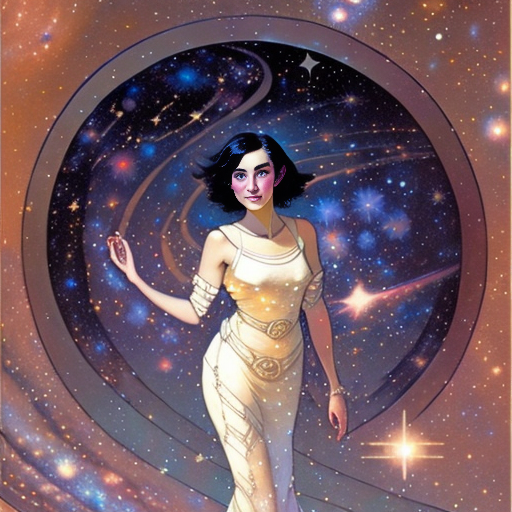
I believe the prompt for this one was “a dreamy young woman with short black hair, bare shoulders, in space surrounded by stars and galaxies. Minerva Teichert and Baen Books.” The original image was a woman in a space suit, but I used something called “image to image” to create new images based on the previous one, in batches of four. I would pick what I thought was the best one for that generation, and run the program again. That’s how I eventually got to this one:
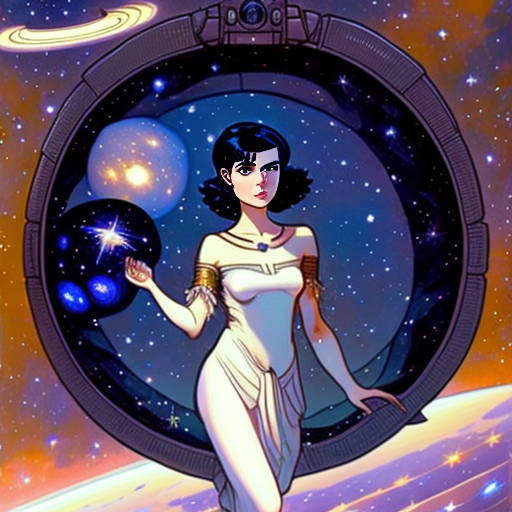
and this one:
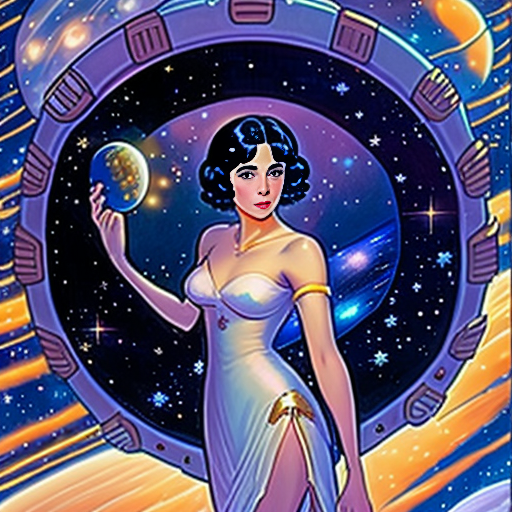
Still need to work on the hands. Also, there’s this weird artifact, almost like poor JPEG compression, that happens if you don’t give the program enough creative leeway with each successive generation. Another method I’ve heard of is to create a really large batch based on a given image, and then use GIMP to cut and paste all the pieces that you like from each one, before running it through one final image to image pass to seamlessly combine them.

A lot of people are either really angry or really scared about AI art and what it means for the future. It’s the same with other forms of automation, I guess. Will it replace artists entirely? Will all our art be 100% AI-generated in the future? Personally, I don’t think so. These programs are just another set of tools, and require quite a bit of practice to master.

Same thing with stuff like ChatGPT and other language learning models that can be used to write poems and stories. It takes a lot of work to come up with an AI-generated story that isn’t totally boring, or has a terrible ending. It can be done, but it does require quite a bit of human input.

So I don’t see these tools replacing artists or writers, at least in the forseeable future. Rather, I think that the successful artists and writers will be the ones who incorporate these tools into their workflow, using them as force-multipliers to make some really amazing stuff. Personally, I would absolutel love it if I could use something like ChatGPT to put out a new novel every month, or even every week.

The other thing with things like novels is that most people only read them once, because they already know what’s going to happen. So if you use an AI to write a novel, but you have to feed it all the twists and plot points… what’s the point? You’ve basically already read it. This is a problem that a lot of amateur writers have with outlining: since they already know how the story is going to end, they find it difficult to sit down and write. 

Now, what I could see is a prompt like “rewrite Lord of the Rings so that Sauron wins,” or “rewrite such-and-such romance novel so that this other guy ends up with the girl.” Or “make Lord of the Rings a gritty cyberpunk novel,” or… you get the picture. And honestly, I’m fine with that. If someone who enjoyed the “alpha” version wants to create a “beta” or a “gamma” version for fun, that’s cool. It might be kind of fun to see how an AI tweaks my books.

What isn’t cool is if someone takes that beta or gamma version of my novel and tries to sell it under their own name. And that’s where most of the legal stuff needs to be hammered out, over issues like copyright. I’m not going to use Stable Diffusion to remove watermarks, or to take someone else’s copyrighted art so that I can enjoy a derivative product without having to pay the artist. And when it comes to using prompts, I’m going to err on the side of using artists like Minerva Teichert who have already passed away, or large publishing houses like Baen whose style doesn’t belong to a single artist.
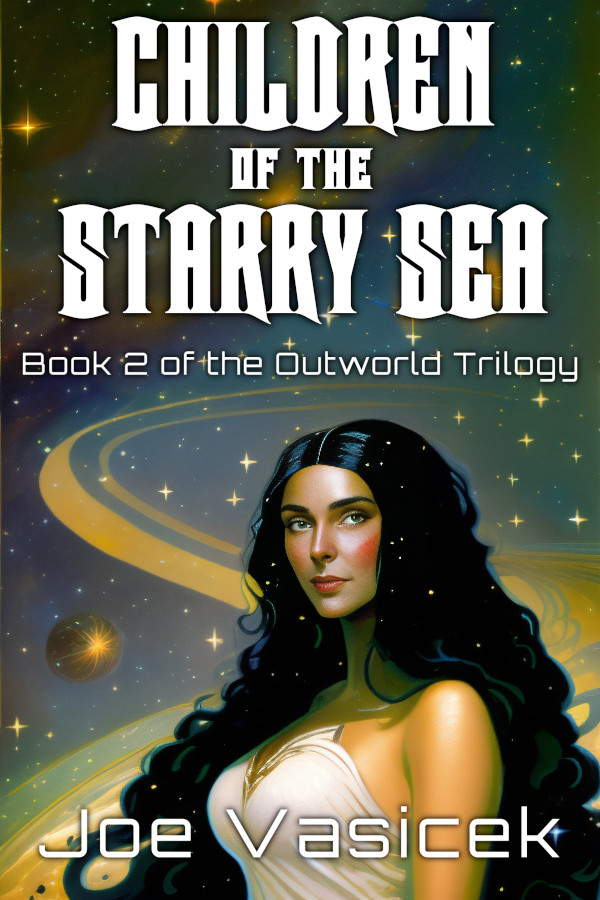
So after playing around with it some more, I finally came up with some concept art for my current novel WIP and used it to throw a cover together! What do you think? This isn’t going to be the final version—in fact, I will probably produce quite a few other test covers before I settle on the one I like. But for my current skill level (still beginner), I’m quite pleased with how it turned out!
C is for Cover Art

They say not to judge a book by its cover, but the truth is we all do. In fact, the cover probably sells a book more than the book blurb does. Whether in print or in digital format, it’s the first part of the book that readers see, and often makes the difference between “meh” and “hmm, what is this? I want to find out more!”

So how do you do cover art when you’re an indie? Is it better to make your own, or hire a designer? If you do hire a designer, how much can you expect to pay?

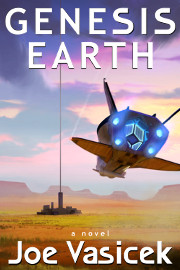
Honestly, when I started out, I think I invested a little too much into my covers. The first novel I published was Genesis Earth:

thumb (Genesis Earth)The cover art is gorgeous, and from an artistic view I’m very, very happy with it, but it took a long time for the book to earn that money back–far longer than the expense really justified. I would love it if all of my books could have awesome covers like this, but when you’re first starting, not every project justifies that sort of expense.

The thing to keep in mind when you do covers as an indie is that you can always change them. When you first start out and you don’t know how well a book is going to do, there’s nothing wrong with doing it on a shoestring budget and reinvesting those earnings later. There is a bit of a feedback loop, where a bad cover will hold a book back, but it’s not that hard to make a cover that’s not great, but acceptable.

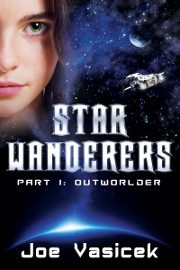
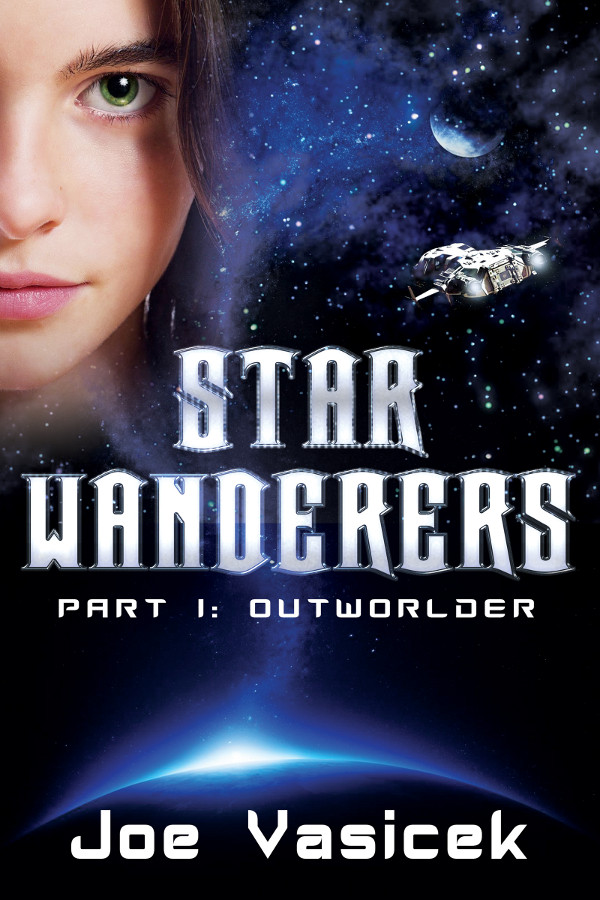
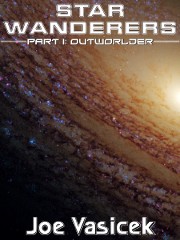
Case in point, check out the first cover I did for Star Wanderers: Outworlder (Part I):

Star Wanderers I (thumb)The cost for this art was $0. I made it myself, using freeware fonts and public domain space art from NASA. It’s not nearly as gorgeous as the cover for Genesis Earth, but it says “space!” in a sci-fi sort of way, and that’s what I was going for. And even with a mediocre cover, this was the book that really started to take off.

Of course, as soon as those books were earning enough, I made plans to reinvest that money in proper cover art. Here is the new cover for Outworlder:

SW-I alt (thumb)I’m working with a cover designer right now to redo all the other ones in the series along a similar vein. In the next couple of weeks, expect to see some cover reveals!

In general, I’ve found that there are three approaches to cover art: doing it completely yourself, hiring a cover designer to make an cover from stock art, and hiring an illustrator to paint an original illustration. The last is probably the most expensive, though it does depend on the illustrator–you can find good illustrators on sites like Deviantart whose rates are quite reasonable. But the quality varies a lot.

Besides the art itself, a key part of the cover is the typography. One thing I’ve learned from working with cover designers is that they can do amazing things just with the fonts and font effects for your title. That’s probably the biggest benefit of going with a cover designer as opposed to an illustrator.

In fact, if you can afford to commission an original illustration, you can probably find a cover designer who will give you a deal on the typography. It is something you can learn yourself, but the difference between you and a cover designer is often the difference between acceptable and awesome.

Like anything with self-publishing, cover design is something you can learn–perhaps something you can excel at–but you probably can’t excel at that and everything else at the same time. What I’ve found is that I’m okay at doing my own cover art, but not awesome. From here on out, I expect I’ll be hiring cover designers.

At the same time, my books are earning enough that I can justify that expense. If I were first starting out, I’d probably DIY it or barter with other writers who do their own covers. A cover isn’t static–you can always change it later.

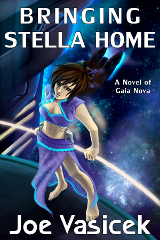
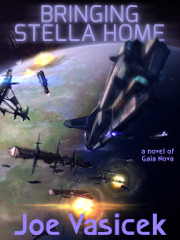
Case in point, check out the covers for Bringing Stella Home:

thumb (Bringing Stella Home)thumb 2 (Bringing Stella Home)

I got a good deal on the illustration for the first cover, but frankly, it’s not that great. The second cover was more expensive, but I’m much happier with it. What I’m probably going to do next is find a cover designer who can redo the title/author typography, since I did that myself and it kind of shows.

So that’s been my experience with cover art. It’s important to get it right, but you do have to work to find the best solution that works for your budget. Fortunately, when you’re an indie, your cover is something you can always upgrade.

What I’ve been up to lately (besides short stories)

It’s been a while since I did an update post, so I figure I should do one of those to let you guys know what projects I’m working on. There are quite a few of them, and I’m happy to say that the writing is going quite well! If I don’t post on this blog very much, it’s probably because I’m busy writing.

Anyhow, here’s what I’m working on (and what you can expect to see in the coming months):

Sons of the Starfarers
Book II: Comrades in Hope

This is the project that’s been taking most of my attention. What started out as a novella has grown and morphed into a short novel–I expect it will top out at just under 40k words. I’m just past the 2/3rds mark now, where it’s still a slog but I can just about see the end. I was hoping to finish it this week, but now it looks like I’ll be pushing it back into April.

That’s okay, though, because my second big project is:

Sons of the Starfarers
Book III: Strangers in Flight

I’ve been itching to start this one for a while, and last night I finally opened up and started it. In the first book, Brothers in Exile, the two starfaring brothers Aaron and Isaac find a beautiful girl covered in henna tattoos and frozen in a cryotank on a derelict space station. In this, the third book, the girl finally wakes up and we get to see things from her point of view.

With the way I’m writing Sons of the Starfarers, it’s going to be structured in a series of three book arcs. Since I want to release the books in each arc fairly close to each other, I don’t want to publish Brothers in Exile until Comrades in Hope and Strangers in Flight are both complete. So even if I end up taking a break from Comrades in Hope for a little while, if I’m working on Strangers in Flight, it’s not putting things off since I’d have to write that one first anyway.

I am really, really excited about these books, and when you read them, I think you will be to. I’m trying to think of ways that I can share them, since it’s hard to talk about something if it’s not actually out there for you to read. Maybe if I posted a series of short excerpts from the first book, no longer than 400-500 words each? I generally skip over blog posts where authors sample their own books, but maybe if they were shorter excerpts, that wouldn’t be as much of a problem. What do you guys think?

So that’s what I’m working on writing-wise. Here’s what I’m working on publishing-wise.

New Star Wanderers covers (and print editions)

So the cover designer I’ve been working with for Star Wanderers told me this week that he’s overextended himself by taking on more work than he can handle and that unfortunately he has to drop some clients. That’s unfortunate but understandable–we all have limitations, and things come up in life that we can’t always plan for. We’ve parted amicably, and he’s promised to get me the files I need to pick up on the cover work where he left off.

I’m really anxious to get the new covers done, though, and would like to find a good cover designer as soon as I can. If you guys have any recommendations, please let me know. Ideally, I’d like to find someone who I could work with long-term, since there definitely won’t be a shortage of work anytime soon!

Because of this, though, I’ll probably keep the original space art covers for the POD books at least for the foreseeable future. The omnibus editions will feature the new art, though, and I’ve just bartered with a friend of mine to do the typesetting for those. I’m not sure when they’ll be out, but it will probably be sometime in the late spring / early summer.

As for the print edition of Star Wanderers: Deliverance (Part VIII), that should be out approximately whenever I get around to it, which would be sooner except that I’m so busy writing Sons of the Starfarers. I’m not sure how many of you are waiting on that one–the print versions for the individual novellas have been selling better than I’d expected, though still at a trickle, so that’s not quite at the top of my priorities right now.

Blogging A to Z Book

Last year, I did the Blogging from A to Z challenge and had a lot of fun with it! The topic I blogged on was science fiction, with a new post each day in April starting with “A is for …” “B is for …” etc. Well, I’d like to do that again this year, but first I’d like to put together last year’s posts into an ebook. It shouldn’t take too long–probably no more than a week at the longest–so I’ll probably take care of that next week or so.

For this year’s challenge, I’m going to blog about publishing. I already have the first few posts planned out: “A is for Amazon,” “B is for Big 6 (now 5),” “C is for Contracts,” etc. These posts aren’t meant to be advice, more just sharing my perspective and experience, since hey I’ve been indie published for 3+ years now, which might as well be 3+ decades what with the way the industry is changing. So even though there’s a lot I’m still learning, I do have a few things to share.

That’s just about it. Better grab some lunch now and head out to write. See you!

STAR WANDERERS Omnibus 2 cover reveal!

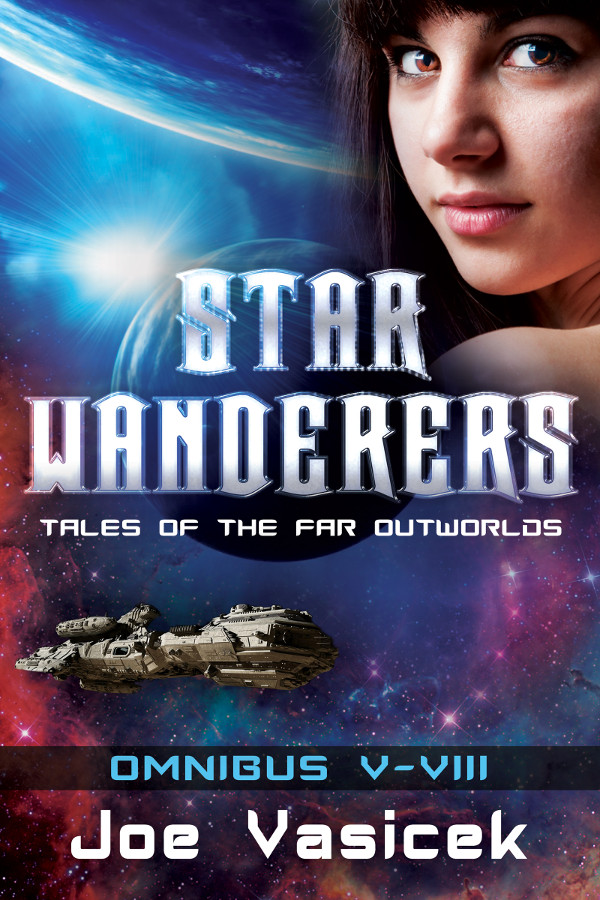
Hey guys! Guess what? I’ve got a new book coming out! This one is a new Star Wanderers omnibus, and includes Dreamweaver, Benefactor, Reproach, and Deliverance. Derek Murphy of Creativindie Covers did the cover design for this one, and this is what we came up with:
SW V-VIII (cover)Star Wanderers: Tales of the Far Outworlds will be out in ebook format in a couple of days–basically, as soon as I can format and upload it. The only content in this one is the Author’s Note, which I’ll post soon to my blog, so if you’ve already got parts V-VIII, there’s no need to buy this one (unless you’d like to have them all consolidated into one ebook).

I’m not sure when the print version will come out, but I’ll definitely mention it here and in my email newsletter when it does. In the meantime, keep an eye out for the ebook version, because it’s coming out very soon!

Not a new book, just a new cover!

So a couple of weeks ago, I got an email out of the blue from Derek Murphy over at CreativIndie Covers.  He’s a cover designer who periodically does cover makeovers for indie writers, as a way to bring in business and build his own reputation.  He wanted to do an experiment to see if he could double my sales in a month by making over the cover for Star Wanderers: Outworlder (Part I).

Star Wanderers I (thumb)Well, I’ll be the first to admit that the original cover isn’t all that great.  The book was a bit of an experiment, to see if writing in a more serial format would be more effective than writing and releasing full-length novels.  I’d spent a fair amount of money to get Bringing Stella Home and Desert Stars up, and sales were too low at that time to justify another huge publishing project. In order to cut costs, I did the covers myself, using public domain images from NASA and Hubble.  They aren’t super great, but they do say “space!” which is better than a gray box with a question mark.

If anything, I’m surprised that the series has done as well as it has with the current covers.  Each book in the series sells in the double or triple digits monthly, and Outworlder has been in the top 20 on Amazon’s Kindle eBooks > Science Fiction & Fantasy > Science Fiction > Space Opera and Kindle eBooks > Romance > Science Fiction subcategories for over a year.  The consistency with which these books have been selling has really surprised me, so anything to push these books to the next level and put them in front of new readers will hopefully yield some awesome results.

So Derek and I went back and forth for a while, and this is what we came up with:

SW-I alt (cover)Pretty sweet, huh? 😀

I am extremely excited about this cover, and I’d love to see what he can do with the other ones.  First, though, we’re going to put this one up for the month of December to see if it has a noticeable impact on overall sales.  I’ve got data from last December as well as the last few months to compare it to, so we’ll see how it does.  And if there is an appreciable increase, I’ll probably go ahead and have him redo all the other covers as well.

Since this is still just an experiment, though, the covers for the print editions will remain the same as the old ones.  I don’t anticipate keeping them forever, though, especially if this experiment works out.  Even so, I’m still going to release them as I’d planned, so if you want the print versions, you can get them.

And who knows?  If these books take off, or I become a well-known author in the future, the original print versions of the Star Wanderers books may be worth something someday.  Maybe.  Who knows?

So far, it appears to be working.  The new cover went live on Amazon last night, and Outworlder has dropped about 700 rankings to #1,705.  That’s without any sort of advertising or promotion, except for the also-bots of course.  Last year around this time I participated in a fairly big group promo, so I’ll try to get this book listed in a couple of places to make up for that.  Or maybe we can extend the experiment through January, in the interest of keeping a really cool cover getting more accurate data?  We’ll see.

Man, it’s so much fun to be a self-published indie writer! 😀

Laying the groundwork for a couple new series

So I just got back from vacation at Cape Cod, which turned out completely different from what I’d expected.  When I left, I said that I’d probably just write like I usually do, except in a different place.  Instead, I took a break from my WIPs long enough to catch a new vision for my career and come up with a really good idea for a new spin-off series in the same universe as Star Wanderers.

The story idea is really awesome.  I don’t want to talk about it too much, since I haven’t even written it yet, but the main characters will be Isaac and Aaron from Benefactor, and the basic premise will start out fairly similar to Outworlder.  From there, though, I expect it to take shape in some very different ways, turning into much more of an epic space opera.

I plan to stick with the novella series format, since I’ve had a lot of success with that so far.  I know that some readers complain about shorter works, but when doing a series of this type, it’s important to put out new titles regularly, and I can do that much easier with novellas than with novels.  Besides, there are a lot of other reasons why I prefer novellas, as I pointed out in this post.

That said, I expect these ones to run a little longer, such as the 30k-40k word (90-140 page) range.  But I won’t really know until I’ve written them.

Before that, I’ve got two more Star Wanderers stories to put out: Reproach (Part VII) and Deliverance (Part VIII).  Both of those are already written; I just have to run them by my first readers and make some revisions before putting them out.  If all goes well, Reproach should be out in September and Deliverance should be out in October.

So that’s the plan.  Career-wise, what I really need to do is replicate the success of Star Wanderers by starting some new storylines that follow the same series format.  It’s a little unnerving, since I don’t know what will stick, but I don’t want to be dependent on just one series–you’ve got to have multiple entry points.  Besides, this new series is a spinoff, so hopefully readers from the first one will carry over.

It’s at this point that I’m hitting myself, because what I really need is to have three books that I can release before Christmas.  In general, I’ve found that it’s better to wait until you have three books out before you make the first in a series permanently free.  I wish I’d spent a lot more time this summer writing new things, rather than revising old stuff or finishing up old series.  But oh well–better to start now than wait until next year.  And who knows?  Maybe I can still pull it off.

For this new series, I plan to invest a little more in cover art.  The NASA images have been good for Star Wanderers, but to really hit the publishing trifecta (title, cover, blurb), I need to commission some original art.  I have the money now, and probably the best thing I can do at this point is reinvest it.  Expect those covers to be awesome.

Oh, and the other elements of the trifecta?  I don’t have a blurb yet, but the working title is Sons of the Starfarers.  Pretty cool, eh?

So there’s that.  I’m currently revising Reproach, but I think I can finish that on the train and send it out to my beta readers before the end of August.  As for The Sword Bearer, I’m going to put that project on hold again, mostly so I can focus on this.  I’ve also been running into some problems with that project, mostly having to do with the worldbuilding.

For that reason, I’m thinking of doing a series of prequel novellas in order to flesh out that world and the backstory.  If it goes well, that should turn into its own thing, kind of like how Star Wanderers fleshes out the background for my Gaia Nova books.  I’m thinking of something along the lines of David Gemmell: heroic fantasy with a real focus on courage, valor, and unlikely heroism.  I’ve already got the first scene of the first book in my head, and it’s pretty dang awesome.

So many stories, so little time … I’d better get back to writing!

When something you’ve written moves you

SW-VI Benefactor (thumb)So I had an interesting experience today as I was revising Star Wanderers: Benefactor (Part VI), and I’m not sure how to describe it without sounding like “that guy” who gushes far too much about his books.  At the risk of being “that guy,” here goes.
As writers, it’s far too easy for us to write something in the heat of a creative passion, only to dismiss it later.  Perhaps we’re so afraid of screwing up that we yearn to fall back on the story that’s safe rather than the story that rings true, or perhaps we realize just how much of ourselves we’ve put into it that it scares us to death that someone might actually read it.  Too often, something else that’s broken about the story distracts us from the stuff that’s actually good, so we end up throwing it all out together.  Our critical minds work so differently from our creative ones that when the fires of creative passion turn to smoldering embers, it’s not unusual to feel like we’ve been left completely naked and need to scramble desperately to cover ourselves.

For that reason, I’ve made myself a rule not to revise a story without first making a set of bullet points, chapter by scene, of what I’m going to do.  My critical mind has full domain of that list of bullet points, but I will not let him carve up my story.  The list contains a series of instructions for my creative mind, who can actually revise quite well when given a little direction.  But when he thinks that the direction is wrong, he’s not afraid to push back.

The revision notes for my books always read like a back-and-forth argument between my critical and creative minds.  Once I’m finished writing up the bullet point list of revisions, I turn on track changes and cross them off one by one as I complete them.  But whenever I get to a point where my creative mind disagrees, I’ll cross it off and write down the reasons why it’s better to go in a different direction.  Some of the more recent notes for Benefactor include:

It’s not as much of an issue as you think.

Eh, the dialog works pretty well.

Already there.  Better to keep it subtle.

Why?  This is good.

No, it works very well with what’s already here.  Don’t change it.

So with that as a preface, I got to a scene in Benefactor today where one of the characters has a major life crisis upon learning that his wife is pregnant.  The pregnancy catches him completely by surprise, and makes him wake up and wonder if his life is really heading in the direction that he wants.  He feels like he’s stumbling into his future blindly, tripping over his feet without knowing where he’s going, and that frightens him.

I’d made some notes to add some stuff for clarification at the end of the scene, but I must have only been skimming it when I made the revision notes because all of that stuff was already there, and expressed more poignantly than I think I could have done.  Basically, the character comes to peace with the life he’s giving up by realizing that he will one day lead his son to follow in his footsteps, just as his own father did with him.

My critical mind completely missed that, because he was only looking for problems that needed to be fixed.  But when I read it again today, I was actually kind of shocked that this was something I’d written.  I don’t want to say that it’s the best thing that’s ever been written, because certainly I have lots of room for improvement, but the passage really moved me, and I wasn’t expecting that.

So yeah, revisions for Star Wanderers: Benefactor (Part VI) are coming along swimmingly.  It might be a bit tough to get the final draft proofread in time for a July release, but I’ve got some friends who might be able to help.  Just like I don’t trust my critical mind to meddle with the story, I don’t trust my eyeballs to catch all the typos and grammatical errors.  But I think that the substantive revisions will be finished by Tuesday, and after that, it’s time to get the publishing wheels grinding.

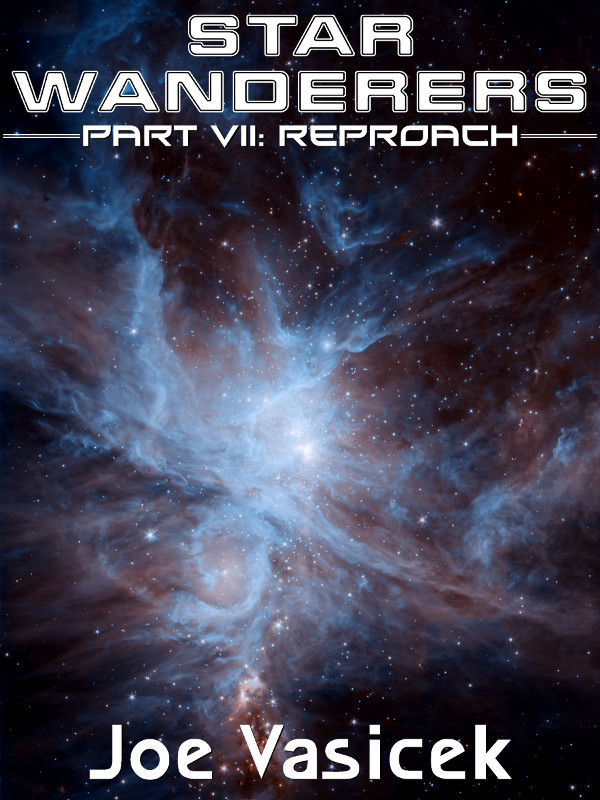
In the meantime, I was playing around with The Gimp today, and I came up with a cover for Star Wanderers: Reproach (Part VII).  Check it out!

SW-VII Reproach (cover) The image is the Orion Nebula, as imaged by the Spitzer Space Telescope.  You can find the original here.
I thought it was fitting, considering how Reproach is a parallel novella to Sacrifice, and Sacrifice also features an image of the Orion Nebula on the cover.  But the important thing is just that it looks cool and is sufficiently eye-catching.

So that’s about it.  I’ve got a lot of heavy revisions to do tomorrow, but even my critical mind agrees that chapters 4 and 5 are actually pretty good.  There’s at least one scene missing and a couple of other things that need to be added, but I’m actually looking forward to writing those.  Also, a couple of characters need some more fleshing out, but that shouldn’t be too difficult.  The Tuesday deadline is quite doable.

Have a good night, and thanks as always for reading!

Update on STAR WANDERERS and a sneak peek at some cover art

So in case you didn’t know, I’ve been getting an omnibus edition ready for Star Wanderers.  It’s subtitled The Jeremiah Chronicles, and contains parts I-IV (Outworlder, Fidelity, Sacrifice, and Homeworld).  This covers the first major series arc, with all of the stories from Jeremiah’s point of view–hence the title.

I commissioned Ina Wong from Deviant Art for the cover, and this the result:

JV4 COMP

I must say, I’m rather pleased.  It’s got a very different feel from the current space photography covers, but I think this is a lot truer to the actual story.  I can’t commission art like this for the individual installments, of course, but for an omnibus edition, I figure it’s alright to go all out.

The only content in the omnibus that isn’t already in parts I-IV will be the author’s note, which I’ll either post here or include as a PDF to my newsletter subscribers.  In other words, don’t worry about missing out on anything if you’ve already read the individual installments.

I’m getting feedback from my alpha readers for Benefactor, the next part in the series, so I’ll probably release that one in the next six weeks.  In the meantime, I’ve picked up work on Reproach again (Part VII), and hope to finish the first draft before the end of the month.

Just as Dreamweaver is a parallel novella to Outworlder (from Noemi’s POV), Benefactor is a parallel novella to Fidelity (from Jakob’s POV) and Reproach is a parallel novella to Sacrifice (from Noemi and Mariya’s POVs).  After that, I’ll do a parallel novella to Homeworld with Lucca and Mariya as the main POV characters, and then branch out into some other characters and storylines.

The fun part about writing this series is that each new story seeds at least two or three others.  I just wish I could keep up!

I haven’t abandoned Lifewalker, but I did reach a point where I figured it would be good to take a short break just to keep things fresh.  My creative process seems to work that way.  As much as I’d like to train myself to stay on project until it was finished, creativity can’t be trained so much as fostered.  I set myself a deadline to finish something by May 31st, so now it looks like that’s going to be Reproach.

As for The Jeremiah Chronicles, all I have left is to write the author’s note and book description.  It should be out on Amazon, Barnes & Noble, and Smashwords by this time next week.  In the meantime, I’ll keep working on Reproach so you guys can have plenty more stories to read!

Random thoughts on creativity and a cover preview

I’ve noticed that I tend to go through at least two revisions on most of my stories.  The first one generally identifies the problems in the rough draft and eliminates them, while the second one adds anything that’s missing and smooths the story over so that it works as a whole.  They both use different parts of my brain: one critical, the other creative.  Since both are important, I can’t easily skip either of them, and combining them into one mega-revision doesn’t really work because it’s hard to switch from one mode to the other.

I’m currently in the second revision for Star Wanderers: Dreamweaver, and it’s coming along really well so far.  Now that I’m in creative mode, it’s a lot easier to add stuff that was missing from the first draft and tidy up some other parts that seem a little disjointed.  With luck, this revision should be finished in a day or two.  It’s really only one chapter that needs the bulk of the work–according to my first readers, everything else is pretty good.  Far be it from me to fix something that isn’t broken.

###

The other day, an old friend of mine emailed me with a question about the world building / plotting process I followed for Star Wanderers.  I wrote a fairly lengthy response, and while most of it was a more detailed explanation of the stuff I’ve already included in the various author’s notes, I came up with some advice that surprised me:

If I had to give any advice, I’d say that the most important thing is to just feed your creativity.  You can’t force your imagination, just like you can’t get any more golden eggs by killing the goose that lays them.  However, you can organize your life and your environment in such a way that bursts of creativity are longer and more frequent.  A huge and important part of it is learning to turn off your internal critic, especially on the rough draft.  Sometimes, if I spend too much time thinking about writing, it paralyzes me so that I can’t actually write–but if I trick myself into opening my WIP without really thinking about it, then ten minutes later I’m plugging away and the ideas are flowing.  And just as bad habits can be very harmful, good habits can be very helpful.

I think a lot of us creative types tend to force ourselves a little too much, especially when we’re first getting started.  We want to be productive, we want to have something that we can show for ourselves in order to feel validated, especially with so many people raising eyebrows at our dreams and creative pursuits.  But productivity goals, while important, are really only a means to an end–and they’re not even the most important means most of the time.

If you want your work to ring with authenticity, or to reflect the truth and beauty you see in the universe, you have to be in touch with that kind of stuff.  And once you get back in touch with the stuff that drove you to create in the first place, there’s nothing that you want to do more.

This morning, I wrote for three hours in one sitting, and I wasn’t tempted by any distractions at all.  I only produced about 1.3k words, but they were good words that added both to the story and my understanding of the story.  I got back in touch with the spark that drove me to write it in the first place, and hopefully that spark will carry through to the readers.  I think that it will.

So yeah–it’s not about productivity goals, or reworking our creative process to be more like someone else’s, or any number of other writerly insecurities.  It’s all about story, and everything that drives us to tell them.

###

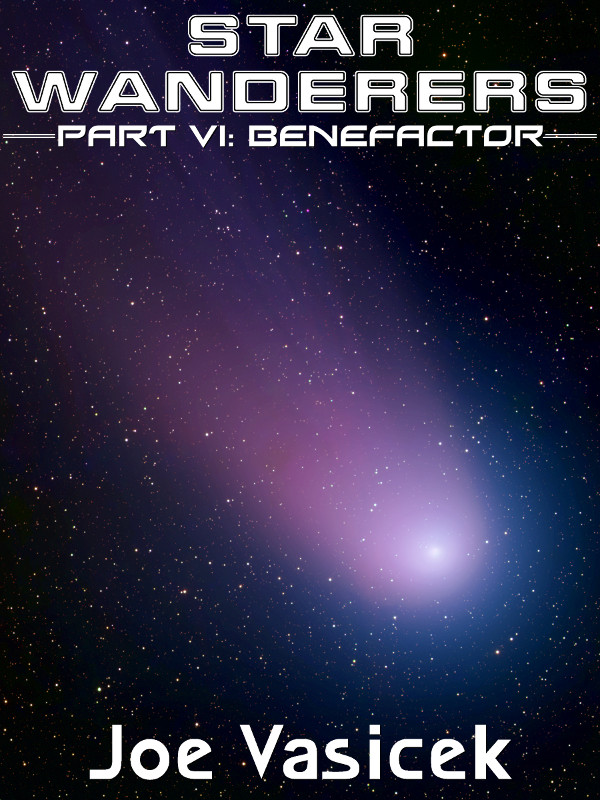
All right, if you’re still reading (or even if you cheated and skipped ahead), I have a treat for you.  I just found the AWESOMEST image for the cover of Star Wanderers: Benefactor, which I hope to finish up later this week after finalizing the revisions for Dreamweaver.  Here’s the cover:

SW-VI Benefactor (cover)

Pretty cool, eh? I <3 NASA. 😀

The picture is of Comet C/2001 Q4 (NEAT), taken by the WIYN 0.9-meter telescope at Kitt Peak National Observatory near Tucson, Arizona.  It was taken on 7 May 2004, and covers an area roughly five times the size of the moon.  As with all NASA images, it’s in the public domain.

The inspiration actually came from comet PANSTARRS, which is visible in the sky right now.  I tried to catch a glimpse of it tonight from the Y Mountain trail head, but there were too many clouds on the horizon to see it clearly.  Hopefully, the skies will be clearer tomorrow.

In related news, comet ISON later this year is expected to put on a really incredible show.  Astronomers think that for a brief time, it may even shine brighter than the moon, making it visible even during the day!  If that happens, it’s going to be AWESOME.  Mark it on your calendars for November–it’s going to be great!

That’s just about it for now.  I’d better get back to forming those good habits I mentioned earlier–like actually getting to bed at a reasonable hour. Later!