So now that the world’s richest African-American—who has done more to save the world from the evil sun monster than everyone at COP 25 put together—has now bought Twitter and promised to bring back free speech to the platform, I am seriously considering whether I ought to make a new Twitter account and become active on social media again.
I deleted my Twitter account back in 2016, before the elections, and blogged about it (in less than 140 characters, of course) by saying “life is better without it.” And that’s true. Life is so much better without a Twitter addiction, and that’s the one thing that makes me reticent to get back on the platform.
There is no doubt that our current incarnation of Twitter, before the Elon Musk takeover, is a toxic dumpster fire of outrage and stupidity. But it is also the public square. Life without social media is a lot healthier in a lot of ways, but it does turn you into something of a hermit as far as the internet goes.
The thing is, I’m not very optimistic about Musk’s makeover of Twitter doing much to change the toxicity of the platform, because I think that toxicity has less to do with politics (though that certainly is a factor) and more to do with the dangers of social media addiction itself. In other words, I think our toxic politics is a symptom of social media toxicity, not a cause. The first half of The Social Dilemma really got this right, though the second half was mostly just bad propaganda about the threat of “misinformation” to “our democracy.”
So before I get back on Twitter again, I need to come up with some personal rules in order to keep it from becoming addictive, unhealthy, or toxic to my author brand. Back in 2010, Douglas Rushkoff came up with a sort of ten commandments for digital media, and that seems like a good place to start. His ten commandments are:
Do not be always on
Live in person
You may always choose none of the above
You are never completely right
One size does not fit all
Be yourself
Do not sell your friends
Tell the truth
Share, don’t steal
Program or be programmed
I probably ought to reread the book where he explains all of these commandments. It’s a quick read, with some good theory and a lot of practical wisdom. It is over a decade old, though, so I’m sure there’s a lot of stuff we’ve learned since then. Some of these rules probably don’t go far enough, while other may go too far.
In any case, I’m not going to get back onto Twitter until I have a plan, because the last thing I want is to get addicted to all of the toxic outrage and watch as my career (and possibly life) implodes because of it.
What personal rules do you follow when using social media?
In the last 5-6 years, I’ve noticed a shift in most of the media content that I consume. Content has proliferated at an unprecedented rate, and the churn—or the rate at which new content pushes out old content—has become one of the driving factors for those of us trying to make our careers in this way.
We see it on YouTube, where three or four adpocalypses have massacred various channels, and where copystrikes have become part of the game. YouTubers who don’t put up content every day, like Tim Pool or Pewdiepie, quickly lose views and subscribers even when they do put up new content.
We see it in video games, where companies like Paradox are now making the bulk of their money on DLCs, some of which make the vanilla version almost unplayable. Back in the 90s, a game was a game was a game. You could get expansion packs for some of them, but that was just bonus content, not a core part of the gaming experience, or the business model.
It’s a huge issue in journalism, where the news cycle has accelerated so much that weeks feel like months, and months feel like years now. Remember the Kavanaugh hearings? That was less than a year ago. The Covington kids controversy happened this year. Everyone is in such a race to break the story that the quality of journalism has fallen considerably, but by the time the corrections come out, the news cycle has already moved on. Fake news indeed.
The churn has also become a major thing in the indie publishing scene. For the last few years, the established wisdom (if there is any) is that you need to publish a new book about every other month—preferably every other week—to keep your entire catalog from falling into obscurity. There’s a 30-day cliff and a 90-day cliff, at which points the Amazon algorithm stops favoring your books over new ones. And now, to complicate things, AMS ads are taking over from more organic book recommendation methods, like also-boughts. The treadmill is real, and it’s accelerating.
I’ve been thinking a lot about this, and I can think of a few things that may be driving it. I don’t have any statistics or firm arguments to back it up yet, just a couple of hunches, but it’s still worth bringing them up to spark a discussion.
First, social media has taken over our society, not only in public life, but in personal life as well. Now more than ever before, we use Facebook, Twitter, Instagram, Snapchat, and other social media to interact with each other. The problem is that these social media sites are incentivized to get us addicted to them, since we are the product they sell—our data, our time, and our eyeballs. Every like is another dopamine hit. Every outrageous headline is another injection of cortisol.
We have literally become a society of drug addicts. The drugs may be naturally produced by our bodies, but big tech has figured out how to manipulate it like never before. And as addicts, we are always looking for our next hit.
That’s not all, though. There’s a feedback loop between the end-users who consume content, and the algorithms that deliver content recommendations to the end-users. When something new gets hot on social media, the algorithms act as a force multiplier to drive it even further. But because of our addiction, and the fact that we’re constantly looking for the next hit, things can fall off just as quickly as they rise. Hence the churn.
It’s also a function of the massive rate at which content is proliferating across all forms of media. I’m not sure how many millions of English-language books are published any year now, but it’s much, much more than it was back when tradpub was the only real game in town. Same with videos, music, news blogs, etc. With so much new content coming out all the time, and so many people on social media ready to share it, the conditions for churn have never been stronger.
But there’s another, more sinister aspect to all of this, and it has to do with the biases of big tech and Silicon Valley. Yes, there is a feedback loop that governs the algorithm, but it goes both ways: the people who write the algorithm can, within constraints, use it to reprogram all of us, or even society itself.
I don’t think it’s a mistake that the churn is worse on sites that are run by big tech, or worse on content creators who depend on the platforms that big tech provides. The authors experiencing the worst burnout all seem to be exclusive with Amazon and Kindle Unlimited, and news sites that are getting hit the worst now (Vice, Buzzfeed, etc) all depended on clickbait tactics to ride the Facebook algorithm.
There are a few content creators who seem to have escaped the churn. As a general rule, they seem to be scaling back their social media usage and developing more traditional income streams, like subscriptions, sponsorships, and email lists. Steven Crowder, Tim Pool, and Pewdiepie are all examples. A few of them, like Alex Jones, Carl Benjamin, and Paul Joseph Watson, are learning how to swim by getting tossed in the deep end. Big tech has deplatformed them, but they’re learning—and showing to the rest of us—that it’s possible to make your own path, even when all the algorithms conspire against you.
I recently listened to a fascinating interview on the Jordan Peterson podcast, where he talked with Milo Yiannopoulos. Milo fell out of the public sphere when allegations of pedophilia emerged, getting him banned from CPAC in 2018. His career isn’t over, though, and his future prospects look quite bright, especially with the plan he’s been putting together. If he succeeds, big tech and the algorithms will never be able to touch him.
In my post a couple of days ago, I argued that one of the unique advantages of books over other forms of media is that they are timeless. As Kris Rusch puts it, books aren’t like produce—no matter how long they sit on the shelf, they don’t spoil. We are still reading books that were written centuries ago.
If that’s true, then there must be something about books that makes them resilient to churn. In fact, books may be the antidote to churn. That’s basically Jeff VanderMeer’s thesis in Booklife. It’s also worth rereading Program or Be Programmed by Douglas Rushkoff, where he offers some helpful rules to keep social media and the algorithms from completely taking over our lives.
So as indie writers, what’s the best way to deal with all of this? I’m not entirely sure. Back in 2011 when I first started indie publishing, slow-build and long-tail strategies seemed a lot more viable than they do now. But if there is something inherent in books that makes them the antidote to churn, then there has to be a way to take advantage of that.
Title: The Open Source Time Machine Genre: Science Fiction Word Count: 3,247 Time: About 10 days
I felt really good after finishing this short story. The last line in particular surprised me, which is always a good sign. I think this story is going to go places.
The idea for this one actually came about 4 months ago. I imagined an inventor trying to convince a bunch of investors to fund his time travel development project by calling on his future self to appear to them. He fails–his future self never shows up–but after the meeting has ended in failure, he goes home and finds his future self waiting for him there. Why wouldn’t he go back in time to help himself get the funding to develop his project? That was the core idea that became this story.
I wrote out a couple of pages of that one before getting frustrated and trunking it. Then, about ten days ago, I broke my operating system (Ubuntu) and had to upgrade/reinstall it three times before it would work again. For Linux users, that’s kind of like a rite of passage. It was frustrating, but also kind of awesome because of all the stuff I learned from it. Open source technology is really, really cool.
Around the same time, I read Program or Be Programmed: Ten Commands for a Digital Age by Douglas Rushkoff. Fascinating book, especially if you’ve got a job/lifestyle where you spend +50% of your waking life in front of a screen. Rushkoff is a technology theorist, and this book is about all the subtle ways in which computers, social media, the internet, and other modern technologies can be used to manipulate us if we aren’t careful. His ideas are brilliant and his perspective is fascinating, so his book definitely got me thinking about things.
With both of these things on my mind, I went for a long walk while taking a break from my writing. Short stories were also on the mind, since I was wondering what I should write about for the month of January. The old time travel idea popped up, and everything just sort of melded together until I had the story.
I wrote the first half of it the next day … and then sat on it for a little over a week. I’m not sure why I did that–maybe I was just nervous about screwing it up or something. By far, the hardest part about writing is getting out of your own damned way. Yesterday, I finally buckled down and forced myself to finish the thing, and it actually turned out pretty well. Took the whole day to finish it, but it’s finished and that’s what’s important.
So after touching it up this morning, running a spell check and tweaking a couple of relatively minor things, I put it out on submission. That’s two stories I have on submission now: “The Infiltrator” got rejected from Clarkesworld, but it’s out at Analog now so we’ll see how that goes.
I think my short form is getting better, though there’s still a lot of room for improvement. I’m going to start running these stories through Kindal’s writing group, even though I’ll put them out on submission as soon as they’re finished. The feedback will be useful in writing the next one.
No idea what the next short story is going to be about. Maybe I’ll go through some of my old story idea notebooks and see what comes together. Or maybe a story will just come to me, and I need to position myself so that I’m ready to capture it on paper when it comes.
We’ll see. In the meantime, I’m very pleased with this one.
Whatever the case, expect to see lots of modern ruins and schizo tech mashups (horse-driven cars? Wood-wheeled bicycles?). If anarchism reigns, expect to see lots of punks roaming the wastelands in muscle cars and motorcycles. If Ragnarok Proofing is in effect and the ruins of civilization haven’t quite decayed yet, expect some variation of a scavenger world. And if someone from our modern era finds himself lost in this bizarre post-apocalyptic future, expect him to find some sort of constant to reinforce that he’s not in Kansas anymore.
Unlike dystopian settings, where society evolves (or is deliberately turned) into a horrible, hellish place, a post-apocalyptic setting represents a reboot of civilization itself, where one society has passed away and a new one is slowly picking itself up from the ashes. It has the potential to be a lot more hopeful, and to give the reader a lot more wish fulfillment. After all, who wouldn’t want to be one of the lucky survivors tasked with rebuilding civilization? Sure there may be zombies or nuclear nasties wandering about, but on the plus side, you don’t have to worry about your bills or your deadbeat job anymore.
Douglas Rushkoff has some interesting ideas about why this type of story is becoming more and more popular nowadays. In his new book Present Shock which he’s been promoting recently, he argues that many of us are so overwhelmed by a world where everything happens now that we wish we could end it all and start over. When we live in an ever-changing present without a coherent narrative to reference our past or our future, we long for something to restore that sense that we’re part of a larger story, even if that story is racing towards a horrible, tragic end.
But every ending is a new beginning, and that’s what lies at the very core of this trope. When our world passes away, what will the new world look like that takes its place? Will we learn from our mistakes, or are we doomed to repeat our worst atrocities? Will we eat each other like dogs, or will we tap into some deeper part of human nature where mercy and compassion lie?
This is all on my mind right now, because I’m writing a post-apocalyptic novel (with the working title Lifewalker) that takes place in Utah 200 years after the end. Humanity was hit by a plague that kills everyone over the age of 25, so that the only people left are orphans, teenage adults, and their babies. It’s fascinating to wonder what from our era would fall apart and what would remain, or what would be preserved and how the new society will take shape.
But it’s not the apocalypse itself that I’m interested in, so much as what happens after things stabilize. The main character is one of the few people who’s immune to the plague, so naturally he feels like a complete outcast. He’s walking the Earth, riding down the ruins of I-15 with a copy of Brandon Sanderson’s Mistborn in his saddlebag. And the people he meets … well, let’s just say I wasn’t very kind to Las Vegas.
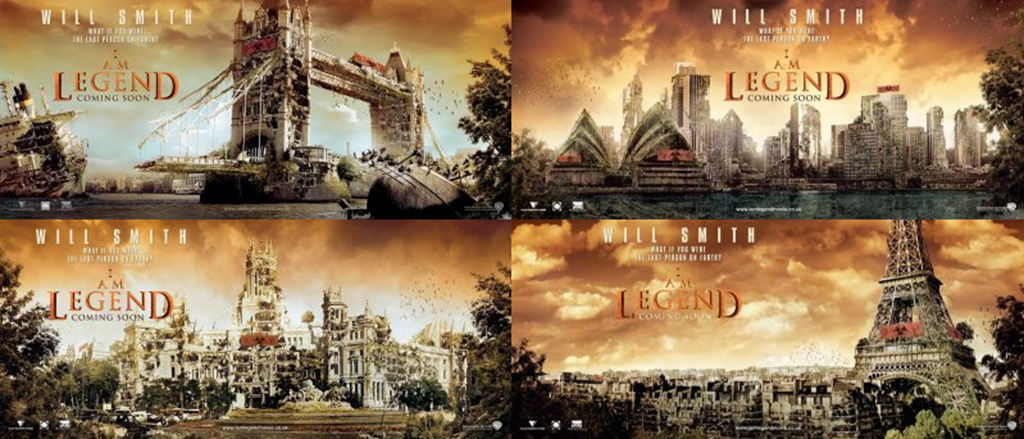
I think that’s another part of the appeal of this trope: it takes our own world and twists it into something fantastic, so that instead of having to wrap our minds around a whole new set of history and physics, we can build on the familiar in wild and interesting ways. A Canticle for Leibowitz did this very well, with another post-apocalyptic tale set in Utah. However, the most famous popular example is probably the movie I Am Legend. I love those long panoramic shots with Will Smith hunting deer in Times Square, or hitting golf balls off the wing of a fighter jet. Stuff like that really sparks the imagination because it combines something familiar with something wild and different.
Believe it or not, this trope has actually happened in real life. After the bubonic plague swept across Europe, whole cities were depopulated, with as much as 60% casualties in some places. When the Pilgrims settled at Plymouth, they were actually building over the ruins of a large Indian settlement that had been wiped out by smallpox just a few years before. And using DNA evidence, scientists now believe that all of modern humanity is descended from a small group of just 50 females who survived a global volcanic eruption some 70,000 years ago.
So yeah, this is definitely a trope I like playing with. I’m on track to finish Lifewalker by the end of May, so you can definitely expect to hear more about it in the weeks and months to come.
Also, for those of you looking for resources to help you visualize what the world will look like after the end of human civilization, here are a couple of excellent resources I’ve found. First, check out The World Without Us, an excellent book written by an environmentalist that poses a basic thought experiment: what would happen if all humans everywhere magically vanished, and all that was left was the stuff that we’ve built? What, if anything, would remain? (spoilers: not much) If you want to explore that idea but you don’t want to read the whole book, check out this wiki on Life After People, a series of History Channel documentaries that basically posed the same question. The answers may surprise you.
So I got back to the States last night, after about forty six hours of travel (and only four or five hours of sleep). It’s good to be back, but I’m already missing Georgia and thinking about all the things I’ll do once I get back.
The weirdest thing about being back home so far is how non-stressful traveling is. I got to JFK, turned on my American cell phone and found out that the sim card is no longer recognized. My train ticket needed to be rescheduled, I didn’t know who was picking me up back home or when, didn’t know the New York subway system all that well…and yet instead of freaking out, I just shrugged and figured I’d solve all that later. Sure enough, Penn Station had wifi, so I instant messaged my brother in law and had him call my mom and work it out.
The lack of beggars in New York City was kind of strange. There was one kid on the Subway who announced (after apologizing for taking people’s time) that he was trying to make money by selling M&Ms, so I helped him out and bought one. In Tbilisi, some ten year old gypsy kid would fall on her knees and give a huge sob story, then walk through the car with her tin can (and would get more money from it than this kid did in New York).
So that was the first thing I ate when I got here. The second thing was a Jamba Juice. Next was a slice of American pizza–so much better than the stuff in Georgia–and then a bottle of root beer. Man, the soda over here is so disgustingly sweet! I was wide awake until the sugar hit my system, and then it was like taking a sledgehammer to the face.
I’m doing pretty well now, even though I woke up at about 3:30 and didn’t really go back to sleep. There’s not much happening this week, so I should be able to get over the jetlag fairly easily.
As far as Star Wanderers goes, I finished everything but the last scene and the epilogue, so I’ll wrap those up today and get ready to publish Part I. The last few chapters aren’t as awesome as I’d like them to be, but I should be able to work those out in subsequent drafts.
In other news, I recently did an interview on Scifinerdsare.us. It’s more geared towards writers than readers, but worth checking out. There seems to be a lot of polarization these days between writers who self publish and writers who follow the more traditional path, which is unfortunate. That said, indie publishing is definitely the best thing career-wise that’s happened to me.
Finally, I just watched a fascinating lecture by Douglas Rushkoff on the Occupy movement and a new cultural phase that he terms “presentism.” The most interesting thing for me is what he has to say about the way our democracy is evolving–basically, it’s becoming a little more like The Colony from Bringing Stella Home. So many story ideas to play with…