What did you do with your summer?

This is the question I’m kind of worried people will ask me (or I’ll ask myself) when fall rolls around.  It’s looking more and more like I won’t be going to New York for the internship, so that begs the question–what else are you going to do?  Are you going to be productive and do something that helps boost your future career, or are you going to waste your time and have this gaping hole in your resume?

Well…I don’t know what to say.  I mean, I could use a break, but I also don’t want the days to turn into weeks and the weeks to slip away until I have nothing to show for myself.  I suppose the best thing to do would be to make some plans and set some goals.

I do already have a backup plan–or at least, a vision of how I want to use this time.  And honestly, I’m kind of glad that I’m not going to New York this summer, partially because it means I don’t have to get catapulted out of my comfort zone here in Provo (not a good reason), but mostly because it means I can focus on the things I really want–and need–to do.

I mean, half of me seems to be freaking out, afraid that I’ll just end up wasting this time.  But the other half is both calm and optimistic, and with good reason.  My sister and her husband (in a surprisingly generous gesture) offered to let me stay in their spare room over the spring term without paying any rent (just so long as I help out with groceries, dishes, that sort of thing).  I have no financial stressors, no pressing obligations, access to vast amounts of resources (ie BYU campus), lots of friends in the area that I can call on for support, as much free time as I could possibly ask for…I mean, if ever I had any freedom to spend my time doing what I want to do and working towards what I want to work towards,  now is that time.  There are virtually no restrictions, and that’s awesome.

Of course, with all of that freedom comes the freedom to screw it up.  But I won’t be doing that.  I know exactly what I need to do, and how this summer can help me achieve my long term goals.

I want to be a full time writer.  At least, that’s what I think I want.  This summer, I can test that out and see if the full time writing thing is something I can actually stand.  Since I don’t have any pressing work or school obligations, and no financial obstructions either, I can devote this time to work on my writing, hone my craft, and produce something that I can take to  an agent/editor and sell.  I’ve been writing nonstop for the past two years, but always as an on-the-side kind of thing.  Now I can see if this is something I can actually stomach for doing full time.

Goal #1: produce on a consistent basis as if writing were my full time job.

And, while regular practice is one of the best ways to hone your craft, it’s better to both read and write–read the kind of stuff that you’d like to write, and use what you read to help improve your writing.

Goal #2: read and review, on this blog, 15 works of science fiction / fantasy (that’s roughly 1 per week, with a little bit of room for leeway).

And, so long as I’m honing my craft, I shouldn’t restrict myself to just reading and writing.  There are a number of good conventions and writers’ conferences, both here in Utah and on the east coast where I’m from.  Besides the opportunity to hear some great talks and panels by experts on the craft, I might also be able to make connections in the sf&f community, the publishing world, and may even have the chance to sell some of my work.  At the very least, I can practice doing all that stuff.

Goal  #3: attend at least 3 conventions and/or writers’ conferences.

One of the things I want the most from this summer is the long-term perspective and vision I need to make some very important life decisions in the near future.  Part of that is trying out the full time writing thing, but it’s not limited to that either. I’ll be graduating soon, probably within the next year, and I still don’t have any post-graduation plans.  Hopefully, the free time this summer will give me a chance to take a  step back and make some plans.

But while thinking things out and weighing my options is definitely part of doing that, another very important part is listening to the spirit, praying about my options and plans, and connecting with the Lord on these things.  Towards that end, I need to work on my personal spirituality, my relationship with the Lord, and take the time to really listen on a spiritual level.  As a summer nomad, working on this individually is going to be even more critical, because I won’t be settled in one ward for a long period of time.

Goal #4: consistent daily scripture study.
Goal #5: worship at the temple at least once weekly.

I think it was my grandfather who said that as long as you’ve got your health, you can do just about anything.  It’s true–being in good physical condition can really help you get everything else done in a much more efficient and effective way.  Besides, it’s important for it’s own sake.  With all this free time, if I didn’t exercise at all I would certainly be neglecting myself.

Goal #6: work out at least five times a week and eat healthy.

And finally, while I still have enough grant money left over to cover just about anything I want to do this summer, it would be wiser (and helpful for my resume) to carry a few jobs and at least break even.  I’m not paying rent, but I am paying for food, gas, car and health insurance, and tickets to all those conventions and conferences I want to go to.  Besides, if I don’t spend the grant money now, I can spend it later on a poli sci internship next school year, possibly in Washington DC or even Scotland.

Goal #7: find part time employment and try to break even.

So those are my seven goals this summer; we’ll see how it works out.  Usually, I’m not that good at keeping goals and resolutions, but I think these will at least point me in the right direction.

Living in a state of limbo

Graduation was today.  I’ve got another year left, but a lot of my friends are moving on.  I took my last exam of the semester on Monday, and my contract at the FLSR ends Saturday morning at 10 am.

And I have no idea where I’ll be living for the summer.

There’s a chance I might be going to New York for an internship with Brandon Sanderson’s agent.  My friend Steve has been planning to move to New York in June, to try and break into writing for Saturday Night Live and 30 Rock, and I thought it would be really cool to live with him while working/interning/whatever in the publishing world there.  I asked Brandon if he knew of any openings with editors/agents for a summer intern, and he got back to me with the news that his agent was looking to take one on.

Well, I got in touch with the guys over at JABberwocky literary agency at the beginning of the month, sent them a resume, had a phone interview, and…haven’t heard back yet.  They told me they’d get back to me after the London book fair, which was this past weekend, so…I’m still waiting to find out what they say.  I think the interview went okay, though I heard from Brandon that they’ve got a lot of other people itching to get this internship.  College graduates.  With degrees in editing and publishing.

So…I don’t know what’s going to  happen.  It would be WAY awesome to go to New York City this summer, and really awesome to be an intern in the publishing world.  REALLY awesome.  I’ve been following the publishing world, especially the sf&f corner of the publishing world, for a couple of years now.  It would be great to get in there and see it up close, see how it works, see what kind of career opportunities exist there and meet the people who are involved in all that.

If it doesn’t work out, though, that’s still okay.  I’ve got a backup plan.  It’s not as awesome, but it still works.  If I don’t go to New York, I’ll probably spend spring here in Provo, taking a break from classes and working odd jobs here and there (private English tutor–my boss at the FHSS Writing Lab can set me up with that–Arabic tutor, freelance editing, temp campus jobs during some of the conferences out here, etc).  I’d also spend some serious time working on my writing, and attend some of the major local sf&f conventions, such as BYU Writers and Illustrators for Young Readers and CONduit.  I might even be able to go home over summer term and attend Worldcon in Montreal.

I’ve got two finished rough drafts right now and two others that are only halfway finished.  With a relatively free summer, I could almost certainly have three polished, finished drafts by the time school starts again.  Perhaps I could even have them all finished before Worldcon 2009 in August, or finish all four of them before World Fantasy 2009 in October.

It would also be a good chance to see whether I can handle the writing lifestyle.  I’ve been writing fairly steadily for the past two or three years, doing between 500 to 1,000 words a day, but it was never the primary thing I was doing.  If I have the summer off from all my other obligations, I’ll be able to explore a little bit what it’s like to write full time.  It doesn’t exactly translate into something nice and shiny on a resume (not like an internship, at least), but it would give me some valuable and useful personal experience.

Besides that, taking time off would help me to figure out what I want to do post-graduation.  I’m aiming to be a professional writer, but I’ll probably graduate from BYU long before I sign my first book deal, so it’s good to have other directions to go.  Trouble is, whenever I’m busy with school I never take the time to think existentially about what I’m doing and what I want to do.  I’m so focused on the day to day aspect of things that I find it hard to make any long term plans.

Of course, either way is going to help me figure that out.  Whether taking time off to work on my writing or working as an intern for a literary agency, I’m going to gain experience that will help me figure out what I want to do after graduation.  So I can expect that to happen no matter where I go, I hope.

So…until I get an email / phone call from the guys at JABberwocky, things are up in the air.  It’s a little bit nerve wracking, especially with all of the moving out / moving in going on around here.  I know I won’t have any trouble getting a spring/summer contract here at BYU, but New York…I have no idea.  I’ve got family up there that I can stay with for a few days until I get settled, and there’s the housing list for the New York stake, but man, it’s expensive over there.

I don’t know.  Maybe I’ll end up staying here in Provo after all.  We’ll see how it goes.

(Image courtesy David Iliff. Published under a CC attribution 3.0 unported license.)

Running the gauntlet

In the past five days, I have written somewhere on the order of 10,000 words. None of them has been fiction (at least, not explicitly–more BS, if anything).

One monster history term paper, one middling poli sci essay, and two exams requiring 2,000 and 1,000 word essays. Blegh. Like pulling teeth.

The upside is, it’s almost finished! Just got my history exam left, and it shouldn’t be too hard. There is an essay, but the teacher already gave us the two questions from which he’ll pick the one on the test, and a short answer section. The rest is multiple choice. Not too hard, especially because I’ve really enjoyed the class.

The two exams I took today…let’s just say I’m glad it’s behind me. The deeper you get into your major, the more you have to take dumb classes about things you don’t care just to graduate. Blegh.

There is one other exam besides the history one, but I’m not counting it because it’s Brandon Sanderson’s English 318 class. His final exams consists of the first three chapters of you novel, plus a query letter and synopsis that he’ll mail out to the editor/agent of your choice (sending out the submission is a required part of the final). I did some research, found an agent, sent out a query email. If I get a response, I’ll send out the chapters to her. If not…I’ll send it out somewhere else. It didn’t seem like she wanted people to send her partials without her requesting it, so I didn’t send that out.

You know, it’s funny how the title of your novel seems a whole lot less clever when you’re finally sending it out to people.

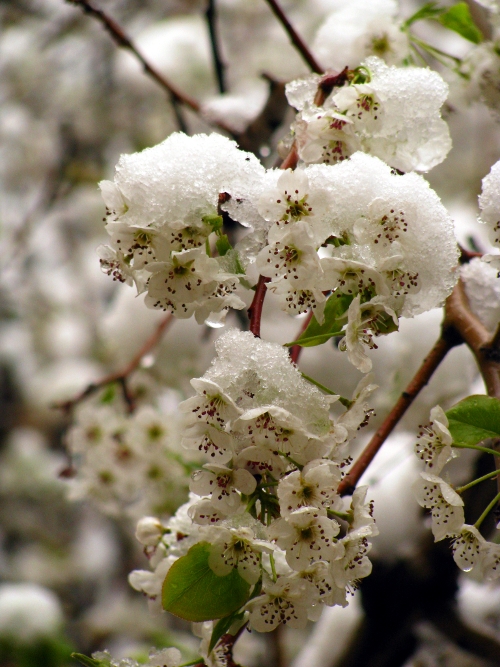
And, as if things weren’t crazy enough, Utah decided to play jokes on us with the weather. We got our worst snowstorm of the year…on April 15th? Holy cow! WTH? (that’s “what the heck,” for all of you non-Utahans)

Here are some shots from my photoblog, before and after (or rather, before and during).

Crazy!

This sucks and I’m a horrible writer

It’s getting really, really hard for me not to believe that statement, especially as I finish up with the middle part of this novel.  I’m starting to realize that I made a whole bunch of mistakes pages and pages ago, and that the climaxes just aren’t working without everything set up right.

I know, cognitively, that it’s mostly just psychological and that this book probably isn’t as bad as I think it is, but I’m finding it hard to convince myself of that.  I got to the climax of part II yesterday, and it was…not what I’d had in my head.  That’s probably what’s frustrating me the most.  If I can’t write down the story as I have it in my head, what does that mean?  It either means I’m a terrible writer, or that I didn’t get the setup right (or both…gah!).

So…where do I go from here?  Throwing out the entire story isn’t an option–I’m not going to allow myself to do that.  I could, however, put it on the back burner for a while, let it simmer…or I could do or die and finish the 1.0 draft, no matter how crappy it turns out.  I suppose that would accomplish something for my self esteem, but is that the way to best serve the story?

Fortunately, this past week we talked about revision in English 318.  Listening to my recording of the class gave me a few ideas.  I could make a list of known problems, with their fixes, and continue as if I’d already made them.  I think I did that a few times with The Phoenix of Nova Terra, but I don’t know how I feel about that now.  I could probably make it work…

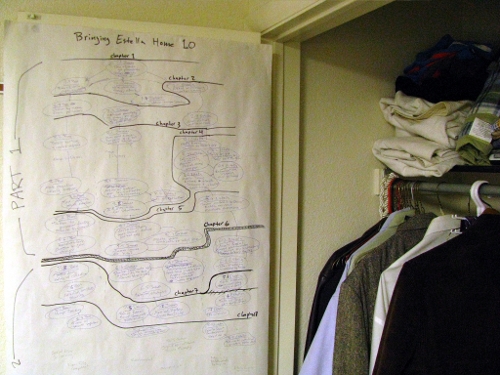
The main issue is that I feel very, very distant from this book.  A month ago, I was immersed in the thing, writing over a thousand words each day, just chugging it out.  Now, for various reasons, other things have come up and drawn away my attention, so I don’t feel that I’m really in this world anymore.  I feel like I’m more of an outsider, writing for the sake of writing rather than trying to tell this story the way it wants to be told.  I can’t really remember what I wrote a hundred pages ago, despite that big sheet of butcher paper up in my closet.

Another thing that complicates all of this is that I’m really, really excited about the other novel, Genesis Earth. I’ve gotten back comments from most of my alpha readers, and I’m all but chomping at the bit to start working on it again.  If I had nothing else going on, no pressing obligations or assignments, with the enthusiasm I have for this project I could probably finish the second draft in a week, and the third draft the week after that.

So…what’s next?

Well, I think I’m going to start the revision on Genesis Earth today or tomorrow.  When I was this enthused about revising Pheonix, I decided to wait and finish Genesis Earth instead, and the enthusiasm for that project died down surprisingly fast.  Better to start now than wait until I’ve got the free time but struggle with motivation.

In the meantime, I’m going to finish the current chapter of Bringing Estella Home and let it rest for a bit.  I’ll probably reread what I’ve got from the beginning, make a few revision notes, perhaps an outline of sorts–try to figure out what’s wrong, what I need to change to make it work.  I’ll restrain myself from actually making those revisions (though I did that, mid-draft, for Genesis Earth, and it turned out alright…sort of), but once I feel I’m sufficiently “into” the story again, I’ll get back to work and finish the 1.0 draft.  Hopefully, I’ll be able to do all that before the end of May.

The trouble here is that I’ll probably end up writing the first draft of this novel and revising the other one at the same time…something I tried last September and failed miserably.  However, by the time all of this is finished, inshallah school will be over and I won’t have to worry about it.  Things are looking really good for me to get an internship in NYC, which makes me think I should drop my Spring classes and just take it easy for a month before I start (as for housing, that’s a whole other conundrum…).

Gah!  Writing is complicated.  Is this something I want to do for the rest of my life?  Something I can do?  I don’t know.  I really don’t know.  I just have to keep on writing through this depressing pessimism and trust that it will pass.

As a side note, I took the title of this post from a Writing Excuses episode some time ago; here is the link to that episode, in case you want to hear it.

Ugghhhhh…

Man, I am sick.  It sucks.

I’m also at a low spot in writing this novel.  That sucks too.

When you get towards the last third of the book you’re writing, you start to have doubts about the whole project.  Is this really any go0d?  Is the story really holding out?  Things slow down a lot, and you lose most of the enthusiasm that carried you through the first half.  The daily drudgery of writing becomes harder and harder, and pretty soon you can’t see beyond the chapter you’re presently writing.  It’s not a whole lot of fun.

Then, as you get into the final stretch, the ending comes into sight and you start to regain a little bit of the enthusiasm.  Your goal isn’t too distant, and you start to see how things wrap up to bring you to that final climax and ending.  You find yourself believing in the story again, and excited to see it to the grand finale.

Of course, the actual writing gets harder and harder, exponentially, right up until the last page, but you’ve regained the motivation and you have at least a portion of the drive.

Right now, I’m kind of at the low point.  It doesn’t help that school is starting to get busier, too.  It certainly doesn’t help to be sick, even if it does give me more time around the house (man, I need to get out…I need to get out…).  But I’m almost at the end of the second act–one climactic battle, one huge and tragic development, one major try-fail cycle, and then I’m on the final stretch.  I’m currently at 64,250 words, so I should wrap up part two by about 68k and finish up the novel at around 100k.  Perhaps a little longer, but I don’t think part three is going to be much longer than part two.

One of the major doubts I have about this novel is that it’s too predictable.  All of my readers from English 318 have been making their predictions, and…really, most of them are correct.  In fact, they’re correctly predicting stuff that happens WAY later, stuff from part three that I haven’t written yet.  If this story doesn’t have any surprises, I worry that it might not be as good.

On the other hand, it has some ideas and concepts that are really drawing in my alpha readers, particularly with the Hameji.  Over and over again, that’s the comment I get–they want to find out more about the Hameji.  This is something that might help me to carry the book, even if it is a bit predictable: show this barbarian spacefaring culture at their most brutal, make them the key antagonists, and then slowly humanize them until the readers understand exactly why they do what they do, and even come to agree with them.  That is pretty fun.

So we’ll see how that goes.  In the meantime, I’m going to go to bed early–9:30 or 10:00.  This sickness is just killing me, and I don’t know of anything more effective at curing it than sleep.  G’night.

Slow but steady

Okay, quick post before I go to bed.

Things are progressing in this novel, slowly but surely, as you can see from the wordcount.  Unlike past weeks, I’m not pushing myself too hard, mostly because I’ve got a lot of schoolwork right now and if I were to spend much more time on this novel, I would neglect a lot of the more important stuff.  Even though my course load is relatively light this semester, I’m a senior and I’m really not as motivated to do this stuff as I used to be.  I get done what needs to get done, but just barely.

I have been successfully getting up early, however.  And I’ve discovered something very interesting: I’m more productive when I have less free time.  Thursday, I didn’t have class until noon, so when I got on the computer at about 6:30 to write, I opened up the email, opened up facebook…and, by the time I had to leave for class, I had only written about 430 words.  Disgusting.  But today, when I had class at 9:00 am and still had my Arabic homework to do, I got in about 700 words in half an hour.

I still have a lot of self discipline to learn, I guess. 😛  The scary thing is that my idea, up to this point, has been to keep my time open in the summer so that I’ll be able to write.  Err…yeah.  We’ll see how that goes.

I’ve been getting a lot of comments back from my alpha readers on Genesis Earth, and it’s been REALLY fun!  Even the criticism–as long as it’s helpful criticism, I really appreciate it.  This one girl in my ward asked me if she could be an alpha reader, then read the whole thing in only a couple of days.  She had a LOT of positive comments–in fact, almost all of her comments were positive–and she said she really loved it!  So much so, in fact, that she said she was having withdrawals, so I sent her The Phoenix of Nova Terra v1.2.  Hopefully, getting her comments back will give me motivation to pick up that old thing and rework it…goodness knows it needs it.  Needs it bad.

My first two novels, The Phoenix of Nova Terra and Genesis Earth are completely different in some ways, but very similar in others.

<spoiler alert>

They both have an important romantic element, and they both have generally positive endings.  The book I’m writing now is something of a tragedy, at least at it’s core, and there is a completely different dynamic there.  No love stories, no happy resolutions–lots of pain, lots of violence, lots of grappling with difficult issues.

</spoiler alert>

I suppose it’s good to try out a lot of different things early on in your writing career.  That’s what I’m doing.  At the same time, though…I get feedback on the one novel, and I kind of want to work on it instead of the one right in front of me!  And when I think about what I did right in the one I finished, I look at the one I’m currently writing and I think “man, this is crap.” Of course, I keep working on it because I recognize that I ALWAYS think “man, this is crap” at some point before I’m done.  Knowing that doesn’t make it easier, however.

Jason from the FLSR writing group said something interesting about that, however.  He said that writing a draft of a novel is like climbing a mountain: you do it three times.

The first time, you climb it in your mind as you plan it out.  You’re excited and motivated, and busy with all the preparations.

The second time, you actually physically do the work of climbing.  It is long, hard, and frustrating, you get lost a few times, the summit is anticlimactic, and the return is boring.  You can’t wait until you’ve finished and it’s all over.

The third time is when you look back on the experience after you’re safely back down.  No matter how excruciating the climb was, you look back on it fondly and remember all the best parts.  You thrive on the memories and wish that you were back up there, standing on the summit, enjoying the experience.

Right now, I’m on my third climb for Genesis Earth and my second climb for Bringing Estella Home. I can remember how miserable I was when I was still in the middle of Genesis Earth–for a while I seriously thought about throwing the whole thing out and doing something else.  However, now that I’ve been letting it sit for a while, I’m getting really, really excited about it!  I can hardly wait before I can get back and write the second draft.

But that’s not going to happen until I finish Bringing Estella Home.  And, no matter how difficult it gets, I swear I WILL finish this book!  I’m a chapter away from act III, and that’s too deep into the thing to quit and start something else!  This book WILL be finished–if not by April, then by sometime in May!

…and they all lived evily ever after.

Today we had a quark writing group party, and it was lots of fun! We all went up to drek‘s new house, up in Draper, and read some of our really old, really bad first attempts at writing stories. Good times!

Drek, Nick, lexish, slipperyjim, jakeson, gamila, aneeka, and one of my friends from the FLSR writing group all came up. Jakeson and his crew got lost on the way, but we had a good time hanging out, chatting, eating the pita bread and hummous that I’d cooked (I figured everyone else would bring sugar-heavy treats, so I cooked something a little more on the healthy side–still delicious, as evidenced by how much everyone ate!), and talking about how we’d gotten started writing.

I think a lot of us had similar stories–while we all wrote for different reasons, we all tried to do something big in high school, something that marked a turning point of some sort. The other common thread that ran through our stories was…how laughably bad they were! There were gradations, of course (Nick’s story that started with the word “Gandalf” and only got worse was pretty ridiculously crazy), but all of our stuff was pretty bad.

It can be both fun and painful to look back on past stuff, especially the stuff you wrote back in high school. It’s like, all the painful awkwardness of high school is not limited to your social life, it seeps into your writing as well, especially if that’s when you first try out your hand at the craft. So many cliches, so much bad grammar, so many viewpoint errors and info dumps…ARGH!!!

Of course, that is precisely what made it so entertaining. The awkward, emo, immature teenage grasp of the universe, combined with dozens of stale cliches and atrocious grammar–brilliant! I’m glad we were all at a point where we could look back on this stuff and laugh. It can do you good to air out your closet and let go of some of the old stuff you are sure would destroy you if you ever let it saw the light of day.

My first writing attempt was a novel that has since been entirely lost. I printed up a hard copy, once a long time ago, but I’ve lost that one and really have no desire to try and dreg it up. Of course, all the digital copies haven’t survived. My second novel attempt, however, I have in both digital and hard copy. That’s the one that I dipped back into for this writing party.

I actually sent out a copy of this to my aunt in Washington DC, who is/was an editor for a magazine. She read about the first twenty or thirty pages and sent me this letter, which I will use to finish off this post. The only places I’ve used ellipses are when my aunt described problems specific to certain passages and quoted them.

October 14, 1999

Dear onelowerlight [name, obviously, has been changed 😛 ]

The manuscript your mom sent home with Evan has proven to be an interesting read in many ways. It is wonderful to see people take an interest in writing. This pastime has given me many hours of satisfaction. I find that the joy is in the journey and that the process is as important to me as the finished job. However, it is always satisfying to have a finished product that I feel good about.

What it looks like you have is a wonderful outline for a novel. Your language is colorful and descriptive. The battle scene held my interest and made me want to know what was going to happen next. My intent was to read the manuscript from beginning to end purely for the joy of reading it. The urge to edit, an urge that often gets in my way as I write a first draft, got in my way as I read. Hence I was not able to follow through. I have written on some of the pages. What follows are a few other observations.

A really good writer named John Gardner said that a piece of fiction opens up a dream to the reader. Anything that causes the reader to become aware of the author or that jolts him out of the fictive dream does not belong. It is always helpful to let a manuscript cool for several days and then begin to read it. This will help you be more objective. Sometimes the things that seem marvelous turn out to be less enchanting than one thought during the rapture of creation.

Titles are difficult. Would anyone have read Catch 22 by another name? Some people don’t think so. It has been postulated that the reason the story about The Man Who Went Up A Hill And Came Down A Mountain didn’t do better as a movie–and presumable a book–was because of the length of the title. For many authors the title is the last thing to be written.

Your first two or three pages contain a good deal of “throat clearing.” An opening needs to grab the reader so he will continue. There needs to be a problem, action and change. It should be action that is vital to the story. Someone is going on a trip. Someone is going into battle. someone is getting married. Someone is being born. Unless you want to write erotic literature it would be better not to start with conception. Work the background in later. In The Gospel of John the first few verses talk about the Word. Immediately the Word is identified with the Son of God and the story of his baptism. The problem of establishing himself as a teacher is presented. In episode IV of Star Wars the force is not explained to us at the beginning, rather we see what it can do. It isn’t until Solo talks about fools who believe in an ancient religion that we begin to have some idea th at the force is more than magic. The characters give all this information to us.

Point of view is the perspective that the story is told from. T he most difficult and therefore least used these days is the omniscient narrator. A good rule of thumb is to see the story through the eyes of the person with the problem. Many authors write in first person. One can also use second or third person. Third person is similar to first person except the pronoun I isn’t used as much. (Actually it is more complicated than that, but that will suffice for now.) Sometimes a narrator who doesn’t see into anyone’s mind tells a story. Most fiction that looks like omniscient narrator is actually being told from the point of view of one of the characters. The narrator can then see into the mind of one person and all the other action is viewed through his eyes. Sometimes a novel will contain oone person’s point of view in one chapter and that of another character in another. This seems to work. It is confusing when shifts occur without warning.

Psychic distance has to do with how close you want your reader to be to the story. Stephen King wants to inspire terror. He gets his readers as close as he can. You hear breathing, feel sweat, hearts race. Jane Austin keeps her readers at a great distance. You see the lights, you hear the conversation, it is all very proper–no sweat, no breathing, no racing hearts. Just as with the point of view, the important thing is that the narrative remains consistent. It must not switch in the middle of a sentence, paragraph, or chapter.

Write in active voice as much as possible. Your English teacher will tell you all about this. Be aware that verbs ending in “ing” do not help your story. (Running up the hill after Jill and tripping over a rock Jack stumbled.) This slows the action of the story down but when used sparingly can add emphasis. The following construction works better (Jack ran up the hill after Jill. He tripped over a rock and stumbled. “D___!” he grumbled. Jill took water from her bucket and soap from her pocket and washed his mouth out.)…

…You have many long sentences. Your writing will be tighter and stronger with shorter sentences and fewer prepositional phrases…

…There are lots of ways to deal with dialogue. You can put the dialogue first and description second…you can put the dialogue at the end…you can break it up the way you have in your manuscript or you can put description on either sie of it…Like every other element of your story, you don’t want it to call attention to itself.

I believe you changed fonts to show a change in viewpoint or in who is speaking. For me this is very distracting. There are other good ways that work. Also it is easier for me to read when it is double-spaced.

Two books that I have found most helpful are John Gardner’s The Art of Fiction. It is out in paperback. John Gardner also wrote a wonderful fantasy called Grendal. It is not very long. It is told from the point of view of the monster. The other book is The Elements of Style by Strunk and White.

Thank you for sharing your manuscript with me. It takes great courage to share one’s work. I admire you for starting out early. Remember free advice is worth what you pay for and don’t let anybody discourage you. You learn to write by writinig. You have a good start.

Your’s truly,

Aunt Yvonne

Almost at part 3

Wow, writing this novel is going a lot faster than I had thought. At the same time, though, I sometimes worry that I’m not going fast enough.

I broke the 50k mark this week, and I haven’t even gotten to any of the major climaxes yet. This thing could easily go to 90k words before the end. With only 6 1/2 weeks left in the semester, can I finish it in time?

At the same time, I have NO IDEA what I’m doing this summer. Really. I have a lot of possibilities, but no concrete plans. With the semester coming to a close in a little more than a month and my housing contract with the FLSR coming to an end, that is a little bit unnerving.

Whatever I do, I want to devote some serious time to revising and rewriting these novels, getting them polished. Finding a spring/summer contact isn’t that hard in Provo; the question is whether I can find a job. I also want to go to the Middle East for a while, and if I go home to Massachusetts in August (which I would like to do) another possibility is Worldcon 2009 up in Montreal.

As far as how Bringing Estella Home is coming, it’s coming along very well. I have all of the key climaxes mapped out in my head, and the one that ends part 2 and begins part 3 is only two chapters from where I am now. I don’t normally keep a detailed outline of the whole novel, but I can usually see at least one chapter ahead. Kind of like the faith-promoting story of how a train conductor only has to see as far as his headlights, except that with novel writing, getting derailed is a very real possibility. I know I’ve crashed and burned in my novel attempts before. Fortunately, this one seems to be right on track.

This semester hasn’t been too hard, but last week was somewhat harder than usual. However, it seems like things are starting to calm down into another lull (knock on wood), so I think I can shoot a little higher as to where I want to be at the end of this week (in terms of my novel). I’ve found that I can do about one viewpoint scene per day, one chapter per week. This week, I’m going to shoot for two chapters by Monday. It seems a bit tough, but since I’ve already written the first scene in chapter 9, I think I can do it.

Also, as an experiment, I’m going to try to wake up early and get in a solid hour of writing before I start my day. I found a random website the other day (lost the link, sorry) that showed the routines of several famous, successful writers. Almost all of them woke up early in the morning and did most of their work before noon. Right now, I write almost everything between eleven at night and three in the morning, so I’d like to see if I can change that. I may fail miserably, but what the heck. Now is the time in my life to figure out what works and what doesn’t.

update on the novel

Ughh…….

Alright, in the tradition of last year when I would write until 2am every night and then blog on it before going to bed, here is another update on how Bringing Estella Home is going right now.

It’s getting tougher.  I’m right in the middle of it right now, in chapter 7, and I’m not sure whose viewpoint I should do next or how I should be organizing these chapters.  I’ve got four viewpoints, but really there are three separate subplots going on, and I need to give them each equal time while structuring them so that the tension builds from one to the other.  When you don’t know what your chapter is doing in relation to the novel as a whole, it’s difficult.

My readers in English 318 tell me that one of the most interesting things in this story is the culture of the antagonists, the Hameji, and that’s really good because I want it to be interesting.  I’ve created a sort of ruthless, cold-hearted, irrationally violent barbarian culture, and over the course of the rest of the novel I’m going to show exactly WHY they are so violent, what drove them to it, etc.  Sound familiar?  It’s my Mongols in space idea, and it’s coming along very well…

…except that I didn’t have Ben’s part figured out very well.  He’s the one who gets brainwashed and turned into one of their soldiers, given a drug that melds his emotional being with that of a collective–kind of like the borg, but only with feelings and emotions, not with thoughts.  It will be interesting to play with that idea, but this chapter, which was originally supposed to focus more on his experience with that transition, just…didn’t work out as well.  Not a lot of screen time for him, for some odd reason.

So I did a little bit of thinking as I was walking home today.  I thought to myself, “if I were a Hameji commander, how would I train these guys?” And it worked out very well!  I think I know what I need to do now, what Ben’s story is going to be for the next couple of chapters.  That’s very good.

Man, going for a walk can really help you sort things out and figure out what happens next.  Even though I have an mp3 player, I rarely listen to it as I’m walking to and from campus.  Many times I have my best ideas while making the commute.  If/when I become a professional novelist, I’m going to have to set aside time each day for long walks.

Finally, I’m a little worried that I’m falling behind on my deadline.  I wanted to finish this thing by the final exam day, sometime in April, but now that I’m sludging through the middle, I wonder if it might take longer.  I have the climaxes figured out very well, but I’m still a long ways away from them.  I might not finish this novel until the end of May, especially since I’ll have to do some major revisions of the first three chapters to hand it in for the English 318 final.  That won’t give me a lot of time to revise my novels for World Fantasy 2009…

Bah.  There is so much to think about.  Rather than deal with it now, I’m going to go to bed.

LTUE 2009

Wow. Life, the Universe, and Everything 2009 is over, and it’s hard to believe that only three days have passed. It feels as if this symposium has been going on for a week, and that’s a good thing. Friday and Saturday, I spent practically every waking moment in the Wilk, the student center where the symposium was held. By the end, I think some of the professionals there were starting to recognize me and strike up conversations with me instead of the other way around. Kind of interesting. Way fun. Loads and loads of helpful advice and information to process. I’ll be lucky if I can soak it all in before the end of the year.

I’m glad to say I was able to open up and talk with a lot of people these past few days–in fact, I got a chance to talk with just about everyone who was on a panel that I’d attended. It was fun to shake their hands, compliment them on what they said, and strike up a conversation around that. It was surprisingly non-threatening, to be honest. I definitely feel more prepared for World Fantasy 2009 now–definitely.

By far, my favorite part of the convention was Tracy Hickman’s main address. It was titled Creative Reading 201, and it was all about how the reader and the writer are both collaborators in the creative experience, something that’s fascinated me for a long time. The implications of this simple fact are tremendous. First of all, it means that a story does not come to life until it is read. Anyone can get published, especially with the technology today, but all of those words are empty symbols until someone takes the time to read it. Second, it means that the spirit speaks to us in the white spaces between the lines. Just as people with different needs take the unique message they need from the scriptures through the power of the holy spirit, so each work of fiction speaks differently to us. Finally, all of this means that stories change as we change, even as they inevitably change us. As we grow, the stories that touched us the most simultaneously grow with us even as they help us to become better people.

Tracy Hickman then shared an incredible story about a book signing he and collaborator Margaret Weis had recently at a veteran’s home. A man in a wheelchair came up to them with an extremely tattered copy of one of their earlier works, about a knight who sacrifices his life in battle to save the order, even though all of his fellow knights in the order look down on him as less than a true knight. This wounded soldier then told them that this tattered book had traveled with him in his pocket throughout his military career, through parajumps, underwater operations, and into war theaters like Afghanistan. While fighting in Afghanistan, this soldier was shot in the lower back. As he went down, his first thought was “what would the knight in Tracy’s book do?” He saw the Taliban forces setting up a mortar on the opposite ridge, and in spite of his wounds and the risk to his life, he took down the enemy and saved twelve of his fellow soldiers fighting in that battle. The soldier then presented his purple heart and bronze star to Margaret Weis and Tracy Hickman, for writing the story that inspired him to be a hero.

Sometimes, as I’m sludging away with my writing and wondering what I’m going to do in 2010 when I finally graduate, I wonder if I’m somehow being lazy. I worry that I’m somehow being irresponsible by not going into some other profession, some kind of respectable 9 to 5 job in an office, the kind of thing that everyone else goes into. I wonder if I’ll ultimately become some kind of a parasite on society, trying to make it big as a writer. In the worst moments, I worry that even if I make it big, I’ll still be some kind of parasite, not really producing anything respectable or useful. After all, fiction is entertainment, especially in genre fiction–don’t we have enough of that already?

Then I remember the impact that one good book can have on people–the way it changes us, the way it opens our eyes and helps us to become better people than we were before we picked up the book. Then I realize: what could possibly be more respectable than telling good, honest, life-changing stories? And then, as I think about it a little more, I realize that that 9 to 5 office job isn’t what I think it is. I realize that I’m not slacking off by trying to be something more than a cog in the corporate machine, producing widgets.

If I strive to tell the truth as a storyteller, and to write the kinds of stories that truly inspire people to do marvelous things and become better people, what greater career is there than that? Teaching, I suppose, comes close to having a similar impact, as well as some kinds of therapy work. Certainly there are other careers that have tremendous opportunities to sacrifice and have a meaningful impact on one’s fellow men. However, my talent is in writing and telling in stories–and it’s a talent that I cannot suppress, from which I cannot escape. So long as I live, I will always tell stories–it’s just hardwired into who I am. Certainly I can use this talent to serve my fellow men in a way that is both respectable and meaningful. And really, for me personally, what else could be better?

It doesn’t mean that it isn’t scary. However, thanks to LTUE this year, I feel that I’ve learned a lot that can help me break in and make it. Whether it was something said in one of the panels or just the experience of attending, it was a truly awesome experience for an aspiring writer like myself.

As far as the files, I’ll post links to the audio files from the conference after I get them uploaded. I should be able to do that sometime within the next 24 to 48 hours, so look out for that.