The interior designer’s approach to story

I recently read a fascinating post on John Brown’s blog with an interesting exercise for analyzing the kinds of stories you most like to read.  By finding out what really turns you on in a story, you can have a much better idea what to write, and how to make your own stories better.

He prefaced the exercise with a story about the interior designer who helped them to decorate their house.  The designer spread out a number of home magazines in front of them, and told them to go through and tear out the pictures that most turned them on.  After doing this, they analyzed the pictures to see what they had in common, and thus discovered how to best decorate their house.

The exercise works much the same way.  First, pick out five books you really like that immediately come to mind.  Mine are:

As many of you know, these are some of my favorite books of all time.  I’ve reread three of them, and I intend to reread the other two at some point.

Next, pick out the elements that these books have in common.  Here’s what I came up with:

1) Set in a different time and place.

Not all these books are science fiction, but the all take place in a world far removed from our own.  Only Spin takes place largely on Earth, but the events of the story transform the world as we know it so much that by the end of the novel, it’s completely different. SPOILER (highlight to see) Besides, at the very end, the two main characters leave Earth by going through the giant portal to another planet, so the novel is arguably about escaping the world as we know it.

2) Stakes that are much more personal than global.

This was interesting, and highlights something I realized when I compared Merchanter’s Luck with Downbelow Station.  In all of these stories, the central driving conflicts are extremely intimate and personal.

To be sure, many of these stories also have an epic backdrop; Mistborn certainly does.  However, I was much more interested in Vin’s growth and development than I was in how the Ska would overthrow the Lord Ruler–in fact, Mistborn is my favorite book in the trilogy for that very reason.

3) Encourages deep introspection.

This shouldn’t come as too much of a surprise if you’ve followed this blog for a while, but I love love LOVE stories that make me see the world in a new way.  Thrillers and adventures are all fun and good, but if it doesn’t make me think, I’m usually like “meh” at the end.

4) Female characters who aren’t weak or passive.

This one might be a bit more controversial, but in all of these stories, I’ve noticed that the female characters are pretty strong, even if they aren’t all kick-butt Katniss wannabes (ugh…I hate Katniss).  Even in Legend, which is largely dominated by men, you still have the earl’s daughter, who is one heck of a spirited woman.

5) Life and death conflicts.

This is interesting: in all of these books, the threat of death is immanently real.  Some of them, such as Legend and On My Way to Paradise, are among the most violent books I’ve ever read.  I’m not sure what it is, but there’s something about life and death struggles that really draws me.

6) Romantic in a broad sense.

I’m using Tracy Hickman’s definition here, in which romance is all about teaching us to feel and bringing us in touch with our deepest feelings.  That’s the central theme of On My Way to Paradise: learning how to be a man of passion after witnessing some of the worst atrocities of war.

All of these books not only make me feel, they are about the feelings that they inspire.  In other words, the emotional elements of the story are both a part of and deeply embedded in the story’s central theme.

The exercises isn’t complete after this, though.  For the last part, take another five books and analyze them to see how they compare.  My second list includes:

So how does the list stack up?  Let’s see…

  1. Definitely true.  NONE of these stories take place in the world as we know it–and that’s awesome.
  2. A Canticle for Leibowitz might seem like an exception, since it follows the broad rise and fall of human civilization after the nuclear apocalypse.  But the things that really drew me to the story were the more personal elements: the novice who makes the illuminated manuscript of the electrical diagram, for example, or the abbot at the very end who SPOILER tries desperately to convince the single mother not to take her baby to the mercy killing station after the bomb fatally irradiates them.  In any case, it’s telling that A Canticle for Leibowitz made this list, whereas none of Arthur. C. Clarke’s books even came to my mind.
  3. Definitely true.  Even Citizen of the Galaxy, which is more adventure fiction than high concept sf, features a fascinating society of interstellar traders that really made me sit back and think about the way we structure our society.  Heinlein has a really awesome way of doing that with everything he writes.
  4. The only possible exception here might again be Heinlein, who had some very extremist views of women (putting it lightly).  However, if I recall, Citizen of the Galaxy has a female character at the end who helps pull out the main character from his indigent circumstances and helps him to come into his own.  Again, they might not all be kick-butt tramp-stamp vampire slayers, but they certainly aren’t weak.
  5. Less true of The Neverending Story and The Dispossessed, but while the central conflicts might not be about life and death, the threat of death (or a total loss of identity) certainly comes into play.
  6. Definitely true.  Few books have taught me to feel more deeply than The Neverending Story.  An absolutely magnificent piece of literature.

So there you have it.  According to this exercise, I should write books set in another time and place, where strong female characters face life and death decisions that personally impact the people in their lives and make the readers think and feel.  Interestingly enough, that is a PERFECT description of Bringing Stella Home, as well as Desert Stars and Into the Nebulous Deep.

Cool stuff.  Makes me want to write.  So on that note, I think I will.
Another publication in Leading Edge!

That’s right!  My poem “Zarmina,” dedicated to Gliese 581 g (the first exoplanet discovered in its sun’s habitable zone) is published on page 98 of issue 61 of Leading Edge!

Also included in this issue is an excellent essay by Brandon Sanderson, in which he introduces his second law of magic systems.  It’s an excellent essay, and has made me rethink how I do FTL systems, especially for the Gaia Nova universe.  I’ll have to do a post a little later on that.

Besides this landmark essay by Brandon Sanderson, this issue features stories by Dan Wells and Dave Farland, as well as an interview with Howard Tayler.  And as always, it includes a number of excellent stories and illustrations.  Check it out!

(Full disclosure, I volunteer as a slushpile reader and occasional copy editor for the magazine.  However, my work always goes through the submission process under a pen name, where only the head editor knows who I am until the decision on whether to acquire the story has been made.)

In other news, Genesis Earth is now up on Goodreads, so go check that out as well!  The nice thing about Goodreads is that you can give the book a # star rating without having to write out anything else.  If you’re so inclined, I would very much appreciate an honest review–but if you do give it a rating, please be honest.  Don’t worry; even if you give me less than five stars, I won’t hunt you down like this crazy author (hint: get some popcorn and read the comments).

So anyhow, that’s what’s been going on here.  Desert Stars is coming along slowly but surely, and I’m working on getting some cover art for Bringing Stella Home.  If you have any ideas or suggestions on the art, please let me know.  I’ll probably go through my back issues of Leading Edge to search out good sf artists.  For some reason, I’m having a hard time finding anything that clicks on deviantart.  My goal is to epublish that book by the end of July.

Wolverton interview and more

The interview with Dave Wolverton was a resounding success!  We had a fascinating conversation about science fiction and the gospel, his latest book In The Company of Angels, self-publishing, the English 318 class at BYU and the profound impact it’s had on the LDS writing community, and much, much more.
On that, I suppose I should disclose my full reasons for going down to St George and meeting with Dave.  I’m putting together an article for the December 2010 issue of Mormon Artist, where I hope to give a brief history of BYU’s “class that wouldn’t die” and explore the impact that it’s had on both the LDS writing community and on mainstream sf&f.

The “class that wouldn’t die” was the group of students who signed up for the first English 318R science fiction creative writing class at BYU, back in ’78 (I think it was ’78…gotta check that).  After the semester was over, the students banded together through forming a writing group, which they called “Xenobia.”

They didn’t stop there, however.  As Xenobia grew and matured, the students decided to form other organizations designed to help new writers (especially sf&f writers) improve their craft and build their writing careers.  Specifically, they founded Quark, BYU’s science fiction and fantasy club; Leading Edge, a student-run magazine that gives written feedback to every story submitted; and LTUE, an annual science fiction and fantasy symposium (like a convention, only no costumes).

These organizations, as well as the 318 class, led directly to the explosion of LDS writers in science fiction and fantasy.  Several bestselling LDS authors, including Stephanie Meyers, Brandon Sanderson, and Dan Wells (among many others) can trace the launch of their careers back to this class.  In turn, these authors are having a tremendous impact on mainstream sf&f literature.

The article is slated to come out in next December’s issue of Mormon Artist Magazine, just in time for LTUE 2011 (which I hope to attend).  Right now, I’m in the research phase, meeting with some really amazing people and gathering some fascinating stories.  This article is going to be awesome.

In parting, let me share one of the more interesting things Dave said in the interview.  As we talked about all these amazing resources available for sf&f writers in Utah valley, I asked him why this happened in this community and not elsewhere.

His answer was extremely insightful: for many writers, the mentality is that once you break in, you have to close the gate behind you.  It’s something of a zero-sub game, where people horde their ideas, compete with each other to break in, etc.

Not so in the LDS community.  As Latter-day Saints, we have a deep-set mentality of helping each other and building each other up.  That’s exactly what happened with the “class that wouldn’t die”–they did everything they could to foster other writers.  The proliferation of Latter-day Saints in mainstream sf&f is a direct result of this.

That’s Dave’s take on it, anyway.  It will be interesting to hear what others think.

Oh, and FYI, Mormon Artist is 100% volunteer run and free, so when the article and interview come out, you won’t have to pay anything to read them.  I’ll certainly provide links on this blog–stay tuned!

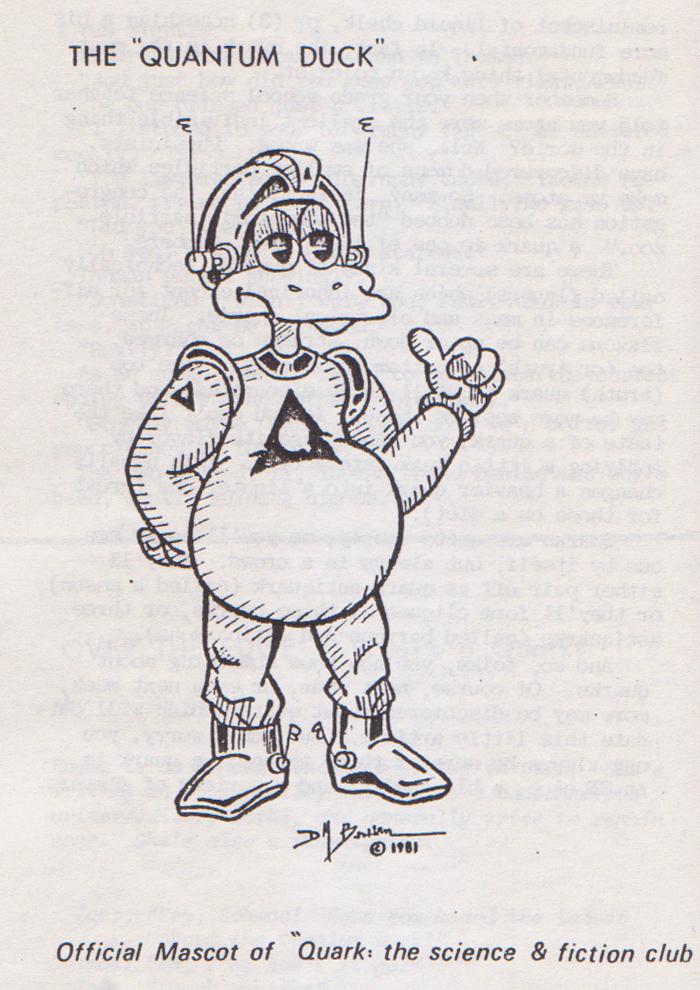
And as one final note, check out this piece of Xenobia history: the original Quantum Duck, as featured in the first issue of The Leading Edge.  Why a quantum duck, you ask?  Because that’s where the club’s name came from: a bumper sticker that said: BEWARE THE QUANTUM DUCK THAT GOES ‘QUARK,’ ‘QUARK’!

T-minus 600 hours and counting

Haircut: check.
Clean clothes: check.
Bag lunch and dinner: check.
Chilled water bottles: check.
Directions to St George from Provo: check.
Interview questions: check.
iRiver 800 with sufficient recording space: check.
iRiver to USB cord: check.
Extra batteries: check.
Asus netbook: check.
2003 Buick LeSabre Custom: check.
4+ hours of ocremix and other music: check.
Copy of On My Way to Paradise to get signed: check.

Tomorrow I am going on a road trip to St George, Utah to interview bestselling author Dave Farland (aka Dave Wolverton) for Mormon Artist magazine.  Wish me luck!

Falling behind

Man, CONduit is at the end of this week, and I’ve still got a good 14k words to go in Mercenary Savior. Today, I only wrote 1,300 words.  I have no idea why my productivity has fallen so much, but it’s not good.

It might not be a totally bad thing, though.  I’m having trouble finding a ride up for Friday, so I might end up spending two or three hours on the bus.  If that’s the case, I might have some writing time then.

I read something interesting on Dave Farland’s daily kick (the email newsletter he sends out–it’s free, btw, and very helpful).  Basically, he said that it’s better to wait to submit something until it’s absolutely perfect than to submit something for the sake of submitting it.

This is making me rethink my plan to start submitting Mercenary Savior right after I finish this draft.  It’s much improved, I think, from the first couple of drafts, but it still needs a lot of work.

As I run down my list of revision notes, I keep thinking “dang, I didn’t pull that off as well as I’d hoped” or “that last scene could have been better.” It’s hard, though, to juggle so many changes; you can only do so much work at once.  Mercenary Savior is going to need another revision after this one before it’s polished.

The only thing is…that means I only have one novel to submit to agents/editors.  Is that a bad thing?  Now that I’m in the real world, I’m anxious to launch my writing career, but at the same time I don’t want to shoot myself in the foot.

I suppose the first thing to do is to finish this beast.  Ugh.