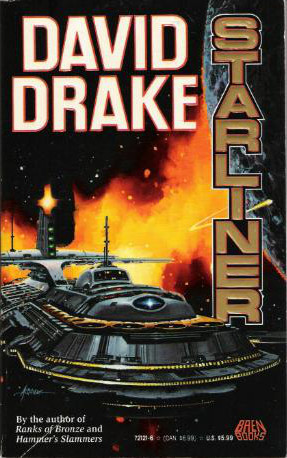
Starliner by David Drake

starlinerWelcome to the Empress of Earth, the finest luxury liner in all of settled space.  Whether you’re alien or human, first class or economy, there is a place on the ship for you.  Just watch out for those Grantholmers and Nevassans–those planets are about to go to war, but don’t worry, the Empress is strictly neutral territory.  The envoys from Earth will see to that.  And as for the rumors that one of those sides might try to hijack the ship, I’m sure the crew is capable enough to deal with such threats.  Even if they are unarmed…

I saw this book on my also-boughts on Amazon, so I decided to pick it up.  It was an enjoyable read.  David Drake is very good at showing competent characters dealing with all sorts of complicated problems, operating within a strict chain of command while sometimes bending the rules a bit to get the job done.

The book is really a series of small vignettes, all tied together through the main viewpoint character, Ran Colville.  There is an overarching storyline about the Empress’s role as a coveted pawn in a larger interstellar war, but that only really drives the story at the very end.  Really, it’s more of a slice-of-life story about the crew of the ship, punctuated by all of the strange and exotic stops along the way–and boy, are there plenty of those!

Even though the Empress is neutral, she’s a potentially valuable military asset that both sides in the Grantholm-Nevassan war want to capture.  To complicate matters further, some of the passengers are dignitaries from either side.  At one point, there’s a romance between the peacenik daughter of a Nevassan diplomat and the son of a Grantholmer nobleman who is honor-bound to fight in the war.  That subplot was a lot of fun.

As you can imagine, there’s plenty of violence.  And really, what would you expect from one of the world’s best military science fiction writers?  Drake does a really good job showing the adrenaline-soaked excitement of combat, as well as all the ugliness.  Even the mooks get a viewpoint from time to time, and when they die, it’s messy and traumatic.  For that reason, the violence feels very realistic, especially in how it affects the main characters.

Ran is something of a player, so there is a fair amount of explicit sex (including a bit of inter-species action).  Drake doesn’t mince words or shy away from the gritty details–he puts it all on the page as matter-of-factly as any other aspect of life.  The sex was brief enough that it didn’t really bother me that much, but Ran’s relationship toward one of his coworkers takes a turn at the end that seemed to come completely out of left-field.  I could understand why, for the purposes of the story, it had to happen, but the way it was handled I just didn’t buy it.

That was probably my biggest gripe.  If I had another, it would be that the story seems to meander a bit in the first two-thirds, but the world-building was interesting enough that it didn’t really bother me.  Overall, it was a fun, light read (well, light for military sf).  The ebook version is free on Amazon, so it’s definitely worth picking up.  If you haven’t read any David Drake yet, this isn’t a bad place to start.
Trope Tuesday: Recycled IN SPACE!

Or, as my friends at Leading Edge would say, IN SPAAACE!!!

The basic idea behind this trope is that setting a story in space makes it cool and different.  The tvtropes article focuses mainly on how this trope is used in children’s cartoons, but it actually goes much wider.  In fact, most space stories are actually based on stories from other genres, or even from history.

For example, Asimov’s Federation series is based on Edward Gibbon’s Decline and Fall of the Roman Empire, David Drake’s Lieutenant Leary series is based on Patrick Obrian’s Master and Commander series, and Frank Herbert’s Dune is based on the rise of Islam.  Westerns are especially prone to get the space treatment (Firefly, anyone?), which is where we get “wagon train to the stars.”

At its worst, this trope is nothing more than a pointless gimmick.  At its best, however, it can produce some extremely good work.  The key, as always, is to work within the limitations of the setting.

One of the best examples of this is Dune.  Frank Herbert didn’t merely lift 7th century Arabia into space and call it Arrakis; he created a distinctly alien world with its own history, culture, biology, and role within the galactic empire.  For example, Herbert solved the FTL problem by linking interstellar travel to the spice, tying his space-Arabs to the politics and economics of the rest of the galaxy.

Interestingly, your space physics don’t have to be perfect for this trope to work; they just have to be believable.  For things like artificial gravity and faster than light travel, most people will accept a little hand-waving, provided that you do it well.  The important thing, as always, is the story.

World Fantasy Day 3

Saturday at the World Fantasy convention was awesome. Tons of amazing panels, with excellent advice and some very interesting insights.

First, I attended “The Story Cycle vs. The Novel,” which was moderated by L.E. Modesitt.  The panelists talked about the evolution of a series and the difference between a cycle of novels vs. a continuation.  In a story cycle, there may be many books, but one ending, whereas in a more loose series, every novel is a standalone with an ending.  In another panels someone used the analogy of an avalanche vs. skipping stones, which I found quite useful.

Next, I attended “The Continued Viability of Epic Fantasy.” The panel started out by defining epic fantasy (as opposed to heroic / sword & sorcery), which they more or less agreed has the following characteristics:

  • Takes place in an alternate world
  • Is large in scope, rather than personal
  • Involves characters who are trying to save the world
  • Has a multi-strand plot with many viewpoints
  • Has an extended story arc

David Drake then blew the premise of the panel out of  the water by arguing that epic fantasy is still selling well–in fact, that the market has been expanding over the past ten years.

Drake also pointed out, however, that when you’re successful, the normal commercial rules don’t apply; first, you have to prove your chops, realizing that the publishers will lose money on your first couple of books.  That’s just a fact, and anyone who denies it is arrogant and stupid.

The next panel was “Slaughtering the Evil Hordes,” about the barbaric hordes trope in fantasy and whether it’s disturbing or a good thing.  I asked the question: “how can you have the hordes win and still make it work?” and Tom Doherty pointed to Modesitt’s Magic of Recluse as a good example of this.  Basically, you have to show the good in each side, sometimes by a shift that makes the reader suddenly and unexpectedly see the hordes in a new light.

Next, I attended “The Moral Distance Between the Author and the Work.” This panel was quite fascinating.  One of the interesting questions that was raised was whether you can deduce an author’s morals from reading their work.  At first, the panelists said that in good art, you can’t, but then Scott Edelman and Eric Flint pointed out that if you read an artist’s whole corpus, usually you can.  Nancy Kress compared artists to dandelions; over time, you grow and mature, but when you send out work, where it goes and what happens to it has nothing to do with you as the artist.

One of the best panels, however was “Authors and Ideas,” which happened the next hour.  The panelists started by agreeing that as an author, your most deeply held personal beliefs will always show up in your work, whether or not you know you believe it.  The stuff we believe most firmly, we never even think to question because it is invisible to us.  Most aliens in sci fi are less alien than the Japanese, and our own great great grandparents are more alien to us than anything else.

The panel then got on to how writing is a collaboration between the author and the reader, where the writer has no control over what the reader will take from it.  Even though your art will contain your beliefs, in order to be great it must also convey what you don’t believe–the “opposition in all things” element.  Done well, the author “shakes hands with the reader over the character’s head.”

After the panels, I had dinner at the con suite–and let me just say, the convention organizers went WAAAAY out of their way to make the con suite awesome.  They literally provided every meal, and enough of it to feed everyone who came in, which really surprised me.  A huge thanks to everyone who volunteered with organizing and running the con.

Anyway, I got into a HUGE discussion at dinner with an amazing couple who runs a used book business out of Massachusetts.  We talked about artificial intelligence, the physical limits of computer circuits, and whether it’s possible for us to one day emulate the human brain on a computer system.  Gained some very interesting insights for my novel Genesis Earth, as well as just a general fun time.  Conversations like this are one of the things I treasure about these events.

And then I bounced around the parties for the rest of the night.  Had fun, talked with Tom Doherty and a handful of authors (though not as many as last year), but probably most importantly made a bunch of awesome writer friends, with whom I will be keeping in touch after the convention.

I might not have met a bazillion agents and editors this year, but I did make a ton of friends among the aspiring writers and editors, and that definitely counts for something.  I look forward to staying in touch and supporting everyone as we break in and make our mark; we’re the next generation of an awesome literary tradition, and we’re definitely going to keep it going!

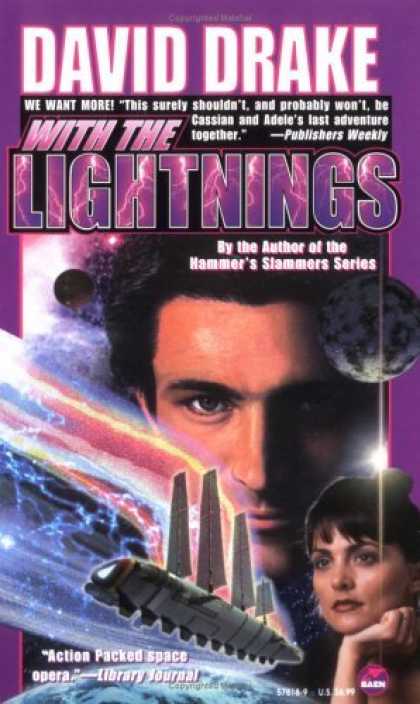
With the Lightnings by David Drake

Daniel Leary, Lieutenant in the Republic of Cinnabar Navy, dreams of commanding a military starship one day.  Unfortunately, as the estranged son of a corrupt senator, and with almost no money to his name, he has virtually no chance of ever seeing it happen.

While serving in an assignment on Kostrama, a neutral trade world between Cinnabar and her mortal enemies, the Alliance, he meets Adele Mundy, chief librarian of the Kostraman capitol.  The title is virtual meaningless, however, as the uncultured Kostramans would give the position to anyone–even a political exile from Cinnibar such as Adele.  Her whole family was assassinated by Leary’s father, and she has sworn to take revenge.

Little do they both know, the Alliance has other plans.

Ever since I met David Drake at World Fantasy 2009 in San Jose, I’ve been meaning to read one of his books.  I must say, I picked a good one.  With the Lightnings is the first book in his RCN Series, which is basically David Drake’s take on Patrick O’Brian’s Aubrey-Maturin novels.  Think Napoleon-era naval battles and political intrigue…in space.

Does it sound good already?  Yeah, I thought so.

I was a little surprised at first, because the first chapter started with a bunch of info dumps.  It took until about the halfway mark for the action to really start, but when it did, it was awesome. A bunch of navy guys marooned on a hostile planet behind enemy lines, trying to survive a planetwide coup and blowing all kinds of stuff up along the way–yeah, it was cool.

The thing I enjoyed most about this book, however, was the insight into the minds of the officers and the way the officers and soldiers interacted.  You can tell that David Drake has experience in the military–lots of experience.

It was evident in the little things the main character noticed–the colors and patterns of soldiers’ uniforms, competency among his own men and incompetency in men not under his command, leadership style and how he dealt with crises–stuff like that.  The language was colorful, but when the soldiers swore, their language had a bite to it that went beyond the actual words.  The people felt gritty, but very real.

At World Fantasy, I mentioned to David Drake that I’d read some of Joe Haldeman’s works, and knew they were both Vietnam vets.  He remarked that Haldeman’s works are very much different than his own: Haldeman’s characters are constantly stabbing each other in the back, whereas in Drake’s works, there is always a sense of teamwork and unity, even when the going gets messy.

I could definitely see that in With the Lightnings–it’s one of the things that made the book so fun to read.  Yes, things get pretty tough and a lot of people die, but there’s always a sense of loyalty within the platoon (or whatever the unit is called).

With the Lightnings is a great space opera action/adventure story.  After reading it, I really want to read more books in the RCN series.  If you want a good, fun military sf adventure story, this is a great one to pick up.