If the internet hasn’t labeled me a homophobic, misogynistic, white supremacist yet, I must be doing something wrong.

That is the lesson that I haven taken from the recent blow-up over Harrison Butker’s commencement speech at Benedictine College. Here’s a pretty good rundown of what actually happened, and the way the internet has reacted:

If this is truly where our culture is right now—where a thoughtful and measured statement of traditional conservative belief is sufficient to incite viral online outrage from those who call themselves progressive—then I must be doing something wrong if the people who are piling up on this gentleman aren’t also piling up on me.

It wasn’t always this way. Granted, there have always been dark and hate-filled corners of the internet where people who despise traditional religious conservatism have spread their virulent views—and to be fair, Twitter/X has turned into such a toxic echo chamber that the outrage over this may be getting amplified more than it actually deserves.

But our culture has changed a lot in the last five years, and not for the better. And if the Overton window has truly moved so far that it’s considered beyond the pale to encourage women to find personal fulfillment as wives and mothers, then Harrison Butker is the man I want to stand with. They can call me every name in the book, and I will bear their vociferous outrage as a badge of honor.

How I would vote now: 2006 Hugo Award (Best Novel)

The Nominees

Learning the World by Ken MacLeod

A Feast For Crows by George R.R. Martin

Old Man’s War by John Scalzi

Accelerando by Charles Stross

Spin by Robert Charles Wilson

The Actual Results

  1. Spin by Robert Charles Wilson
  2. Accelerando by Charles Stross
  3. Old Man’s War by John Scalzi
  4. Learning the World by Ken MacLeod
  5. A Feast For Crows by George R.R. Martin

How I Would Have Voted

  1. Spin by Robert Charles Wilson
  2. Old Man’s War by John Scalzi
  3. No Award
  4. Learning the World by Ken MacLeod

Explanation

This is going to be controversial, but I don’t think any of George R.R. Martin’s A Song of Ice and Fire books should have been nominated for the Hugo Award. In the first place, those books are pure fantasy, and while the line between fantasy and science fiction can become blurry at times, with everyone drawing it in a slightly different place (Dragonriders of Pern, for example), I do think it’s important to draw that line somewhere, because each of us as readers draws that line somewhere. Some readers read only fantasy, some read only science fiction, and even among readers who read both, they scratch very different itches.

(As a side note, A Dance With Dragons came out right when I was indie publishing my first few books, and I remember being super annoyed that it was monopolizing all of the top spots on the Amazon bestseller charts for subgenres like science fiction > action & adventure, even though it was very clearly not a science fiction book. That annoyed me as both a writer and a reader.)

More than that, though… how do I say this? I know that a lot of people are (or were) huge fans of Game of Thrones, that it had a huge and lasting cultural impact, and that the writing quality of both the books and the miniseries was quite excellent, at least for the first few books/seasons… but to what end? The HBO series itself is blatantly pornographic, and the books are even worse, glorifying the immorality and horrific violence that characterizes the series. Worse, there is no good or evil in this world: only power. This means that there are no heroes, only victims and victimizers.

I’m not sure how much Game of Thrones is responsible for shaping our current cultural decay, and how much it was simply a reflection of the culture in which it was created, but this obsession with power and the victim-victimizer complex lies at the heart of all of the social pathologies currently driving the West to cultural and spiritual suicide. It’s the force driving our own modern Game of Thrones, between the MAGA disciples of orange Jesus and the machinations of our Big Tech and Deep State overlords, with their hordes of hypnotized NPC zombies protesting in behalf of [current thing], all while remaining carefully masked. It turns out that when you embrace Martin’s paradigm, rejecting good and evil for the pure pursuit of power, and define everyone by their victimhood status, it leads to the death of everything in your culture that is good, true, and beautiful.

And even laying all of that aside, the fact that Martin hasn’t finished the damned series yet has done more to destroy the epic fantasy genre than all the other things that his career has otherwise accomplished. If you’re a new fantasy writer and you have a great idea for an epic fantasy series, you’d better have a good day job or a sugar daddy/momma, because most readers won’t give your series a chance until after you’ve finished the last book. But can we honestly blame the readers for this, when Martin ran off with their money and left them all burned?

Back when Game of Thrones / A Song of Ice and Fire was still ascendant, fans and readers were all mesmerized by how skillfully George R.R. Martin could subvert their expectations and pull off twists that no one had foreseen. It turns out that the biggest expectation that Martin ever subverted was the expectation that he would finish the damned series.

Anyways, that’s enough ranting about George R.R. Martin and the pathological effect that I believe he’s had on the culture. I read A Game of Thrones back in 2010 and decided to skip the rest of the series. The writing was fantastic, but I hated all of the characters and could tell that things were going to get way too dark and way too graphic in the later books. And now, I wish I lived in a world where George R.R. Martin was still a mostly unknown midlist author, with a small cult following but not a lot of influence on the culture overall. It would be a much better world.

I skipped Accelerando, because I’ve read enough Charles Stross to know that his particular brand of grungy cyberpunk nihilism rubs me the wrong way. Learning the World wasn’t terrible, but I DNFed it because I got bored, though I could be persuaded to try it again. It was just too much of an idea book, without enough story to really hook me.

Old Man’s War… my thoughts on that one are complicated. I cannot stand Scalzi as either an author or a human being. He’s basically an obnoxious internet influencer who made it big back in the days of the blogosphere, before “influencer” was a job title. Of course, to be an influencer, you have to either 1) be an extremely attractive woman, or 2) be off your rocker somehow, and that definitely describes Scalzi. He is an obnoxious blowhard who likes to argue with people on the internet for fun and profit, except he’s apparently not as good at social media as he was at blogging, so he’s pivoted to writing science fiction and playing the SFWA mean girls game instead.

But most of that happened after Old Man’s War, so it’s not exactly fair to judge the book on all of that. And I have to admit, I enjoyed it back in 2008 when I read it. It’s basically a retelling of Starship Troopers and The Forever War, but without all of the nihilism and politics—and since the nihilism and the politics are the things that got me hung up on both books (though I actually enjoyed the politics of Starship Troopers; the part that slightly annoyed me was getting a lengthy treatise on human sociology instead of an adventure novel), Old Man’s War was basically a retelling with all of the good parts and less of the bad parts. So I’ll grudgingly give Scalzi his due and admit that his first book is good enough to deserve an affirmative vote.

But Robert Charle’s Wilson’s Spin is easily the best book on the ballot from this year, and possibly the best Hugo-nominated book that I’ve read from this whole decade. It’s fantastic. One of the best science fiction novels I’ve ever read. The rest of the trilogy is just as good, too. In fact, Spin and its sequel Axis were a huge influence on my own Genesis Earth, though it may not be obvious at first glance. I read Spin when I was studying overseas in Amman, Jordan, while I was still working on the first draft of Genesis Earth. The next year, I read a whole bunch of Robert Charles Wilson’s other books, and I have to say that I have yet to read a book he wrote that I didn’t enjoy. His books have had as much influence on me as Ursula K. Le Guin, and largely scratch the same itch.

So that’s how the 2006 Hugos shape up for me: three books that I didn’t like, and two that I did—and one of those books is one of my all-time favorites.

Why I no longer consider myself to be a libertarian

I’ve been going back and forth on this post for almost a year now, wondering how exactly to express my thoughts. Some of the positive reviews on my fiction have expressed that I write “libertarian fiction,” and in some ways, I think that’s accurate: certainly, I value liberty very strongly, and support those government policies that are designed to safeguard our liberties while opposing those that seek to destroy it. That has not changed. But my views of libertarianism more generally have, perhaps in some ways that might surprise my longtime readers.

First, a little bit of my personal history. I grew up in one of the most liberal parts of the country, Pioneer Valley, Massachusetts, and considered myself a conservative while I lived there. Then, after serving a two-year mission for my church in Silicon Valley, California—what is probably the most progressive, leftist part of the country—I went to college at Brigham Young University, in the most Republican county of the most Republican state in the United States. At that point, I considered myself to be a sort of left-leaning classical liberal. When Dick Cheney spoke at BYU’s commencement, I blogged about the protests and attended the alternate commencement where Ralph Nader spoke.

I graduated in 2010, in the middle of the Great Recession, and made the fateful decision not to go to grad school at that time. To this day, I count that as the single best decision I ever made in my life (right up there with deleting my Facebook and Twitter accounts). Not only did this force me to learn how to navigate the real world, but it also got me out of the indoctrination factory that the national university system has become, even to a degree at my alma mater, BYU.

About five years after I graduated, I got red-pilled and started listening to right-wing commentators like Glenn Beck, Ben Shapiro, and Dennis Prager. I also looked seriously into Ron Paul and the libertarian movement, and became something of a libertarian. As fractitious as libertarianism is as a political philosophy, it seemed like the most logically coherent and intellectually honest way of understanding the world, whereas leftism and conservatism were both riddled with internal contradictions.

But then I got married and started a family. That experience has changed me in a lot of ways, perhaps even more than all the rest of my life experiences combined. But politically, the biggest thing it has caused me to rethink is this question:

What is the fundamental unit of society?

I’d always played lip service to the belief that the family is the fundamental unit of society, but starting a family of my own has made that real for me—indeed, has made me realize—in a way that simple bumper-sticker slogans never could. Before, I was living for myself. Now, I live for my children. Before, I was the hero of my own story, and that story was a single volume. Now, my story is just a single volume in an ongoing saga, a link in the chain of the generations that came before and will go on after me.

Libertarians believe that they stand in opposition to authoritarians of all stripes, be they communists, fascists, socialists, etc. But both libertarians and authoritarians operate on the unspoken assumption that the individual, not the family, is the fundamental unit of society. Leftists want to destroy the family and put the state in charge of raising and educating children, in order to make them obedient to government authority. Libertarians, on the other hand, romanticize this idea of the atomized individual who follows his own path and eschews all forms of collectivism, including the family. Ayn Rand’s books are populated by ubermensch who seem like they’ve sprung forth from the head of Zeus, and the children in her novels are basically just adults in miniature.

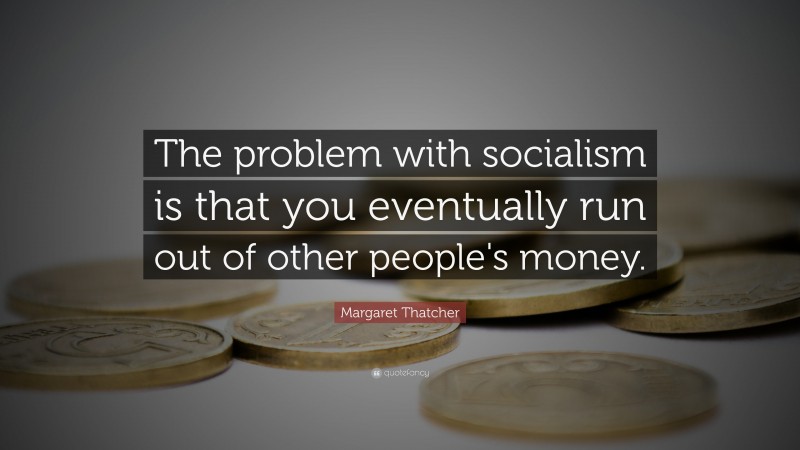
Allow me to put it this way: Margaret Thatcher had a brilliant quote about socialism that libertarians love to repeat. And from a purely economic standpoint, I believe that the libertarians are correct. But change that quote just a little, and you get this:

The problem with socialism libertarianism is that you eventually run out of other people’s money families.

Families don’t just happen. They take a lot of work to build and to maintain, and unless they are planted in a culture that nourishes them, they will wither and die. Libertarianism does not foster that kind of a culture, yet it depends on families in order to raise the kind of people who can make a libertarian society work. People from broken families often lack the mental and emotional maturity to take upon themselves the personal responsibilities that come with personal liberty—in other words, they lack the capacity for personal independence which libertarianism depends on. Growing up in a healthy family isn’t the only way to develop that sort of independence, but a society of broken families will invariably fail to produce such a people.

This is why libertarianism ultimately leads to authoritarianism. We aren’t all characters in an Ayn Rand novel: we aren’t all ubermensch all of the time, reshaping the world by the strength of our will. And when we inevitable fail, where can we turn to for help? If society is nothing more than a group of individuals, then ultimately the only place to turn to is the state. Perhaps there may be churches, companies, or other private civic organizations to which a person may turn, but any form of libertarianism that rejects altruism as a moral good will fail to foster these organizations as well. So, in the absense of anywhere else to turn, individuals will, over time, turn increasingly to the state, trading their libertarian freedoms for economic and social security. A society that exalts the individual at the expense of the family will always, in the end, devolve into a statist tyranny.

If you want to create a stable society that recognizes individual freedom, you have to recognize the family as the fundamental unit of that society, and you have to proactively enact policies that will foster a culture of strong families. Not only does this give you a social safety net that is totally apart from the state, but it also ensures that your society will be self-perpetuating, since one of the central purposes of the family is to create and raise children.

In fact, the family is perhaps the best antidote to government power creeping into every facet of society, which also makes it the best way to push back against woke leftism, ESG, and the Great Reset. Hence why everything about leftist progressivism is calculated to destroy the family. Parents concerned about CRT in their schools? Domestic terrorists. Kids who say that they’re transgender? Transition them without telling the parents, and take them away from their families if the parents object.

But it’s not just a partisan issue. If the family is the fundamental unit of society and needs to be strengthened, then there are things on both the left and the right that need to change. For example, poverty is a huge issue for families, since poor families are much more likely to break up due to the stress. But conservatives often ignore the issue of income inequality, mouthing platitudes about the free market while giving us socialism for the rich and capitalism for the poor. And the libertarians are little better, what with how they push for the legalization of drugs, prostitution, abortion, and pornography. Few things have done more to destroy the family than widespread substance abuse and the hypersexualization of our society.

This is why I’ve mostly given up on reading Heinlein anymore. He’s a brilliant writer with a fascinating take on some of science fiction’s most fundamental tropes, but whenever he writes about sex or sexuality, all I can think of is “the problem with libertarianism is that you eventually run out of other people’s families.” Heinlein and his boomer readership took the family for granted, neglected their own, and gave us a world of widespread sexual promiscuity, where society is falling apart.

So that’s why I don’t consider myself a libertarian anymore, even though there are many tenets of libertarianism that I still admire and believe, especially on the economic side. I suppose you say that I’m a conservative, but that isn’t really accurate either, because most strains of conservatism in 2024 really seem more about conserving the leftism of two or three generations ago. So I guess that means I’m politically homeless—just like most of my fellow Americans these days.

Navigating Woke SF, Part 5: Where do things stand now?

So it’s been almost exactly two and a half years since I posted my first “Navigating Woke SF” blog post, where I demonstrated an anti-conservative bias in the responses I was getting to my traditional short story submissions, and predicted a cultural backlash against the woke moral panic of our times. Those predictions are now playing out all around us, from the Bud Light boycott to the last few Disney/Pixar bombs to the unlikely success of movies like The Sound of Freedom, which is still showing in theaters in my area.

To no one’s surprise, the institutions like Disney that have already been captured by the woke intersectional left have been tripling- and quadrupling-down on their woke insanity, as we see in movies like The Marvels and Disney’s live action Snow White. Which has opened up some wonderful opportunities for conservative-minded publishers and creators to outflank them, as we see with the Daily Wire’s competing release of Snow White:

Indeed, the anti-woke backlash in the mainstream culture has gotten so bad that South Park recently lampooned it with an episode where all of their characters were replaced by “diverse women.” I didn’t watch the full episode, but the clips I saw from it were absolutely hilarious—and directly over the target.

So with all of that brewing in the cultural mainstream, where do things stand in our particular little corner of it? Namely, science fiction publishing and the traditional short story markets?

Well… let me tell you a story. It begins earlier this year, when I decided that I wanted to take some of the money I’ve been earning with my indie-published book sales and subscribe to one of the traditional science fiction magazines. For a writer like me, it’s a legitimate business expense, and it seemed like a nice way to support the genre, as well as build my science fiction collection.

I decided to go with Clarkesworld, because even though they are woke, they seemed to be less woke than most of the other major magazines. The particular brand of diversity they like to emphasize is on publishing non-US authors, especially Chinese authors, who tend to write stories that are neither woke nore anti-woke, which can be a real breath of fresh air. Seriously, there is some really fascinating science fiction coming out of China these days, which is definitely worth checking out, and Clarkesworld, to their credit, tends to publish a lot of good Chinese authors.

So I subscribed to Clarkesworld magazine and began to receive a physical issue each month, which I added to my currently-reading pile and slowly read through. But I began to notice something disturbing with each issue: namely, that even if the story itself wasn’t particularly woke, there would always be some woke element thrown into it. For example, the story might be a weird western adventure tale, but one of the characters would randomly mention their LGBTQ wife. Or the story would be a far future space opera, and one of the characters would casually drop that they were trans, even though it had nothing to do with the story.

At the same time as all of this was happening, I discovered this interesting podcast where a former Dreamworks animator discusses how he left the company after learning that the Dreamworks executives were explicitly trying to use their movies as a form of social engineering for the woke agenda. The mechanism for this social engineering was what I found particularly interesting: namely, that they would associate the movie’s villain with some specific aspect of culture/religion that they were trying to villify, and associate the good guys with those aspects of the woke agenda that they were trying to push. In the example given in the podcast, they literally had the villain shout “the family is the basic unit of society!” at the climax of the story.

According to the former Dreamworks animator, this is especially true of sequels for popular franchises and IPs. For example, Wreck-it Ralph is a really fun and well-told story about a “bad guy” from a video game trying to become a hero, and becoming one when he sacrifices himself to save a misfit character from another video game, who turns out to be that video game’s queen. Really charming, really good story. But Wreck-it Ralph 2 throws all of that out of the window, turning Ralph into a simp and Venelope into a liberated girl boss, and crapping on all the traditional Disney princesses at the same time. The message was laid on pretty thick, and the result was a garbage movie.

Which made me wonder about Clarkesworld, because that particular social engineering technique is EXACTLY what I was seeing in almost all of the Clarkesworld stories. The thing is, I couldn’t tell if it was deliberate or unintended. I can totally believe that the Clarkesworld editors would tell their authors “we love your story, but we want you to add just this small woke element to it, and then we’ll publish it.” There are enough desperate authors out there who would probably do exactly that, if it meant receiving an acceptance from a pro-paying market after getting so many disheartening rejection letters.

But personally, I think it’s more likely that the authors are throwing in these elements themselves, without any explicit direction from the editors. That is, the authors are so desperate to be published by these woke traditional magazines that they’re not only self-censoring the stuff that they don’t think the editors will like, but they’re adding woke elements just because they know it will increase their odds of getting accepted. Which to me, is just sad.

Honestly, I wish that the more conspiratorial option were true, and that Clarkesworld has a devious social engineering agenda that they push onto their stories. That would be better than the alternative, which is that the literary science fiction field has been so thoroughly captured by the left that authors are adding woke elements to their stories without getting any feedback, direction, or urging from the editors and publishers, just because they know these stories won’t go anywhere without them.

So how is a conservative (or at this point, even a non-leftist liberal) supposed to navigate the field? At this point, I really don’t think there’s any way to do it except to go indie, or to go with Baen (which is itself independent of the Big 6 Big 5 Big 4+1 Big 3+1 whatever the New York book publishing establishment is called these days, after the Simon & Schuster sale). There may be some other small publishers that, like Daily Wire, are driving into the smoke of our cultural institutions’ Götterdämmerung, but within the science fiction field, I don’t think any of them are big enough to offer much more than what you’ll get by going indie—except, perhaps, with the opportunity to get in early with the up-and-coming next generation of editors and publishers, who will eventually replace the dinosaurs that currently dominate the field.

But that’s a big gamble that may never pay off, because the science fiction field has been dominated by leftists since at least the mid-60s, to the point where most subgenrese of science fiction are now synonymous with woke. After all, if the authors themselves are inadvertently telling stories that use social engineering techniques, not because the editors are making them, but because that’s the only way to get published, the rot runs very, very deep. And even during the “morning in America” moment in the 80s, when science fiction pulled back from the leftist crap to give us classics like Ender’s Game, there was still a thread of the wokeism in stuff like the sexuality in the Vorkosigan books, or the environmentalism in Hyperion (which I love, don’t get me wrong… but yeah, Dan Simmons is a bit of a tree-hugger).

The point that I’m trying to make with all of this is that, when it comes to the woke agenda, science fiction is a thoroughly captured field. That’s what this last episode in navigating woke SF says to me. If that ever changes, it will be after most of the traditional markets like Clarkesworld collapse and the major awards like the Hugos and Nebulas go defunct, because until that happens, everyone in this particular field is still going to be in denial about the anti-woke cultural backlash. That’s just how deep the woke goes. So until then, if you’re a non-woke author like me, the only way to navigate the field without compromising your values is to go full indie, at least when it comes to short stories.

What about supporting the arts? At this point, instead of subscribing to a particular publication or magazine, I’ve decided to make a short list of non-woke authors I want to support, and to buy their books as soon as they come out. One of those authors is Andrew Klavan, who writes more in the mystery/thriller genre than science fiction, though his Another Kingdom trilogy is quite good. I’m reading his latest Cameron Winter mystery right now, and it’s quite good. I highly recommend it.

Did the internet ruin fandom?

Ever since I made a spreadsheet to track all the Hugo and Nebula award-winning books, I’ve noticed some interesting patterns. I’ve already blogged about how the genre seemed to transform after the creation of SFWA and the introduction of the Nebula Awards. That seems to mark the point where the left’s long march through the institutions began in our genre, though it may be coincidental as that is also when the New Wave began. Or the two events may be connected, which wouldn’t surprise me.

In any case, I’ve expanded that spreadsheet to include the Dragon Awards and the Goodreads Choice Awards for the fantasy and science fiction categories, and I’m now in the process of adding all the books from the Locus magazine’s readers’ poll, at least for science fiction and fantasy. From what I can tell, Locus basically sets which books will be considered for nomination with most of the older awards, creating what a cynical person might call a “master slate.” And since Locus has been insufferably woke for a very long time (I still read my local university library’s copy every month, though articles like this one make me question why), that goes a long way to explaining how the Hugos and Nebulas became so woke—though I’m still not sure if Locus is woke because its core readership (and primary revenue source), the New York publishing establishment, is woke, or if the organization was captured during the left’s long march through the institutions. Or if Locus has simply been woke from its inception.

But I’ve noticed other patterns, including some with the Goodread’s Choice Awards (which include a very public vote tally) that seem to indicate that the Hugos, the Nebulas, and the Locus readers’ poll are now of minimal cultural significance: a sideshow, if you will, or a very small clique that represents the genre’s past, not its future. Which is actually pretty obvious—you don’t need to assemble a spreadsheet of thousands of books to see that. But it’s an interesting pattern nonetheless, and it’s made me wonder if perhaps the rise of the internet—in particular, social media—killed fandom, at least as we traditionally understand it.

From what I can tell, SF&F fandom began in the 20s during the era of Hugo Gernsback’s “scientifiction” and the pulps. During the Golden Age of the 30s and 40s, fandom began to organize things Worldcon and the Hugos, but the genre was still very monolothic, with so few books and magazines being published each year that it was possible for a devoted fan to read all of them. In fact, the culture generally was very monolithic, with ABC, NBC, and CBS dominating television, the New York Times dominating the newspapers, and Life and the Saturday Evening Post dominating the magazines.

Because of the monolithic nature of the culture during this time, it was possible for a single figure to dominate and shape the field, like Walter Cronkite in journalism, or John W. Campbell Jr. in science fiction. But fandom was still mostly a localized affair, with geographical distance and the limitations of communications technology keeping fannish controversies from becoming too fractious or toxic—though not for lack of effort. But in a world without internet, where arguments happened either in person at conventions or the local club, or else evolved gradually in the pages of the various fanzines, none of the factions ever tried to split or go their own way. Granted, part of that was due to the monolithic nature of the genre—if they did split off, where would they go?—but there was still a sense that everyone in their small corner of fandom was a part of a far greater whole, even with all of their passionate and sometimes fractious opinions.

But as science fiction grew, it became less monolithic, if for no other reason than that it was no longer possible to read all of the books and magazines that were coming out. From what I can tell, the genre crossed that threshold sometime in the 60s. This was also when the New Wave pushed back against the standards set by Campbell and began producing some very experimental (and also more left-wing) work. But fandom didn’t totally fracture at this time. Instead, from what I can tell, the Locus reader’s poll emerged in order to filter out everything but the very best work for consideration for the awards.

In a world where everyone considers themselves to be part of the larger community of fandom, awards—even the relatively minor ones—carry a lot of weight. This remained true through the 70s and 80s as science fiction grew to the point where it truly went mainstream. In fact, the awards became even more important, because there was no longer any way for even the most devoted fan to read (or watch, or play) all of the new books and magazines (or movies, or shows, or games) that were coming out. New subgenres and subcultures of fandom began to emerge, but everyone still looked to the awards—particularly the Hugos and the Nebulas—as the standard of excellence.

But the publishers placed even more weight on the awards, because winning a Hugo, or getting on a New York Times bestseller list, often were key to propelling sales. So over time, the publishers gradually took over the awards, as well as the organizations and infrastructure that had been built around them. With the Nebulas, it isn’t hard to see how this happened, as SFWA allows publishers to be members (creating a very obvious conflict of interest that the leadership of that organization has chosen to ignore). With the Hugos, it probably happened through Locus, since the magazine depends so much on advertising for its financials. This became even more true as the subscriber base declined in the 90s, as it did for all of the major magazines in the field.

What caused the decline in subscribers? The internet, of course. Fans no longer depended on the ‘zines to stay in touch with the broader community, but began to organize into listservs, email chains, and message board forums instead. Later, blogs and social media continued this trend. Geographic distance became increasingly irrelevant, and fandom became less of something that you connected with through your local group of friends and more something that you connected with online as an atomized individual.

But ironically, the more interconnected fandom became via the internet, the more it began to fracture. All of those passionate opinions were no longer tempered by the boundaries of time and distance, and the snarkiest and most vitriolic or self-righteous opinions were often the ones that garnered the largest audience. This became even more true with the advent of social media, which relies on amplifying outrage to addict its users and maximize profits. Social media also encouraged the formation of echo chambers, where the various corners of fandom spent so much time talking to each other than they soon had little in common with the wider fandom. Geographical distance counted much less, but ideological distance counted for more—much more.

But did the internet ruin fandom, or save it? Or in other words, was this transformation a net loss or a net gain for fans of the genre? Because, on the creation side of things, I think the internet was very much a positive development. No longer did a creator have to rely on a small clique of ossified New York gatekeepers for their work to see the light of day, and the nature of online distribution meant that a quirky book written for a tiny but underserved subculture could find and grow an audience quite effectively, even without any mainstream appeal. Of course, this only accelerated the division of fandom, but it also meant that those subcultures—many of which had been underserved for decades—now had much more content tailored specifically for them.

In the 10s, the deepening divisions within fandom manifested in a fight for control of the major awards—specifically, the Hugos. That was whate the puppies were all about. But the fight became so toxic that the awards themselves became discredited, and the victory of the wrongfun brigade proved to be a Pyrrhic one. And because the culture is no longer monolithic, and fandom is no longer a single community united by a love for the same thing, the fall of the awards has given us a world where it matters much less that you’re a fan of science fiction and fantasy generally, and much more that you’re a fan of X author, or X game, or X thing.

Gone are the days when a single author, or editor, or influencer can reshape the culture in their own image. The wrongfun brigade is still trying to do that, but all they will ultimately accomplish is to destroy everything that they touch, including all of the legacy institutions that they now control. But this also means that we’ve lost that sense of being part of a larger, broader community. Of course, it’s fair to argue that that was always just an illusion, and that we’re all much better off now that there’s something literally for everybody. But I do think that’s come at a cost of increasing social isolation.

The pandemic has no doubt accelerated this. I wasn’t at Chicon or Dragoncon this past weekend, but I have friends that were, and I plan to meet up with them at FanX Salt Lake later this month. It will be interesting to get their take on all this. In the meantime, I will continue to fill out my book awards spreadsheet and look for interesting patterns.

Three common tropes that I hate (and what I’d like to see more of instead)

So I’ve been reading a lot of books in the last few months, which means that I’ve been DNFing a lot of books too, and I’ve noticed some recurring patterns in the books that I’ve DNFed. A lot of these are tropes that I’ve either gotten sick of seeing, or that tend to make for a much weaker book. Or both.

I thought it might be interesting to point a few of them out, but I don’t want this post to be totally negative, so I’ll counteract that by also sharing some positive tropes that I’d like to see more of instead. If you guys enjoy this post, maybe I’ll do something like it again in a couple of months.

The Only True Love is LGBTQ Love

I see this one all the time in SF&F these days. Basically, if there are two characters who are romantically involved with each other, or if there is a romantic subplot to the story (not the main plot: sci-fi romance is a separate thing, for purposes of this trope), then that romantic relationship has to be gay, trans, or queer in some way. Or polyamorous, I suppose (does poly fall under the “+” in “LGBTQ+”? Maybe it’s the “P” in “LMNOP.”)

From what I gather, this trope began when LGBTQ activists pointed out that their particular kinks and orientations were “under-represented” in SF&F. Publishers, editors, and authors responded by filling their stories with more LGBTQ relationships, in order to avoid getting singled out as not being sufficiently LGBTQ-friendly. It’s the same principle as the zombie apocalypse: you don’t actually have to be the fastest runner, you just have to run faster than the guy behind you. Of course, since the SF&F field is so thoroughly dominated by leftists, pretty soon every story had an LGBTQ romance in it, to the point where straight romantic sub-plots are now actually kind of rare, at least in the books that are winning all the awards. Which is how you know the “under-representation” angle was a lie from the beginning.

It’s gotten to the point where if any character at all announces themselves as LGBTQ in the first few chapters of a novel, or the first few paragraphs of a short story, I immediately DNF. Call me homophobic; I don’t really care. These stories are so predictable that I can often pick out both which characters are going to be LGBTQ and which ones will end up together, within a page or two of them stepping into the story.

Of course, the main reason I don’t like these stories is because I’m not LGBTQ myself, and personally find straight romantic subplots to be much more interesting and satisfying. But there is another reason, and it has to do with the way that all of these stories aren’t just about entertaining readers, but about promoting LGBTQ pride.

This is going to get me a lot of hate, but it’s true so I’m going to say it anyway: the only thing that unites the LGBTQ movement together is the normalization of sexual perversity.

Think about it for a moment: what do each of the letters in LGBTQ really have to do with each other? Most gays would be happy to live in a world without women, and most lesbians would be happy to live in a world without men. Both of them view bisexuals with veiled suspicion and sometimes outright hostility, as if they’re somehow traitors to the wider homosexual cause. Transgenders affirm their identity by playing into as many stereotypes of masculinity and femininity as they can, which puts them directly at odds with masculine women and feminine men. And queers adopt all sorts of positions that contradict—or even negate—every other letter in the pantheon.

The LGBTQ movement is so full of internal contradictions that the only way it can hold together is to unite against a common enemy, and the only enemies that they all have in common are the people who affirm that there is a moral dimension to human sexuality, and that some forms of sexual expression are immoral. Even the modern notion that all consensual sex is fine goes too far for these people, because it excludes pedophilia, since children are not capable of giving their consent. And does anyone really doubt that one of the LGBTQ movement’s ultimate goals is to normalize pedophilia? When it’s not uncommon to see children under 12 at pride parades, drag shows, and drag queen story hour at the local library, sometimes as the very stars of the show?

I’ll say it again: the only thing that unites the LGBTQ movement is the normalization of sexual perversity. As soon as the leaders of the movement draw a line in the sand and say “this is not okay, this goes too far,” the movement will turn on itself and the revolution will eat its own. Thus, every new form of sexual perversion must be one-upped by something even more perverse. That is why we are literally butchering and chemically castrating children now.

(As a side note, it’s worth pointing out that being gay does not automatically make you part of the LGBTQ movement. My brother in law is openly gay, but he’s also a practicing Latter-day Saint who rejects all of this stuff. His faith is directly at odds with the LGBTQ movement, and he has chosen to keep his faith.)

So now, whenever I read a book with two (or more) characters in an LGBTQ relationship, I can’t help but feel that I’m reading “message” fiction, where the message is ultimately to normalize some other aspect of sexual perversion. Sorry (not sorry), but no thanks.

Instead: More pro-family, pro-natalist, life affirming fiction

So what do I want see instead? More stories with strong, healthy families. Stories about motherhood and fatherhood, that affirm the importance of both parents in raising children. Pro-natalist stories where having children is seen as a good thing, not as destroying the environment or burdening the world with more mouths to feed. In other words, stories that affirm and celebrate the intrinsic value of life—every life.

The one thing that all LGBTQ relationships have in common is that they cannot naturally produce children. Because of this, stories that follow the “all true love is LGBTQ love” tend to be about found families, rather than natural families. Parents are often absent or abusive in these stories, and children are either adopted or non-existant. A significant number of these stories also tend toward the macabre, since affirming the intrinsic value of life ultimately invalidates many of these LGBTQ relationships.

But that’s not why I want more pro-family, pro-natalist, life affirming stories. It isn’t about bashing LGBTQ, but about presenting a vision that stands apart from the LGBTQ movement, and doesn’t kowtow to the activists’ demands. It can even have room for some LGBTQ characters and relationships. Kings of the Wyld by Nicholas Eames is a good example of that, where one of the side characters is monogamously gay, and the protagonist is very much a family man. Another life affirming book I really enjoyed was To Sleep in a Sea of Stars by Christopher Paolini.

All Christians are Evil or Stupid

This is one you probably don’t notice if you aren’t Christian yourself, but I see it all the time, as do most other Christian readers that I know. If a character in a book or a story is some sort of Christian, then invariably they will turn out to be a villain, or so stupid that they’re less of a help and more of an obstacle to the protagonist. Or an eccentric curiosity.

It wasn’t always this way. Back in the 80s and 90s, there were lots of science fiction novels where the good guys were Christians. But these days, if the Christian character turns out to be a good guy, the author is either indie or a pariah to the rest of the SF&F field, like Larry Correia, John C. Wright, or Orson Scott Card.

Activists like to point out that if a majority of books tend to portray a particular race, gender, or sexuality in a negative light, it’s a sign that the field itself is racist/sexist/etc. They aren’t wrong. Now apply that to how mainstream science fiction and fantasy tends to portray Christians, and you begin to see the problem. There is a ton of anti-Christian bigotry in the culture right now, and it shows when you read most of these books.

Instead: More badass Mormons

So what do I want to see instead? More stories with badass Mormons. I’m only partially joking. As a member of the Church of Jesus Christ of Latter-day Saints, of course I would love to see more books with members of my faith doing awesome and inspiring things, but I’d be happy to see other kinds of Christians too.

Even books with generic Christians as good guys would be nice, but it would be better if something unique about their faith is central to the story. For that, you need to go deeper than a generic approach, so it would be better to make the character a member of a particular church or creed. And even though we Christians have our own theological differences, and sometimes argue quiet passionately over them, I wouldn’t at all mind to read stories with more Catholic main characters, or Evangelical, or even a well-written Jehovah’s Witness.

But personally, I want to see more badass Latter-day Saints.

An Innocently Profane and Vulgar Childhood

This one isn’t quite as prevalent as the other two, at least in the books I’ve read recently. However, it is definitely a common trope, especially in more recent books. Basically, it’s when something profane or vulgar invades a character’s childhood, but that isn’t portrayed as bad or even significant. For example, when there’s a child on the page and the people around them are swearing, or maybe even the children themselves. Or as a child, a character is exposed to something sexual, but it’s not a big deal.

In most of these books, it doesn’t seem like the author is doing it intentionally. But as Jonathan Haidt points out, liberals tend not to value things like purity and innocence as much as conservatives, or even really at all. Since the SF&F field is so thoroughly dominated by leftists, I think they often tend to violate the innocence of childhood without realizing that they’re doing it.

But in some books, it seems like the author is doing it intentionally to make a point: either that innocence itself is an illusion, or that children do better when they aren’t sheltered from the harsh realities of the world (they don’t). Or often, the author just thinks it’s funny to juxtapose childhood innocence with the profane (it isn’t—at least, not to me).

Instead: More noblebright

This isn’t generally a trope that you see in noblebright fiction. Not that noblebright doesn’t wrestle with questions of profanity, vulgarity, and evil, but it does tend to respect the boundaries of childhood innocence. And even after the characters lose their innocence, they still tend to become purified by the events of the story. There is a difference between being innocent and being pure, and a lot of really excellent noblebright stories explore the finer nuances of that difference.

Noblebright isn’t very popular right now, but I hope that will change in the coming years. There are some very good reasons to think that it will. Of course, noblebright can be done poorly, and stories that don’t put their characters into any real peril tend to be boring and unengaging. But it is possible to put children in peril without violating their innocence, or rejecting the concept of innocence to begin with. That is what I want to see.

Do trans people exist?

There’s this video clip currently making the rounds where Senator Josh Hawley (R-MO) confronts a crazy-eyed law professor from Berkely and gets called out for, among other things, saying that trans people “don’t exist.” It’s a highly partisan exchange that I’m sure will be used by both sides to rally the base, but it also gets at the fundamental incoherence of the modern LGBTQ+ movement, which I find absolutely fascinating.

First of all, it’s worth examining the accusation that Hawley doesn’t think that trans people “exist.” What exactly does that accusation mean? It can actually mean one (or both) of two things:

  1. The category of “trans” is not (or should not be) a legitimate identity for legal and societal purposes.
  2. People who identify as “trans” should be un-personed and deprived of all their basic human rights.

It’s extremely disingenuous of the professor to conflate those things, because it is entirely possible to believe the former without believing the latter: that is, to believe that “trans” as a category is illegitimate while also acknowledging that people who identify as “trans” are still people and deserving of basic human rights. Also, it’s disingenuous of her to argue that denying “trans” as a category causes people who identify as “trans” to commit suicide, as the suicide rate for transgender people is the same after they transition as it is before they transition. But I digress.

The thing that makes this interesting, at least to me, is that if you follow the professor’s logic to its conclusion, it actually undermines the fundamental premise of the gay rights movement: that gays, lesbians, and bisexuals didn’t choose to be gay, but in fact were “born this way.” Allow me to explain.

At first, the argument was “I didn’t choose to be gay, I was born this way.” Thus the concept of sexual identity was born, with categories for heterosexual, homosexual (gay/lesbian), and bisexual.

Then, the argument was “I’m a man/woman who was born in a woman’s/man’s body.” In other words, that gender and sex are separate things, and it is possible to identify with a gender that is different than your sex. Thus, the concept of gender identity was born, and with it the category of transgender.

At this point, it’s important to point out that the “born this way” argument still held sway. The idea wasn’t that trans people choose to change gender, but that they were, in fact, born in the wrong body. Thus the distinction between sex and gender.

But once the trans category was added to the movement, transforming it into LGBT, that created a major epistemological problem for its members: how do you know which category you belong to? That is, how do you know whether you’re actually a gay man, or really a woman in a man’s body? You can’t be both. You were either born one way, or you were born the other. So which one is it, and how do you know?

This is where the movement began to fall apart, because there is no objective way to tell the difference between gay/lesbian and trans. It’s entirely subjective. And once we allowed that, suddenly we got a bunch of people saying things like:

“What if I feel like a man today, and a woman tomorrow?”

“What if I don’t feel like a man OR a woman?”

“What if I feel like I’m actually a cat, or a wolf?”

“What if I feel like I’m a totally different gender/sexual category that none of y’all have imagined yet?”

And suddenly, just like that, the “born this way” argument was completely undermined, because if gender and sexuality are subjective, then it can be whatever you want it to be. Which is how we got personal bios like this one:

Serah Eley is a software developer and former podcaster who once produced a weekly science fiction podcast called Escape Pod. It’s since gone on to become somewhat successful. She strangely mispronounced her name as Steve Eley at the time; she’s since realized that life is much more fun as a woman, and came out as transgender last year. Serah lives in Atlanta, Georgia with her two wives, Alison and Cat.

So if there were ever any betting pools on what happened to Steve: changed sex, joined a committed lesbian love triangle is the dark horse winner. She is, obviously, still Having Fun.

So gender is something you can change on a whim because it’s “more fun”? That doesn’t sound at all like Serah was “born this way.” It sounds a lot more like “reality is whatever I want it to be.”

But if sexuality and gender are all subjective, the entire premise that the movement was originally built upon—that LGBT people are “born this way”—is completely false, and the “born this way” argument is outdated at best, and at worst was a Trojan Horse for the LGBTQ+ agenda from the very beginning.

Either way, by the standards of this Berkeley professor, gays, lesbians, and bisexuals “don’t exist.”

Just like man and woman “don’t exist.”

Just like objective reality doesn’t “exist.”

Because biological sex, “born this way” arguments, and objective reality itself are all fundamentally transphobic.

That’s where you get if you follow the LGBTQ+ logic to its ultimate conclusion. The fundamental premises on which the movement is based are totally incoherent and self-contradictory. It’s remarkable, really, because the language the movement uses is not all that different from the Orwellian doublespeak of 1984.

But hey, I’ve also been reliably informed that reason and logic are all just constructs of white supremacy, so obviously that means that professor crazy-eyes is right and there’s nothing to see here. Move along. Move along.

Why books written by mothers are better than books written by childless women

I never know which posts of mine China Mike Glyer is going to pick up for his pixel scroll, or whatever he calls the daily bucket of chum that he feeds the folks over at File 770 (the ones who aren’t Chinese bots, anyway). I’ve written at much greater length about my 2022 reading resolution here, and my insights and impressions gained through the experience here and here, but for some reason the post he decided to pick up was the last one. Perhaps he thought that it would be better at ginning up outrage than the other posts? But if that were the case, surely he would have picked up the one before that instead. It was practically written for ginning up outrage among the File 770 crowd (or at least the ones who aren’t Chinese bots).

So when I got the pingback last night, I glanced over the post over at File 770 and saw this comment from Cora Buhlert:

I have to admit that whether or not writers have children is not a characteristic I pay the slightest bit of attention to. Never mind that it is difficult to tell, because even today, not every writer chooses to talk about their family or private life.

But I guess that Joe Vasicek is the sort of person for whom people without children, particularly women without children, are by definition evil.

Cora is an indie writer from Germany that I used to interact with a lot on the KBoards Writer’s Cafe, and some other indie author hangouts. She’s earned the ire of Larry Correia a couple of times, and she has a bad tendency to straw man any opinions or perspectives that challenge her worldview. On one thread, we went back and forth over whether Hitler was a creation of the political right or the political left. I tried to explain that “left” and “right” mean different things in the US than they do in Europe, but it was like trying to have a discussion with a brick wall.

So it doesn’t surprise me in the least that she’s completely mischaracterized me in the comment above. I do not believe that childless women are evil—if I did, I would not have served in the bishopric of a mid-singles ward (a mid-singles ward is a Latter-day Saints congregation of unmarried and divorced people in their 30s and 40s. I was the ward clerk—basically, the guy who handled all the finances and other paperwork for the congregation). My faith teaches me that people are not evil, but are all children of God, no matter who they are born to or what their life choices may be.

In fact, my interest in the parental status of the Hugo and Nebula winning authors has nothing to do with religion or morality, and everything to do with life experience. I didn’t get married until almost a decade after I had started to write professionally, and the experience of becoming a father was so completely lifechanging that it’s transformed my writing as well: what I choose (and don’t choose) to write about, who I choose (and don’t choose) to write for, as well as the themes and ideas that I explore in my books.

You can see this transformation if you read my Genesis Earth Trilogy. Genesis Earth was my first novel, but it wasn’t until almost nine years later—after I’d met my wife and was engaged to be married—that I felt I had the life experience necessary to write the sequel, Edenfall. And the final book, The Stars of Redemption, was not the sort of thing I was capable of writing until after I had become a father and knew what it was like to help bring a child into the world.

When my daughter was born, the very first thought that came into my mind was “this is her story now, not yours.” We all like to say that we’re the hero of our own story, and in a very basic way, that’s true. But when you become a parent (assuming that you’re a responsible parent, and not a scumbag), you’re no longer living just for yourself, but for your children. “He who findeth his life shall lose it: and he that loseth his life for my sake shall find it.”

Having a child changes your perspective on everything. Among other things, you have a much deeper and more personal investment in the future, since you know that your child will inherit that world. Your perspective on your own family history changes too, as you have become a link in the generations, not merely a byproduct of it. Life becomes a lot harder, but it also becomes more meaningful. Things that took up a great deal of your time and attention when you were single suddenly become trivial, and other things that didn’t make much sense to you about people before suddenly click into place.

So that was why, when I decided to read all of the Hugo and Nebula winning novels, I was curious about the parental status of the authors. I wanted to know if the experience of being a parent had affected the quality of their writing, since I know it’s affected mine. And honestly, it’s not that hard to look up: almost all of these authors have Wikipedia pages with a section about their personal lives. Obviously, the details about their children are sparse, but the only thing I cared about was whether or not they had any.

(As a side note, there were other stats that I decided to track, such as the age of the author when they won the award. That hasn’t seemed to have impacted my taste, except that I have not enjoyed a single award-winning novel by an author who was in their 20s at the time that they won. The only exception was Isaac Asimov with the retro-Hugo for The Mule (Foundation and Empire), but that wasn’t awarded until after he was dead. There are also three authors whose age I was unable to determine from a quick internet search: Michael Swanwick, Sarah Pinsker, and Charlie Jane Anders.)

(As another side note, I’ll be the first to admit that I may have made some errors in my research. For example, if a five-minute internet search on an author didn’t tell me anything about their kids, I assumed they didn’t have any. It’s entirely possible that they just prefer to keep that information private. Also, I didn’t bother to look up when they had their children, so it’s possible that they were still childless at the time they won the award.)

Why should I be interested in this sort of thing? Why look at things like an author’s age, gender, or parental status?

Two reasons. The first is that I wanted to do a deep dive on the Hugos and the Nebulas, the two awards which represent themselves as representing the very best of the science fiction genre. Since that is the genre that I write, I want to understand not just the kind of books that win these awards, but the kind of authors who win them. The goal is to have a deeper understanding of the genre, and to look for trends and movements within it.

Second, and more importantly, I want to have a better understanding of my own reading tastes. All of this is subjective, of course, since the act of reading is always a collaboration between the reader and the writer. I’m sure that some of the books I think are terrible are considered by others to be the best in the world, and vice versa. My goal is to look for patterns that will tell me whether I’m likely to enjoy a book (or an author), so that I can find the best books more efficiently. I don’t do this for all of the books that I read, but since the Hugo and Nebula winning books are supposed to be the very best, I figured it was worth it to do a deeper analysis—especially since my goal is to read all of them.

The thing that surprises me is that it isn’t parental status that matters, but gender + parental status. I can think of a couple of reasons why this would be the case. The most obvious is that it’s easier for me to empathize with a childless man, since that was me for such a long time. And I do think that’s a major part of it.

But I also think that there’s something specifically about being a mother—or deliberately choosing not to be one—that’s also a factor. And yes, I’m talking about biological essentialism. I mean, I’m not a biologist, but I know that I will never be able to be a mother—that’s a life experience that I will never be able to have. Conversely, I will never be able to deny my potential motherhood, an equally major life decision. Both of those experiences are bound to have a major impact on an author’s writing, either way.

I also think this factor is what lies at the heart of Roe v. Wade, the worst decided Supreme Court case since Dred Scott v. Sanford. Certainly the cultural impact of that decision has profoundly influenced how our society views children and motherhood. It’s also why I am sooo looking forward to Matt Walsh’s documentary What Is a Woman? coming out in two weeks:

With all of this in mind, I find it fascinating that every Hugo Award for best novel after 2015 (the year that the Sad Puppies had their high water mark) was won, as far as I can tell, by a childless woman. It would be interesting to see if that trend extends to nominees, or to the other categories like best short story, best novelette, and best novella. Maybe I’ll look that up sometime.

And now that I’ve referenced Roe v. Wade, I’m sure that Cora Buhlert (if she’s reading this) is saying to herself: “yup, he just thinks that all childless women are evil.” And to the extent that File 770 is read by humans and not bots, they’re no doubt picking and choosing those parts of this post that confirm their prejudices (if China Mike Glyer even has the balls to cross link to a post that includes that trailer—do it, China Mike! I dare you!)

But I don’t really care either way, because now I have a much better understanding of my own personal reading tastes, and how they contrast with the Hugo/Nebula crowd. For me, the best books are those that are written by authors who have had the life experience of being a mother, and the worst books are by those who have chosen to deny themselves that path. Apparently, the Hugo/Nebula crowd takes the opposite view. Good to know.

Navigating Woke SF, Part 3: Toward a New Short Story Strategy

So I really love how China Mike Glyer cherry-picked the excerpts that he quoted from my last blog post, leaving out how I said that it’s important to give people the benefit of the doubt, or how you can’t take diversity statements at face value because of all the elitist signalling language. But the thing that I especially love is the way he characterized all of what I said as an “opportunity to learn from a professional why he’s self-rejecting from these short fiction markets.”

No, That’s Not Self-Rejection

There are so many things wrong with the phrase “self-rejection.” On its face, it sounds empowering, but the underlying assumption is that submitting your short stories to the traditional markets is your best/only option, and therefore you’d be a fool not to follow that path. Is that really an empowering message? Or is it actually more empowering—not to mention, straightforward—to say that it’s not you rejecting yourself, but you rejecting them?

For a long time, though, I really did believe that choosing not to submit a story to a high-paying market was tantamount to rejecting my own story. Even as an indie author, I still believed that for a short story to be successful, it had to be traditionally published first.

That was the thinking that informed my old short story strategy. Submit to the traditional markets first, and don’t self-publish until all of the high-paying professional markets have been exhausted, or (hopefully) until the exclusivity period of your contract wears off. You might spend years sending your story out to the markets, only to find that self-publishing is the only way to get it out into the world, but at least you have the moral victory of knowing you didn’t “self-reject.” Except, in a world where it’s possible to be your own publisher, you did reject your own story all those years, simply by choosing to keep it on submission instead of publishing it yourself!

To be fair, when it comes to short stories, self-publishing and traditional publishing are not mutually exclusive. And years of experience with self-publishing short stories has taught me that it’s very difficult to earn significant money with them. As I put it a couple of months ago:

…short stories can be useful to do just about every other thing except make money selling them directly. If you price the singles at $2.99, you might sell as many as one or two per year, making less than $5. If you price them at 99¢, you may sell as many as a dozen per year, if you’re lucky—again, making less than $5. I didn’t have much luck getting bundles of 3-5 to sell, but larger collections of 10 to 12 stories do occasionally sell, and at a decent enough rate that I’m earning more on those stories than I would if I’d sold them individually as singles. But short story collections don’t sell anywhere near as well as novels.

So if you can expect to sell a short story to a high-paying market in a reasonable period of time, it certainly makes sense to put it out on submission instead of self-publishing it first. But as I’ve established in the last two posts, when most of the high-paying markets have gone totally woke, that changes the equation—especially if you are a straight white male who refuses to bend the knee.

To review, here are the potential benefits of submitting to the traditional short story markets first:

  • The pay.
  • Marketing.
  • Prestige and reputation.
  • Networking.
  • Awards and SFWA membership, if you care about that. I don’t.

And here are the potential drawbacks:

  • Lost time.
  • Lost time in exclusivity.
  • Lost time in submission.
  • Lost time not submitting simultaneously.
  • Lost time running out of open markets.

In short, the biggest potential drawback is all of that lost time where you could have self-published that story, but didn’t. Tell me again how that isn’t self-rejection?

Costs and Benefits of Self-Publishing (and How Wokeness Changes the Equation)

So if you can’t really expect to make any money self-publishing short stories, what good are they anyway?

In my previous post, I compared short stories to pawns in the game of chess. The pawn is the weakest piece in the game, but many chess masters still consider it the “soul of the game,” not because of what each piece individually can do, but what they can accomplish when taken together. A strong pawn structure is key to both openings and midgame strategy, and in the endgame, pawns become critically important as they threaten to advance to the final rank, where they can be queened.

Short stories are similar to pawns in this way. Taken individually, they’re not particularly significant, and if you’ve only written or published one or two of them, they’re probably not going to have a huge impact on your career. But when you have a bunch of them and get them to work together, they can build your career (not to mention, help you develop your craft) quite effectively. And there’s always the chance that you can get one optioned for film, just like advancing a pawn to the back rank.

About a year ago, I did something very unconventional and made all of my short story singles free. Here was my thinking behind that decision:

As a short story reader, I’m already used to paying for anthologies—and I’m more likely than other readers to buy them, since I’m the kind of reader who seeks out short stories. So if I pick up a handful of free short stories from an author and come to really enjoy her work, I’m already primed to buy her collections when I finish each story—and that makes the backmatter of each free single the best place for her to advertise her collections.

It’s a bit like first-in-series free, except instead of the one free book pointing to the rest of the series, there’s a bunch of free short stories all pointing to the same one (or two or three) collections. The typical reader is probably going to need to read a few of an author’s short stories anyways to really become a fan, so making all of the stories free could really be the way to go.

Of course, the big downside to this as an author is that you probably can’t sell reprint rights to the stories that are available as free singles. Why would an editor buy your story for their publication if it’s already available for free? So you would have to make the singles free for a limited time, if selling the stories to the reprint markets is part of your strategy.

But if you’re going to eventually bundle those stories into a collection, that’s not really a problem. Publish them as free singles as soon as the rights revert back to you, and then take down the singles when you have enough of them to put into a collection.

In the past several months since embarking on this experiment, I’m happy to report that it’s been a success! Not only have these free short story singles brought in new readers by giving them a wider sample of my work, but they’ve also been quite effective at building engagement among my newsletter subscribers and driving sales of my other works.

So here are the benefits I’ve seen by publishing free short story singles:

  • Marketing. The free short story singles are great marketing tools because the cost to try them out is minimal, not only in terms of price but in terms of time.
  • Discoverability. Nothing is quite as good at getting your name out there as a free story.
  • Name recognition. They say the average person has to see your brand at least seven times before it starts to stick. By putting a bunch of short stories out there that readers can pick up for free, it helps my name to stick with them.
  • Engagement. My short story singles are some of my most—and best—reviewed ebooks. This is something I genuinely didn’t expect, but it’s helped to boost the effectiveness of everything else.
  • Converting casual readers into fans. This has also been a pleasant surprise. Every time I send out a newsletter plugging one of my free short story singles—even one that’s been out for a while—I see an uptick in sales of my other books, as well as an uptick in fanmail from readers who credit the short stories for really turning them onto my work.
  • Regularly putting out new work. This is potentially huge. At the end of the day, nothing else is as good at selling your books as publishing the next book. Ideally, all those books would be novels, but since I’m not the kind of writer who can put out a new novel every month, short stories can pick up the slack—especially if they’re free.

There are still a lot of things that I still want to tweak, both to drive organic newsletter subscribers and to drive sales of my short story collections, but in terms of overall strategy I think I’ve got the self-publishing end down pretty good. So what are the drawbacks?

Because most of the high-paying short story markets only purchase first publication rights, the cost is that you give up what you could have gotten by going with the traditional markets first. But if all of those markets have gone too far woke, that changes the equation considerably:

  • The Pay. If all but a handful of the higher paying markets have gone woke and are therefore off the table, it doesn’t make sense to hold out for the money—nor does it make sense to make pay rates the deciding factor in whether or not to submit. If you have the time on your publishing schedule to send it out, great! Go for it! But don’t let the hope of a couple hundred bucks keep you from putting it out yourself.
  • Marketing. If a market has gone woke, then it’s reasonable to assume that its readers and supporters have also gone woke. Since that’s not my target audience, it doesn’t make sense to hold out for getting published, no matter how large their readership or subscriber base. In fact, publication with a woke market may actually hurt me by turning off the very non-woke readers that I’m hoping to reach.
  • Prestige and reputation. Same as above. If a market has gone woke, their reputation precedes them for both good and ill. Better to know my target audience and stay true to them than to seek honors from those who insist I bend the knee.
  • Networking. If my predictions are correct and the culture is starting to shift decisively against everything woke, then the writers and editors I ought to be networking with are largely working on passion projects and semi-pro startups, not the established markets.

Revised Short Story Strategy

With all of that in mind, here is my new short story strategy:

Stage Zero: Put the Story on the Self-Publishing Schedule

The goal here is to publish something new consistently every month. Every time I write a short story, I immediately put it on the publishing schedule for a month where I don’t have a novel or a bundle already scheduled.

At a minimum, I should have enough stories to fill out the publishing schedule for at least the next six months. That way, if one of them sells to a traditional market, I can bump all the other ones forward, or have time to write something new. And ideally, I should fill out the schedule for the next 12 to 18 months, in order to have more time to put new stories on submission.

But unlike before, I’m not going to wait until a story exhausts all the potential markets before I self-publish it. If the story hasn’t sold yet to a traditional market and it’s slotted to be self-published next month, self-publishing takes precedence.

Stage One: Submit to the Traditional Markets

Before, my plan was to submit to all of the available markets that paid at least 5¢ per word, starting at the highest paying ones and working my way down until all of them were exhausted. But since most of those markets have gone incurably woke and it no longer makes sense to hold out for the pay, I’m now willing to submit to any market that pays at least 1¢ per word.

Since time is the key factor here—and the most relevant cost—instead of starting with the highest paying markets and working my way down, I’ll prioritize markets that allow simultaneous submissions and hit them all up at about the same time. Of course, if the story sells, I’ll promptly inform all of the other markets and withdraw my story. The same holds true if the story is still out for submission when I self-publish it.

For markets that allow simultaneous submissions, I’ll submit to any market that has an average wait time of 90 days or less, but for markets that do not allow simultaneous submissions, I’ll only send my story to them if their average wait time is 45 days or less. Again, time is the key factor here, and the most relevant cost. If a market can’t turn around my submission in less than six weeks, and still demands that I give them the exclusive right to consider my story, free of charge, I’m probably better off submitting elsewhere.

Stage Two: Self-Publish as a Free Short Story Single

This part of the plan remains exactly the same as before. But since ideally I’m turning around stories faster, that means I can put out short story collections faster as well. I’m not sure when I should decide to keep the short story single up while it’s also bundled in a collection, but that’s a publishing decision that has little to do with navigating the woke SF markets, so I’ll mull it over for now.

Stage Three: Bundle in Collections and Submit to the Reprint Markets

Again, this part of the plan is largely unchanged, with the caveat that I won’t be submitting my stories to any market that’s gone totally woke. Because of this, there may be times when my previously published stories aren’t on submission at all, but since that’s already the case, I’m not too worried about it. Besides, submitting to the reprint markets isn’t a high priority.

Conclusions

Thank goodness we live in a time when independent publishing is a viable option! If not, there’s a very good chance that none of my stories would have an avenue for getting out into the world, simply because I’m a straight white male who refuses to bend the knee to the woke establishment’s lies. In spite of all the insanity—and in spite of the fact that most of the major SF&F short story markets have gone completely woke—this is still the best time in history to be a writer and a reader.

Navigating Woke SF, Part 2: When Is It Not Worth Submitting?

So a couple of hours after I published my last blog post, China Mike Glyer of File 770 infamy picked it up for his daily pixel scroll. Hi, China Mike! I thought you might be looking for some red meat to feed your readers—aside from the Chinese clickfarms, of course—but I was especially pleased that you included my affiliate links with the excerpt you copy-pasted! Not only does this bring in some extra cash (thanks, China Mike!), but it also gives me some metrics to compare File 770 with, say, some of the other indie authors that I do newsletter swaps with. And wow… let’s just say there’s a reason why they call you China Mike Glyer and leave it at that.

So in today’s episode of red meat for China Mike, I’d like to pick up where I left off with the last post and pose the question: when is a science fiction market too woke to be worth submitting to? But to answer that question, we first need to answer: why bother submitting short stories to traditional markets at all, when self-publishing is an option?

It’s a good question, because there are a lot of good reasons to self-publish short stories. In my experience, they don’t earn particularly well on their own, but they are quite useful as newsletter magnets to gain new email subscribers, free ebook giveaways to let readers sample your work, and giveaways for newsletter subscribers to remind them that you exist and keep your books in the forefront of your mind. I make all my short story singles free on all the ebookstores, and keep them up until I have enough to bundle them into a collection, at which point I take them down and submit to the reprint markets. It’s a system that’s worked pretty well for me so far.

Potential Benefits of Submitting to Traditional Markets

So why submit to traditional markets first? Why hold off self-publishing in the hopes that you can sell first publication rights? Here are a few of the reasons:

  • The pay. A professional short story sale will bring in several hundred dollars, and even a semi-professional sale (1¢ per word or more) will typically earn more than pizza money. Over the lifetime of a typical story, that’s a good chunk of the income you can expect to earn from it (unless it’s optioned for a movie, of course).
  • Advertising. A short story sale, especially to a higher-paying market, will get your work—and your name—out to many readers who may have never heard of you before. Making your self-published short stories free accomplishes a similar thing, but with a different audience. Lots of readers who follow the magazines don’t typically look up free short stories on Amazon, though I’m sure that some of them do.
  • Prestige and reputation. Whenever you make a professional or semi-pro sale, that’s another human being proclaiming that your story is good enough to pay you for the privilege of publishing it. The SF&F short story markets are incredibly competitive, especially the higher-paying ones. Not all readers care about this, but being able to say that your stories have been published in Analog, or Asimov’s, or F&SF helps to set you apart from other authors—and many readers do sit up and notice. I certainly do.
  • Networking. Breaking into a short story market can be a great way to make connections with other writers and editors in the field, which can open up some really great opportunities later. I’ve had some really great experiences with this, and I look forward to having more in the future. You never know how things will turn out when you put yourself out there!

I suppose you could also include “awards” and “SFWA membership” on that list, but frankly I don’t care much about either of those. Contrary to the impression that China Mike wants to give you, I’m really not much of a drama llama, and as for awards… we’ll get there.

Potential Drawbacks of Submitting to Traditional Markets

Importantly, there are several potential drawbacks to putting your stories out on submission, especially if you have a viable self-publishing strategy. Some of those reasons include:

  • Lost time. It takes a lot of time to submit your stories to all the traditional markets, even just the professional ones. I used public data on The Submission Grinder to discover that the average wait time for professional SF&F markets is about 30 days, which means that if you want to submit to all of them, you won’t be able to self-publish that story for years.
  • Exclusivity. A lot of markets include an exclusivity period in their contracts, which can run upwards of a year or longer. Again, that’s a lot of lost time where you can’t self-publish that story, even if it does sell.
  • A very competitive market. You can keep a story out on submission for years, only to exhaust all but the token-paying markets. This isn’t necessarily a judgment of the story’s quality, either—I have stories that I’ve sent out 30+ times that have received more than 25% personalized rejections, that have never been picked up by a traditional publisher. There are just too many really good stories out there for the higher-paying markets to publish them all.
  • No simultaneous submissions. This one really bugs me. For some reason, most of the higher-paying SF&F markets don’t allow simultaneous submissions—that is, they demand the exclusive right to consider your story before they pay you a dime. What’s worse, the wait times for many of them can stretch on for months. This is how stories end up on submission for years—and all of that is time where you can’t self-publish.
  • Submissions bandwidth. At any given time, there are only between 10-20 SF&F markets open to submissions that pay more than 5¢ per word (for flash fiction, it can get up to 30). The average wait time for these markets is about 30 days, and most of them do not allow multiple submissions. Therefore, if you write more than one short story per month for an extended period of time, you will very quickly run into a bandwidth problem, where there aren’t any available markets to submit to.

So those are the potential costs and benefits that you have to contend with when writing and publishing short stories.

How Wokeness Changes the Equation

Now, let’s get to the first question: when is a short story market so woke that it isn’t worth submitting anything to them? This is something I’ve been thinking about a lot in the past few days, and while I don’t think it’s possible to come up with an objective, impartial standard, I do think that it’s important to draw the distinction, because wokeness changes the cost/benefit analysis substantially.

It wasn’t always this way. Traditional sci-fi publishing has trended to the political left (sometimes to the extreme political left) of mainstream American culture since the New Wave era back in the 60s and 70s. It seems that the campus radicals took over much of the field, not to mention the fact that American traditional publishing has always been centered in New York. But until just the last few years, it was still possible for left and right to coexist in our pluralistic society. People of different political persuasions could agree to disagree amicably, and while there may have still been whisper campaigns and secret author blacklists, you could still expect to see a healthy mix of opinions and perspectives in most places that published short stories.

That is not true today. Certain subjects and opinions have been deemed verboten, while others have been exalted to the status of eternal truth, and any story that questions or challenges the politically correct narrative doesn’t have a chance in most of these markets. In other words, science fiction has gone woke.

(As a side note, this reminds me of a review that I received for my short story “Payday,” in which the universal basic income leads to runaway hyperinflation, causing society to unravel and forcing the protagonist and his family to flee. Sound familiar? In the author’s note, I mentioned how the story had been rejected by all of the pro-paying science fiction markets, and the reader found that even more disturbing than the story itself.)

“Woke” is a slang term describing a basket of socioeconomic and political ideologies that are incompatible with and antithetical to individual rights and liberties. Taken to their logical conclusion, they end in the sort of totalitarian horrors the world saw in the 20th century (and continues to see today in communist China).

I recently listened to an episode of the Jordan B. Peterson podcast where he interviewed Yeonmi Park, a North Korean defector and human rights activist. It was an incredibly powerful interview—well worth listening to in its entirety. One of the things that really struck me was the fact that nightmare dystopian societies can only endure so long as everyone, in their own little way, tacitly supports the lie. In such a society, declaring the truth is itself a supreme act of insurrection, because (in the words of Solzhenitsyn) “one word of truth outweighs the whole world.”

In the science fiction markets that have been taken over by wokeness, the truth is silenced by vicious accusations of white supremacy, transphobia, post-colonialism, and a hundred other virtue-signalling examples of doublethink. If George Orwell published 1984 today, they would probably pan it as anti-Asian and push to get it cancelled or banned. There can be no compromise with these people, as there is no room for discussion or debate. These woke ideologies possess people, who cling to it like the worst possible kind of religion.

I used to think that a story from someone like me would still be able to slip through, if it was good enough. But then I spent a year subscribed to every science fiction and fantasy market that had a free podcast. Most of the stories were poor to mediocre, but the authors hit all the woke intersectional checkboxes—and made sure to tell you that in their author bios. There were some exceptions, of course, but that was the general rule. Whenever there was an exceptionally good story, it was usually from an author who only checked one or two of the boxes—but their story would usually check off a couple more, such as having an LGBTQ+ romantic subplot, or having mostly POC characters. And in the wokest sci-fi podcasts, the editors always made sure to pound you over the head with an explicit political message, sometimes even before the story itself.

Of course, there are still some short fiction markets that care more about the strength of your story than upholding the woke establishment narrative, or making sure all their authors hit all the right intersectional checkboxes. But not generally among the professional-paying markets.

So how woke is too woke?

The events of the past year have convinced me that wokeness is like a cancer: no matter how small or innocuous it is when it starts, if left untreated it will metastatize and grow. The only way to treat it is to remove it from your life. No compromise. No discussion or debate. The woke care nothing for right or wrong, truth or falsehood: only narrative and power. When they look at me, they do not see a person: they see a heirarchy of identities. And if my stories are any good—that is, if they serve the truth—then they see those stories as a threat. After all, “one word of truth outweighs the whole world.”

Therefore, it cannot be a question of degree. If a market has gone even slightly woke, then submitting your stories is an exercise in futility if you don’t hit the right checkboxes or will not bend the knee. And I will never bend the knee.

How To Tell If a Market Is Woke

So now, with a working definition of “woke” (promoting ideologies incompatible with and antithetical to individual rights and liberties) and the determination that wokeness is toxic in any degree, how can I tell if a market has gone truly woke?

First of all, I think it’s important to give everyone—and every market—the benefit of the doubt. There are still people on the political left who can break bread with and hold reasonable conversations with those on the other side of the aisle. Likewise, there are still short story markets that tend to lean left, but will still publish good stories by authors across the political spectrum.

Second, it’s also important to point out that just because an editor hits one or two—or most—of the woke intersectional checkboxes, that doesn’t necessarily mean that the market itself is woke. This isn’t a matter of balancing transgender people of color with straight white males—that’s merely wokeism in reverse! People are people are people, no matter how they identify. Anyone can become ideologically possessed, just as anyone can choose not to be.

So with that in mind, what are the red flags?

1) Has the market won any awards that have gone completely woke?

Specifically, I’m thinking here of the Hugo Awards. They were trending to the left for a very long time, but 2015 was the year that they specifically went woke by voting “no award” over several deserving authors and editors. The transformation was completed in 2017, when the new rules shut out the Sad and Rabid Puppies, and both of those movements died out.

Therefore, if a short story market has won a Hugo since 2015 or been nominated for a Hugo since 2017, I’m not going to bother submitting to them. And if a market has had stories that have won or been nominated for a Hugo in those years, I’m going to ignore the market as well, unless it appears to be a fluke or a one-off.

2) Does the market have an explicit diversity statement in their submission guidelines?

Diversity statements are not actually about reassuring minority authors that they are welcome to submit their stories. Instead, diversity statements are all about signalling. You can see this with the term “latinx.” The vast, vast majority of actual latinas and latinos have either never heard of the term or absolutely hate it, but because it’s a gender non-binary term, the woke absolutely love it—and use it primarily as a signal to other woke people just like them.

Therefore, if a market has an explicit diversity statement that contains woke signaling language, it’s going on the blacklist. Even if the market only put out a diversity statement to keep the woke mob from descending upon them, that’s still a sure sign that they’ve bent the knee.

Occasionally, a market won’t have a separate diversity statement, but will include language like “we welcome submissions from authors of all races, genders, and backgrounds.” In that case, it’s probably best to give them the benefit of the doubt. But if they use the word “latinx,” even once (or “folx,” or “black bodies,” or “indigenous,” or…), then that’s a clear signal that they’re woke.

3) Does the market publish content that is explicitly woke?

Editors always say that the best way to know what they’re looking for is to read a couple of issues or listen to a couple of episodes or stories. That seems like a reasonable standard, so I see no reason why I shouldn’t hold them to it.

Do the editors ever go off on explicitly woke political rants, or try to explain the message of the story in woke ideological terms? Do the author bios read like a checklist of woke intersectional identities? Are the stories themselves often thinly veiled rants about woke issues? Again, it’s important to apply the benefit of the doubt here, but you can tell a lot about a market by what they choose to publish. I won’t be wasting my time with the markets that regularly publish any of those things.

Conclusion

I believe that the culture is changing, and an anti-woke backlash is forming that will shock the people who are too deeply esconsed in their echo chambers (here’s to you, File 770) to see it coming. If I had to guess, I’d say that we hit peak woke in our culture about a year ago, and now that the pendulum is swinging the other way, nothing will stop it until it goes as far to the anti-woke side as it did to the woke side.

I’m not yet sure if this is good or bad. If we reject the lies that wokeism is built upon and embrace the individual rights and liberties that informed our founding documents, it could be very good indeed. But a lot of damage has already been done, and if we merely exchange leftist-flavored collectivism for rightist-flavored collectivism, it could be very, very bad.

That’s why writers and creators like me have a very important role to play—that is, those of us who aren’t afraid to speak one word of truth. That alone is reason enough not to waste one moment of time on these woke science fiction markets whose great day of power is swiftly coming to an end.

My short story strategy has changed a lot in the last year, much like our country. I still need to work through all of the implications of this change in order to formulate a new publishing strategy. But I’ll leave that for another post. This is sufficient for now.