2020-01-23 Newsletter Author’s Note

This author’s note originally appeared in the January 23rd edition of my email newsletter. To sign up for my newsletter, click here.

Every week, when I sit down to write the author’s note for this newsletter, I try to come up with something that you’ll find genuinely interesting or insightful. I don’t want to talk about myself too much, since that tends to get boring rather quickly, and I also don’t want to talk too much about writing, since for non-writers that also tends to get boring. Most of my fans probably aren’t professional writers, and those of my colleagues who do subscribe to this newsletter probably just want to keep tabs on what I’m doing and aren’t themselves fans (except for you, J.R. Handley).

Then again, since you’re someone who 1. actually opens the newsletter, and 2. bothers to actually read it, you probably do have some interest in both me and my writing. So I hope you’ll indulge me, because the thing that’s on my mind this week has to do with a couple of blog posts I read by Kristine Katherine Rusch and Dean Wesley Smith.

I have tremendous respect for Kris and Dean. Their opinions on writing and publishing had a huge impact on my decision to jump into indie publishing nearly nine years ago. That said, their advice has been a mixed bag: some of it ranks among the best writing and publishing advice I’ve heard, but some of it has sent me down the wrong path, sometimes for years.

On Wednesday, Dean wrote a blog post where he explained his big secret:

It actually boils down to one simple thing… I don’t care what anyone thinks of me. Or of my writing, or methods of writing.

I just flat don’t care.

In other words, the grand key to understanding all of Dean’s writing and publishing advice is this: don’t give a damn about anything else except having fun.

All of a sudden, everything began to fall into place; both his good advice (don’t let agents scam you, trust your own voice, don’t let writing groups boss you around, don’t devalue your work) and his bad advice (never revise anything, never read reviews, do all of your own covers, write everything quickly, don’t outline anything, don’t actively promote your books). It all comes down to his core philosophy of not giving a damn.

But is that really the best approach?

Dean’s advice is very good for writing a certain kind of book. But the kind of books that I want to write are the ones that I like to read: books that really stick with you, either because they get you to think deeply about something, or feel deeply about something in a way you’ve never felt before. And I may be wrong, but Deans approach of not giving a damn seems like a terrible way to write those books.

Another thing that Dean always talks about is “critical voice.” Basically, all writers have two voices in their head: one that understands story and makes you want to write, and the “critical voice” that tells you what’s wrong with everything and makes you want to give up writing forever. Maybe he’s right about that. But does it necessarily follow that the only way to write anything is to get your critical voice to shut up?

For the last few years, I’ve been developing a new method for outlining my books. I used to think that outlining is terrible because it takes all the fun out of writing—in other words, exactly what Dean says. Instead, outlining helps me to keep my “critical voice” in check, because when something is broken the outline helps me to see where the problem is, and how to fix it. It also helps me to eat the proverbial elephant one small bite at a time.

Is there a useful place for “critical voice” in the writing process? Can giving a damn actually be the key to writing a better book, or making writing fun again?

This past week, I was writing a new scene in Star Wanderers from Noemi’s point of view. It takes place during the events of Fidelity and Benefactor, when Mariya’s father loses his job and the family doesn’t know what they’re going to do. It felt like a slog until I realized that the conversation between these two characters, Mariya and Noemi, offered a really interesting chance to explore questions of faith, doubt, and the problem of evil. Suddenly, the scene really came alive for me, and the key was asking myself “what can I offer my readers here? What will they take away from this?” In other words, giving a damn actually made the writing more fun, not less.

A few weeks ago, Kris wrote a really interesting blog post where among other things she said:

If a writer isn’t afraid of what she’s writing, then she’s doing it wrong because she’s not stretching herself. You should always reach just a bit, go a place you haven’t gone before.

I like that. And if I didn’t actually care about what you or others thought—if it was all about myself and “having fun”—I don’t think I’d ever really stretch myself as a writer. Or perhaps I would, but not in the right way. I’d be like one of those bodybuilders, with massive pecks and teeny tiny legs.

All of which is to say that I think I finally understand now why Dean Wesley Smith’s writing and publishing advice is so hit-or-miss. And also, that I understand a little better how to write the kind of books that made me want to write in the first place.

Back to novels again

So yesterday I finished the rough draft of Sons of the Starfarers: Brothers in Exile.  It needs work, but at least I’ve got something to work with.  Of course, before I can do that, I need to take a break and work on something else.

For my next project, I’m going to do a massive revision of a novel I wrote almost three years ago.  Heart of the Nebula is a direct sequel to Bringing Stella Home, and features James McCoy as the main character.  He’s older and (somewhat) wiser, with a lot more responsibility resting on his shoulders as an officer in the Civil Defense Corps of the Colony.  With the Hameji occupation driving them into famine and poverty, the stakes are a lot higher than the first book, and the dangers and intrigue a lot more complex.  Not only are there pirates and criminals to deal with, but the Patrician is playing his own game, and James soon gets caught up in it.

Currently, this book is a real mess.  I’ve attempted numerous revisions of it before, but finished none of them.  The first part of the book is probably pretty close to where it needs to be, but then there are a bunch of broken subplots, characters who were excised from certain sections and left in others, scenes and chapters out of order, and relationships that develop either way too fast or hardly at all.

Before I dive in, I’m reading through the whole draft and making notes on a scene by scene basis.  I’ve got a map set up for where all the scenes need to go, and I’m putting together a checklist of all the changes I have to make.  I did the same thing when I wrote Bringing Stella Home and Genesis Earth (come to think of it, Desert Stars as well).  Hopefully, this will help the revision to go quickly and to fix all the broken elements without watering down or polishing out the good stuff.

Probably the most important thing about revision notes is that they help me to separate my critical mind from my creative mind.  When I’m looking at the book in my critical mind, I want to throw out the stuff that isn’t perfect and make lots of changes to the story.  However, that can be a lot more destructive than constructive, since it’s the creative mind that really makes the good stuff.  By writing a set of notes before diving into revisions, I can keep my critical mind from making too many changes to the actual story, and identify the problems so that when I go back to make the changes, I can switch the critical mind off and keep the creative mind on.  And often, instead of making the changes I told myself to make (or rather, the changes my critical mind told me to make), my creative mind comes up with something else that puts the story on a much better path.

That’s the theory, anyway.  We’ll see how it goes.  The revision notes are going pretty quickly now, and even though things are going to get more complicated deeper into the book, I don’t think it will take me more than three or four days to finish them (unless I get called in to a job somewhere). Once that’s done, I’ll dive right into the book, probably tossing half of it and rewriting from scratch.

Thing is, it’s been a long time since I’ve worked on a novel this way.  All last year, I’ve been writing novellas, and while some of them have required overhauls, it’s never been too complicated.  With novels, though, it can be a mess.  I’m sure I can do it, but I’m not sure how long it will take me.  Hopefully no longer than a month, but I’m not going to stress it.  The important thing is to do it right, and to really immerse myself back into this world.

So that’s what I’m working on now.  I hope these updates on my writing projects aren’t too boring.  They’re really helpful in writing the Author’s Notes at the end of each book, because I can go back to my blog, drill down the categories by book title, and see what I was working on at various different times when other stuff was happening in my life.  For a book like Heart of the Nebula, that’s going to be important, because it’s been almost three years in the making.  For most of that time, it was just sitting on the back burner (or, more accurately, the fridge), but it’s out again now and I’m focusing on it again.  We’ll see how it goes.

When something you’ve written moves you

SW-VI Benefactor (thumb)So I had an interesting experience today as I was revising Star Wanderers: Benefactor (Part VI), and I’m not sure how to describe it without sounding like “that guy” who gushes far too much about his books.  At the risk of being “that guy,” here goes.
As writers, it’s far too easy for us to write something in the heat of a creative passion, only to dismiss it later.  Perhaps we’re so afraid of screwing up that we yearn to fall back on the story that’s safe rather than the story that rings true, or perhaps we realize just how much of ourselves we’ve put into it that it scares us to death that someone might actually read it.  Too often, something else that’s broken about the story distracts us from the stuff that’s actually good, so we end up throwing it all out together.  Our critical minds work so differently from our creative ones that when the fires of creative passion turn to smoldering embers, it’s not unusual to feel like we’ve been left completely naked and need to scramble desperately to cover ourselves.

For that reason, I’ve made myself a rule not to revise a story without first making a set of bullet points, chapter by scene, of what I’m going to do.  My critical mind has full domain of that list of bullet points, but I will not let him carve up my story.  The list contains a series of instructions for my creative mind, who can actually revise quite well when given a little direction.  But when he thinks that the direction is wrong, he’s not afraid to push back.

The revision notes for my books always read like a back-and-forth argument between my critical and creative minds.  Once I’m finished writing up the bullet point list of revisions, I turn on track changes and cross them off one by one as I complete them.  But whenever I get to a point where my creative mind disagrees, I’ll cross it off and write down the reasons why it’s better to go in a different direction.  Some of the more recent notes for Benefactor include:

It’s not as much of an issue as you think.

Eh, the dialog works pretty well.

Already there.  Better to keep it subtle.

Why?  This is good.

No, it works very well with what’s already here.  Don’t change it.

So with that as a preface, I got to a scene in Benefactor today where one of the characters has a major life crisis upon learning that his wife is pregnant.  The pregnancy catches him completely by surprise, and makes him wake up and wonder if his life is really heading in the direction that he wants.  He feels like he’s stumbling into his future blindly, tripping over his feet without knowing where he’s going, and that frightens him.

I’d made some notes to add some stuff for clarification at the end of the scene, but I must have only been skimming it when I made the revision notes because all of that stuff was already there, and expressed more poignantly than I think I could have done.  Basically, the character comes to peace with the life he’s giving up by realizing that he will one day lead his son to follow in his footsteps, just as his own father did with him.

My critical mind completely missed that, because he was only looking for problems that needed to be fixed.  But when I read it again today, I was actually kind of shocked that this was something I’d written.  I don’t want to say that it’s the best thing that’s ever been written, because certainly I have lots of room for improvement, but the passage really moved me, and I wasn’t expecting that.

So yeah, revisions for Star Wanderers: Benefactor (Part VI) are coming along swimmingly.  It might be a bit tough to get the final draft proofread in time for a July release, but I’ve got some friends who might be able to help.  Just like I don’t trust my critical mind to meddle with the story, I don’t trust my eyeballs to catch all the typos and grammatical errors.  But I think that the substantive revisions will be finished by Tuesday, and after that, it’s time to get the publishing wheels grinding.

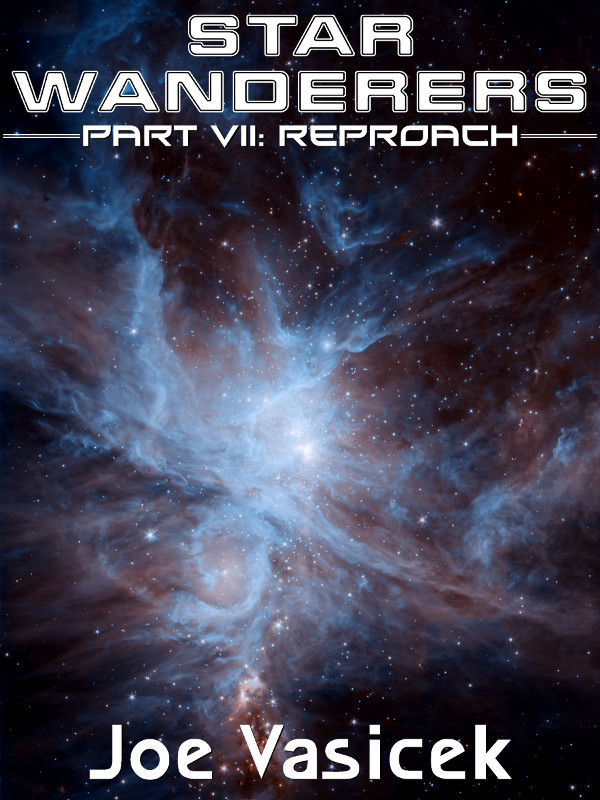
In the meantime, I was playing around with The Gimp today, and I came up with a cover for Star Wanderers: Reproach (Part VII).  Check it out!

SW-VII Reproach (cover) The image is the Orion Nebula, as imaged by the Spitzer Space Telescope.  You can find the original here.
I thought it was fitting, considering how Reproach is a parallel novella to Sacrifice, and Sacrifice also features an image of the Orion Nebula on the cover.  But the important thing is just that it looks cool and is sufficiently eye-catching.

So that’s about it.  I’ve got a lot of heavy revisions to do tomorrow, but even my critical mind agrees that chapters 4 and 5 are actually pretty good.  There’s at least one scene missing and a couple of other things that need to be added, but I’m actually looking forward to writing those.  Also, a couple of characters need some more fleshing out, but that shouldn’t be too difficult.  The Tuesday deadline is quite doable.

Have a good night, and thanks as always for reading!

Slogging along

So I’m working part time now, making ends meet as I get ready to finish up the year and go abroad for a while.  This time, I’m only doing about 20-30 hours per week, so it’s much easier to balance writing with everything.  Minecraft is still a distraction, but I think I’m finding a good balance.

Star Wanderers is coming along, but I made the mistake last week of reading some of the critical feedback on the first part while working on the second.  Not that the feedback is bad–it’s quite good, actually, and very helpful–but taking criticism on a work in progress put me into a temporary slump.  I think I’m most of the way out of it now, but progress is more sporadic than I’d want it to be.

However, I just started revising Into the Nebulous Deep today, and I’m very excited about that.  Into the Nebulous Deep is a direct sequel to Bringing Stella Home, featuring James, Lars, and the Colony five years after the events of the first novel.  I haven’t looked at it since May, but lately I’ve been thinking a lot about it, so I think it’s time to dust it off and work on it again.

It definitely needs a new title, though; “Into the Nebulous Deep” is much too convoluted.  Anyone have any ideas?  I’m thinking something like “Heart of the Nebula” or “Into the Deep,” but neither of those have quite the right zing.

Even though I finished the first draft almost six months ago, no one has read this one yet.  It had some pretty big issues that I felt I needed to fix before sending it out to first readers, but I wanted to give it some time to settle before reworking it.

As if that’s not enough, I’m also working on getting Journey to Jordan up and published.  This book is more of a travel journal, so I’m self-editing it, but it’ll probably take a couple weeks before it’s up and ready.  I was going to publish it under a pseudonym, but now I think I’ll just keep it under my own name.  I’m not sure whether I should change the names of people mentioned in the book; I never say anything libelous about anyone, but if that’s the standard MO for works of non-fiction, then maybe I ought to do it.  In any case, my goal is to have it out over Thanksgiving break.

Other than that, not too much to report on.  I’m bringing back my travel blog in anticipation of going abroad, but I haven’t said anything particularly interesting other than “I’m back!”

Oh, and I’m reading Khalil Gibran’s The Prophet and thoroughly enjoying it.  I don’t generally like poetry, but Poe and Gibran–I could read them all day.

Why I’m not a fan of writing groups

I was listening to a recent episode of I Should Be Writing today, and it got me thinking about writing groups and how my philosophy on them has changed.  Long story short, I used to love them, but now I’m not such a huge fan.

I should probably start out by mentioning that I lead a college writing group for two years, and I don’t regret the experience at all.  The Quark writing group was extremely helpful, both in terms of my own growth as a writer, and the connections it gave me with other writerly people.  I still keep in touch with many of them.

But now…I just don’t think writing groups are all that great.  In fact, I think that they often do more harm than good, not just for experienced writers, but for the beginner who lacks the confidence to strike out on their own.  Here’s why:

The group dynamic gives inexperienced critiquers a false sense of authority.

Most writing groups consist of writers who are at roughly the same level of expertise.  For beginners, this means that the people critiquing your story might not know any better than you whether the story is broken.  However, because of the dynamics of the whole thing (captive audience, desire to impress peers, etc), these people are likely to act as if they have more authority than they really do.

To be fair, I’ve had plenty of critique partners who have managed to be modest and down-to-Earth when offering their critiques.  However, I’ve also seen plenty of others get puffed up and offer some really dumb advice.

Beginning writers often naively look for someone to show them the answers–some mentor or authority figure whose every word is true, who will light the path and show them the way.  Put a bunch of them into a writing group together, and more often than not you’ll end up with the blind leading the blind.

The weekly submission process does not simulate the reading experience.

Logistically, most writing groups have to set a limit on the size and number of submissions.  For the Quark writing group, our limit was three submissions of four thousand words each.  It worked out fine for short stories, but most of us were writing novels, which meant that we had to workshop our books in little four thousand word chunks.

The problem is that nobody reads novels at that rate.  Either they get hooked and finish the thing, or they get bored and stop reading.  Therefore, while the feedback you receive might be good for helping out with craft issues, by the time the next week rolls around either everyone has forgotten what happened already, or they remember it wrong, or they were expecting something different and are ticked off because they have to wait another week.

After I revised Bringing Stella Home a couple of times (after–see below!), I workshopped it through a writing group I’d put together after leaving the Quark writing group.  I can’t tell you how many times I heard “why are we in James’s point of view this week?  I hate James!  I want to get back to Stella!” I got this comment so often, for a while I thought the book was really flawed.  However, when I got the feedback from my first readers, no one had this problem at all.

The reason?  They read the book the way it was actually meant to be read.

Workshopping a work in progress is the surest way to kill a book.

Committees might be good at doing some things, but they’re absolutely horrible at producing anything innovative or original.  Make no mistake: if you’re workshopping something you haven’t already finished and you follow most or all of the feedback you receive, you’re writing your book by committee.

Most writers agree that when you write your first draft, you should not revise anything until it’s done.  This is because the act of revision makes you so critical of your own work that it’s very easy to get discouraged or “fix” something that was actually a good idea.

Workshopping a work in progress does exactly the same thing: it puts you in a critical frame of mind that will literally kill your book.  Even if you manage to finish it, it won’t be nearly as good as it could have been because you’ve probably nipped all your best ideas in the bud, before they had time to grow and develop.

A truly great book does not appeal to everyone.

There’s a word for something that appeals to everyone equally, that runs about middle of the road and doesn’t upset anyone.  That word is “average.”

No truly great work is loved by everyone.  This isn’t just true of controversial stuff–it’s true of everything.  For every one of your favorite books, there’s a one-star review of it on the internet somewhere.  So if everyone tells you your book is good, that might not actually be the case.  In fact, it’s a much better sign when some people hate it and others can’t stop raving about it.

The trouble with writing groups is that the group dynamic can lead to a herd mentality, where everyone goes along with the first opinion that gets expressed.  Ever played Werewolf?  The same thing happens there.  One person throws out an accusation, the vote gets called, everyone starts looking around to see who is raising their hand and before you know it, all the hands are in the air.

So unless one of the seven or eight people in your writing group loves your work enough to stand up and defend it, chances are the feedback will err on the side of being too negative.  This makes it very difficult to tell whether your story actually sucks, or whether it’s just above average.

Writing groups teach you to write to rules, not for readers.

One of the dynamics of writing groups is that they encourage people to find and latch on to certain writing rules, where people can say “this story is broken because of x” or “this writing is flawed because of y.” Over time, this becomes so ingrained that people stop reading to see whether the story actually works and instead read to see whether the story follows the rules.

The truth, however, is that there are no hard and fast rules when it comes to writing.  For example, you’ve heard of “show, don’t tell”?  Yeah, go and read Ender’s Game.  The entire book is one giant tell–and it’s brilliant.  It was the first sf novel to win both the Hugo and the Nebula awards in the same year, and has remained a perennial bestseller ever since.

Nothing hit this home for me more when the cryo scene excerpt from Genesis Earth won first place in the 2009 Mayhew contest at BYU.  Parts of the scene lapse from first person past tense to second person present tense, and the members of my writing group pointed that out as a major no-no.  However, even though it broke the rules, it worked well enough to win an award.

To be fair, there are some things that writing groups are very good for.  They can be a good way to learn the basics of craft (ie “the rules”), and they do give you a sense of community that can be very encouraging when you’re just starting out.  However, the drawbacks are so great that I don’t think I’ll ever go back.

Personally, I’ve moved from writing groups to a core group of first readers whose feedback I value and whose opinions I trust.  I finish my project, send them the entire manuscript with a deadline in which to read it, and thank them graciously for whatever feedback I receive.  Most of them aren’t even writers, in fact–but all of them are readers.  Most of them don’t know who the others are, and none of them ever see any of the feedback from the others.

Criticism is good; if you want to grow as a writer, you should welcome criticism and constantly solicit it.  But I do believe it’s possible to grow out of a writing group–or to succeed without ever being a part of one at all.

Breaking the Top 10, and a big thank you

As I’m writing this, “Memoirs of a Snowflake” holds the #8 spot in the Kindle Store for the general short story category — #150 overall.  Almost 1,000 people have downloaded it since it went free over the weekend, and it’s already garnered some fantastic reviews!

All this positive attention makes me want to thank all those who have taken the time to post reviews of my work, so I thought I’d do that here.

Specifically, I’d like to thank L. Christensen for the early 5-star review of Genesis Earth, and her very favorable reviews of my other work.  Full disclosure: L. Christensen is one of my first readers; however, I did not solicit any of her reviews–she posted them on her own.  Also, I’d like to thank Katie Armstrong for the other 5-star review of Genesis Earth–I have no idea who you are (well, a vague idea maybe), but thank you!

Another reviewer who’s been very kind is EA Younker over at goodreads.  She’s posted some glowing 5-star reviews for “Memoirs of a Snowflake” and “Decision LZ1527” on that site, as well as a more critical but still encouraging 3-star review for “From the Ice Incarnate.” Thanks for taking the time to read my work!  I’m glad you enjoyed it.

Over on Smashwords, Ernest Winchester posted a nice 5-star review of “Decision LZ1527,” only a couple hours after I uploaded it.  More recently, Michelle Glorioso and Annie B posted some extremely gratifying reviews of “Memoirs of a Snowflake.” Thanks so much!

Of course, not all the reviews have been glowingly positive. “From the Ice Incarnate” has garnered some criticism from readers who feel that it was missing something, either sufficient character depth or a satisfying ending.  I appreciate the feedback; short stories aren’t my forte, so I’ll be sure to keep that in mind as I work on my short form.  Also, Genesis Earth has garnered a couple of critical yet well-reasoned reviews, most notably from the review site Science Fiction Addiction.  Once again, thanks for taking the time to respond so thoughtfully.  And thanks to all the other generally positive reviews which I haven’t mentioned specifically here.

So far, Bringing Stella Home hasn’t gotten any reviews, so if you’ve read it and enjoyed it, I would appreciate it very much if you would take the time to do that.  In the meantime, thanks for all your support!

Should authors respond to reviews?

In the last six days since it went free, “From the Ice Incarnate” has had almost 2,250 downloads, and with so much attention, reviews are starting to trickle in.  Amazon has a very elegant system, which not only allows other readers to vote on whether a review is helpful, but to comment and start a discussion.

This raises a question, however; when is it appropriate for an author to respond to a review?  I’ve seen answers that go all over the board; some readers love it, while others are adamant that writers should never respond in any way–that to do so would be consummately unprofessional.

From an indie writer’s perspective, this is especially tricky.  On the one hand, we want to engage with our readers, since that’s a crucial part of making this into a viable career (Seth Godin makes some excellent points on that subject).  On the other hand, because reviews are so subjective and judgmental, there’s a very real danger that any discussion involving the author could turn very nasty, very quickly.

Whenever anyone posts a positive review of my work, I want to thank them.  If I only respond to positive reviews, though, that could make me look like I’m ignoring the critical ones.  But if I acknowledge the critical reviews that are thoughtful and well reasoned, what do I do with the inevitable one star reviews written by someone who’s just plain crazy?

The last thing I want is to be forced into taking a reactionary position in a public discussion.  While I’m confident I can keep my ego in check and avoid outright argument, that’s not the only danger I foresee here.  Besides, I believe very firmly that the story should speak for itself, and for that reason I think it’s better for the author to be as invisible as possible.

At the same time, I really do want to thank those who take the time to post a glowing review.  Perhaps the best option is to acknowledge them here or on twitter instead of Amazon?  I’m not sure.  And sometimes, questions arise that aren’t related to the story, where responding directly to the review is the most efficient way to handle it.

In any case, I’m going to be cautious for now, at least until I find a position that makes sense.  If you have any suggestions for how I can balance these concerns, please let me know.

And for those of you who have posted kind reviews: thank you!

ABNA reviews of Genesis Earth

Today I checked up on my entry for the 2011 Amazon Breakthrough Novel Award contest, and saw that it garnered a couple of very encouraging reviews!

Here’s the first one:

ABNA Expert Reviewer

What is the strongest aspect of this excerpt?

I enjoyed the background of this excerpt immensely. The futuristic technology like images projected onto walls, transparent floors, milky skies, cryofreeze.

What aspect needs the most work?

I would avoid using the term “ground zero” as it has such a close association with 9/11.

The idea of generating a wormhole was popularized with Star Trek’s Deep Space 9 series, so this is not an entirely original idea. What is going to set this book apart from existing media on this idea?

What is your overall opinion of this excerpt?

This is a strong piece of work. Nicely edited. While the idea of going through a wormhole to explore new worlds is not an original idea, I am curious what this young explorer will find out there? And what will he find within himself and his co-explorer when they wake from cryofreeze? There is potential here.

Not bad!  I’m glad to see the reviewer feels that the story is well edited–I certainly spent a lot of time revising it, and it looks like that’s paid off.  As for the criticism about the wormhole, I’m not too worried about that, since it’s more background information for the story than a central element in the story itself.

Here’s the second one:

ABNA Expert Reviewer

What is the strongest aspect of this excerpt?

The idea of space travel and finding a ‘new Earth’ isn’t a new one. For years Sci-Fi authors have written about the non-sustainability of our planet, of the melting ice caps, the over population and crowding. This author has taken that concept and twisted it into something more unique and young. Our hero is a 17 year old who went on to school at 14 to become a Planetologist. You see his family and friends live in deep space, they’re trying to create an artificial worm hole and find a new Earth. The younger take on how Michael feels trapped both by his parents and the ghost of Earth is fantastic. I love the author’s voice through Michael on deep space, cryogenics and alien life form.

What aspect needs the most work?

The one thing to me that stood out was that it seemed rushed. I think the author knew this and that was why the author even addressed it in the excerpt through Michael and his mentor as he prepares to leave. They just found the other side of the worm hole, there might be alien life, and they send two people within a couple days into the wormhole, knowing they won’t be back for 80 years. I just wish there was a more valid reason then Earth people (who are light years away) would try to send the military first. There has to be away of not making it seem so pushed and rushed.

What is your overall opinion of this excerpt?

Overall this story got me; I really want to know when the full book comes out (or if it’s already out) and read the rest. What about Terra who has a slight sway to schizophrenia? Or the fact that 80 years is a long time and anything can happen, will there be alien life? Is it just another dimension and time? The hook was there and reeling me in trying to get me to keep turning the pages, long past the last word of the excerpt.

Wow, what a nice review!  I was especially surprised to see this person wondering when the full book is coming out.  I don’t have a deal for it (yet), but hopefully, it won’t be long.  Also, it’s good to see that someone really enjoyed the narrator’s voice.  Young Adult can be hard, not just from an artistic perspective but because of so many differing editorial opinions on what a “YA voice” is supposed to feel like.  Good to see that someone thought I got it right.

As for the criticism, I can definitely see how it’s valid.  Part of the reason for rushing Michael and Terra out so fast is to set things up for the sequel, but I suppose I could have them wait a few months before launching the mission.  I thought that’s what I’d done, but I suppose I need to make it more clear.

If you would like to read the 3,000 word excerpt for Genesis Earth, you can download it for free here.  You might need to download some software from Amazon if you don’t have an ereader, but it shouldn’t be too hard.  Their Kindle for PC program is free, so I just use that.

So yeah, check it out.  I hope you enjoy it!

Chomping at the bit

It’s 1:30 am where I am, and I just finished reading through the second draft of Bringing Stella Home and all of my first readers’ comments.  I don’t know how to describe what I’m feeling right now, but I am so ready to make this story shine!

First of all, the story itself is incredibly powerful, at least to me.  True, the current draft is full of problems (some of them so embarrassing I cringe just to think that I allowed other people to read it) but at its core, there is definitely something poignant and moving.  One of my first readers is on active duty right now in Afghanistan, and it actually inspired him to write a poem.

Of course, a reader can be “moved” in bad ways as well as good, and some of the feedback on the current draft’s problems brought out a side of my friends that I didn’t know even existed (yes, Kindal, I’m talking about you).  Seriously, reading those comments was like getting gutted and filleted with a rusty fishing knife.  If I’d had problems with my self esteem, I probably would have cried.

Oh well.  At least it wasn’t boring. 🙂

But harsh or not, the comments were all useful–surprisingly useful, actually.  In a story this big, it’s easy to miss things (even big things like character motivations), but after reading through all my reader comments, I feel confident that I’ve got a solid outline for the revision.

Some of the suggestions were pretty dang good, too.  Usually, I only adopt about half (or less) of the proscriptive comments my readers give me, but this time, I’ll probably end up taking quite a few more.  I don’t know if it’s because I was an idiot when I wrote the first draft or because my readers were getting into the story a lot more than usual, but the advice this time opened me up to all kinds of new ideas.

I probably can’t say much more without spoiling my own story, and I definitely don’t want to do that.  Let me just finish by saying that I believe this story may be the one that breaks me into publishing.  I hope this doesn’t sound conceited or arrogant, because I don’t mean it that way at all.  I just think that this story has some serious potential, and that if I treat it right, it will end up in print someday.

Inshallah, someday soon!

In the meantime, I’m going to put everything into revising this next draft–that is, everything short of secluding myself in a white room and starving myself (or graduating and not looking for a job, which is a more realistic possibility).  This story is calling to me–it needs to be told.  It needs to be fixed.  It needs to be polished and shared with other readers.

It needs a lot of work.  But now it’s 2:00 pm, and I’d better get to bed.  Another exciting day of photocopying newspaper clippings and compiling spreadsheets of data on press freedom in Turkey awaits me.  Excuse me if I sound too excited.

Thank you readers

I appreciate my first readers very much, even when it hurts.  Especially when it hurts.

Today I got the comments back from a longtime Quarkie friend on Genesis Earth, and she told me that, in her opinion, the book still needs a lot of work.  However, she made it very clear when (and why) she was bored, when (and why) she was interested, and where (and why) she would stop reading.  Thankfully, she kept reading and gave me useful feedback right up to the end.

My friend’s comments helped me to rethink several weak points  of my novel.  In particular, her anthropology experience helped her to pick up on some racist undertones that I didn’t intend and hadn’t realized were there.  If my story would have appeared in print like that, I would have been flamed up and down the sf community!  Without her feedback, I probably wouldn’t have picked up on that.

The feedback did more than point out problems, however; it helped me to rethink these problems and begin to find new, innovative solutions.  Rather than getting me angered or depressed, the criticism stoked my creative engines by getting me to take a step back and rethink my story from the ground up.  Though the feedback was harsh (basically, “I’d throw this book across the room at this point”) it was extremely helpful and got me more enthused than ever to write.

Receiving criticism and advice is a very delicate thing, especially for a budding writer.  If you try to follow every peice of feedback you recieve, your book will inevitably tank.  However, rejecting criticism is also tough because you don’t always know why you’re doing it.  There is a fuzzy grey area between rejecting a comment because it’s not right for your story, and rejecting it because it rubbed your ego in the wrong way.

I don’t ever want to reject critical feedback because it hurts.  After all, it’s not about me at all–it’s about the story.

Criticism is never “right” or “wrong,” “good” or “bad.” It is only “useful” or “not useful.” To pick out the useful feedback, you always have to listen to–and appreciate–every piece of feedback that you get.  Only after you’ve done this can you can say (in private!) “no, this isn’t right for my work.”

In the meantime, thank everyone who takes the time and effort to read your work and comment on it.  They’ve done you a huge service, and the last thing they deserve is to be attacked by an egocentric, peurile, self-righteous amateur.  Honest criticism, no matter how much it hurts, is the best thing any writer can receive.

On that note, I want to thank all my first readers for helping me with my novel, Genesis Earth!  I genuinely appreciate all of your comments. You’ve helped me to step back and see my work for what it is.  You are helping me to make this novel a stronger, better book, and that means more to me than you know.  So thank you!