Heinlein’s rules for the digital age

I’ve been thinking a lot about Heinlein’s rules and how they apply to my own writing career.  While a lot of newer writers like to debate Heinlein, all of the long-time professionals tend to agree with him.  For that reason, I think it’s worth taking a serious look at his rules and doing my best to follow them.

The trouble is that Heinlein formulated his rules before the digital age, when self-publishing was non-viable and writers sold to editors, not to readers.  While I wouldn’t go so far as to say his rules are outdated, I do think that they need to be tweaked a little in order to apply to today’s aspiring professionals.

As a disclaimer, I should say that I’m only a beginning writer without much authority or experience.  However, my goal is not to debate Heinlein, but to explore ways in which his advice can be adapted to myself and writers in my position.  If any of you have any thoughts or input, I would very much like to hear it.

So anyhow, here we go:

Rule One: You Must Write.

Pretty straightforward: if you want to write for a living, then the bulk of your time should be spent writing.  Too many indie writers spend all their time and energy promoting their one book when they should be writing others.  If promotion gets in the way of writing, then you should stop promoting and just go write.

Personally, I could probably spend a lot more time writing new material as opposed to revising stuff I’ve previously written (yes, that’s the infamous third rule; I’ll get to it in a minute).  I tend to spend a month writing something new, then take a couple of months to revise old works without producing new material.  If I want to be strict about following Heinlein’s rules, I should probably change that.

Rule Two: You Must Finish What You Write.

Another straightforward rule, but you’d be surprised how hard it is when you know you can publish whatever you write.  Kris Rusch calls these ideas “popcorn kittens,” after a popular youtube video that embodies what goes on in our minds when we have the freedom to create anything.  The problem with too much freedom is that it’s a struggle not to flit from one idea to another, dabbling in all of them but carrying none to completion.

I myself had this problem over the summer, and to some extent I’m struggling with it now.  The key is just to buckle down and have the discipline to finish what you start.  Pretty straightforward.

Rule Three: You Must Refrain From Rewriting, Except to Editorial Order. 

This is Heinlein’s most controversial rule, especially for new writers.  However, I think he has a good point.  If a story is fundamentally broken, revising it is no more effective than stirring around a pile of crap; and if the story works, revising it without first getting a trusted second opinion could actually make it worse.  After all, writers are often the worst judges of their own work.

The key question, then, is where to go for that second opinion.  In the old days, money flowed from the editors to the writers (or at least from the publishers, who employed the editors), but in the new world of publishing, it’s exactly the opposite.  Most of us can’t afford to hire editors for extensive developmental edits, especially when we’re just starting out, and while it’s possible to publish a rough draft, for most of us it’s probably not a good idea.

My approach is to share my unpolished work with a network of trusted first readers, and use their feedback to guide me in the revision process.  I don’t always adopt all of their suggestions, but I carefully consider each one.  Most of the time, I use them to see where the problems are, then use my creative mind to come up with a solution, sometimes taking the book in an entirely new direction.  And if something works well for some but doesn’t for others, I figure it’s not a problem but a judgment call that requires my attention.

Using this method, it currently takes me about four or five drafts before I feel confident enough to publish something.  If I really wanted to follow Heinlein’s rules, I would probably try harder to nail it on the first draft, but I’ve found that my creative process works better in revision mode than while writing new material.  So long as I can revise efficiently enough to produce at least two novels each year, I think I’ll be in good shape.

Rule Four: You Must Put Your Story on the Market.

In the old days, this meant submitting your manuscript to contests, magazines, and publishing houses, not self-publishing.  For short stories, contests and magazines are probably still the best place to start.  However, with novels, indie publishing is generally much better.

The trouble is that publishing your own work is as scary as hell, especially when it’s close to your heart.  This is probably the main thing keeping most new writers from going indie: the need for external validation which grows out of a lack of much needed self-confidence.

The key, I believe, is to get some emotional distance between yourself and your work.  As a rule, I don’t respond to reviews, good or bad.  As for external validation, I don’t seek it at all.  I only publish the stories that I believe in, and even if I’m nervous about sending them out into the world, I figure it’s better to suck it up and do it anyway.  It was the same with writing queries; the only difference is that the market is now the readers, not the editors.

Rule Five: You Must Keep It On The Market Until It Has Sold.

This is especially challenging for indie writers.  When weeks go by without a single sale, it’s easy to believe that your work is crap and that you should just take it down.  It’s even worse when your book isn’t selling and you get a bad review.

Just like with queries, however, the key is to keep your work out there until it finds its natural audience.  With indie publishing, you have all the time in the world, provided you don’t lose confidence.

The key question in my mind is whether to take down your old, crappy stuff as your writing improves, or to leave it up alongside your newer, better work.  Personally, I think it should come down to the readers; if the old stuff is consistently getting bad reviews, it’s probably better to take it down, but if not, might as well keep it up.

So there you have it.  From Heinlein’s rules, I’ve more or less crystalized the following approach:

  1. Always make time to write, even at the expense of promotion.
  2. Only chase new ideas if you know you can finish what you start.
  3. Don’t revise without first getting feedback from trusted readers.
  4. Don’t wait for external validation before you publish.
  5. Keep your work up, even if it doesn’t sell.

Not quite as pithy as Heinlein’s rules, but they seem pretty reasonable.  I don’t have the experience to say whether they follow his, however, so if you have any comments or suggestions, please chime in.
Managing excitement and an idea for an epic fantasy novel

After getting about 40% through Star Wanderers 1.0, I hit a wall and decided to put the project on the back burner for now.  The beginning part, which I’m hoping to shop around as a novelette, has some issues with it and those are keeping me from making any real progress in the rest of the story.

I wish I could just wave my hand and pretend as if I’ve already fixed those problems, but my creative process just doesn’t work like that.  I guess I’m more of a discovery writer in that way, because I can only build on stuff that I’ve already written.  I have to figure out my characters as I write, otherwise they just fall flat.

It’s discouraging, because I feel like I don’t have enough control or discipline over my creative process.  Other writers seem to be able to pick up a project and finish it, even when that project is commissioned by someone else (editors, franchise owners, etc).  But with me, if I can’t get excited about a project, I can’t finish it.

Fortunately, even if I can’t always control which project I’m excited about, I always seem to be excited about something.  After finishing the last revision for Desert Stars, I felt this unusually strong urge to work on Into the Nebulous Deep (which, after the last post, I’ve tentatively decided to rename Heart of the Nebula).  I totally didn’t see that coming, but I’m glad that it did, because that project is getting due for its first major revision.  It’ll probably be a quick one, just to fix some major known issues before sending it off to first readers.

As for new projects, I’m not quite sure what to pick up next.  I’ve got a feeling I could give Edenfall another shot, though it’s dubious at this point, and I still have a bit of lingering excitement over the untitled Gaia Nova novel that involves Roman, Danica, Rina, and Stella’s son.

At the same time, though, I have a really cool idea for a fantasy novel involving magic swords.  The idea is that the swords are actual characters, with the ability to think, feel, remember, and communicate with those who wield them.  They can only be wielded by those whose minds have been melded to them, however, kind of like the Dragonriders of Pern.

As the swords get passed down from generation to generation, they pass on their skills and memories, so that those who wield them become legendary warriors.  However, all but one of the swords goes insane, turning their wielders to evil.  The one sword that remains has refused to take on a new master, even though war and destruction sweeps the land.  A prophecy states that the one who wields this sword will eventually defeat the evil of the others, but when the good sword finally does take on a new owner, it ends up being a farmgirl / tavern wench (I haven’t really decided).

I don’t have a lot of experience writing fantasy, but this story is starting to really excite me.  If I can combine it with a few other ideas and read some good fantasy novels to get into that mood, I think I can make some good progress on it.

So yeah–I have plenty of projects to work on, so things aren’t that bad.  I just need to find one that I can really get into for the next couple of months; if I keep bouncing around from project to project without finishing any of them, that’ll be bad.

Thoughts on outlining

I’m on track to finish my fifth novel in a couple days, and surprisingly, the writing has been going very smoothly.

Usually by this point, my eyes are bleeding and I feel as if I have a hundred caltrops in my pants.  Finishing a rough draft is still the hardest part for me, since by the end everything seems to suck and I just want to trash the whole project.

I still feel a little bit of that with Into the Nebulous Deep, but not nearly as much as with my previous stuff.  Part of that is probably because I feel confident that I can fix whatever I screw up, but the other part probably has to do with the way I’ve learned to outline.  In one short sentence, here’s what I’ve learned:

An outline is simply the story you tell yourself to help you tell the story.

I don’t think there’s any mortal writer on this planet who can keep a whole novel in their head at one time.  Scenes, yes; chapters, maybe; novels, absolutely not.

However, since everyone’s creative mind works a little differently, everyone has to find the process that works for them.  Brandon Sanderson, for example, writes story bibles that are almost 100k words long.  If I were to try to do that, I’d get bored halfway through and spend the rest of the day dorking around on youtube.  Other people prefer to fly by the seat of their pants, and while there’s something to say about trusting your subconscious, I need a little structure to keep from getting totally lost.

It took me a while to figure out the process that best works for me, but based on how ITND has been going, I think I’ve hit my stride.  Breaking it down into plot, setting, and character, here’s how I basically do it:

Plot

For me, the basic plot of the story comes in a flash of creative insight once all the ideas in my head have reached a critical mass.  It’s like watching a fissure shoot across a smashed window pane, or lightning arcing from the ground to the sky.

If I don’t have time to start the project right away, I’ll let the plot mull around in my head for a couple days, then open up notepad and free write the basic structure of the story in an unedited stream of consciousness.  When I do start the project, I’ll look back to the free write to refresh my memory, but otherwise work out of what’s in my head (which may have changed).

While the project is ongoing, I’ll divide the whole novel into parts, chapters, and scenes.  For the chapter I’m currently working on, I’ll have the various scenes listed in bold with their corresponding point of view character (eg: “1.1: James“), followed by a brief one or two line description of the action and plot significance.  If I introduce a new character in that scene, I’ll write their name in ALL CAPS (I believe that’s a screenwriting convention I picked up from my old college roommate).

For chapters I haven’t written yet, I just write a few lines of description for what I envision happening in them.  When I first start out, I usually have a clear idea where I want the story to end, but I don’t bother outlining all the stuff in the middle since that usually changes based on stuff that comes before.  I only keep my outline a few chapters ahead of where I currently am, and may change things completely if something new comes up.

This process works very well for me.  I use it for every draft, and refer to it often.

Character

I’ve found that I need to do a lot more outlining to figure out my characters than I do with my plot.  However, it’s like Tracy Hickman said with the marbles: don’t hold onto your outline too tight, or all the marbles will slip out between your fingers.

The things I absolutely need to know about my characters are:

  • back story
  • motivations
  • first impressions
  • flaws & handicaps
  • strengths & advantages
  • why the reader should care about / sympathize with them

For some odd reason, I find it most helpful to write this out longhand, usually while taking a walk.  For additional help, sometimes I’ll take a personality test on behalf of my character and get a handle on them through their personality type; for that, I prefer the Meyers-Briggs typology.

But once I feel I have a solid handle on a character, I’ll throw everything out if it feels instinctively right for a character to do something completely different.  Thing is, I need the outline (especially the motivations and back story) to get to the point where I know the character well enough to let them take over.

And for some reason, all my main characters feel too…generic.  I’m not sure why, but that’s something I’ve got to work on.

Setting

Setting, for me, is all about discovery writing.  I’ve tried using wikidpad to worldbuild my universe before I start, but that’s never worked.  Instead, I daydream a lot and trust my subconscious to give me what I need when I need it.

That’s not to say I don’t do research–just that most of my research is on the fly.  If I only stay on wikipedia and the footnotes and references, no problem; if I get sidetracked on facebook, however…

Often, when I’m doing setting descriptions, I’ll run a quick google image search to pull up pictures to give me a better visual idea of what I’m describing.  I especially use this for clothing; that’s why, if you check my search history (please don’t), you’ll find all these weird, girly terms like “ottoman dress,” “jumpsuit,” “leather jerkin,” and “full frontal snogging” (whoops, where did THAT come from??).

The big problem is when I figure something at the beginning of the book and then forget about it halfway through.  For that reason, I should probably invest in a good copy editor when I start to publish.  I should also take the time to draw out a starmap, since it’s getting REALLY hard for me to remember where the Belarian system is in relation to Tajjur and Karduna Prime…hmm…

I should probably figure out a better system to keep track of my settings, but as far as outlining them goes, the less the better.  I love waving my hand and creating stuff–it’s one of the main reasons why I’m a science fiction writer.

So anyways, that’s more or less the outlining system I currently use.  I might end up outgrowing certain aspects of it, or finding a better system, but this is what works best for me now.

Of course, I still have a lot to learn.

Killing the sacred cows while doing data entry

Sorry for the lack of blog posts; I’ve been working 40 hours a week at this temp job, which doesn’t leave a lot of time for other things outside of writing.  I’m still plugging along at about 1k to 2k words per day, but a lot of other stuff is falling behind.  Fortunately, the job only lasts another two weeks, and that should earn me enough to take the next month off and focus on writing.  I’m really looking forward to that.

This job isn’t too bad; it’s tedious, but I can read blogs and listen to podcasts and music while I do it, so I’ve been catching up on a lot of business research.  Last week, I read all of Kris Rusch’s The Business Rusch Publishing blog series, and right now I’m working my way through Dean Wesley Smith’s Killing the Sacred Cows of Publishing.

Let me just say, this stuff is pure gold.  Every post (and a surprising number of the comments, especially those by Laura Resnick) have been extremely eye opening.  At the outset, almost everything Dean or Laura say about the industry seems absolutely blasphemous…but it all makes so much sense.

Like the post about how agents shouldn’t be giving authors any career advice… because they’ll usually advise you to write to the market, not to what you’re passionate about (and can therefore write well). Or how if you’re a midlister, it’s usually in the agent’s best interest to side with the editor, since they may have ten or more clients at stake in this house and you only represent a $3k annual revenue stream to them (or less).

The best piece of advice across the whole series so far comes from Dean:

Don’t listen to rules (myths) and do what works for you and if it doesn’t work, try something else, and when that stops working, try something else. Don’t do it my way or Larry Brooks way or Laura’s way or Harlan’s way. Steal parts from all of us and do it your way.

The thing I find most gratifying, however, is the fact that I figured out on my own that submitting to agents first probably isn’t the best way to break in. But man, there is so much awesome, paradigm-shifting stuff in these posts, it is amazing.  Pure gold.

In the meantime, Into the Nebulous Deep is going surprisingly well.  I should have it finished by mid-May, and though it will probably need some serious revision (unlike Dean, my creative mind gets more fired up in the revision process than the drafting process), the major story arc is coming along very nicely.

I wonder if that has to do with the fact that ITND will be my fifth completed novel.  My first one, Ashes of the Starry Sea, was mostly smooth to write, but it was also a practice novel and as such royally sucks.  Genesis Earth went through an EXTREMELY convoluted writing process, but it was good enough to get to the quarter-finalist stage of the 2011 ABNA contest (and in two days, I’ll find out if it made the semi finals…<fingers crossed>).  Bringing Stella Home was also pretty tough to write, as was Worlds Away from Home, though the revisions have been more straightforward so far.

So does this mean I’m starting to come into my stride as a novelist?  I hope so, because I want to start pushing myself.  After ITND, I want to revise WAFH in six weeks or less–and I’ll probably throw out 1/3 to 1/2 of the material and completely rewrite it.  After that, I want to do Sholpan in two or three weeks–but that shouldn’t be hard, because the material is mostly there already.  Whether Genesis Earth wins or loses the ABNA contest, I’ll want to write Edenfall–before August, if I can manage it.  And then, there’s always that post-apocalyptic blight project…

Anyhow, sorry for the rambling.  The point is, I want to take my writing to a new level this summer, and after this temp job is finished, I’ll be in a great position to do it.  In the meantime, I’ll merrily watch Dean kill the sacred cows while I fill out UPS shipping data for the next two weeks.

And now, here’s some candy for your ears:

Change of plans

So I was going to start Edenfall this week…but then, I realized I wanted to spend some more time in the universe of Worlds Away from Home, so I decided to work on Into the Nebulous Deep instead.

ITND is a direct sequel to Mercenary Savior.  Basically, it grew out of the realization that James’s story wasn’t anywhere near finished.  Like WAFH, I’m trying to throw in some romantic elements…how well that works out remains to be seen.  I’ll probably get it all wrong on the first draft, but make it shine in subsequent drafts.

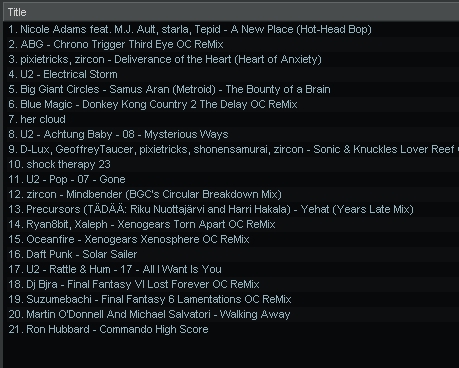
Anyhow, here’s the soundtrack I’ve put together.  Most of the songs are from ocremix, but there’s also a good bit of U2 and a little Daft Punk, as well as a couple chiptunes that probably no one’s heard of.  Man, I love chiptunes.

I’m going to try to write through this rough draft as quickly as possible.  Right now, I’ve got a deadline for April 16th, but I wonder if I can finish before that.

Part of that has to do with my new goal of two novels per year; I want to train myself to write quickly, so I can be putting out more work.  More than that, though, I want to try and tap into my creativity in a deeper way.  If I can train myself to write quickly, I’ll be less prone to self-edit, which hopefully will help the creative part of my mind to flourish more freely.  That was certainly the case with WAFH 2.1, and I want to do it again.

I stopped ITND 1.0 back in December in order to work on Bringing Stella Home; not because it wasn’t working, but because BSH needed a little more work.  After that, I ended up picking up WAFH.  Now, it’s time to go back and finish this project.

Writing update, getting ready for LTUE, & Katniss must DIE

So I’m back at work at WAFH, making slow but steady progress.  At this point, I’m throwing out about half of what’s on the page and redrafting stuff to fill in the gaps, but that’s only going to increase.

It’s not particularly hard, but it does take a lot out of me.  I’m finding that I can write for about two or three hours before my creativity runs dry.  When I’m spending more time online or playing games and less time focusing on the story, that’s a sign that it’s time to do something else to refill the well.

Man, I wish that well would stay full for longer…but in the meantime, 2.5k words per day isn’t so bad.  I’ll take it.

In unrelated news, I’m currently about a third of the way through The Hunger Games and I hate the main character, Katniss.  She’s a total attention whore, and fits all the classic characteristics of a Mary Sue.  A tortured past, a heart of gold, ridiculously well skilled, beloved by everyone and romantically irresistible, even to her enemies…blegh!  I hope she dies or gets tortured beyond all humanity.

In spite of this, I’ll probably finish the novel, just because it’s been such an influential bestselling title–as a writer, I’ve got to do my research.  However, I don’t see myself finishing the series.  There are other reasons why I don’t particularly like this book, but I’ll wait until a later post to articulate them.

In other unrelated news, LTUE 2011 is coming up, and I am so freaking excited for it!  Here are the panels I definitely plan on attending:

Thurdsay

9:00 am:
– Best and worst writing advice ever given
(Anna del C Dye (M), Mette Ivie Harrison, Tyler Whitsides, Frank L. Cole, James Dashner)

11:00 am:
– Self-Publication pros and cons
(Jessica Douglas (M), LuAnn Staheli, Sandra Tayler, Anna del C Dye)

2:00 pm:
– Writing Strong Female Characters
(Sheila A. Neilson, Aleta Clegg (M), Clint Johnson, Jessica Day George, Bree DeSpain)

4:00 pm:
– The Writing Life: how to set and keep goals, how to prioritize.
(Angie Lofthouse, Julie Wright (M), Sandra Tayler, Berin Stephens)

6:00 pm:
– Marketing and Publicity–what can you do?
(Stacy Whitman (M), Bree DeSpain, James Dashner, Dene Low, Elana Johnson)

Friday

10:00 am:
– Tracy Hickman Presentation

11:00 am:
– Main Address: Steve Keele

12:00 pm:
-Charisma is not a dump stat: The real world importance of personal appearance and social skills in achieving your creative dreams.
(Howard Tayler, Jake Black (M), Tracy Hickman)

2:00 pm:
– The Problem of Sequels
(Anna del C Dye, Mette Ivie Harrison, Larry Correia (M), Bree DeSpain, Jessica Day George)

5:00 pm:
– What You Can And Can’t Do In A YA Novel
(Mette Ivie Harrison (M), Elana Johnson, Bree DeSpain, Robison Wells, J. Scott Savage)

Saturday

9:00 am:
– What I wish I had done, if I could do it all over again – A Guide to New Writers
(Lisa Mangum, Dave Wolverton, Brad R. Torgersen (M), Kathleen Dalton-Woodbury)

11:00 am:
– Main Address: James Dashner

12:00 pm:
“Zombies and You: A guide to what does and does not constitute an apocalypse”
Ross Wolfe

2:00 pm:
– Building believable economies/politics
(Dan Willis, Eric Swedin (M), Roger White, David Ferro)

3:00 pm:
– Can your dreams pay your bills?
(Rebecca Shelley, Ami Chopine, Sandra Tayler (M), Dave Wolverton, Michael R. Collings)

There are more, but these are the ones that look most interesting to me.  As usual, I’ll record all of the panels I attend, so if you want a copy, just email me.

Man, I’m so excited!  LTUE this year is going to be awesome!

Major project shift

I’ve got this goal to finish my current work-in-progress, To Search the Starry Sea, by May 1st 2010.  However, the deeper I get into the story, the more I realize how many problems it has–how much it sucks, in other words.

Normally, this wouldn’t keep me from dropping the project or putting it on hold.  It happens with every rough draft (or second or third draft, for that matter); midway through every project, I start to get all angsty and worry that the project sucks, that it’s beyond saving, that I’m wasting my time, etc.

However, this time it’s different for a number of reasons.

First of all, the story itself doesn’t suck. However, it does have a weak beginning and a poor setup, which makes it very difficult to develop the middle section.  With better conflict foreshadowing and character introductions, I could tear right through this section, but without that, I’m floundering more and more.

A couple months ago, I started to realize this, so I started a set of revision notes for the next draft.  My thought was “if I know the story needs changes, rather than going back and changing them, I can just make a note of them and move on.”

However, that approach isn’t working because the unwritten changes aren’t impacting the story as fully and completely as they would if I’d write them out.  If the changes were minor, I could let them go–but when they have to do with something fundamental, like setting up a romantic subplot, or turning a minor character into a major character into a major viewpoint character, I can’ t just make a note of the change and move on–I need to write the thing to see what it changes.

In other words, I need to restart this project from the beginning.  But if I do that while I’m still angsty about it, it’s going to end up like crap.  I’ve got to let it sit for a while.

It’s frustrating, because I really want to finish a straight draft from start to finish.  For both Genesis Earth and Bringing Stella Home, I only finished the rough draft after dropping the project for a while and restarting it at the beginning.  If it works, I guess it works, but it would be nice if the creative process were more linear.  Blegh.

All is not lost, however.  Most of my first readers for Bringing Stella Home have gotten back with their feedback, and it’s been extremely helpful.  I’ve got a clear direction and lots of ideas for where I want to take that story, and now that I’ve spent some time away from it, I can honestly say that it doesn’t suck all that bad.  In fact, after a lot of work, it might actually be decently good.

There are several reasons why it makes sense to work on Bringing Stella Home right now.  For example,

  1. I’m excited about it.  Better to capitalize on that now than wait until after the enthusiasm has died.
  2. I’ve got lots of ideas flowing to me now.  I could try to write them all down for later, but why not try them out now, while they’re still fresh?
  3. I’m sending Genesis Earth out to a bunch of places, and the rejections are starting to come in.  If I can respond to a rejection by sending out a second book in a timely way, I will look much more like a professional, and the agents/editors will take me more seriously.

My goal was to have To Search the Starry Sea done by May 1st.  Let’s see if I can do Bringing Stella Home 3.0 (and yes, the title will change) by that day instead.  And if that proves too difficult, what with graduation, internship, looking for work, and figuring out life, at least I can reach the halfway mark by then.

So that’s my new goal: Finish Bringing Stella Home 3.0 by May 1st, 2010 (or at least be halfway finished). To do that, I’ll have to read through all the comments by the end of this week and have the revision notes all figured out.

Better get started!