“This is my culture; this is my community”

So back at World Fantasy in San Jose, I picked up a bookmark for a science  fiction club in the Washington DC area, WSFA.  I figured that since I was headed out there, I should check it out.  Last night, I went to my first meeting.
Getting there was quite an adventure.  The meeting was in Maryland, at a member’s house–I had to go to the end of the green line, then cross over the beltway and walk nearly three miles to get there.  The sidewalks were still covered in snow, so I had to keep to the street, which was a little unnerving on the overpass–but I made it.

I didn’t know anybody there and had no idea what to expect, but the people were friendly and I soon felt like I fit in.  It was a little bit like a cross between Quark and Bimbos of the Death Sun, which is a pretty awesome mix.  The meeting was called to order and people started discussing some pretty interesting projects, like publishing a special edition Jeff Vandermeer novella for Capclave in October and getting various things for the con squared away.

A couple of things about the club surprised me: one, the members were all middle aged and older; and two, how extremely liberal everyone was, politically.  I say I was surprised, but really, I could easily have seen this coming.  The east coast is very different from the inter-mountain west, so it stands to reason that there would be differences.  Not that I minded.

I’m not sure how many people in the club are writers, but like any good sf&f community, everyone seems to be an avid reader.  I was surprised that so few people had heard of World Fantasy, but when I told them I wanted to break into publishing, they all told me that I should come to Capclave, the DC area con that happens in October.  Will I be in the area for that?  Not sure yet.

Fortunately, I didn’t have to walk back to the metro; one of the regulars was heading to Arlington and gave me a ride.  We had an interesting conversation on the way back–he’s from Philly, drove a cab for a few years, and has quite a colorful vocabulary.

We were talking about fandom in general, though, and he made the comment “this is my culture; this is my community.” That’s exactly the sense that I got from the meeting–that these fans have built a community around science fiction and fantasy that transcends fandom and stretches into all other aspects of their life.  It’s similar in some ways to the sense of community that you feel in the LDS church–even when you move to a new place, you’re not a stranger.

Am I going to keep coming to WSFA meetings, or become a member?  I don’t know.  A lot of it depends on what I do in April.  I’ll probably come to a few more meetings, though–these are my people.

Thoughts on World Fantasy 2009

Since it’s been a couple of days since World Fantasy 2009, I guess I should share some of my thoughts before life starts pulling me in other directions.

First of all, I was surprised at how similar it was to LTUE, CONduit and other convention/symposium events I’ve already attended.  The basic format was the same: dealer’s room open all the time, with panels every hour until the evening.  The only real differences from that were the hotel bar downstairs, the consuite upstairs, and the parties at night.

Second, I was extremely surprised to see so many other people from Utah.  Honestly, there were about thirty or forty of us, about half of whom I knew from LTUE, CONduit, English318–and the others all knew someone I knew from one of those places.  It’s funny to think that we traveled nearly a thousand miles just to network with each other, but that’s pretty much the case.

Third, I was surprised at how much drinking was going on.  Maybe it’s just because I don’t drink, but it doesn’t make sense to me to come to a business meeting and get intoxicated in front of the people you’re trying to impress.  Not that I was uncomfortable.  There were enough other non-drinkers there that I didn’t feel out of place, and even the outright drunks were more entertaining than anything else.  If anything, I guess it was an interesting anthropological experience (kind of like reading Twilight, except…different).

Fourth, I was surprised at how down-to-Earth and accessible everyone was.  Big name authors, editors and agents at the major houses, staff and editors from the small presses–everyone was very friendly and accessible.  I talked with Ann VanderMeer briefly about my capstone project on Israeli politics.  I talked with David Drake about the difference between him and Haldeman.  I talked with Kay Kenyon about Star Control II and Alastair Reynolds.  I talked with Liz Gorinsky (editor at Tor) about Jake Von Slatt, Jim Frankel (senior editor at Tor) about Guy Gavriel Kay, Guy Gavriel Kay about Brandon Sanderson, Brandon’s Agent Joshua Bilmes about Eddie, his assistant-gone-agent, etc etc.

None of this was planned; it all just happened.  Everyone was very friendly.  In fact, I was particularly surprised at how many people became interested in me when I said I was an Arabic / Mideast studies major.  I ran into Brent Weeks’ wife in the bar and talked with her for almost half an hour about Egypt and the Middle East, and she actually seemed interested in what I had to say.

At the same time, I was surprised at some of the tackier things that happened, too.  Maybe this is just my pet peeve, but at every single panel I attended, someone in the audience raised their hand and said “I don’t really have a question, but…” and went on and on for several minutes discussing one of their ideas–TAKING TIME AWAY from the panelists and the people with genuine questions.  Some people even tried to pitch books that way!  Laaaaame.

I will say, though, that as far as pitching books, it wasn’t exactly what I was expecting.  From Brandon’s Class, it seemed that a lot of these people would let you send your full manuscript if you just asked them…and maybe that was the case, but other Utah friends at the convention told me that when they tried to pitch, it didn’t turn out so well.  I generally felt a lot of question, so I tried to err on the side of being non-aggressive.  At least I can mention in a cover letter that I saw them.

The last thing that surprised me was a lot more personal, but out of everything else, it probably surprised me the most. I saw several aspiring writers who seemed so stressed out about breaking in, and it surprised me, because…I don’t feel that way at all.  In fact, I felt a strong sense of peace as I thought about my future.  It’s not a question of “if” I’ll be published, but “when,” and getting there is going to be an exciting adventure.

Anyhow, I enjoyed World Fantasy 2009 a ton!  It was an overwhelmingly positive experience.

World Fantasy 2009 — second day

Friday was a long, awesome day  at World Fantasy.  I feel like I’m floating around on a sea full of big names and interesting people, and it’s surprisingly less intimidating than I thought it would be.

The day started with a number of panels.  I attended “Writing human characters, whether or not they’re human” and “VaanderMeer on VanderMeer.”

The VanderMeer panel was very enjoyable–Ann and Jeff are down-to-Earth good people, and it was interesting hearing their stories, especially Ann on her experiences as an editor.  At one point, she could have shared any number of slushpile horror stories, but she didn’t.

Took lunch at Lee’s Sandwiches, for no other reasons than price and nostalgia. I used to eat at Lee’s all the time when I lived in San Jose, because it was so cheap.  It’s been so long, but it was exactly as I remembered it.  Good times.

Met up with Daniel Alonso, another writer friend from LTUE/CONduit.  It was good to see him.  We wandered around the dealer’s room for a while and struck up conversations with various people, including David Drake.  Talked with Drake about the difference between him and Haldeman–apparently, in Haldeman’s novels, nobody trusts anybody, whereas in David Drake’s novels, people mistrust everyone but the comrades in their unit.  Interesting.

Let me just say, once again, that I am surprised how many people from the Utah scene are here at World Fantasy.  On the “Writing non-conciliatory fantasy” panel, I recognized at least a dozen other Utah writers, and there were probably at least as many there that I didn’t recognize!  Surprising, when you consider the panel was about anti-heroes.

Besides the “Writing non-conciliatory fantasy” panel, I attended “Invention vs. tradition” and “The last resort” in the afternoon.  Both were very interesting, but unfortunately I was very tired after the last one, so didn’t catch as much from it.  That’s what happens for late afternoon / early evening panels, generally.

Went to a book release party for Edge publishing.  It was an interesting event.  Barbara Galler-Smith and Josh Langston wrote Druids together long-distance, having only met over the internet.  They both seem like pretty cool people, just from running into them.  From the readings, the book reminded me a bit of David Gemmell.

Had dinner with some other writers from the Utah scene–Josh, Isaac, and Jancy.  Talked with Jancy for quite a while–turns out she’s from Santa Clara, got a master’s degree from BYU with John Bennion as her advisor.  It also turns out that she recently switched agents; she’s represented by Eddie now, Joshua Bilmes’s old assistant.  We talked about my book and whether it’s YA or not,  which went on to a very interesting discussion of YA themes.  Jancy’s a way cool person.

The evening event was a giant mass autographing party in the ballroom.  Everyone was there doing a signing.  I hung out at Dan Wells’s booth and met Mary Robinette Kowal.  She was way cool, easy to talk with, interesting and humble.  Yet another down-to-Earth good person at this convention.

Met a lot more people from the Utah scene in the evening, such as J. Aleta Clegg, who was around when LTUEThe Leading Edge, and Quark were founded.  Also talked with Julie Wright, found out that she’s an editor as well as a writer, talked about the blog she co-authors and Leading Edge.  Yet more down-to-Earth good people.

After that, drifted from party to party, until everyone was so drunk that my attempts to make useful contacts started to become counterproductive.  Had fun at the same time, though.  Good people, good times.

I’m looking forward to tomorrow!

World Fantasy 2009 — first day

After four years, I’m back in California!  Yay!

Okay, now that I’ve got that out of my system (because California is, without a doubt, the most awesome state in the union), let me just say that the first day of World Fantasy 2009 was most excellent.

For Cavan, Alex and me, the day began at about 4:30 am, when we woke up early to road trip it out to San Jose.  The salt flats near Dugway were very beautiful in the early morning light, as were the mountains.  Nevada stretched on forever, but a little bit of Ennio Morricone helped it pass enjoyably.  After Reno, we descended through the Sierras, passed Sacramento and the Central Valley, crossed over the gorgeous bay area mountains and arrived in San Jose without incident.

Well…there was one incident.  We got a little lost finding Alex’s friend’s house, and pulled a U-turn that ticked off one of the local drivers.  She honked her horn and shouted out her window: “go back to Utah!”

California, I love you.  You haven’t changed at all since I left. 🙂

We’re staying with Alex’s friend, within walking distance of the downtown area where the convention hotel is situated.  No, really, we couldn’t have planned it better.  Alex’s friend is way chill.

After we registered, we scoped out the hotel.  It feels a lot like the hotels in Cairo–big and grand, with lots of marble and large open spaces.  We browsed around the dealer’s room, saw lots of small publishers, some of whose books I’ve reviewed for Leading Edge. Everyone was very friendly and easy to talk with.

The only panel  tonight was on the Google book settlement, and it was very informative and helpful for someone as clueless on this issue as me.  Some very choice words were exchanged between the president of SFWA and a Google employee in the audience, but most of the panelists had the same  opinion–that the settlement would set a terrible precedent for copyright law and should be fought tooth and nail.  Interesting, timely stuff.

We heard about a party on the top floor, so we decided to check it out, and low and behold!  Practically the entire convention was there.  Ran into some familiar faces from LTUE and CONduit; it turns out that there are one or two dozen people from Utah at this convention, and most of us already know each other.  How awesome is that?

Let me just say, I am so happy that I have friends at this convention.  All that networking in Utah over the last two years is really paying off.  It’s so much easier to meet new people when you’re working together as a group.  I’m starting to get an idea of the editors/agents here that I should contact and how to approach them.  I’m also meeting a lot of other aspiring writers, making new friends.

In short, the party was not only productive, it was lots of fun.  Met new people, reconnected with old friends from the Utah scene, got the scoop on Dan Well’s Serial Killer book and the pending sequels (which I’m eagerly anticipating), and just had an overall great time.

An excellent finish to a very eventful day–and the convention has only just begun!

T minus 5:08:37…

Business cards…check.
Clean clothes…check.
Clean shaven…check.
Soap and toiletries…check.
Batteries…check.
Battery recharger…check.
iRiver 800…check.
Music…check.
Computer…check.
Camera…check.
Tentative convention program…check.
Map and directions…check.
Snacks and lunch…check.

Five hours to liftoff and counting.  This time tomorrow, I’m going to be in California! Yay!  And holy cow, did I mention that I’m nervous?

World Fantasy 2009, here we come!

Convention jitters

World Fantasy starts in less than 72 hours, and I’m getting nervous about it.  Really nervous.  This is the first big-time science fiction convention I’ve ever been to, and I’m worried that it will be too intimidating, or that I’ll make a fool of myself, or that I won’t put myself out there enough, or…

All the same, I’m expecting to have fun.  Lots of fun. 🙂

But between now and 5:00 am Thursday morning (when we take off for California), I have to: 1) grade 20 papers, 2) take a midterm, 3) write two essays, 4) run at least 30 regressions, 5) read 2 poli sci articles, and 6) finish American Babylon and write up a report on the last three chapters.

Yeah.  Not fun (except the regressions–what can I say, I’m a nerd).

In unrelated news, I met an interesting girl at Leading Edge last week.  She’s at least as much of an sf&f fan as I am, and one of the very, very few girls I’ve met who prefers science fiction over fantasy.  Somehow, she convinced me to read The Dispossessed by Ursula K. LeGuin with her (or maybe I convinced her to read it with me?), but I started it tonight, and it’s really good.

Technically, I’ve got a class for Washington Seminar that I should go to tomorrow…but I can skip it and listen to the mp3 while I’m driving to California.  Don’t want to miss Leading Edge this week, for obvious reasons.

Speaking of which, if I don’t go to sleep right now, I’m going to be barely functional for the next two days.  Not good.  G’night.

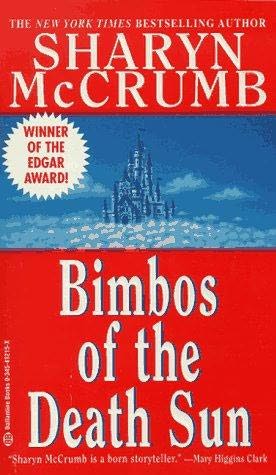
Bimbos of the Death Sun by Sharyn McCrumb

It’s that time of year! Elves, Klingons, slave women, gamers, computer geeks, aspiring writers, and superfans are converging on Rubicon, the annual science fiction convention. Mild mannered citizens beware!

Newest among the motley crew is Jay Omega, a young, local computer professor and first-time author on a mission: make sure that nobody he knows in real life finds out that he is the author of Bimbos of the Death Sun. Fortunately, his friend and secret lover (but only a secret to him), Marion, is there to promote his book and keep him from getting hopelessly lost.

But then, Appin Dungannon, famous author of the prolific adventure series of Tratyn Runewind, is found dead in his hotel suite.  Who could possibly want him dead?  Turns out, just about everyone: Appin is also famous for hating the series more than any other person on the planet, and for treating his fans like slime.

As the convention threatens to fall apart, Jay takes on the case and tries to answer: who killed Dungannon, and why? In a world where fantasy has more power than fact, however, the answer is stranger than anyone in theiTr right mind would expect.

This book was hilarious. Sharyn McCrumb explores science fiction and fantasy fandom the way a drunk anthropologist would explore an aboriginal jungle tribe. Even though her characters are all shallow caricatures of the real thing, their clumsy interactions turn the story into a wonderful farce that is as entertaining as it is educational.

There were only a couple of parts that bothered me. At one point, McCrumb gets into the head of an overweight, hopelessly ugly fangirl cosplayer and shows her thought process as she pursues a romantic relationship with an equally ugly and socially incompetent fanboy. I didn’t feel that McCrumb authentically portrayed the character’s own thoughts–it sounded more like a person from the outside giving their take on the experience. Then again, McCrumb was going for humor, not true character depth.

Besides that, this book is definitely dated. The computer technology in the novel is ridiculously primitive, on par with the Commodore 64, the Tandy 400, and the trusty old 386. In other ways, too, this book is solidly 80s–any science fiction convention nowadays would probably have less Trekkies and more Anime cosplayers. However, the dated aspects only make the novel more endearing, in my opinion. Who wouldn’t be nostalgic for the good old days of the 386?

This book isn’t high literature, and Sharyn McCrumb would probably be the first to admit it. It was, however, wonderfully entertaining, one of those rare and beautiful books that made me laugh out loud, heartily. For someone like me who is just starting to become involved in science fiction and fantasy fandom, it was a hilarios and helpful primer to this fascinating subculture. As McCrumb states in her foreward:

Science fiction writers build castles in the air; the fans move into them; and the publishers collect the rent. It’s a nice place to visit, but please don’t try to live there.

That said, I find it telling that it was people in fandom who recommended this book to me. Good to know that at least a few of us don’t take ourselves too seriously.

Six weeks to World Fantasy

Holy cow!  How is September halfway over?  It seems like school started just a week ago.  Only six and a half weeks before World Fantasy convention in San Jose, and I think I’m going to have to readjust some of my goals.

I’d wanted to finish Bringing Stella Home 2.0 by the 11th of October, but the way school and work is looking, I probably won’t be able to write 2k words every day in order to meet that goal.  Besides, the story has several major issues that can only be fixed with a major overhaul, so there’s no way this novel is going to be ready for submission in time for the convention.

However, Genesis Earth is looking pretty good.  So far as story issues go, I was very satisfied with the third draft–I think I fixed all the major issues and wrote something that’s pretty close to salable.  Before the convention, I want to go through and make one final revision, one where I polish up the prose and fix the readability issues.  That shouldn’t be too hard–I can probably do that in two to three weeks.

So here’s what I’m going to do in the next six weeks.  I’m going to check out all of Robert Charles Wilson’s books and immerse myself in his prose–not to copy it, but to hopefully boost the quality of my own prose.  The quality of his writing is fantastic, a beautiful mesh of literary prose and thriller pacing and rhythm.  While I’m doing that, I’ll start the 4.0 draft of Genesis Earth and work hard at it, until I’ve polished that work as much as I can.  That’s the work that I’ll try to sell when I’m at World Fantasy.

I’m a little worried, because I submitted the full manuscript to Krista Marino back in June and haven’t heard back.  At the BYU Writers and Illustrators for Young Readers conference, she said she had a response time of 4 months, but I’m worried I won’t hear back from her before World Fantasy.  Is it appropriate to send a polite note asking her to get back to me before the convention?  I don’t want to shoot myself in the foot by sending out simultaneous submissions, and if an editor asks to see my ms, I want to be able to send it to them ASAP.  Then again, I suppose I could just tell them that the full is currently with someone else, and that would demonstrate some professionalism…but I want to be able to send it if/when they ask for it.

Which reminds me: I need to do some HEAVY agent/editor research before this convention.  I want to go to World Fantasy with a list of people to look for, so I know where to go to network, which panels to attend, who to look out for in the hallways and parties.  I want to be very professional about this, and get the most out of those two/three days that I can.

As for Bringing Stella Home, my current WIP, I’m going to do my best to finish it before World Fantasy so that I can start November with something new.  I need to finish that book before I can set it aside and let it percolate in my mind for the next revision.  Besides, it’s been too long since I’ve worked on something completely new.  After October, I’ll need to take a break from all these revisions.

So that’s the plan: Finish Genesis Earth 4.0 and Bringing Stella Home 3.0 before World Fantasy.  Research all the editors and agents to look out for at the convention.  Oh, and hold down 14 credit hours and 2 on-campus jobs at the same time, with some time left over for a dating/social life (INSHALLAH).

Hehe…these next six weeks are going to be packed!

Summer roundup

Alright, with the first week of school already over, I figure I should recap and evaluate my writing progress this summer.

When school ended in April, I was still waiting to hear back from Brandon Sanderson’s agent about an internship.  My backup plan (which I started as soon as classes ended) was to stay in Provo and write full time.

Sanderson’s agent ended up taking on a different intern, which ended up being the best for both of us, since I get the sense that he was looking to mentor someone who would go on to become a professional agent.  Me, I was just looking to network and develop some connections in the publishing world, which I did anyway (at least in the local Utah scene).  Besides, Provo is WAY cheaper than New York!

From the beginning, I treated writing as a full-time job.  I set project deadlines, daily and 7-day wordcount goals, and spent somewhere around 8 hours a day working on my various projects.  I submitted a full to an editor from the BYU Writing and Illustrating for Young Readers conference and partials to the other two editors.  I also submitted to the Writers of the Future contest and to the LDS Publisher Christmas story contest (much smaller, but geared toward a niche market).

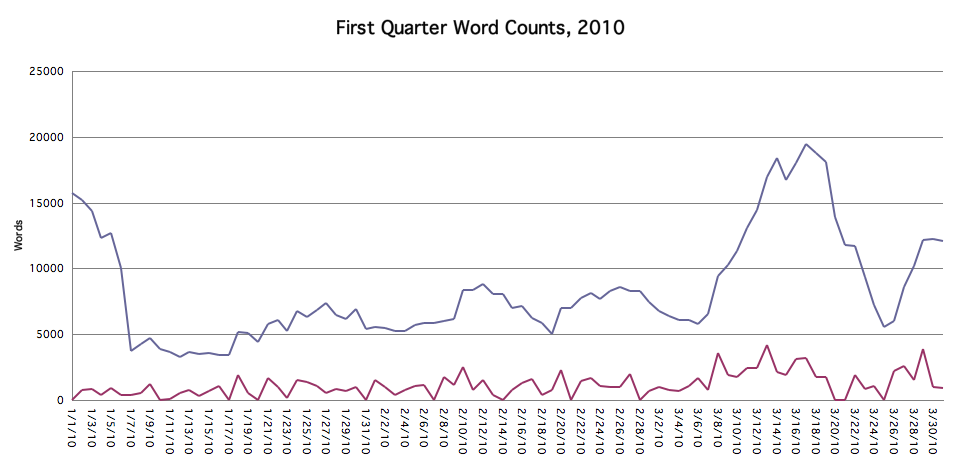
I started keeping my stats on May 25th, using a spreadsheet to keep track of my daily wordcount for each of my projects, the daily total wordcount, the 7-day cumulative wordcount, and any writing I did for synopses or revision notes.  Since BYU’s summer recess begins in April, I missed the stats  for the first three weeks or so, but I kept consistent records since then until now.

From May 25th to August 31st, I wrote 244,065 words in 8 projects (3 short stories and 5 novel drafts).  I averaged 2,490 words per day.  Adjusting for Sundays (I typically take Sundays off), I averaged 2,906 words per day.

My goals were to write 4k words per day, and to shoot for a constant 7-day total of 24k, but to never let that total dip below 12k words.  In 98 days, the 7-day running total only went below 12k eleven times–on those particular days, I was either traveling, moving out, moving in, or extremely busy with back-to-school chores.  For the two weeks I was on vacation, I still wrote more than 12k words each week.

Interestingly enough, out of the eight fiction projects, only one was a rough draft–a short story that I worked on for two days and never completed.  The vast majority of my writing went into revising novels that I’d already written.

I completed the first draft of Bringing Stella Home in early June (my third complete novel rough draft).  Later, in July, I began the second draft.  I’m currently just over halfway through with the revisions and hope to finish by October 10th.

I started a revision of my first novel, Ashes of the Starry Sea, but decided midway through that I was running up against diminishing returns and decided to drop it (I completed the rough draft in April of 2008–it was my first finished novel and the reason I started this blog, waaaaay back in August 2007).

I started a new draft of Hero in Exile, making some drastic revisions, but found it difficult to juggle more than one writing project at a time and put it on the back burner.  I may or may not pick it up again once Bringing Stella Home 2.0 is finished.

I completed the third draft of Genesis Earth and started to submit it.  I will probably do one language/readability edit before the World Fantasy convention in late October and try to sell it while I’m there.

Overall, the summer was a practice run to see if I could write full time and survive the insanity.  I always feared, as a child, that if writing became my full time job I would come to hate it.  I found, however, that writing full time (8+ hrs/day, 6 days/wk) only made me enjoy it more.  Now that school is back in session, I already wish I had more time and mental space to dedicate to my writing.

I miss the summer, but not because of the lazy days, or the parties, or the vacationing–I miss the opportunity to write full time!  Provided I can find a way to support a family off of this, I can definitely see myself turning this into a career.  In the meantime, I’ll keep honing my craft and start working on getting an agent.

Now, more than ever, I feel that breaking in is more of a question of ‘if’ than ‘when.’

🙂 🙂 🙂

Heaven’s library

2,943 words today, even though today was the first day of Writing and Illustrating for Young Readers.  I’ve reached the major climax of the book–the moment I’ve been replaying over and over in my head.  Perhaps this novel is not as bad as I’d thought–perhaps I can pull this off.  The current incarnation is terrible, but I can see in my mind how good it can be in its second or third incarnation.  Inshallah, I’ll pull it off.

Today was the first day of BYU’s writing conference, and it was great!  The speaker in the last workshop I attended, Dandi Mackall, was exceptional.  I don’t have my notes with me and the BYU library closes in twenty minutes, so I’ll recap the best part of her presentation, the story she told in the last five minutes.

She said that once she had a dream where she died and went to heaven (thank goodness!).  When she got there, the angel who greeted her offered to show her around, and asked what she wanted to see first.  Her answer?  The library, of course!

In heaven’s library, she found shelves stretching as far as she could see, full of the very best books.  She picked out a few and recognized some of her favorites, the ones that had impacted and changed her life.

After a while, though, she started to get a little disappointed: all of the books in heaven’s library were books we already had down on Earth.  Why was that?  Didn’t heaven have anything new–anything we hadn’t already seen down below?

“But all these books were here first,” said the angel.

Still, she couldn’t accept that as an answer, so the angel took her down a long, winding, narrow corridor.  The deeper she went, the narrower and dustier it became, until she started to feel uneasily.  This part of the library was dark and dirty.  It was clear that hardly anybody every came down here

Finally, the angel led her to a door covered in cobwebs.  He brushed them aside and opened the door, leading her inside.  Here was a room many times larger than the first, with old, dusty bookshelves stretching higher than she could see.

She picked out a book and started reading through it.  It was one she’d never heard of, but it grabbed her.  She could tell that it was really good.  She picked up another one, and realized that it was just the kind of book that one of her friends would have loved to read.  She picked up another one, and realized that this one could have helped out another friend when she’d gone through a terrible life crisis.

All of this made her angry. “Why didn’t we have these books?” she asked the angel. “They are just as good as the ones in the other room.  Why didn’t they make it down?”

“These are all the books that remain unwritten,” said the angel. “Each one of these is a book that a writer, somewhere below, has in them but fails to write down.

“This one is by a writer who just won’t let anyone touch her writing and give her the criticism she needs to improve her craft.  This one is by a writer who doesn’t have the discipline to write consistently and finish what he starts.  This one is by a writer who doubts her story and doesn’t think she can ever get it to work.”

At this, she nodded and let the angel lead her back out to the main room.  As she left, she saw one final book near the door.  It had her name on it.

What a great, encouraging story.  I didn’t do nearly as good a job retelling it as Dandi did the first time, but it had a tremendous impact on me. I hope sharing it with you, it does something of the same. 

For some reason I don’t understand, fate, God, or genetics (or some malicious combination of the three) conspired to turn me into a writer.  I don’t write for fame or fortune; I write because I can’t not write.  Sometimes, I wonder if I’m making a mistake trying to turn this into a career, into something that will feed myself and my future family.  Looking at the millions of other floundering writers like myself, it’s easy to feel anxious.  After all, only a tiny fraction of us will ever get published, let alone make a professional career out of this.  Do I even have a fighting chance?

But then I hear a story like this one and I remember why it is that I write.  Not for fame, fortune, publication, personal gratification, or even just because I can’t not do it.  It’s because storytelling itself is important.  It helps us connect with the world around us, to see its beauty and wonder.  It helps us to appreciate ourselves and understand others.  It stimulates our imaginations and, by so doing, helps us to life our eyes from the ground and see the divine  potential that is all around us.  It helps us to grow through vicarious experience–it helps us to live and to love.  

Writing, at its best, is a sacred act, an important act, and if by grace we have been touched by inspiration and given a story to write, we should consider it noble and honorable to bring that story incarnate into the world, to touch the lives of others and lead them to what is good and true.