How the world really works

This interview is two and a half hours long, but it’s worth listening to every minute. It completely blew my mind, and connected a bunch of things I’ve been wondering about—not in a conspiratorial way, where everything has an explanation, but in a way that makes pragmatic sense while also opening up to tons of other questions.

The TL;DW version is this: our world operates a lot like the world of the Dresden Files, with a secret history and world that is invisible to most of the mundane normies. But instead of magic, the hidden world runs on money, power, and influence. And instead of factions like the Fey, the white/red/black vampire courts, or the Denarians, the primary factions are the MIC (military industrial complex), the FIC (financial industrial complex), and the TIC (technology industrial complex). And China, which is the only major nation state that hasn’t been brought under the control of the FIC, TIC, or MIC, thanks to the iron fisted rule of the CCP.

But just like the magical world of the Dresden Files lives in fear that the mundane normies will wake up and turn on them, the people who run the world need to give the rest of us stories that will keep the masses happy and distracted, lest they rise up and ruin their ongoing machinations of power. Because even though any one of us has little to no power, as a group we have far more power than we know. Which is why they try to turn us on each other, with stuff like woke vs. MAGA, liberal vs. conservative, left vs. right, Evangelical vs. Muslim/Mormon/Catholic/whatever. It’s all fake. All divide and conquer.

The way to break the system is to remove their leverage over you. Pay off your mortgage, get out of debt, become self reliant etc. For businesses, it means to run a private company with no long-term debt or publicly traded stock, that runs a reliable profit without having to raise capital from outside sources. On the extreme end, you can opt out of the dollar entirely by going full crypto and moving to a jurisdiction where that isn’t against the law.

Under this view, what’s happening with the Iran War right now is a controlled demolition of the post-WWII world order, and the creation of a new one. Trump is an agent of the FIC, which wants to defeat the MIC by ending the endless wars and bringing peace to Western Asia (what the MIC has gotten us to call the “Middle East.”) Closing the Strait of Hormuz is the mechanism for accomplishing this, which is also in China’s interest, because the MIC is standing in the way of China’s Belt and Road initiative. Once they have destroyed the IRGC and brought Israel out from under the MIC (by ending foreign aid), the MIC will probably accept Ukraine as a consolation prize, turning that into a long-term conflict that will allow them to plunder Europe instead. The new world order will be much more stable, though the US will be much less powerful. But on the bright side, we avert WWIII.

At least, that’s what I got from it. Like I said, it’s a fascinating interview.

How I would vote now: 2023 Hugo Award (Best Novel)

Alright, let’s tackle the most controversial Hugo awards since Sad Puppies 3—and possibly the most controversial Hugos ever!

The Nominees

Legends & Lattes by Travis Baldree

Nettle & Bone by T. Kingfisher

The Spare Man by Mary Robinette Kowal

The Daughter of Doctor Moreau by Silvia Moreno-Garcia

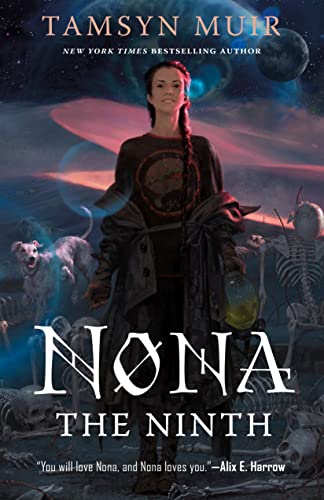
Nona the Ninth by Tamsyn Muir

The Kaiju Preservation Society by John Scalzi

The Actual Results

  1. Nettle & Bone by T. Kingfisher
  2. Legends & Lattes by Travis Baldree
  3. The Kaiju Preservation Society by John Scalzi
  4. The Daughter of Doctor Moreau by Silvia Moreno-Garcia
  5. The Spare Man by Mary Robinette Kowal
  6. Nona the Ninth by Tamsyn Muir

How I Would Have Voted

  1. No Award
  2. The Daughter of Doctor Moreau by Silvia Moreno-Garcia
  3. Legends & Lattes by Travis Baldree

Explanation

The 2023 Hugo Awards were an epic clusterfuck, from which the Hugos might never recover (and honestly, I kind of hope they don’t). Not only did the organizers exclude a bunch of titles like Babel by R.F. Kuang that probably would have placed very high, if not outright won first place—excluded them for no other discernible reason other than that they might have offended the Chinese Communist Party, since China was hosting the awards—but they also disqualified thousands of Chinese ballots for the same reason that they disqualified thousands of Sad Puppy ballots in subsequent years since the big kerfluffle in 2015: namely, that they were Wrongfans having Wrongfun.

Apparently, to get on the Hugo ballot, you have to either 1) pander to or be a member of the SFWA mean girls club (for crying out loud, two of the authors on this year’s ballot were former SFWA presidents), or 2) write a lesbian love story. I suppose you can also get on the ballot if you write a love story that’s gay, transgender, polyamorous, or some other flavor of queer, but lesbians are easier because the male readers are less likely to be grossed out or confused by it.

Anyways, I didn’t enjoy any of these books, though I have to admit that I didn’t even try to read The Kaiju Preservation Society (because I cannot stand Scalzi, either as an author or a human. The Collapsing Empire with its random throwaway sex scene in the second or third chapter was the last straw for me) and The Spare Man (my wife picked it up and was so confused and turned off by the non-gendered pronoun dickery that I knew it was too woke for me). I DNFed Tamsyn Muir’s Locked Tomb series with Gideon the Ninth, for reasons that I detailed in my recap of the 2021 Hugo Awards.

As for Nettle & Bone, I was pleasantly surprised at first, because the love interest was heterosexual—which, for the Hugos, is very unusual these days. But there were other things about the book that turned me off, such as the anachronism of a religious medieval world that’s been gutted of anything religious that might offend a non-religious reader in 2023, and a very anti-natalist bias with some lines that could have come straight from Margaret Sanger. So that’s why I put Nettle & Bone below No Award, and didn’t even bother ranking it anywhere on my ballot.

Legends & Lattes wasn’t terrible, but I got bored after the first couple of chapters, and because of the lesbian love story I’m not too keen to try it again (though I suppose I could be persuaded otherwise). As for The Daughter of Doctor Moreau, I didn’t find anything objectionable with that one, and actually got about halfway through, but… I just didn’t care about any of the characters. Not a terrible book, but it just wasn’t for me.

Of the two, I think I liked The Daughter of Doctor Moreau better, or disliked it less, which is why I put it on the ballot above Legend & Lattes and below No Award. Why include anything on a ballot below No Award? Because the way that ranked choice voting works, you can still influence the outcome that way even if No Award is eliminated during the counting. It’s basically like saying: “I don’t think any of these books deserve an award, but if I had to award one of them, I’d give it to (1) and (2), in that order.”

So that’s my take on the infamous 2023 Hugo Awards. Frankly, I think it would have been much better if the Chinese wrongfans had completely taken it over, and made it so that Worldcon was held in China every other year, with Chinese authors dominating the Hugos from now on. There are certainly enough Chinese sci-fi readers to justify such a move. But alas, it seems that the Trufans are going to keep clutching the Hugos with a deathgrip until 1) they’re all dead (since most of them are boomers anyway), or 2) the Trufans and the Hugos both become culturally irrelevant, if indeed they aren’t already.

(Speaking of China, hi Mike Glyer! Still buying views from Chinese clickfarms to boost your online rankings? It must be a real slow news week if you pick up this blog for your File 770 pixel scroll.)