2019-10-24 Newsletter Author’s Note

This author’s note originally appeared in the October 24th edition of my author newsletter. To subscribe to my newsletter, click here.

There’s this guy I follow on YouTube named Tom Luongo who has a very interesting take on Star Wars: The Last Jedi. According to him, it’s one of the best Star Wars films ever made. I recently got into an online conversation with him about it, so I thought it would be interesting to bring up some of that in this newsletter.

Tom is a radical anarcho-capitalist libertarian who lives on a farm in Florida that he and his wife built. I listen to his political commentary mainly for the contrast. He’s a natural contrarian who tends to fall into the trap of wishcasting, which has really blackpilled him in the last few years. I disagree with him almost all of the time, but he’s got a fascinating take on things, and I think his central thesis is basically correct.

You really should read or listen to Tom’s take on The Last Jedi. His argument goes something like this: the Skywalker-Solo family was always bound to come to a tragic end because the original series never resolved any of their underlying flaws, so in order for anything good to come of the family’s fall, everything built up by the previous generation first needs to come crashing down. Unfortunately, The Last Jedi falls in the midpoint of that arc, when the characters hit their lowest point, which is why so many fans were disappointed with it—just like so many fans of A New Hope were disappointed by The Empire Strikes Back the first time they watched it.

If nothing else, his argument has convinced me to watch The Rise of Skywalker, which I wasn’t planning to do. In fact, after The Last Jedi, I had pretty much checked out of the Star Wars fandom forever.

I discovered Star Wars when I was seven years old and saw A New Hope for the first time. Completely blew me away. My parents made me wait a year and a half to watch Empire Strikes Back, and for the last couple of months I was counting down the days. When I first saw Empire, I was lukewarm on it, but I really liked the Battle of Hoth and Luke’s duel with Vader (strangely, I don’t remember being surprised to learn that Vader was Luke’s father). In later rewatchings, it grew to be not only my favorite Star Wars movie, but my favorite movie of all time. I also loved Return of the Jedi, and felt that it really sticked the landing for the trilogy.

I read all the Star Wars books from the library that I could get my hands on. Timothy Zahn, Kevin J. Anderson—but it was Roger Allen McBride’s Corellia Trilogy that really opened my eyes to a different kind of science fiction. Instead of all the flashy lasers and adventurous antics, he used the limitations of physics to depict a universe far more vast and far more ancient than my young, boyish mind had ever dared imagine. I began to branch out to other works of science fiction, and over the next few years I discovered Card, Le Guin, Asimov, Clarke, Heinlein, Herbert, Burroughs, and all the other greats.

When Phantom Menace came out, it was a huge disappointment. Midichloriens? Jar Jar Binx… ugh. Darth Maul was pretty okay, but the rest of the movie was garbage. But I held out hope that Clone Wars would be better… and it wasn’t. Too much CGI, too little story. The romance was icky, the plot was too slow, and the fight scene with Yoda was a farcical caricature. I was disgusted, but I still saw Revenge of the Sith in theaters, because surely they had to get Vader right… and once again, they failed. Massive disappointment. It was like Lukas had taken a massive dump on my childhood, and was trying to sell it back to me as merchandise.

I cooled off to Star Wars for the next few years. It was never a religion to me. I dabbled a bit with the video games and expanded universe novels, but at this point in my life, I was more of a casual fan. I turned to other works of science fiction and fantasy, and began to pursue my own writing more seriously.

Ever since 4th grade, I always knew I would be a writer. All through high school I had some novel project or another I was working on, but it wasn’t until college that I finished any of them. In 2008, I took Brandon Sanderson’s writing class at BYU and finished my first novel. Incidentally, my wife was in the same class, though it would be another ten years before we met each other.

When The Force Awakens came out, my expectations were low. I didn’t want to get shafted like I had by the prequels. It was probably because of those low expectations that I enjoyed it. Han Solo’s character was utterly ruined, and the plot was little more than a rip-off of A New Hope, but hey, at least it didn’t totally suck! Then Rogue One came out, and it was excellent. On par with the original trilogy. Star Wars was back.

And then, The Last Jedi… green alien breastmilk… Leia Poppins… Admiral Gender Studies… Space Vegas…

Ironically, I think I would have hated it less if Rogue One hadn’t been so good. By the time TLJ came out, I felt like I was on a rollercoaster that was giving me a really bad case of whiplash, and I just wanted it to end. The low points felt so low because the high points were so high, and with TLJ it felt like it was all crashing down again.

At that point, I noped out. No more Star Wars. I was out. The fact that so much of my childhood—and not only that, but my chosen career—was so tied up in the franchise only made it that much more painful.

And then I heard Tom Luongo’s take on The Last Jedi, which has made me rethink some things. I’m not entirely convinced that it’s a great film, but perhaps it’s not as flawed as I thought it was. It really does come down to The Rise of Skywalker. Will it bring the roller-coaster ride to a satisfying conclusion, or will it fling us off the rails the way the prequels did? (“nooooooooooooo!”) I guess we’ll find out in December.

Thoughts on the new Star Wars trailer

I have a lot of thoughts on the new Star Wars trailer. But first, a little background.

Growing up in the 90s, I was a huge Star Wars fan. It’s not an exaggeration to say that Star Wars was my life. I played X-Wing every day, I watched at least one of the original trilogy movies every week, I read every Star Wars book in the library that I could get my hands on, and I daydreamed and made up Star Wars stories all the time. I was living in the golden age of science fiction (about age 9-12), and that meant Star Wars.

Then Episode I came out. Like all the other fans, I was super, super excited about it. Like all of the other fans, it was a huge disappointment. Several things ruined that movie for me, but the biggest were Jar-Jar Binks and midichloriens. The most magical aspect of the Star Wars universe, the Force, was singlehandedly ruined by the whole midichlorien thing, and as for Jar-Jar … I don’t even want to go there.

There were a lot of other little things too: like the pod racing sequence, where the sand people were thrown in for a gag, and that part where Obi Wan and Qui Gon Jinn drove a submarine through the center of the planet. My suspension of disbelief was stretched to the breaking point, and this awesome thing that I loved now felt like a little kid story. But the biggest things that broke the movie for me were Jar-Jar and the midochloriens.

But that was Episode I, and Episode II was bound to be better. After all, how could you screw up the Clone Wars? Unfortunately, I was about to find out.

To be fair, Episode II wasn’t nearly the disaster that Episode I was. Not that that’s saying much, but still, it wasn’t horrible–it was just bad. The romance was cringe-worthy, the pace was glacial, and the action sequences had too much flash and not enough substance.
Jar-Jar was gone (thank the stars!), but C-3PO and R2D2 were little better, and the fact that they were in the story at all caused a major sprain to my suspension of disbelief. The lightsaber duel with Yoda and that other guy felt like it was thrown in for a gag, and Anakin … yeah. By the time the big stadium battle happened at the end, all I could do was yawn. The battle of Hoth had a lot less flash to it, and yet was infinitely more engrossing.

By this point, I’d started to phase Star Wars out of my life. I still occasionally watched the original trilogy movies, and played stuff like X-Wing: Alliance from time to time, but I wasn’t nearly as invested in the franchise as before. I’d moved on to stuff like Tolkien and Lord of the Rings, and spent more time playing stuff like Civilization and Alpha Centauri. Star Wars did not hold the same magic as it had before.

Then came Episode III, the final nail in the coffin for me. I can sum it all up in one word: “NOOOOOOOOOOOO!!!!!
Episode III was marginally better than Episode II, but that was only because of Order 66, where all the Jedi died and the Republic transformed into the Empire. Order 66 was pretty cool. But the rest of the movie? I mean, right from the first battle, I knew that it was going to suck. When a ship in orbit tilts to one side, it does NOT cause everything to fall in that direction! Lucas might as well have shown people falling off of the south pole. From that point on, my suspension of disbelief was shattered beyond any hope of recovery.

But the worst part was Anakin’s transformation. Here’s a guy who is supposed to turn from this whiny, annoying brat into the most iconic sci-fi villain of all time … and I just wasn’t buying it. With each progressive step, he just didn’t seem any different than before. Instead of the character driving the story, it felt like the plot was shoehorning the character into a role, and all he could do was passively accept it. The slaughter of the young Jedi knights at the temple, the oath of fealty to Chancellor Palpatine–none of it felt authentic at all. And even after he put on the mask, he was still the whiny, annoying brat from before. Darth Vader, the linchpin of the entire franchise, was ruined.

At that point, I completely checked out. That’s right–the kid whose whole life was tied up with Star Wars now wanted nothing to do with it. I still went back to some of the old, pre-Episode I stuff from time to time, just for nostalgia’s sake, but I had no desire to keep up with any of the new stuff that was coming out. Books, games, TV shows–I was done.

Then Disney bought Star Wars, and rumors started to fly. My expectations at first were pretty low, but George Lucas had done so much to screw it up already that I figured Disney couldn’t do any worse. Then I realized that Disney does a lot more than princesses and fairy tales these days, and my indifference turned to curiosity. When J.J. Abrams was slated to direct it, curiosity turned to the faintest glimmer of hope.

Which brings us to this:

I have to be honest, I’m actually kind of excited. After all that the prequels did to ruin Star Wars for me, that’s saying quite a lot.

First of all, the black stormtrooper. I’ve heard a lot of griping about the fact that he’s black (or more accurately, that he isn’t one of the clones from Episode II), but come on guys–do you really expect the first generation stormtroopers to stay on active duty for fifty-plus years? Of course the Empire is going to replace the clone warriors with newer soldiers (hopefully, ones that can actually shoot).

Personally, I think it’s kind of awesome that he’s black. More than that, though, I think it’s awesome that he has a face. Imperial stormtroopers have always been quintessential mooks, and that’s always bugged me. Just once, I’d like to see the good guys face off against a bunch of stormtroopers who can actually shoot straight–it would add a whole new level of tension and danger. To feature one as an actual character is promising indeed

One of the things I loved the most about Star Wars was the grungy, dirty, second-hand feel of most of the technology. In the original trilogy, you really get the sense that you’re in a used future, especially on the planet Tatooine. From what I can see in the trailer, it looks like they’re bringing that back. Deserts + derelict spaceship wreckages + super fast hovercars that look like they’re about to break down = OMG YES.

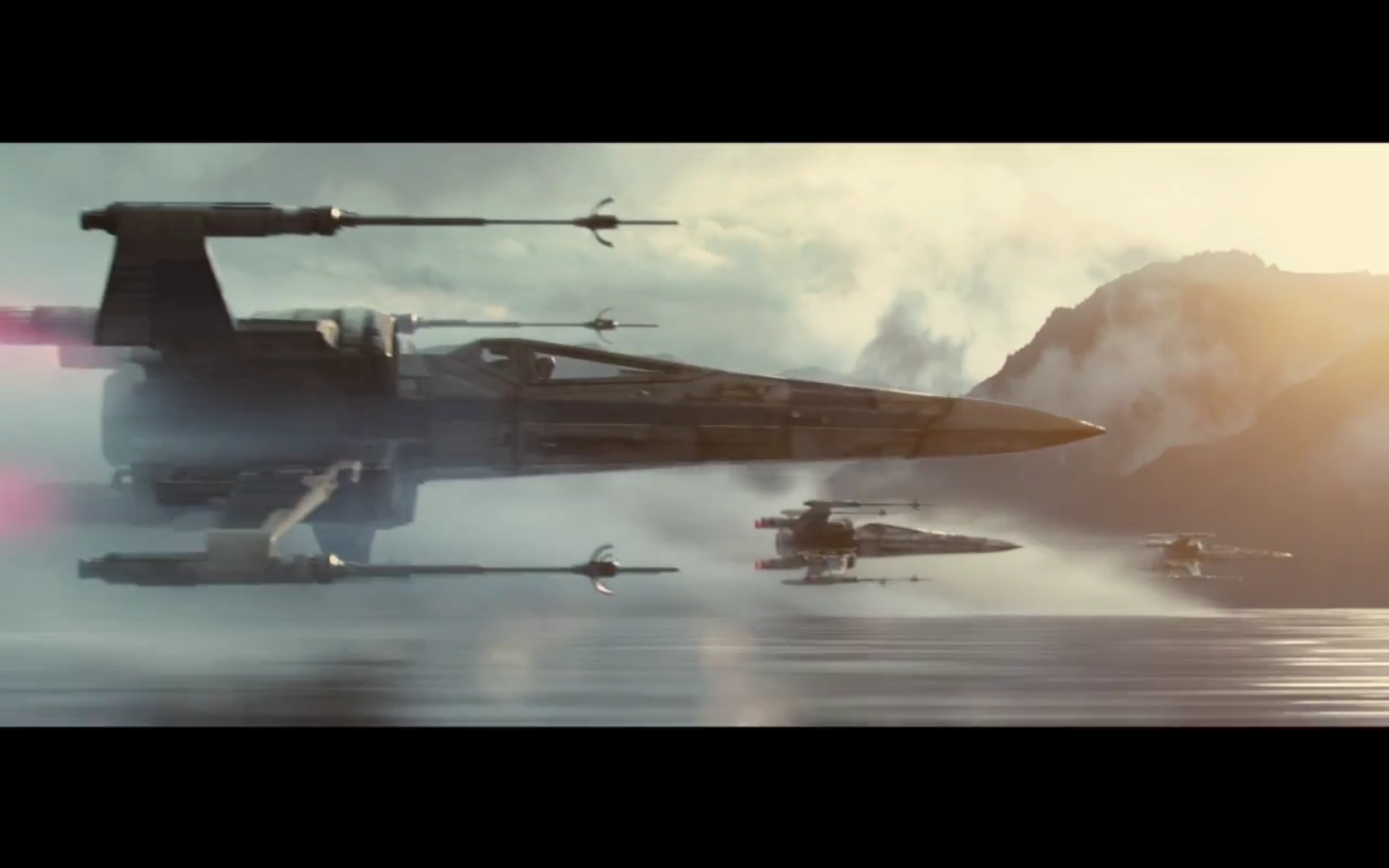
But the part of the trailer that really won me over was this part right here:Screenshot from 2014-12-12 11:12:18Specifically, how realistic the X-Wings look. The way they kick up those clouds of water as they buzz the surface of that lake–you can’t deny, that’s pretty freaking awesome. My biggest running issue with the prequels was how they constantly abused my suspension of disbelief, so the fact that these X-Wings actually look real is perhaps the most promising part of the trailer for me.

Yes, the bad guy’s lightsaber with the dinky little lightsaber spurs looks … well, dinky. No argument there. But the last part, with the Millennium Falcon doing the crazy barrel roll as the music hits you with all of its glory–HOLY CRAP YES!!!!!

There’s not a whole lot of substance in this trailer. It’s only a tease–but wow, what a tease! I’d hate to get my hopes up only to have them dashed as badly as Episode I dashed them, but I’ve got to be honest: I’m actually kind of stoked for this movie now.

Episodes I, II, and III alienated a lot of the older fanbase, but it did appeal to the younger generation that came to the Star Wars universe without any preconceptions or expectations. Before I saw the trailer, I thought that Episode VII would simply continue that trend. Now, I actually think it may turn things around–bring back the old-school fans while showing the younger generation that Star Wars can be so much more.

Y is for Yesteryear

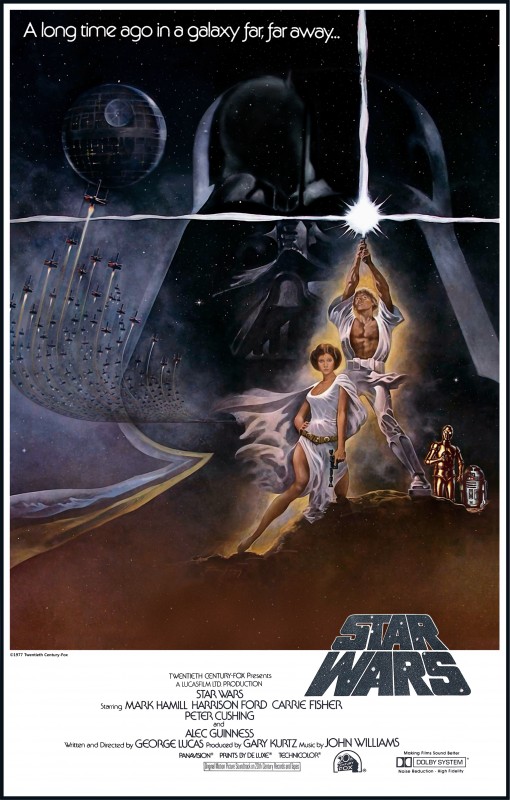
Star_wars_oldThey say that the golden age of science fiction is about twelve years old.  That’s definitely true for me.

My first exposure to the genre was Star Wars: A New Hope.  I saw it when I was seven, right around the height of my dinosaur phase.  Everything about the movie completely blew me away, from the Jawas and Sand People of Tatooine to the stormtrooper gunfights and lightsaber duels.  After watching Luke blow up the Death Star, I spent the next few hours running around the yard pretending to fly my own starfighter.

In a lot of ways, I’ve never really stopped.

My parents made me wait until I was nine to watch The Empire Strikes back, because it was rated PG.  Without any exaggeration, I can say that those were the longest two years of my life.  I was literally counting down days by the end, and to pass the time without going crazy, I read up on all the books about space that I could possibly find.

My father bought the original X-wing flight simulator game somewhere around then, and I soon became totally engrossed in it.  Since the 386 was our only entertainment system (no Super Nintendo–I had to visit a friend’s house for that), X-wing became the defining game of my childhood.  I spent hours and hours on that game, to the point where I knew exactly which simulated missions the characters from the books were flying and how to complete them faster and easier.

I thought The Empire Strikes Back was a little slow the first time I saw it, but it’s since grown on me, to the point where now it’s my favorite film in the whole series.  Thankfully, my parents let me watch Return of the Jedi the next day, and for the next few months my life felt utterly complete.

Around this time I discovered the Star Wars novels and soon immersed myself in them.  The Courtship of Princess Leia by Dave Wolverton soon became one of my favorites, as well as the Heir to the Empire trilogy by Timothy Zahn and the X-wing series by Michael A. Stackpole.

But it was Roger Allen McBride who first introduced me to a different flavor of science fiction with his Corellia trilogy.  As I mentioned in V is for Vast, those books had just enough of a touch of hard science to intrigue me about the other possibilities of the genre.  That was the last Star Wars series that I read before branching out into other works of science fiction.

The Tripod trilogy by John Christopher was my first introduction to the dystopian / post-apocalyptic genre, depicting an enslaved humanity after an alien invasion.  Those books really captured my imagination for a while.  The Giver was also quite interesting and thought provoking, though since it didn’t involve spaceships or aliens it wasn’t nearly as compelling.

I read a lot of fantasy in my early high school years, including Tracy Hickman, Lloyd Alexander, and (of course) J.R.R. Tolkien.  While I enjoyed those books and immersed myself in them for a while, my true love was still science fiction.  For almost a year, I watched Star Trek: Voyager religiously with my dad.  And every now and again, I’d pick out a science fiction book from the local town library and give it a try.  That’s how I discovered Frank Herbert’s Dune.

In eleventh grade, my English teacher had us choose an author and focus our term papers solely on their books for the entire year.  She suggested I choose Orson Scott Card, but I chose Cormac McCarthy instead.  I’m not sure if that was the worst decision of my high school career, or the best decision, since assigned high school reading tends to make any book feel like it sucks.  I discovered Ender’s Game the following summer, and finished it in a delirious rush at 3am the morning after checking it out from the local library.

More than any other book, Ender’s Game cemented my love for the genre, and showed me just how powerful and moving the genre could be.  It opened so many insights into the world and human nature, reading that book made me feel like I’d opened a pair of eyes that I didn’t even know I’d had.  Looking back, that was probably the moment when I knew I would be a science fiction writer.  I’d known I was going to be a writer ever since I read A Wrinkle in Time at age eight, but to be a science fiction writer specifically, that goal was probably cemented by reading Orson Scott Card.

After high school, I served a two year mission for my church, during which I didn’t read any novels or watch any TV or movies.  When I came back, though, Orson Scott Card and Madeline L’Engle helped me to ease through the awkwardness of adjusting back to normal civilian life.  When I left for college, I expanded my horizons even further, starting with Isaac Asimov’s Foundation series and Edgar Rice Burrough’s Princess of Mars.

When I discovered Pioneer Books in downtown Provo, I knew I’d found my favorite bookstore in Utah Valley.  I have so many fond memories sitting cross-legged on the floor in the science fiction section, browsing through the musty used books for hours at a time.  That’s where I discovered C.J. Cherryh, Arthur C. Clarke, Robert A. Heinlein, Ursula K. Le Guin, and numerous other authors who are among my favorites today.

When I discovered Spin, Robert Charles Wilson soon became one of my favorites.  I picked up that novel as a free PDF from Tor, and read it over the summer while studying abroad in Jordan.  Once again, that same hard sf sensibility I’d gotten from Roger Allen McBride touched me in an unforgettable way.  But it was the human element of that book that really moved me–in fact, it’s always been about the human element.  The world building in Downbelow Station was great and all, but the romance of Merchanter’s Luck had a much more lasting impact.  Starship Troopers had some good ideas, but it was Mandella’s personal journey in The Forever War that moved me almost to tears.  The intrigue of the Ender’s Shadow series was quite entertaining, but it was Ender’s Game and Speaker for the Dead that really taught me what it means to be human.

I finished my first novel, Genesis Earth, shortly after returning from that study abroad, and tried to capture the same sensibility from Spin as well as the intimately human element.  Since then, I’ve written several more sci-fi novels, some of them tragic, some triumphant, but in all of them I’ve tried to get as close as I can to the personal lives of the characters.  I don’t know if I’ll ever write a character portrait so intimate as Shevek’s in Ursula K. Le Guin’s The Dispossessed, but I certainly hope to someday.

For me, science fiction started out as a wonderfully exciting entertainment and turned into something much more meaningful.  If there’s anything the genre has taught me, though, it’s that the two aren’t mutually exclusive–that you can have your adventure and learn what it means to be human as well.  Indeed, the more imaginative the adventure, the greater the truths I’ve taken from it.

Because of that, even though I’m almost in my thirties now, I can’t possibly foresee a time when science fiction isn’t a major part of my life.  It’s a love affair that’s grown just as much as I have, and continues to grow with each new author I discover and each new book I write.  When I’m old and grizzled and pushing eighty, I’m sure there will still be a part of that twelve year old boy in me, still running around the yard flying his starship.

Trope Tuesday: Childhood Friend Romance

Oh come on--you just KNOW that they get together!

There’s something heartwarming about a romantic couple that knew each other as children.  Maybe it’s that return to innocence, or a sense that destiny is on your side, but I find these kinds of stories hopeful and encouraging.

My favorite example of this is probably Deanna and Michael from For Better or for Worse.  My sister was obsessed with that comic growing up, so my parents bought her just about every book and I got to read them all.  I still remember when Deanna showed up again, after seven or eight books: at first, I was like “holy cow, is it the same girl from way back when Michael was a little boy?” And then he started dating her, and I was like “YES!!!”

Another good example is Phantom of the Opera, with Christine and Raoul.  Lloyd Alexander’s Chronicles of Prydain also had a long-running friendship between Taran and Eilonwy, which eventually took a romantic turn.  Apparently, Jane Austen was also fond of this trope, though I haven’t read enough of her to be able to say.

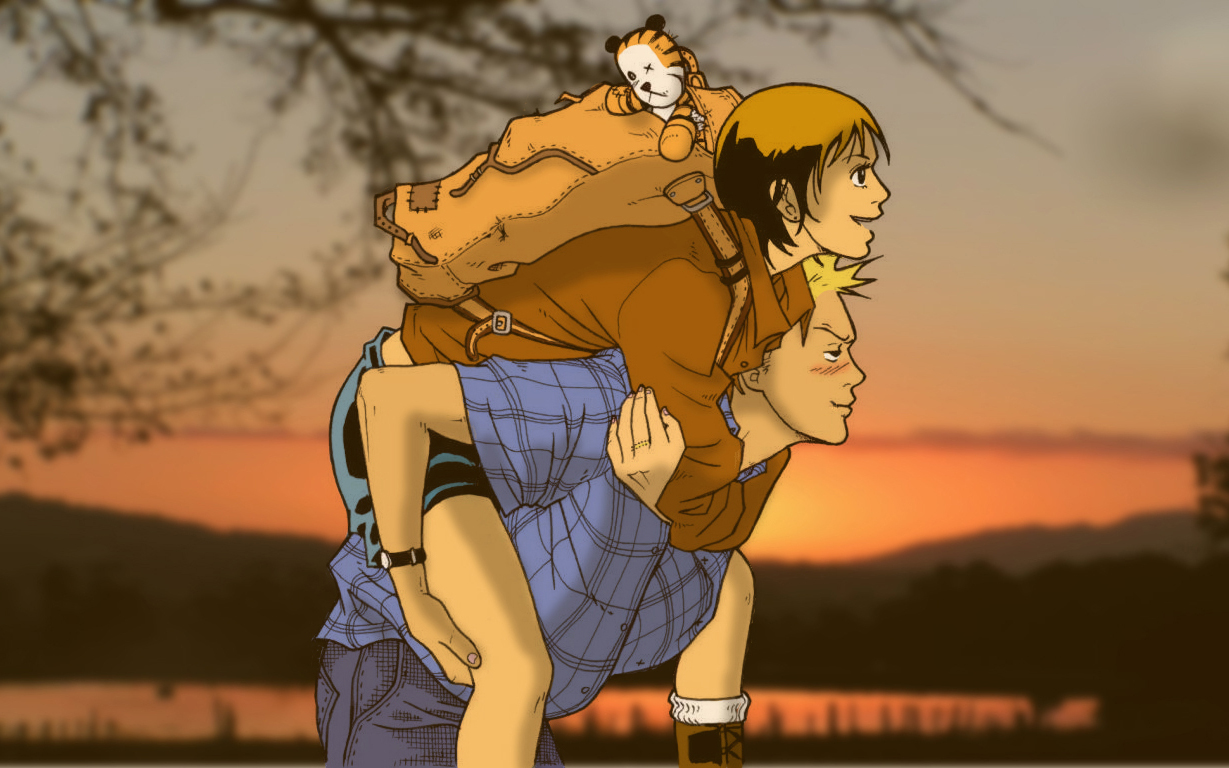
A lot of times, this trope is coupled with a childhood marriage promise.  It doesn’t have to be, though; I just love the thought that Calvin and Susie eventually end up together, even though they hate each other as kids.  As a storytelling device, this trope can also work well in conjunction with first girl wins.

Sometimes, though, the love is unrequited.  In many stories, this happens when one of the friends thinks their relationship is more like a brother and sister thing.  The scientific rationale for this is called the Westermarck effect, where people become sexually desensitized to those with whom they grow up together.  A good example of this would probably be Cyrano de Bergerac; the whole nose thing was more a self-esteem issue for Cyrano than a turnoff for Roxane.

In the Middle East, where it’s still common for first cousins to marry, this trope tends to be a lot more prevalent.  In Arabic 202, we read several magazine stories about couples who fell in love after growing up together.  There might be a bit of a squick factor there for Western readers, though–and that’s something you have to look out for with this trope.  If the characters really are like brother and sister, and they get together anyway…ew.

So there you have it.  For an innocent, hopeful, satisfying romance or romantic subplot–or a crushingly depressing tale of unrequited love–the childhood friend romance trope can be used to great effect.

Image courtesy sora1589. Line art by nami86.

Apocalyptic story idea

Ok, here’s another crazy story idea.

When I was really young, I used to hang upside down off the edge of the bed and look up at the ceiling, trying to imagine what it would be like if the ceiling were the floor and the floor were the ceiling.  You should try it sometime–it really changes the landscape of your house.  I think there was a Calvin and Hobbes comic strip on this same concept, too.

So, here’s the idea.  It’s a little wacky, but here goes.  What if everyone, all over the world, suddenly fell UP instead of falling DOWN?  Not objects, or animals, or anything else–just people.

Imagine where you are sitting right now.  Look up.  What would it be like if all of a sudden you fell down–or, rather, up?  Would it hurt?  How much?  Would you die?  Would you be able to grab onto something?  What would it be like once you stood up and found yourself on the ceiling?

Then, imagine the change to the landscape!  Imagine the change to the WORLD!  Instead of sky, there’d be nothing but ground overhead, and a giant, bottomless blue abyss beneath!  Would you be able to leave the building you’re in?  If you were in your car, what would you do?  If you were in your car, and you got into an accident, what would you do?

Imagine all those people, walking around outside in the city streets, or walking around campus the moment the apocalypse hits, and BAM!  They’re all falling skyward!  How crazy would that be?  How tragic!

What would you do after you’d realized what happened?  Would you be able to get around?  If you had access to a car, probably–just lie down on the ceiling and drive upside down, I suppose.  But then again, what about the accelerator pedal?  How would you reach it?  You’d have to rig something up–it would be difficult.

And what if you were trapped in a building with no way out?  What if your car were parked outside somewhere?  How would you survive?  Where would you get food?  What would you do once that ran out?  How would you contact people?  Would you even make it?

What if the ceiling weren’t strong enough to support your weight?  What if you fell through it?  What if you were with someone who fell through a weak part in the ceiling?  What would happen?

You get the idea.  It’s a pretty wacky idea, but think about it–if it happened, it really WOULD be apocalyptic!  Crazy!