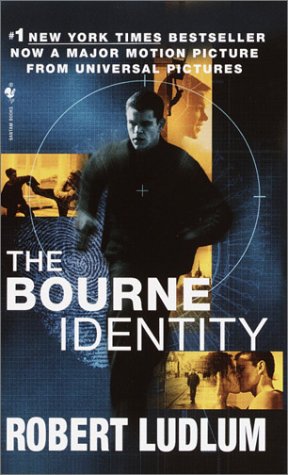
The Bourne Identity by Robert Ludlum

On a stormy night off the coast of Marseilles, a local fishing trawler recovers a man with a gunshot wound to the head.  The local doctor patches him up, but when he recovers, he has no knowledge of his past life.  Even his name is a mystery.

Fortunately, he has a clue to help him get started: a microfilm surgically implanted in his hip containing an account number for a bank in Switzerland.

When he arrives in Switzerland, he finds that the account contains millions of dollars, as well as a name: Treadstone 71.  Before leaving the bank, however, a squad of hitmen attack and nearly kill him, for no reason that he can possibly understand.

On the run from people he doesn’t know for things he doesn’t remember, Jason Bourne finds himself in a struggle, not only for his life, but to find his true identity.  But the answers, he fears, are much, much darker than he can possibly accept.

Okay, to start things off, let me say that this book is NOTHING like the movie.  NOT AT ALL.  The two are completely separate stories.  The beginnings of both are similar, with the whole amnesia thing and the bank account number implanted in his hip, but after Jason leaves Marseilles, everything gets different.  EVERYTHING.

For that reason, it’s difficult to say which is better, because they both try to do very different things.  The movie is more about the action and suspense; the book is more about the intrigue and character development.  Both succeed quite well at what they respectively set out to do.

That said, I enjoyed the book at least as much, if not more than the move.  Ludlum’s writing is quite good, and he paints an excellent picture of both the exotic European setting and the complex psychological portrait of his main character.  Unlike Crichton, whose characters often fall flat, Ludlum does an excellent job creating characters who stand up on their own right.

The suspense lagged somewhat in the middle for me, when the details about Cain and Medusa came to light (that’s one thing I’ve got to say about Crichton–he’s a master of suspense), but it wasn’t enough to keep me from finishing.  The ending, however, was atrocious–not in a clumsy way, but in a too-many-loose-ends kind of way that meant that the story wouldn’t truly be resolved until the sequel.  I hate stories that do that, but oh well, what can you do?

Overall, though, the book was quite good–better than I expected.  I can see why Ludlum was such a successful writer: he created interesting, capable characters and put them in exotic, foreign settings to fight ruthless, evil villains in a desperate zero-sum struggle for survival.

Interesting characters + exotic setting + high stakes conflict + good writing = win.  Oh, and Bourne is way more awesome than Bond. Just sayin’.
Thoughts after finishing In the Realm of the Wolf

Wow.  I just finished In the Realm of the Wolf by David Gemmell a couple hours ago, and it was AMAZING.  So amazing, in fact, that I want to write a post examining my reaction to it before I write the review.

You know that ecstatic, otherworldly feeling you get when you finish an amazingly good book?  Where you feel like you just came home from a long, epic journey and you can’t stop thinking about it?  Where your mind is racing with all sorts of new and beautiful ideas, as if you’ve opened your eyes for the first time?

That’s how I felt after finishing this book.

As a writer, I want more than anything for my readers to have the same experience when reading my books.  I don’t expect everyone will, but I want to be able to connect with a good chunk of my readers this way.  David Gemmell does this for me, and my main question is therefore: how does he do it?

Looking back, I’ve got to say that the book started good and steadily got better, right up until the awesome finish.  The first two chapters were good, but around the third chapter, my expectations started to be exceeded.  It wasn’t until the last half of the book that I realized just how much I was connecting with the characters, and when the climaxes hit, I found myself rooting for them more than I usually do.

So I guess escalation had something to do with it.  Gemmell starts with a pretty simple plot: Waylander has to evade a bunch of guild assassins out to kill him, but he doesn’t want to because his wife just died and he’s depressed.  Then more and more characters get involved, and the stakes steadily grew until the fate of global empires hung in the balance.

Yet throughout it all, the focus was always on the personal conflicts and the impact of the events on the individual characters.  The vast armies sweeping the land were more of a background setting element than anything else; the real story lay in the choices the characters made and why they made them. And when the characters started confronting their demons, I rooted for them as if they were my close, personal friends–or more than friends.

Yet Waylander himself is very much a larger-than-life character.  He’s a better hunter and tracker than the Sathuli tribesmen, a better swordsman than most of his opponents, by far the best crossbowman in the Drenai saga, and a cold, efficient killer with a body-count of hundreds.  Not only is he rich enough to support the bankrupt king of Drenai singlehandedly with his vast financial assets, but in each of the three books in his trilogy, he plays the most pivotal role of any character in the rise and fall of nations and empires.

And yet…I can still connect with him.  Why is that?

Maybe it’s because he’s far from perfect.  He vanquishes hundreds of soldiers, assassins, monsters, and demons, but he doesn’t escape uninjured.  In Realm of the Wolf, his less-than-perfect swordsmanship is a key element of the plot.

It’s the internal conflict, however, that really makes me connect with him.  Don’t get me wrong–I’m not a cold, unfeeling killer, nor have I lost my whole family to roving bandits–but I can understand his struggle to find happiness in the face of so much evil, both within him and without.

Or maybe it’s not so much that I understand him as that I’m fascinated by him, and I don’t know why.  It certainly helps that he has a soft side–that he’s not a complete monster.  In all the books, his quest is always to save lives, not just to take them, and every once and a while he does something to keep my sympathy.  The way he spared the Sathuli scout in Realm of the Wolf, for example.

Overall, though, I think it’s the characters and their conflicts that made this book come alive.  Waylander is basically an adventure tale with some interesting characters; In the Realm of the Wolf is also an adventure tale, but the personal stakes are much higher, and the focus is more on the characters than on the rise and fall of empires.

Anyways.  I still feel like there’s something elusive that I’m not quite getting, but those are my thoughts after finishing this book.  If you didn’t find it helpful, I hope you at least found it interesting.  And if you have the chance, read the trilogy!  It’s goood!

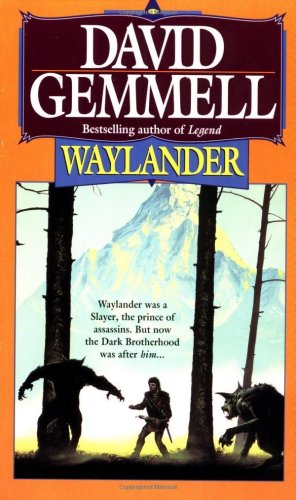
Waylander by David Gemmell

The Drenai lands have been overrun, and the Vagrian conquerors, led by Kaem and the Dark Brotherhood, are laying waste to all that lies before them.  Only the stronghold at Purdol withstands them, but unless the Drenai can rally a counterattack, all will be lost.

In these trying times, a strange old man visits the assassin Waylander and urges him to go to the sacred Nadir mountain of Raboas and retrieve the legendary Armor of Bronze.  With this armor, the Drenai commander Egel can rally the army that will save the kingdom.

But Waylander is a hunted man–a man of dark secrets and many enemies.  Kaem wants him dead for killing his son.  The Nadir want him dead for violating their lands.  And the Drenai want him dead for assassinating their king.

I love David Gemmell.  When you pick up one of his novels, you know exactly what you’re going to get: gritty, complex characters, bloody battles, ruthless villains, and difficult moral decisions that transform even the most depraved individuals into true heroes, if only for a few moments before they die.  Waylander is no exception.

Perhaps the most interesting part of the book is the story behind the founding of the Thirty.  When the young Source priest named Dardalion forsakes the pacifism in order to save the lives of his fellow countrymen, twenty nine fellow priests join him to form the band of legendary warrior monks.  This religious order goes on to play a pivotal role in some of Gemmell’s best works.

Waylander himself is also an interesting, memorable character.  During the events of Waylander, he’s basically hit rock bottom, but as he learns again what it means to love and fight for what he loves, he climbs out of that dark place.

I really enjoyed this book.  My only complaint is that the ending felt a little rushed.  All the plots and subplots get tied up, but some of them so abruptly that there’s little room to savor the emotional impact.  Still, the novel was quite satisfying overall.  I look forward to reading the next book in the Waylander saga.

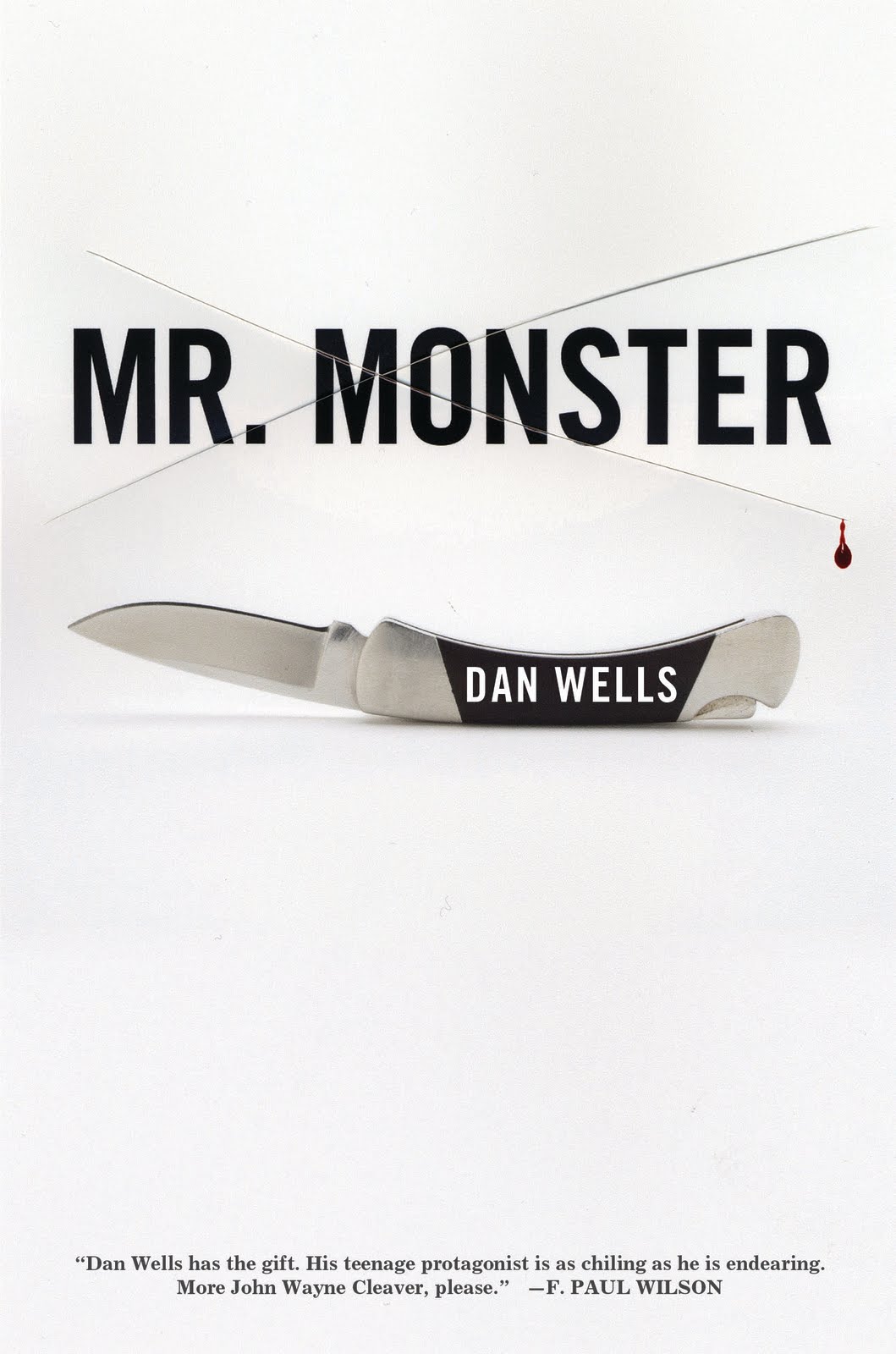
Mr. Monster by Dan Wells

John Wayne Cleaver wants very much not to kill you.  He wants it so much, in fact, that he’s made up a host of rules to keep his inner monster from taking over.  The way he complimented your shirt, for example–he said that to counteract the delicious thought of you tied to a wall, screaming in terror while he skins you alive.

It’s nothing personal.  He doesn’t hate you.  He just has a need–or rather, his inner monster has a need–to take your life.

You see, John Cleaver is a sociopath with all of the psychological tendencies of a serial killer.  Now that he’s killed once (albeit to save his community from an ancient demon), it’s getting very difficult for him to tell who he really is.  Is he his addiction?  Or is that a separate persona–one that he can control, suppress, and eventually overcome?

He’d better find out quick, because a new killer has arrived in town–a demon, just like the first–except this one is in touch with the Brotherhood.

This was a good book.  I enjoyed it as much as I enjoyed the first, perhaps a little more so.  The ending was awesome–excellent lead-in to the last book in the trilogy.  Too bad we have to wait a year to read it. <shakes fist at the universe>

Dan Wells is very good at writing strong, well-developed characters, especially with his main character, John Cleaver.  This might sound bad, but as a Mormon I can relate with John’s personal rules to keep his stray thoughts under control.  Not that I have a secret desire to murder people, but I’d be lying if I said that it’s easy to live a celibate, porn-free lifestyle as a twenty-something young man.  But I digress.

The best part of this book was the way the romantic tension compounded the basic conflict of John vs. his need to kill.  It’s not easy to date a girl when you have passionate dreams every other night of killing her.  That tends to make things a little awkward (just a little).  In spite of how sick that might sound, John and Brooke’s relationship is quite compelling, and I found myself instantly drawn to them because of it.  Again, it makes it easy to relate–not that I, uh–yeah.  Whatever.

Overall, the book is great.  However, I do have one criticism, which may be more personal, but I’m sure it applies to others as well.  When John confronted the killer, things got a little too disturbing for me–not the tense, wide-eyed, “oooh, what happens next?” kind of disturbing, but the “this is just wrong–why am I reading this?” kind of disturbing.  It didn’t make me put the book down, and the resolution was quite satisfying, but I did step back and ask that question at one point.

The ending, though, is pure awesome.  The last page–man, I’m looking forward to see what happens next!  And if there are only three books in this series, John Cleaver has to come to terms somehow with his inner monster–he can’t continue in this way all his life.  He just can’t. He’s got to find some kind of equilibrium.  And him and Brooke–well, let’s just say I’m very eager to see how the series wraps up.

Mr. Monster comes out in the US at the end of September (I borrowed the UK edition from my sister).  Like I said, it’s probably not for everyone, but if you can stomach a particularly gruesome episode of Law and Order: SVU, you shouldn’t have a problem with this book.  Or should you?  Guilt!  Guilt!

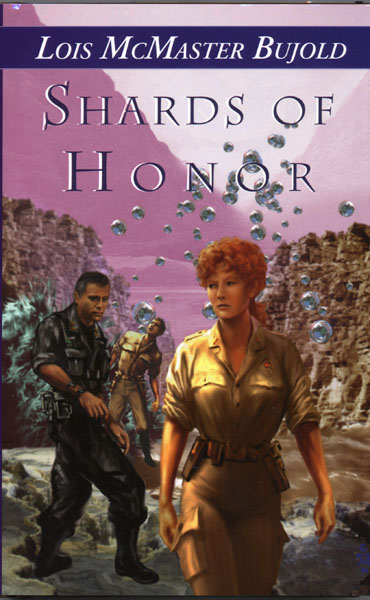
Shards of Honor by Lois McMaster Bujold

Cordelia Naismith never thought she would find the love of her life on a scientific survey to an unexplored border world, let alone that he would be a Barrayan, one of the enemy.  But Aral Vorkosigan is not just any other officer in the Barrayan Military.  He is courteous, fair-minded, thoughtful–and above all else, driven by an innate sense of honor.  To her surprise, Cordelia soon finds that she has more in common with the man than she thought possible.

But the rumors of war between Escobar, Beta Colony, and Barrayar soon conspire to drive them apart.  Though Cordelia sees Vorkosigan for the good man he is, the rest of the galaxy only knows him as the “Butcher of Komarr”–an unfortunate title which Vorkosigan does not entirely deserve.

As Barrayar goes to war and Cordelia finds herself rising through the ranks of the Betan Military, she is forced to choose between loyalty to her country and loyalty to the man she loves.  When the two are mutually exclusive, how does one preserve one’s honor while securing a degree of happiness?

I loved this book.  Unlike some romances, where the male protagonist is a complete douchbag, Aral Vorkosigan is the kind of guy I’d like to be like.  Bujold strikes an excellent balance between strong and sensitive that enhances, rather than taints, his manliness.  Besides that, Vorkosigan is extremely fascinating, with a complicated backstory and motivations that are both believable and interesting.

Though it’s technically a romance, the book reads very much like military science fiction, with deliciously tongue-in-cheek phrases like “the cadet was too young to believe in death after life” and rigorous attention to the details of military life, such as rank and chain of command.  The book definitely has enough explosions, space battles, and political intrigue to appeal to boys as well as the romance audience, but Bujold melds the space adventure elements seamlessly with the romantic elements, so that readers of either genre don’t feel left out or patronized.

There was only one thing that bothered me, and since it contains spoilers I’ll put it in black so that you don’t inadvertently see it.  To read it, highlight the text:

After Cordelia ran away from home and married Vorkosigan, why did she never think about her homeland again? You would think that as a career military officer who had dedicated her life to her country, she would at least have some lingering doubts that she’d done the right thing by running away–especially when her husband became the new Lord Regent of Barrayar! To me, this seems in-congruent with her character.

All things considered, though, this was an excellent, well-written science fiction adventure/romance. I thoroughly enjoyed it and will definitely be reading more of Lois McMaster Bujold’s work again.

Thoughts on the convolutions of discovery writing

It’s been forever since I posted, so I figured I’d put something up and let you guys know what I’ve been up to.

I’m happy to say that Worlds Away From Home is going well; I wrote just under 20k this week, which is more than I’ve written in a long time.  I hope to keep a steady 15k to 20k for the next three weeks as I finish this draft.

I think I’m through the roughest parts (famous last words, right?), and I’ve got a fairly clear idea where I want to take this.  That is, I have a target ending that’s both specific enough to give me direction and vague enough to give me some flexibility.  If I’m doing things right, I expect these characters will surprise me before the end.

When I first started this novel almost two years ago, I hit a bad rough patch right around my current spot and had to put it on hold for a while.  At the time, I thought it was because of a particularly difficult scene (which I just rewrote), but now I see that the problem was much bigger.

I thought that I was telling a story about a guy who nearly falls for the wrong girl and ends up with the right one in the end, when really the first girl was the right one.  Once again, I found myself telling a very different story than the one I set out to tell.

Interestingly, in order to see what I needed to do to fix the problem, I had to write a completely unrelated novel in the same world about the same overarching world events.  My problem, I think, was that I spent so much time world building that I stopped paying attention to what the characters were doing.

With the current draft, I’ve discovered that this story is very solidly a science fiction romance.  There’s plenty of sf action, but it’s the romance that drives the plot.

While this discovery comes as a pleasant surprise, it also worries me because the potential audience may be very small.  Traditionally, science fiction has been anathema to romance, and while that may be changing (as evidenced by this interesting post at tor.com), I wonder how well this book will sell, especially because it’s not your typical romance.  In some ways, it’s actually a critique of our typical ideas of romance.

Oh well.  I suppose there isn’t anything I can do about it except finish the damn thing and worry about selling it later.  These types of thoughts tend to be counterproductive to the creative process, especially when you’re more thank 50k into the draft.

Overall, though, I’m optimistic.  I like this story that I’m telling, and while I may cringe at the mistakes I make as I go along, I know that I need to resist the urge to fix them until the rough draft is complete.

Writing for me is like wandering around blindfolded with a Polaroid camera and taking a picture of something that sounds cool.  When I take off the blindfold and check the picture, it takes a while before I can see the coherent whole.  Usually, though I have some idea what to expect, the end result surprises me.

I love it, though.  That element of surprise and spontaneity is well worth the lack of control, because usually (if I handle things right) it helps to give the story depth, meaning, and honesty that my conscious mind simply could not give it.

I’m very optimistic about this novel.  Now that the world is solidly built, I can focus everything on the characters, and that’s where the true story lies.  I’m currently having a lot of fun torturing them, but I know where their headed with their growth arcs and how all of this ties together (well, most of it, anyway).  If I can pull it off, it should be quite satisfying.  In the meantime, I’m excited to seeing where it takes me.

The Madness Season by C. S. Friedman

In the 21st century, Earth was conquered by an alien collective consciousness known as the Tyr.  Now, five hundred years later, humankind has been scattered across the Tyr-occupied worlds as slaves.  It is a dark and uncertain existence, under the rule of masters who do not care whether their charges live or die.
For the last five hundred years, Daetrin has been a survivor.  An anomaly among humans–a man with the power to live indefinitely–Daetrin is used to keeping his true nature hidden.  But when the Tyr learn of his strange abilities and take him away for further study, he finds himself on the run, out in the open.

In order to survive, however, he must face his greatest fear–the fear that he isn’t entirely human.

This book was interesting.  C. S. Friedman’s prose is quite good, and her main character has a very unique and engaging voice.  For some reason, she wrote all of Daetrin’s stuff in first person, while the other characters in third person.  I think that the main reason for this was to preserve the sense of surprise and horror when he made certain discoveries while at the same time revealing certain critical aspects of her world that the reader absolutely needed to know in order for the story to make sense.  It didn’t bother me–in fact, I think she did it quite well–but it might not work for you.

In terms of story, this book was interesting but a little confusing.  It lagged at times, especially towards the beginning, and towards the end so many things came together at once that it was difficult for me to keep track of them.  I’m not entirely sure why that was, but I think it’s related to the fact that I never felt a very clear sense of progression.  Plotwise, things happened, but I didn’t see how one led necessarily to the next, or where things were going overall.

That said, the ending was satisfying, and I enjoyed reading this book.  You don’t realize it until the end, but the whole book is basically Friedman’s sf take on a certain type of well known, very popular mythical monster.  I won’t spoil the book by telling you which one, but when I saw it, it made me smile.

In terms of science fiction, there are a lot of old tropes with very few new ideas, except for the shapeshifting alien species known as the Marra.  Their culture was interesting, and I thought Friedman did a very good job conveying both the familiarity and the alien-ness of that species.  The Tyr weren’t quite as interesting, because they were basically just the Borg with scales and spikes, but the Hraas and the Tekk (who are a type of human) were also well done.

This is definitely the kind of book you’d want to sit down and read, rather than take everywhere with you and read whenever you get a spare moment.  Without sitting down and dedicating some time to it, it’s very difficult to really get into the story or feel immersed in the world.  I made that mistake, and it took me nearly a month to finish it.  That said, it was a good book; I’ll definitely be reading some Friedman again.

When taking a break is not enough

So these past few days, I’ve been taking an unofficial break from writing.  After I finished Mercenary Savior 3.0, I didn’t feel that the time was quite right to start my next project.  Plus, I figured that after working so hard, I kind of deserved a break.

It’s been kind of weird, though.  In some ways, it’s kind of relaxing not to be writing every day, but in other ways, it’s unsettling.  I don’t feel like I’m recharging the well–I just feel like I’m being lazy. Writing is hard work, but it’s satisfying work, and I miss that sense of satisfaction.

I hope to get it back soon, though.  I’ve got a rough outline and a ton of ideas for my next project, and I kind of know where I want to start.  The trouble is, I still feel that something is missing, and I’m not sure what it is.  Maybe the best way to overcome that is to blog about my ideas and see what happens.

So for this next project, I want to recycle the story and characters from Hero in Exile, which I left unfinished back in winter of 2009 (right around the time when I finished Genesis Earth).  It takes place on Gaia Nova, a planet that is half desert/wilderness, half densely settled urban arcologies.  The main character is a boy named Jalil who became separated from his parents when their ship was destroyed in orbit; they threw him into an escape pod with his mother’s ID pendant, and he crashed into the desert.  A local tribe of Bedouin-type nomads took him in and raised him, but he’s always wanted to get back to his biological family and find out who he really is.

Things get complicated, though, because the sheikh of the tribe has no sons, and therefore wants to marry Jalil off to one of his daughters in order to keep the tribal holdings in the family.  He’s so desperate that he orders one of his daughters, Mira, to seduce Jalil by any means necessary.  Since chastity and virginity are highly valued within the tribal society, Mira feels very uncomfortable about doing this.  She has feelings for Jalil and would like to marry him, but not in that way.  At the same time, however, she doesn’t want to disobey her father.

The story starts right around the time when Jalil sets out in quest to find his biological family and learn of his true origins.  He decides that the best way to do this is to go on a pilgrimage to the Temple of a Thousand Suns, deep in the urban arcology side of the planet.  The sheikh of the tribe sends Mira with him, under the pretense that she’s making the pilgrimage.  The real reason she’s going, however, is to catch him in a moment of weakness and seduce him, thus forcing him through the stain on her honor to marry her and return to the tribe.

Jalil, however, is completely oblivious of all this.  He is totally naive to the ways of the world, and believes very strongly in honor, virtue, and other high moral ideals.  As he and Mira leave the desert and descend into the morally corrupt world of the arcologies, however, Jalil finds himself becoming more and more disillusioned.  He and Mira become closer and closer physically, yet further apart in the ways that really matter because of the poison of deception and manipulation that has come into their relationship.  Eventually, they both find themselves forced to make some defining decisions, just as everything they’ve known and believed is shattered and destroyed.

That’s the general idea, at least.  I suppose you could call it a romance where the main obstacle to them getting together is the intense pressure on them to have sex. It’s probably been done before, but hopefully my sci fi take on the idea will make things interesting.

I still feel like I have a lot of prewriting work to do, though.  I want to make Mira and Jalil both viewpoint characters, and to do that I need to have their backstories and motivations worked out very well.  With Jalil, I think I’m ready to start, but I’m not so sure about Mira.

Anyways, that’s where things stand.  Do you like the idea?  Don’t like it?  See something interesting that I haven’t seen?  Let me know–please let me know.

Oh, and I need a new title.  Hero in Exile is way too cheesy.

Red Mars by Kim Stanley Robinson

For eons, sandstorms have swept the barren, desolate landscape of the red planet.  For centuries, Mars has beckoned to mankind to come and conquer its hostile climate.  Now, in the year 2026, a group of one hundred colonists is about to fulfill that destiny.

I first picked up this book two and a half years ago, when I was still trying to read a novel a week.  I’ve got to be honest; this was the book that made me break that new years resolution.  It is freaking huge, and some points are more interesting than others.

That said, this is an awesome piece of hard science fiction.  Lots of people have written about Mars, but very few have done it believably.  Kim Stanley Robinson does an job here–you can tell that he put in a ton of research, both into Martian geography (areology?) and feasible technology.

When I read science fiction, however, that’s not what I generally read for.  I’m more interested in characters, conflict, and thematic elements–in other words, the stuff that makes for a good story.  As far as that stuff goes, my opinion of Red Mars is somewhat mixed.

For example, the first chapter starts out with a murder, as seen from the point of view of the murderer.  Right away, I’ve got a reason not to sympathize with the main viewpoint character.  When we get into his mind and I see his motivations for killing the character, I like him even less–and he’s one of the main, driving characters.

Some of the characters are more sympathetic, and I enjoyed the sections in their point of view.  Others, however, were just plain boring–I neither loved them nor despised them.  Because of this, a lot of the character drama early in the novel didn’t engage me much; stuff was happening, but I didn’t really care.

When it comes to setting, Red Mars is also somewhat mixed.  Robinson goes to great depths to describe the Martian landscape, and several of his setting descriptions were quite interesting and wonderful.  At the same time, he explains everything in a very clinical, scientific way–his imagery is never as poetic and captivating as Ray Bradbury’s, or Ursula K. Le Guin’s, or George R. R. Martin’s.  I came away with a lot more knowledge about Mars, but not quite as much of a sense of wonder.

Things did get interesting once the political tensions started to come into play.  Robinson’s portrayal of the colonization of Mars raises a lot of interesting questions about the political relationship between Earth and Mars once those colonies start to become self-sufficient.  He follows things through right to the war for independence, and the implications of the conflict are quite interesting.  I finished the last hundred pages or so at a sprint.

All in all, I wouldn’t recommend this book unless you’re already a fan of hard science fiction.  Like most hard sf, character and conflict plays second string to scientific plausibility.  Within its sub-genre, however, Red Mars is awesome.  Let’s just put it this way: even though I got bored with it the first time, I knew I would one day pick it up and finish it.  I don’t regret that I did.

Untitled

Man, I don’t write for this blog as much as I should.

Life is going well.  I just recently got a part time job doing telephone surveys; hopefully, it will help tide things over until I can get something better.  Between that and donating plasma, I should be able to pay the bills for the next couple of months.

I’ve also been writing quite a bit, hitting between 2k and 4k words per day.  At this rate, Mercenary Savior 3.0 should be finished by the end of next week.  That’s good, because I’m excited to start submitting it.  I’ve already got Genesis Earth making the rounds, but the sooner I can get another project out there, the better.

For my next project after , I want to recycle Hero in Exile (ugh, it needs a new title) and turn that into a complete novel.  I have a lot of ideas for it, but it will require some research, which may delay the actual start date.

For example, the main character (who I’m going to rename) has this major conflict where he’s trying to go home.  As a young boy, his parents put him in an escape pod that crash landed on the planet, where he was raised by the locals.  As the writer, I’m going to need to know about adoptions, know a handful o f adoption stories to pattern things off of, and maybe read a couple of essays  on the meaning of “home.”

As another example, one of the major themes I want to get across is the struggle to maintain personal moral integrity in a morally corrupt world.  I probably won’t have to look too far for that–being Mormon has given me lots of opportunities for research there–but I need to do a lot more to be aware of that particular conflict.  When you’re slogging away, it’s very easy to focus too much on plot and no enough on the rest.

Probably the biggest preparation is going to be working through the character motivations, and that inevitably means building a background, since motivations grow out of the character’s history and background.  But that’s going to involve a fair degree of pre-writing, which I may or may not be able to do before I start page one.

And that’s another scene; I’ve got to completely revamp the beginning.  What I have now involves the main character staring out over the desert just before a sandstorm.  Picturesque, but essentially navel gazing with little real character development.  Instead, I want to show him thinking or doing something that reveals the central, most important aspect of his character, the way Brandon Sanderson did it in Elantris.

So anyways, lots of work to look forward to, in terms of writing that is.  Other kinds of work…well, it’s good to have a sense of security.  Even though I’ve been producing a lot, I’m sure I could have been producing more (upwards of 6k or 8k per day) if I’d had that sense of security provided.

Anyways, there is more that I could say, but I’m going to go to bed because it’s freaking 2:22 AM.  Night.