Is An Empire in Disarray for You?

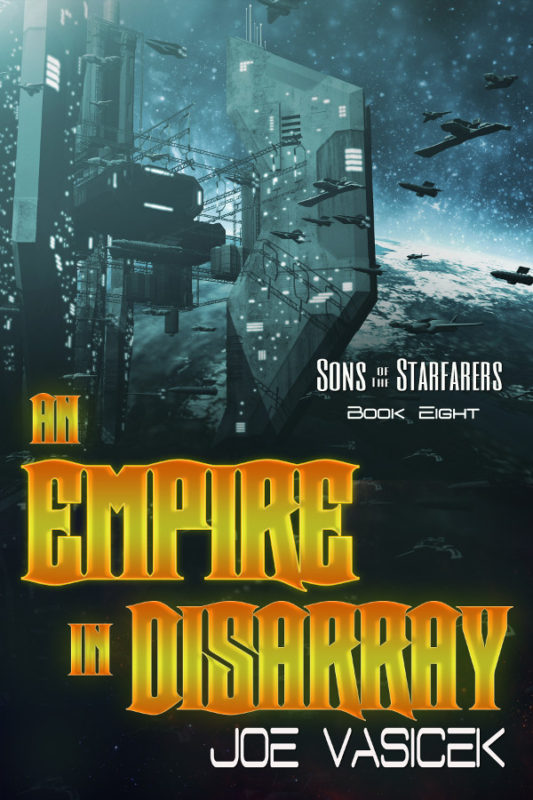
An Empire in Disarray is late-series space opera at full intensity: shifting alliances, desperate diplomacy, covert raids, and the personal cost of holding a fragile coalition together when everything starts to crack. This is book eight in the nine-book Sons of the Starfarers series, which means the story is driving hard toward endgame—without losing sight of the characters who’ve carried you across the war.

If you want a sci-fi series where battles and politics matter because they press people to their moral limits, this is the kind of reading experience you’re in for.

What Kind of Reader Will Love An Empire in Disarray?

If you love …

  • character-driven military science fiction and space opera with long-running arcs and real consequences
  • rebellion-vs-empire stories that evolve into messy “what now?” politics after the turning point
  • tense alliances, betrayals, secret negotiations, and behind-enemy-lines missions
  • found family (and actual family) dynamics under extreme pressure—duty vs. loyalty vs. love
  • big stakes told through a close, emotional lens (you feel the cost, not just the spectacle)

…then An Empire in Disarray is probably your kind of story.

What You’ll Find Inside

An Empire in Disarray follows Mara Soladze and the people bound to her as the Outworld war effort enters its most unstable phase: victories don’t settle anything, power reshuffles, and old enemies become uneasy necessities. The book mixes fleet-and-station scale strategy with intimate, character-level tension, especially as trust becomes both the most valuable currency—and the easiest thing to weaponize. The result is a fast-moving, high-stakes installment that feels like the calm-before-the-storm is finally over.

What Makes An Empire in Disarray Different

Fans of authors like Lois McMaster Bujold (character-first military sci-fi), Elizabeth Moon (duty, leadership, and hard choices), or James S. A. Corey (factional politics in space) will recognize the blend of strategy, relationships, and shifting loyalties—but this series leans especially hard into consequences that accumulate across many books.

Where many space operas keep escalating external threats, Sons of the Starfarers also asks what happens when the “good side” starts fracturing under its own compromises. And in this installment, the story’s distinctive edge is how it forces characters to navigate collective survival while still fighting to remain fully themselves.

What You Won’t Find

You won’t find a cozy, standalone entry point here—this is the eighth book in a nine-book arc, and it’s written to pay off (and complicate) what came before. You also won’t find grimdark nihilism for its own sake: things get intense, but the series is ultimately driven by the question of whether people can become better under pressure, not merely harder.

Why I Think You Might Love An Empire in Disarray

In the author’s note, I half-joke that nobody should write a nine-book series—and then I admit why I did it anyway: because I’ve cared about these characters from the beginning, and I wanted to see where war would take them when it stopped being abstract and became personal. When I was drafting this book, I’d just moved back to Utah after a long stretch in Iowa, driving that lonely road through Wyoming and down past Evanston into the mountains—thinking about pioneers, endurance, and the strange mixture of hardship and beauty that comes with trying to build something that lasts.

That’s the heart of this installment, too. The ending I’d imagined for this series was never going to be neat or permanent—politics rarely is, especially after revolution—and my background in political science (and the places I’ve lived and traveled) shaped that. But the real reason I think you might love this book is simpler: An Empire in Disarray is where you get to see how far Mara has come, and what kind of person she chooses to become when all the easy choices are gone.

Where to Get the Book

Related Posts and Pages

Explore the series index for Sons of the Starfarers.

Return to the book page for An Empire in Disarray.
Is Brothers in Exile for you?

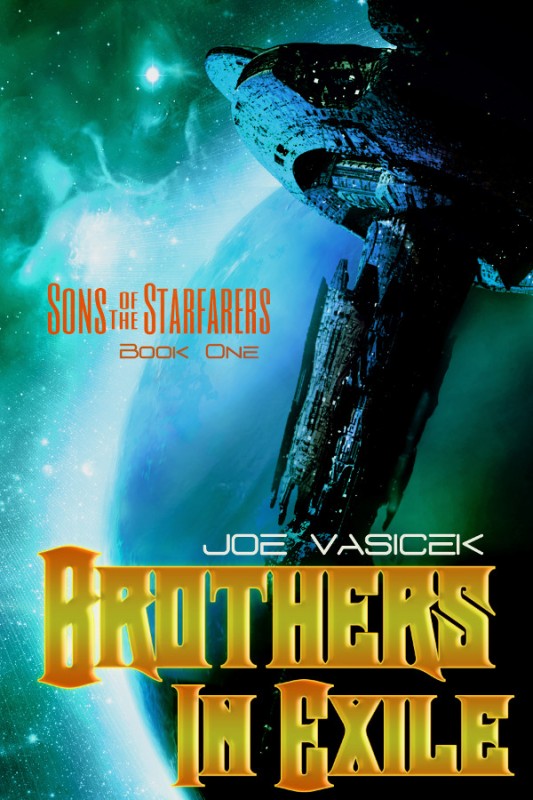
Brothers in Exile by Joe Vasicek is a character-driven space opera / adventure sci-fi about two brothers trying to survive as independent starfarers on the edge of a growing empire. When their routine run takes them to a silent derelict station—and a discovery they can’t ignore—the story turns into a tense, momentum-driven ride through frontier ports, bad deals, and the early tremors of interstellar conquest.

Brothers in Exile is Book 1 of Sons of the Starfarers, a clean, character-driven space opera series about starfarers caught in the early tremors of imperial expansion.

What Kind of Reader Will Love Brothers in Exile?

If you love…

  • frontier space opera: starships, stations, salvage, dangerous trade routes
  • space opera with heart: loyal crews, sacrifice, and family bonds under pressure
  • clean, hopeful science fiction (minimal profanity, no explicit sex) with faith, family, and conscience in the background
  • high-stakes trouble that escalates fast: one decision → bigger consequences → empire-scale ripple effects
  • mystery + rescue momentum, where “we can’t just walk away” drives the plot

…then Brothers in Exile is probably your kind of story.

What You’ll Find Inside

Isaac Deltana is the careful one—the older brother trying to keep their ship, their finances, and their lives from flying apart. Aaron is the spark—reckless, brave, and stubbornly determined to do the right thing once he believes something matters. The tone is tense but humane: a fast-paced, character-driven space adventure with heart, built around survival, moral choice, and the bond between brothers as the Outworlds begin to feel the shadow of the Gaian Imperials stretching outward.

What Makes Brothers in Exile Different

A lot of space opera is driven by lone wolves or chosen ones; this one is driven by family—two brothers who can’t stop being brothers even when everything is going wrong. It has the frontier trading feel of classic space opera, but puts family and moral choice front and center. It has a “scrappy ship on the fringe” flavor you might associate with Firefly, but the moral center is steadier and the tone is less cynical. And while there’s big-picture geopolitics (expansion, control, annexation), the story stays grounded in human-scale decisions: what you owe a stranger, what freedom costs, and how far you’ll go to keep someone from being used or erased.

What You Won’t Find

You won’t find grimdark nihilism, explicit sexual content, or shock-for-shock’s-sake violence. This is clean, character-driven space opera—fast-moving and emotional—rather than slow, technical hard sci-fi. The science is ‘believable enough,’ but the focus is on choices, consequences, and the bond between brothers.

Why I Think You Might Love Brothers in Exile

I wrote Brothers in Exile because I wanted a space adventure where the relationship mattered as much as the action. In my author’s note, I talk about how the brother dynamic in the film Gettysburg (and the real emotional weight behind it) helped shape the characters Isaac and Aaron—the older brother trying to be the responsible one, and the reckless younger brother who pushes back against the authority figures in his life. If you enjoy stories where family is both the complication and the strength—where two people face the void together and refuse to stop caring—I think you’re going to enjoy this book.

Where to Get Brothers in Exile

Related Posts and Pages

Explore the series index for the Sons of the Starfarers series.

Return to the book page for Brothers in Exile.

The Choice to Believe in Gunslinger to Earth

At its core, Gunslinger to Earth, the space-opera finale of the Gunslinger Trilogy, asks a simple but lifelong question: What do you choose to believe when the universe refuses to give you certainty? When Earth vanishes into an impossible anomaly—and later reappears transformed—no one can prove exactly what happened. The characters must decide for themselves what is true, what is worth fighting for, and who they will become in the face of the miraculous.

Where the Idea Came From

The theme grew out of a major turning point in my own life. I started this book just after I began dating the woman who would become my wife and while I was reinventing my writing process to tell better stories. It was a season of uncertainty, hope, and change, full of questions I didn’t know how to answer. That personal crossroads naturally shaped the theme of the story into one about faith, conviction, and choosing a future even when you can’t see what comes next.

How the Choice to Believe Shapes the Story

Throughout Gunslinger to Earth, every major character is confronted with a moment where proof is impossible, but a choice is required. Rex must decide whether to trust Charlotte, whether to follow Sam and Jane, whether to cross the wormhole, and ultimately whether to stay in paradise or return to a mortal life with someone he loves. No one can make these choices for him—not Sam, not Jane, not Charlotte—because the heart of his journey is learning to choose his own truth instead of waiting for certainty that will never come.

On a cosmic scale, the entire plot turns on the same dilemma—an end-times science fiction mystery wrapped in the language of prophecy. The anomaly that swallowed Earth may be the fulfillment of ancient prophecies, or it may be an alien event we don’t yet understand. Mahijah may be exactly who he claims to be, or something else entirely. No lab test or political briefing can answer those questions. Sam, Jane, Rex, the empaths, and the remnants of Earthfleet all have to decide for themselves what they believe—and those choices lead them to the endings they earn. The story isn’t about proving the miracle; it’s about how people respond when the miraculous breaks into their livesthe heart of the choice to believe.

What the Choice to Believe Says About Us

We all live in a world where certainty is rare, where conflicting stories demand our loyalty, and where the most important truths—love, faith, family, hope—are things you commit to long before you can prove them. Gunslinger to Earth reflects that deeply human reality in a character-driven science fiction way. It suggests that belief isn’t about having perfect evidence; it’s about having the courage to choose who you’re going to be and what kind of future you want to build. At the end of the day, the world is shaped not just by what happens to us, but by what we decide to believe about ourselves, about others, and about the meaning of our lives.

Why This Theme Matters to Me

When I wrote Gunslinger to Earth, the closing volume of the Gunslinger Trilogy, I was learning to make those kinds of choices in my own life—about faith, about love, and about the kind of writer and person I wanted to become. It was a moment when I had to step forward without seeing the whole path. That experience shaped the story in ways I couldn’t fully articulate at the time, but I can see clearly now. This book matters to me because it’s ultimately about hope: the hope that even in chaos, even in uncertainty, we can choose what we believe—and those choices can lead us somewhere good.

Where to Get the Book

Related Posts and Pages

Explore the series index for the Gunslinger Trilogy.

Return to the book page for Gunslinger to Earth.

Is Gunslinger to Earth for you?

See all of my books in series order.

Is Gunslinger to Earth for You?

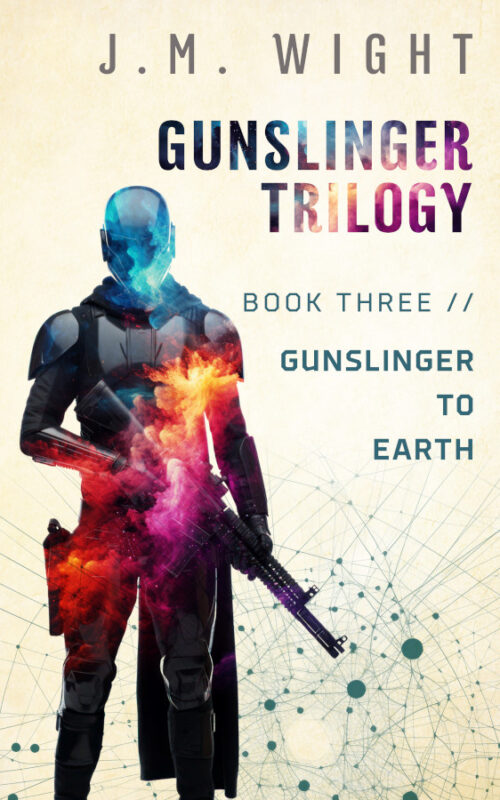
Gunslinger to Earth is a character-driven space opera adventure about crossing a cosmic no-man’s-land to discover what happened to the home you thought was lost forever. It blends gunslinger-style starship action, found-family dynamics, political revolution, and end-times mystery as Rex Carter, Sam Kletchka, and Jane Kletchka risk everything to follow Earth into an impossible anomaly. It’s a fast, hopeful, and surprisingly tender finale that wraps up the Gunslinger Trilogy with both high stakes and a genuine sense of homecoming.

What Kind of Reader Will Love This Book?

If you love…

  • Space opera that feels like Firefly meets end-times science fiction, with a gunslinger pilot, a loyal found family, and a war-torn galaxy trying to pull them apart
  • Stories where faith, prophecy, and cosmic mystery actually matter to the plot, not just as window dressing
  • Coming-of-age under fire, as Rex Carter tries to decide who he is and where he belongs while revolutions, wormholes, and vanished planets rearrange the map of human history
  • Character-focused military SF with moral clarity, loyalty, and hope, rather than grimdark cynicism

…then Gunslinger to Earth is probably your kind of story.

What You’ll Find Inside

Gunslinger to Earth is a story rooted in space opera adventure, end-times science fiction, and prophecy-driven mystery. The hero of this third book in the trilogy is Rex Carter, a cadet still reeling from the day Earth and Luna vanished into an impossible anomaly. Torn between his patriot girlfriend Charlotte, his loyalty to Sam and Jane, and his fear for his family back home, Rex has to grow up fast as he’s swept into a mission to follow Earth across the “world-bridge” and find out what really happened.

The mood balances tense, boots-on-the-deck action (derelict ghost ships in the anomaly, desperate battles near wormholes, claustrophobic escapes from Luna) with a deep, almost awe-struck sense of wonder as the crew finally confronts a transformed Earth and the fulfillment of ancient prophecies. The style is fast-paced, voice-driven, and accessible—more “frontier adventure with big ideas” than hard-science textbook—with a strong throughline of family, faith, and the search for home.

What Makes It Different

Fans of classic space opera and military SF—think Firefly, The Expanse, or David Weber—will recognize the starship battles, political tensions, and ragtag crews, but Gunslinger to Earth takes those ideas in a very different direction. Instead of treating religion and prophecy as background flavor, this book leans straight into them: the disappearance of Earth isn’t just a physics problem, it’s tied to the City of Enoch, the fulfillment of Latter-day Saint-style millennial prophecies, and a literal “new Earth” where history has turned a corner.

Where many space war stories focus on winning the next battle or installing the next regime, this one asks what happens when the war is suddenly dwarfed by something much bigger—when the homeworld itself is renewed and taken off the game board. It’s less about toppling empires and more about how ordinary, stubbornly decent people respond when God, history, and politics all collide at once. And because it’s the capstone of the Gunslinger Trilogy, it doesn’t just raise the stakes; it actually lands them with a clear, hopeful ending.

Readers who enjoy the moral backbone of Lois McMaster Bujold, the frontier grit of Firefly, and the cosmic mystery of The Expanse will find familiar elements here—but woven together in a way that feels genuinely new.

What You Won’t Find

You won’t find grimdark nihilism, graphic sex, or wall-to-wall gore here. The story has violence, war, and real loss—this is a revolution and an end-times crisis, after all—but it’s written at about a PG-13 level, with the camera panning away from anything needlessly explicit. You also won’t find a sneering, anti-religious tone; faith and prophecy are treated respectfully and sincerely, even when characters struggle to believe them. This is a cleaner-but-still-intense sci-fi adventure that focuses more on meaning, loyalty, and wonder than shock value.

Why I Think You Might Love It

I wrote Gunslinger to Earth during a major turning point in my own life—just after I started dating the woman who would become my wife, at a time when I was reinventing my writing process so I could tell better stories more consistently. In a lot of ways, this book is about that same kind of turning point on a galactic scale: the moment when old patterns break, a long-promised future finally arrives, and you have to decide who you’re going to be on the other side of it. My hope is that if you care about loyalty, about home, about the possibility that history is going somewhere meaningful, then this story will leave you with the same feeling it gave me while I was writing it: that even in the middle of chaos, there’s a way through—and it leads somewhere worth fighting for.

Where to Get the Book

Related Posts and Pages

Explore the series index for the Gunslinger Trilogy.

Return to the book page for Gunslinger to Earth.

The Choice to Believe in Gunslinger to Earth.

See all of my books in series order.