Blurb for Bringing Stella Home and thoughts on Borders

One of the essential elements for a successful in epublishing is a killer book description, and I think I’ve got a pretty decent one for Bringing Stella Home.  However, I could use some feedback, so if you could read it and tell me what you think, that would be great. Here it is:

It is a dark time for the galactic empire. Rebellions at Tajjur and the New Pleiades sap the empire’s strength from within, while hordes of spacefaring Hamiji warriors from the outer reaches sweep ever closer to the Imperial capitol, slagging entire worlds in their wake.

When the Hameji forces conquer his homeworld, young James McCoy runs away to rescue his older brother and sister, Ben and Stella, from their grasp. Though he faces an enemy undefeated in battle and feared throughout all of inhabited space, James will stop at nothing–not even death–to get his brother and sister back.

Things start to look up when he meets Danica Nova, a Tajji mercenary captain who takes him in and becomes his mentor. James reminds Danica of her own brother, whom she failed to protect when the empire slaughtered her family years ago. Now, she hopes to find some redemption from her demons by saving James from his own.

Unfortunately, neither of them realizes that Stella has become a concubine to the main Hameji overlord–and that Ben has been brainwashed and made into an elite shock trooper in the empath squadron sent to hunt them down.

So what do you think?  Too long, too confusing, too cliche, or too boring?  The genre (if you can’t tell) is space opera / space adventure, so I’m hoping it will appeal to fans of Orson Scott Card, C. J. Cherryh, Lois McMaster Bujold, Star Wars & Star Trek, etc.  It’s also got a slight military science fiction bent to it, though I wouldn’t presume to be qualified to write true military sf.

In unrelated news, I recently did an interview with Charlie of Playground51, which appears to be down for some reason (the link is on my Blog Tour page above).  Topics discussed include how I got the idea for Genesis Earth, which parts were inspired by real life, and thoughts on book promotion.  Hopefully the site will be up again soon!

Also, I’m thinking it’s time to do a major overhaul of my blog template.  As much as I love the current one with the purple stars and nebulae, I need something with two sidebars so that my books don’t push everything else to the bottom.  If you have some ideas for a good WordPress template that still keeps the sci-fi feel of this one, please let me know!  I’m very much open to suggestions.

Finally, since the Borders liquidation is all over the news, I thought I’d share my $.02.  It’s sad, certainly, but I don’t think that the fallout will be nearly as gloomy as Joshua Bilmes claims.

Corporate-run big box stores are certainly on the way out, but there will always be a market for good stories, and in many ways the new ebook technology is causing that market to expand at a wonderful rate.  So while the predictions of the print death spiral appear to be coming true (David Gaughran did a great post recently on that), new models will emerge–indeed, are already emerging–which will fill the vacuum.

The thing that gives me great reason to hope is that these new business models give so much power back to writers.  Instead of relying on the mercies of large media corporations to build a viable career, we can now make a living by publishing independently or going with any number of small independent presses.  Readers have more choices and writers have more options.  It’s glorious.

If anything, the Borders bankruptcy has confirmed to me that I’ve made the right choice to go indie, rather than wait for New York to anoint me before launching my career.  Will I ever go with a traditional publisher?  I’d like to someday, but I no longer feel dependent on the old system to accomplish my dreams.  Instead, it’s my readers who will decide my fate, and that’s exactly as it should be.

So thanks for reading!
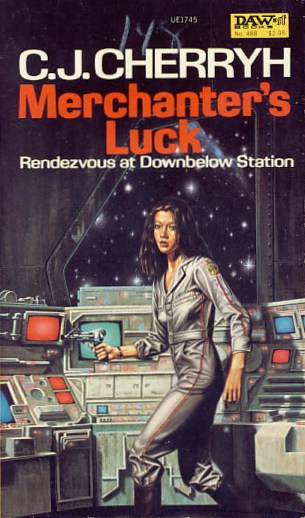
Merchanter’s Luck by C. J. Cherryh

He was a down and out merchanter, the captain, crew, and sole proprietor of a run-down bucket of bolts spacecraft.  She was a daughter of one of the finest starfaring clans, with seven hundred cousins standing between her and the one thing she wanted more than anything else: command of a starship.

They met at Pell during the height of the Company War–the key strategic point on the border between Union and Earth.  Their fateful meeting would affect not only the outcome of the war, but the course of their own lives–for the starship Lucy of Wyatt’s Combine was not at all what she seemed to be.

Before I review this book, I need to issue a disclaimer: you probably aren’t going to enjoy it very much unless you’ve already read Downbelow Station.  Cherryh isn’t the best at easing her readers into her worlds, and without the background on Union, Alliance, and the Company War, you’ll probably be hopelessly lost.

That said, I absolutely loved this book.

The premise is so awesome.  Space adventure hardcore, with a beautiful love story set amidst an epic interstellar war, where alliances are constantly broken and no one can be trusted…oh man, I LOVED this book!

While the premise seems pretty standard, C. J. Cherryh transcends the well-worn tropes and cliches of her genre by intimately developing her characters and working their motivations into the story until they are the ones driving the plot, and not the other way around.

Every character is unique, and though they act in ways that may seem strange to our modern sensibilities, there are always reasons for everything they do, cultural or otherwise.  As windows into their far-future spacefaring culture, they give the reader a wonderful view of Cherryh’s unique and marvelously constructed universe.

The thing that surprised me the most, however, was the sharp contrast between this book and Downbelow Station. While Downbelow Station traces the epic arc of the Company War through the viewpoints of a large cast of characters, much like Tolkien or Dune, Merchanter’s Luck focuses more on the characters themselves, in much the same way as David Gemmell or Ursula K. Le Guin.  In other words, while Downbelow Station is comparable to “high” or epic fantasy, Merchanter’s Luck would fall closer to “low” fantasy or sword & sorcery.

The interesting self-realization I took from the book was that I’m much more interested in the intimately personal stories than the sweeping epic tale of the Rise and Fall of cultures and civilizations.  I suppose that’s why I’m more of a David Gemmell nut than a Tolkien fanatic, and perhaps why I’m more into space opera and military sf than epic fantasy.  In all of my novels, the focus is always on the individual characters and their personal conflicts, and whenever I get sidetracked and focus too much on the overworld story, it always falls apart. 

Merchanter’s Luck definitely doesn’t get sidetracked, and that’s why I loved it so much.  I fell in love with the characters almost from the very first page–from the blurb on the back cover, even.  And most of all, I fell hopelessly in love with the starship Lucy:

You know you’re doing science fiction right when your readers bemoan the fact that they weren’t born in the 26th century, when they could command their own spaceship.  C. J. Cherryh is an amazing writer, and if I had the chance, I would teleport into her Union-Alliance universe in a heartbeat.

If you love well-crafted far-future worlds and stories about the people that live in them, check out Downbelow Station (or really, just the first chapter–that’s all you need for a solid grounding) and read this book!

Old story notebook, part 2

Alright, here is the second part of my oldest story notebook, the one that I just found a couple days ago.  These ideas date from 2007 when I started pursuing writing as more than a hobby, up to the summer of 2008 when I went to Jordan on the BYU study abroad program.

The Singularity: it will lead more to a social change and conflict than a transformation of humanity–increasing disparity between techies and non-techies, and a tech/class conflict. What will the perspective be of those who look at us and our advances after the new dark ages? Or are we in the dark ages?

Interesting–if you believe in the technological singularity, that is. I’m not quite so sure I do anymore; that’s kind of what Genesis Earth

was all about.

An alien race of beings that have no sensory organs, but instead perceive the thoughts of beings with sensory organs, and thus do all their perceiving through others.

There is so much cool stuff you can do with aliens–stuff that nobody seems to be doing, because they always stick with the tropes. Or maybe I’m just not well-read enough.

The more advanced our society becomes, the more our education specializes so that it becomes harder to know the minimum necessary to understand everything. This leads to class/tech divisions, and to the potential for society to fall apart.

Have you ever wondered about this? I mean, it’s kind of crazy how complicated we’ve made life and living. And all this we call “civilization.”

When relativistic space travel becomes more widespread, society will develop new rituals and ways to mourn and deal with the separation that comes with people going forward out into space.

I think I had this thought while reading Speaker for the Dead or another of Orson Scott Card’s Ender’s Game books. That series totally blew my mind.

If we lived in a telepathic society, we would learn to separate our deep thoughts from our shallow thoughts to put up a facade in public–but how would the relationship between deep and shallow change the way society works? If we had to hide even our thoughts?

Heck, what would a telepathic society even look like?

Aliens who shed their skin each year (or something else) and have derived a culture that treats each person as having a different identity each year.

Kind of like in Tahiti, where people change their names at different stages of their lives (childhood, adulthood, etc). I hear it makes family history work insanely frustrating.

We make contact with aliens who need a human companion with whom they merge telepathically, and the story is from the human translator’s point of view.

This would make a really cool anime.

First contact was made in the 12th century with the Abassids, and the explorer ship returned with Arab emissaries to the alien homeworld. Now those emissaries are returning to establish regular connections via ansible, and they are shocked to find the world in its current state.

Okay, I think this idea has some really cool potential. I’m not sure I’d be the one to write it, but it sounds like it could be really awesome, if it were done right.

An alien species incapable of lying.

It would probably turn first contact into an unmitigated disaster. After all, lying is the essence of diplomacy.

When we first go into space, colonies will be governed by multi-national corporations, not stats. Profit will come before the welfare of the colonists themselves, and the wars will be over trade routes and tariffs.

Sounds like something straight out of C. J. Cherryh.

An alien species* that considers it okay to show uncovered reproductive organs but obscene to show the eating organs. *Or, a human society

It sure would be weird, especially if it were a human society that did that.

An alien spaceship comes to Earth and it’s full of colonists.

Definitely been done already. Probably multiple times.

Dolphins are a post-alien species that came to Earth millions of years ago.

Has this been done before? I seriously doubt it. I’d write it, but any story set on Earth tends to bore me.

EDIT: Alright, yeah, it’s been done–quite a bit, actually. Looks like I need to get out from under my rock and read some more.

Aliens have colonies under the ocean.

Hey, if they have them anywhere, they’re probably down there.

Is a necessary element of our free agency our ignorance of ourselves, on the deepest level?

Perhaps.

A 19th century Mormon gets stuck in a time warp and ends up in 21st century Utah.

Oh, the horror!

I’d better stop here, since general conference is about to start. I’ll finish this list in the next couple of days, probably. Blogging keeps me sane. In the meantime, have a wonderful Easter!

Christmas break 2009

Christmas was great this year!  I spent it in Texas, with my extended family–the family on my dad’s side, who I almost never see.  The break has been a lot of fun so far!  No school or work obligations, lots of time to lay back and relax, plenty of games to play and books to read, plus fun people to hang out with–it’s been great!

Most of my cousins are young teenagers right now, and are a lot different than I remember.  However, I was able to get some presents for them that I think worked out well.  David is into his iPod, so I got him some U2 albums (How to Dismantle an Atomic Bomb and Joshua Tree).  Savannah and Nash are both avid fantasy readers, so I got Savannah Mistborn: The Final Empire and Nash Victory of Eagles (the one chain bookstore in Midland didn’t have His Majesty’s Dragon, so I got him another from the series).  Daniel, I didn’t know what to get, so I gave him my old camera.

Ashley (who is older) was telling me about how she lived abroad and wants to spend some time in Australia, so I got a travelogue on Australia by the same guy who did A Walk in the Woods. Based on her reaction, I think she’s going to like it!

It was much easier to get stuff for direct family, since I know them better.  For Kate, I got Soulless, a steampunk / paranormal mystery novel that had an awesome release party at World Fantasy 2009.  I don’t know if she’ll like the book, but the party was very steampunk / regency fantasy with the cosplayers, so I think she will.  I got Danny The Screwtape Letters, since I know he likes that kind of religious fiction–turns out he’s been meaning to read it for a while!  Mykle, I got the first book in C. S. Friedman’s latest series, since I know that she’s his favorite author–24 hours after Christmas, he’s already 200+ pages into it!  And for Sarah and Mykle, I got them both $20 gift certificates to Pioneer Book in downtown Provo.  They were very happy with that!

I wish I’d had the time to get presents for everyone in the family, but with moving out, coming here so quickly, and not having a car (or much of an idea what they wanted), it just wasn’t very practical.  I did get my mom a gift certificate to B&N, but I haven’t gotten anything for my dad yet.  I will, though–he wants stuff from our Christmas memories, and I happen to have all my old childhood journals in my carry on luggage.  Lots of Christmas memories in those!

I’m satisfied with what I got, even though it wasn’t all that much.  Besides the generic clothes, socks, ties, candy, popcorn, and other stuff, I got a spiffy tool kit from Robin and a flexible tripod from pop.  Very nice!  They will add some weight to my luggage, but I think I can give some of it to mom or pop to bring home.

As far as writing goes, I’m less than 13k words from the end of Bringing Stella Home 2.0.  It’s not quite ready for alpha readers yet, but I want to get it ready soon (it’s going to take so much work! <sob>).  If I average 2.6k words over the next five days, I’ll have it finished in time to start something new by new years!

That’s the goal.  As for what the next novel is going to be about…let’s just say it’s Homer’s Odyssey meets C. J. Cherryh and Ursula K. Le Guin in space, where Telemachus is a girl and the story is primarily from her point of view.

I hope I can pull it off!

Why I love Robert Charles Wilson

From Mysterium, which I plan to review here soon:

“Do you ever wonder, Howard, about the questions we can’t ask?
“Can’t answer, you mean?
“No. Can’t ask.
“I don’t understand.”
Stern leaned back in his deck chair and folded his hands over his gaunt, ascetic frame. His glasses were opaque in the porch light. The crickets seemed suddenly loud.
“Think about a dog,” he said. “Think about your dog–what’s his name?”
“Albert.”
“Yes. Think about Albert. He’s a healthy dog, is he not?”
“Yes.”
“Intelligent?”
“Sure.”
“He functions in every way normally, then, within the parameters of dogness. He’s an exemplar of his species. And he has the ability to learn, yes? He can do tricks? Learn from his experience? And he’s awarer of his surroundings; he can distinguish between you and your mother, for instance? H’es not unconscious or impaired?”
“Right.”
“But despite all that, there’s a limit on his understanding. Obviously so. If we talk about gravitons or Fourier transforms, he can’t follow the conversation. We’re speaking a language he doesn’t know and cannot know. The concepts can’t be translated; his mental universe simply won’t contain them.”
“Granted,” Howard said. “Am I missing the point?”
“We’re sitting here,” Stern said, “asking spectacular questions, you and I. About the universe and how it began. About everything that exists. And if we can ask a question, probably, sooner or later, we can answer it. So we assume there’s no limit to knowledge. But maybe your dog makes the same mistake! He doesn’t know what lies beyond the neighborhood, but if he found himself in a strange place he would approach it with the tools of comprehension available to him, and soon he would understand it–dog-fashion, by sight and smell and so on. There are no limits to his comprehensions, Howard, except the limits he does not and cannot ever experience.
“So how different are we? We’re mammals within the same broad compass of evolution, after all. Our forebrains are bigger, but the difference amounts to a few ounces. We can ask many, many more questions than your dog. And we can answer them. But if there are real limits on our comprehension, they would be as invisible to us as they are to Albert. So: Is there anything in the universe we simply cannot know? Is there a question we can’t ask? And would we ever encounter some hint of it, some intimation of the mystery? Or is it permanently beyond our grasp?”

This is the kind of science fiction that I love: the kind that brings me right up to the limits of human knowledge and makes me feel naked in the face of the unknown. The kind where the aliens truly feel alien, not like an unusually bizarre race of human beings. I want the aliens to surprise me–I want to feel that there’s something about them that is completely beyond my comprehension. Something sublime, something romantic.

In all of his books that I’ve read, Robert Charles Wilson captures this feeling spectacularly. So does Arthur C. Clarke, C. J. Cherryh, and Orson Scott Card. Larry Niven, Jerry Pournelle, John Scalzi and Alastair Reynolds are excellent writers, and I’ve genuinely enjoyed their books, but their aliens are too…understandable. Too clear cut, too defined. After a while, you don’t feel that there’s anything left to surprise you, anything that is so alien it’s beyond your grasp.

In some ways, I think this boils down to the author’s worldview. Those with a more positivist worldview believe that the world is fundamentally understandable, and that every phenomenon can be modeled and predicted, provided that we have a sophisticated enough understanding of natural law. The interpretivist worldview, on the other hand, posits that while truth may exist, there are limits to our understanding–that some things are inherently unpredictable and impossible to model.

I used to think that I was a positivist. Then I took Poli Sci 310 with Goodliffe, and it turned my world upside down. Genesis Earth is, in some ways, a product of that personal worldview shift. I don’t think I’m anywhere near on par with my aliens as Wilson, Clarke, and Card are with theirs, but I hope I’m on my way.

Downbelow Station by C. J. Cherryh

“The stars, like all man’s other ventures, were an obvious impracticality, as rash and improbable an ambition as the first venture of man onto Earth’s own great oceans, or into the air, or into space.” Thus begins Downbelow Station, an epic tale of man’s future beyond Earth.

The outer colonies of Earth have rebelled and are fighting a long, ferocious war against the Earth colony. Mazian’s fleet, the main battle fleet aligned with Earth, has been out of contact with their superiors for so long that Earth company no longer controls them. As they fight their losing war against the Union of outer stations, they leave wreckage and destruction in their wake, determined not to give Union forces anything that could be used against them. One by one, the stations that serve as stepping stones to the Beyond fall into destruction in this terrible, senseless war of attrition.

Pell is the last major station before Earth, the nexus point between the two warring sides. It is also the only station orbiting a marginally habitable world with sentient life–the peaceful and primitive Hisa, who worship the sun and dream of traveling one day to the stars. The Konstantin family is determined to do everything they can to maintain Pell’s neutrality, but with the war coming closer and floods of refugees bringing crime and disorder, that proves increasingly difficult. It is made even more difficult by power players within the station who, unbeknown to Mazian or the Konstantins, are seeking to strike a deal with Union.

This story won the 1982 Hugo award. Since I like to write science fiction, specifically epic space opera much like this, I was very interested in reading this book and seeing what Cherryh’s vision of the far future looked like.

Her worldbuilding in this book is really, really cool. In the first chapter, she outlines how human history takes mankind to the stars–through commercial means and business interests, not government expansion. Each station serves as a jumping off point for the next expedition to the next star system, with independent merchanters hauling the profits back to Earth and conducting trade between the stations. As humanity expands, however, communication between Earth and the Beyond becomes more and more difficult, and when the Earth company tries to impose taxes on the outer stations, they rebel and form the Union.

Stationers and merchanters have distinct cultures, with the stationers feeling much more rooted to one place, trusting more in bureaucracy, and feeling more of an allegiance with Earth and the company. Merchanters, on the other hand, are much more nomadic and independent, putting more credence to family names than port of origin, and tend to have single-parent families (to keep the population from becoming inbred, merchanter women remain single, obtaining their children through short-lived relationships whenever they come into port). Two of the main characters (Damon and Elene) are a stationer-merchanter couple, and the cultural differences really come out in the way they interact with each other.

At the same time, it’s a story of first contact and what happens after first contact. The Hisa are a distinct race of sentient beings, creatures who don’t understand the ways of the humans, especially war. Their presence adds a degree of tension, especially when you consider how disastrous the war could be on Human-Hisa relations. The Hisa, however, are very clever, and the humans come to realize that they have a lot to learn from this peaceful race of furry little creatures. One of the viewpoint characters is a Hisa, and it’s really interesting to look at the station, the world, and the humans from this alien perspective. Cherryh did a good job creating a believable, complex alien race.

Overall, this story is more about grand ideas and concepts than it is about individual characters, so while Cherryh did a fair job with her characterization, her point of view was always a bit distant and I never felt extremely close to any of her characters (except perhaps Mallory–more on that later). That made it a bit hard to read the story as I got deeper and deeper into the story. There was a lot of setup before the action really started to break, and because I wasn’t very close to the characters, I didn’t feel as engaged by the story.

The action, too, was very difficult to visualize. I never really understood how faster-than-light travel worked in this book, and because all of the space battles happened partially inside warpspace, I never knew what was going on. That was a little frustrating, and kept me from really understanding or getting the tension. The gunfights and hand to hand combat was good, but it was almost always chaotic mobs against lines of armed police and/or soldiers, and never really described all that concretely. Cherryh didn’t really describe what the soldiers were wearing, what they looked like, what their guns were like, what the mobs looked like, sounded like, etc. Distant viewpoint, more conceptual than immediate.

The political situation, however, was very interesting and complex. There were a lot of different players, each with their own distinct goals and interests. There is the Company, whose chief spokesman in the beyond is Ayres, a diplomat whose delegation essentially becomes prisoner to the Union; the Union, lead by Admiral Azov, a shrewd, effective military commander; there’s Pell, led by the Konstantin family (Damon, Emilio, Angelo); but then within these three main parties there are all sorts of other divisions, such as Mazian’s fleet (and within Mazian’s fleet there is another division, with Mallory and her ship as a sort of loose cannon), the merchanters, the Lucas company (Konstantin’s main rivals within Pell), the refugees of Pell (known as “Q,” for quarantine), etc etc.

With some of these groups, you know clearly who is good and who is evil. With others, however, you’re not so sure. Mallory was a fascinating character to me–fascinating because even though I hated what she was doing to everyone else, I really admired the way she ran her ship, the way she respected and took care of her troops, and the way she was always on top of things. She earned my respect, despite that I spent a good portion of the book hating her, and of all the characters, she was the one I felt closest to. She always did what needed to be done, even if it meant getting her hands bloody, and though she was a bit arrogant, she made up for it by being an excellent, top-rate leader. She was by far the most interesting character, the wild card, and Cherryh played her very well.

Cherryh’s writing is very dense and abstract; this book took me a lot longer than I thought it would. It’s not for everyone, and I wouldn’t be surprised if ended up quitting midway through. I almost did that, but I forced myself to read through it until the plot really took off. Cherryh’s vision of the future, however, is really fascinating, something complex, futuristic, and yet very believable, from the way she connects everything together. A fascinating world, and a vision that is, for all the war and horror, satisfyingly hopeful in the end.
