What does it mean that Brandon Sanderson is woke?

I’ve been thinking a lot about Brandon Sanderson lately, and his recent turn toward including more woke content in his books, especially Wind and Truth. I haven’t read it (I’ve only read the first book in the Stormlight Archive), but I have read excerpts from it, and heard from other people that it includes a great deal of woke content, including a gay romance that is central to the story. Most notably, Brandon himself wrote a blog post addressing this, in which he very politely said that his conservative readers are wrong, and that anyone who objects to the gay romance on the basis of Biblical morality is not living up to Christ’s teachings about showing love and compassion. Which is, of course, one hell of a way to gaslight a large chunk of your readership. You can read more of my thoughts on that here.

I really hope Brandon pulls back from the position he’s now staked out for himself, but sadly, I don’t think that he will. From what I can tell, as a local Utah author with several direct (through his class) and indirect (through members of his writing group who are close family friend) connections to Brandon, the roots of this transformation run very deep, possibly before his debut novel, Elantris, was picked up by Tor. After all, Brandon has always surrounded himself with people who are on the extreme left side of the political spectrum, from his early days as an unpublished author working the convention circuit to get picked up by a New York publisher, all through the descent of his Writing Excuses podcast into woke madness, and most recently, to Wind and Truth itself. For a very long time, he has surrounded himself with these people. Clearly, their association has had a deep and lasting impact on him.

So what comes next? Here are some of my thoughts and predictions.

Prediction 1: Brandon will not teach English 318R at BYU after the current academic year.

For the last two decades, Brandon has taught a creative writing class at BYU as a visiting professor. Both my wife and I have taken this class. Ever since the pandemic, he has posted his lectures online on YouTube, and they have become quite popular. His class has become something of an institution at this point.

However, Brigham Young University is a religious institution, and the new president, President Reese, is rumored to have a mandate from the church leadership to clean house. From my vantage point here in Provo, there is a great deal of truth in these rumors. My wife is currently applying to be a professor at BYU, and we were asked some pointed questions about our belief in the teachings of the Family Proclamation in our General Authority interview.

What I suspect will happen is that the university leadership will talk with Brandon privately and inform him that he will not be teaching this class in the future. Brandon, being classy, will not make a big stink out of this, but he will announce at the end of the semester that the time has come for him to “move on,” or something like that, without making a big fuss. It might take another year before he gets the axe, but I will be very surprised if he continues to teach his class at BYU after the ’25-’26 academic year.

Prediction 2: Over the next few years, Brandon will lose a significant portion of his readership.

From what I’ve heard, Brandon Sanderson has somewhere between 800,000 to 900,000 true fans who buy just about every book he puts out. I don’t know what portion of those fans are conservative enough to be bothered by his turn toward the woke, but a large number of his fans do live here in Utah, judging from the massive turnout he gets at local signings and launch parties. In mingling with more conservative readers, I’ve also come to see that he has a large following in things like homeschool circles, where his turn toward wokeness is sure to be viewed with alarm.

Over the next few years, I think that most of these conservative fans are going to quietly stop buying or reading his books. They probably aren’t going to make a lot of noise as they do so—conservatives are very used to keeping their opinions to themselves. But I do think that many of these readers will see Brandon’s embrace of woke ideas and woke stories as a betrayal, and will lose confidence in him generally.

This is not a thing that we can measure very well from the outside, but from the inside, I suspect that Brandon’s publishers will be able to measure a drop in his sales. It may not be more than a dip, and he’ll still sell better than 99.99% of other authors for quite some time, but I suspect that his sales have already hit their high water mark, and we’ve already seen “peak Brandon.” People will deny it, but a large portion of this decline will be from conservative readers quietly deciding not to buy his books.

Prediction 3: Brandon’s fanbase will become increasingly toxic.

I’ve already experienced a degree of this on my other posts, but I expect it will become even more pronounced as time goes on. Brandon already has a rabid online fanbase that can descend like hyenas on anyone who posts something critical of him, especially on places like BookTube. But as more conservative readers start to pull away from his fanbase, the ones who remain will likely become even more toxic, as the remaining fans feel an obligation to defend him.

This is not to say that Brandon will encourage any of this. Brandon himself has always been remarkably classy toward his critics, and I don’t think that will change at all. He may, in fact, find it necessary to reign in his fanbase and ask them not to be so toxic. Whether or not they will listen, however, is something else entirely.

Prediction 4: Large multi-volume epic fantasy will die out with the ending of the Stormlight Archive.

By “large multi-volume epic fantasy,” I mean the kind of fantasy series where each book is upwards of 400k words, and there are at least three volumes—but usually, more like a dozen. Stuff like Wheel of Time, Sword of Shannara, Song of Ice and Fire, etc. I think we’ve already seen the high water mark for these kinds of books, and that they will no longer be considered commercially viable after the Stormlight Archive has finished.

The big trouble is that of the three major authors who are currently known for large multi-volume epic fantasy, two of them (George R.R. Martin and Patrick Rothfuss) have failed to finish their series, and probably never will. The third is Brandon Sanderson, and he became famous for finishing Robert Jordan’s Wheel of Time after the author died… again, leaving the series unfinished.

Many readers feel betrayed by this failure of the author to deliver, and as a result, many readers won’t pick up a new series until it is already complete. But this creates a chicken and egg problem, where new epic fantasy authors find it very difficult to break into the genre, since it takes a lot of time and effort to write even one +400k word epic, let alone a whole series of them.

Because of this, there really aren’t a lot of midlist or up-and-coming authors waiting in the wings to take the baton from Brandon, Martin, or Rothfuss. Also, if you calculated the Gini coefficient for fantasy book sales right now, it would probably be very high, indicating that Brandon has the lion’s share. That’s not a good sign of health for a genre—think of the western, where Louis L’Amour is just about the only author who still sells worth a damn. I love L’Amour and westerns, but it’s not what I’d call a thriving genre.

Brandon will probably never become to fantasy what Louis L’Amour has to westerns, but that’s only because people still read Tolkien, the grandfather of epic fantasy to whom every fantasy author owes an incalculable debt. Also, I’d like to point out that Tolkien didn’t write a multi-volume epic: my copy of Lord of the Rings is in a single volume, as the author originally intended.

There will probably always be a small subset of readers who prefer the sprawling +400k word multi-volume epic fantasy series to everything else, as well as a small subset of independently wealthy authors who can afford to sink their whole lives into writing this sort of thing. But I strongly suspect that the format will morph into something more serialized, along the lines of The Wandering Inn, with shorter individual works (that might not even be “books,” necessarily) released much more frequently. I don’t think this subgenre will be commercially viable after the end of Stormlight Archive—at least, not in the traditional book format.

Yes, Brandon Sanderson has gone woke

By his own admission, in his latest blog post: On Renarin and Rlain. He says the post is addressed “toward my more conservative readership.” However, he also calls himself “an ally to LGBT+ people” and boasts about writing the “first openly gay men [in] the Wheel of Time.” When discussing Christianity and his own Latter-day Saint faith, he makes repeated appeals to “empathy” and “respect,” without addressing the Bible’s clear condemnation of sexual sin. He also does not mention the Family Proclamation, which clearly lays out his own church’s position on homosexuality, transgenderism, and gay marriage.

In other words, Brandon basically told his conservative readers “I hear you, but you’re wrong.” He implies that any conservative Christian who has concerns with the gay romance in Wind and Truth is lacking in empathy and respect. He also implies that by voicing their concerns, they are dividing the world into “us” vs. “them” and betraying a key tenet of their own Christian faith.

If Brandon genuinely wanted to allay the concerns of his conservative readers, he would have acknowledged the Family Proclamation and Biblical standards of sexual morality. He would have discussed the gay romance of his latest book in the context of such standards. Then, he would have presented an argument similar to Andrew Klavan’s: that conservative art is not the same as conservative life. Good art must provide an honest and truthful representation of life. It should not glorify or promote those aspects of life that are evil. Brandon starts to make the first half of that argument, in discussing how Tracy Hickman portrayed gay characters in his books, but he fails to follow it up. He doesn’t explain how making a gay romance essential to the plot of Wind and Truth serves the good, the true, and the beautiful.

Brandon doesn’t seem to trust his conservative Christian readers to be able to separate the sin from the sinner. He also refuses to acknowledge the lived experience of his gay and lesbian readers who have chosen to live morally pure and faithful Christian lives. Like Brandon, I am a member of the Church of Jesus Christ of Latter-day Saints. Some of the most inspiring members of the church for me are those who struggle with same-gender attraction but still live true to their testimonies. I imagine it must feel pretty lonely at times like this, when their brother in Christ has chosen to side with those who preach the false gospel of pride, equity, and self-worship, instead of the gospel of the One who declared “Father, Thy will be done, and the glory be Thine forever.”

Has Brandon denied his faith? I’m not Brandon’s bishop, nor am I his eternal judge. It’s important to remember that the church is not a place for perfect people. I do think there ought to be a place in the church for self-described LGBT+ allies, so long as they sustain the leaders—and the doctrine—of the church. But if he hasn’t crossed the line, he’s certainly standing a lot closer to it than I ever would.

My personal testimony is that the Family Proclamation is inspired of God, and that the men who wrote and signed their names to it are prophets, seers, and revelators. It teaches true principles about the family and sexual morality. We are all children of God, gays and lesbians included, and that makes us all brothers and sisters regardless of how we choose to live. At the same time, Christ didn’t suffer and die for us so that we could continue in our sins. If the Family Proclamation is true, affirming homosexuality is not an act of love, no matter how empathetic it may be. Christ had empathy for the woman caught in adultery, but because He loved her, He also commanded her to “go, and sin no more.”

On a personal level, I feel frustrated and disappointed by Brandon’s recent turn. I count Brandon as an early mentor—in fact, it was Brandon’s class that inspired me to pursue writing as a career. I haven’t spoken with Brandon in years, but I do still count him as a friend. If I could sit down with him I would ask him about the people he’s surrounded himself with. They seem to be leading him in a bad direction, since he seems to have grown out of touch.

Has he betrayed his conservative readers? Yes, I think he has, and that he’s making a big mistake by doing so. One of the things that set him apart until now was the fact that his books are very clean. His fans may argue that Renarin and Rlain’s romance is also clean, but as a conservative reader, it feels more like a camel’s nose peeking under the tent. In a world of drag queen story hour, pornographic gay pride parades, and genital mutilation of children, is it even possible to have a clean gay romance? I think not. To paraphrase Brandon, as much as we may long for the days where there was no slippery slope, maybe that world never existed. Maybe there will always be an instinct to divide the world into the “clean” and the “queer.”

So let me just say this: whatever the stories that Brandon wants to tell, I can no longer trust that they’ll be the kind I’ll want to read. He could still turn around, of course, and I genuinely hope that he does. But reading between the lines, it seems that this turn toward the woke is not a new direction from him. It seems to be something that he’s contemplated for some time. I’ll still read the rest of his secret projects and keep my signed copies of the original Mistborn trilogy. But I’m going to DNF the Stormlight Archive, and probably won’t buy his future books.

Brandon ends his blog post by saying that one of his primary goals in life is to be more empathetic. This is what motivates him to write: because it’s how he explores the world. I, too, feel compelled to explore the world through my stories, but my primary goal is to pursue the truth. Those two goals aren’t always in conflict, but when they are, I think the pursuit of truth should be higher. The pursuit of truth ultimately leads us to love one another more fully and more meaningfully than the pursuit of empathy does. It saddens me that Brandon disagrees.

Has Brandon Sanderson gone woke?

Update (11 Jan 2025): Brandon has addressed this question with his blog post On Renarin and Rlain, and I have responded with Yes, Brandon Sanderson has gone woke.

This is a genuine question: I don’t have any new information or tea to spill. But there have been some rumblings recently that make me wonder if Brandon has gone over to the woke side—or indeed, if he was always quietly there to begin with.

Most of these rumblings have come from the recent videos that Jon Del Arroz has put out on the subject. Before you post your angry comments, know that I am already aware that JDA is an extremely polarizing figure (which doesn’t necessarily speak ill of him—or good, for that matter). Personally, I don’t have a strong opinion about JDA either way: I don’t know him personally, so I can’t speak to his character, and while he does seem to have the right enemies, that only says so much. A lot of his content does seem to be clickbaity and hyper-partisan, and the way he wears his Christianity on his sleeve can make me uneasy at times (though I do appreciate that he’s open about his beliefs).

With all of that said, JDA has broken some very interesting and important stories in the recent past, such as the very serious sexual abuse allegations against Neil Gaiman—and more importantly, the way the publishing industry and legacy media have been working to downplay that story and even cover it up. So when he started covering the controversy surrounding Brandon Sanderson’s recent release of Wind and Truth, the fifth book in the Stormlight Archive, and how some of his fans are reacting to what they perceive as a woke sell-out, I perked up.

But the thing that prompted me to write this blog post is what Brad Torgerson posted, and which JDA quotes in the above video. I’ve chatted with Brad on several occasions, and I know and like him a lot. He’s also a bit of a polarizing figure in the fandom, mostly for spearheading the Sad Puppies movement in 2015, but he’s always struck me as a good guy and completely undeserving of most of the crap that he’s taken, including some local convention drama. Brad and I are both Utah writers, and we both run in the same circles, though we only cross paths maybe a couple of times a year.

As for Brandon, it’s been a few years since the last time I spoke with him, but I did take his writing class at BYU, and one of the members of his writing group is also a member of our writing group. In fact, I’m very curious to talk with her the next time we meet, because a couple of months ago she did cryptically mention that there were a couple of things in the early draft of Wind and Truth that she read that she really, really did not like, and advised Brandon to cut. Are those the same things that are behind the controversy now. Perhaps—though she did make it seem like Brandon’s agent and publisher were also advising him to cut them, so whatever it was, I don’t think he added it because they pressured him to, and he “sold out,” as JDA characterizes.

Also, I think JDA takes it a little too far when he says that Brandon is denying his faith. As a member of the Church of Jesus Christ of Latter-day Saints, I’ve served in a bishopric before, and participated in church disciplinary councils where excommunication and disfellowshipment were on the line. From what I can tell, nothing that Brandon has said or done would warrant a formal church council—not even donating to the Utah Pride Center, though if I were his bishop, I would want to talk with him about that. The church is a place for sinners and doubters, which we all are in some degree. If Brandon were to explicitly denounce the Family Proclamation, that might (or might not) warrant a disciplinary council, but I don’t think it’s fair or accurate to say that Brandon has denied his LDS faith.

With that said, if Brandon is putting gay romances and transgender characters in his books, that’s awfully hard to square with the Family Proclamation, which explicitly states that “marriage between a man and a woman is ordained of God” and “gender is an essential characteristic of individual premortal, mortal, and eternal identity and purpose.” Personally, I sustain the Family Proclamation wholeheartedly and without reservation, and it saddens me to see other members of my faith take issue with it. I firmly believe that these are the words of living prophets, with the same scriptural authority as the Bible and the Book of Mormon, and I look forward to the day when the Family Proclamation is officially canonized in the Doctrine and Covenants, which I expect it will be.

You have to leave some room for nuance, though. My book Queen of the Falconstar, which is currently available as a free ebook (no, I didn’t plan it that way), has a LGBT main character, whose bisexuality is an important part of the plot. The book does not “celebrate” her bisexuality, or promote it as a morally justified lifestyle choice—in fact, it’s a major driver in her downfall in the second book, which I’m currently writing. When I was writing the first book, there were many times when I wondered if I should scrap this part of her character, but when I prayed about it, I got the distinct impression that I should keep it in. In fact, there were many times when I wondered if I should trunk the whole book, and the only reason I ultimately wrote and published it was because I felt prompted by the Spirit that God wanted me to write this book.

Of course, stating it in these terms means I’ve basically alienated everyone from either side of this issue. But it’s true. The book is neither woke nor anti-woke: it has a bisexual main character whose sexuality is a liability and an obstacle. Guaranteed to offend both sides. Also, I firmly believe that this was a book God wanted me to write—and for that reason, I’ve been careful not to write it in such a way that it disparages or denies the Family Proclamation, though the characters themselves would probably not agree with it. Which is also guaranteed to offend basically everyone.

Enough about Queen of the Falconstar. I only bring it up to make the point that you have to leave room for nuance, if you want to write truthfully. But if Brandon’s conservative fans feel he has betrayed them, that feeling is totally legitimate—and frankly, the part of this story that interests me the most. Is that what’s going on here? I’ve only ready partway through book 2 of the Stormlight Archive, so I’m not up to date on the series. A cursory glance at the Goodreads reviews shows that there’s some interesting discussion about this, but I’m not connected enough with the Sanderson fandom to really say what that means.

However, I did find this article on Brandon’s blog, dated back to 2023, which makes me think that he’s always been symathetic to some, if not all LGBTQ causes. Then again, he does talk about how his LGBTQ friends have been “patient” with him as he’s “come a long way,” so maybe there has been some recent influence on him? I honestly don’t know, though I suspect that all those sensitivity readers have been leaning on him pretty hard. His scalp has got to be worth quite a lot.

Jon, if you’re reading this, thanks for covering this story. I’m not particularly close to Brandon anymore, but I do run in many of the same circles here in Utah, and count him as an early mentor of mine, so I’m following this story with interest. Also, thanks for reading from the Family Proclamation on your channel. If you want to talk, feel free to leave a comment or shoot me an email.

Chat GPT Writes Fantasy in Various Authors’ Styles

Generic (no author style specified):

Once upon a time, in a land far, far away, there was a brave knight named Sir William. He was renowned throughout the kingdom for his valor, loyalty, and unwavering sense of justice. One day, a dreadful dragon named Gorthor, known to terrorize the kingdom, descended upon the land, spreading fear and destruction wherever it went.

Princess Elara, the fair and kind-hearted daughter of King Roland, was taken captive by the fearsome dragon and locked away in a tower atop a treacherous mountain. The king was devastated, and his subjects lived in fear of the dragon’s wrath. But Sir William, hearing of the plight of the princess and the suffering of the kingdom, knew that he had to act.

With his sword in hand and armor gleaming in the sunlight, Sir William set off on his quest to slay the dragon and rescue Princess Elara. He journeyed through thick forests, crossed raging rivers, and traversed treacherous mountains, facing numerous challenges along the way. But he was undeterred, for his determination and bravery were unmatched.

As Sir William approached the dragon’s lair, he could feel the scorching heat of its breath and hear its monstrous roars echoing in the distance. Undeterred, he marched forward, steeling himself for the battle ahead. The dragon emerged from its lair, its scales gleaming with malice, and attacked with its fiery breath and razor-sharp claws.

Sir William fought with all his might, dodging the dragon’s flames and striking with his sword. The battle was fierce and intense, with the ground trembling from the dragon’s fury. But Sir William refused to back down, fueled by his desire to save the princess and free the kingdom from the dragon’s tyranny.

With a mighty swing of his sword, Sir William struck a fatal blow to the dragon, piercing its heart. The dragon let out a deafening roar before collapsing, defeated. The kingdom rejoiced as the news spread that the dragon had been slain.

Sir William ascended the mountain and unlocked the tower where Princess Elara was held captive. She greeted him with tears of joy, thanking him for his heroism. Sir William was captivated by her beauty and grace, and he knew that she was worth every battle he had fought. They descended the mountain together, hand in hand, as the kingdom welcomed them with open arms.

King Roland was overjoyed to be reunited with his daughter, and he honored Sir William for his selfless bravery. The princess and the knight fell in love, and they were wed in a grand ceremony attended by the entire kingdom. Sir William became a legend, with songs and tales of his courage and valor echoing throughout the land.

And so, Sir William and Princess Elara ruled the kingdom with wisdom, fairness, and compassion. They lived happily ever after, and the dragon Gorthor became a distant memory, a tale of a brave knight who slayed the beast and rescued the princess, eternally cherished in the hearts of the people.

In the style of Brandon Sanderson:

Sir William, a knight hailing from the planet Scadrial in the cosmere, embarked on a perilous quest to defeat the dreaded dragon Gorthor and rescue Princess Elara, daughter of King Roland of Alderia. Armed with an Allomantic steel spike, Sir William utilized his enhanced physical abilities to navigate through the treacherous terrain and fend off beasts of the wilds.

As he journeyed through the dense forests of Alderia, Sir William encountered a mysterious old woman who revealed herself to be a Feruchemist. She gifted him with a metalmind that stored strength, fortifying his resolve for the challenges ahead. With newfound determination, he traversed raging rivers and scaled towering peaks, all while tapping into the stored strength in his metalmind to push beyond his physical limits.

Upon reaching the dragon’s lair, Sir William faced Gorthor in an epic battle of steel and flame. His Allomantic steel enhanced his agility, allowing him to dodge the dragon’s fiery breath, while his Feruchemical strength empowered him to wield his sword with unmatched prowess. The battle was fierce, and Sir William drew upon every ounce of his Allomantic and Feruchemical powers to gain the upper hand.

As the fight reached its climax, Sir William tapped into his metalmind to deliver a devastating blow, piercing Gorthor’s heart and vanquishing the dragon. But the victory came at a cost, as Sir William’s metalmind was depleted, leaving him weakened and vulnerable.

Princess Elara, who had witnessed the battle from her prison in the tower, rushed to Sir William’s side, tending to his wounds with her Healing powers as a Lightweaver from Roshar. Her radiant abilities mended his injuries, and their connection grew stronger as they bonded over their shared experiences.

With Gorthor defeated and Princess Elara freed, Sir William’s deeds spread across the cosmere, earning him the admiration of other Knights Radiant from different planets. He and Princess Elara returned to Scadrial, where they were wed in a grand ceremony attended by representatives from various worlds in the cosmere.

Together, they ruled Alderia with wisdom, fairness, and compassion, drawing upon their combined knowledge and abilities. Under their leadership, the kingdom flourished, and the people hailed them as legends in their own right. Sir William’s tale of courage and sacrifice spread far and wide, becoming a part of the cosmere’s history and inspiring future generations of Knights Radiant to rise up and protect the realms from the forces of darkness.

Little did Sir William know that his encounter with Gorthor was not a mere coincidence, but a ripple in the greater tapestry of the cosmere’s interconnected realms. The dragon’s appearance was but a symptom of a greater threat looming in the shadows, a threat that would require Sir William and Princess Elara, along with their newfound allies from across the cosmere, to join forces and face the challenges that lay ahead in order to safeguard all of creation.

In the style of George R.R. Martin:

In the grim realm of knights and dragons, where honor and loyalty were scarce commodities, Sir William’s tale took a darker turn. As he battled the dragon Gorthor, the creature’s claws tore through his armor, leaving him with grievous wounds that festered with infection. Princess Elara’s efforts to nurse him back to health were valiant, but the scars that marred Sir William’s body were a constant reminder of the brutal reality of their world.

As they returned to King Roland’s castle, they found themselves embroiled in a web of political intrigue. King Roland, swayed by the whispers of cunning advisers, questioned Sir William’s motives and cast doubt on his intentions. Rumors spread like wildfire, painting Sir William as a threat to the kingdom rather than a hero. Princess Elara, torn between her love for Sir William and her loyalty to her father, found herself caught in the crossfire.

In the shadows, enemies lurked, seeking to undermine Sir William and seize power for themselves. Betrayal came from unexpected quarters, as allies turned against him, driven by their own ambitions and greed. Sir William’s once staunch allies dwindled, leaving him isolated and vulnerable. He realized that the dragon’s defeat was only the beginning of his struggles.

Princess Elara, torn between her duty to her father and her love for Sir William, faced her own battles. Her father’s health deteriorated, and his advisers vied for influence, manipulating her at every turn. She learned that the dragon’s capture had been part of a larger conspiracy, and she had to navigate a treacherous path to uncover the truth and protect her kingdom.

As tensions mounted, Sir William and Princess Elara found themselves at odds, torn apart by conflicting loyalties and the machinations of those who sought to undermine them. The kingdom descended into chaos, and war loomed on the horizon. Sir William, once a celebrated hero, became a hunted man, forced to go into hiding as he sought to clear his name and unravel the web of deceit that threatened to tear the kingdom apart.

With each step, Sir William faced new dangers and encountered foes both familiar and unexpected. His once noble cause had become a desperate fight for survival, as he struggled to stay one step ahead of those who sought his downfall. Princess Elara, torn between her love for Sir William and her duty to her kingdom, had to make impossible choices that would forever change the course of their lives.

In the end, Sir William’s fate was tragic. Betrayed by those he trusted, he fell in a final, desperate battle, his legacy tarnished and his name forgotten. Princess Elara, heartbroken, was forced to pick up the pieces and carry on, forever haunted by the choices she had made and the cost of power and politics.

And so, in the realm of knights and dragons, where honor and treachery walked hand in hand, Sir William’s story became a cautionary tale of the perils of ambition, the fleeting nature of glory, and the harsh realities of a world where even the bravest of knights could fall victim to the darkness that lurked in the hearts of men. The dragon’s defeat had been but a fleeting moment of triumph, swallowed by the relentless tide of intrigue and betrayal that plagued the kingdom.

In the style of Robert E. Howard:

The sun sank low, casting shadows that seemed to crawl across the rugged terrain as Sir William ascended the perilous mountain path. His armor weighed heavy, but his resolve burned hotter than the dragon’s breath that he knew awaited him at the peak. Legends of the fearsome beast, Gorthor, had spread like wildfire, and the princess, Elara, held captive in its lair, was in dire need of rescue.

Sir William’s sword gleamed with deadly intent, the only companion he needed as he pressed on, his mind focused on the task at hand. His steps were measured, his senses keen, as he navigated the treacherous trail that wound higher into the mountains. The dragon’s roars grew louder, a savage symphony of primal rage that set Sir William’s blood boiling.

Finally, he reached the dragon’s lair, and the beast emerged in all its terrifying glory. Its scales glinted with malice, its breath a searing inferno that scorched the air. Sir William met the creature head-on, his sword slicing through the air with the precision of a seasoned warrior.

The battle was brutal, a clash of steel and flame that shook the very foundation of the mountain. Sir William’s sword danced with deadly grace, finding its mark again and again, but the dragon was a formidable foe. Its claws slashed through the air, and its fiery breath threatened to consume Sir William. Yet he fought on, his eyes blazing with determination.

With a mighty swing of his sword, Sir William struck a fatal blow, piercing the dragon’s heart. The beast let out a monstrous roar, its lifeblood staining the ground. Sir William stood victorious, his chest heaving with exertion, his armor spattered with dragon’s blood.

He made his way to the tower where Princess Elara was held captive, the door creaking open to reveal her tear-streaked face. She rushed into his arms, and Sir William held her close, their relief palpable. The princess’s gratitude shone in her eyes, and Sir William’s heart swelled with a sense of accomplishment.

As they descended the mountain together, they were met with cheers from the kingdom. King Roland embraced his daughter, and Sir William was hailed as a hero. He and Princess Elara ruled the kingdom with wisdom and courage, their bond deepening with each passing day. Sir William’s name became a legend, spoken in awe by those who heard the tale of the knight who had slain the dragon and rescued the princess from its clutches.

The dragon Gorthor was vanquished, but Sir William knew that danger lurked in every shadow, and that new adventures awaited. He would forever be remembered as the hero who had stared death in the face and emerged victorious, his legend destined to live on in the annals of history as a testament to the indomitable spirit of a true warrior.

In the style of Ursula K. Le Guin:

Once upon a time, in a world shrouded in mystery and magic, Sir William, a knight of noble birth, heeded the call of duty and embarked on a quest to confront a fearsome dragon named Gorthor. Clad in his armor of polished steel, he rode forth with his sword gleaming in the pale moonlight, driven by a sense of purpose that burned like a fire within him.

As he journeyed through the wilderness, Sir William beheld the beauty of the land he swore to protect. The ancient trees whispered ancient wisdom, and the rivers sang melodies that echoed through his soul. He encountered creatures both fantastical and fearsome, yet he remained steadfast, for his heart was set on saving Princess Elara, the beloved jewel of the realm.

At last, Sir William reached the foot of the mountain where the dragon’s lair was said to be hidden. The air crackled with an otherworldly energy, and the mountain loomed ominously, as if guarding a secret known only to the stars. With measured steps, Sir William ascended the treacherous path, his senses heightened, his sword at the ready.

The dragon Gorthor, with scales that shimmered like midnight stars, emerged from the shadows, its fiery breath casting an eerie glow in the darkness. The battle that ensued was a dance of danger, a symphony of steel and flame. Sir William moved with grace and skill, dodging the dragon’s onslaught while striking with precision, his heart pounding with every swing of his sword.

But the dragon was cunning, its movements as swift as the wind, and it tested Sir William’s resolve. The knight faltered, feeling the weight of the challenge before him. Yet, in that moment of doubt, he found strength in the memory of the princess he sought to rescue, and he pressed on, determined to prevail.

With a final, mighty swing, Sir William’s sword found its mark, piercing the dragon’s heart. Gorthor let out a mournful cry and crumbled to the ground, its once fearsome form reduced to mere ashes. Sir William stood victorious, but his heart was heavy with the weight of the battle.

He ascended the mountain to the tower where Princess Elara was held captive. As he opened the door, he beheld her, a vision of grace and courage. Her eyes shone with gratitude as she embraced him, and Sir William felt a warmth spread through his chest, a feeling he had never experienced before.

Together, they descended the mountain, hand in hand, their hearts intertwined. The kingdom rejoiced at their return, and King Roland greeted them with tears of joy. Sir William and Princess Elara wed in a ceremony that united the realm, their love a beacon of hope in a world often fraught with darkness.

They ruled with wisdom and compassion, their reign marked by fairness and justice. The memory of the dragon Gorthor faded into legend, a cautionary tale of the consequences of greed and tyranny. Sir William and Princess Elara’s legacy lived on, a tale of valor and love that inspired generations to come.

And so, in the annals of history, the tale of Sir William and Princess Elara, a knight and his beloved, passed into legend. Their names were spoken in hushed whispers, their deeds woven into the tapestry of folklore. For in a world where darkness lurks, the light of courage and love will always shine, a testament to the enduring power of the human spirit.

In the style of J.R.R. Tolkien:

In the time of yore, when shadows loomed and darkness encroached upon the realm, there arose a valiant knight known as Sir William of the House of Evergreen. Clad in armor that bore the markings of ancient lore, and wielding a sword forged in the fires of the dwarves, he set forth on a perilous quest to vanquish the dragon that had plunged the land into fear.

Through ancient forests and across mist-shrouded moors, Sir William journeyed, guided by a vision of a fair princess, Elara, whose heart was pure and whose soul shone like a star in the night sky. He faced daunting challenges along the way, from foul creatures that lurked in the shadows to enchanted barriers that sought to impede his progress. But his resolve remained unshaken, for he bore in his heart a sense of duty and a steadfast determination to set things right.

At last, Sir William reached the dragon’s lair, a desolate peak shrouded in darkness and wreathed in smoke. The dragon, known as Gorthor the Dread, emerged from the shadows, its scales glinting with malevolence, and unleashed a torrent of fire. Sir William stood firm, his shield raised, and his sword gleaming with the light of the stars.

A battle of epic proportions ensued, as Sir William faced the dragon with unwavering courage. He danced and dodged, his sword slashing through the air with the precision of an elven blade. The dragon’s fiery breath and mighty talons tested his mettle, but he fought on, his eyes fixed on the dragon’s heart, the only vulnerable spot.

With a resolute swing, Sir William struck a decisive blow, piercing the dragon’s heart and bringing it down with a roar that echoed across the land. The dragon’s flames faded, and Gorthor the Dread fell, defeated. The realm rejoiced as news of the dragon’s demise spread far and wide.

Sir William ascended the towering peak where Princess Elara was held captive, her beauty shining like a beacon in the darkness. Her eyes were filled with tears of gratitude as she embraced him, and Sir William’s heart swelled with joy. Together, they descended the mountain, hand in hand, amidst cheers and celebrations from the grateful people.

King Roland, overjoyed at the safe return of his daughter, bestowed upon Sir William the highest honors, and the knight was hailed as a hero throughout the realm. He and Princess Elara were wed in a grand ceremony that united the kingdom in jubilation.

Sir William and Princess Elara ruled with wisdom and compassion, bringing a new era of peace and prosperity to the land. Their story was woven into the tapestry of legends, a tale of valor, love, and sacrifice that echoed through the ages. And so, the name of Sir William of the House of Evergreen, the dragon slayer, and his beloved Princess Elara, the fair and kind-hearted, were revered in the annals of history, a beacon of hope for all who heard their tale.

…and as a poem in the style of J.R.R. Tolkien:

In the days of yore, when shadows fell,
And dragons roamed o’er hill and dell,
A knight of noble heart and might,
Set forth to face a fearsome plight.

Sir William, with his sword so bright,
And armor gleaming in the light,
Embarked upon a perilous quest,
To slay the dragon, cursed and blessed.

Through darkened woods and mountains high,
He traveled with a steadfast eye,
His heart filled with a solemn vow,
To save the princess, here and now.

With each step, danger lurked near,
As whispers echoed in his ear,
And shadows danced with eerie grace,
Testing his courage in that dark place.

But onward he pressed, undeterred,
His sword at hand, his soul unblurred,
For he was driven by a dream,
Of a princess fair, and her heart’s gleam.

At last, he reached the dragon’s lair,
A cavern filled with smoke and glare,
And there he stood, so brave and bold,
Facing the dragon, fierce and cold.

Gorthor, the beast with scales of fire,
Roared and breathed a seething pyre,
But Sir William stood firm and strong,
And sang a song, a valiant song.

With blade and shield, he fought the fight,
As sparks and flames lit up the night,
His sword struck true, his aim was keen,
As he battled the dragon, fearsome and mean.

And then, with one final strike,
He pierced the dragon’s heart alike,
Gorthor fell, defeated and still,
His fiery breath no longer ill.

With victory won, Sir William climbed,
The tower where the princess chimed,
Elara, fair as morning light,
Embraced him, tears of joy so bright.

Together, they descended down,
To a kingdom that had lost its frown,
King Roland and his people cheered,
As the dragon’s threat had disappeared.

In wedded bliss, Sir William and Elara,
Ruled with wisdom, fair and clear,
Their love a beacon, a guiding star,
For all who sought hope, far and near.

And so, their tale was passed along,
In songs and stories, old and strong,
Of a knight who slayed a dragon dire,
And a princess whose heart was pure fire.

In the style of Terry Pratchett:

Once upon a time, in a land that had an unusually high number of hills, but a suspiciously low number of dragons, there lived a knight named Sir William. He was known far and wide for his impressive mustache, which was as bushy as a hedgehog and just as prickly, and his uncanny ability to always find the silver lining in the darkest clouds.

One day, the peaceful kingdom was thrown into turmoil when a fearsome dragon named Gorthor decided to drop by for an extended vacation. The dragon’s arrival was met with panic and chaos, as it had a penchant for hoarding treasure and breathing fire on anyone who dared to challenge it. Princess Elara, who had a knack for getting into trouble, found herself captured by the dragon and locked away in a tower that had seen better days.

Sir William, armed with his trusty sword, which he had affectionately named “Whisker,” knew that he couldn’t let the kingdom fall into chaos. With a determined gleam in his eye and a flask of tea at his side, he set off to rescue Princess Elara and rid the kingdom of the dragon’s fiery antics.

As he made his way to the dragon’s lair, Sir William encountered all sorts of peculiar creatures, from talking trees who dispensed cryptic advice to mischievous fairies who played pranks on him. He even had a humorous exchange with a grumpy troll who demanded a toll for crossing a bridge that was barely held together with twigs and string.

When he finally reached the dragon’s lair, Sir William was met with a blast of scorching flames and an impressive display of tail-whipping. But he didn’t let that dampen his spirits. With a quick thinking and a little help from a magically enchanted umbrella that he had acquired from a whimsical wizard, Sir William managed to outwit the dragon and land a well-aimed strike with his trusty sword.

The dragon, startled by the unexpected turn of events, let out a surprised yelp and flew off into the sunset, leaving a trail of glittering treasure in its wake. Sir William wasted no time in rescuing Princess Elara, who was delighted to see him and grateful for his heroic efforts.

As they made their way back to the kingdom, Sir William and Princess Elara were met with jubilant cheers from the kingdom’s inhabitants. King Roland, relieved to have his daughter back safe and sound, bestowed upon Sir William the title of “Chief Dragon Trouncer” and declared a day of feasting and celebration in his honor.

Sir William and Princess Elara, who had developed a mutual admiration for each other’s wit and bravery, fell in love over cups of tea and their shared love for a good pun. They got married in a ceremony that was as joyous as it was hilarious, with the kingdom’s inhabitants regaling each other with tales of Sir William’s daring exploits and clever comebacks.

From that day on, dragons thought twice before venturing into that kingdom, for they knew that they would be met with a knight whose sword was sharp, and whose wit was even sharper. Sir William and Princess Elara ruled the kingdom with kindness, humor, and an unwavering sense of justice, and they lived happily ever after, with plenty of tea and puns to keep them entertained for the rest of their days. And the dragon Gorthor? Well, it decided to take up a career in stand-up comedy, regaling audiences with tales of the knight who had managed to outwit it with an umbrella.
The Generational Cycles of Grimdark vs. Noblebright

A couple of months ago, I was discussing genre trends with my indie publishing mastermind group where we drew some fascinating connections between grimdark fantasy, noblebright fantasy, and Strauss-Howe generational theory. In that discussion, we came up with a theory that predicts when each type of fantasy (grimdark, nobledark, noblebright, and grimbright) will be ascendant, and explains exactly why. According to this theory, grimdark is currently in the beginning phase of a multi-generational decline, and will be replaced by noblebright as the ascendant form of fantasy by about the mid-2030s.

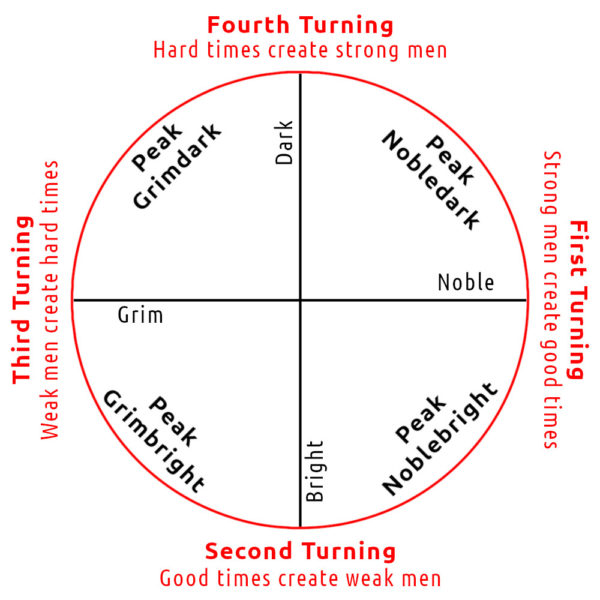
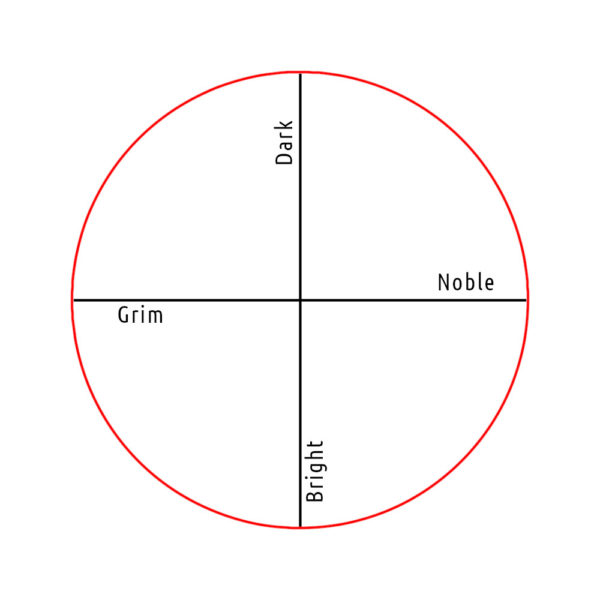
To start, we need to understand the difference between grimdark and noblebright. Both forms of fantasy exist on a field with two axes: noble vs. grim and bright vs. dark.

The bright vs. dark axis describes whether the fantasy takes place in a world where good usually triumphs over evil (bright), or a world where evil usually triumphs over good (dark).

The noble vs. grim axis describes whether the characters have the power to change the world (noble), or whether they do not (grim).

Thus, with these two axes, we get the following combinations:

  • Noblebright: A fantasy world where good usually triumphs over evil and the characters have the power to save it.
  • Grimbright: A fantasy world where good usually triumphs over evil, but the characters aren’t on a quest to save it and are usually preoccupied with smaller concerns.
  • Grimdark: A fantasy world full of moral shades of gray, where evil usually triumphs over good and the characters are either anti-heroes or otherwise fail to save the world.
  • Nobledark: A fantasy world where evil usually triumphs over good, but the characters are empowered to change it.

These categories are subjective to some degree, and fans will often disagree about which category to put each book/series. However, I think that most fans will agree on the following examples:

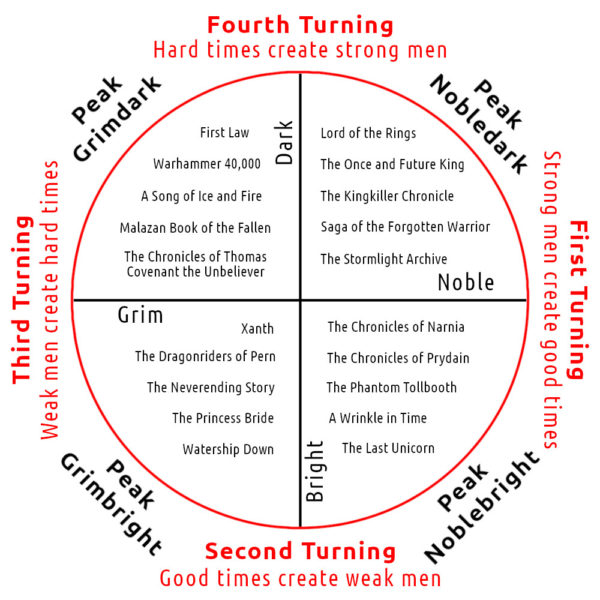
  • Noblebright: The Chronicles of Narnia by C.S. Lewis
  • Grimbright: The Princess Bride by William Goldman
  • Grimdark: A Song of Ice and Fire by George R.R. Martin
  • Nobledark: Lord of the Rings by J.R.R. Tolkien

Next, let’s review in the broadest possible terms William Strauss and Neil Howe’s generational theory. To really understand their work, I highly recommend that you read The Fourth Turning. I have some criticisms of the finer nuances of that book, but their ideas are really excellent, and their predictions hold up surprisingly well three decades later.

If I had to boil their theory down to one simple, easy-to-understand statement, it would be this:

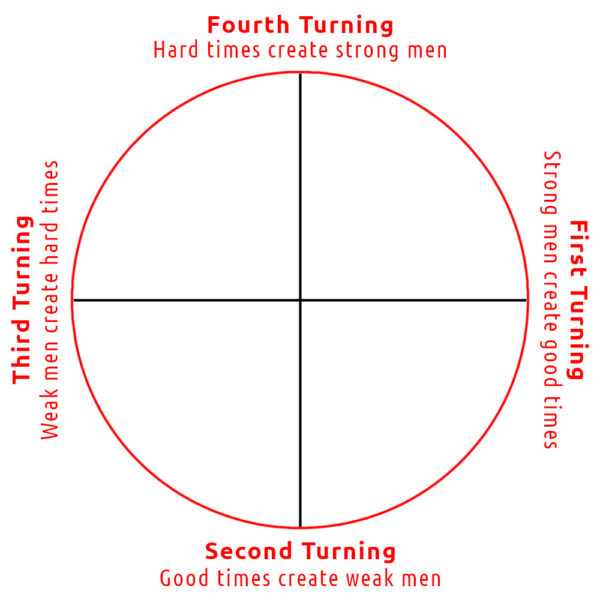
Strong men create good times.

Good times create weak men.

Weak men create hard times.

Hard times create strong men.

Thus, our society and culture passes through a secular cycle that takes about 80-100 years to complete (or in other words, the length of a long human life). The cycle has four seasons, or turnings, each one corresponding to a generational archetype (since it takes about 20-25 years for people born in the one turning to start having children of their own, thus moving us into the next generational turning).

The first turning happens when the society comes together after resolving a major crisis (eg the Revolutionary War, the Civil War, World War 2) and builds a new, stable order. The second turning happens when their kids rebel against that order, seeking freedom (eg the First and Second Great Awakenings, and the various counterculture movements of the 60s). The third turning happens when the order breaks down completely and everyone goes their own way (eg World War I, the Roaring Twenties, and the culture wars of the 90s). Finally, the fourth turning happens when the society faces a major existential crisis that totally reshapes it.

According to the theory, each axis of the grimdark/noblebright field corresponds to a different generational turning. Thus, stories that are noble have the most resonance in a first turning, stories that are bright have the most resonance in a second turning, grim stories resonate most in a third turning, and dark stories resonate most in a fourth turning.

In other words, the generation that comes of age during a major existential crisis will tend to gravitate more toward fantasy where evil typically triumphs over good, whereas the generation that comes of age during a period of rebuilding will tend to gravitate more toward fantasy where the characters have the power to change the world. And so on for bright and grim stories: the generation that comes of age during a spiritual awakening will gravitate more toward stories that take place in a world where good usually triumphs over evil, and the generation that comes of age in a declining and/or decadent society will gravitate more toward fantasy where the characters are relatively powerless.

Another way of thinking about it is to consider what each generation is not going to be drawn to, or which stories are not going to resonate well. An American who came of age in the 40s and 50s, when US power was on the rise and the Pax Americana was reshaping the world, isn’t going to resonate well with grim stories about powerless characters. Likewise, a boomer who came of age during the counterculture movements of the 60s and 70s isn’t going to resonate well with a dark fantasy world where evil usually triumphs, because (as much as they hate to admit it) they grew up in a very sheltered world that generally made sense—so much so, in fact, that they couldn’t help but rebel against it.

According to this theory, the next generational turning begins when one of the four forms of fantasy (noblebright, grimbright, grimdark, or nobledark) is at a peak. Over the course of the turning, that fantasy form declines until the next form in the cycle becomes ascendant, at which point the next generational turning begins.

Thus, at the start of a first turning, nobledark stories are typically ascendant, where the fantasy worlds are dark and morally gray, but the characters are empowered to save the world. As that generation successfully establishes a new order, the culture’s taste in fantasy shifts away from dark stories and toward noblebright stories, where the characters are still empowered but the world is more ordered and stable.

At the start of the spiritual awakening that characterizes a second turning, noblebright fantasy is ascendant: stories with an optimistic outlook on the world where the characters are larger than life. But as the awakening progresses, people in the society care more about freedom and individuality and less about the group, so stories about characters who sacrifice everything to save their world resonate less with them. Thus, by the end of the second turning, the ascendant form of fantasy is grimbright, which is really more of a slice-of-life fantasy about beloved characters having fun (but not world-altering) adventures.

At the start of a third turning, where the social order has started to break down and corruption begins to permeate all levels of the society, these grimbright stories start to take a darker tone. Readers find it too “unrealistic” to believe that good always triumphs over evil, and they certainly do not believe that good people have the power to change the world—at least, not the “smells like teen spirit” world that they inhabit. Their tastes shift away from the fun, adventurous slice-of-life of grimbright, and toward the dark and gritty anti-heroes of grimdark.

Finally, at the start of the fourth turning, grimdark is ascendant, but readers are starting to lose patience with it. As each new crisis in the real world compounds with all the others, they find it unbearable to read about characters that don’t have the power to change the fantasy worlds they inhabit. At the height of the fourth turning, society reaches an existential breaking point where, in the words of Strauss and Howe, “all of [our] lesser problems will combine into one giant problem, [and] the very survival of the society will feel at stake.” (The Fourth Turning, p277) At this point, readers are ravenous for books about characters who are empowered to fight back against the tides of evil and darkness. Grimdark fantasy declines and nobledark fantasy ascends.

I haven’t read all of the series in the diagram above, but I do have a pretty good sense of most of them, and I put the diagram together with the help of my mastermind group. The key thing about it is that each fantasy series came out in roughly the generational turning that corresponds with each quadrant.

Now, it’s worth pointing out that these trends aren’t absolute. In each of the secular seasons, you can find examples of contemporary fantasy that runs counter to trend. For example, David Gemmell’s Drenai Saga came out in the 80s, at the start of the last third turning when grimbright should have been ascendant, and yet the Drenai Saga is solidly nobledark. Terry Pratchett’s Discworld books had their heyday in the 90s, 00s, and arguably 10s, but they probably fall into grimbright (though you could make the argument that, as absurdist fantasy, they are more similar to grimdark: stories where good and evil really doesn’t matter, and the characters are just doing their best to go along).

But the theory doesn’t state that each fantasy form’s antithesis dies completely when that form is ascendant: only that it reaches a nadir of decline in its resonance with the culture. But without sufficient contrast, the ascendant form cannot stand out. Thus, there still has to be some noblebright Paolini to provide sufficient contrast with the grimdark of Abercrombie and Martin, some low fantasy slice-of-life Legends and Lattes grimbright to make the epic nobledark high fantasy of Sanderson stand out stronger.

According to this theory, as we continue to muddle our way through this present fourth turning, the decline of grimdark fantasy will accelerate, and the bestselling fantasy books of the 2020s will mostly be nobledark. And indeed, we can already see that happening with the meteoric rise of Brandon Sanderson (especially his Stormlight Archive series), the popular enthusiasm surrounding Larry Correia (whose Saga of the Forgotten Warrior falls squarely into nobledark), and the enduring anticipation of Patrick Rothfuss’s fans for the conclusion to the Kingkiller Chronicle. Meanwhile, enthusiasm for George R.R. Martin has waned significantly with the train wreck of Game of Thrones, and Abercrombie, though still quite popular, seems to be testing the nobledark waters with his YA books.

It would really be interesting to do a deep dive on the generational archetypes and make a study of how that affects the fantasy forms that run counter to the cycle. But that’s beyond the scope of this blog post, and frankly I need to get back to writing my own books. But what do you think of this theory? Does it resonate with you, or is there something that we missed?

#GiveThanks Day Three

(30) My wife posted today that she’s grateful for Tillamook Mudslide ice cream. So am I!

(31) I’m grateful for the original Star Wars series for cultivating within me a deep and lifelong love for science fiction.

(32) I’m grateful for Michael Ende and his magnificent book The Neverending Story, which remains my favorite novel of all time, and showed me as a child just how powerful and moving a book can be.

(33) I’m grateful for Madeline L’Engle and A Wrinkle in Time for helping me to realize that one day, I would be a writer.

(34) I’m grateful for Ursula K. Le Guin and her masterful book The Dispossessed for showing me how the written word can make you feel you understand a fictional character from a completely alien culture better than you understand yourself.

(35) I’m grateful for Orson Scott Card and Ender’s Game for keeping me up until 4am and giving me one of the most incredible reading experiences of my life.

(36) I’m grateful for David Gemmell and his Drenai Series for moving me to tears with the inspiring heroism of his characters.

(37) I’m grateful for my childhood teachers who encouraged me to read and instilled in me a love of reading.

(38) I’m grateful for Terry Pratchett and his wonderfully entertaining Discworld books, which definitely helped me to become a funnier person.

(39) I’m grateful for Paperback Swap, which has been a wonderful tool for swapping books and building my personal library.

(40) I’m grateful for all of the wonderful books I have yet to discover.

(41) I’m grateful for Goodreads for helping me to organize and keep track of the books that I read, and to set reading goals.

(42) I’m grateful for the ability that I have to blog about my writing and my reading, something that didn’t really exist until just a couple of decades ago.

(43) I’m grateful for NaNoWriMo and the encouragement that it gives all of us to write things we didn’t think that we could.

(44) I’m grateful for Brandon Sanderson, his wonderful books, the positive influence that he is on the fantasy genre, and for the class he taught at BYU that both I and my wife were privileged to be able to take (though we didn’t know each other at the time).

2020-02-15 Newsletter Author’s Note

This author’s note originally appeared in the February 15th edition of my newsletter. To sign up for my author newsletter, click here.

I’m writing this author’s note on Friday evening, after a long and wonderful day at Life, the Universe, and Everything (LTUE). Of all the science fiction conventions that I attend, I think LTUE is my favorite. It’s local to Utah Valley, so a lot of the regulars have become longtime friends of both mine and Mrs. Vasicek’s.

But the biggest reason I love LTUE is because it has such a strong writing track. Where FanX Salt Lake (the big local media con) is all about fandom and geek culture, LTUE is all about helping creatives to develop their craft, learn the business, and connect with the people who love the things that they create. It started as an academic symposium for aspiring science fiction writers, but in recent years it has branched out to other creative fields like art, film, gaming, etc, all with an emphasis on science fiction and fantasy.

There have been a lot of really great panels in the last couple of days. One of my favorites was on the future of Fantasy, where Peter Orullian, James A. Owen, Rafael Hohmann, and Charlie Pulsipher (who does a fantastic Velociraptor impression) discussed the rise and fall of Grimdark, the dawning of Noblebright, the push from the industry for the #ownvoices movement, and the indie explosion of LitRPG. Lots of really fascinating trends to keep an eye on!

I forget which panel it was on, but M. Todd Gallowglass gave some really prescient advice for aspiring writers: “You don’t make a writing career by being read; you make a career by being reread.” He was also on a great panel about whether or not it’s worth it to pursue a master’s degree, and he shared some very interesting points that run counter to what I’ve heard from everybody else: namely, that for a career writer it generally isn’t worth it. M. Todd Gallowglass is one of my newest favorite people at LTUE, and he’s always a blast to talk and hang out with.

The good folks from World Fantasy Convention are here at LTUE as well, and they gave a panel talking about all the wonderful things we can expect from attending World Fantasy 2020 in Salt Lake this year. It’s so close by, why wouldn’t we want to attend? I’m really torn on this: it’s a convention that caters more to the traditional side of the business, which isn’t the path that I’m pursuing, but I attended World Fantasy in 2009 and 2010, and it is a really great convention… also, it’s so close this year, practically in our own backyard… I don’t know. But even if I decide not to go, I will almost certainly attend the barcon.

The LTUE benefit anthology launch party was also a lot of fun! Lots of great stories from old-timers and regulars. I look forward to reading it! I also look forward to collecting as many signatures from everyone as I can. For last year’s anthology, Trace the Stars, I’ve gotten all but four of the author signatures. Also, I’m happy to report that next year’s LTUE benefit anthology will include a story of my own!

Brandon Sanderson wasn’t here on Thursday or Friday, but I expect we’ll be seeing him tomorrow. Kevin J. Anderson is here, as well as David Farland, Eric James Stone, and Tony Daniels, senior editor at Baen. Tony Daniels was also on a panel today with Mrs. Vasicek, where they discussed near future SF. Lots of fascinating things to think about, both from a technological angle and a social angle. I really liked Mrs. Vasicek’s “left field” near-future prediction: that AIs will eventually replace professors and every college student will have a personally tailored AI!

Speaking of Mrs. Vasicek, she gave a really fantastic presentation today called “Rage Against the Algorithm,” where she offered some insight into the Amazon hive mind, gleaned from their recent research papers. It appears that book covers are about to matter a whole lot more in the Amazon algorithm, and that they are putting a lot more emphasis on search and on the review system (which they are working to fix). Also, book categorization may start to become dependent at least partially on reviews. If you’re one of my author-fans and all of this sounds intriguing, let me know and I’ll email you a copy of her powerpoint.

On Friday morning, I moderated a panel on unconventional outlining techniques with Mackenzie Kincaid, Michael F. Haspil, and Els Curtis. That was a lot of fun. Mackenzie had some really great advice for productivity apps and hacking your own personal habits, and Michael and Els had lots of great insight into their own personal outling methods as well. Some really great questions from the audience really got the panel rolling, and I think it turned out quite well.

Friday night was the big mass booksigning, and it was a lot of fun! Definitely my most successful signing even so far. Caught up with a bunch of my old fans, and met a lot of new people as well, several of whom went on to buy a book or two. Also got into some really great conversations with other fellow creatives, including Emily Martha Sorenson, whom Mrs. Vasicek and I chatted with until almost everyone else was gone. It was really fantastic to talk with so many great people who share the same passion for geek culture and speculative fiction! Mrs. Vasicek and I both had a blast.

By the time this newsletter reaches your inbox, we will probably be on our way to the last day of LTUE. Mrs. Vasicek has a panel on computer hacking that looks really interesting, and I’m on a writing/publishing panel about how to avoid rookie mistakes—basically, how to learn from all of the many, many mistakes I’ve made over the years! Should be a lot of fun. If you’re there, be sure to come up and say hi! If not, maybe next year.

That’s my LTUE report for this year. It’s definitely shaping up to be one of the more memorable ones. Each year, it seems to get even better—may that continue for many more years to come!

2019-10-17 Newsletter Author’s Note

This author’s note originally appeared in the October 17th edition of my author newsletter. To subscribe to my newsletter, click here.

I had a major realization about my creative process while writing “Sex, Life, and Love under the Algorithms.” My original goal was to take a short break from The Stars of Redemption in order to work through a creative block. Instead, I came away with a plan that could revolutionize the way I write everything.

The major realization was that my natural writing length is between 10k and 30k words. When I try to write short stories, they tend to balloon very quickly into something longer. But when I try to write novels, I always run into a creative block somewhere in the middle, usually around the 30k-40k word mark.

This doesn’t mean that I can’t write novels; just that I have to find ways to work through this problem. I remember asking Brandon Sanderson a question about this ten years ago while taking his writing class:

Me: So I have this problem, where every time I try to write a novel, I always get stuck in the middle and have to put it aside for a few months before I can finish it.

Brandon: But you finish it, right?

Me: Uh, yeah. But—

Brandon: Then what’s the problem? So long as you end up with a finished novel, your creative process is still working. It might not work the same as someone else’s, but it works.

Ever since then, that’s basically been my process. I work on a novel until I hit a creative block, then lay it aside and pick up another half-finished novel and work on it until I either finish it or hit another creative block, at which point I lay it aside to work on something else.

But in 2017, I decided that wasn’t good enough. I wasn’t producing novels fast enough to keep up the rigorous release schedule that I needed in order to stay relevant in the indie publishing world. So over the course of the next two years, I developed an outlining method to write faster, cleaner, and more efficiently.

I’ve written three or four novels using this new method, and in spite of all my best efforts, I always find myself getting stuck somewhere in the middle—in other words, after surpassing my natural writing length. At the same time, I still haven’t managed to write more than 2-3 novels per year.

It’s very difficult to keep writing on something that won’t be finished for months when your sales are starting to flag and you know you need a new release to boost everything again. Some people thrive on that sort of pressure, but not me.

That’s why “Sex, Life, and Love under the Algorithms” was so refreshing to write. From start to finish, it only took a month to write (and the only reason it took that long was because I was taking it easy). No creative blocks. No long breaks. What’s more, I now have a story to submit to the major markets, or self-publish, or do whatever else I can think of to earn money and reach new readers.

This made me wonder: what if I could write all of my novels this way?

In the golden age of science fiction, there was this thing called the “stitched novel.” Most SF writers specialized in short stories, but found it much more difficult to write novels. The solution they found to this problem was to stitch together several short stories that took place in the same world, and turn that into a novel. Asimov’s Foundation books were written this way, for example.

What if, instead of stitching together a novel after the fact, I used my novel outlines to come up with short stories or novelettes that I could later assemble into a finished novel? Each story would be a complete story in itself, and I might only reuse half of it in the novel, or rewrite it from a different character’s point of view.

Not only would I avoid hitting creative blocks, but I’d also be able to get paid during the novel-writing process itself, and also have more frequent new releases. I would also have more material to submit to the major magazines and other traditional short story markets, potentially getting my name out that way.

To keep my readers from paying for the same story twice, whenever I self-published one of these stories, I would make it free for the first couple of weeks. I would also retire most of these stories after the novel itself came out, though I might use one or two of them to help promote it.

There are a couple of novels I still need to finish using the old method. The Stars of Redemption is one of them, and I should probably also finish the Twelfth Sword Trilogy before doing anything too experimental. But I have some new story ideas that could really work out well with this assembled novel technique. Also, I think it’s time to retire the Star Wanderers novellas and combine them into a single novel, which could serve as a proof-of-concept.

I have no idea if this plan will work or not, but I figure it’s worth a try. If breaking things down to my natural writing length enables me to write more novels in the long run, that would be fantastic. And if the quality of my novels goes up because the short stories help to flesh out things like character and setting, so much the better.

Life, the Universe, and Everything 2019

Life, the Universe, and Everything was this past weekend. It’s a local Utah convention with an academic flair, which means there’s a little less cosplaying and a lot of interesting and informative presentations, in addition to all the great panels. There’s also a strong writing and publishing track, though in recent years they’ve expanded the tracks on art, music, and film. Regardless, it all comes back to science fiction and fantasy.

I’ve been coming to LTUE for the last eleven years, and I think this was my favorite one yet! Part of that might have to do with the fact that future Mrs. Vasicek was there with me, but still. Lots of friends, lots of books, lots of panels, and lots of fun!

On Thursday, there was a really fascinating presentation on pre-modern methods of food preservation, such as pickling and fermentation. Really interesting stuff. Not only did we geek out on cheesemaking and sauerkraut recipes, but we also looked at how the production and supply of salt shaped trade routes, empires, and wars. It was extremely informative.

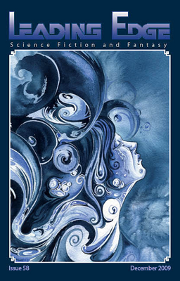
Since Thursday was Valentine’s Day, I picked out some chocolates and a copy of Leading Edge issue 58, where my first published work appeared. I was a bit worried that it would seem tacky, but some friends assured me that it wasn’t, and future Mrs. Vasicek seemed to really appreciate it.

There were a bunch of interesting panels on Friday. My favorite was probably the one on community building for creatives, with Sandra Tayler and M. Todd Gallowglass. They both had some very interesting stories and advice, as well as the other panelists. My biggest takeaway was that in order to build a community around my own work, I need to be a better participant in other creative and fan-based communities. Like LTUE, for example.

I also picked up a copy of the first LTUE benefit anthology, Trace the Stars. My mission for the rest of LTUE was to get as many authors from the anthology as I could find to sign it. Some of them weren’t there, but I did get most of the ones who were. One day, I’ll get all the signatures and turn it into a book of power! Wuah-haha!

The book signing was fairly low key. A lot of the big names didn’t show up, partly due to the weather, but there was still a good turnout. One of my very first fans who bought Desert Stars at my first ever book signing came over to chat. It was really good to catch up with him, and to let him know that I’m still writing and publishing.

There were a lot of really great panels on Saturday, on topics like surgery in space and what archaeology would look like on an artificially created world. Caught up with Eric James Stone and his wife Darci, who is a close friend of future Mrs. Vasicek. As we were all hanging out in the library, Brandon Sanderson walked up to say hi, and I was able to introduce future Mrs. Vasicek to him. We were actually both in Brandon’s class ten years ago, and didn’t know each other at the time. Brandon got a kick out of that.

My Saturday panels were very well attended and went off very well. The one on villains was particularly good, I think. There was just enough contrast in our viewpoints to keep it interesting without being too argumentative, and everyone had good points. When we made our plugs at the end, I urged everyone to subscribe to Pewdiepie, which got a kick out of the audience. I’m doing my part!

The panels were great, the banquet was great, catching up with old friends was also great. I may have spent a little more than my budget on books, but it was great to support my author friends, and I’m really looking forward to reading some great stuff!

All in all, another great year!

Why writing every day may not be the best advice

When I started writing back in college, the prevailing advice was to write every day. And to be fair, at the time, that was very good advice. I was just getting started on my writing career and had a lot of learning to do. My writing improved by leaps and bounds as I strived to make progress on my WIPs every day.

Now, though, I’m not so sure that writing every day is the best thing to strive for.

It’s not that I’m against the idea of practice. Writing is one of those rare creative professions where people don’t think you get better the more you do it. Of course, that’s flat-out wrong. The best musicians put in hours and hours of practice, as do the best chess players, or the best soldiers, or the best sports stars. Writing is no different. If you don’t put in the time and effort, you won’t get the results.

At the same time, there’s a tendency among aspiring and even journeyman writers to become consumed with guilt because they missed their writing goal for the day. This is counterproductive. Goals don’t exist to give you satisfaction or guilt, but to give you direction. Satisfaction comes from what you achieve in pursuit of a goal, not in the goal itself.

So that’s one aspect of it. But there’s another aspect, and that’s how effective it is (or isn’t) to write every day.

Between high school and college, I worked as a gofer on a masonry crew. One of the things my boss used to say was “work smarter, not harder.” He often said it rather tongue-in-cheek, but it’s still an important concept. It doesn’t matter how hard you work if you’re doing it wrong.

This applies to writing as well. What does it matter that you write every day, if you’re just going to throw out most of it anyway? Is that really the best use of your time and energy? If by taking a week to establish things like plot, character, world-building, etc, you could write a much cleaner and better first draft, does it matter that you technically weren’t writing every day during that week?

Write smarter, not harder.

Now, I’m very glad that I did write every day back when I was starting out. My first (and possibly my second) million words were mostly crap, so it was better to put in the time and get through it as quickly as possible, just for the learning and growth.

But now that I’m an established journeyman writer, I find that the results are much better if I take the time to do some basic prewriting before I attack the first page. My first drafts are cleaner. The story comes together easier, with fewer problems. I don’t have to do “triage” revisions, where I’m throwing out characters, subplots, or even major plot points simply because they don’t work.

In Brandon Sanderson’s writing class, I once asked what I needed to change so that I could write my WIPs straight through without getting stuck in the middle. Brandon asked me if I was still finishing them, and when I said yes, he basically said don’t worry about it. That was good advice then, but it isn’t anymore. I’ve reached the point where writing smarter is more important than writing harder.

Anyway, those are my thoughts at the moment. Things change a lot when you’ve been writing for 10+ years, and unlike all the resources available for aspiring writers, there isn’t a whole lot of stuff out there to help guide you through the later phases. I’m basically figuring it out as I go.