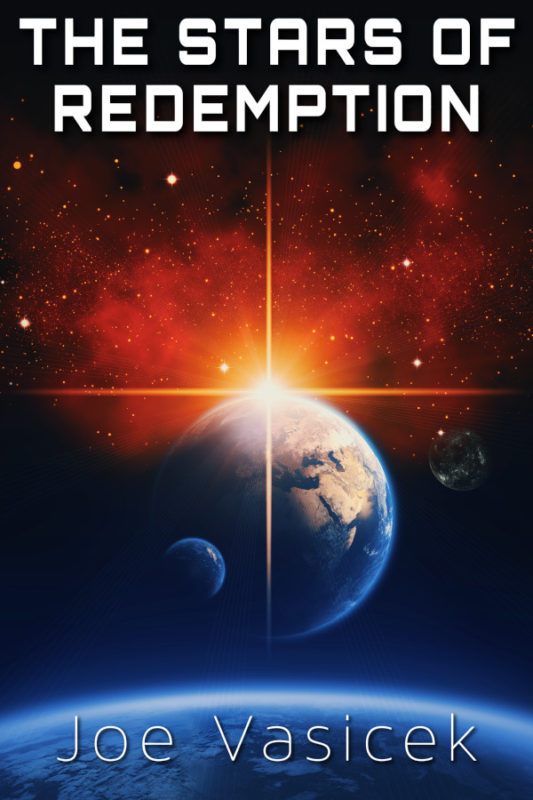
The Stars of Redemption brings the Genesis Earth Trilogy to its heartwarming conclusion, weaving together cosmic mystery, high-stakes adventure, and the emotional journey of a family caught between past and future. In this character-driven science fiction novel and grand finale of the Genesis Earth Trilogy, the secrets of the ghost ship, the wormhole, and humanity’s long-lost Earth collide, pushing Terra, Michael, Estee, and Khalil toward a destiny that tests their courage, their bonds, and their hope.
What Kind of Reader Will Love This Book?
If you like…
Character-driven science fiction where relationships matter as much as the big ideas
High-stakes adventure rooted in loyalty, courage, and found family
Deep-time, big-concept SF (time paradoxes, shattered superintelligences, dead Earth, existential threats)
Teens thrust into danger who must grow up fast without losing their humanity
Stories where the emotional journey hits as hard as the plot twists
…then The Stars of Redemption is exactly the kind of story you’re looking for.
What You’ll Find Inside
The Stars of Redemption follows Estee and Khalil as they ride a mysterious ancient ghost ship run by a fractured AI. The two young adults now know the truth about the time travel paradox that created it, but they aren’t sure how to stop it from going back and annihilating the human race. But solving the paradox will create an alternate timeline—one where many of their loved ones have lived totally different lives. The result is a tense, emotional, wonder-filled journey that blends survival, mystery, love, grief, and cosmic terror into a finale that feels both epic in scope and heartwarmingly personal.
What Makes It Different
Fans of classic time-paradox stories and authors like Arthur C. Clarke, Becky Chambers, or Michael Crichton will recognize the sense of cosmic mystery, but The Stars of Redemption takes those ideas in a uniquely human direction. Where many time-loop or AI-disaster stories focus on spectacle, this one leans into relationships, trauma, and the fragile bonds that hold people together when everything else collapses. And unlike most YA or near-YA science fiction, it refuses to sacrifice scientific wonder or thematic depth—holding the line on both heart and hard SF ideas.
What You Won’t Find
If you’re looking for grimdark nihilism, sexually explicit romance, or nonstop action with minimal character growth, this isn’t that book. But if you prefer science fiction grounded in hope, heart, survival, and meaning, with characters who feel real enough to bleed, you’ll feel right at home here.
Why I Think You Might Love It
I wrote The Stars of Redemption shortly after becoming a young father, and that life-changing experience deeply informed the conclusion of the Genesis Earth Trilogy. Starting a family of my own made Estee and Khalil’s found family more vivid, as well as Estee’s need to fill the hole left by losing her parents. This became the most mature and thoughtful book in the trilogy—the kind of story I always wanted to write but couldn’t until I’d lived a little more myself.
If you loved the high-concept wonder and emotional heart of Genesis Earth and Edenfall, I think you will find The Stars of Redemption to be a thoroughly satisfying, deeply meaningful conclusion to the trilogy!
If there’s any book on this list that I’m open to changing my mind on, it’s Death’s End by Cixin Liu. enjoyed The Three Body Problem, though it did have a lot of long sections of exposition, which comes across as amateur writing in English (and probably doesn’t in Chinese). But the characters held my interest, and the ideas in the book were absolutely fascinating. Also, there was absolutely none of the wokery that has come to saturate our Western culture in recent years, which made the novel feel very refreshing. So I enjoyed the first book in the series quite a lot.
However, things got really weird in the second book, and I didn’t connect with the characters nearly as much, so when the long sections of exposition began to feel like they were droning on, I decided to DNF it. I’ll probably try this series again at some point, but since I DNFed the second book, I can’t really say that I’d vote for the third book if the awards were held again. But I do need to give this series a second chance.
The book that won this year was the second book in N.K. Jemisin’s Broken Earth trilogy, which I didn’t read because I hated the first book so much. Since it’s going to be a while before I get to the 2016 Hugos (I’m currently rereading Uprooted by Naomi Novik, which I DNFed before, but the library loan for the audiobook expired so I’m back on the waitlist again—just too many audiobooks I guess), I’ll briefly give my take on The Fifth Season and why that book made me DNF not only the series, but N.K. Jemisin as an author.
I believe that abortion is the defining moral issue of our times, just like slavery was the defining moral issue for 19th century America. Future generations will probably look on us the same way we look on the abolitionists and slaveholders of the antebellum era, and I suspect they will judge us just as harshly for failing to stand up for the rights of the unborn. After all, we hold these truths to be self-evident, that all men are created equal, that they are endowed by their Creator with certain unalienable rights, and that among these are life, liberty, and the pursuit of happiness. For the 19th century, the defining issue was liberty, and the good guys won. For the 20th century, it was life, and the good guys lost, but the 21st century is shaping up to be a rematch (though based on the unbridled narcissism of today’s culture, the pursuit of happiness is giving it a run for its money, but on the abortion issue the two are aligned).
N.K. Jemisin is a very talented author. She wrote large sections of The Fifth Season in second person, and made it work. That’s a little like running a three minute mile in an era when most people thought it was impossible. Of course, she knows that she’s talented, which lends her voice a degree of arrogance, but she’s not the first author to have an oversized ego—in fact, you could argue that Orson Scott Card is much more obnoxious when it comes to that, and Card wrote the second-best book to ever win a Hugo (Ender’s Game. The best Hugo-winning book, IMHO, is Hyperion by Dan Simmons).
[Spoilers ahead]
However, it’s not the prose or the writing of The Fifth Season that I take issue with, but the underlying message. The book starts with an infanticide, where the main character comes home to find out that the father of her child has murdered her child and run away. Of course, this creates a massive amount of sympathy for the main character. The rest of the book alternates between flashbacks to the MC’s past, establishing her backstory, and the present, where she eventually acquires enough power to destroy the world. However, at the very end of the book, we learn that the MC’s backstory culminated in her killing another one of her children to prevent that child from becoming a slave. In other words, the big reveal is that the MC committed infanticide herself, on one of her own children, and the whole novel is carefully crafted to not only make us sympathize with her, but root for her when she does it.
I know that there were slaves in places like Haiti who killed their own children for similar reasons. However, there were also many other slaves who took the exact opposite view on the value of human life, such as Harriet Jacobs in Incidents in the Life of a Slave Girl. N.K. Jemisin has ancestors who were slaves, but she herself is a rich, progressive black woman living in New York City who is as far removed from slavery as I am (after all, there’s a reason why my people are called “slavs”).
But it wasn’t Jemisin’s views on slavery that I took issue with, so much as on using it as a justification for infanticide. It’s the same argument that we hear on the pro-abortion side of the issue, how it’s actually more merciful to slaughter an unborn child in the womb than to let that child be born into a life of poverty—never mind that our modern era is so fantastically wealthy that our poor are more likely to be obese than starving. In other words, the message of The Fifth Season is an antithesis to A Canticle for Leibowitz, which is not only a superior book, but is also on the side of the good guys in the defining moral conflict of our times, while N.K. Jemisin is on the side of the bad guys—or as I prefer to call them, the Death Cult.
So that is why I DNFed The Fifth Season and decided to never read anything that Jemisin ever writes (unless, of course, she comes to the light and changes her position on the right to life). It is also why I will always vote No Award on any ballot that includes Jemisin as one of the authors.
I started All the Birds in the Sky but didn’t finish it. To me, it felt like the author was trying too hard to be cutesy and childlike, but I personally found it off-putting. It’s been a while since I read it, and for some reason I can’t find it in my reading journal, but I seem to remember that there were some content issues, too—which would explain why I found it off-putting, given then childish tone.
I didn’t read A Closed and Common Orbit because I DNFed the series with the first book. Here is the entry for it in my reading journal:
This seems like the kind of book that would be right up my wheelhouse, but on closer inspection it really isn’t. The whole thing is one big cultural diversity parade, and the central question of the story half the time is whether the humans are using the right pronouns for the aliens. Also, you’ve got your obligatory super sex positive aliens and your nymphomatic, porn-addicted mechanic who’s played as the adorable one. So yeah, not at all for me.
I’ve written before about Ninefox Gambit, but I might as well include an excerpt from my reading journal on that one as well:
The story never really hooked me, and the action at the beginning felt disjointed without any conflict or characters for me to care about. Also, there were a lot of info dumps… But the thing that made me decide to DNF was when the main character turned out to be a lesbian. I don’t know that this book will follow the “all true love is LGBTQ love” trope, but I didn’t want to stick around to find out.
I suppose I could be convinced to try this one again, though. At the time, I was reading a lot of other award-winning and nominated books, which was why I had little patience for another woke lesbian love story. Seriously, I DNFed 27 books that month, most of them for similar reasons.
Finally, Too Like the Lightning was another book that I DNFed for obnoxious wokery. If I remember correctly, it takes place in a far future where gender is something that everyone intentionally ignores. It wasn’t quite as bad as Ann Leckie’s books, but it was definitely going for the same kind of woke nonsense. Also, there were some religious proscriptions that the author seemed to think would make for a much better society, but that I personally found super dystopian, and not in a good way.
The Calculating Stars actually started out pretty good. Mary Robinette Kowal is a very skilled writer, and her main character in this book was both likeable and interesting—something that seems to be increasing rare in Hugo-nominated books. It also didn’t hurt that in the very first chapter, a giant meteor wiped out Washington DC and most of the eastern seaboard. But then it gradually turned into a story about the little woman who roared and her band of misfit minorities who team up to fight Captain Patriarchy, and the super-woke feminism just ruined it for me.
I didn’t read Revenant Gun or Record of a Spaceborn Few because I DNFed both series with the first book. With Yoon Ha Lee’s Machineries of Empire series, I don’t remember much, except that the first book made absolutely no sense to me, with so much meaningless violence that it bordered on the absurd. With Becky Chambers’s Wayfarers series, it started off as an interesting space opera, but the ship quickly turned into a lesbian love boat, with lots of queer and transgender aliens to boot. Wokery ensues.
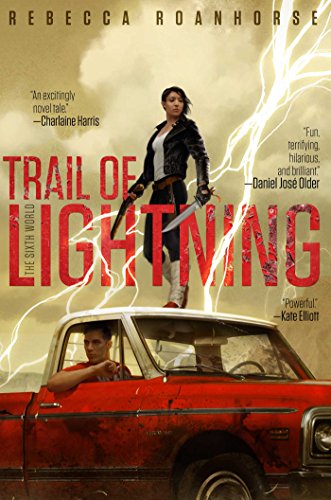
As for Trail of Lightning, I honestly don’t remember much about that one, other than that it started to give me woke vibes and I didn’t really like any of the characters. I think it also played the Death is Chic and Life is Not Worth Saving trope, which I personally cannot stand. If the main character had struck me as a good and decent person, I probably would have kept reading, but so many books that suffer from wokeness also suffer from having protagonists who are just terrible human beings in general. I don’t think the two are unrelated.
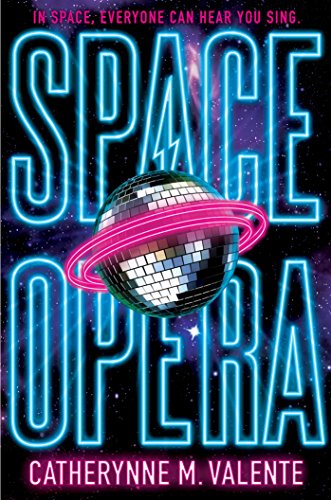
The first chapter of Space Opera was laugh out loud hilarious, and I actually enjoyed it quite a lot. Valente’s gonzo humor is a lot of fun! Then… I don’t know quite how to put this, but the story just started to feel depressing, and I’m not sure why. Also, the gonzo writing style started to grate on me after a while, kind of like Chuck Wendig’s writing does for anything longer than a blog article. It wasn’t a terrible book, but I didn’t end up finishing it.
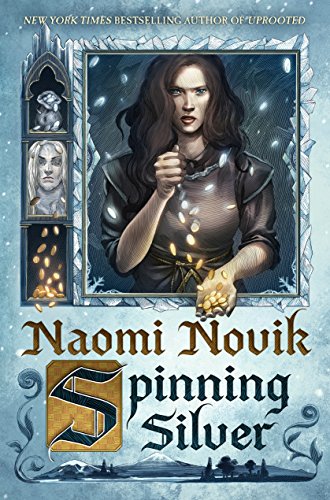
But I really loved Spinning Silver, much more than I was expecting to. I’m not generally into fairy tell retellings, but this one stirred something primal in my Slavic roots and scratched an itch I didn’t even know that I had. Besides all that, it’s just a damn good story. The villains were genuinely villainous, the peril was genuinely perilous, the good guys all had satisfying growth arcs, and the ending was a crowning moment of awesome that brought everything full circle in the best possible way. Really great book.
The Galaxy and the Ground Within by Becky Chambers
A Master of Djinn by P. Djeli Clark
A Desolation Called Peace by Arkady Martine
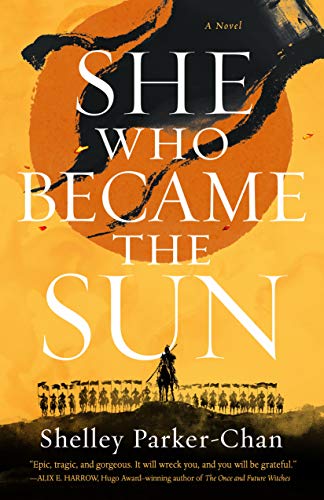
She Who Became the Sun by Shelley Parker-Chan
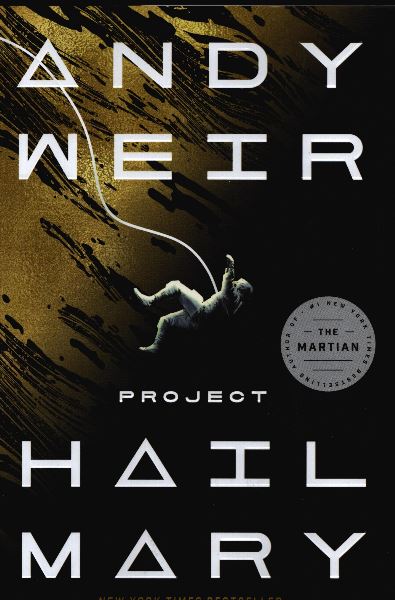
Project Hail Mary by Andy Weir
The Actual Results
A Desolation Called Peace by Arkady Martine
Light from Uncommon Stars by Ryka Aoki
A Master of Djinn by P. Djeli Clark
The Galaxy and the Ground Within by Becky Chambers
She Who Became the Sun by Shelley Parker-Chan
Project Hail Mary by Andy Weir
How I Would Have Voted
Project Hail Mary by Andy Weir
No Award
Explanation
Project Hail Mary was a fun read, and a really good hard SF novel. There were a couple of minor things that made me roll my eyes, but the story itself was solid, and the science was fascinating. Also, the ending really stuck with me for several days. I don’t think it was better than Hyperion or Ender’s Game, but it certainly was deserving of a positive vote for best novel.
I DNFed everything else on the ballot. Normally, that alone wouldn’t be a reason for voting No Award, but some of these books were just insanely woke: in particular, Light from Uncommon Stars was full of transgender madness (and judging from the author bio in the back, the author herself is caught up in the madness as well).
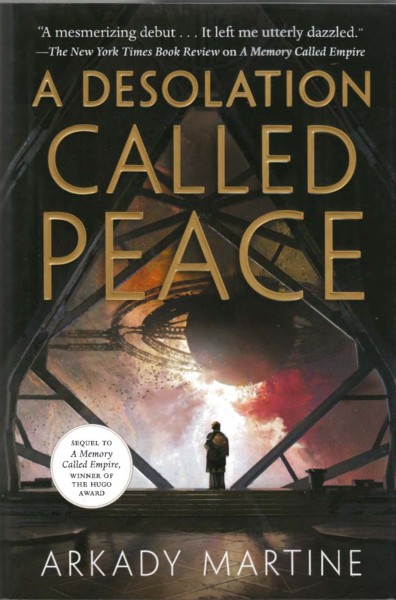
I didn’t read A Desolation Called Peace or The Galaxy, and the Ground Within because I’d already DNFed the first book in the series, mostly for the “all true love is LGBTQ love” trope (I should do a blog post dissecting that particular trope), so I can’t speak to the relative wokeness of either of those titles. But it says something that I tried and DNFed the series.
But the most infuriating read for me was She Who Became the Sun, since by all indications it should have been right up my alley, what with all the steppe nomad warriors and all. The writing was pretty good too, and the setup was fantastic. Yes, there was some gender bending stuff, but for the first half of the book I generally didn’t find it any more offensive than Mulan. I forget why I decided to skip to the last chapter, but the ending was so infuriating that it put this author solidly on my blacklist, just like The Fifth Season did for N.K. Jemison (more on that when we get to 2016’s Hugo ballot). I can’t say much without spoiling the book, but it has to do with what many conservative and alternate media commentators rightly call the death cult. Really infuriating.
As for A Master of Djinn, having traveled across Egypt and the Middle East, the worldbuilding was so fundamentally broken that I just couldn’t swallow it. The author basically created a steampunk Middle East that embraces several tenets of modern wokism. The only alternate reality in which the main character wouldn’t be tossed off of a high building for being a lesbian is a reality where the source code of Islam has been rewritten so entirely that it isn’t really Islam anymore. Which I suppose is fine for a pulpy escapist fantasy, but this one just didn’t appeal to me.