2019-10-10 Newsletter Author’s Note

This author’s note originally appeared in the October 10th edition of my author newsletter. To subscribe to my newsletter, click here.

I saw Joker yesterday. Don’t worry, I won’t give away any spoilers. It was every bit as incredible as I expected it to be, and yet in some key ways, not what I was expecting at all.

First, the basics. This movie is dark. Very, very dark. I believe this is the darkest, most terrifying iteration of the Joker ever made. Part of that is because it is so realistic. There are no magical superpowers, no aliens or infinity stones or any of that stuff. This story could have already happened in our world. It could yet happen.

That said, it is clear that the people who made it have deep respect and appreciation for the franchise. It isn’t like The Last Jedi, where the filmakers explicitly tried to subvert all of the things the fans love about Star Wars. In many ways, Joker is a homage to all of the iterations of Batman that have come before it. This could just as well be the origin story of Cesar Romero’s Joker as Heath Ledger’s.

Joaquin Phoenix is incredible. I didn’t think it was possible to do a better Joker than Heath Ledger, but Phoenix has done it. He really draws you into the Joker’s head, and his transformation from a broken misfit to a sociopathic supervillian is believable, compelling, and utterly terrifying. He earned every moment of the eight-minute standing ovation this movie received on its debut.

There is a dramatic arc to violence that very few movies, TV shows, or even books show in its entirety. When a character swings an axe at someone’s head, the scene usually cuts. You know what happened. But in Joker, you see everything. It’s a lot like Blade Runner in that respect. The bodycount is not that high, but the violence really hits you, and stays with you.

If you aren’t in touch with your dark side, this movie will profoundly disturb you. It will also screw with your mind. If you struggle with PTSD, this is probably one to avoid, unfortunately. Even if you think you like dark movies, this one may be too much for you. But if you do enjoy it, you will probably want to see it again, and again. There are so many layers to this movie that a single viewing is not enough to fully take it all in.

Without question, Joker is a major cultural landmark. It is, above all else, a brutally clear and damning indictment of all of us. In a world convinced that guns cause violence, Joker focuses on mental health and the cracks in our healthcare system. In a world obsessed with priviledge and inequality, Joker is about our pathological lack of empathy and compassion.

Part of the controversy surrounding this movie is the gulf between the critics who hate this movie, and the general audience, which loves it. After watching it, I think the critics can be divided into three camps.

First, there are the social elites who are so out of touch with the reality that the rest of us live in that Joker is anathema to their lived experience. It’s not that they hate it, so much as that they’re confused and bewildered by it. They are also bewildered by Brexit and the election of Donald Trump.

Second, there are the wokescolds who hate Joker because they recognize it as an indictment of themselves. They deride it as an “incel movie” because they know that their woke politics are partly responsible for creating a culture where “incels” are a thing, and that drives these people to violence.

I actually think that this isn’t the case for most of the critics. Sargon of Akkad recently put out a video on this, and while I agree with him that the wokescold critics see Joker as a mirror, I don’t think they see themselves as the people who drive the Joker into psychopathic madness. Instead, I think that the vast majority of the wokescold critics see themselves in the Joker.

In Milo Yiannopoulos’s interview with Jordan Peterson, he made the very salient point that the angriest, most radical people on the far left are, in their personal lives, broken and in pain. Often, they are victims of abuse. Personally, I would expand that to include many on the alt-right as well, but the point still stands.

The wokescolds want to see themselves as heroes working to overcome systems of oppression and inequality. They see themselves as builders, but Joker shows them that all they really want is to burn it all down. That’s why I believe this movie has provoked such a virulent backlash from the wokescolds: because it is a mirror that shows them as they really are, and they are terrified of what they see in it.

Without love, it is impossible for our culture and society to heal. That, I believe, is Joker’s ultimate message. The reason that Arthur becomes the Joker is because no one ever showed him any compassion, empathy, or love. He laughed through the pain until the pain made him laugh, and became the villain that Gotham deserved.

How often do we really listen to each other? How often do we reach outside of ourselves and genuinely connect? A recent study shows that the average American hasn’t made a single new friend in the last five years. Is that you? Is that your neighbor? The family across the street, or the guy who lives down the hall?

It doesn’t take much to reach out. Sometimes, all it takes is a smile—but isn’t that the joke? Somewhere, I hear maniacal laughter…

Trope Tuesday: Knight Templar

For this one, I’m going to pull the description straight from tvtropes itself, since the whole page is pretty good:

Sometimes, the Forces of Light and Goodness get too hardcore. In a deadly combination of Well-Intentioned Extremist, The Fundamentalist and, generally speaking, not so different, they get blinded by themselves and their ideals, and this extreme becomes tyrannical sociopathy.

Usually, the Knight Templar’s primary step (or objective) to his perceived “utopia” is to get rid of that pesky “free will” thing that is the cause of crime and evil. Many Knight Templar types are utterly merciless in dealing with those whom they consider evil, and are prone to consider all crimes to be equal. The lightest offenses are met with Draconian punishments such as full imprisonment, death, brainwashing, or eternal torture.

It’s important to note that despite being villains/villainous within the context of the story, Knights Templar believe fully that they are on the side of righteousness and draw strength from that, and that their opponents are not. Trying to reason with one isn’t much good either, because many Knight Templar types believe that if you’re not with them, you’re against them. Invoking actual goodness and decency will have no effect, save for making Knights Templar demonize your cause as the work of the Devil. After all, they are certain that their own cause is just and noble, and anyone who stands in the way is a deluded fool at best.

Basically, this is what happens when the villain not only believes that he is the hero of the story, but a heroic hero.  It’s not himself he’s fighting for, but his cause–and because the righteousness of his cause is unassailable, anything that stands in the way of achieving it must be destroyed.

The name of the trope comes from the Knights Templar, the medieval military order established during the Crusades to maintain European dominance in the Middle East.  They were an elite fighting force that became associated with many of the atrocities of the Crusades.  When Saladin conquered the Kingdom of Jerusalem, he was careful to avoid civilian casualties but took no prisoners among the Templars and Hospitaliers.

Of all the story tropes I’ve studied, this one reflects reality more accurately than most.  When people believe unquestioningly that they’re right, they tend to stop listening to anyone who disagrees with them.  They turn the space around them into an echo chamber, like a one-sided Facebook feed or a narrow message board community.  When their beliefs reach a certain degree of fervency, they start to become angry not only with those who disagree, but with those who fail to agree with or support them.  Once their cause compels them to action, it doesn’t take long for the ends to justify the means.  Give them a little power, and you’ve got yourself a real life Knight Templar.

It’s precisely because this trope so closely reflects reality that it’s one of the better ways to create motivations for the villain.  It’s not enough to want to take over the world, you’ve got to have some reason to take it over–and what better reason than a cause you firmly believe in?  Assuming, of course, that the cause is believable–it’s still quite easy to botch things in the execution.

This is precisely the sort of thing Gandalf was trying to avoid when he refused to take the ring:

Understand. I would use this ring out of a desire to do good. But through me, it would wield a power too great and terrible to imagine!

Galadriel and Faramir refused the ring for similar reasons.  Boromir succumbed to the temptation, but repented for it by giving his life to defend the hobbits against the attack of Saruman’s Uruk-Hai.

In Christopher Nolan’s Batman trilogy, this is also a recurring trope.  It’s the main motivation behind Razalgul in Batman Begins, and describes Harvey Dent’s face-heel turn as he transforms from Gotham’s white knight into Two Face.  Come to think of it, it seems that the superhero genre in general is teeming with this trope.

There aren’t very many true Knights Templar in my own books, but I’m writing a fantasy series that should feature a few of them.  In The Sword Keeper, a brotherhood of sentient swords has passed on the fighting skills of generations of warriors, enabling their bearers to unite the world into a peaceful empire.  Then, one by one, the swords go insane, driving their bearers insane with them.  It all starts when one of them goes Templar, and ends when all the swords are lost or destroyed … all, that is, except the one whom the hero of prophecy will take up to save the world.  And that hero happens to be a backwoods tavern wench who isn’t even strong enough to lift it, much less wield it in battle.

So yeah, even though this isn’t a trope that I’ve played with much, it’s one that really irks me in real life, so that probably means you’ll be seeing it soon my own fiction.  If you have any other thoughts or examples to share, please be sure to drop a comment.  I’d be very much interested to hear your thoughts on this one.

Image source: Templar Knight in Battle Dress

Trope Tuesday: Freudian Trio

Last week, I blogged about the Three Faces of Eve trope.  But if we’re going to discuss power trios in any depth, we first need to examine the classic Freudian Trio, one of the most prevalent combos and, in some ways, a precursor to all others.

As you might expect, the Freudian Trio borrows heavily from Sigmund Freud, specifically, his theory of the Id, the Ego, and the Superego.   The main idea is that the human mind is divided into three parts: the Id, which comprises our basest animal instincts; the Superego, which comprises our concepts of morality and social norms; and the Ego, which struggles to find a balance between the two.

In the Freudian Trio, these elements of the psyche are represented by:

Each of these character archetypes are fascinating in their own right, and deserve to be examined in much greater depth.  However, in the Freudian Trio, it’s the combination of the three that proves so fascinating.

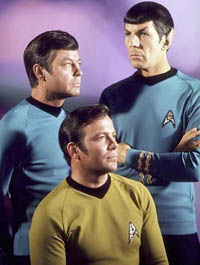
When faced with an interesting moral dilemma, the McCoy often wants to screw the rules and run in with guns blazing, while the Spock advocates caution, reminding us of the prime directive.  Or maybe the McCoy is paralyzed by indecision, while the Spock is the only one cold enough to make the sadistic choice.  In either case, the way the Kirk manages to resolve it will almost always reveal something deeper about the world or human nature.

The thing that’s truly amazing is how prevalent this trope is in fiction.  To name a few:

  • Star Trek: McCoy (Id), Spock (Superego), and Kirk (Ego).
  • Star Wars: Han (Id), Leia (Superego), and Luke (Ego), also:
  • Star Wars: Emperor Palpatine (Id), Grand Moff Tarkin (Superego), and Darth Vader (Ego).
  • Ender’s Game: Peter (Id), Valentine (Superego), and Ender (Ego).
  • Lord of the Rings: Gollum (Id), Sam (Superego), and Frodo (Ego), also:
  • Lord of the Rings: Gimli (Id), Legolas (Superego), and Agagorn (Ego), also:
  • Lord of the Rings: Dwarves (Id), Elves (Superego), and Humans (Ego).
  • Arthurian Legend: Sir Gawain (Id), Sir Lancelot (Superego), and King Arthur (Ego) (I would argue that Guinevere fits the Id role better, but I’m not an expert).
  • The Dark Knight: The Joker (Id), Harvey Dent (Superego), and Batman (Ego).
  • The Matrix: Neo (Id), Trinity (Superego), and Morpheus (Ego).
  • Shaun of the Dead: Ed (Id), Liz (Superego), and Shaun (Ego).
  • Fullmetal Alchemist: Edward (Id), Alphonse (Superego), and Winry (Ego).
  • The Melancholy of Haruhi Suzumiya: Haruhi (Id), Yuki (Superego), and Kyon (Ego).
  • Final Fantasy VI: Kefka (Id), Leo (Superego), and Emperor Gestahl (Ego).
  • Final Fantasy VII: Barrett (Id), Cloud (Superego), and Tifa (Ego).
  • Myst: Achenar (Id), Sirrus (Superego), and Atrus (Ego).
  • Starcraft: Zerg (Id), Protoss (Superego), and Humans (Ego).
  • Homestar Runner: Strong Mad (Id), Strong Sad (Superego), and Strong Sad (Ego).
  • The Good, the Bad, and the Ugly: Tuco (Id), Angel Eyes (Superego), and Blondie (Ego).
  • 20,000 Leagues Under the Sea: Ned (Id), Conseil (Superego), and Aronnax (Ego).
  • Twilight: Jacob (Id), Edward (Superego), and Bella (Ego).
  • Archie Comics: Veronica (Id), Betty (Superego), and Archie (Ego).

The Betty and Veronica one is particularly interesting because it’s also a love triangle.  In fact, most love triangles feature some kind of play on the Freudian Trio: the good girl vs. the bad girl, the nice guy vs. the jerk, the girl next door vs. forbidden love, prince charming vs. the loveable rogue.

Sometimes, the villains come from a dysfunctional or broken Freudian Trio, where one of the three died, was kicked out, or was never part of the combo in the first place.  When this happens, it’s called (aptly enough) a Evil Duo.  Examples include Pinkie and the Brain, Lex Luthor and the Joker, and Kefka and Gestahl (though that particular duo was very, very, VERY short lived).

Finally, it’s worth pointing out that the Freudian Trio is so common, it even occurs in real life.  Perhaps the best example of this would be World War II, where Churchill was the Id, Stalin was the Superego, and Roosevelt was the Ego.  With quotes like “never, never, never, never give up,” Churchill practically embodied the McCoy (his drinking penchant also helped), while Stalin, with his fanatic adherence to communism and his “million is a statistic” approach to the revolution, was as cold and calculating as you can get.  FDR was the one who held the alliance together, and it was only after his death that the Cold War really broke out.

Of course, it’s possible that we only see this trope everywhere because our brains are programmed to see it.  But if that’s true, it makes for an even stronger argument that the Freudian Trio plays on some powerful, universal archetypes.

Trope Tuesday: Chaotic Evil

If a character in a story scares the hell out of you, chances are he’s a Chaotic Evil.  From ax-crazy psychopaths to nightmarish clowns, from cold-hearted monsters to eldritch abominations, these guys are known for their complete lack of empathy, their nihilistic outlook on life, and their sick sense of humor.

From the easydamus character alignment page:

A chaotic evil character does whatever his greed, hatred, and lust for destruction drive him to do. He is hot-tempered, vicious, arbitrarily violent, and unpredictable. If he is simply out for whatever he can get, he is ruthless and brutal. If he is committed to the spread of evil and chaos, he is even worse…it represents the destruction not only of beauty and life but also of the order on which beauty and life depend.

According to tvtropes, characters who fall under this alignment can be categorized by five types, in decreasing order of redeemability:

  • A Chaotic Good who took things a little too far and inadvertently fell into evil.  Can usually be brought back with a heel realization if they haven’t already crossed the moral event horizon.  Scar from Fullmetal Alchemist is a good example of this type (incidentally, he’s also my favorite character from that series).
  • A character with a very feral nature who believes that everyone is out to get him and thus ends up killing everyone in order to protect himself.  Often manipulated by the Big Bad to do his dirty work.  He doesn’t really kill out of malice, though, so there may still be a possibility of redemption.
  • Committed to chaos before evil.  Can be convinced to team up with the heroes, if only because they happen to share the same enemy.  For these characters, their freedom is the most important thing–though don’t trust them too much, or else you’re liable to end up with a knife in your back.
  • Committed to evil before chaos.  These guys will never team up with the heroes, but they may team up with the Big Bad, even becoming one of his mooks if it gives them more opportunities to unleash fiery mayhem of death on the world.
  • True Chaotic Evil.  These are the most dangerous, because they have absolutely no loyalties and absolutely no compunction.  The best you can hope for is to kill them before they wipe out your entire civilization.

Fortunately, the Chaotic Evil’s weakness is his inability to put together a competent organization. If he has any plans, they’ll usually fizzle out because they’re too haphazard.  When the Chaotic Evil overlaps with the Chessmaster, however, things can get really, really dangerous.

My favorite Chaotic Evil is definitely the Joker from the Dark Knight.  He is, without a doubt, the most dangerous incarnation of this trope that I’ve ever seen.  Running a close second is Kefka from Final Fantasy VI.  Best final fantasy villain of all time, hands down–he totally owns Sephiroth.

I have to admit, I haven’t used this trope much in my own work yet.  Gazan from Bringing Stella Home probably falls under this character alignment, but he’s more of the third type than a true Chaotic Evil.  As a race, the Hameji initially fall under this trope, but they have reasons for everything they do, so once they overthrow the established order, they shift more to Chaotic Neutral.

One day, though, I’m going to write a character with this alignment.  One day…

Trope Tuesday: Character Alignment

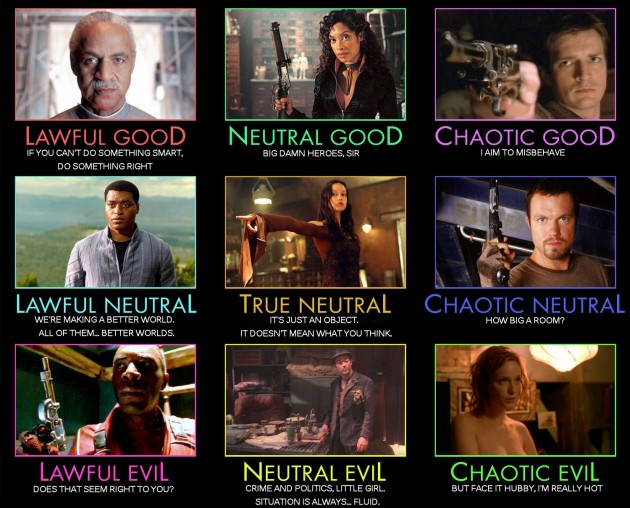
Alternate versions put 20th Century Fox in the Lawful Evil slot.

I love personality tests.  There’s something immensely satisfying about putting yourself on a grid that tells you something new and insightful about yourself and the people around you.  My personal favorite is the Meyers-Briggs test (I’m an ENTP), but I like playing around with others as well.

Character alignment is what you get when you combine fictional characters with the role they’re supposed to play in the story.  It’s a way to categorize the different ways they react to problems and ethical dilemmas, and to see which are inclined to be enemies and  which are inclined to be allies.

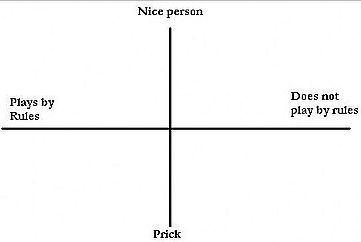
These systems initially arose out of RPG systems like Dungeons and Dragons, which use numbers, charts, and statistics to turn a story into a playable game.  There are many different kinds of alignments, but the most well-known is probably the one used by D&D, which charts characters along a good-evil axis and a lawful-chaotic axis.  In practice, the result looks a little like this:

Of course, that’s a very simplified version.  The tvtropes page goes into much greater depth, but I’ve personally found that this page right here does a much better job explaining the concepts behind the chart.

The horizontal axis, law vs. chaos, describes how much the character values order and authority vs. their own independence and freedom.  Lawful characters value honor and obedience, while chaotic characters value innovation and rebelliousness.  Characters who are neutral with regards to law and chaos generally respect authority, but put their own interests first and go against the established norms when that’s the best way to further their own ends.

The vertical axis, good vs. evil, describes how well (or poorly) characters tend to treat other people.  Good characters are altruistic and make sacrifices to protect the defenseless, whereas evil characters will kill, rob, or torture the innocent simply for the evulz.  Characters who are neutral with regards to good and evil don’t like to hurt others, but are not above pursuing questionable means to achieve their own goals.

Put together, the alignments create a 9-square chart, like the one at the top of the post.  While it’s certainly not obligatory to fill every slot, doing so can add a greater degree of depth to your story, as it certainly did with Firefly.

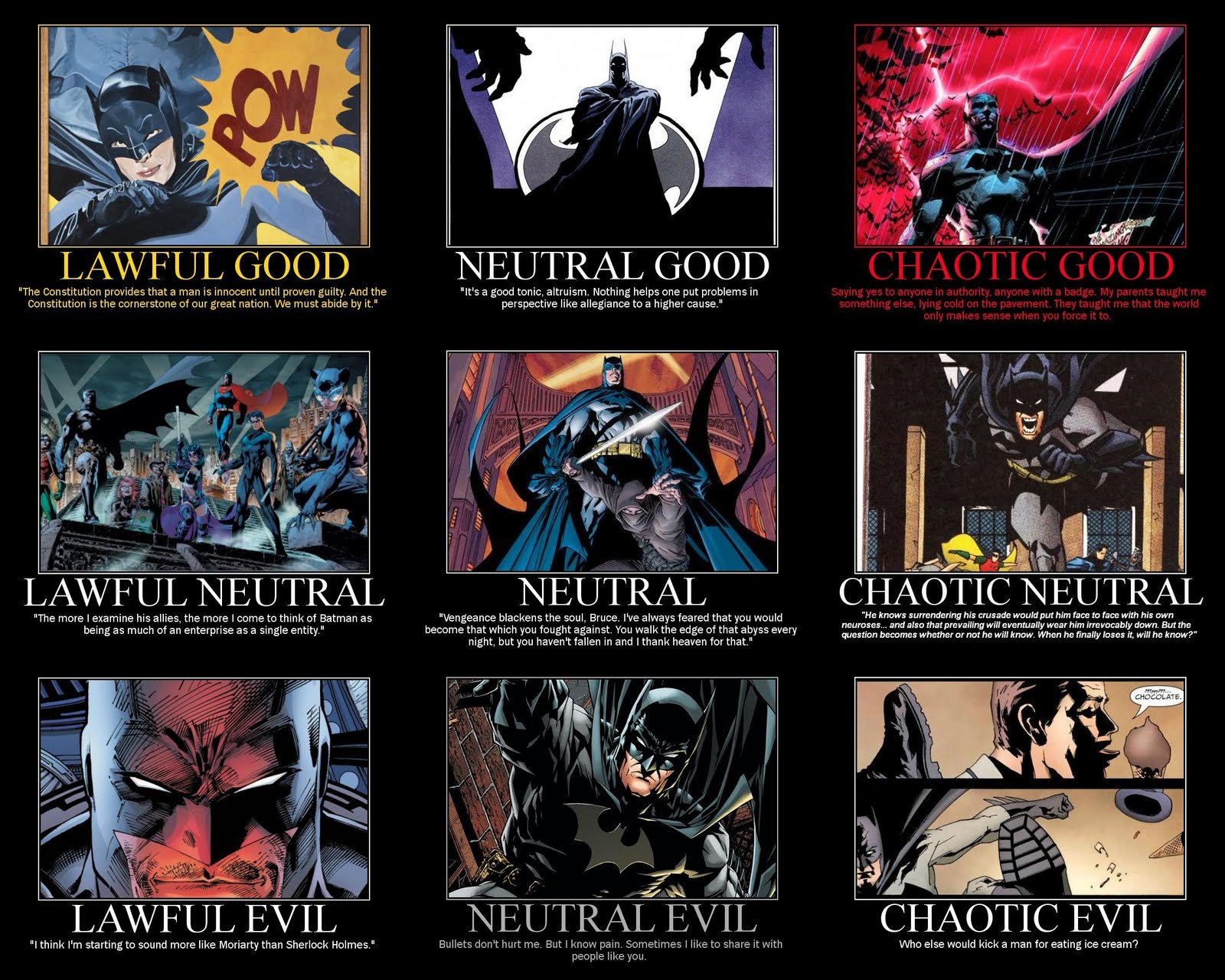
As with any formula, however, there is danger in holding too closely to the chart and becoming inflexible.  In real life, people switch alignments all the time, just as personalities can change and evolve (in high school, for example, I was an INTP).  Not only that, but some characters even fulfill all the possible roles, depending on the incarnation and the story.

Because I'm BATMAN!

The point is, character alignment is just a tool, not a hard-and-fast rule that needs to be used with every story.  If it’s a helpful way to think about your characters and set them up with interesting conflicts, great.  If not, don’t sweat it; Homer and Shakespeare were telling great stories long before this chart.

I’m going to be going overseas soon, so I expect my internet access is going to be spotty for the next couple of months.  Because of that, I’m going to write up a bunch of Trope Tuesday posts on each of the nine alignments and schedule them to post automatically.  So stay tuned for more!