Why Nick Cave is wrong about human creativity and generative AI

First of all, I don’t think that Nick Cave is entirely wrong. Laying aside how ChatGPT is just one of the many LLMs that are publicly available, and that using it as a stand-in for all of generative AI is like saying “AOL Online” when you mean “the internet,” he does make a fair point that using generative AI as a replacement for basic human creativity is wrong.

What he doesn’t understand is that using AI this way is also counterproductive. He blithely assumes that it takes not skill or effort whatsoever to use these AI tools—that all one has to do is tell ChatGPT what to write, and it will magically produce something if not great, then at least publishable. But as someone who has written several AI-assisted novels and short stories, I can assure you that it does take effort to produce something more than merely passable. Indeed, with longer works like novels, I can assure you that our current AI models are incapable of producing even passable work without considerable human intervention.

This is why I call it AI-assisted writing, as opposed to AI writing. When you do it right, the AI tools don’t replace your inner human creativity, but augment and enhance it, making things possible that were either impossible before, or that required a prohibitive degree of struggle. Writing with AI is still a form of creativity, though it might not look exactly like previous forms. But isn’t that also true of writing on a computer vs. writing longhand? Does it take any less creativity to write a novel on Microsoft Word than it does to write it on parchment with a fountain pen?

Granted, the technological leap from word processor to generative AI is much more profound and fundamental than the leap from pen and paper to typewriter, or from typewriter to MS Word. Speaking from experience, I can say that writing a novel with ChatGPT or Sudowrite feels a lot more like directing a play with an amateur (and very stupid) actor than it feels like wrestling with the empty page, at least in the early generative stages. But it’s still, fundamentally, a creative act—and that’s the main thing that Nick Cave misses in his rant. Anyone can ask ChatGPT to write them a novel, just like anyone can bang their hands on a piano or strum their fingers across the strings of a guitar. But to produce something good—that requires effort.

However, there is an even deeper level where Nick Cave is wrong here, and that is in the unspoken assumption that the difficulty in creating something is the thing that gives it value. It’s the same principle that Karl Marx expounded in his labor theory of value: that the economic value of a good or service is determined by the amount of labor required to produce it, or in this case, the creative and artistic value. That’s just wrong.

Do we love J.R.R. Tolkien’s Lord of the Rings because it took him several decades to write it, and largely represents the greatest product of his life’s work? Obviously not—otherwise, every amateur writer who’s been polishing and repolishing the same unfinished novel for the last twenty years must necessarily be the next Tolkien, no matter the fact that their book reads more like the Eye of Argon than The Fellowship of the Ring.

So if it’s not the creative struggle or the amount of human effort that ultimately gives art its value, what does? The same thing that gives a product or service its economic value: the utility that it provides to the person who consumes it. In other words, the thing that gives art its value is the goodness, truth, and beauty that it brings into the lives of those who receive it.

This is especially true of writing, which is perhaps the most collaborative of all the arts. Without a reader to read it, a book is nothing more than processed and flattened wood pulp full of meaningless squiggles (even less than that for an ebook). When I read a book, I care not a whit for how much work it took for the author to come up with it. Same with the music I listen to, or the games that I play. What I care about is how it makes me think, feel, or experience the world.

And if it’s possible to bring more goodness, truth, and beauty into the world by using generative AI, so what? If it’s easier than writing a novel the old way, does that somehow mean it’s “cheating”? If the answer to that question is yes, please tell me why you don’t churn your own butter, or hunt your own food, or chop your own wood and burn it to heat your house—because all of those applications of modern technology are “cheating” in exactly the same way. Also, I hope all the books in your personal library are handmade, illuminated manuscripts, because the printing press is far more of a “cheat” than generative AI, as the last few hundred years of history clearly shows.

Nicholas Cave is wrong. ChatGPT is not the most “fiendish” thing “eat[ing] away at [our] creative spirit.” Our humanity is far more resilient and anti-fragile than he gives it credit. Those who try to replace human creativity with AI will fail, not because of artists like Cave who stubbornly resist the “temptation” to use these tools, but because of those who embrace the new technology with an open mind, and discover that our humanity is not a liability, but our greatest asset—a premise that Cave ironically rejects with his fearmongering about our fundamental replaceability.

How Not To Write An AI-Assisted Novel

The worst way to write a novel with generative AI is to make the AI do all the work.

In fact, thinking of it in terms of “how much of the work can I get the AI to do?” is pretty much guaranteed to give you a really crappy book by the end of it. The AI’s job isn’t to “do the work,” any more than a power tool’s job is to build a house. You do the work. AI is just a tool to multiply your efforts.

But let’s take a step back. Who am I to talk about all of this? My name is Joe Vasicek, and I’m an indie author who’s been writing and publishing regularly since 2011. At this point, I have several dozen novels under my belt, including about half a dozen AI-assisted novels, the first of which is published under my Joe Vasicek pen here on this blog. Also, my wife is a PhD student and research assistant who works with generative AI and large language models. Her thesis is on using generative AI to create interactive cross references for any body of text, customized to the user. We talk a lot about generative AI and share what we’ve learned, so we’re both fairly knowledgeable on the subject.

At this point, it’s still very much the wild west of writing with AI-assistance. The technology is new enough that there really are no experts on the subject, though I expect that that will change rapidly over the next few years. And while I can’t (yet) say that I’ve made gazillions of $$$$ from my AI writing methods, I can say that I’m one of the first professional writers to develop a method for writing with AI-assistance.

And that’s not a boast. Whenever I get together with other writers, I wish there were more of them (really, any of them) that I could talk with about this stuff. There are some online communities that come at it more from the AI side than the professional writing side, and I probably ought to spend more time in those, because it’s probably only a matter of time before one of them has a runaway bestseller and shakes up the publishing industry in the same way that Amanda Hocking shook things up when the indie publishing revolution was just getting underway.

Maybe that someone will be you. Who knows? We’re still very much in the wild west of AI writing, and probably will be for a while.

It’s that very loneliness that makes me want to blog about AI-assisted writing—that, and the fact that I’m still trying to figure it out for myself, so I would love to hear what’s working for other writers. But one thing that I’ve learned from my own experience is that the worst way to write an AI-assisted novel is to dump all the work on the AI and expect anything good to come out.

The main reason for this is that LLMs and generative AI do not think—at least, not in any meaningful way that’s similar to the way you and I think. Instead, these models analyze human language for patterns, and replicate those patterns according to the parameters and instructions give by the user. It’s much closer to how your phone is able to predict your next word when you go to write a text, except that instead of writing the next word, ChatGPT or Sudowrite or whatever LLM you happen to be using is instead predicting the next 5-10 paragraphs.

So really, it’s not very useful to think of an AI as being able to “write” anything. Instead, it’s much more useful to think of it as “simulating” the thing that you’ve told it to write, or producing a simulation of the kind of work that a human would produce, given your parameters and instructions. The AI isn’t “doing the work” for you, it’s merely simulating the end product of that work. You still have to make it your own.

And how do you make it your own? Personally, I’ve found that the best way to do that is to open up a new document on my second monitor and type it all out by hand, occasionally referring to the AI-generated text when I don’t know what to write next, but largely trusting in myself to create the real, non-simulated draft. No copy-pasting! The mental exercise of writing it all out, word for word, stimulates something in the creative mind, and in most cases I end up writing something completely different, using the simulated version of the novel merely as a stepping stone.

So why do I go through all the trouble of generating a whole novel, when I’m probably going to throw out most of that text anyway? That’s a very good question—so good, in fact, that it needs to be the subject of its own post.

…it sure has been quiet around here

So I was looking back at my stats, and I couldn’t help but notice that (not counting yesterday’s post) it’s been almost two months since I posted anything on this blog. What happened?

I could give all the normal excuses: time flying by, kids taking up the time, etc etc… but that would all be evading the main reason, which is that I’ve been working on a secret project for the last six to eight months now, and that’s sucked up all my time.

I can’t yet reveal exactly what the secret project is, because I’m still gathering data and revealing everything about it would screw that up. Also, I don’t want to overhype it, because it’s not the sort of thing that’s going to blow your mind and make you super excited when I reveal it… or maybe it will? I don’t really know.

But without revealing any specifics, I can say that I’ve been developing a method for writing AI-assisted novels, and I think I’m at a point where I can start using it to finish some of my open trilogies, like the Falconstar Trilogy, or maybe even write some new books.

I also really want to share some of the things I’ve learned, because I do think that AI is going to change everything when it comes to writing, and not necessarily in a bad way. Originally, I just wanted to keep my head down, because there are so many negative opinions and misconceptions about AI in the writing world. But now, I think it will actually be better to be more open about it and share some of the things I’ve learned.

So I will probably do a blog series about AI-assisted writing. I also want to finish a couple of other blog series that I started ages ago, and never really finished—maybe turn those into a nonfiction book at the end or something. And I’ve also been reading some old Hugo nominated books, in an effort to figure out how I would have voted in past years. That’s been a very interesting exercise.

So for the next few weeks, my goal is to post something new every Wednesday and Friday. My email newsletters typically go out on Thursdays, so that’s a pretty decent amount of content to put out there. And if I have something fun to share, like a meme or a picture or a video, I’ll try to post those on Mondays if I can. But if there’s anything in particular that you want me to blog about first, feel free to let me know!

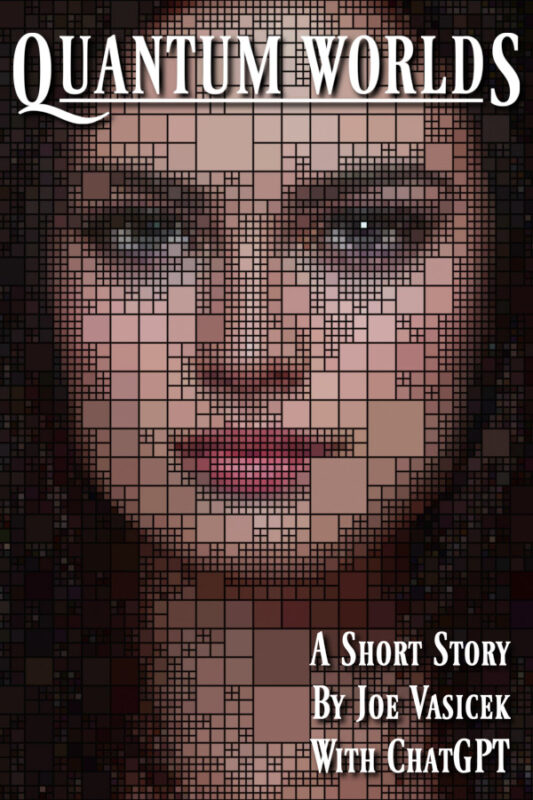
“Quantum Worlds” cover reveal

Behold!

This is the first story I wrote with ChatGPT, about… a struggling science fiction magazine editor who decides to embrace AI instead of fighting against it, and revolutionizes everything. So of course, it makes sense that the cover would be patterned after Clarkesworld’s iconic covers, since I basically wrote it in response to them closing down submissions to all AI-assisted stories.

It’s out for free now, if you want to check it out. Enjoy!

Back from Coeur d’Alene

It occurs to me that most of my posts in the past month have either been extremely doom-and-gloom, or they’ve been excerpts from some of my most recent work. This probably gives the impression that I’m huddled in a corner somewhere, black-pilled and traumatized, and seeking some sort of an escape through my writing, when really, that is not the case.

In fact, the main reason I haven’t posted more is because I’ve been so busy with life and family. It’s been a really great year for us, with a new baby and a bunch of cross-country road trips that have been a lot of fun. I’ve also been testing out a lot of AI writing techniques, and while that has really invigorated my creativity in a major way, it’s also taken me away from things like this blog, which is why you haven’t heard as much from me.

If I were still on social media, I have no doubt that I would be doom-spiraling right now, what with everything that’s happening in the world. Even without social media, I’ve been glued to the news sites I follow, checking for hourly updates on the war with Israel (which I really do believe is the opening stages of World War III). But that’s actually not very new for me: back in high school, I was the same way, following the news every day from the public computers at my school library. The 9/11 attacks happened on the first day of school for me, but in the last couple of months of the previous school year, I remember being frustrated that no one seemed to be taking this Osama Bin Laden guy more seriously, especially after the USS Cole and Kenya embassy bombings. Then the summer came, and I mostly goofed off, but as soon as school got started I was back to following the news on a daily/hourly basis.

So I’ve got a lot of experience with taking scary news in stride and not letting it totally consume my life. In fact, that’s the main reason I follow things like this so closely: so that when the unthinkable happens, I can face it without getting shocked or overwhelmed. And recent posts to the contrary, I’m not black-pilled at all. In fact, I tend to believe that I was put on the Earth at this specific period of time for a reason, and not just one that was imposed on me: that at some point, before I was born, I was given a choice between this and some other era, and I specifically chose this time to be born. Maybe I’m just imagining it, but it would not at all surprise me if that turned out to be the case.

In any case, we just got back from our last family road trip of the year, this time up to Coeur d’Alene to spend some time with Piper’s brother and his family, as well as my in-laws, who joined us on the trip. We had a really good time! Our daughter had a blast playing with all her cousins, especially the ones about her age right now. We also got to see her cousin’s baptism, so that was really good. Provo to Couer d’Alene is about an 11 hour drive, which is not quite far enough to justify getting a hotel, but for a 7 month-old and a 3 year-old, it was pretty hard. We’re all glad to be home now.

My wife is super busy working on her PhD. Specifically, she’s getting a paper ready for a major conference she hopes to attend with the rest of her lab. Her paper is on using AI to generate useful cross references across a body of work (eg Shakespeare, Jane Austen, The Bible, etc), and she’s developed a method that cuts down the cost of creating a cross reference set by upwards of 50%. But for the next couple of days, she’s going to be really busy with all of that.

Meanwhile, I’ve been taking care of the kids while the grandparents are on another road trip out to Omaha. It hasn’t been that bad, but I’ve also been pretty swamped with work, which one of the reasons I’ve been neglecting this blog. I have a bunch of ideas for posts I’d like to share, but no time to get to them, though hopefully that will change soon. Here are some of the posts I’d like to write:

  • A part 4 to my Navigating Woke-SF series. I recently had some experiences with the woke SF publishing world that have made me rethink things in a way that y’all would probably find very interesting.
  • An update to my generational cycles of grimdark and noblebright theory. This is one of the things I’ve been thinking about, and I’m starting to think that some of my basic premises in that post were wrong, or at least not entirely accurate, requiring an overhaul.
  • A lot of thoughts on AI and writing. This has been my main focus for the past couple of months, and I have thoughts. Many, many thoughts.
  • More thoughts on geopolitics and current events, especially on the trajectory of the unfolding global conflict and what it all means on a moral and spiritual level. But I think I should hold off on posting too much about that, since I’ve already spent so much time on it already.

Which of those things would you like to see next? I can’t promise anything, but I do want to spend more time on the stuff that followers of this blog actually want to read. In the meantime, I’ll try to intersperse a few quick update posts like this one, and get back into the habit of regular blogging.

Some major news about my first AI-assisted novel

The Riches of Xulthar is now complete! I’m sending it out to my editor this afternoon, and if all goes well, it will be available in all formats by the end of September.

In the meantime, I have decided to post the entire thing chapter by chapter on my blog. I’ll be posting the final, unedited version, as well as my AI-assisted draft which I wrote/generated with Sudowrite. It was about 60/40 generated/written, so I can’t say how much of it was purely AI, but if you plug it into an AI text detector you should be able to get a pretty good idea.

My process for writing this novel was as follows:

ChatGPT: The whole thing started out by playing with ChatGPT, with the prompt “let’s write a fantasy adventure story in the style of Robert E. Howard.” I thought it would turn out to be a pretty straightforward short story, but it quickly ballooned into something else. I still kept playing with it, but mostly to get the framework of the overall story.

Outlining: Once I had a general idea for the story, I spent a couple of weeks outlining the whole thing, as if I were outlining one of my regular novels. Besides a chapter/scene map and a list of all the throughlines with their associated plot points, I also filled out character sheets for the main characters, with a little bit of help from ChatGPT.

Sudowrite: I used Sudowrite to write/generate the first draft. This was about 60/40 human written to AI generated. Basically, I would write a few hundred words, generate a few hundred words, and either keep it, tweak it, or throw it out and write something else. Rinse and repeat.

Humanizing: Once I had a decent rough draft, I passed it through the “human filter” by rewriting it into a new document, with the AI-assisted draft on my other screen. No copy-pasting, though there were sections where I basically wrote it out almost exactly how it appeared in the rough draft. However, I also made some pretty substantial changes, even expanding the rough draft into new scenes and chapters. This phase took the most work.

Revising: After the humanizing phase was done, I went through a normal revision draft, the way I do with all of my novels. I got some feedback from my writing group for the prologue and first chapter, but otherwise didn’t get any reader feedback, mainly because the process was so accelerated that I doubt anyone could have gotten it back to me in time. More on that later.

Polishing: For the final polishing draft, I went through and cut a straight 10% off of the whole novel, scene by scene. No major story changes for this phase: just sharpening up the prose and making it as clean and tight as possible.

Without using AI, it takes me anywhere from 6 to 18 months to write a novel, sometimes much more. But from start to finish, The Riches of Xulthar only took me three months—and the first of that was mostly just figuring out what to do with all of this content that I’d produced while playing around with ChatGPT. I didn’t start using Sudowrite to generate the actual first draft until the second week of May, and here we are in the second week of July, and the entire thing is finished.

I am very eager to hear what you guys think of this book, which is why I’m posting both the final unedited draft and the AI draft on my blog. I’ll be posting a new chapter every week, the final draft version on Thursday, and the AI draft version on Saturday. I hope you enjoy it!

The Sudowrite draft of The Riches of Xulthar is finished!

It only took about a month, but it would have been much faster if I’d used Story Engine. Honestly, I probably could have generated the text in a week if I’d used that tool, or perhaps even an afternoon. Instead, I outlined the project myself, wrote the first couple of paragraphs for each individual scene, and wrote / generated the rest.

Most of what I used Sudowrite for was on a sentence and paragraph level for this draft. Typically, I would write a bit, get to a point where I wasn’t sure what to write next, generate some text, and then either 1) use it as-is, 2) use it, but run it through a couple of rewrite filters first, 3) use it, but tweak it myself, or 4) throw it out entirely and keep writing. Because the AI didn’t have an outline to work with, it often took the story off in weird and non-useful directions, but there were a couple of times where it surprised me in a good way, and I decided to keep it in.

One of the things I found was that Sudowrite is terrible for magic systems, world-building, character arcs, foreshadowing, unresolved sexual tension, or anything else that happens on a macroscopic scale, especially if that story element changes over the course of the novel. For example, he AI engine wanted every scene involving both my male and female leads to culminate in the climax of their romantic subplot. Likewise, it was very difficult to get the AI to hit the right beats for their character growth; that was something where I really had to babysit it.

But for those microscopic, word / sentence / paragraph level story elements, I was pleasantly surprised with how Sudowrite performed. It felt a bit like I was riding in the front of a tandem bicycle, instead of writing alone. When I hit stretches that required a lot of uphill effort, I could rely on the AI engine to do most of the work while I steered. Of course, riding a tandem is no fun unless both people are pedaling, so I still had to do my part, but the hills and the rocky parts felt a lot easier, which was nice.

This Sudowrite draft isn’t anywhere near publishable, but that wasn’t what I was going for. Instead, the goal was to get it good enough to use as a starting point to rewrite the entire thing myself. Rough drafts are pretty hard for me, but rewriting and revising comes much easier after I have something to work with. Even if I end up throwing out every word, I expect that I can power through this “humanized” draft in a fraction of the time it would take me to write the novel from scratch. I may even finish it this week!

But perhaps the area where the Sudowrite draft did the most was with helping me to be productive even when my attention was being pulled in multiple directions by small children. A significant chunk of this book was written in the BYU Library’s family study room, with one eye on my three year-old daughter as she played with the other kids. Even after I had to step in to referee a bit, or to take her for a snack or a potty break, the AI tools enabled me to jump right back in and keep writing.

The amount of focus it takes to write with AI tools is much, much less than what it takes to write without them. At least, that has been my experience. Granted, my goal with this draft was not to make it publishable, but to make it good enough for the next phase, which is more like 95% human effort and 5% AI, as opposed to 40% human effort and 60% AI, which I used for this draft.

But I doubt there are any AI tools right now that can get a book into a published state with minimal human effort. In general, I’ve found that these AI-assisted writing tools are great for getting a book from terrible to passable, but not as useful for getting a book from passable to genuinely good—and as for getting a book from good to genuinely great, you can forget it with our current set of AI tools. Much better to rely on human efforts for that.

To use another analogy, it’s kind of like using a two stage rocket to get to orbit, where the booster rocket is the Sudowrite draft and the second stage rocket is the humanized draft. The booster won’t get you to orbit on its own, but it will get you through max Q and send you high enough that the second stage can finish the job. And since you’re going up in two stages instead of just one, it doesn’t take nearly as much fuel to get there.

Another advantage of doing it this way is that the final draft will be almost 100% human-written. There’s no copying or pasting in the humanized draft—every sentence and every word is typed out by hand, and while some of it may come verbatim from the Sudowrite draft, most of it is going to be changed in some way, sometimes quite substantially. For example, today I “humanized” a scene that was about 750 words in the Sudowrite draft, but ended up at around 1500 words.

What I’ll probably do is pick a few scenes from this novel and post the before and after, to show how substantially it’s changed. But even the Sudowrite draft isn’t totally AI generated, at least with the way I’ve been using these tools. Like I said above, it’s much closer to 60/40.

The Sudowrite draft of The Riches of Xulthar clocks in at about 33.2k words. That still falls short of the 40k word minimum threshold for a novel, but it will get longer with the next draft, and I expect it to end up somewhere between 40k and 45k words. With luck, I’ll finish the humanized draft by the end of this week, and the revisions before the end of this month.

Would you read an AI-written novel?

That is the question, more or less, that I posed in subject header of my last email newsletter. The goal was to be a bit provocative, of course, but I did genuinely want to hear from my subscribers on this topic, and in the author’s note I shared a lot more of my thoughts on the subject of AI-assisted writing.

So far, I’ve gotten about half a dozen responses—a lot less than I was expecting, honestly—but the responses I have gotten have been overwhelmingly negative. As in, “no way in HELL will I ever read an AI-written novel, and if you ever outsource your writing to an AI, I will never buy any of your books again!”

…which is awkward, because I’m currently working on an AI-assisted novel, with plans to write several more.

From this and other experiences, it’s become clear to me that there is a small but extremely vocal segment of the population that has strong and vitriolic opinions about AI. There’s probably a much larger but less vocal segment that thinks AI is terrible (though not terrible enough to shout about it from the rooftops), and another large segment that is AI-curious but doesn’t really have a strong opinion one way or another. At this point, the people like my wife who are proponents of AI are practically the lone voices in the wilderness, at least as far as the culture is concerned.

When it comes to books and reading, I suspect that people skew much, much harder to the “AI is so evil!” side of the spectrum than the “AI is so awesome!” side. This is especially true of science fiction and fantasy, since (1) most SF writers are actually luddites in real life, (2) SFWA is a vitriolic echo chamber of the most luddite of them all, and (3) readers of SF&F tend to skew older, tend to be higher educated, and tend to be higher earners than the general population—meaning that they have more to lose with the AI revolution than they have to gain.

But here’s the thing: as an indie author who has been struggling for the last twelve years to build a successful writing career, and has barely been able to keep it going for most of that time, AI-assisted writing represents either a potential game-changer that can help me achieve the kind of success that has eluded me for years, or else it represents an existential threat that will snatch those dreams of a writing career completely out of my reach. There really is no middle ground—at least, not in the long term.

In the old days, there were six major publishers, dozens of reputable small presses, several regional distribution networks, and thousands of local bookstores, where most readers went to buy their books. To have a writing career, you needed to get picked up by a publisher, who would usually give you five or six books to grow into an audience, at which point you were pretty well set up for the future.

Of course, any number of things could happen to torpedo your career, and very few bestselling authors (let alone authors generally) made enough to live comfortably off of their writing alone, but the hardest part of breaking in was breaking out of the slushpile and getting a publishing deal. At that point, you could expect a certain degree of career stability, at least for a few years.

Under this system, it was entirely possible for a genre-specific magazine like Locus to track all of the SF&F books that had been published in the last year. Places like Writer’s Market were able to track all of the publishers, and many readers could—and did—subscribe to all the SF&F short story magazines, and read all the stories. Among writers, there was still a lot of competition, but most of it took place in the slushpile, not after publication.

I’ll be honest: I never actually experienced this system, because it died a couple of decades before my first story was ever published (“Decision LZ1527,” Leading Edge Magazine December 2009). The only things I know about it are what I’ve been able to piece together from Brandon Sanderson’s writing class, Kris Rush and Dean Wesley Smith’s blogs, several now-defunct podcasts like Adventures in Sci-Fi Publishing, Locus Magazine itself, and various conferences and conventions that I’ve attended over the years, including Worldcon and World Fantasy. I’ve definitely done my homework on the subject, though admittedly, it can be difficult sometimes to separate the myth from reality.

From what I can tell, the old publishing system (which was really more of a 50-year aberration, when you look at how things were set up in the pulp era and before—but I digress) began to fall apart when the big box stores like Borders and Barnes & Noble began to take over from all the mom-and-pop indie bookstores. This led to a distributor collapse, since the big box stores only wanted to deal with one or two national distributors. Publishers responded by downsizing their marketing departments, since now they only had to sell to one or two distributors, which in turn led them to drop a lot of authors with small, regional followings in favor of the big name authors with big, national followings. Pretty soon, most of the major publishers were following a blockbuster model, where if your first book didn’t hit big, they dropped you. Then the global financial crisis happened, a bunch of editors got fired and decided to hang out their shingles as literary agents, and pretty soon the only way to get published was to go through an agent first, then make it through the slushpile, then have a national bestselling first novel… and if you couldn’t do that, tough luck.

That was the state of the industry when I first started indie publishing back in 2011. The rise of Amazon kindle and the epublishing revolution gave us an alternative to the soul-crushing, dream-killing system that traditional publishing had become. A lot of us jumped on the chance to “go indie,” becoming our own publishers and digitally publishing our own books.

…except then, Amazon launched Kindle Unlimited and gobbled up most of the market share, making it so you basically had to go through Amazon if you wanted to have a career. Which meant that your career was beholden to the whims of the Amazon algorithm, which favored new books over old books and books in KU over books that weren’t. Also, if anything you wrote fell under the Seattle-based Amazon’s definition of “hate speech,” you could fuggedaboutit. And then, Amazon launched Amazon Ads, which turned indie publishing into a pay-to-play game, where you either had to roll over most of your profits into advertising, or see your books languish with a ranking of 100,000 or higher.

By the end of the 10s, “going indie” was less about being truly independent and more about constantly trying to please the Amazon gods. That meant rapid-releasing, spending a lot on ads, publishing in KU, and writing to trends like reverse harem or werewolf dragon shifter pirates. Those of us who didn’t play that game soon found that we were voices in the wilderness, who were barely able to eke out a meager existence by publishing something new every month.

Now, it is impossible to keep up with everything coming out in your genre. Something like 2-3 million new books are published on Amazon every year, and the bottom third of those never sell a single copy. The competition has moved out of the slushpile and onto the internet, and while lots of great stuff is getting published, the stuff that gets pushed to the top is typically the stuff that aligns with the agendas of the people who control the aglorithms—and in areas outside of the publishing industry, this agenda involves things like drag queen story hour, pride paraphernalia for toddlers, medical assistance in dying, mask mandates and vaccine passports… the list goes on and on.

Which brings us to where we stand today, with generative AI poised to revolutionize the publishing industry yet again. Like it or not, AI is going to change everything—we can already see the wave beginning to swell. The only question is whether we, as authors are going to catch this next wave, or be crushed by it.

It could very well be that this wave is actually a tsunami. That is the pessimistic scenario. If it is, then all of us writers are toast, because the readers of the future will all be amateur prompt engineers who just tell an AI to write what they want to read. A handful of big-name authors will hang on for a generation or two, just on the strength of their brand, and a very small cottage industry will emerge for authentically human-written books, but it will mostly be for hobbyists, like crocheting and perler beads.

If the pessimists are right, then there’s nothing we as writers can do except roll over and die, maybe after vainly shaking our fists at the sky for a little while. That’s what most of the folks over at SFWA are doing right now. But having worked with some of these generative AI tools for several months now, I don’t think the pessimistic scenario is going to play out.

Instead, I think that most readers are going to find that the kind of books they want to read are not the kind of books that they can generate easily themselves. A lot of amateur prompt engineers will have fun with it, just like lots of fans have fun with fanfiction right now. A handful of these prompt engineers will get good enough to generate the kind of books they want to read, and will turn into writers, but that’s not going to be most readers.

Meanwhile, writers will divide into two camps: those who embrace AI-assisted writing, and those who reject it. Except for a few big-name authors who already have a big readership, those who reject AI-assisted writing will find that they cannot write fast enough to keep up with all of the AI generated books and stories that are going to flood the market—not a flood of crappy books, but a flood of passably fair to genuinely great books, as AI technology continues to get better.

Those authors who do embrace AI-assisted writing will find that the AI tools are surprisingly difficult to master, and require a complete retooling of their writing process in order to use them effectively—but after they do, they will find that these AI tools are incredible force multipliers that allow them to write significantly more, and write significantly better. They will be able to rapid release without burning out, and will thus find much more success in building their readership, since publishing a new book is the best way to market all of your old books.

But since (to my knowledge) no one has yet mastered these AI tools, for the next few months/years, most of the AI-assisted stuff that gets published is going to be pretty bad. The whole world is now on a curve, and when we reach the top of it, we will begin to see some really great stuff come out from those authors who are putting in the time and effort right now to truly master these AI tools, and to integrate them into their creative process.

This is why I personally am very excited about AI-assisted writing: because in a world where millions of books are published every year, discoverability is my biggest challenge, and the solution to the discoverability problem ultimately comes down to being more prolific. That is why I try to publish at least one thing every month, usually a free short story… but if I could publish a $2.99 novel every month, that would be so much better. By myself, I don’t write fast enough to do that—but with an AI, I probably could. And it’s not like the discoverability problem is going away—in fact, I expect it to become even more challenging, with tens of millions of books getting published each year as AI-assisted writing becomes mainstream.

Ultimately, though, I think that the key to a successful writing career in a post-AI world is going to involve building a community of fans around your books and your writing. Among other things, fannish communities help to humanize and personalize the connection readers feel with their favorite authors, which is probably why so many readers answered “NO!” to my initial question. The concept of a purely AI-written book probably feels just as threatening to those pessimistic authors as it does to those readers who love that human connection they feel with their favorite authors and fan communities.

But the fundamental reason I’m optimistic about this is because I don’t think there is, or ever will be, a book that is written purely with AI. Even if the author is more of a prompt engineer than a writer, there’s still got to be human involvement somewhere in the process. And if that person is also an experienced writer, who has successfully written several novels of their own, they’re going to be able to leverage that experience in a way that a pure prompt engineer can’t.

So it may turn out that the writers who are best positioned to succeed in the coming years are the ones who cut their teeth in the old world, before the AI revolution, because very few writers in the future are going to have the confidence and experience that comes from writing a novel entirely without AI. Thus, all of those writers who already have a few novels under their belt, and who take the time to truly master these AI tools and integrate them into their process, may be in the best position of all. That’s the optimistic scenario, and that’s the one I’m currently betting on, which is why I’m doing everything I can to master these AI tools.
Riches of Xulthar update

So it’s the 25th of the month, which is also the 25th day of the billing period for Sudowrite, and used up all of my AI words. The Riches of Xulthar, my first AI-assisted novel, is currently a little over 27k, which means I have 13k words to go (I’m shooting for the minimum novel word count for this project, though I’ll probably go 1-2k over).

I could buy some extra AI words to round out the month, but I’m going to just wait until the next billing period on June 1st. That means no more generative AI writing, but there’s still a lot of work to be done, not only for this project, but for all those practice short stories that I wrote with Sudowrite at the beginning of the month.

I’ve been vacillating between whether The Riches of Xulthar is any good, and whether I ought to just trunk it. Part of the problem may be that I got caught up in Laria’s story, which isn’t very typical for the sword & sorcery genre.

But more than that, the writing process has just been really choppy: it started as a short story attempt with ChatGPT, with the prompt “let’s write a fantasy adventure story in the style of Robert E. Howard.” But it quickly morphed into something much longer than a short story—and because ChatGPT has a short memory, I started running into problems because of that.

My early attempts to “humanize” it by typing out (not copy-pasting) the AI output into a separate document made it even messier, since I kept trying to feed those humanized bits back into ChatGPT. When it started to feel like I was wrestling with the AI to pull the story in the right direction, that was when I needed to try another AI writing tool.

Sudowrite has been great in some ways, and a struggle in others. Most of the struggle is to be expected, given that the program has quite a steep learning curve, but it does make me wonder if this first novel is any good. Most of the time, I feel like the best I can do is to get it about 80% there, and finish the rest of it myself.

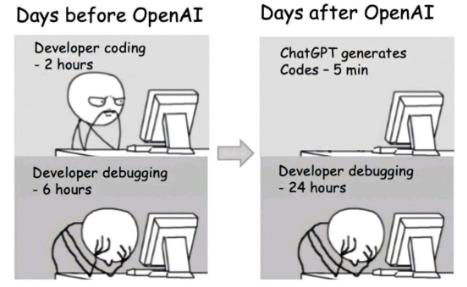
And that may be the best I can do with these AI tools at all. Most of the time, it feels like I’m only getting it 50% or 60% finished, so getting it 80% of the way to a publishable quality book may actually be optimistic. It may turn out that AI-assisted writing is a lot like the coder meme above.

So for this next week, I’m going to set the AI writing aside and focus on the “debugging” phase, which I’m calling the “human filter.” It involves retyping the story word for word into a new document, and tweaking or revising it along the way. It will be interesting to see how that goes.

More early thoughts on AI-assisted writing

It’s become something of a cliche that true writers write because they can’t not write, but as with so many other stereotypes and cliches, there’s a kernel of truth in it. I’ve been writing on and off since the 8th grade, and even during periods of my life when I wasn’t able to focus on writing, the writing itch would still come for me, and I would have to sit down and sketch out something, even if I never did anything with it.

Over the years, I’ve gotten pretty good at telling whether I’ve done enough to satisfy that creative urge that drives me to write, and whether that urge has been left unsatisfied. Yesterday, I realized that something felt off because that creative urge had not been satisfied—which is strange, because after only two weeks of working on this AI-assisted novel project, I’m already halfway done with the first draft. Indeed, yesterday I “wrote” (if that’s the right word for it) a little over 4.5k AI-assisted words.

Now, this should go without saying, but the point of writing professionally is not how good the creative process makes you feel, but how well and how quickly you produce a quality finished product. But I do think there’s a correlation between the two: that you are more likely to create a quality finished work the better your creative process satisfies your creative urges.

In the last three months of writing with AI, I’ve had some writing days that were better than almost any I’ve had in years. I’ve also had some very meh days, which is to be expected… but what isn’t so expected is this feeling of being creatively unsatisfied, which I usually don’t feel unless it’s been two or three weeks since I’ve done any writing. Something weird is going on.

How much of this feeling of creative dissatisfaction is due to the fact that I’m outsourcing a significant portion of the creative work to an AI, and how much of it is simply to be expected from trying to master a new and unfamiliar skill, which has kept me from satisfying that urge in the same way as I have in the past? At this point, it’s difficult to say. Probably a little of both.

Having worked on this for a while now, though, I think that the writers (and other creative types) who are going to succeed the most with AI-assisted creative work are the ones who figure out how to integrate the human element of their process with the AI element of their process, such that each one complements and enhances the other. Right now, everyone’s talking about how AI will replace us, but that’s really the wrong way to think about it if you want to learn how to master these tools.

I suspect that the way to master AI-assisted writing is not to try to get the AI to “do the hard stuff,” or replace some aspect of the creative process, but to integrate it within your creative process such that it enhances and magnifies your own, very human efforts. For that reason, I’m changing the way that I count my daily words so that I no longer make a distinction between words that I “write” myself, and words that the AI “writes” or generates, because the AI can’t generate words unless I give it enough to work with. Often, that means that I write a little, then generate a little, then tweak what the AI generates and write a little more. When the process is working well, it’s very difficult to say which parts were purely AI “written,” and which parts were purely human “written.”

But it’s still going to take a while to figure out exactly how to integrate AI into my writing process. As I continue to do that, I’m going to pay close attention to how it satisfies—or fails to satisfy—my creative urge to write, not because that is the end goal, but because I suspect that if my creative urge is not being satisfied, the AI-assisted stuff that I’m producing probably isn’t very good. It may not be very good even if my creative urges are satisfied, but if something about the process is missing, then something about the final product probably is missing as well.

Anyhow, those are some more of my random thoughts as I continue to experiment with AI-assisted writing. I was hoping to finish the rough/AI draft of The Riches of Xulthar before the end of the month, but I’m almost out of AI words for this billing cycle, so I’ll probably move on to the “humanizing” phase for what I’ve already written, which is where I retype the AI-generated stuff in order to pass it through what I like to call “the human filter.” Hopefully that helps to give the story a little more of my personal voice and style, and not read like something that could have been AI generated by anyone. But I’m still working out and experimenting with that part of the process, just like all the others.