In Defense of Black & White Morality

I was born in 1984, and for most of my life, stories with black and white morality—in other words, stories about the struggle between good and evil, with good guys who are good and bad buys who are bad—have been considered unfashionable and out of style. This is especially true of fantasy, where grimdark has been the ascendant subgenre for basically the past two decades. The Lord of the Rings movies gave us somewhat of a respite from this, but the popularity of George R.R. Martin’s Game of Thrones seems to have turned everything darker and grittier, to the point where I just don’t enjoy reading most new fantasy anymore.

I remember going to conventions like World Fantasy 2009 and talking with other aspiring writers, most of whom could not stop gushing about this George R.R. Martin guy and how he was subverting reader expectations in new and innovative ways. So I picked up a copy of Game of Thrones, and after finishing it, I thought: “yeah, the writing was pretty good, and the story did have a lot of unexpected twists… but I hated literally every character in this book who was still alive by the end of it.”

Looking back, it seems like the greatest reader expectation that GRRM subverted was the expectation that he would finish the damned books. Then again, the books only really took off after the TV series got big, and I suspect that the real reason the TV series got so big was because of all the porn sorry, the sexposition that the writers threw in. (Sex + exposition = sexposition. Seriously, the term was coined because of Game of Thrones.)

So for at least the last three decades (Game of Thrones came out in 1996), grimdark fantasy has been in style, with its morally ambiguous characters and its gray-on-grey or gray-on-black morality. Meanwhile, stories that are unambiguously about the struggle between good and evil have been considered trite, passé, or otherwise out of style. We live in a modern, complex world, and stories with such black-and-white conflicts are far too simplistic and unsophisticated to speak to our times.

That’s a load of horse shit, and here’s why.

But first, because we live in the stupidest of all possible timelines, I need to preface this discussion by stating what should be obvious to anyone capable of free and independent thought: namely, that talking about morality in terms of “black” and “white” has not a damned thing to do with anyone’s race. Seriously. It is not racist in any way to use “black” to symbolize evil and “white” to symbolize good, and the term “black and white morality” is not an example of white supremacy or whatever. Frankly, only a racist would think that it is.

But if you’ve only recently recovered from the insane left-wing cult that dominates every aspect of our society right now, and terms like “black” and “white” still trigger you, perhaps it will help to keep these two images in the forefront of your mind as we talk about morality in terms of black and white:

Now, on to something of actual substance.

The biggest complaint against black and white morality is that it divides all of the characters into black hats and white hats. In other words, all the bad guys are unambiguously bad, and all the good guys are unambiguously good, with no room in the middle for moral ambiguity or complex ethical dilemmas. So in other words, the spectrum of morality in your story looks something like this:

Now, while that may work for a certain kind of story, I will concede that it’s usually a sign of poor writing. This is especially true of epic fantasy, where complex worldbuilding and an expansive cast of characters is typical for the genre. Black hats and white hats might work for a twenty minute episode of a classic western, but not for a multi-book epic fantasy series.

However, when black and white morality is done well, it looks a lot more like this:

Notice that every shade of gray is contained within the spectrum. Indeed, allowing for the extremes of good and evil is the only way to hit every shade of morality and have it mean anything at all.

Think of Lord of the Rings. Yes, there are purely evil characters like Sauron, and purely good characters like Gandalf, but in between those two extremes there is a lot of moral ambiguity. For example, you have Boromir, who falls to the temptation of the ring but redeems himself with his sacrifice; Gollum, who ultimately rejects the last remnants of good that is in him, but still ends up serving the good in the end; Sam, who isn’t particularly noble or heroic, but bears the ring without succumbing to its temptation because of the power of friendship; Faramir, a noble and heroic figure who nevertheless knows his own limits and recognizes that the ring will corrupt him if he takes it; etc etc. Even the hero of the story, Frodo nine-fingers, succumbs to temptation in the end, and only succeeds in his quest by a brilliant subversion of the reader’s expectations.

Now, let’s contrast (pun intended) black and white morality with gray and grey morality, which TV Tropes defines as “Two opposing sides are neither completely ‘good’ nor completely ‘evil’.” Here is what that looks like when it’s done poorly:

…and here is what that looks like when it’s done well:

Does anything about those two images stand out to you? Because the thing that stands out to me is that they look almost identical—which means, as a newbie writer, it’s much easier to get away with a badly written gray-and-grey story than a badly written black-and-white story. Little wonder that all those aspiring writers at World Fantasy 2009 were gushing about George R.R. Martin.

Of course, since there’s only so much of this morally gray soup that readers can stand, two other sub-tropes of graying morality have emerged to satisfy the readers’ unfulfilled needs: black-and-gray morality, which TV Tropes defines as “Vile villain, flawed hero,” and white-and-gray morality, where “the best is Incorruptible Pure Pureness, and the worst is an Anti-Villain.”

Representing both of those visually, here is what black-and-gray morality looks like:

…and here is what white-and-gray morality looks like.

Much more satisfying than the nihilistic, soul-sucking soup that is gray-on-grey morality, but taken individually, neither one truly represents the full spectrum of moral complexity. The only way to include every shade of gray within your story is to do black-and-white morality, and to do it well.

Also, do you notice how the gray on the right side of the black-and-gray spectrum looks a lot darker than the gray on the left side of the white-and-gray spectrum? Those are both identical shades of 50% gray, but they appear darker or lighter than they actually are, simply by association with only one of the extremes.

Likewise, even if a black-and-gray or white-and-gray story is done well, it will still feel like it’s totally black or white. And if you read a white-and-gray story for the contrast reading after a black-and-gray story, the effect will be more similar to reading a badly written black-and-white story, regardless of the quality of either one.

To get the full spectrum of morality, with all of its finer nuances and shades of gray, you must include both extremes of good and evil. Remember, here is what that looks like:

Which is why it’s a load of horse shit to say that black and white morality is “unsophisticated” or “simplistic.” Done poorly, perhaps that’s true—but you can say that of any book done poorly. Done well, though, a black-and-white tale of good and evil is more satisfying and complete than any other kind of tale is capable of being, even if done well.

“But Joe!” some of you may be saying right now. “What about blue-and-orange morality? What about that most bizarre of moral codes that is neither good nor evil, lawful nor chaotic, but bacon and necktie? What does that look like, represented visually?”

Fine. Here’s your blue-and-orange morality, which TV Tropes defines as “morality that’s bizarre, unconventional and distorted by human standards”:

He who takes the bacon path shall be with dinner blessed,
But he who takes the necktie path shall be for dinner dressed.

And here’s a poem by ChatGPT to explain the finer nuances of it:

In bacon’s sizzling embrace, flavors shall dance and sing,
A feast for the senses, a delightful offering.
Juicy and savory, its aroma fills the air,
Blessed is the one who follows the bacon’s dare.

Yet the necktie path, with elegance and grace,
Leads one to adornment, a refined embrace.
In formal attire, he walks the path of class,
Dressed for the occasion, ready to raise a glass.

For bacon nourishes the soul, brings joy and delight,
A savory indulgence, a culinary highlight.
While the necktie adorns, a symbol of esteem,
Preparing for gatherings, where memories gleam.

So choose your path wisely, with heart and desire,
Whether blessed with bacon or dressed to inspire.
For in the journey’s choice, a tale shall unfold,
Of dinners blessed or dressed, both stories worth being told.
Will A Song of Ice and Fire stand the test of time?

A while ago, I wrote a blog post titled Why I don’t like George R.R. Martin, in which I laid out some of the issues I had with the Song of Ice and Fire series, and why I decided not to read past the first book. That post has been getting a lot of traffic lately, probably because the last season of Game of Thrones is coming out and there’s a lot of hype right now about it.

At FanX a couple of weeks ago, I attended an interesting panel with Steve Grad from Pawn Stars on the do’s and don’ts of collecting. On that panel, he expressed some skepticism that Game of Thrones signatures and collectibles would hold their value over time. This made me wonder: will the books this TV series is based on stand the test of time?

Full disclosure: I have only read the first book, A Game of Thrones, and have not watched any episodes of the miniseries. I’ve watched a few of the more important scenes on YouTube and occasionally follow discussions about it on online forums. After reading the first book, I decided that this series was not the sort of thing I wanted to watch or read. See the blog post linked above.

People have been calling George R.R. Martin the American Tolkien for years now, but I’ve always been skeptical of that claim. Tolkien’s books are timeless because they are so archetypal, with the classic struggle of good vs. evil permeating every page. In contrast, Martin rejects the archtypes of good and evil for a nihilistic black-and-gray morality, where there are no heroes, only victimizers and victims.

Why, then, is A Song of Ice and Fire so popular? First of all, because the writing and storytelling really are top notch. For all my criticism of George R.R. Martin, I fully recognize that he is a master. But there are a lot of excellent, masterful books that never capture the public imagination quite like Game of Thrones and A Song of Ice and Fire. What, then, makes Martin’s work so different?

I believe it’s because George R.R. Martin has struck a nerve with the current zeitgeist, and scratches a uniquely contemporary itch in a way that none of the great works by the old masters can. What is that zeitgeist? It is spirit of a culture in the late stages of decadence, where wealth disparity, big government, endless wars, easy credit, runaway debt, moral decline, and corruption are the defining aspects of the age.

In a world where, in so many ways, we are shielded from the consequences of our own actions, morality becomes irrelevant and entertainment shifts to serve our basest, most carnal lusts. In such a world, we turn to nihilistic stories like Game of Thrones, which are saturated with sex and violence. They reinforce the view that good and evil don’t exist, that honor and integrity are for fools, and that wealth, power, and sexual indulgence are all ends in themselves. “Eat, drink, and be merry, for tomorrow we die, and it shall be well with us.”

At the same time, these stories satisfy a deep sense of self-loathing that arises out of the very nihilism that they celebrate. In those few moments when we are honest with ourselves, the decadence of our age profoundly disgusts us. As Haruki Murakami put it, “secretly everyone is waiting for the end of the world.” That is exactly what stories like Game of Thrones give us: gleeful destruction and total collapse, with blood, fire, ice, and steel. No one is safe. Anyone can die, even our most beloved characters. Winter is coming.

Every empire collapses, however, and every age of dedadence comes to an end. The very nihilistic elements that make stories like A Game of Thrones so appealing ultimately cause them to fall away and vanish, along with the culture itself. To stand the test of time, stories must be built upon archetypes that transcend the spirit of the age, rather than indulge it. Does George R.R. Martin do this? I don’t believe that he does.

A Song of Ice and Fire has an added disadvantage in that the TV series has overtaken the books. How many people will simply give up on the books after watching the season 8 finale? A Dance with Dragons averaged a 2.9-star rating on Amazon the year it came out, with thousands of reviews. It takes George R.R. Martin so long to write these books that it’s already become a meme, and his health isn’t all that great.

Personally, I think we’ve already reached peak George R.R. Martin. The season 8 finale will be an enormous affair, but after that the show’s popularity will steadily decline, and the books will not renew the public interest. I still think the books will do well compared to other books in the fantasy genre, but compared to previous installments, I think the Song of Ice and Fire series will go out with a loud and plaintive whimper.

A generation from now, when the current age of decadence is over and our children and grandchildren are rebuilding the world, I believe they will look at these books and scratch their heads—if they even bother to read them at all.

Trope Tuesday: Honor Before Reason

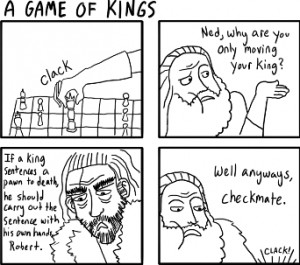
nedstarkIf you can’t do something smart, what do you do? Something right–at least, when this trope is played straight.

Characters who place honor before reason tend to be idealists, starry-eyed or otherwise.  It’s not that they’re stupid–at least, not always–but they do tend to be vulnerable to flaw exploitation.  If the Fettered can’t take a third option, this is how he often gets trapped.

On the other hand, without this trope, we wouldn’t have as many heroic sacrifices or men of their word. In the dark, everyone would turn out to be a jerkass, and the world would be a terrible place to live.

Since the best stories often have some sort of moral dilemma at their core, there’s something about this trope that speaks to us, even (or perhaps especially) in the face of sadistic choices and necessary evils.  It appeals to the more innocent part of us that still wants to believe in incorruptibility.  On the other hand, characters who follow this path don’t tend to think creatively enough to actually solve the problem–or at least, solve the problem without committing the ultimate sacrifice.

Not surprisingly, this trope is a very good indicator of where a story stands on the Sliding Scale of Idealism vs. Cynicism.  In idealistic stories, characters who place honor before reason are often vindicated, such as Bilbo in The Hobbit or Luke Skywalker in Star Wars.  In more cynical stories, the honorable characters not only get eaten alive, their noble idealism actually makes the problem worse.  The classic example of this is Ned Stark from A Game of Thrones, as the cartoon above suggests.

The opposite of this trope, reason before honor, is shoot the dog.  Interestingly enough, in the first scene in which Ned Stark appears, he commits an act that arguably fulfills both tropes at the same time (executing a man who is most likely innocent but has been found guilty by the law).  Lawful stupid doesn’t necessarily come into play, but it often overlaps.  Again, it all goes back to the scale.

This trope pops from time to time in my own writing, though I’m not nearly as cynical about it as George R.R. Martin.  Jalil from Desert Stars generally fits this trope, though Tiera is just as honorable and definitely not stupid about it.  Stella from Bringing Stella Home fits this trope at first, though her choices are vindicated later on.  In Stars of Blood and Glory, though, there’s a character who fits this trope perfectly, and I’m not sure whether he gets vindicated or not.  It will be interesting to see what the readers have to say about that.

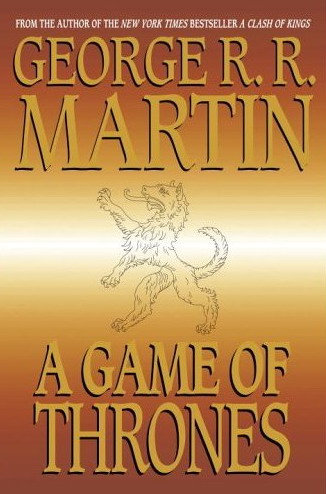
A Game of Thrones by George R. R. Martin

Almost twenty years have passed since the fall of the Targaryen dynasty–twenty years since the last of the dragons was seen in the Land of the Seven Kingdoms.  Now, the libertine Robert Baratheon sits on the Iron Throne, blind to the conspiracies and secret combinations that surround him.

In this dangerous time, Ser Jon Arryn, the King’s Hand, dies of mysterious causes.  Most of the realm accepts the official story that the death was natural, but when Arryn’s wife Lysa sends a letter to her sister, Catelyn and her husband Ser Eddard Stark immediately suspect that the death was orchestrated by the Lannisters.  Only one thing remains: to travel to King’s Landing and uncover the proof.  Soon, King Robert calls on Ser Eddard to become his new Hand, giving them the perfect opportunity to do this.

Little does Ser Eddard know, the intrigue goes much deeper than any of them realize.  For the Lannisters are gathering an army, and Queen Cersei and her brother, Ser Jaime, harbor a secret that would tear the realm apart.  Meanwhile, the last of the Targaryens bears a child prophesied to rule the world, while far to the North, an ancient evil bides its time, waiting to sweep the seven kingdoms with horror the likes of which has not been seen in a thousand years.

Winter is coming–and the people of the Seven Kingdoms are ill prepared to face it.

Everyone seems to be talking about George R. R. Martin’s Song of Ice and Fire series these days–next to The Wheel of Time, it’s probably the biggest epic fantasy line of the last ten or fifteen years.  Martin is well known for killing off his characters and writing in shades of gray, so I thought it would be good to give this series a try.

As soon as I picked up the book, I was hooked.  Martin knows how to craft a beautiful, engrossing fantasy world.  In order to leave no doubt on that point, observe:

Yeah, that pretty much sums up what Martin did with his Land of the Seven Kingdoms. It’s an awesome fantasy world, and I found myself lost in it from the first page.

I must admit, however, after hearing so much about the Song of Ice and Fire series, I was surprised at how few characters died in this book. That’s not to say everyone survived–in fact, Martin killed my favorite character, which made me feel HORRIBLE–but I was expecting there to be more. However, this is the first book in the series, so I assume that the really crazy stuff happens later.

While overall I loved A Game of Thrones, I admit I did have a few misgivings about the book. Martin really does write in shades of gray, and while that makes the story unpredictable and surprising, it also makes things very dark and austere. Martin seems to have no interest in redeeming his characters, and when any of them try to be noble, he cuts them down at every turn.

Personally, I don’t care for that. Flawed characters may be more relateable, but seriously flawed characters (or characters with no interest in overcoming their flaws) turn me off. In this way, Martin is practically the antithesis of David Gemmell; whereas Gemmell makes you love his characters despite their flaws, Martin keeps you reading in spite of the fact that you hate all his characters.

How does he do it? By creating a beautiful, wondrous world. By crafting a masterful story full of intricate twists and turns. By making you hate some of the characters so #%$^! much that you have to stick around and see how they die. It’s all entertaining and extremely engrossing, but at the end of it all, I didn’t come away with any real love for Martin’s characters–except perhaps for a couple of Eddard’s kids, who are still young enough to be somewhat innocent.

I suppose it’s all a part of this new non-conciliatory movement in fantasy. Don’t get me wrong; A Game of Thrones is an EXCELLENT book, but it’s very…non-conciliatory. If that’s your thing, more power to you, but I personally prefer stories about redemption, where romance still lives and even the most unlikely character can be a True Hero, if only for a few fleeting, glorious moments.