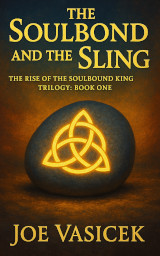
This is the prologue of my epic fantasy novel, The Soulbond and the Sling. It’s a fantasy retelling of the story of David and Goliath, in a world where magical powers can only be unlocked through marriage. I used AI to write the rough draft, but everything here has been rewritten in my own words. I will probably revise it a couple more times before the book is published, but this is close enough that I think it’s worth posting. Enjoy!
Madoc leaned against the rough-hewn timber of the palisade, his breath forming ghost-like wisps in the cold night air. Another uneventful night on the eastern borderlands—though of course, almost anything could be lurking in the darkness below. He took a deep breath, fighting sleep, and began to pace, the wooden floorboards creaking beneath his weight.
For nearly six years, he’d been stationed at this frontier outpost that guarded the high road between the kingdoms of Zyonna and Edumar. In that time, he’d seen a distinct drop in the number of merchants who frequented the roads by day. And by night, the road was so empty, they could have been stationed in the wilderness. Beyond the palisade walls, the chill wind swept down from the rugged heights of Zyonna’s northern plateau, carrying the crisp, earthy scent of highland heather with its promise of the coming spring.
He paused his pacing to peer into the darkness. Tonight, the stars seemed to blaze more brilliantly than usual, though the gently rolling contours of the land were barely visible against the moonless sky. The trees had been cleared for several hundred yards, but the lands beyond were thickly forested. At this time of year, rain and sleet were all too common, so the star-strewn sky was a welcome relief, though it only seemed to multiply the shadows below.
He slowly made his way toward a cluster of soldiers huddled around a small brazier, their cloaks wrapped tightly against the chill late-winter breeze. Their words carried easily to his ears.
“My cousin trades with the rivermen from Edumar,” said Ferris, a stocky young bowman with a thick red beard. “He says half of the villages he used to frequent are empty now. It’s like that throughout the whole kingdom.”
“The Fellspawn, no doubt,” grunted Pete, a wiry veteran with a patch over one eye. “It’s been getting worse on the other side of the border for years. Nothing for us to worry about, though. Our king isn’t a wicked soulbond mage like Gardomir.”
“Nothing to worry about?” Ferris retorted, his eyebrows knitting in disbelief. “The Fellspawn knows no borders. They may spawn out there in Edumar, but they’ll come out here right as—”
“They’ll do no such thing, so long as our mages keep the corruption at bay. It’s all just a part of the natural cycle. We might get an occasional direwolf or two, but you don’t need magic to deal with those.” He spat over the edge of the stockade for emphasis.
Ferris shook his head. “My cousin says there’s nothing natural about the Fellspawn out there in Edumar. The abominations he’s heard about don’t just pop up on their own. They’re being summoned by something—or someone.” He glanced around the circle, looking for support.
“Your cousin says a lot of things,” the one-eyed veteran grunted.
Madoc paused, curious to see how his men would react. Few of them were greenhorns like Ferris, though tensions had been gradually rising in the fort these last few months. But whether that was due to mere cabin fever or the rumors from the other side of the border was difficult to gauge. He turned to the side, facing the wall, and let the men’s voices carry.
“I don’t know, Pete,” said Tom, another old-timer who’d been stationed here longer than Madoc. “They call King Gardomire the Many-Bonded now. They say he’s taken five soulbound concubines. If anything can stir up the Fellspawn, it’s that.”
“Trader’s tales,” Pete scoffed. “Next they’ll be saying King Gardomire breathes fire and has horns.”
“No, it’s true,” Tom insisted. “He really has bonded five slave women to his will, raping them for all the magic that they can give him. It’s made him more powerful than any of our soulbound mages. But that isn’t all. They say he’s taken up with dark unnatural dark magics too—wielding the Fellspawn himself, even.”
“Like hell it has,” spat Pete. “Kings forge alliances with other kings, not with the forces of nature. You can’t trust everything that you hear.”
“But what if there’s some truth to the rumors?” Ferris chimed in, his voice tinged with concern. “They can’t all be wrong.”
“Aye,” said Tom. “The lad has a point. King Gardomir’s always been a power-mad tyrant, but lately, the stories out of Edumar have been getting downright grim.”
Madoc had heard enough. He pushed off from the rough-hewn timbers, stepping with deliberate heaviness as he walked toward his men. The quiet murmur of conversation ceased as the floorboards creaked beneath his thick leather boots.
“Enough with the ghost stories, lads. Speculating without facts is as pointless as trying to shoe a fish. Are we soldiers, or idle gossips at market day?”
Pet grunted in appreciation, though Ferris and Tom straightened uncomfortably.
“Sorry, sir,” Tom muttered. “Just trying to pass the night.”
Madoc smiled and clapped him on the shoulder. “Just another boring night on the border, eh? That’s how it always is. We tell ourselves stories like wide-eyed children just to pass the time, and the next you know, the stories spread and gain a life of their own.”
“But what if there really is something more out there, sir?” said Ferris, the flickering light of the brazier reflected in his eyes, “More than the usual border reivers, I mean.”
Madoc turned and looked the young man squarely in the eye, though he kept his posture relaxed. “Have any of us seen a creature of the Fellspawn that was more than a match for our spears?”
The men shook their heads. Madoc pointed to the shrouded treeline below.
“Have any of you seen King Gardomir in those shadows, sporting horns and breathing fire?”
Old Pete snorted.
“Whatever’s happening in Edumar,” Madoc continued, “it doesn’t change our duty here. We keep watch, we stay alert, and we don’t let imagined horrors distract us from the real ones. Besides,” he added, gesturing behind them, “we’ve got the orb.”
The men all glanced down to the courtyard of the fort, where a crystalline sphere sat atop a sturdy stone pedestal. Its smooth, dull surface reflected the starry sky, without any hint of the enchantment that lay upon it. If anyone—or any thing, for that matter—approached the outpost with violent intent, the orb would glow a fierce orange, warning the men as surely as a roaring fire. Enchanted orbs like this one had been placed strategically along the length of the eastern frontier, aiding the men of the guard in their watch.
Madoc clapped Ferris’s shoulder. “See, lad? Whatever may lurk in Edumar is no threat to us tonight. Now, keep your eyes open and try not to freeze your arses off.”
The older men chuckled appreciatively, bringing a hint of pink to their cheeks. Even Ferris smiled. At the sight, Madoc felt the knot in his chest ease a little. It wasn’t that he discounted the rumors entirely, but spreading them would serve no one. They all knew their duty. Twenty men on the edge of the kingdom, serving as Zyonna’s first line of defense. The last thing they needed was to start jumping at shadows.
Madoc left them and walked to his preferred spot in the northwest corner of the stockade, where he could watch both the eastern approach from Edumar and the high road back to Caer Zyonna. From here, the distant hills looked a little like sleeping giants, their silhouettes barely visible against the starry sky. He settled in for another quiet night, where the occasional wandering deer would be the only break in the boredom, beside the nightly changing of the watch. His mind began to wander, planning out patrol routes and mess hall duties for the coming week.
In truth, the lack of border activity troubled him more than any rumor about King Gardomir or the Fellspawn. When he had first been posted here, the high road had seen a steady flow of merchant traffic between the two kingdoms, stretching almost from dawn to dusk. Now, even in broad daylight, it was rare to see anyone on the road. The thought made Madoc frown. Smugglers and reivers, he could deal with, but the relative silence was unnatural for these parts. After all, the crown hadn’t posted him on the wilderness. So why did it feel increasingly like they had?
The hour passed slowly. At the end of it, a new group of sentries came up to replace the men who had clustered around the brazier. They made the rounds slowly, checking to make sure all was quiet beyond the rough-hewn palisade. Madoc grunted a little and rose to check in with them, grateful for the distraction from his thoughts.
“How’s it look, Lodan?” he asked as he approached the two men on the southern wall.
“Calm as a spring meadow,” Lodan answered with his northern accent.
“Aye,” said Adam, his companion. “If it weren’t for that persistent northerly wind, it might even be pleasant out here.”
Madoc narrowed his eyes, peering eastward where the shadow outline of Edumar’s rolling hills brooded against the sky. “Aye,” he agreed. “Make sure to stay warm, lads. We need your arms and legs as much as we need your eyes.”
“Wait,” said Lodan, frowning as he lowered his voice. “Listen—what was that?”
The sound was so low that Madoc initially took it for the wind. It was a low, rhythmic thumping, coming from the east. Like footfalls, but spaced too far apart to belong to any man or horse.
“Thunder?” Adam asked.
“Too low for thunder,” Lodan answered, though his voice was tight and uncertain.
Madoc stiffened as he strained to listen. There it was again—a low, reverberating thud that he felt in his chest as much as he heard with his ears. He quickly scanned the horizon, but no rainclouds marred the sky in any direction. The stars shone undisturbed.
He glanced down into the courtyard below and felt his stomach clench. The orb had picked up a faint orange glow, like the last embers of a dying fire. The sight sent a chill snaking down his spine. Sinister shadows danced across the grass, cast by the glowing orb.
“Sound a quiet alert,” Madoc ordered. “All men to their positions. No horns, no shouting.”
Lodan and Adam nodded and moved quickly, hurrying down the ladder with silent feet. They entered the barracks and quickly began to wake the sleeping men, who soon began to emerge. There were only twenty of them, but they woke quickly, scrambling up the wall with their armor half-fastened and their weapons in hand. Within a few minutes, the once-sleepy outpost was transformed, every man in position along the eastern wall.
All the while, Madoc peered into the darkness where the highland meadows gave way to scattered copses of pine and birch. He had an unsettling feeling that something dangerous lurked unseen in those woods, just beyond their sight. Should he send out a scouting party? No—best to keep his men concentrated and wait. The night was too dark to risk sending them out by twos and threes.
Besides, he sensed that whatever was out there was coming straight for them.
“Form up,” he called softly to the archers gathered along the wall. “Nock arrows but hold until my command.”
The men silently obeyed, holding their bows and nocking their arrows in near total silence. There were no torches or light to see by—they had been careful not to show any sign that the fort had been awakened. All of the countless drills had prepared them well for this moment, though Madoc didn’t miss the nervous glances that some of them exchanged. Down in the courtyard behind them, the warning orb began to brighten.
“Do you see anything, sir?” Tom asked, squinting into the night.
Madoc was about to answer when a massive figure suddenly detached itself from the trees. It stood nearly twice the height of a man, with a great, hulking body twisted monstrously by thick, corded muscle. Two curved horns jutted unnaturally from its skull, gleaming like obsidian blades. And its eyes—God, its eyes—glowed with a faint amber light that seemed to pierce Madoc’s very soul.
“Sweet mercy,” whispered one of the archers. “What is that thing?”
The warning orb now blazed like a captured sunset, bathing the entire courtyard in a deep orange light. Madoc’s throat felt suddenly tight.
“Draw!” he heard himself issue the order. “Loose!”
Arrows whistled through the chill night air, shattering the silence. The volley was tight and well-aimed, every arrow flying true. Madoc held his breath.
The volley struck the beast with enough power to drop a line of charging war-horses. But to Madoc’s dismay, most of the shafts bounced harmlessly off of the creature’s hide. Those few that did stick seemed to have no effect, for the beast began to advance toward the fort, its relentless strides devouring the earth beneath it with alarming speed.
“Again!” Madoc yelled. “Draw and loose!”
The archers quickly nocked new arrows and loosed them at the approaching beast. The second volley was a little most scattered than the first, but still flew true—to much the same result. Almost all of their shafts glanced off of the beast’s hide. Those few that stuck seemed merely to anger the colossal intruder.
It surged toward the fort with ferocious speed, lowering its massive horns. “Brace for impact!” Madoc barely managed to yell before the creature slammed into the wooden palisade.
As a young man decades ago, Madoc had fought in the war with Edumar. During one of the sieges in the course of the campaign, he had seen an iron-tipped battering ram reduce the wooden gates of a walled town to kindling. But even that was not enough to prepare him for what he now saw.
The beast’s impact shattered the wall almost totally. Logs as thick as a man’s waist burst inward, splintering into fragments. The adjoining watchtower crumpled in on itself like parchment crushed in a fist. Men screamed, some of them thrown clear by the impact, others caught in the collapsing structure.
Madoc struck the hard-packed earth of the courtyard, driving the air from his lungs. Pain lanced through his shoulder, but his training took over and he quickly rolled, somewhat softening the blow. As soon as he came to a stop, he staggered to his feet.
All around him was chaos. Men ran in every direction, some trying to form a defensive line, others fleeing toward the stables. The monstrous intruder stood amid the wreckage of what had once been the palisade. The bright orange light of the warning orb lit it in terrible detail, like a nightmare given flesh. As it gazed upon the chaos it had spread, its amber eyes held no animal confusion—only calculated, intelligent malice.
“Hold your ground!” Madoc yelled, just as the creature let out a thunderous roar. Men cried out and staggered, and Madoc felt his own ears ring.
The beast stepped fully into the courtyard, its massive head swiveling as it surveyed the panicked humans scattering before its approach. Then its eyes fixed on the glowing orb, which now pulsed with such intensity that it cast the whole outpost in a hellish orange light.
“Rally to me!” Madoc shouted, drawing his sword. The blade felt pitifully inadequate against such a monstrosity, but he raised it nonetheless.
A handful of his most battle-hardened veterans quickly formed a desperate line beside him. Madoc yelled, and they charged at the Fellspawn monster with their swords and spears. Two brave spearmen managed to penetrate the beast’s hide, eliciting a roar of rage. A massive clawed hand swept out, raking the first spearman across the chest and all but disemboweling him. The second man barely had time for a massive step before those gnarled fingers closed around his torso, crushing armor, flesh, and bone with sickening ease.
Madoc swung and slashed at the beast’s leg in an effort to hamstring it. His sword bit into that gray, leathery flesh, to little effect, barely penetrating more than an inch. The creature didn’t even look down.
Instead, it stepped up to the warning orb and wrapped its massive hand around the glowing crystal. The orange light intensified, bleeding through its fingers like rays of dying sunlight. Then it squeezed, and the orb shattered with a sound like glass grinding against stone.
Madoc gasped in shock and horror. The outpost was thrown into sudden darkness, the monster reduced to a looming, shadowy mass. His men fell back in confusion, stumbling over their fallen comrades. From the stables, Madoc heard the panicked whinnying of the horses in their pens.
The beast heard them too. It turned with surprising swiftness, its amber eyes fixating on the door to the stables, where the outpost’s horses stamped and kicked in terror.
“No,” Madoc breathed.
With casual ease, the creature tore off the thatch roof and reached inside. A horrible human scream filled the night as the stable hand met his hand. Then the beast reached a little farther, and pulled out a chestnut gelding in its massive hands. Still alive, the panicked horse thrashed frantically as the creature wrung it like a rag. The animal split in two, splattering the courtyard with blood and steaming entrails.
The last of the men who still held their ground now broke down and ran. Even Madoc fell back, barely keeping a grip on his sword. He felt his gorge rise but quickly forced it down.
“To me!” he bellowed in desperation. “For Zyonna!”
But no one rallied to his call. Their spirits shattered, their courage spent, men scrambled for the rear gate or sought to hide in the barracks and the blacksmith’s shop. And far too many of them now lay motionless on the blood-soaked earth.
The creature tore methodically through the dead horse, quickly consuming the remains of the once magnificent beast. A few brave souls took potshots at it with their bows, to little effect. It devoured most of the horse’s front half before dropping the remaining carcass and straightening to its full height. Blood dripped from its jaws as it turned to face Madoc with those terrible amber eyes.
Madoc’s gut fell, and for a brief, heart-stopping moment, he thought it would come for him. But then, a sound emerged from deep within its throat—a rhythmic, guttural cry of satisfaction.
“Gol-guh. Gol-guh.”
With casual indifference toward the survivors of the attack, the creature pivoted on its heel and ambled back through the collapsed eastern wall. Its steps were unhurried, making clear that it was leaving on its own terms, and no one else’s. Once outside, it veered away from the dense forest from which it had emerged, heading westward instead.
Toward the high road. Toward Zyonna.
An awful silence fell over the ruined outpost, broken only by the moans of the wounded and dying, and the crackle of flames where a brazier had spilled and caught on splintered wood. Madoc stood frozen for several heartbeats, struggling to process all that he had just witnessed. The attack had barely lasted longer than a few minutes, but it felt as if half a lifetime had passed.
Then his training quickly asserted itself. He blinked and turned to his men.
“Check for survivors!” he ordered. “Get the wounded out where we can treat them. And someone put out that fire before it spreads!”
Gradually, men staggered back into the courtyard, some emerging from the places they’d hid, others dragging themselves up from where they’d been thrown. Those who were whole moved quickly to carry out their commander’s orders. Soon, they were laying out the wounded on the hard-packed earth.
Madoc made a quick assessment of their losses. Five men dead, including the stable hand. Eight wounded, two critically. Half their horses slain or fled out into the night. The eastern wall was destroyed beyond repair, meaning they’d likely have to abandon the outpost. And the warning orb—their most valuable asset by far—reduced to little more than glittering shards.
He turned and stared in the direction the creature had vanished. Not toward Edumar, he realized with a chill. It was heading west, deeper into Zyonnan lands.
“Ferris!” he called, spotting the stocky highlander. “Can you ride?”
“Yes, sir,” the young man answered. “What would you have me do?”
“Take the fastest horse you can find and ride for Caer Zyonna. That… thing… is headed straight toward our country’s heartland. Every settlement between here and the Western Marches is in danger.”
“Sir,” said Ferris, his face paling in the dim starlight. “What was that thing?”
“I don’t know. But the kingdom must be warned. Tell them…” Madoc struggled to articulate the horror they’d just witnessed. The creature was obviously Fellspawn, though it hadn’t behaved like one. Instead of making a frenzied and indiscriminate attack like any other wild beast, it had shown purpose. Intelligence. As if it had not been merely spawned, but sent.
“Sir?”
He narrowed his eyes, suddenly remembering the beast’s final call. “Tell them the Golga has come.”
Ferris nodded grimly, mounted the nearest horse, and galloped westward down the road toward the kingdom’s distant capital.