Need new title

I need a new title for Bringing Stella Home.  As you can probably tell, the current one just isn’t quite good enough.  Got any suggestions?

I was thinking of something that combines the words “fire” and “salvation,” but I haven’t come up with anything cool yet.

If you’ve got any better ideas, please let me know.

Chomping at the bit

It’s 1:30 am where I am, and I just finished reading through the second draft of Bringing Stella Home and all of my first readers’ comments.  I don’t know how to describe what I’m feeling right now, but I am so ready to make this story shine!

First of all, the story itself is incredibly powerful, at least to me.  True, the current draft is full of problems (some of them so embarrassing I cringe just to think that I allowed other people to read it) but at its core, there is definitely something poignant and moving.  One of my first readers is on active duty right now in Afghanistan, and it actually inspired him to write a poem.

Of course, a reader can be “moved” in bad ways as well as good, and some of the feedback on the current draft’s problems brought out a side of my friends that I didn’t know even existed (yes, Kindal, I’m talking about you).  Seriously, reading those comments was like getting gutted and filleted with a rusty fishing knife.  If I’d had problems with my self esteem, I probably would have cried.

Oh well.  At least it wasn’t boring. 🙂

But harsh or not, the comments were all useful–surprisingly useful, actually.  In a story this big, it’s easy to miss things (even big things like character motivations), but after reading through all my reader comments, I feel confident that I’ve got a solid outline for the revision.

Some of the suggestions were pretty dang good, too.  Usually, I only adopt about half (or less) of the proscriptive comments my readers give me, but this time, I’ll probably end up taking quite a few more.  I don’t know if it’s because I was an idiot when I wrote the first draft or because my readers were getting into the story a lot more than usual, but the advice this time opened me up to all kinds of new ideas.

I probably can’t say much more without spoiling my own story, and I definitely don’t want to do that.  Let me just finish by saying that I believe this story may be the one that breaks me into publishing.  I hope this doesn’t sound conceited or arrogant, because I don’t mean it that way at all.  I just think that this story has some serious potential, and that if I treat it right, it will end up in print someday.

Inshallah, someday soon!

In the meantime, I’m going to put everything into revising this next draft–that is, everything short of secluding myself in a white room and starving myself (or graduating and not looking for a job, which is a more realistic possibility).  This story is calling to me–it needs to be told.  It needs to be fixed.  It needs to be polished and shared with other readers.

It needs a lot of work.  But now it’s 2:00 pm, and I’d better get to bed.  Another exciting day of photocopying newspaper clippings and compiling spreadsheets of data on press freedom in Turkey awaits me.  Excuse me if I sound too excited.

Go to Tor.com and read this.

Brandon Sanderson’s story of how he decided to become a writer is very interest.  It goes back to elementary school, when he hated books and reading in general.  A wise teacher put a copy of Barbara Hambly’s Dragonsbane in his hand, and it started a chain reaction that led to him becoming a bestselling writer.

As one of Brandon’s students, I’ve heard the story several times.  However, I had no idea how significant a role that Michael Whelan, the illustrator of that book, played in it all.  Tor commissioned Michael Whelan to do the cover for Brandon’s next book, The Way of Kings. In response, Brandon wrote a blog post at Tor.com explaining how significant it is to him that Mr. Whelan was chosen to do the cover art for The Way of Kings.

It’s an awesome and moving blog post.  You should check it out.

In unrelated news, I am 110 pages into outlining Bringing Stella Home 3.0 and enjoying the process immensely.  I’ve got some awesome first readers.  Even with all the honest criticism, I’d much rather be writing than doing office work at my internship.  Ah, well, April 15th will be here before we know it.

As for graduating and finding myself in the real world…not quite as thrilled about that.  More like scared s***less.

Major project shift

I’ve got this goal to finish my current work-in-progress, To Search the Starry Sea, by May 1st 2010.  However, the deeper I get into the story, the more I realize how many problems it has–how much it sucks, in other words.

Normally, this wouldn’t keep me from dropping the project or putting it on hold.  It happens with every rough draft (or second or third draft, for that matter); midway through every project, I start to get all angsty and worry that the project sucks, that it’s beyond saving, that I’m wasting my time, etc.

However, this time it’s different for a number of reasons.

First of all, the story itself doesn’t suck. However, it does have a weak beginning and a poor setup, which makes it very difficult to develop the middle section.  With better conflict foreshadowing and character introductions, I could tear right through this section, but without that, I’m floundering more and more.

A couple months ago, I started to realize this, so I started a set of revision notes for the next draft.  My thought was “if I know the story needs changes, rather than going back and changing them, I can just make a note of them and move on.”

However, that approach isn’t working because the unwritten changes aren’t impacting the story as fully and completely as they would if I’d write them out.  If the changes were minor, I could let them go–but when they have to do with something fundamental, like setting up a romantic subplot, or turning a minor character into a major character into a major viewpoint character, I can’ t just make a note of the change and move on–I need to write the thing to see what it changes.

In other words, I need to restart this project from the beginning.  But if I do that while I’m still angsty about it, it’s going to end up like crap.  I’ve got to let it sit for a while.

It’s frustrating, because I really want to finish a straight draft from start to finish.  For both Genesis Earth and Bringing Stella Home, I only finished the rough draft after dropping the project for a while and restarting it at the beginning.  If it works, I guess it works, but it would be nice if the creative process were more linear.  Blegh.

All is not lost, however.  Most of my first readers for Bringing Stella Home have gotten back with their feedback, and it’s been extremely helpful.  I’ve got a clear direction and lots of ideas for where I want to take that story, and now that I’ve spent some time away from it, I can honestly say that it doesn’t suck all that bad.  In fact, after a lot of work, it might actually be decently good.

There are several reasons why it makes sense to work on Bringing Stella Home right now.  For example,

  1. I’m excited about it.  Better to capitalize on that now than wait until after the enthusiasm has died.
  2. I’ve got lots of ideas flowing to me now.  I could try to write them all down for later, but why not try them out now, while they’re still fresh?
  3. I’m sending Genesis Earth out to a bunch of places, and the rejections are starting to come in.  If I can respond to a rejection by sending out a second book in a timely way, I will look much more like a professional, and the agents/editors will take me more seriously.

My goal was to have To Search the Starry Sea done by May 1st.  Let’s see if I can do Bringing Stella Home 3.0 (and yes, the title will change) by that day instead.  And if that proves too difficult, what with graduation, internship, looking for work, and figuring out life, at least I can reach the halfway mark by then.

So that’s my new goal: Finish Bringing Stella Home 3.0 by May 1st, 2010 (or at least be halfway finished). To do that, I’ll have to read through all the comments by the end of this week and have the revision notes all figured out.

Better get started!

I’m published!

That’s right–my first published story just came out in issue 58 of The Leading Edge.  I am happy to say that after three years of formally pursuing my career as a writer, I am now a published author!

The story is titled Decision LZ1527, and it’s about a guy asking a girl out on a date–as told from the point of view of the little men inside his head piloting his body like a starship. I really like the tagline in the table of contents: “A man, a woman, and a whole crew of matchmakers.”

Full disclosure: I submitted this story after I joined the staff as a volunteer slushpile reader.  Most of the editors for this issue are pretty good friends of mine (including the Production Director, who’s one of my most trusted alpha readers).  I submitted it under a pseudonym, however, so most of the staff didn’t know it was mine until after they’d accepted it.

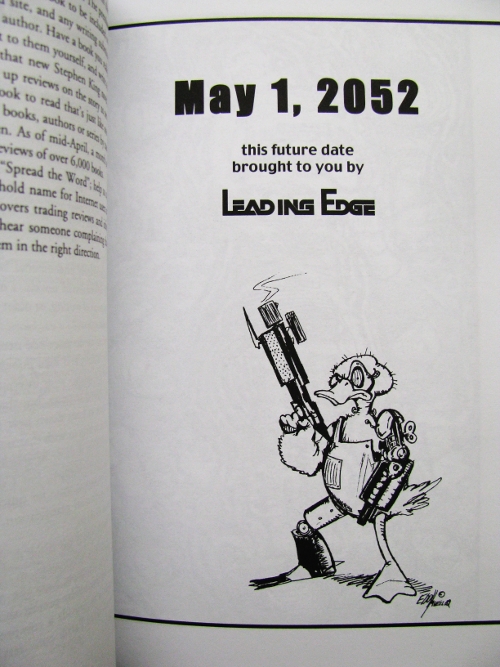
The Leading Edge is known for the excellent quality of its illustrations, and I’m happy to say that I lucked out with with the artist the editors picked for my story!  Josh McGill is a graphic designer and aspiring children’s book illustrator.  He’s done art for issues 53 and 55 of The Leading Edge. The picture on the right is the one he did for the front page of my story.  I must say, I’m impressed!

The Leading Edge is a semi-professional small press science fiction and fantasy magazine affiliated with BYU.  It’s been in publication since the early 80s, when Marion K. “Doc” Smith’s famous “class that wouldn’t die” got together and started it, along with Quark and LTUE.  If you would like to support the magazine (and read my story!) you can purchase a copy of issue 58 at the following link:

Issue 58: “Redemption Songs”

Lot’s of people dream about getting published, but it takes a lot of hard work and rejection to actually make it happen.  As writers, though, we tend to be harder on ourselves than we ought to be.  It took almost four years for Decision LZ1527 to find its way into print, but it did.  That’s enough to make the rest of the process worth it.

Let’s hope it’s the first of many!

Writing the synopsis

Ugh.  It’s so hard to write synopses.  I spent all my free time tonight writing one, so it doesn’t look like I’m going to get more than a couple hundred words (if that) in To Search the Starry Sea.

It’s a necessary evil, though–so many agents and editors require it.  Now that I’ve got a one-page synopsis down for Genesis Earth, I can start submitting more liberally.  I’m sure, though, that it needs tweaking before it’s ready to send out.

For that reason, I’m uploading it to this blog, so you guys can take a look.  I’ve got to warn you, though, there are SPOILERS in this document–so please, don’t read it unless you were one of my first readers!  You all know who you are.  Here it is:

10-3 march one-page synopsis 4.0.

What do you think?  Let me know in the comments.  And thanks!

End of the apprenticeship

I got in a long conversation with my roommate tonight, where we talked about girls, government, the economy, 2010 elections, corporatism, Ursula K. Le Guin, and all other kinds of good stuff.  Towards the end, we got to talking about my goals to be a full time writer, and I showed him the record I’ve been keeping of my daily word counts.

In case you’re interested in seeing a copy of it, here it is:

wordcounts (to 27 February, 2010)

I basically showed him how I’ve been keeping track of my work, setting and keeping goals on a daily basis, juggling work, school, etc while taking a very professional approach to my writing.  While it impressed him, it impressed me almost more–all of this is so habitual by now that I sometimes forget how hard I’ve been working at it.

The most surprising thing?  Since May 2009, I have written over 422,000 words!

😮 😮 😮

There’s a saying in writing that says you have to write one million words before you write your first good word.  Until now, I thought I was still somewhat short of that number–on the upper end, certainly, but still short.

Well, I’ve been writing on a more or less daily basis since August 2007.  If I’ve written almost half a million words since May 2009, how many words did I write between August 2007 and May 2009?  At least half a million, I’m willing to guess!

In other words, it is quite possible that I’ve already surpassed my millionth word.

Wow.

I’m not sure what to think about that.  On the one hand, it’s exciting. On the other hand, it’s downright scary.  If it’s true, it means that I should move past the apprenticeship phase and start pushing this as my career.

That is insanely scary–and yet, at the same time, absolutely thrilling.  It’s going to mean investing a lot more time into researching the market and sending out to agents, receiving lots of rejections and wondering if my stories are any good.

Scary.  And yet, when I finally do get a publishing deal (and I’m more confident now than ever that this will actually happen someday–inshallah someday soon), that’s when it gets really scary.  If that first book doesn’t earn out, my career will be toast.  I’ll have to slave away in an office for the rest of my life.

Holy crap, that’s scary.  At the same time, though, it’s gonna be awesome.

Bring it on!

Gah! It sucks

I’m about a third of the way through To Search the Starry Sea, and my greatest fear at this point is that it isn’t as good as the last novel I wrote.  Because if it isn’t as good, that means that I’m getting worse, not better, and if I’m getting worse, that means I’m never going to make it as an author, because I’m not even published yet, and if I’m not going to make it as an author, that means I’m going to have to do what I’m doing NOW for the rest of my life, which means that I’m going to be miserable and life is going to suck…

<pant> <pant> <pant>

Seriously, though, sometimes I wonder if I’ve really made the right choice.  To Search the Starry Sea is much more of a happy adventure story, but sometimes I feel that it lacks depth and meaning.  I’m starting to get feedback from my alpha readers for Bringing Stella Home, and their reactions to it are surprisingly encouraging.  That story moved people–but this one?  I don’t know.

Then again, Bringing Stella Home is dark, gritty, and very tragic.  I remember feeling depressed by the story even as I wrote it.  Is that the kind of story I want to be known for?  If I can write something deep and meaningful and have it be optimistic and adventuresome, that would be a lot better.

I’m discovery writing it hardcore, which means that side characters often come to play a much more central role than I’d thought, and events that I thought I could cover in a chapter, I have to cover in two.  I have an idea where the story is going to end up, though, and it’s going to be awesome. How awesome?  Let me show you:

Yeah, it’s going to be awesome.

I think the key to keeping it meaningful is 1) to keep in mind the main character’s inner conflicts, framing them in a way that the readers can relate to their struggles, and 2) keeping the overall growth arc constantly in mind.  How does what’s happening affect how the character is changing?  That kind of stuff.

I hope I can finish this in two months.  I’m mired in the middle of it right now, and the end is far from sight.

In the meantime, I think I’ll get some sleep.

Retired notebook: part 1

Like most writers, I keep a notebook with me at all times.  I use it a lot for scrap paper, but I also jot down all the weird story ideas that come to me, usually while I’m doing something completely unrelated to the idea.

A while ago, my old notebook got too ratty to keep in my back pocket, so I replaced it and put the other in my dresser drawer.  I thought it would be interesting, though, to go through some of the ideas I came up with.

Here they are, from the beginning:

A society in which infanticide is not considered a crime, up to two years (since infants are not conscious in the same way as adults and children).

…okay, maybe that one was a little creepy. Next:

A near future dystopia in which the film extras in movies made in overpopulated developing countries literally act out the battle scenes, because hollywood studios can pay for the loss of life.

Another creepy one, but it’s actually legit. I came up with it in the Las Vegas airport, listening to a panel from CONduit on my iRiver while waiting for my connecting flight.

On the panel, Dave Wolverton mentioned that in China, the most that any corporation can be sued for negligent homicide is $10,000. This got me to thinking, what if they had the extras fill out forms indicating next of kin, and shoot the battle scenes with real guns? It would cause a huge uproar among humanitarian organizations, for sure, but there’s certainly an audience that would pay for it. And really, who loses from it?

Yet another example of economics at work–and why capitalism is evil.

A time travel device that allows collection of data from the future without affecting causality–how would this change political science?

In other words, what if we could go into the future and quantifiably measure the effects of decisions made in the present? What if our hindsight really was 20/20? Something like that.

A candidate who always has the latest liberal candidate’s bumper sticker on the same corner of his/her car, so it builds up over time.

Just an interesting character quirk.

An MMORPG for orcs and elves where they play as humans.

Haha! I’d forgotten about that one. 🙂

Zombie insects.

“Infestation” takes on a new meaning.

Sentient planets.

We’ve already got that (sort of): it’s called the Gaia hypothesis.

Golfing on the moon or mars.

Or tennis, or soccer, or basketball…seriously, how cool would it be?

Were-squirrels!

…okay, maybe that one wasn’t quite as awesome.

A psychic agency that allows you to IM dead relatives.

I’d be surprised if this doesn’t already exist.

There’s more, but I’ll save it for another post.

“This is my culture; this is my community”

So back at World Fantasy in San Jose, I picked up a bookmark for a science  fiction club in the Washington DC area, WSFA.  I figured that since I was headed out there, I should check it out.  Last night, I went to my first meeting.

Getting there was quite an adventure.  The meeting was in Maryland, at a member’s house–I had to go to the end of the green line, then cross over the beltway and walk nearly three miles to get there.  The sidewalks were still covered in snow, so I had to keep to the street, which was a little unnerving on the overpass–but I made it.

I didn’t know anybody there and had no idea what to expect, but the people were friendly and I soon felt like I fit in.  It was a little bit like a cross between Quark and Bimbos of the Death Sun, which is a pretty awesome mix.  The meeting was called to order and people started discussing some pretty interesting projects, like publishing a special edition Jeff Vandermeer novella for Capclave in October and getting various things for the con squared away.

A couple of things about the club surprised me: one, the members were all middle aged and older; and two, how extremely liberal everyone was, politically.  I say I was surprised, but really, I could easily have seen this coming.  The east coast is very different from the inter-mountain west, so it stands to reason that there would be differences.  Not that I minded.

I’m not sure how many people in the club are writers, but like any good sf&f community, everyone seems to be an avid reader.  I was surprised that so few people had heard of World Fantasy, but when I told them I wanted to break into publishing, they all told me that I should come to Capclave, the DC area con that happens in October.  Will I be in the area for that?  Not sure yet.

Fortunately, I didn’t have to walk back to the metro; one of the regulars was heading to Arlington and gave me a ride.  We had an interesting conversation on the way back–he’s from Philly, drove a cab for a few years, and has quite a colorful vocabulary.

We were talking about fandom in general, though, and he made the comment “this is my culture; this is my community.” That’s exactly the sense that I got from the meeting–that these fans have built a community around science fiction and fantasy that transcends fandom and stretches into all other aspects of their life.  It’s similar in some ways to the sense of community that you feel in the LDS church–even when you move to a new place, you’re not a stranger.

Am I going to keep coming to WSFA meetings, or become a member?  I don’t know.  A lot of it depends on what I do in April.  I’ll probably come to a few more meetings, though–these are my people.