This post is just to let you know that I’m still alive, that I haven’t gone anywhere, and that I’m still writing.
I’ve been a little disorganized recently, with job obligations (this is my last week), a TEFL course to finish, and other stuff…can’t quite remember what other stuff, but I’m sure there was something.
Anyhow.
Point is, things have been upside down recently, but I plan on posting more frequently once I fall back into a routine. Here’s what I hope to blog about:
Blog awards: I recently got tagged by two of my blogging friends, so I’ll be passing those on.
My solo hike up Y Mountain last Saturday. Expect to see this soon, with some pictures.
Thoughts on dreams and dream interpretation. I had a really interesting experience with this recently.
Update on Star Wanderers; I hope to finish draft 2 in a couple days and send it out to alpha readers.
“Does it ever bother you to do bad things to your characters?” A question I got recently, which is a blog post just begging to be written.
Also, I’m putting together a blog tour right now for Bringing Stella Home and Sholpan, so if you’d like to have me on as a guest blogger, feel free to shoot me an email at joseph dot vasicek at gmail dot com.
In the meantime, this might interest you: I wrote a poem Sunday based on a first line I got from work. My coworkers were talking about dating, saying how they were going through a drought, and I replied with “my life is a drought, and my soul is a desert.” Great first line, huh? 🙂 If you want to read the poem, you can find it on my deviant art page here.
Other than that, there’s not much else to say. My daily routine is all shot to @#$! right now, but that’s what happens when you’re a freelancer; you’re productive for a while, until projects and schedules change, then you go through a period of chaos until you fall back into a productive routine. All a part of the lifestyle.
And now, in order to promote a more healthy lifestyle, I’m going to go to bed. G’night, interwebs. Be good.
That’s what I’m wondering about right now with my latest project, Star Wanderers. The full-length novel isn’t complete yet, but the first part forms a self-contained novelette that has been sooo much fun to write.
The story takes place in the Gaia Nova universe, about five hundred Earth years before the events of Bringing Stella Home. The main character is a 20-something boy who, as is customary in the outworlds, left his home to wander the stars, searching for a suitable place to settle down and start a family.
While visiting a remote space station, he unwittingly gets roped into marrying this girl, whose father is trying save her from starvation by sending her away. The problem, though, is that neither the boy nor the girl speak the same language.
So basically, he just wants to drop her off at the next port and be done with it, while she thinks that she’s his wife and is trying to live up to those expectations. Over the course of their voyage, though, they gradually fall in love and become a couple. That’s where the novelette ends, and the second part of the novel begins.
Because I’m a total dork, I looked up all the major tropes in Star Wanderers on tvtropes. Here’s just a few of them:
So yeah, I’m really excited to share this story with people. The only problem is I want to submit it to the Writers of the Future contest, and I’m not sure if they’ll consider it if it’s already self published. The contest guidelines say that all the rights remain with the author, and defines “professional publication” as something with >5,000 sales/downloads, but that doesn’t say whether it’s okay to publish the piece you’re submitting. I’ll probably have to shoot someone an email or something.
In any case, I’ll probably put up the first part of Star Wanderers before I publish the novel. For everyone who’s signed up for the newsletter, I”ll probably give it out as a free ebook. If Writers of the Future is okay with it, I’ll do that in the next month or so; if not, I’ll submit it to the contest first and wait to see what happens.
But either way, I really want to share this story!
So I have some news, and it’s probably going to freak my parents out a little bit…I decided to turn down the full-time job offer that I mentioned a few weeks ago.
The company is great, they treat their employees well, I got along well with everyone there–so why not take the job? Because it wasn’t helping me make progress toward my long-term goals, it wasn’t teaching me any new or useful skills, and it wasn’t in a field where I’d like to make a career. After weighing the benefits vs. the costs, especially the opportunity costs, it just didn’t make sense to stay.
I know what a lot of you might be thinking: “Dude, a job’s a job. In this economy, you should take it and count yourself lucky!” I reject that, though. Last year, I managed to cut my expenses to less than $950 per month. I’ve been saving up my paychecks, and I’ve got enough to float me for a couple of months until I find a job that fits better, hopefully part-time.
The big thing I’m worried about is whether I’m digging myself into a hole. Since graduating in April 2010, here are the jobs I’ve held:
Conducting unsolicited phone interviews at a call center.
Picking, packing, and shipping at a costume company warehouse.
Delivering phone books from my car.
Miscellaneous unskilled labor at a candy factory.
Miscellaneous unskilled labor at an alarm company warehouse.
Processing inventory and shipments at an alarm company warehouse.
So yeah, nothing all that great. I’ve been doing some volunteer stuff in the interim, though, especially with Leading Edge and the “class that wouldn’t die” article from last year. But in general, it feels like I’m getting stuck in a rut, and that the longer I stay stuck, the harder it’s going to be to break out.
What I really want is something that will expand my mind and/or give me another major cultural experience. That’s why I’m thinking seriously again about teaching English abroad. But grad school is definitely another attractive option, especially if it gives me a chance to work on my Arabic.
With that in mind, here are the options I’m considering right now:
Travel to the Caucasus in January and volunteer teach English with the TLG program. It’s not particularly lucrative, but if I can balance my writing career on the side while having an awesome cultural experience in a region of the world that interests me, it might be perfect.
Study Arabic and/or Middle Eastern Studies at a university in the Middle East, ideally AUB or AUC. I don’t really want to be a security analyst, but I would love to make a career as an Arabist of some sort–provided, of course, that I could balance it with my writing.
Pursue a graduate degree in History, Anthropology, or Sociology in the United States. I’m less sure of this option, mainly because I don’t know if I’m passionate enough about any of those subjects to really succeed at them.
Take a chance and travel to the Middle East to teach English. I’d probably go to Jordan or Oman, where I actually know people, but Egypt, Libya, or Tunisia might be good too, especially with the Arab Spring opening them up. It might also be dangerous…but hey, at least it’s an adventure.
Finding a graveyard desk job, like night auditor at a hotel, and use that to support myself until the writing career start to take off. Even though this is the most boring option, it’s probably the most likely one I’ll follow…which probably isn’t a good thing.
The main goal, of course, is still to go full time with the writing career. That’s like the holy grail. I’m still optimistic about that; it’s just a matter of finding something useful to do in the interim. The last thing I want is to settle, or to get stuck in a comfort zone, or lose sight of my long term goals…
…I don’t know. I’m still figuring all this stuff out. But regardless, I just don’t think working full-time at an unskilled labor job is going to get me anywhere–and that’s an opportunity cost I can’t afford to take.
So my birthday is coming up a little later this week, and my family has been asking what’s on my wish list. In order to help them out, as well as anyone who might feel inclined to give me stuff, I thought I’d post it here on my blog. Some of the stuff might be reaching a bit, but what the heck, might as well throw it out there.
Item One: Signed First Edition Hardcover Copy of Legend by David Gemmell
This is the ultimate gift of all time for me. It is my life’s goal to obtain a signed copy of Legend, which is made all the more difficult by the fact that David Gemmell passed away in 2006. He is, by far, my favorite fantasy author, and this book is my favorite of everything he’s written.
I don’t expect to fulfill this life ambition on this particular birthday, but in the unlikely chance that it lies within your power to help me obtain a copy, know that I will be your slave for life in exchange for this priceless gift. Literally. With chains and everything (or caramel topping and whipped cream, if that’s your preference).
Item Two: Göttmann Dress Cap
Specifically, the Dallas-2 design pictured here. I have no idea how or where you’d get it, but that’s what I want–specifically from Göttmann Caps and Hats, in Germany. I’ve got a similar cap right now and it’s pretty spiffy, but it’s from Ross so the quality is pretty cheap. I need an authentic writerly cap like this to give me x2 pretentiousness and +5 charisma.
Item Three: Kant Stop The Music T-Shirt
This one’s a little pricey for a T-shirt, but I absolutely love the design. What better way to combine your love of music with your love of 19th century philosophy?
Item Four: Beginnings, Middles, and Ends by Nancy Kress
Nancy Kress is one of my favorite people to listen to at a con, and I’ve heard a lot of good things about this book. If you want to get me a book on writing, this would probably be the best one (or, alternately, either of Orson Scott Card’s books: Character and Viewpoint or How To Write Science Fiction & Fantasy).
Item Five: Anything by Hiyao Miyazaki
You simply can’t go wrong with this awesome Japanese director. I already own Princess Mononoke, Kiki’s Delivery Service, and Castle in the Sky. Even though it was done by Miyazaki’s son, I wouldn’t mind a copy of Tales of Earthsea either.
Item Six: Interstella 5555
My favorite anime ever! Now out on Blu-Ray!
Item Seven: Mirage: the Remixes by Armin Van Buuren
Recently, I’ve really gotten into trance & progressive music, and Armin Van Buuren is one of my favorite artists. I skip lunch each week just so I can listen to his radio show, A State of Trance. His latest album, Mirage, is really good, and so I’d like to pick up a copy sometime of the remixes. Alternately, you could get me the Imagine remixes album, or anything by Cerf, Mitiska, & Jaren.
So that’s pretty much my wish list. Of course, if for some reason you’re not in a position to get me any of this awesome swag, I’ll take a gift card or a sweater or a homemade whatever <grumble>. But if you do get me a gift card, please make it an Amazon gift card, so I can buy more books and music. And if it is within your power to get me a signed hardcover first edition copy of Legend…let’s just say, I’m only partially joking about the slave thing.
Just a quick post to let you know about a new feature:
I just started an email newsletter for my ebooks, to keep my readers up to date with the latest releases. I also plan on doing some giveaways, discounts, and exclusives, so if you’re at all interested, sign up by filling out the form in the sidebar just below the featured ebook!
My goal with the newsletter is to establish a channel where I can connect with my core readers, those who are interested in everything I release. Hopefully, this will be a good way to cultivate their interest and build a tribe of followers, who will then be excited to go and share my books with their friends.
Of course, I’ll be sure to keep any personal information confidential and not share my subscriber’s emails with any third parties. I’ll also keep the newsletters sparse, so as to keep from cluttering people’s inboxes. This blog is for regular writing updates; the newsletter is strictly for announcing new releases, giveaways, discounts, and exclusives.
As a reward to everyone who signs up over the weekend, I’ll be giving out a free copy of Sholpan via the newsletter on Monday. I’ll do that through Smashwords, so it’ll be available in multiple formats.
That’s just about it for the newsletter. In other news, I received my first royalty payment from Amazon today! I celebrated with my roommates by breaking open a bottle of sparkling grape juice that I’d been saving for the occasion.
As of right now, I am a professional novelist. Weird, huh?
For those of you who don’t know (or can’t remember, since it’s been so long), I’ve been doing this ongoing thing where I go through my old story notebooks. Last time, we covered my last semester of classes at BYU; this time, we’ll cover my time in Washington DC, when I was trapped in an internship from hell.
Now, you may be wondering: “why is this guy just giving away his ideas for free?” Well, last week at dinner group, the conversation turned to story ideas, so I pulled out my current story notebook and started going down the list. This quickly turned into a game of “name that tune,” where we managed to show that EVERY SINGLE IDEA had already been done.
And you know what? That’s perfectly okay! There are no original ideas anymore, just new ways of executing them, and maybe a handful of combinations that haven’t yet been tried. The purpose of keeping a story notebook with you at all times isn’t to come up with something new, it’s to keep track of the stuff that really turns you on.
Enough with that. On to the notebook.
In a spacefaring culture, the custom will be for the males to leave the station and depart in search of a wife at another port, either to capture or win over in some way. The women will tend more to running off with the travelers. This preserves genetic diversity.
This is actually something I want to talk about in a longer post. The problem of inbreeding in a space-based society is something that many science fiction authors have wrestled with, from Robert Heinlein to C. J. Cherryh. Their solutions are quite inventive, but while I was in Washington DC working on To Search the Starry Sea (my escapist retreat from a hellish internship), I managed to come up with a few of my own, and used them in Star Wanderers. More on that later.
What if one of the founders was a time traveler, sent on a mission to ensure that the US constitution made it through?
Hehe…in other words: James Madison, Time Traveler. It has a certain ring to it, no?
The human mind is like a congress–so many people at extreme odds, arguing constantly but holding together somehow.
Oh boy. If that were true, the US congress today would be like a paranoid schizophrenic.
A subway haunted by patrons from the past–maybe you will become one when it goes back in time.
Who hasn’t been creeped out by the subway at some point or another? Except the New York subway system is way creepier than the Washington DC Metro–I swear, some of those rats are man-killers.
A magic system where the cost is your unborn children. If you don’t have children within a certain period of time, you die.
Sounds like some of the Arab short stories I’ve read. Families and children are much more important to them than to us in the West.
When the Developed World develops instantaneous transportation devices, it will essentially merge into one super country, while the developing world will be left out. The only sense of distance will be in the developing world, and terrorism will be an issue.
A government where the Supreme Court is a super-intelligent robot.
Hopefully this would rid the country of activist judges…or would it??
A character who believes, at his core, that there is no such thing as a genuine surprise, simply a lack of information–and that if we had perfect information, there would be no surprises.
Sounds a lot like the platonic 19th century ideal of a scientist. What with quantum physics and such, there aren’t a whole lot of those left.
There are two kinds of shame: shame from loss of honor, and shame from not following the herd. Don’t mistake the one for the other.
This one isn’t so much a story idea as an observation. I learned a lot in my hellish Washington DC internship, most of which had very little to do with my area of study and everything to do with the less-than-honorable ways in which the world works. And on that note:
____ always felt that the world around him was somehow less than real; an illusion. While staring out the window of the train, he wondered if the window wasn’t just a video screen, like the car windows of old movies–or when looking out at the view of the mountains beyond his house, with the picturesque clouds and too-blue sky, if it wasn’t just an elaborate painting on a wall at the end of the world. In moments like these, ____ longed to peel back the video screens–to break down the pretty painted wall at the end of the world–and see what lay on the other side of reality.
If my hellish internship on K street taught me anything, it taught me that I would rather be a writer than have all the connections or political influence in the world. I got out of Washington DC as fast as I could, and haven’t looked back since.
That’s right–I was up until about 2 am last night finishing it. Man, time goes by fast sometimes. This is probably just the first part of a much longer novel, but I hit a good stopping point so I’ll probably put it on the back burner for now while I finish Edenfall and do a final polish for Desert Stars.
What I really want to do is submit this first part to Writers of the Future, since it falls just under 15k words. I might be a little biased, but I think it’s got potential. 🙂 It’s going to need some work, though; the story literally sprung out of my head one day, and while that doesn’t necessarily mean that it’s bad, it’s probably missing a couple of scenes and needs some work with the transitions. Also, the tone completely shifts midway, from a happy go lucky space adventure to something much more serious. Not sure what to do about that.
So yeah, I’ll probably set this story aside for a little while so I can come back at it with fresh eyes. It’s not too long, so the revisions should be pretty quick; hopefully, I’ll have it ready to submit to Writers of the Future before January. If it doesn’t make the contest, I’ll shop it around the short markets for a year while I finish the novel-length version. At some point I’ll probably epublish it, but I’m not sure when.
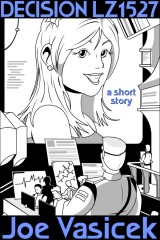
In other news, my short story “Decision LZ1527” just went free on Amazon, so if you want to pick up a copy or tell your friends, go right ahead! It’s right around #200 in the Kindle free category now, but for some reason hasn’t hit any of the lists. Hopefully that’ll change before the ranking drops back down.
“Decision LZ1527” first appeared in the December 2009 issue of Leading Edge, and was my first traditionally published short story. Basically, it’s about a college freshman working up the courage to ask out a girl he likes, as told from the perspective of the little men inside his head. Like Star Wanderers, the story just sprung out of my head one day. It was a ton of fun to write, and I’m glad that so many others seem to enjoy it too.
In other news, I just got back the edits for Sholpan, so I’ll hopefully have that up on Amazon and other eretailers over the weekend. More on that as it happens, but it’s happening soon. I’d also like to put together a blog tour for Bringing Stella Home and Sholpan both, so if you’d like to have me on as a guest blogger, shoot me an email at joseph dot vasicek at gmail dot com. More on that later as well.
And that’s just about it for now. Take care, and I’ll see you around!
Well, I went through a significant rite of passage over the weekend: I got my first one star review on Amazon.
The review was for “From the Ice Incarnate,” which doesn’t really surprise me because it’s currently my lowest rated story. The biggest complaint seems to be that it feels more like a vignette than a complete story, which is a fair criticism. I’ve tried to make it clear in the description that this is an excerpt from a larger work, so hopefully it doesn’t feel like a bait and switch.
I wish everyone loved all of my stories, but of course that’s not possible. And although it’s easy to dismiss readers who complain about free ebooks, any book takes an investment of time and emotional energy; no matter what the price, the writer has a responsibility to deliver the best story they can write.
This is the reality of the new system: readers are the new gatekeepers, and rankings are one of the major ways that they give feedback. It’s a lot more public than a rejection letter, but ultimately I think this is a much better way for stories to grow into their natural audience.
Every writer gets one star reviews from time to time; writing is so subjective that it’s inevitable. My object isn’t to please everybody, but to do my best and to be constantly learning.
I realize that by the time you read this it will probably be September 12th, and most of you will be breathing a collective sigh of relief that the 10th anniversary of 9/11 is over and done with. I apologize for bringing up the subject again; I’ve been putting off writing this post because I feel exactly the same way. And yet it doesn’t feel right to say nothing, so I figure I’ll just get this off my chest and return to my normal blogging routine tomorrow.
To be honest, there’s very little I can say about 9/11 itself that I haven’t said already. Last year’s post pretty much summed up everything I could say about my experience that day, and I won’t try to do a better job here.
There’s a reason I chose to spill everything last year as opposed to now, however, and that’s because last year was the final year in a decade that I think it’s safe to say all of us would rather forget. It started with the 9/11 terror attacks and ended with a global financial meltdown and massive recession, with two ultimately fruitless wars and millions of shattered lives in between.
I almost want to call it the “Decade of Lost Dreams,” which is sad because many of those years were the prime of my life. It’s true, though; the world has gotten a lot darker and grittier, at least for us Americans, and there are very few places we can look to for hope. President Monson wrote an excellent op-ed in the Washington Post on that subject, coming at it from a more spiritual perspective.
I wish I could be more positive, but I don’t expect things to get better anytime soon. These are dark times, and even if the specter of terrorism isn’t as bad as it used to be (thanks to the brave men and women in counter-terrorism and the military, to whom I give my utmost respect), the economy is a hundred times worse. With the crisis in Europe, I wouldn’t be surprised if we fall into a second recession; it may be that the 00’s were merely the “Decade of Disillusionment,” whereas the 10’s will truly be the “Decade of Lost Dreams.”
I actually want to do a series of posts on this later, because even though things are grim, I still think there’s a lot of options open to us–possibly more than at any other time in history. But that’s a subject for another time.
Basically, I just wanted to say that I feel like after 9/11, the country took a nosedive off a cliff, and that’s something I would rather put behind me than commemorate. Fortunately, we don’t need to let that define us–I know I certainly don’t. And as for those who have been working hard to make this world a better place since then, I tip my hat to you. We need a lot more people like that right now.
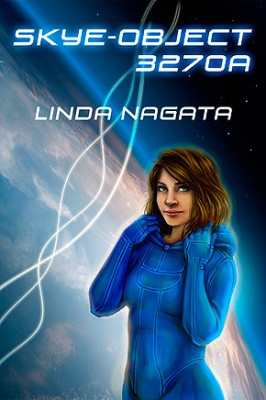
It’s not easy being a teenager in the orbital colony of Silk–especially when all the adults are functionally immortal and anyone under one hundred is considered an adolescent. To make matters worse, Skye fell to the city in an escape pod when she was just a baby, with no idea who she is, where she’s from, or how long she was drifting in space.
Fortunately, she’s a tough girl with several close friends and a determined spirit. One way or another, she’ll find out where she’s from–and whether there are any of her people still out there.
I thoroughly enjoyed this book. It combined the best of both science fiction and young adult: likeable teenage characters struggling to find their place in a high-tech alien world. In particular, I found it fascinating how the widespread nanotech shaped both the society and the universe.
But the story isn’t about the technology, it’s about the characters, their adventures, and the friendships that form between them. This was what really made the story come alive for me. There’s a small amount of wish fulfillment, which may or may not be your thing, but overall I found the characters to be both believable and likeable. It was a lot of fun to watch them grow and learn together.
At times, though, it felt as if the characters weren’t challenged enough. The friendship and relationship issues were well done, but it wasn’t until the end that they started to have any significant try-fail (or try-almost fail) cycles in their adventures. Also, while the ending was quite satisfying, it was also a little abrupt.
Those didn’t detract much from the rest of the story, though. Overall, I thought it was a very satisfying read–the sort of book I wish I’d found when I was twelve or thirteen. If I wasn’t already hooked on science fiction by that age, I have the feeling that this book would have turned me into a lifelong fan.
As a footnote, I’d like to add that this is EXACTLY the kind of book that indie publishing was made for. It’s a great story, but the science-fictional setting is so unconventional that most publishers wouldn’t take a chance on it. Even houses like Tor and Baen are focusing more on sub-genres like urban fantasy and military sf, which both have large, proven readerships. For something that’s a little more niche or experimental, it’s good to see that there’s still a way to get it out to readers who would love it.
So yeah–if you like young adult books and you’re not turned off by space elevators, nanobots, or alien planets, you should totally try out this book. I think it will surprise you just how much you enjoy it.
 Item One: Signed First Edition Hardcover Copy of Legend by David Gemmell