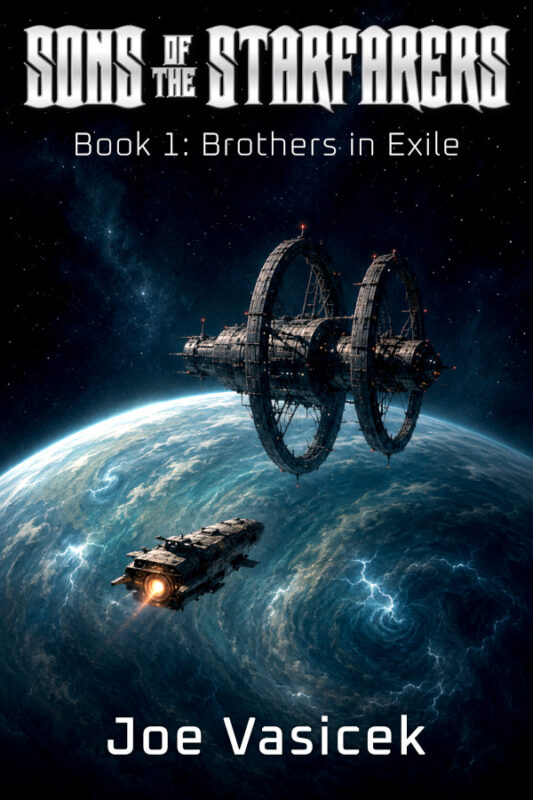
Brothers in Exile — excerpt 1

Something about the Nova Alnilam system felt wrong. Perhaps it was the silence that greeted Isaac and his brother as they exited jumpsace near the fifth planet. The deep blue ice giant world shone pale in the crystalline light of its sun, while all their commscans picked up nothing but empty static. For a planet that was supposed to have a mid-sized orbital colony of more than a thousand people, that was highly unusual.

“Alnilam Station,” he said, transmitting across all the major radio bands. “This is Isaac of the Medea, requesting docking permission. Do you copy?”

Silence. Isaac counted to five and glanced at his younger brother Aaron.

“I don’t think they’re picking us up,” he said. “How’s our orbital trajectory?”

“It’s coming, it’s coming,” said Aaron, his eyes practically fused to his display screen. “Just give me a second.” He brushed his unkempt brown hair out of the way and scratched at the patchy stubble on his chin.

Isaac sat back in his chair and mentally reviewed what they knew about the system. A class F star on the barely inhabited Outworld fringes of the south second quadrant, it lay almost six light-years from the nearest established settlement. The first colonists had arrived about a hundred and twenty standard years ago, but all the records since then were spotty and inconsistent. An obscure astrographical survey in the Gaian Imperial catalog showed that the system was rich in uranium and other radioactives, which if true would make it the perfect third leg in a trade route of the local stars. Few starfarers ever came out this way, though—for all Isaac knew, they were the first people to visit this colony in a generation.

==========

Brothers in Exile (Sons of the Starfarers, Book I) is coming out later this month. This excerpt is the opening scene, taken from the first chapter.

To be notified by email when it comes out, you can sign up for my mailing list hereBrothers in Exile is also listed on Goodreads, so feel free to add it to your to-read list. It doesn’t have a cover yet, but that should be coming out soon.

Thanks for reading!

Okay, back to work

Well, the Blogging from A to Z challenge was fun, but now that it’s May it’s time to switch gears and focus on other things. I’ve got about a bazillion projects going on, so it’s definitely going to be a full month! Here’s what I hope to accomplish:

Writing

  • Finish the first draft of Strangers in Flight (Sons of the Starfarers Book III).
  • Revise Comrades in Hope (Sons of the Starfarers Book II) and get it ready for publication.
  • Start writing Star Wanderers: Wanderlust (Part IX).

Publishing

  • Finish redoing the covers for the Star Wanderers ebooks.
  • Put all the Star Wanderers books on Google Play, All Romance eBooks, and DriveThru Fiction.
  • Typeset The Jeremiah Chronicles and Tales of the Far Outworlds for print.
  • Publish Brothers in Exile (Sons of the Starfarers Book I).
  • Finalize all the print editions for Star Wanderers I-VIII.

That’s pretty much it. Some of it, like redoing the Star Wanderers covers and putting those books up on Google Play and ARe shouldn’t take more than an afternoon. Others are going to take a lot more work to fully realize.

The thing I’m most excited (and nervous!) about is getting Sons of the Starfarers ready for publication. I’ve had an awesome time writing these books so far, and I think you’re really going to love them. Brothers in Exile is with my editor right now, and I’m working with a new cover designer to come up with some awesome cover art. If all goes well, it should be out by May 15th.

In the next few days, I’m going to post some short 250 word excerpts from Brothers in Exile to give you a taste. I’ve never tried something like this before, so let me know what you think! I’ll probably post the first one tonight.

Here’s the book description:

TO WAKE A LOST GIRL FROM THE ICE, TWO BROTHERS MUST FACE AN EMPIRE.

Deep in the Far Outworlds, a derelict space station holds the bones of a long-dead people—and a beautiful young woman locked in cryofreeze. When the star-wandering brothers Isaac and Aaron find the sleeping girl, they soon realize that they are her only hope for rescue. If they don’t take her, then slavers certainly will.

With no way to revive her, they set a course for the New Pleiades in the hopes of finding someone who can help. But a storm is brewing over that region of space. After a series of brutal civil wars, the Gaian Empire has turned its sights outward. A frontier war is on the verge of breaking out, and the brothers are about to be caught in the middle of it.

They both harbor a secret, though. Somewhere else in the Outworlds is another derelict station—one that they used to call home. That secret will either bind them together or draw them apart in

SONS OF THE STARFARERS
BOOK I: BROTHERS IN EXILE

Pretty cool, huh? Keep an eye on this space over the next few days for more!

Z is for Slaying the Zombie Memes of Publishing

Being an indie writer is awesome. Without a doubt, self-publishing is one of the best decisions I have ever made, and has enabled me to build exactly the kind of writing career I have always wanted.

So it frustrates me to no end when people in the publishing industry try to discourage new writers from self-publishing the way that I did. What’s worse, they often justify their advice with information that has been debunked or opinions that have been shown to be unfounded. These “zombie memes” keep coming back as if the act of repeating them is enough to make them true.

Some examples of these zombie memes include:

  • Self-publishing is a bubble.
  • Ebook growth is stalling and will soon decline.
  • Getting visibility as a self-published author is impossible.
  • Amazon is evil because _______.
  • Amazon is destroying literature.
  • Self-publishing is destroying literature.
  • ______ is destroying literature.
  • Publishers nurture writers.
  • Publishers are the guardians of literature.
  • Traditional publishers only publish high-quality books.
  • Self-published books are flooding the market with crap.
  • Only a handful of indie writers are making a living.
  • Self-publishers should not be called authors.
  • Ebooks shouldn’t be cheaper than print.
  • Publishing a book is harder than writing one.
  • Readers are reading the wrong books.
  • Publishers help authors navigate the digital world.
  • Agents help authors navigate the digital world.
  • There is nothing unethical about agents who act like publishers.
  • There is nothing unethical about standard publishing contracts.

Bullshit, all of it. Pure, unfiltered bullshit.

No matter how many times you kill these memes, they just refuse to die. Some people get a thrill at rehashing all the old arguments, but not me. I’d much rather leave the good fight to others, and quietly keep building my career while the naysayers all please themselves with the sound of their own voices.

Then again, perhaps that’s the key to slaying the zombie memes right there–successfully building your own career in spite of all the critics and naysayers. It’s a lot harder to believe all this crap when you see enough people succeeding in spite of it. The critical mass of indie writers is growing, and becoming a lot harder for the establishment to ignore.

This month, I sold over 700 books. I’m making enough on my books now that I don’t need a full-time or even a part-time job–writing is what I do full-time now. It’s still touch-and-go from month to month, but I’m living the dream, and because of the opportunities made possible by self-publishing, I have every confidence that I will continue to live that dream until the day I die.

The best way to slay a zombie meme is to create a competing meme that speaks even louder. That’s exactly what we in the indie movement are doing. And one day, when the zombie memes are finally dead for good, ours will be alive and thriving. It’s a new world of publishing, and never a better time to be a writer.

Y is for Yog’s Law

Anyone who was trying to break into publishing before the ebook revolution should be familiar with Yog’s law, which states:

Money should always flow toward the writer.

The purpose of the law was to keep new writers from falling into one of the many writing scams. Places that charged writers to publish were almost all vanity presses, and those that weren’t didn’t give writers access to the distribution channels necessary to make their work widely available. If you wanted to have a career, you had to go with a publisher, and the best way to tell if a publisher was legitimate was to look at how the money flowed.

Nowadays, with self-publishing, the line between writer and publisher has been blurred. An indie writer can expect to contract out work, sometimes to the tune of several hundred or even thousand dollars, in order to produce a professional product. In these cases, money clearly is not flowing to the writer. So what does this mean for Yog’s Law?

Some people have attempted to reformulate Yog’s law by drawing a distinction between the writing side of the business and the publishing side. While I think that that’s instructive, I’m not convinced it’s entirely useful. The distinction is not always clear, and even where it is, in practical terms it’s basically meaningless. You can just as easily fall for a publishing scam with your publisher hat on as with your writer hat.

So is Yog’s Law obsolete? Is it a curious relic of a publishing era that is passing into the twilight of history? In its old formulation, perhaps, but I would like to propose a new formulation that is perhaps even more relevant to today’s publishing industry than the old one ever was. That formulation is as follows:

Control should always flow toward the writer.

In the old days of publishing, writers had virtually no control over their careers. Publishers decided which books would make it to readers, which writers would get the attention of the publishing establishment, and how many books those writers could publish in a year. Authors had almost no say in their cover art, marketing, or any other aspect of the production and distribution of their work. In such an environment, the only assurance they had that their publisher would do a reasonably competent job was by seeing whether they put their money where their mouth was–hence Yog’s Law.

But today, writers do have control. We have a variety of publishing options today, and money isn’t the only factor in determining whether a path is legitimate. In fact, it may be one of the worst factors. Not only have advances gotten worse in the last few years, but the rights grabs have gotten so bad that signing a traditional book deal today basically amounts to selling your birthright for a mess of pottage. Yes, money is flowing to the writer, but the writer is still getting screwed.

Control means being able to have the final say on the cover art, the editing, or on an other aspect of a book’s production. It means that important stuff like the metadata or book description is not left to an entry-level employee that the author has never met.

Control means that no contract should be one-sided. It means an end to non-compete clauses of any kind. It means that rights reversions should actually have meaning, and that no book should be tied up for the life of copyright.

Control means that the bulk of the revenue should go to the person who does the bulk of the work. Bringing a book to market is not a challenge in the digital age, but writing a book certainly is. Publishers exist to serve writers, not the other way around.

Control means that a writer should know exactly what services they are paying for. If they commission work from a freelance editor or cover designer, they should be the one who directs that work, not a third-party who doesn’t also assume some of the risk if the project doesn’t work out.

By the standard of control flowing to the writer, most of the contracts coming out of New York fail miserably. That is not acceptable in an age where the New York publishers aren’t the only game in town. If a writer can make a living by going it on their own, then anyone who pays less than a living wage is basically running a scam.

Control should always flow toward the writer. Money used to serve as a proxy for control, but now that we have the real thing it’s no longer the best measure. Control, not money, is what you need to build a career.

A few quick updates

So I thought I would post the Y post today for the A to Z challenge, but I didn’t get around to it so it looks like I’ll be doing Y and Z tomorrow. And yes, I know that “expectations” was a cop-out for X, but hey, at least I didn’t spell it “x-pectations.”

As far as other stuff goes, I’m still at work on Sons of the Starfarers, though I’ve been doing a lot more publishing stuff than writing stuff recently, mostly proofing and formatting. Once the second batch of covers for Star Wanderers comes in, I’ll take an afternoon off to update the rest of that series.

It’s nice to have someone else doing the cover art for you, though it’s still very collaborative since you have to approve everything and give feedback for tweaks. Still, these cover designers are doing a much better job than I could on my own.

Speaking of Star Wanderers, I’ve been getting a lot of reviews lately from people saying that they’re disappointed the series is over and wishing that it could continue. Well, be careful what you ask for, because you just might get it! I already mentioned that I’ve been thinking about writing a full-length novel, but I’ve also got some ideas for additional parts with some of the other characters.

Right now, I’m working on Strangers in Flight (Sons of the Starfarers Book III), but I should be finished with that one in May, with an open schedule for a couple months. That should be time enough to write Star Wanderers: Wanderlust (Part IX). I sketched out a couple of scenes for this one last year, but I think I’m going to toss those and start with something new. In particular, I have a great idea for an opening scene with Samson and Heloise (yes, Samson is going to be the star of this one. The title “wanderlust” should have given that away, lol).

Beyond that, it would be interesting to write a story from Captain Elijah’s point of view, and another from Master Korha’s. I suppose it would even be interesting to write a story from Salome’s perspective, though that would be a tough one. If I’m going to expand the Star Wanderers series, I’m going to write at least another four books, so if you guys have suggestions for characters to bring back, let me know.

That’s just about it for now. There are other projects I plan to work on, but Sons of the Starfarers and Star Wanderers should take up most of my focus for the next few months. Hopefully that means I can get the books out to you faster! I’ll certainly do my best.

X is for Expectations

What sort of expectations should or shouldn’t you have when you start self-publishing? What is plausible, and what is unrealistic?

Honestly, it’s probably a good idea to go into it with expectations that are fairly low. Most books don’t sell more than a handful of copies, and there’s no way to tell what will and will not take off (if there was, publishing would be a whole lot more lucrative). There’s nothing wrong with dreaming, but it will save yourself a lot of trouble and heartbreak (not to mention, money) if you go in expecting things to be kind of rough for the first few years.

When I started out with “Memoirs of a Snowflake” and a couple of other shorts, they didn’t hardly sell at all. Then I published Genesis Earth, and while I saw maybe 50 sales in the first three months, after that they fell off to single digits for the next two years (and yes, zero is a digit). I made my shorts free for a while, and they got tens of thousands of downloads, but that didn’t really translate into sales.

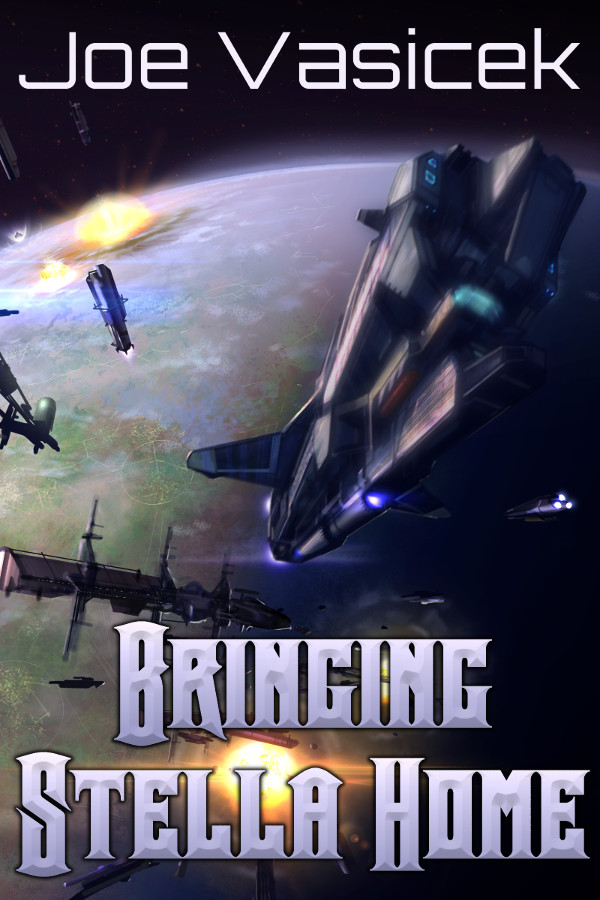
I didn’t expect to be a runaway bestseller right out of the gate, so I wasn’t too disappointed, but still it was kind of a blow. It was worse when Bringing Stella Home only got about ten sales in its first month before falling off to single digits just like Genesis Earth. I suppose things could have gone differently if I’d promoted a bit more aggressively, but that seemed like such a crap shoot that I channeled that energy into writing instead.

And it paid off eventually. When Star Wanderers took off, it generated some interest in all of my other books–not as much as I was expecting, but enough to bring them up to double digits every other month or so. My Star Wanderers books are all selling in the double and triple digits, and I couldn’t tell you why other than that the story just seems to strike the right chord with enough people. Those books would probably be doing better if I promoted them more, and since it looks considerably better than a crap shoot now, that’s something that I plan to be more aggressive about.

I think there’s an important difference between dreams and expectations. Dreams can suffer through setbacks considerably better, and help to maintain a sense of optimism that is perhaps one of the most important things an indie writer can have. Expectations, though, are much more practical and down to Earth, and can provide a useful yardstick for measuring progress. They can also provide an anchor in the face of uncertainty. Those are important things for an indie writer to have as well.

Expectations can be negative, though. If you don’t expect a book to do well, then perhaps you won’t put as much effort into it, sabotaging and self-rejecting your own work to the point where it really can’t do well. If you expect a book that hasn’t been selling at all to continue not to sell, you may lose sight of important opportunities to put it in front of the people who are most likely to fall in love with it.

Every genre is different, every book is different, and every writer is different. Because of this, no one can tell you exactly what to expect–including me. Like me, you might be stuck making nothing but pizza money for the first two years–or your books might take off fantastically well right from the start. There’s no way to know what will happen until you get your feet wet.

Next A to Z post tomorrow

Sorry, no A to Z Challenge post today. I moved to a new apartment, and when I wasn’t moving I was spending time with my girlfriend … so yeah, not a great day for productivity. On the plus side, though, Lindsey Stirling’s new album just came out, and it’s pretty dang awesome.

Did I mention that I have ADHD? About that

Don’t worry, I’ve got topics for X and Y, and they’re both good ones. But for now, I think I’m going to go sleep in a private bedroom for the first time in over a year.

W is for Writing the Next One

If you want to make a living as a writer, you’ve got to write a lot of books. One book is not sufficient to make a career, unless you’re the exception that proves the rule. But that’s okay, because writing is probably the thing that made you want to do this as a career in the first place. I mean, if writing is the thing that you love, wouldn’t you jump at the chance to do it more?

Sadly, I think a lot of writers put way too much pressure on themselves to produce the next book, and too often that takes all the fun out of the writing process itself, turning it into a miserable slog. I’ve certainly been there myself, and I have to say, the whole thing was just ridiculous. As soon as I regained my own confidence, I abandoned all those silly rules and metrics and just decided to write my own way, no matter whether it was right or not.

I used to keep a detailed spreadsheet where I tracked my daily word count, making all these pretty graphs to show how much work I was producing. Then I went overseas for a year, and the stress of living abroad made it difficult to keep up.

I found myself writing or revising stuff just to boost my word count, and abandoning projects at the first sign of a snag just because I knew that if I didn’t keep my momentum, the stresses of living in a foreign country would force me to take a break. It actually threw me into a funk for a while–not because I wasn’t creating stories, but because I wasn’t keeping my word counts.

So I decided to toss all that stuff out the window, and in the last 2-3 weeks before I went home for the summer, I wrote Star Wanderers: Dreamweaver (Part V) from start to finish. Once the pressure was gone, the story practically wrote itself.

Some writers thrive on external pressures like word counts, timers, and the like. Others think that they thrive, but they really don’t. They cling to writing rules and writing metrics out of habit, or because they’re familiar, or because someone with more experience told them that they should. The truth, though, is that every writer is different, and what works to keep one motivated might just get in the way of another.

It can change over the course of your career, too. The chief advantage of using these metrics is that it gives you a sense of progress, which can buoy you up substantially when you’re first starting out. It can be a real challenge getting through your first novel, or even your second or third, so having a way to measure your day-to-day work can be extremely helpful. But after you’ve written a few books and gotten your feet underneath you, those metrics can get in the way, especially if they make you feel guilty.

Of all the kinds of guilt out there, writerly guilt is probably the stupidest. There is nothing immoral or taboo about not hitting your daily word count. It does not make you a bad person or violate the laws of the universe. Why would you put that burden on yourself? It’s not like anyone else is putting it on you. Life is too short to beat yourself up for not writing.

Instead, learn to channel all the things that make writing fun. It can be, after all–that’s how we all got started in the first place! If you can learn to capture the thing that makes writing fun for you, and not lose sight of that, then even when the going gets tough and the writing becomes a slog, you can still get through it and come out with something that you feel proud of.

Not every part of the writing process is fun, just like not every process of climbing a mountain is fun. But taken as a whole, it’s exhilarating and awesome. I mean, check out this video of these two guys climbing Shkhara, the highest mountain in Georgia. There were moments in that expedition that were tough, but the challenge only made it more worthwhile. It’s the same with writing.

I love writing. I want to write more than a hundred books before I die, and I’m already well on my way. Writing an awesome story is its own reward, even though there are many other rewards that often come afterward. Having people read and enjoy your stories is the greatest reward of all, and it more than pays for all of the hard parts that come before.

On an episode of Writing Excuses, Tracy Hickman once said that no matter how many books you write, it’s important to believe that you haven’t written your best book yet. I’ve definitely found that to be true. That’s not to discourage you that the stuff that you’ve written is bad, but to encourage you that your next one will be even better. And more often than not, it will!

V is for Vanity Presses

There is a HUGE, HUGE difference between self-publishing as an indie and publishing through a vanity press. So huge, in fact, that the two are not even comparable. An indie author is a professional and an entrepreneur. A vanity press author is a victim of a scam.

A “vanity press” is a publishing company that caters to the vanity of anyone who wants to see their name on the cover of a book. They make their money not by selling books, but by selling overpriced services to naive and starry-eyed writers. If you have any self-respect at all, you should stay as far away from these companies as possible.

I am not an expert on vanity presses by any means, but here are some things that strike me as red flags that a company might be one:

  • They claim to be a “self-publishing” company (an oxymoron if there ever was one).
  • They use the phrase “published author” anywhere in their sales pitch.
  • They offer to publish your book on Amazon (you can publish your own book on Amazon).
  • They offer a “publishing package” that costs upwards of a thousand dollars.
  • They offer a “marketing package” that costs even more.
  • They require you to pay for your own editing and/or cover.
  • They have any sort of affiliation with Author Solutions.
  • David Gaughran has written a blog post lambasting them.
  • They require you to buy X number of print copies.
  • Their sales representatives won’t stop calling you.
  • They claim that they can get your book on Oprah.
  • They claim that they can get J.K. Rowling to review your book.

This is by no means a comprehensive list. If you have any to add, please do so.

The scary thing is that the big-name legacy publishers are not only in bed with these crooks, they’re openly fornicating with them. When Penguin Random House bought out Author Solutions, the largest and arguably the dirties vanity press in existence, they did nothing to clean up the company–in fact, they gave Author Solutions CEO Kevin Weiss a seat on the board! And other legacy publishers like Simon & Schuster responded by contracting with Author Solutions subsidiaries like Archway to do exactly the same way.

Vanity presses are scams. They exist to exploit the dreams and vulnerabilities of new writers, robbing them of their money and their dignity. They are extremely good at giving themselves the appearance of legitimacy, which has been made all the easier by the fact that the traditional publishing establishment has embraced them. You will find them at large publishing expos like Books Expo America. You will find favorable articles about them in venerable trade publications like Publisher’s Weekly. Their poison has infected the very heart of the legacy publishing industry.

At the heart of the indie publishing revolution is the idea that no one should come between writers and readers. Vanity presses violate that principle in every possible way–they are blood-sucking parasites with no respect for writers or for readers. For the sake of your career, for the sake of your books–hell, for the sake of your own self-respect–you should stay as far away from them as possible.

U is for Uncertainty

There’s a lot of uncertainty that comes with being a working writer. I’m caught up in the middle of it right now as I get ready to launch a new series, and it’s enough to drive me crazy.

First of all, I’m not sure whether this new series, Sons of the Starfarers, will do well or whether it will flop. It’s a spin-off series from my Star Wanderers books, but the story is very different–much more action/adventure, whereas Star Wanderers is more of a sci-fi romance. I hope that my readers will eat up both of them, but until I actually hit “publish,” there’s no way to know.

The uncertainty is harder for me to deal with because the stakes are a lot higher. When I published Star Wanderers, I did so on a shoestring budget as a sort of side project that I didn’t think would take off. For Sons of the Starfarers, though, I’m going all in, commissioning a cover designer and hiring a professional editor. I don’t anticipate the production costs to go much higher than $300 per book, but there’s going to be nine books at least. Those costs add up rather quickly, and at $2.99 it’s may take a while for these books to earn back their costs.

Still, the stakes could be much higher. I’m a young single guy with no dependents, living on his own in a rather inexpensive part of the United States. My health is good and I’m fortunate enough to have graduated college without any debt. At this stage in my life, I’m in a really good position to take some calculated risks. Pursuing this writing career has definitely been one of them, and so far, it’s paid off about as well as I could have hoped.

But things would be very, very different if I had a wife and kids to take care of. If it’s just me that I have to worry about, I’m perfectly fine with taking risks and committing to projects that may fail spectacularly. But if there were a possibility that someone else could be hurt by my failures–someone I care very much about–I’d be a lot more worried.

At least the nice thing about being an indie writer is that you get your royalty checks like clockwork every month. I can look at my sales reports for March and know exactly how much money is going to come in in June. With legacy publishers, I hear it’s not unusual for royalties and advances to come four or five months late, or to be wildly off when they do come. That’s one uncertainty that I don’t have to worry about because I’m an indie.

Another uncertainty that I don’t have to worry about is that something out of my control in the production process will doom my book. I’m totally in control of my book’s production–if the cover art sucks, I may have to scrounge up a couple hundred bucks to hire a new cover designer, but I can do that without having to worry about my publisher ignoring my concerns. There may be a lot of uncertainty, but as an indie there’s also a lot of flexibility and control.

Uncertainty is a fact of life, whether or not you’re a career writer. Generally, though, where there’s more uncertainty, there’s also more opportunity. When I took the plunge and became a self-published writer, I was under no illusion that my success would be guaranteed–but I also knew that the only limitations would be the ones I put on myself. And personally, I like it that way. The uncertainty might be enough to drive you crazy when you’re staring it in the face, but when the risks pay off, they pay off very well.

Hope for the best, plan for the worst. Follow the path of least regret.