What I would do if I were starting out now

In a word, short stories.

Write a bunch of short stories. One or two a week if possible. Keep that up for a year or two, tapering off at the end to transition into novels. But keep writing short stories even after novels have become the main focus.

Make a serious effort while writing short stories to master both the craft and the art of storytelling. View it as an apprenticeship period. Experiment. Try out new things. Join a writing group, preferably of experienced professional writers, and have them rip your stories apart. Soak up as much constructive feedback as possible, and apply it to the next story.

At the same time, don’t spend so much time reworking old stories that you aren’t producing new ones. Learn how to keep a rigorous production schedule. If a story is totally broken, toss it out! Get to the point where you can hit 2k words consistently every day, and knock out a story at least every couple of weeks or so.

In a word, learn how to be prolific.

Experiment with standalones, but also build a couple of universes with recurring characters. Write a few series, both sequential and non-sequential. Focus especially on the non-sequential series, though—the ones where any story can be an entry point. Learn how to find the sweet spot between writing a satisfying ending and leaving a hook for the next one. That sweet spot is different for every genre.

Submit every story you write to the traditional short story markets. Start with the highest paying markets and work your way down. Pay close attention to average response times on sites like the Grinder and don’t submit to any market with an average response time of more than 30 days, no matter how high the pay rate. The goal is to get each story through all of the pro- and semi-pro markets in about a year. If a market can’t get back to you in a timely fashion, it’s not worth your time. Ideally, you want to be receiving multiple rejections every day.

Once you’ve got about twenty or so stories that have come off of submission, start self-publishing.

Use the first couple of stories to learn how the process works. Figure out how to format, do cover work, and write up all the metadata on your own, then do all you can to streamline that process until it becomes automatic. You can outsource some of the more difficult stuff, but learn to do as much as you can on your own. Don’t spend more than about $50 per story to publish it, preferably more like $30.

Once you’ve got a process down, set a rigorous release schedule of 2 stories per month. Keep to that schedule religiously. Don’t worry too much how the stories are selling: they probably won’t sell well until you’ve got a couple dozen or so out. Just focus on getting them out.

Keep an email list, with links to subscribe in the front and back of all your books. Build that list as much as you can. Most of your early marketing efforts should go to building that list, and cultivating a relationship with the people on it. Don’t rely on Facebook, because you don’t own that site and can’t control it. Same with any other social media. Do all you can to bring your readers to a place you control.

Start blogging. Build relationships with other bloggers. Strive to post something new every day. Make it the kind of site that your readers will want to come to. Be sure to have pages for all of your books, as well as a series page that lists every story in every series, in chronological and written order (side note: I really need to write up a series page).

Experiment with free pulsing and price pulsing. Experiment with price points. Experiment with bundles. Experiment with everything.

ORGANIZE YOUR DATA. Ohmygosh. You’re going to be drowning in data after just a few months. Keep all of your sales reports, and compile all that into spreadsheets showing how many sales you got of each title each month, how much you earned from each title each month, etc. Data, data, data! Learn how to thrive with data!

Write a formal business plan, and update it constantly as you go. Write down all the strategies that work, as well as the ones that don’t. Write down all the strategies you want to try out. In case it wasn’t obvious, write down your release schedule. Write down your to do list, organized by urgent / not urgent and important / not important quadrants. Write down everything. WRITE IT DOWN.

Eventually, you’ll get to the point where you’re releasing bundles alongside or even in place of your short stories. Don’t unpublish anything. Maybe update the covers, if you decide your early ones are really really bad. But don’t worry about it too much. Just focus on being as prolific as possible.

As long as you keep moving, you’re going to get somewhere. So always keep moving. Even when you have a disappointing sales month, or a spat of bad reviews, or whatever, just keep moving. Even if you’re moving in the wrong direction, that’s better than not moving at all.

At some point, you’re going to start to see some success. You may even have a breakthrough. At that point, you can start moving on to novels. Hopefully you’ve written a couple of them by now. Your first one is probably utter crap, so toss it out and focus on the good ones.

Hopefully, you’ve written it in the same universe as a bunch of your short stories. That will make the marketing easier, but its not strictly necessary so don’t worry about it too much if you haven’t. Also don’t worry too much if the novel isn’t in a series of its own. It’s better if it is, but standalones have their place too.

Try to write in trilogies, or to write standalones that can easily be turned into trilogies. The first book should stand on its own, the second should end on a low note and hook into the third book, and the third book should blow the reader’s mind away. Brandon Sanderson’s Mistborn series is a great example of this.

If your career hasn’t taken off by now, you aren’t experimenting enough. That, or you’re cutting too many corners. One way or another, you’re going to have to put in the work.

That’s pretty much it. Have fun!

Thoughts on Wonder Woman

This isn’t going to be a review so much as a reaction post, though I’ll do my best to make it spoiler-free for those of you who haven’t seen the movie yet. Can’t guarantee that, though.

Short version: I liked it! Longer version: I liked it, with some caveats.

Marvel seems to do plot and characters better, especially over multiple movies. DC, on the other hand, specializes in explosions and emotional… stuff. Lots of emotional stuff.

This cartoon sums it up quite well:

By far, the weakest part of Wonder Woman was the plot. Whenever there was something that strained credulity, it invariably had to do with a missing beat or plot point, or something that wasn’t foreshadowed properly, etc.

That said, the universe itself was actually pretty coherent. And there were some interesting twists. And the plot, for all its holes, was still strong enough to hold the movie together. And the explosions were pretty cool.

By far, though, the best part of the movie was Gal Gadot.

Have you ever seen someone who was so incredibly gorgeous that they made you rethink everything you thought you knew about beauty? Normally when that happens, it takes a couple of minutes for your mind to recalibrate and for everything to return to normal. With Gal Gadot, my mind failed to recalibrate. The whole movie, I couldn’t stop thinking how gorgeous she is.

It was pretty cool. And when I say “gorgeous,” I don’t just mean sex appeal. True beauty is about so much more than that: poise, elegance, confidence, etc. She’s not a bad actress either. No wonder the feminists over at Slate hate her—she’s basically their Harrison Bergeron.

The movie also had a really good message: that people are capable of both good and evil, therefore it’s not about what we deserve, it’s about what we believe. Very empowering, and very different from all the sturm und drang we usually hear: identity politics, collective guilt, the original sin of “privilege,” and virtue signalling of the perpetually offended.

There was absolutely none of that in this movie. Just a strong female character trying to save the world while very much being a woman at the same time.

Things I Learned from Working in a Call Center (Blast from the Past: September 2010)

While poking around in the archives, I came across this interesting post from my first year out of college. At the time, I was just getting started in the labor force and wanted to learn as much from my jobs as I could—even the mundane ones. The result was this.


Over the summer I worked part time at a local call center.  At the time, it was just what I needed: a flexible job that helped me pay the bills while figuring out where I wanted to go next.  That said, I learned very quickly that call center work is not the sort of thing I want to do for large portions of my life.

I’m glad to say I quit my job on good terms with the management, and was one of their more productive interviewers.  I don’t harbor any hard feelings against the company I worked for or any of the particular employees.

However, I do want to reflect a bit on the nature of the work itself, which was less than awesome, as well as some of the things I learned about myself in the process.  Since this has nothing to do with the company I worked for, I’m not going to mention it by name.  Also keep in mind that the things I have to say are heavily influenced by my own opinions, so they may not apply to you.

That said, here are some of the things I learned from working in a call center:

1) In the long run, jerks only punish themselves.

I spoke with a lot of incredibly rude people in this job.  I also spoke with a lot of people who were courteous and well-meaning.  Without exception, the jerks seemed overstressed and miserable, while only the courteous people ever seemed genuinely happy and content with their lives.

I think the way we treat others says more about ourselves than anything else.  People who are mean and nasty to each other are never truly happy.

2) A small amount of patience makes most things go faster and smoother.

I hated it when people told me “just put ten for everything.” As an interviewer, I couldn’t do that—I was required to ask every question verbatim.  Those who were patient enough to let me do that got through the survey quickly and painlessly, while the impatient people who tried to rush things almost always got upset.

I think it’s safe to say that this has a general application as well.  When we’re patient enough to let things happen the way they’re supposed to, things happen faster and more smoothly.  When we try to rush things that shouldn’t be rushed, we screw up.

3) The ability to genuinely listen is a rare skill.

I can’t tell you how many times I asked a simple question on a survey, only to find the person on the other line answering something completely different.  I didn’t expect anyone to drop everything and devote their full attention to me, but how much effort does it take to answer a simple question?

I’ve known for a long time that listening is a skill that requires work to cultivate, but apparently, it’s also one that few people have truly mastered.  If you can’t understand a straightforward question well enough to give a yes or no answer, how can you understand something as complex as another person’s feelings?

4) Political campaigns are evil.

This is a little tongue in cheek, but I stand by it one hundred percent.  Every survey we conducted for a political campaign asked questions that were clearly geared toward developing negative campaign ads and manipulating public perception.  None of them asked how the government could best serve the people.

5) Having a flexible work schedule makes writing both easier and harder.

It makes it easier because you can plan your time around other things that are going on; it makes it harder because your days generally have less structure.

I think I hit a pretty good balance by working in the morning and writing in the afternoon, then going in to work again in the evenings if I needed the hours.  Call centers are always looking for people to work in the evenings.

6) Reducing everything to numbers makes human interactions meaningless.

This was, by far, the thing I found most frustrating about my work.  I talked with hundreds of people from all over the country and didn’t connect with hardly any of them on a personally significant level.  It was all about checking off boxes, where each completed survey was just another number in the system.

This tended to be more true of the short surveys, less true of the longer ones.  For that reason, I loved it when I got a survey that took twenty or thirty minutes to complete.  It’s very hard to talk with someone for thirty minutes without making some kind of a connection with them, however fleeting.

7) If you have a love of learning, find a job that lets you use your mind.

To be perfectly honest, I never felt completely satisfied at my work.  A robot with sufficiently advanced voice recognition software could probably have done my job as well as I could (at least for the ninety second surveys).  Over time, I felt like my work was turning me into a robot.

That’s ultimately why I felt I had to get out.  Maybe I have a problem with authority, but I can’t stand being just another cog in the corporate machine.  There’s got to be a way to pay the bills and still live life meaningfully.

Image courtesy W. Lowe

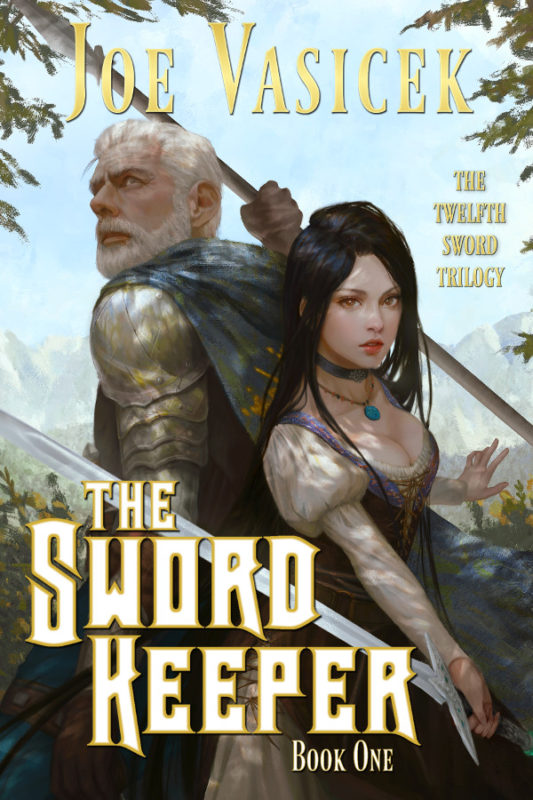
WIP excerpt: The Sword Keeper

At first, Tamuna felt as if she were falling through an abyss. Darkness surrounded her, so thick she could almost taste it.

Before she could panic, her fall slowed until she was floating in midair. Her feet touched water, and a deep sense of peace swept over her, the peace that one only feels in a dream. As the darkness cleared, she found herself swimming in a clear pool fed by a mountain spring. Rugged cliffs rose behind her, while a small stone chapel stood a short distance from the shore. An eagle cried out in the cloudless blue sky, momentarily breaking the solitary silence of the wilderness.

Where am I? Tamuna wondered. How did I come to this place? If this was a dream, it felt more real than any she’d ever experienced. The water was cool and refreshing, with a bed of fine gravel under her feet. There was no danger of drowning, though the pool was deep enough that she had to swim instead of walk. She was naked, of course, but that didn’t bother her. It would be silly to swim in her clothes.

She reached the edge of the pool and climbed onto a large rock. Snow-capped peaks lined the horizon in every direction, while virgin forests stretched out in the valleys below. The view was so stunning, it completely took her breath away. She’d heard of places like this, where the cattle herders took their cows in the summer and the hunters roamed in the winter. However, when she scanned the mountains on the horizon, none of them were familiar.

“Hello?” she shouted. “Can anyone hear me?” The echo came back a few seconds later, but only the wind answered her.

She shivered and rubbed her arms with her hands. The breeze was uncomfortably cool on her bare, wet skin, but fortunately the sun was rapidly drying her. She sat down on the rock and began to wring out her hair.

She noticed a small footpath nearby, leading to the stone chapel. A set of woolen clothes lay neatly folded at the head of the path, clearly meant for her. As soon as she was dry enough to dress herself, she climbed down from the rock and slipped the clothes over her body. They were thick and warm, perfectly suited for the mountains. The embroidery was red and gold on black in the style of the Khevsurans, with a recurring cross and circle motif. She took a few moments to admire her reflection in the lake before setting off down the path.

Like most mountain churches, this one was built in the shape of a cross, with tall, narrow windows and intricate patterns carved onto the exterior. The stones were crumbling, and a long crack ran down the wall through the highest window. From the outside, it seemed to be empty.

I’m alone, she thought silently. And yet somehow, she knew that wasn’t true. Ever since the darkness had lifted, she’d felt a presence nearby, waiting for her. It felt as if she were part of a story that she was living through instead of merely hearing about.

When she reached the front doors, they swung open of their own accord, revealing a vaulted chapel that was dark and empty. Aging marble tiles covered the floor, while the walls and pillars were hewn from rough-cut stone. A ray of light shone down from the cupola, illuminating the apse at the center.

And there, embedded in a slab of pure white marble, stood the sword.

Her breath caught in her throat. Once again, she felt the call of destiny compelling her forward. She covered her head with one of the shawls by the entrance and quietly stepped inside.

“Hello?” she said aloud. Though her voice was barely louder than a whisper, it carried throughout the sanctuary.

Tamuna, a voice spoke in her mind. She froze, her blood turning to ice. Was someone behind her? She glanced over her shoulder, but saw only shadows. Perhaps the wind was playing tricks with—

Tamuna, the voice spoke again, this time as clear as if she had heard it with her ears. She spun around, but again, she was alone.

As she turned back to the apse, the air immediately in front of her began to ripple like a mirage on a hot day. The sword seemed to morph and change, until she saw two images before her: the sword in the slab of marble, exactly as before, and a tall young man with golden hair and a carefully trimmed beard, wearing a silver coat of mail and the tunic of a warrior.

“Wh-who are you?” she asked, taking a step back. Something about his gaze held her, telling her there was no need to be afraid.

“Tamuna Leladze,” he said softly, looking at her with the barest hint of a smile. “Over a thousand years have passed since mortal eyes have seen this place, now in ruins in the world of men. Many have desired to wield me, but I have refused them all. I am Imeris, the twelfth and final sword, and this is my sanctuary.”

Tamuna frowned. “The twelfth sword?”

“Yes,” said the young man. His image faded until he was almost invisible, so that Tamuna found herself staring at the hilt of the sword in the marble slab. It called out to her the way it had in the tavern, and she realized that the man and the sword were the same.

“How did you know my name?”

“I know a lot about you, Tamuna,” said Imeris, coming back into view. “Our minds made contact the moment you laid eyes on me. I know how your heart longs for adventure, how you dream of faraway lands. And yet, your unshakeable loyalty to the few close and lasting friends in your life keeps you rooted to your home.”

“You can read my mind, then?”

“Only because you are too innocent to know how to shut me out. What I read in your mind, others can easily read in your countenance.”

Tamuna gazed into Imeris’s eyes and felt as if she were staring into a mirror back through centuries of time. And yet, he looked like a man only a few years older than her.

“Why have you brought me here?” she asked.

“Do you see the inscription written on the floor beneath your feet?”

Tamuna looked down and saw an inscription, written in old, faded letters in the marble floor. She squinted and tried to make them out, but the writing was too ancient for her to read.

“What is it?”

“It is an ancient prophecy, pronounced on the day when I was forged.”

“What does it say?”

“It says: This sword IMERIS, though last to be forged, certainly shall not be the least. For in the days when the order is broken and darkness sweeps across the face of the land, it shall await the one who will wield it in truth and wisdom to free the world of men.” He paused, looking her in the eye. “You are the one of whom the prophecy speaks, Tamuna. You are the one whom I have chosen.”

A crack of thunder sounded in the distance, sending chills down Tamuna’s spine. For a brief moment, a cloud overshadowed the sun, throwing the chapel into shadow. Imeris looked up and frowned.

“There isn’t much time,” he said. “The enemy is nearly here. They will seek to destroy us.”

“D-destroy us?” said Tamuna, her knees going weak. “There must be some mistake. I can’t possibly be the one you’re looking for. I’m just a tavern girl!”

Imeris looked at her long and hard, making her flinch. “There is no mistake, Tamuna. I recognized you the moment your mind reached out to my own.”

Her cheeks paled. “But…”

“Of course, you must take me up of your own free will if you take me up at all. If you so choose, you may leave this place by returning to the pool. Once you are submerged, you will return to your home.”

Tamuna nodded in relief. So there is a way out, she thought to herself. This doesn’t have to be my destiny. But even though the realization eased her somewhat, she couldn’t shake the feeling that to do so would be a mistake.

“What about the prophecy?” she asked. “If I reject you, will you find someone else?”

Imeris shrugged sadly and looked off into the distance. “Perhaps,” he said as he faded from her view. “Perhaps not.”

She hesitated a moment, alone now with just the sword. Once again, she felt it calling out to her, though this time, her thoughts were much clearer. You must take me up of your own free will, Imeris’s words came back to her. Another crack of thunder sounded in the distance, breaking the silence that had fallen with his departure.

I can’t do this, she told herself. This isn’t for me—I shouldn’t get involved.

As she walked back outside, her feet felt strangely heavy. A part of her longed to run back to the church and draw the sword out of the marble, just for the chance to experience an adventure. But of course, that wouldn’t be right. She couldn’t just leave Sopiko like that, after all that her aunt had done for her.

She reached the water’s edge, but hesitated before climbing in. A cool wind whistled over her skin, making the reeds dance and tossing back her long black hair. The surface of the water rippled, while a mass of giant thunderheads towered in the sky. She shivered, and not just from the cold. Lightning flashed in the valley, and a shadow darker than any she’d ever seen raced across the forests toward the mountaintops. There was a presence in that shadow, something primal and dangerous that made chills shoot down her spine.

Thunder rolled across the land, giving her pause. What if Imeris was right—what if she was the one from the prophecy? And if she was, then what would happen if she didn’t follow through?

The thunderheads towered high above her now, blocking the sun, and a stiff wind blasted the lake and flattened the golden-brown grass. Something evil was in that storm. Her heart raced, and she knew that she had to turn back.

She ran to the mountain church as fast as her feet would take her. Her breath came in short bursts, and her heart pounded furiously in her chest. She sprinted through the open doorway and ran to the sword in the marble slab.

“Imeris!” she shouted, gasping for breath. “Imeris, where are you?”

The sword called out to her, just as it had in the tavern. This time, she didn’t hesitate. As the sunlight turned to darkness, she gripped the handle and pulled with as much strength as she could muster. Thunder cracked directly overhead, and the sword came free with a metallic hum.

And then she was falling again through the abyss, tumbling as if a crack in the earth had swallowed her.

Happiness is always a choice, take 2

CGP Grey made an awesome video last week, which should come as a surprise to nobody, but this one is exceptional even by CGP Grey’s standards. In it, he borrows some of Doctor Randy J. Paterson’s work in How to Be Miserable: 40 Strategies You Already Use and gives us a seven step program on how to be miserable. Those steps are:

  1. Stay still.
  2. Screw with your sleep.
  3. Maximize your screen time.
  4. Use your screen to stoke your negative emotions.
  5. Set vapid goals.
  6. Pursue happiness directly.
  7. Follow your instincts.

Since this basically describes 80% of people on the internet at any given time, it comes as no surprise that the video soon went mega-viral.

Generally, I think most of CGP Grey’s anti-advice is spot on. However, there is one part that I disagree with rather strongly. It’s the part where he says:

True happiness is like a bird that might land on your ship, but never if you constantly stand guard to catch him. Instead, improve your ship and sail into warmer waters. The bird will land when you aren’t looking.

Happiness is not a bird that comes and goes as it pleases, without any input from you. Instead, it is a decision you make on how you will respond to things outside of your control.

In other words, happiness is always a choice.

A while ago, I wrote a blog post on the subject. In it, I said:

There are only two classes of things in this world: things that act, and things that are acted upon. Empowerment is when you give somebody the ability to act for themselves, independent of outside forces. Disempowerment is when you take that ability away.

There is nothing more empowering than to realize that no matter where you are in life—no matter how shitty your circumstances—you can always still choose to be happy.

Happiness is a feeling that only exists inside of you. It is not something external that is forced or bestowed upon you by outside forces. It is wholly internal to your heart and mind. It is a reaction to outside forces—a reaction that you choose to make.

If happiness is not a choice—if it is something over which we have no control—then we cannot have any control over any of our feelings. Our passions are external forces that act upon us, and we are powerless to stop them because our emotional development ended at age two.

Is there anything empowering or liberating about this philosophy? No. Quite the opposite. It debases mankind and makes us no better than the animals. It destroys our agency and makes us slaves to our passions.

Happiness is always a choice.

That said, I do think there’s some truth to CGP Grey’s bird analogy as well. Happiness is not like a bird, but joy, or enduring happiness, is.

Joy is a deeper form of happiness that comes as a result of hard work and accomplishment. We can’t decide to have joy without first putting in the effort. And even when we do put in the effort, there’s no guarantee that joy will be the result. There may be pain, or failure, or even tragedy.

But even as we seek to do the things that will bring us joy, we can choose to be happy along the way. Indeed, we must. If we don’t, we risk losing the hope that enables and empowers us to keep striving. Choosing to be happy, no matter the circumstances, is the first step toward finding joy.

However, it’s important to point out that this is not a cure for depression or mental illness, which are medical conditions and must be treated as such. Choosing to be happy will not cure your mental illness any more than smiling will cure diabetes.

So, perhaps not a major disagreement, but definitely a legitimate quibble. What are your thoughts?

Selected daily thoughts, January 2017

One of my resolutions this year is to keep a journal of daily thoughts. The inspiration for this was the Meditations of Marcus Aurelius, which I haven’t yet read, but the idea really struck me as a good one. I wouldn’t pretend to be as profound or as influential as the greatest emperor of Rome, but for myself and my posterity, it seems like a good project.

In any case, I thought I’d share some of the best thoughts here on this blog, starting with January. Let me know what you think!


January 1st

When the student is ready, a teacher will appear.

January 3rd

Patience is often the final key to success.

January 9th

We live in an age when a multi-billion dollar IP can grow from a bunch of notes scribbled on the back of a napkin by a waitress. It’s fantastic.

January 12th

Every able-bodied man of this Republic, who is of a sound mind, should possess a shotgun, a rifle, and a handgun, and should train regularly in their use.

January 17th

There are no villains or heroes, there are only people who do villainous or heroic things. —Ben Shapiro

January 19th

We never get rid of our problems. We only trade up or down for different ones.

January 21st

Liberty is easy to sell but difficult to buy. —Felix Torres

January 22nd

We are living in a world where our online perception of reality, crafted by social media, is more real to us than reality itself. Is it any wonder then that we no longer treat each other as people, but as commenters with meatspace avatars? Whenever we are online, we are also alone. It is impossible to go online “with” someone. Little wonder that society has become so fragmented.

January 23rd

You can’t plan a perfect day, but you can plan a great day and make it perfect.

January 25th

Humility is thinking less about yourself, not less of yourself. —Dieter F. Uchtdorf

January 29th

Power flows from the muzzle of someone else’s gun. It starts with the ability to inspire the hearts of men.

January 31st

We are all trapped in the prison of our own mind: our beliefs about what is and is not possible. We cannot achieve greatness until we first break out of that prison.

Write every day or quit now?

Hoo-boy, do a bunch of writers have their panties in a twist over this article. Who would have thought that the suggestion to “write every day” could be so triggering? Not just for aspiring writers, either, but for Hugo-award winning authors as well.

I’m being a jerk, of course. So is Stephen Hunter. But he isn’t wrong.

Writing is hard. Habits are automatic. Turn writing into a habit, and you’re much more likely to succeed. That’s it. That’s the whole message.

In particular, I really liked this part:

The most important thing is habit, not will.

If you feel you need will to get to the keyboard, you are in the wrong business. All that energy will leave nothing to work with. You have to make it like brushing your teeth, mundane, regular, boring even. It’s not a thing of effort, of want, of steely, heroic determination… You do it because it’s time.

Now, do I follow this advice? Do I write every day? No, but I probably should. It would certainly make life interruptions easier to deal with. I would probably finish a lot more books, too. Right now, I write almost every day, but there’s a very big difference between finding success and almost finding success.

As far as professional goals go, making writing into a daily habit is a pretty damn good one. Unless, of course, you’re just a professional victim and/or Twitter queen with a writing hobby. Which seems to be the case for a great many butthurt people.

And what if health, or circumstances, or whatever else prevent you from writing every day? What if just the title of the article throws you into fits of self-guilt? Remember that it’s free advice. It’s just an opinion. Take a deep breath and like it or leave it as you will.

Personally, I like it. It feels right. If writing were so habitual that I didn’t have to expend any willpower to do it, I could get so much other stuff done. Why would I want to do otherwise?

Great article. Check it out.

So it’s the beginning of June already, and it’s starting to feel like summer here in Iowa. Because it’s so flat, the sky stays light F O R E V E R, which is kind of neat. Lots more time to go on walks, which is where I work out plot points and other stuff.

Patriots in Retreat
Phase:2.0 Draft
100%

In any case, Patriots in Retreat (my current WIP) is coming along well. It’s turning out to be shorter than I’d expected; there’s only three chapters left, and it’s not quite 20k words. Will probably come in between 3ok and 25k, making it one of the shorter Sons of the Starfarers books.

Middles are tough, even for short novels. I have no idea if this draft is going to turn out clean or not. But I am trying to cycle through as I write, to minimize the number of drafts I need to do. If I can master that technique, I can double or triple my production.

The Sword Keeper is just about finished, only a few more touch-ups before I send it out to my editor. Need to get back in touch with him. We’re definitely still on track for a release this fall, and I’m super excited because I think this is one of the best books I’ve written. Look out for a WIP excerpt later on this week.

There’s a couple of short stories I really want to write, but I’m so swamped with the other stuff that I don’t know when I’ll be able to get to it. I’m not behind (yet) on my current WIP, but I need to keep a steady pace of just under 3k words to meet my deadline, which is going to take some effort.

I haven’t started writing Gunslinger to the Galaxy yet (the sequel to Gunslinger to the Stars)… well, that’s not quite true, because I have written the first line:

My name is Jane Kletchka, and I’m here to set the record straight.

…but in any case, I’m starting to get a bunch of great ideas for that one. Will probably start working on it sometime this fall.

Publishing-wise, I’ve got a ton of stuff to work on but not enough time to juggle it. Most of the stuff falling by the wayside is marketing stuff, which isn’t good, but sales seem to have picked up in the last month so hopefully that isn’t too much of a problem. Still waiting for some reviews to roll in for Gunslinger.

Major items on my publishing to do list include:

  • Write the author’s notes for “The Open Source Time Machine” single and short story bundle.
  • Compile the metadata for “The Open Source Time Machine” single and short story bundle.
  • Format and publish “The Open Source Time Machine” single and bundle.
  • Send The Sword Keeper to Josh Leavitt for editing.
  • Write the book description for The Sword Keeper.
  • Find a cover artist for The Sword Keeper.
  • Rewrite all short story descriptions.
  • Make a new cover for A Hill On Which To Die.
  • Upload all books to DriveThruFiction.

Not a small list—and that doesn’t include all the maintenance-type stuff!

So that’s the big challenge: making time for all of this while working the day job. It’s only 5-6 hours a day, but it adds up. I am saving money, though. My goal is to turn around at least $100 from my writing profits each month into investments. It would be really cool to start investing in space technologies, and the research for that could tie into my writing projects very well. Virtuous cycle and all that good stuff.

That’s what I’m up to these days. Peace, love, and penguins y’all. Thanks for reading!

Free & 99¢ books for June!

Hey guys, just a heads up about this month’s free and 99¢ books. If you’re looking for a way to get into my books, this is a great place to start!


Free

Nothing Found

99¢

Genesis Earth

Genesis Earth

$14.99eBook: free through August 14th!Audiobook: $4.99

Michael and Terra never thought that they would be the first human beings to set foot on an alien world. What they discover forces them to question their deepest beliefs about what it means to be human.

More info →