And that right there is the heart of the matter: mentors tend to die. And stay dead. Even if they do figure later in the story, they tend to be spirit advisors from the other side with little or no chance of coming back from the grave–even if everyone else does.
So why does this happen?
The most obvious reason is that if the mentor and the hero are both working toward the same goal, the mentor cannot overshadow the hero–otherwise, why not forget the hero and send the mentor off to save the world? The hero may start off weak, which is why he needs the mentor in the first place, but at some point in the growth arc, he’s going to have to stand on his own two feet. Oftentimes, the most poignant (and convenient) way to mark that transition is to knock the mentor off.
That doesn’t explain everything, though. If the only reason for killing the mentor is to give the hero a growth arc, you can accomplish that just as well by putting him on a bus. So why does he have to die?
Lots of reasons! Character growth, increasing tension, making the story more meaningful–the list goes on and on. For an in-depth discussion on killing off characters, I’d recommend checking out this last week’s episode of Writing Excuses. My own personal take is that everyone dies eventually–even the immortal characters have to pass through some sort of transition from this world to the next–so the best thing I can do for a character isn’t to keep them alive, but to make their lives and their deaths actually mean something.
It’s also worth pointing out that in most stories, the mentor isn’t actually fighting against the big bad, but the dragon–the big bad’s lancer. Again, the main reason for this is to keep him from overshadowing the hero. But the dragon is a character in his own right, with his own agenda that may run counter to his boss–think Darth Vader from Star Wars. And in a lot of stories, the dragon actually tries to tempt the hero to come around and join him.
Perhaps that’s another reason why mentors often die–if they didn’t, then the bad guys wouldn’t ever be able to dissuade the hero through temptation. The hero would be so protected that he’d never have the opportunity to switch sides, or at least he’d never have to face any moral ambiguity because of the guardian mentor constantly guiding him.
So those are some of the reasons why mentors tend to have a short life expectancy. Can you think of any good ones?
So last week was the first week of school here in Georgia, but before I blog about that, I thought I’d do a post on the short backpacking trip I did with a friend of mine the week before. It was a lot of fun, even if our plans did change about a dozen times along the way. That tends to happen a lot to plans here in Georgia, but if you’re flexible and can roll with it, you can have a lot of fun anyway.
So our original plan was to go from Baghdati to Sairme, a small resort town in the Lesser Caucasus range just south of Kutaisi, and from there catch a bus over the mountain and hike a few trails out in the western side of Borjomi National Park.
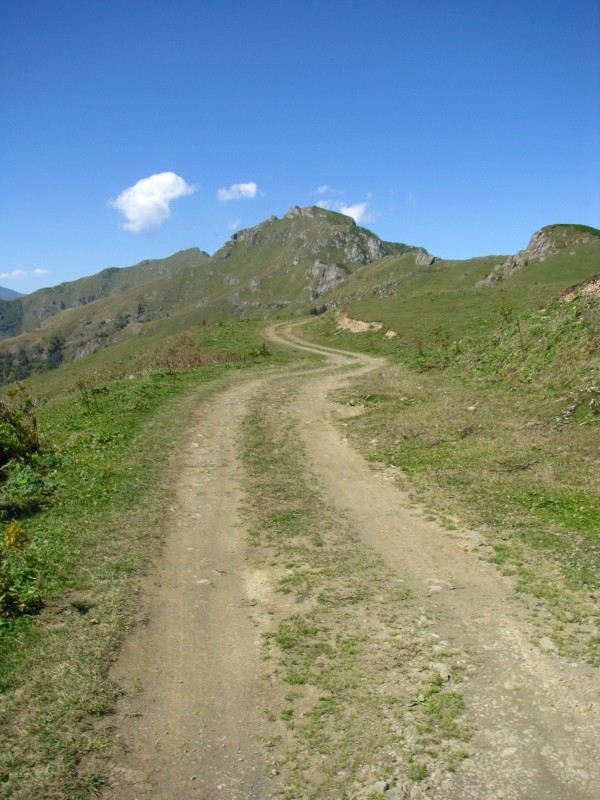
Well, when we got to Sairme, we found that there isn’t a bus that goes over that road, and for good reason. It isn’t exactly a “road”–more like an unusually wide dirt path. Farmers sometimes use it, but only because they’re local and it doesn’t make sense to go 80+ kilometers out of the way on the main route from Zestaponi to Surami.
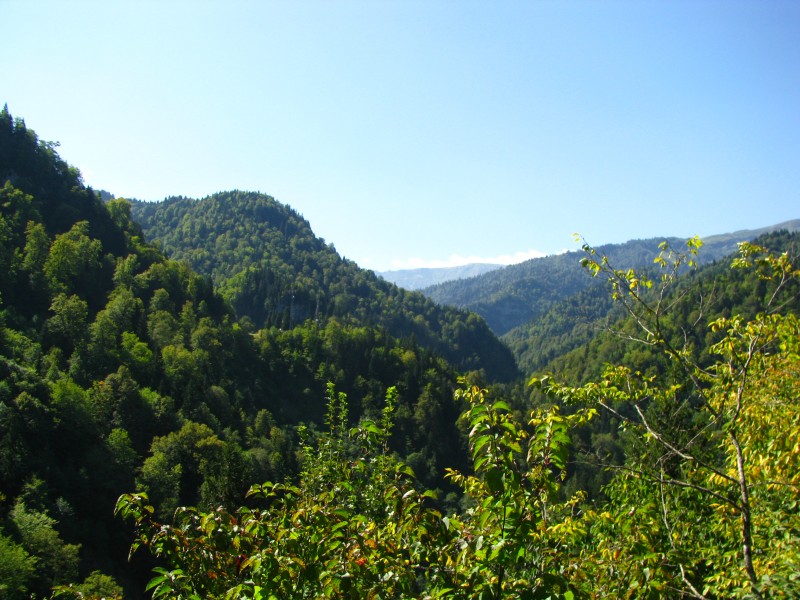
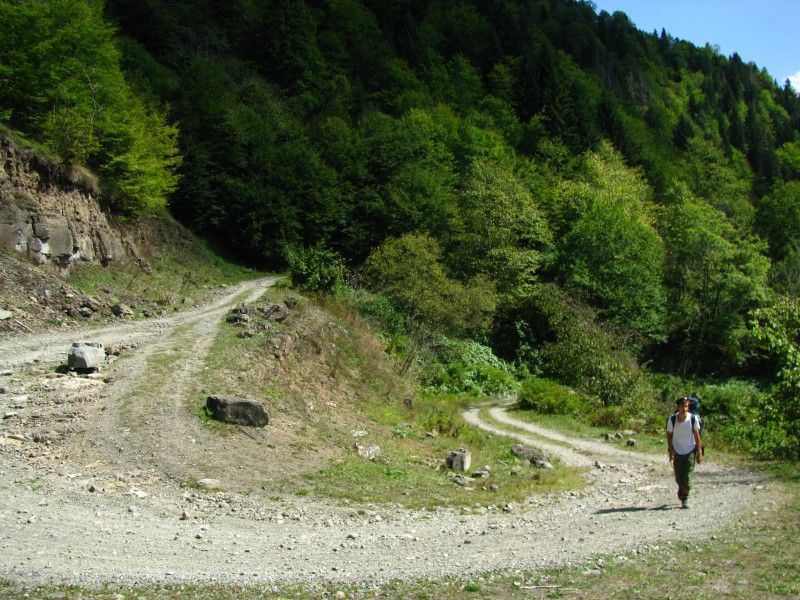
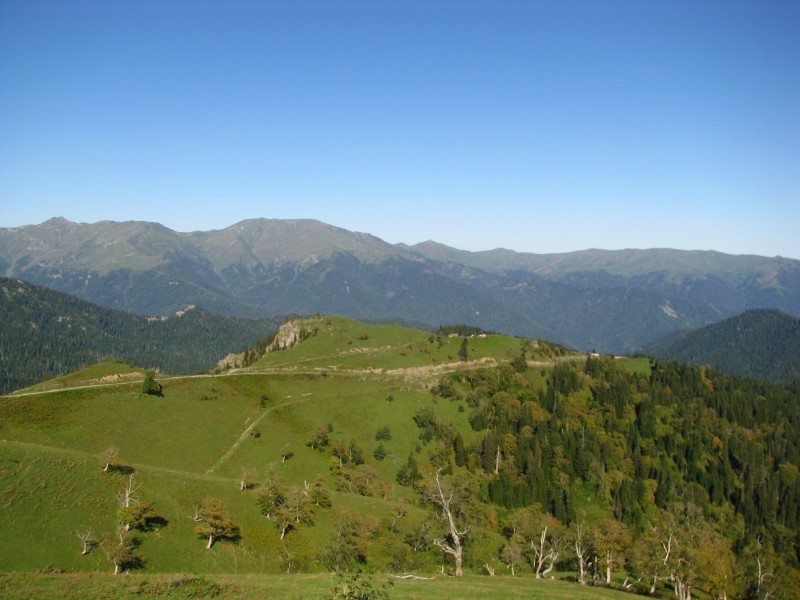
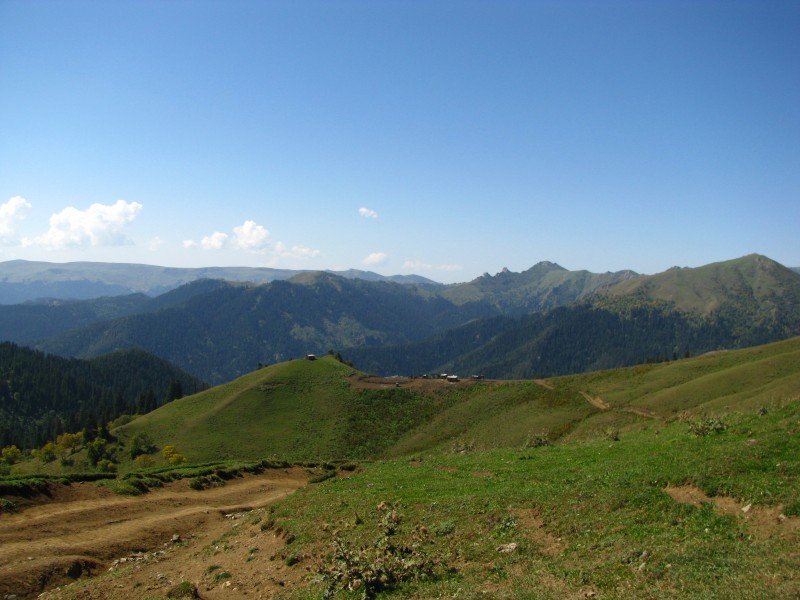
The mountains around Sairme.The “road” from Sairme to Abastumani.
The locals told us it was about 35 km to walk to Abastumani, so we figured “hey, we have food, sleeping bags, and a tent–why not hike it?” According to the map, if we left at 1pm and averaged 3 km/hr, we estimated we should reach the pass just around sunset.
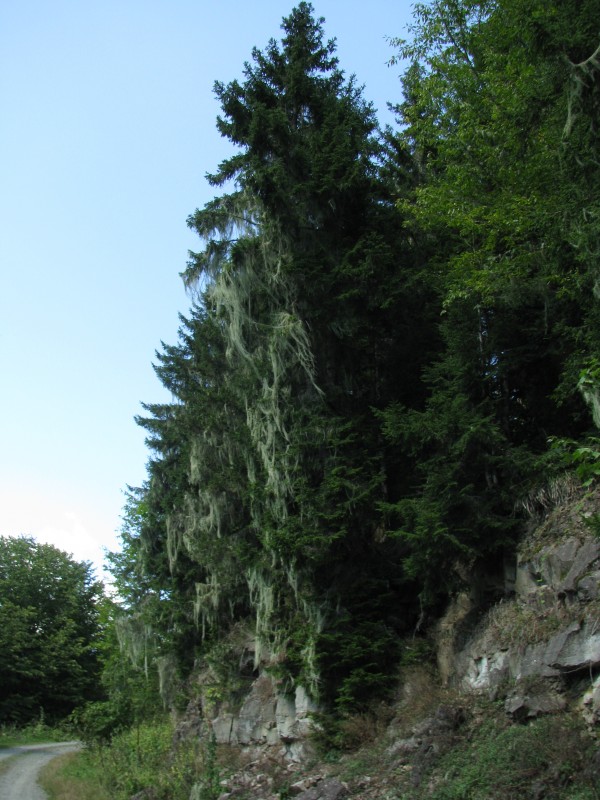
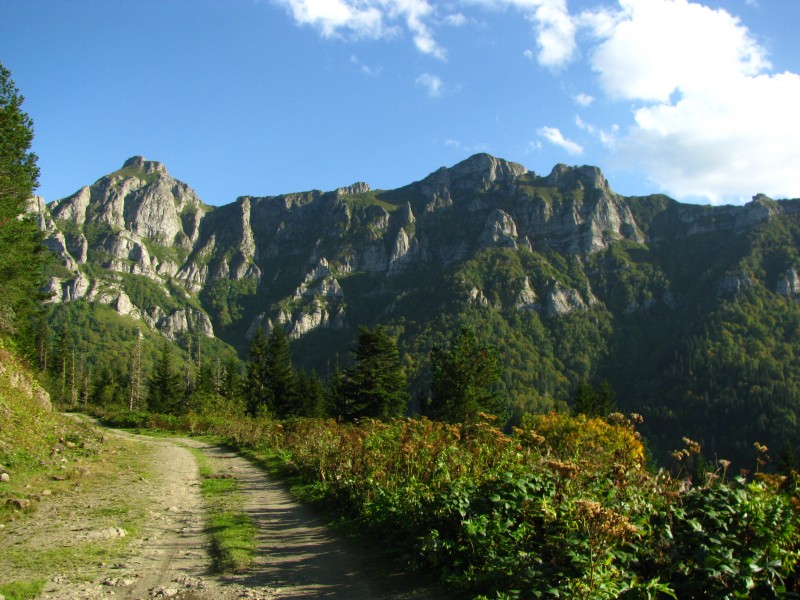
Some interesting moss around the 2,000 meter elevation mark.Mount Didmaghali, just above the treeline. We camped about two kilometers from here.
The calculations were fairly accurate; we hiked for about 6 hours, making about 18 kilometers on the first day and climbing around 1300 meters. In all that time, we only passed three vehicles, and they were all heading back to Sairme. One of them was carrying a bunch of guys who were so surprised to see us, they gave us a giant wheel of cheese. We gave half of it to a local farmer who looked like he needed it more than us, and ate most of the rest over the course of the next few days.
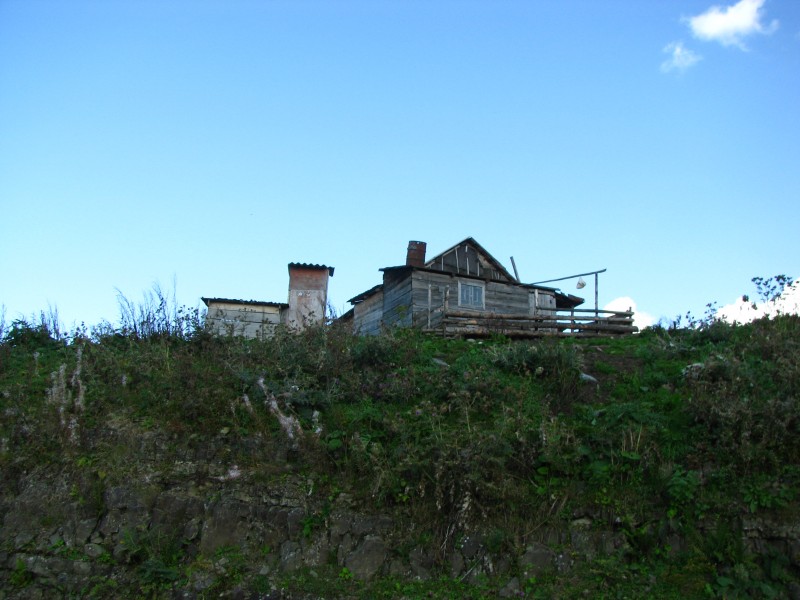
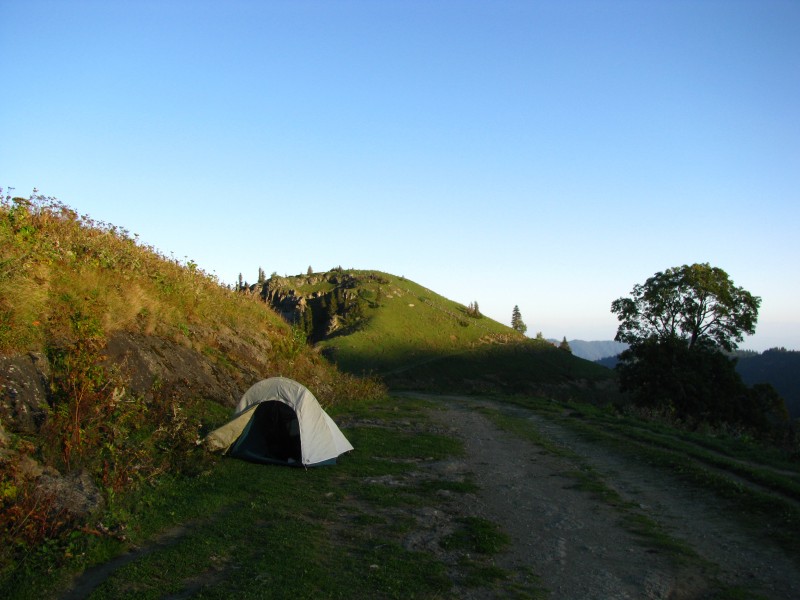
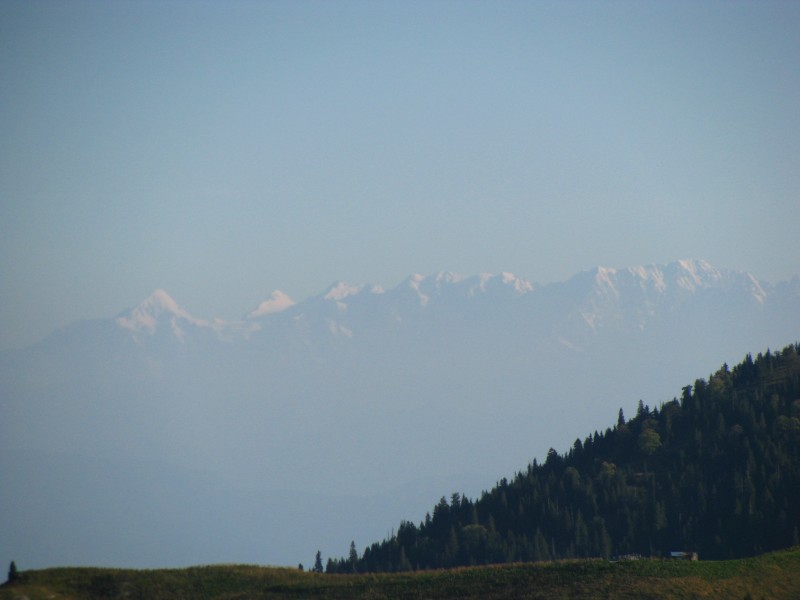
One of the farmers’ huts up above the treeline. The guys who farm here are generally seasonal workers, who live in the valley during the winter.Our campsite, by the side of the road near Mount Didmaghali. It got a little windy at night, but was actually quite comfortable.That moment when you realize “OMG, those aren’t clouds–those are MOUNTAINS!”
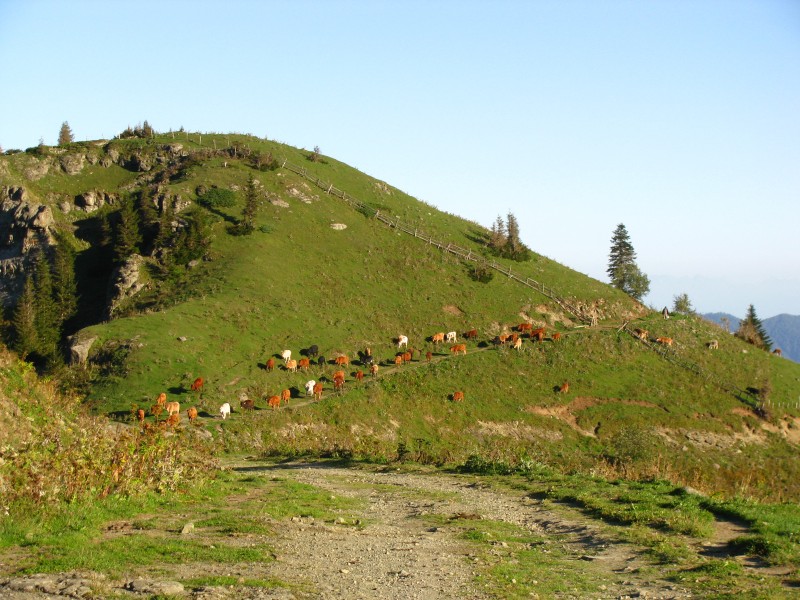
We camped out just above the treeline, next to a hill where a bunch of cows were grazing. The local ranchers brought the herd back in while we cooked dinner, which was kind of cool. Imagine a couple hundred cows walking past your tent. The good thing about being so close to the farmers, of course, was that we didn’t have to worry as much about bears and wolves.
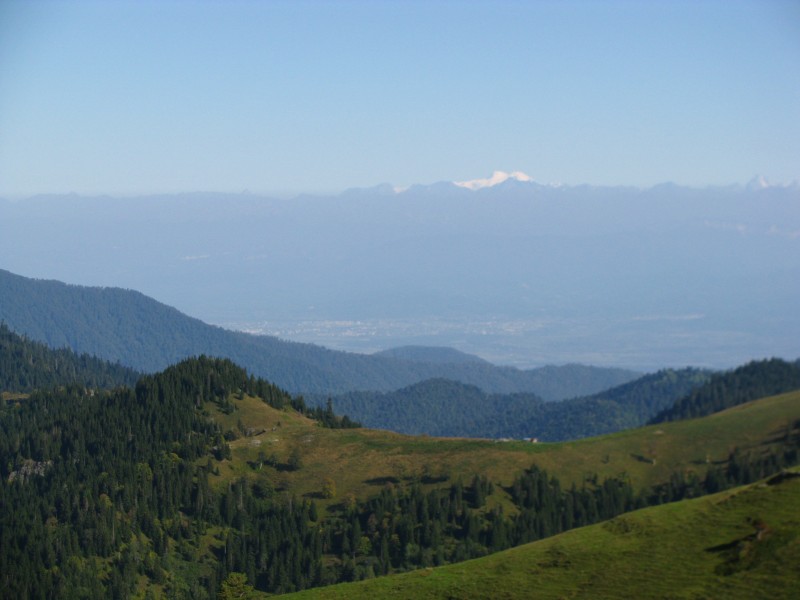
At one moment while we were looking out acros the way we came, the clouds on the horizon began to part somewhat, and I had one of those stomach-dropping moments as I realized that most of those white shapes weren’t clouds, but mountains. We were looking at the Greater Caucasus range, with Mount Elrus standing above the mountains of Svanetti and a whole bunch of other snow-capped peaks further off to the east.
As the sun sent, the temperature dropped fairly quickly, and the wind picked up a lot. I wasn’t able to sleep for a few hours, it was so strong. But the stars were beautiful–at one point, I saw a satellite that was so bright it had to be the ISS. Cool stuff!
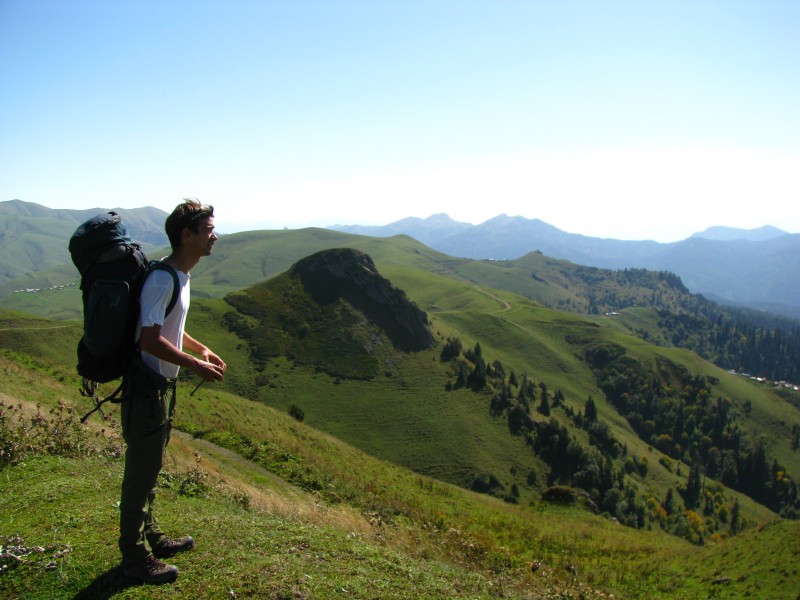
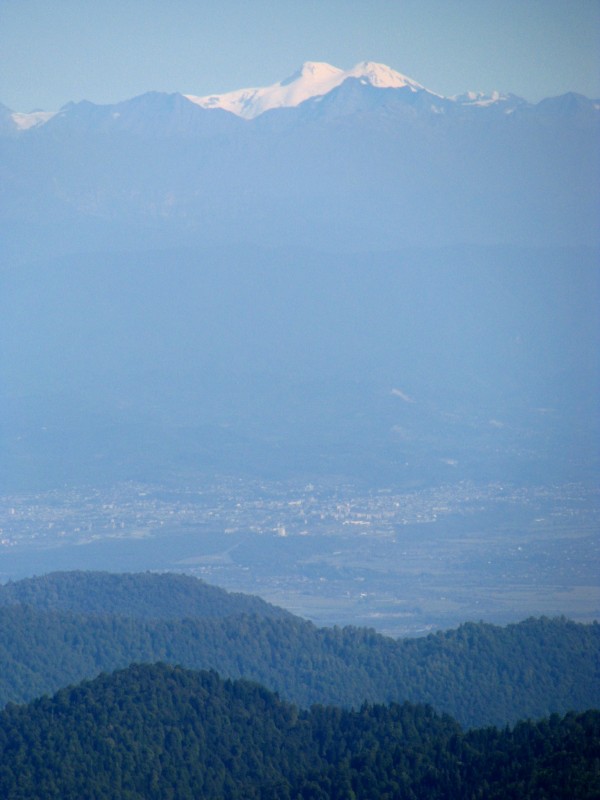
The farmers bringing out the herd in the morning. One of the cows ate some of our bread, which was kind of annoying, but I guess I shouldn’t have left it out. Cows will eat (or try to eat) just about anything!The view from the top of the first pass, just east of Mount Didmaghali. The little hill on the left is where we spent the night.Mount Elrus, with several other major Caucasus peaks below it. You can also see Kutaisi and some other settlements in the valley.The view from Zedeki pass.
The next day, we had a beautiful hike up to the first pass and over the mountains into Samtskhe-Javakheti. The weather could not have been more perfect–it warmed up as soon as the sun came up, and was pleasant for the rest of the day. We had some amazing views, too, especially from the top of the pass.
The road on the other side of the pass.The view on the other side of the pass. Those are the mountains of Samtskhe-Javakheti, with Turkey and Armenia in the distance.
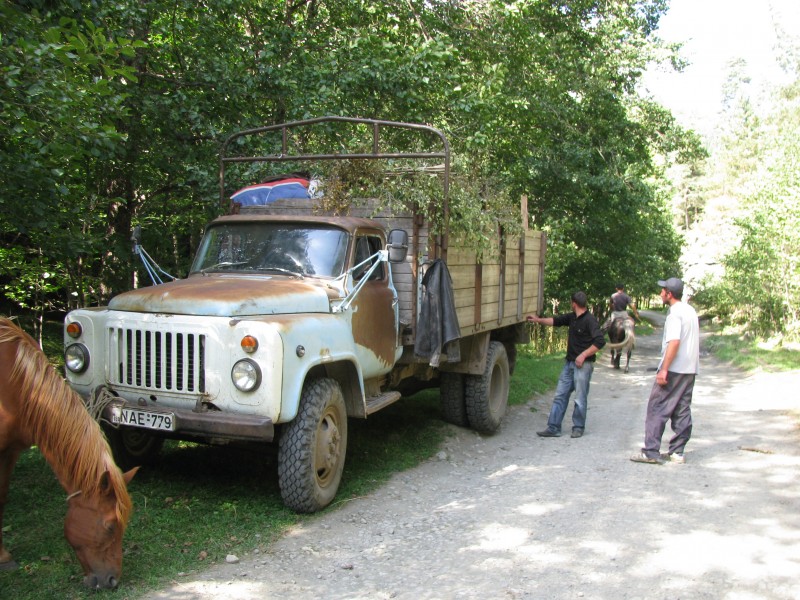
On the way back, we fell behind a bit, so we decided to hitch a ride with a passing farmer’s truck. The guys were hauling some empty barrels, a bunch of brush, and some calfs, and they put us in the back with the animals.
Wow, was it crazy! The road was so bumpy, literally every other bounce almost threw us off of the truck. The cage would pull back branches and snap them back so hard, some of them could have knocked us off as well, and the cows crapped all over the place, including the back of my pants. For most of the way, we had a sheer cliff on one side, and even though there were lots of trees, it was pretty scary, especially at the switchbacks.
In other words, it was an adventure!
The truck that took us down most of the way. Bumpiest ride of my life!My pants, after the cows got to them.
I wish I had some pictures from the ride, but it was all I could do to hang on for dear life. After about 45 minutes, my hiking partner had had enough, and demanded that the guys stop and let us off. My camera had fallen off in the truck bed, but I didn’t realize that until we were back down. Fortunately, we were only about 5 km from Abastumani, and found the guys just outside the settlement. The camera was still in good shape, and in typical Georgian fashion, they invited us for bread, cheese, and cha-cha.
So it ended up being an awesome two days of hiking and backpacking. The views from above the treeline were incredible, and the conditions were absolutely perfect–we could not have asked for better. We spent the next couple of days exploring Akhaltsikhe, Borjomi, and Bakuriani, but I’ll save that for another post later–this one has gotten long enough.
So yeah, it was definitely worth the trouble bringing out all the backpacking gear from the States. I hope to have plenty of opportunities to use it again before the end of the season!
I’m currently in Kutaisi, about to catch the night train to Tbilisi for church, but I thought I’d post a quick update just to let you know how I’m doing, and what I’ve been up to.
The last few days have been awesome. I went backpacking with a friend of mine from last semester, and we had a blast. Hiked the pass near Mount Didmaghali between Sairme and Abastumani, up above the treeline. I’ll do a big post on it sometime next week, with stories and everything (and boy, are there some stories), but before that, I wanted to share this:
That’s Mount Elbrus, the highest mountain in Europe, with the highlands of Svaneti just below it, and Kutaisi in the foreground down in the valley. The elevation difference is over 5,500 meters (18,000 feet). The picture is a bit fuzzy because of the haze, as well as the distance between points and the poor quality of my old camera, but it was an unbelievably beautiful day–as evidenced by the clear view of Elbrus’s summit.
Awesome, awesome stuff. From Zedeki pass, we could see almost the entire Caucasus range, from Mount Elbrus in the west to Mount Kazbek in the east. The conditions could not have been more perfect. Covered between 35-40 km (20-25 m) in two days, in a beautiful, remote region between Imereti and Samtskhe-Javakheti where few people, let alone tourists, ever go.
I’ve got to go now, but expect to see a longer post on the trip soon. School starts on Monday, so things might be a little crazy for a while, but I’m sure they’ll settle down soon into a comfortable and productive routine. See you around!
One thing about the hero’s journey is that it tends to be very male-centric. It’s possible to pull off a gender-swap, or to follow the structure loosely while allowing for substantial variation, but the basic form follows the assumption that the hero is male, and that most of the women he meets fall into one of two basic archetypes: sedductress (as we saw last week) or goddess.
The goddess (or “hero’s muse,” as tvtropes labels this trope) is an idealized woman who often serves to motivate the hero on his quest. She stands in stark contrast to the sedductress, who works toward the hero’s downfall, and the meeting with her is an important part of the journey. Speaking of the meeting with the goddess, Joseph Campbell said:
The ultimate adventure, when all the barriers and ogres have been overcome, is commonly represented as a mystical marriage of the triumphant hero-soul with the Queen Goddess of the World. This is the crisis at the nadir, the zenith, or at the uttermost edge of the earth, at the central point of the cosmos, in the tabernacle of the temple, or within the darkness of the deepest chamber of the heart. The meeting with the goddess (who is incarnate in every woman) is the final test of the talent of the hero to win the boon of love (charity: amor fati), which is life itself enjoyed as the encasement of eternity.
In some stories, the goddess figure represents a love interest for the hero. This is especially the case with stories from the medieval and renaissance periods, such as the protoypical knight errant and his lady, or tales of courtly love. In most cases, the girl is either faithfully married or a chaste virgin. In more modern stories, she often takes the form of the manic pixie dream girl.
The goddess doesn’t have to be the love interest, though. She can also be a motherly figure, such as the Oracle in the Matrix, or she can be an innocent, childlike girl, such as the Childlike Empress from The Neverending Story. The important thing is that she helps the hero to experience the power of love, whether that love is romantic or platonic.
I’d write more, but my internet time is kind of limited, so this is as much as I can say on this trope for now. If you have anything to add, feel free to do so in the comments. I’m traveling to a rather remote part of the Caucasus, but I’ll be back in a few days to chime in.
…how much I’m looking forward to being back in Georgia.
My flight leaves from JFK on Saturday and arrives in Istanbul at about 6 am on Sunday. The flight to Tbilisi doesn’t leave for another seven hours, so I plan to take the tram downtown and see some of the sights. I’ll arrive in Tbilisi late that afternoon, spend the night at a hostel…
…and then take off the next morning for Kars, Turkey. I plan to meet up with a friend there and go tour the ruins of Ani, ancient capital of Armenia. I have no idea yet how I’m going to get there, but there should be some buses in Tbilisi or Akhaltsikhe, and from Kars you can charter a taxi.
So after all that, I’ll head out to Baghdati to meet my new host family! For the fall semester, I’ve been assigned to the school in the village of Rokhi:
It’s about an hour south of Kutaisi, right up against the Lesser Caucasus mountains, and it looks like an awesome place! A couple of other TLGers have been there before me, and they tell me it’s really great. It’s definitely going to be a change of pace, going from city to village, but it’s one I’m looking forward to. There are only 300 students in the school (grades 1-12), so maybe I’ll learn all my students’ names this time.
The family I’ve been assigned to sounds a bit older, with a thirty year old son who works at the school. It sounds a bit rustic, with Turkish toilets and no internet at home, but I’m looking forward to that, especially the no internet part. Don’t worry, I plan to get out and blog regularly–I’m sure there are local internet cafes, plus Kutaisi isn’t that far and I know where to get internet there.
Getting out to church is going to be a bit tricky: I’ll probably go into Kutaisi on Saturday, take the noon train into Tbilisi (5 GEL) and spend the night at a hostel (15 GEL), or take the sleeper train (10 GEL) and show up in the morning. Getting back shouldn’t be too difficult: the Baghdati marshrutka leaves from Didube at 16:00 (or so I hear), and from there it’s only about 6 or 7 kilometers.
I have no idea how long I’ll be in Georgia this time: my contract runs until the end of December but I may extend again, depending on what other options open up. I’ve really fallen in love with Georgia since coming there, and may just choose to stay on another year. The Caucasus is a really amazing place, full of hidden treasures and remote places.
Which reminds me: I’m bringing a tent and sleeping bag this time, to do some backpacking in Borjomi and Tusheti. Packing them was tough: the airline restriction is 20 kg total of weight (44.1 lbs), and after a whole lot of work, I finally got it down to 42.5 lbs. The disassembled backpack frame is going to have to go as a separate piece of luggage, since it was too big to fit in any bag, but it shouldn’t be too hard to reassemble it out in Georgia.
That’s about it. I’ll leave you with this awesome Georgian song I found on youtube. The dance troop is Erisioni, and they put on an amazing show that’s kind of like Riverdance, except for Georgia. Let me tell you: when it comes to dance (folk or ballroom), I don’t think anyone in the world is as amazing as the Georgians.
I’m back from vacation, but I’m going to take a break from the Hero’s Journey trope posts to talk about something that I really feel passionate about. I hope you’ll forgive me if this turns into a rant, but I think this is an important issue that has some very dangerous implications that need to be explored.
In modern fiction, there’s a very prominent trope that a man is not a virgin. The basic idea is this: if the protagonist is an adult male and he hasn’t yet had sex with a woman, there’s something fundamentally wrong with him. Of course, because of his adventurous lifestyle, he can’t be tied down in a committed relationship–that would spoil the story. But he can’t be holding himself back, either, lest his manhood come into question. And most of the time, he doesn’t really want to, anyway.
This trope has a whole host of unfortunate implications, though, all of which serve to reinforce constrictive gender roles, disempower both men and women, drive a gulf of misunderstanding between the sexes, and emasculate true manhood and its role in our society.
To demonstrate this, let’s take this trope to the logical conclusions that our society seems to have come to.
In fiction, the sex as rite of passage trope is often seen in stories about angsty teenagers trying desperately to get laid. These are not typically stories about love–they are stories about peer pressure, objectification, and power. By equating sex as a rite of passage in this way, it actually divorces sex from any concept of love or commitment, and turns any form of physical intimacy into a caricature of itself.
It doesn’t stop there, though. If sex is a rite of passage, then it’s only reasonable that the young novice should have an older mentor to help him through the initiation process. Thus we get the professional sex-ed trope, where the boy’s mentors or guardians help guide him through his first sexual encounter. The implications for pedophilia and underage sex are more than a little disturbing.
We can see this trope in action in the way we treat female sex offenders. If a 30-something male teacher has sex with one of his female students, he gets a lengthy prison sentence and spends the rest of his life stigmatized as a predator. If a 30-something female teacher has sex with one of her male students, she gets a slap on the wrist and TV spot. She’s not a sexual predator–she’s just having a personal crisis.
Needless to say, this double standard is extremely destructive for the victims of such abuse.
If a true man is not a virgin, then a true man doesn’t say no to sex. Even if he can say no, he won’t because that’s just not what men do. Therefore, being a man is functionally synonymous with being a pervert.
The danger here is that it reduces men to their basic animal urges. If being a man means finding a warm, inviting place for your penis each night, then you might as well go out to the pasture and eat grass. Whatever happened to self control and delayed gratification? Do you think anything meaningful would ever have come out of our civilization if we couldn’t keep our pants on?
And yet, both men and women seem perfectly willing to believe that it’s not only unmanly for a man to control his animal urges, it’s impossible. On the Kindle Boards forum about a month ago, there was a thread on erotica and marriage and one of the members posted this:
I used to work as a forums admin on a large women’s forum (over 100,000 members) and the relationships forum had a lot of heated discussions on this topic. I won’t of course refer to any specific threads, but the discussions went a lot like this:
One woman concerned that her husband was spending too much time watching porn
A massive amount of women telling her that it’s ok, that ‘all men watch porn’
A small amount of women saying either they don’t agree with it or that their men don’t view it
A percentage of women saying their men are addicted to porn and would rather watch it than go to bed with a willing wife
A percentage of women saying it’s not the porn itself that concerns them, but the type of porn their husbands watch
Another group of women saying they either watch it themselves, or watch it with their husbands
Yet another small group of women who either were or are prostitutes/strippers/involved in amateur porn (who are either for or against based on their experiences)
A very vocal percentage of women saying that if your man says he doesn’t watch it, he’s a liar
A heated discussion ensuing….
How does it possibly empower men to tell them that they cannot control their own sexual impulses? It’s a self-fulfilling prophecy, which harms not only men but women as well. If all men are perverts, then women can’t afford to wait for a decent man and should settle instead for a deadbeat porn addict.
This one really gets to me. I hear it everywhere, even from people who don’t consciously buy into the logic behind it. I used to buy into it myself. It’s the idea that women are so complicated that they are impossible to understand, whereas men are as simple as an on/off switch.
In my experience, men and woman are both human. Both of them are equally complex and equally emotional. Yes, they are different, but in such a way that it’s equally difficult (or equally easy) for the one to understand the other. Generally, women tend to externalize their complexity, whereas men tend to internalize it. At least, that’s what I’ve found.
Our society takes this to the next level, however, and teaches men that they should just swallow their emotions. If they don’t, they risk being seen as weak or effeminate (never mind that equating weakness with femininity is a whole other can of worms in itself). And after a lifetime of living this way, it can be hard not to believe that that’s just the way men are.
But this is perhaps the most insidious danger of all. It’s the falsehood that real men don’t cry, or show emotion, or have any capacity for compassion or tenderness. It’s the fallacy of equating strength with violence. It’s the destructive belief that men will never rise above the lowest common denominator of their hormones, and should never even try. And because men are so obviously different from women in this regard, any attempt to understand them would be futile.
But how can you have a committed relationship with someone you can’t understand? How can you possibly hope to make the necessary sacrifices for each other to make the thing work out? And if you can’t reach the understanding necessary for a committed, loving relationship, how can you ever hope to raise a family together?
So yeah, sorry for the rant, but this trope REALLY gets under my skin. It doesn’t help that one of my favorite authors, David Gemmell, is a big fan of it. I tried to get into his Rigante series, but this trope was so strong that I couldn’t finish the first book.
I should also clarify that the thing that irks me isn’t just the trope, but how much our society has bought into it. By themselves, tropes are neither good nor bad, but when something like this becomes so prevalent that it defines the entire operating system on which our society is based, that’s when someone needs to speak out.
And for the record, I am a 28 year old single male who is not ashamed to say that he is still saving himself for marriage. Am I gay? No. Has it been difficult? Yes. Am I anything less than a man because of it? Hell, no. In fact, I would argue that the wait has made me more of a man than I otherwise would have been, and I’m sure that my future wife will agree.
Real men aren’t defined by their hormones or their sexual history. They’re defined by the way they treat the people around them, especially the ones who are most important in their lives.
I know what you’re thinking: “Huh? Why does the hero die at the beginning of the story? Isn’t that supposed to happen later?” Well…yes, it does, but the symbolic death at this point is important, too. At its core, the hero’s journey is a story of transformation and growth. When the hero comes back from the lands of adventure, he isn’t the same person he was when he first left–he’s been changed in some way. And in order for that change to take place, the hero needs to let go of who he was and move forward.
Joseph Campbell describes it like this:
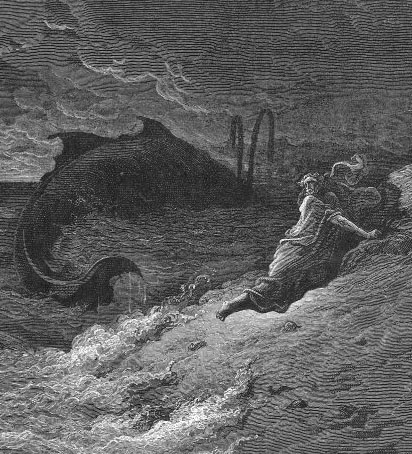
The idea that the passage of the magical threshold is a transit into a sphere of rebirth is symbolized in the worldwide womb image of the belly of the whale. The hero, instead of conquering or conciliating the power of the threshold, is swallowed into the unknown and would appear to have died. This popular motif gives emphasis to the lesson that the passage of the threshold is a form of self-annihilation. Instead of passing outward, beyond the confines of the visible world, the hero goes inward, to be born again.
Of course, the death and rebirth doesn’t have to be literal (though it can be, as it was with Dionysus). The point is to show that the hero has fully crossed the threshold, cutting all his ties with home and burning his ships on the shores of the land of adventure. Once the hero passes through the belly of the whale, there’s no going back–it’s all or nothing now.
So how common is this trope really? Actually, it occurs more often than you might think. In Harry Potter and the Sorcerer’s Stone, it happens when Harry boards the Hogwarts Express and realizes he’s leaving his old world completely behind. It happens in The Lion, the Witch, and the Wardrobe when Peter and the others decide to go after Mr. Tumnas instead of returning to their own world through the wardrobe. It happens in Star Wars IV when the Millennium Falcon gets sucked into the Death Star, and in Final Fantasy IV when Cecil washes up in Mysidia.
The main theme running through all these examples is that adventures are hard. If they were easy, anyone could go on them–and no one would be changed by them. They may be fun, and they’re definitely worth it, but to set out on one, you always have to give up something close to you–and that’s hard.
At the edge of the familiar world lies a threshold, the boundary separating the peaceful, boring land of the hero’s home from the dangerous and exciting lands of adventure. The threshold might be literal, such as the wall in Stardust and Sabriel, or it might be more symbolic, such as the field in Lord of the Rings that marks the furthest that Samwise has ever gone. Either way, the threshold is often the site of the hero’s first significant challenge–and the one who offers that challenge is the threshold guardian.
According to Joseph Campbell:
The ‘threshold guardian’…[stands] for the limits of the hero’s present sphere, or life horizon. Beyond them is darkness, the unknown and danger…The adventure is always and everywhere a passage beyond the veil of the known into the unknown; the powers that watch at the boundary are dangerous; to deal with them is risky; yet for anyone with competence and courage the danger fades.
In terms of story, the purpose of the threshold guardian is not to present some impossible test or to pose some sort of world-altering threat. Rather, they exist to mark the boundary between the familiar world and the unfamiliar, and to show how the hero is different from all the other people who chose to stay at home instead. In other words, their main purpose is to kick-start the adventure.
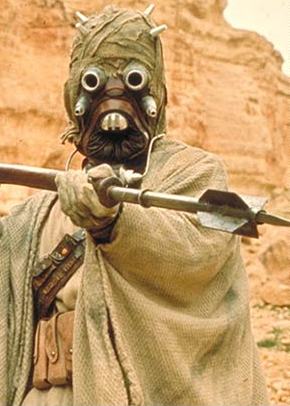
For example, in Star Wars Episode IV: A New Hope, the threshold guardians are the Tusken Raiders who roam the Jundland Wastes surrounding Luke Skywalker’s home. Venturing out into the wastes is dangerous–yet Luke does it, to bring back R2D2 after the droid runs away.
When R2D2 warns Luke that the Tuskens are approaching, Luke doesn’t run away from them–he crawls to the top of the ridge to get a better look. This leads to his first real encounter with danger, and almost gets him killed. Fortunately, Obi Wan Kenobi rescues him and takes him home, telling him about the ways of the force and presenting him with his father’s lightsaber. The adventure is off to a good start.
If Luke had never ventured out into the Jundland Wastes, or if he had run from the Tuskens at the first sign of danger, he never would have been rescued by Obi Wan, never would have learned about his father, never would have left his home and probably would have died when the Imperials attacked his uncle’s homestead. If the Tuskens had never attacked him, he would have loaded R2D2 into the speeder and gone back home, never meeting Obi Wan as well. Without the Tusken Raiders, the whole story never would have happened.
In Harry Potter and the Sorceror’s Stone, Draco Malfoy plays a similar role. If Harry Potter had joined House Slytherin, Voldemort would probably have taken over before the end of the first book. Instead, the early animosity between Draco and Harry’s newfound friends pushed him to take sides, setting the stage for everything else that was to come.
The threshold guardians don’t always have to take an adversarial role. In a lot of stories, defeating the guardian means winning an ally, even sometimes a best friend. That’s what happens when Robin Hood spars with Little John–in fact, the trope is subverted because Little John actually wins. Or perhaps the whole thing was a secret test of character, because it’s Robin Hood’s good-natured reaction to losing that wins Little John over.
Not every instance of the hero’s journey has a threshold guardian, but many of them do. It’s a clear and compelling way to mark the threshold between home and adventure, which is present in every hero’s journey, simply by definition. When done well, it’s a great way to show what makes the hero different from all the other would-be adventurers who chose to stay home.
Under the hood of my latest ebook release, Star Wanderers: Part I.
So a couple of days ago, I set out on a quest to figure out a better way to build an ebook. In the process, I ended up learning WAY more about ebooks than I’d bargained for, in the most awesome of possible ways. Seriously, I don’t think I’ve ever felt so empowered as an indie author as I do right now.
My old process was extremely convoluted. It basically involved saving my manuscript as HTML (introducing all kinds of excess code) and using four or five programs to cobble together a Frankenstein-like creation, with bolts sticking out of its forehead and extra arms and fingers sticking out of weird places. The tools I was using were like blunt instruments, and I was operating them blindfolded.
So what changed? Well, three things:
I added the Writer2ePub plugin for Open Office / Libre Office,
I downloaded an open-source epub editor called Sigil, and
I watched this video:
So what did I learn?
<geek>
First of all, that ebooks are WAY simpler than I thought they were. An epub is basically a zipped folder containing HTML files for the text, jpgs/gifs for the cover and any interior illustrations, a CSS stylesheet, maybe some extra fonts (if you want to get fancy), and two additional additional files ending in .opf and .ncx that look a lot like HTML files.
So why is this so exciting? Because it means that if you know HTML/CSS, you can build a fully functional epub file using only notepad, windows explorer, and the command prompt. THAT’S IT! And if you want to learn HTML, you can do so for free at w3schools.com.
Basically, an epub is structured just like a website, except that an ebook reader reads it instead of an internet browser. If you can build a website, you can build an epub with very little trouble. Even if you can only tweak a website, you can build an epub with very little trouble.
</geek>
In other words, the barriers to entry for ebook publishing are ridiculously low. If you’re patient and a good learner (or hell, just a good learner), there is not a single reason why you need to spend any money to format your ebooks, upload them directly to retailers, or do anything else. Using tools that are 100% available for free, you can create a product that looks every bit as professional as anything coming out of New York–in many cases, even more professional.
So what’s my new process?
1) Format the master file in Open Office.
This includes adding the copyright page and table of contents, adding anchors (in OO they’re called “bookmarks”) and hyperlinks, adding the author’s note and acknowledgments, any teasers, etc. I save the file in open document format, add “Smashwords Edition” on the copyright page and save it as a .doc file for Smashwords.
At some point, I’m going to upgrade to Libre Office, but I haven’t gotten around to it yet. When I do, it’ll basically be the same thing.
2) Export as .epub using the Writer2ePub plugin.
I cannot tell you how happy I am with this Open Office / Libre Office plugin. It pulls out all of the unnecessary formatting and breaks up every chapter into a separate, cleanly coded HTML file, all bundled together into a fairly simple epub. SO MUCH BETTER THAN SAVING AS HTML. Or Mark Coker’s “nuclear option,” for that matter.
I don’t add the cover at this point, though. Writer2ePub adds some weird stuff if you do it that way, and I find it easier just to code it manually in the next step.
3) Finalize the .epub in Sigil.
Sigil is basically just an HTML editor with some extra functionality that allows it to build an epub from those HTML files. It’s easy to learn, simple to use, and tells you exactly what’s wrong when something breaks. Unlike Calibre and Mobipocket Creator, you can always see what’s going on underneath the hood. Simple, clean, and elegant. I love it.
This is the phase that takes the most work. I add the cover, fill in the relevant metadata, tweak the CSS stylesheet for margins and indents, add the book guides, build the table of contents, etc. If you want to know exactly how I do this, let me know and I’ll write up a post on it later. It’s a little technical, but not too difficult. Like I said, if you know even a modicum of HTML, you can figure it out.
Once this step is finished, I have the final epub version of my book. I upload that to Pubit! and Kobo Writing Life, and just about anywhere else outside of Amazon where I sell my book. Someday soon, Smashwords will hopefully allow you to directly upload an epub, at which point I’ll do that here as well.
4) Convert to .mobi with KindleGen.
Amazon uses its own proprietary format for ebooks, unlike everywhere else, which takes the open source epub format. This is probably because of all the weird and funky stuff that Amazon likes to track for data collection purposes, although honestly, who knows? A mobi file is about twice as large as an epub, and I suspect that that’s the reason.
KindleGen is a free program that Amazon has made available to developers in order to facilitate conversion of epubs and other ebook formats into mobi. It’s a command line tool, which means that you have to get a little retro to use it. But hey, I grew up in the 90s with DOS, so it’s actually kind of nostalgic.
Once you’ve got KindleGen installed to c:\kindlegen, all you basically need to do is go to the file folder where your ebook is saved and enter the following command:
c:\kindlegen\kindlegen mybook.epub -c1 -verbose
“mybook.epub” is whatever you named your epub file, “-c1” stands for standard DOC compression, and “-verbose” stands for verbose output (whatever that means). There are other options you can enter, but I’m not sure what they do yet. All I know is that if you want to convert from epub to mobi, this will give you a clean result.
There are a few small things that get lost in the conversion, so you need to add them as redundancies in the epub. The biggest one I’ve noticed so far is the paragraph indents: if you go into the CSS stylesheet using Sigil and add p { … text-indent: 2em; … } that should fix it.
And that’s it! Once this step is finished, I’ve got the final mobi version and can upload that directly to Amazon and my kindle. Once that’s done, my book is available from every major ebook retailer in every country in the world. Total time = maybe an hour (plus however long it takes for the retailers to publish the files to their stores).
I know it’s 2012 and this is old news by now, but do you have any idea how cool this is? With one hour of work and two or three programs, all of which are available for free, I can produce a clean, professionally formatted ebook, and sell it around the world instantaneously with a marginal cost of zero.
And now, because I took the time to learn how to use the tools, I can be confident that there aren’t any bits of rogue or useless code in it either. The only “black box” is really the mobi format, but I could probably crack that and figure it out if I wanted to.
So yeah, needless to say, I am extremely happy to be an indie writer. 🙂
However, it is not typically where the story begins. In order for the hero to leave the ordinary world, he must first start out there, so we know what’s at stake and what he’s leaving behind. This is why Luke Skywalker starts out on his uncle’s homestead, and why Neo starts out as a bored and lonely employee of Metacortex. Events outside the hero’s experience may have already put him on a trajectory to leave on the adventure, but he won’t know it until the call comes.
The hero may start out in a quiet, peaceful village, far removed from any sort of conflict–or he may start out in the middle of a crapsack world, as is the case with dystopian fiction. The important thing is that it’s the world he’s always known–that he hasn’t ever really made an effort to leave or change it.
How he feels about his world largely determines how he chooses to respond to the call. In older literature, the hero typically refuses it. The advantage of this is that it gives the reader a sense of scope–that this adventure is not a small or a trivial thing. It also sets up an immediate minor conflict that gives some motion to the opening chapters.
In modern stories, though, it’s more common for the hero (or his friends) to jump at the call. There are also many advantages to this. In Lord of the Rings, it gives Frodo an immediate band of sidekicks. In Harry Potter, it plays up the sense of wonder at the magical world. In the Chronicles of Prydain, it highlights the impulsiveness and naivete of Terran, as he realizes later on in the story just how stupid of him it was.
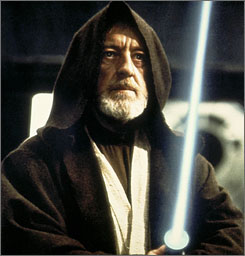 Being a mentor to the hero can be a pretty tough job. Don’t believe me? Check out the tvtropes page: