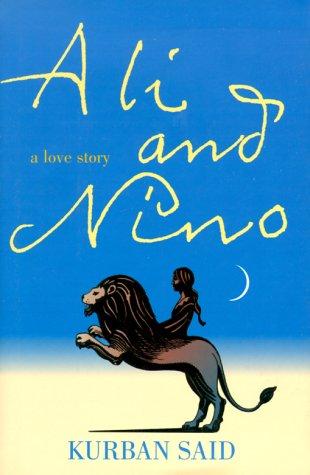
Ali and Nino by Kurban Said

At the crossroads of Europe and Asia, Christianity and Islam, the progressive West and the reactionary East, the peoples of the Caucasus lie poised between three empires and their own dreams of independence.  And at the city of Baku, where the ancient and unchangeable desert meets the oil rigs of the Caspian Sea, young Ali Shirvanshir has fallen in love with Nino Kipiani, a Georgian and a Christian.

A timeless story of forbidden love, Ali and Nino is both the Romeo and Juliet of the Caucasus and the national novel of Azerbaijan.  It is as much a romance as it is a story of the clash of cultures and identities in our rapidly changing modern world.  Above all else, it is a beautiful and haunting tale that will leave you dreaming with your eyes open and yearning for lands that you’ve never seen.

This is, quite possibly, the most perfect book I have read all year.  I picked it up in Tbilisi from another TLG volunteer on Sunday, and I finished it at a breathless sprint on Wednesday.  But while the story was good, it was the writing itself that really captivated me.  The simple yet surprisingly rich descriptions of the alien cultures, so dreamlike and yet so straightforward, often to the point of being shocking–here, let me give an example:

“Shamil’s Prayer!” called Iljas Beg to the musicians.  Immediately a wild melody arose.  Iljas Beg jumped into the middle of the hall.  He drew his dagger.  His feet moved in the fiery rhythm of the Caucasian Mountain Dance.  The blade glittered in his hand.  Nino danced up to him.  Her feet looked like small strange toys.  Shamil’s Mystery began.

We clapped to the rhythm of the music.  Nino was the bride to be abducted…Iljas put the dagger between his teeth.  Like a bird of prey, his arms outstretched, he circled round the girl.  Nino’s feet flew whirling round the hall, her supple arms depicting all stages of fear, despair, and submission.  In her left hand she held a handkerchief.  Her whole body trembled.  Only the coins on her cap lay quietly on her forehead, and that was the correct way–this is the most difficult part of the dance.  No one  but a Georgian girl can do such fantastically quick turns and not let even one coin on her cap tinkle.

Iljas raced after her.  Without stopping, he chased her round and round.  The wide gestures of his arms became more and more dominating, Nino’s defensive movements more and more tender.  At last she stopped, like a deer overtaken by the hunter.  Closer and closer Iljas Beg circled.  Nino’s eyes were soft and humble.  Her hands trembled.  A wild, short howl from the music, and she opened her left hand.  The handkerchief fluttered to the floor.  And suddenly Iljas Beg’s dagger flew onto the little piece of silk and nailed it to the floor.  The symbolic dance was finished.

By the way, did I mention that before the dance, I gave Iljas Beg my dagger and took his?  It was my blade that  pierced Nino’s handkerchief.  It is best to be on the safe side, for a wise rule teaches: “Before you trust your camel to Allah’s protection, tie it fast onto your fence.”

The whole novel is like that, and it’s awesome.  The narrative passes from one description to the next, and you feel almost like you’re caught up in a dream, reading a fairy tale.  It’s only the railroads and oil rigs, the mention of Paris and London and Moscow, that make you step back and realize that this isn’t a fantasy novel, but something set in our modern world.

And yet, even though it feels like a fairy tale, the author gets a surprising number of things right.  Georgians really do have some of the most beautiful eyes of any people.  I haven’t yet been inside the sulfur baths at Tbilisi, but everything else in Said’s description of that city is more or less correct. Kakhetian wine really is the most famous within Georgia, and probably the whole Caucasus as well.

The most gratifying thing is to see how it all comes together.  Even though the descriptions sometimes feel as lavish as a Persian rug, no word is wasted–there is a good reason for every tangent, solidly grounded in the story.  There are plenty of red herrings and Chekhov’s guns to make the plot twists thoroughly satisfying.  But never at any point did I feel compelled to try and predict what would come next.  I enjoyed the story so much, I was barely aware of the fact that I was reading.

Whether you’re looking for an exotic romance, or you just want to explore a culture thoroughly alien from your own, Ali and Nino is a book you will thoroughly enjoy.  If, like me, you have any interest in the Caucasus, you probably won’t be able to stop coming back to it.  And if you’re just looking for a good read, I can think of few books that are more perfect than this one.

Trope Tuesday: Freudian Trio

Last week, I blogged about the Three Faces of Eve trope.  But if we’re going to discuss power trios in any depth, we first need to examine the classic Freudian Trio, one of the most prevalent combos and, in some ways, a precursor to all others.

As you might expect, the Freudian Trio borrows heavily from Sigmund Freud, specifically, his theory of the Id, the Ego, and the Superego.   The main idea is that the human mind is divided into three parts: the Id, which comprises our basest animal instincts; the Superego, which comprises our concepts of morality and social norms; and the Ego, which struggles to find a balance between the two.

In the Freudian Trio, these elements of the psyche are represented by:

Each of these character archetypes are fascinating in their own right, and deserve to be examined in much greater depth.  However, in the Freudian Trio, it’s the combination of the three that proves so fascinating.

When faced with an interesting moral dilemma, the McCoy often wants to screw the rules and run in with guns blazing, while the Spock advocates caution, reminding us of the prime directive.  Or maybe the McCoy is paralyzed by indecision, while the Spock is the only one cold enough to make the sadistic choice.  In either case, the way the Kirk manages to resolve it will almost always reveal something deeper about the world or human nature.

The thing that’s truly amazing is how prevalent this trope is in fiction.  To name a few:

  • Star Trek: McCoy (Id), Spock (Superego), and Kirk (Ego).
  • Star Wars: Han (Id), Leia (Superego), and Luke (Ego), also:
  • Star Wars: Emperor Palpatine (Id), Grand Moff Tarkin (Superego), and Darth Vader (Ego).
  • Ender’s Game: Peter (Id), Valentine (Superego), and Ender (Ego).
  • Lord of the Rings: Gollum (Id), Sam (Superego), and Frodo (Ego), also:
  • Lord of the Rings: Gimli (Id), Legolas (Superego), and Agagorn (Ego), also:
  • Lord of the Rings: Dwarves (Id), Elves (Superego), and Humans (Ego).
  • Arthurian Legend: Sir Gawain (Id), Sir Lancelot (Superego), and King Arthur (Ego) (I would argue that Guinevere fits the Id role better, but I’m not an expert).
  • The Dark Knight: The Joker (Id), Harvey Dent (Superego), and Batman (Ego).
  • The Matrix: Neo (Id), Trinity (Superego), and Morpheus (Ego).
  • Shaun of the Dead: Ed (Id), Liz (Superego), and Shaun (Ego).
  • Fullmetal Alchemist: Edward (Id), Alphonse (Superego), and Winry (Ego).
  • The Melancholy of Haruhi Suzumiya: Haruhi (Id), Yuki (Superego), and Kyon (Ego).
  • Final Fantasy VI: Kefka (Id), Leo (Superego), and Emperor Gestahl (Ego).
  • Final Fantasy VII: Barrett (Id), Cloud (Superego), and Tifa (Ego).
  • Myst: Achenar (Id), Sirrus (Superego), and Atrus (Ego).
  • Starcraft: Zerg (Id), Protoss (Superego), and Humans (Ego).
  • Homestar Runner: Strong Mad (Id), Strong Sad (Superego), and Strong Sad (Ego).
  • The Good, the Bad, and the Ugly: Tuco (Id), Angel Eyes (Superego), and Blondie (Ego).
  • 20,000 Leagues Under the Sea: Ned (Id), Conseil (Superego), and Aronnax (Ego).
  • Twilight: Jacob (Id), Edward (Superego), and Bella (Ego).
  • Archie Comics: Veronica (Id), Betty (Superego), and Archie (Ego).

The Betty and Veronica one is particularly interesting because it’s also a love triangle.  In fact, most love triangles feature some kind of play on the Freudian Trio: the good girl vs. the bad girl, the nice guy vs. the jerk, the girl next door vs. forbidden love, prince charming vs. the loveable rogue.

Sometimes, the villains come from a dysfunctional or broken Freudian Trio, where one of the three died, was kicked out, or was never part of the combo in the first place.  When this happens, it’s called (aptly enough) a Evil Duo.  Examples include Pinkie and the Brain, Lex Luthor and the Joker, and Kefka and Gestahl (though that particular duo was very, very, VERY short lived).

Finally, it’s worth pointing out that the Freudian Trio is so common, it even occurs in real life.  Perhaps the best example of this would be World War II, where Churchill was the Id, Stalin was the Superego, and Roosevelt was the Ego.  With quotes like “never, never, never, never give up,” Churchill practically embodied the McCoy (his drinking penchant also helped), while Stalin, with his fanatic adherence to communism and his “million is a statistic” approach to the revolution, was as cold and calculating as you can get.  FDR was the one who held the alliance together, and it was only after his death that the Cold War really broke out.

Of course, it’s possible that we only see this trope everywhere because our brains are programmed to see it.  But if that’s true, it makes for an even stronger argument that the Freudian Trio plays on some powerful, universal archetypes.

Sid Meier’s Alpha Centauri, aka the best 4x strategy game of ALL TIME

Sid Meier’s Alpha Centauri is, without a doubt, the best strategy game I have ever played.  I have many fond memories playing it into the early morning hours while I was in college.

I just bought it for $2.99.  What have I done??

The last time I played this game, it quite literally consumed my life.  I eventually had to delete it from my computer just to keep up with my schoolwork.

But wow, it’s so good.  And the best part, in my opinion, is the story.  Unlike other 4x strategy games, where everything is basically up in the air, Alpha Centauri has a very distinct storyline full of interesting twists and turns.

It starts out with a colony mission to (where else?) Alpha Centauri that fractures into seven factions, based not on ethnicity or nationality, but on ideology.  These are: the scientists, the religious fundamentalists, the communists, the free-market capitalists, the diplomatists, the militarists, and the environmentalists.

The last faction is my favorite, because the planet itself is a character in this story.  As you settle and explore new territory, you come across giant patches of fungus and swarms of hostile mind-worms.  The more the game progresses, however, the more you realize that the fungus is part of a giant neural network, and that it’s trying to communicate with you.  When you finally learn to communicate back–THAT’S when things get interesting.

Oh man, I love this game.  It’s a science fiction classic, reminiscent of Orson Scott Card and Arthur C. Clarke.  I just hope I can exercise some self-restraint this time–but hey, if I can moderate how much time I spend on Minecraft, surely I can do the same with Alpha Centauri.

Famous last words…

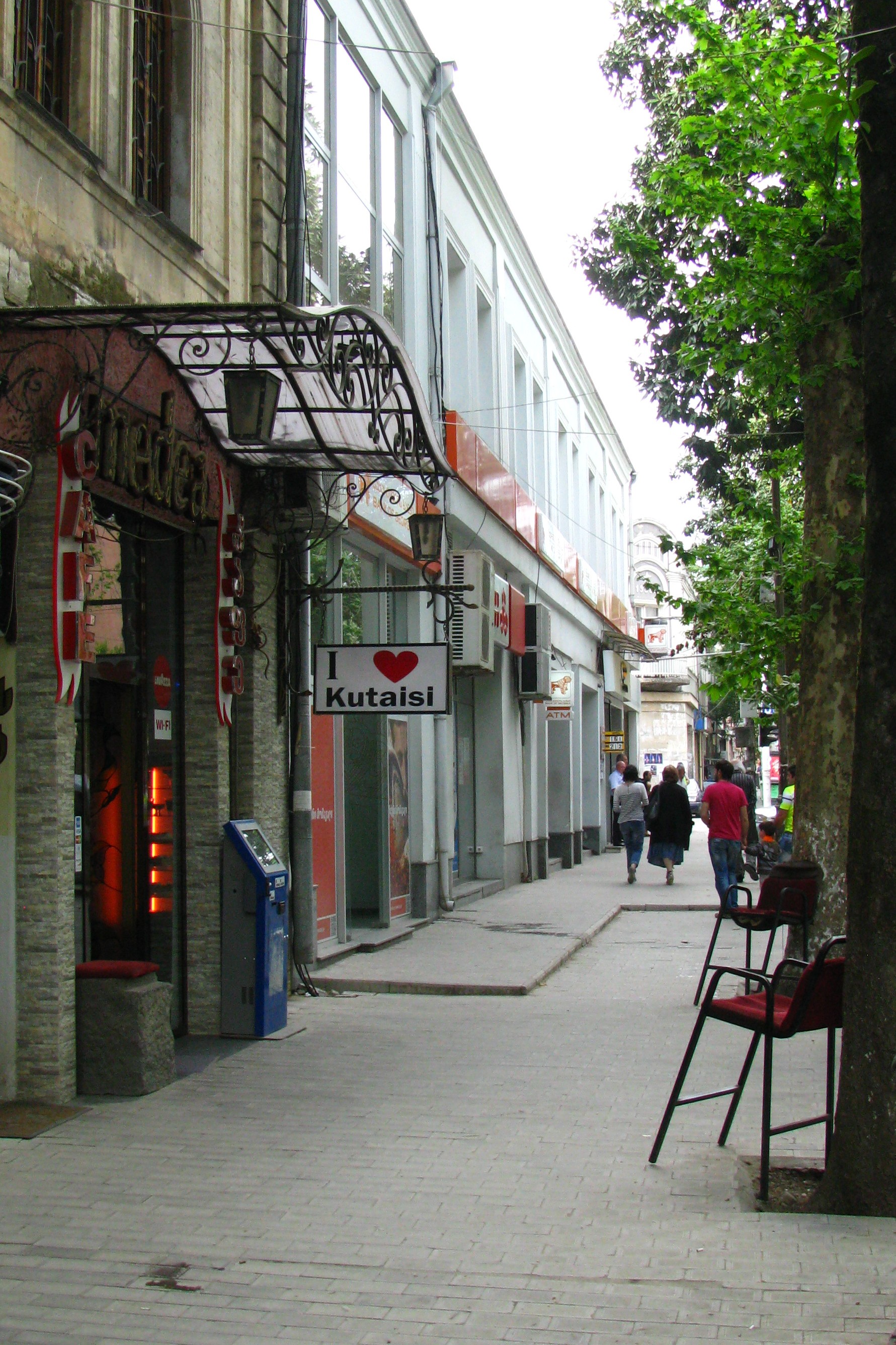
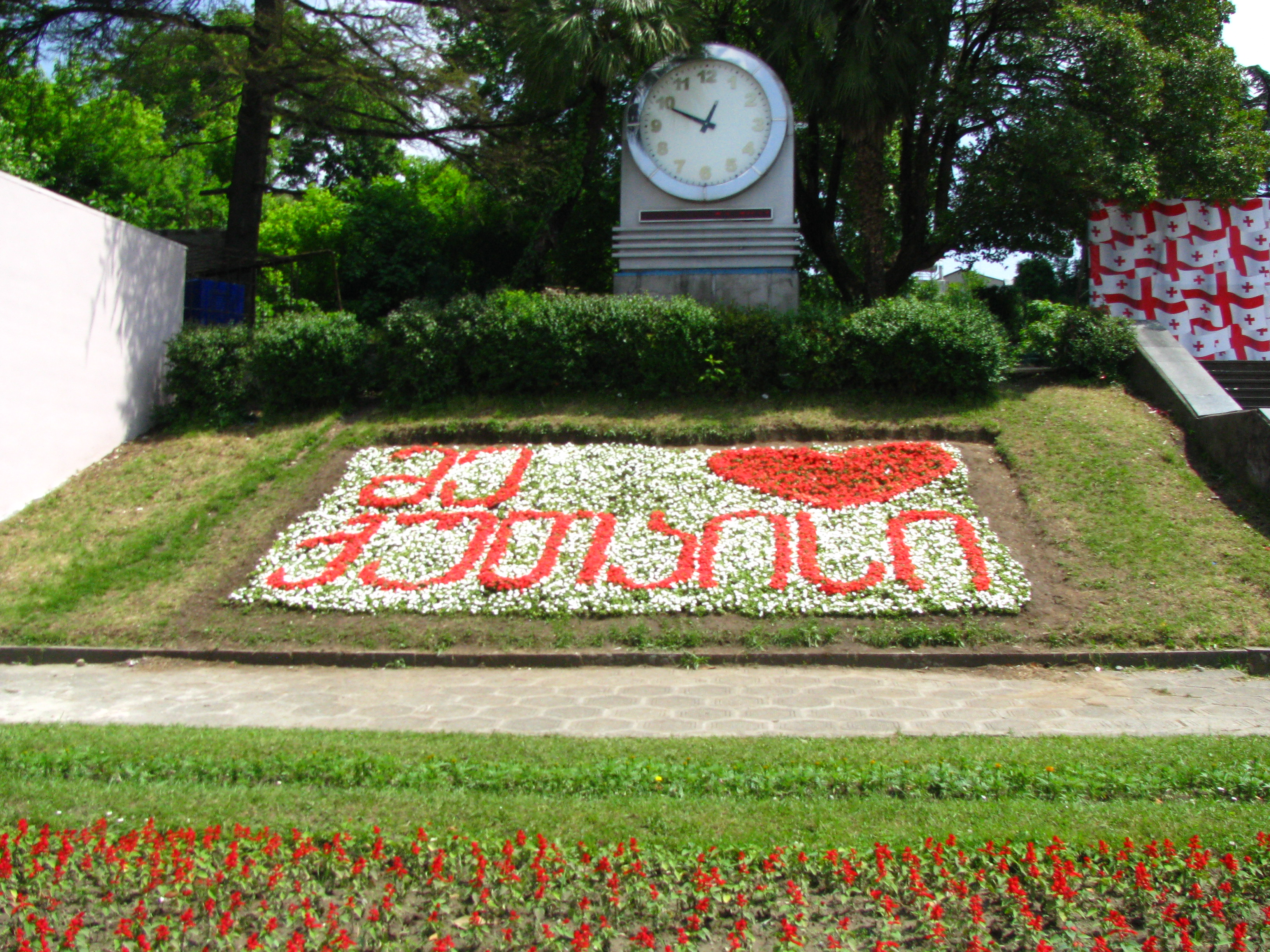
მე ♥ ქუთაისი (I ♥ Kutaisi)

Medea Cafe & Bar, a popular expat hangout in downtown Kutaisi. It’s also something of a landmark because of the conspicuously English street sign.

That’s Georgian for “I ♥ Kutaisi.” Like the New York City ad campaign on which it’s based, it’s become a part of the local culture.  You can see it on billboards, street signs, stickers, t-shirts–unlike the US, where it’s uncool to wear a band’s t-shirt at their own concert, everyone was wearing their “I ♥ Kutaisi” shirts at Kutaisoba last week.

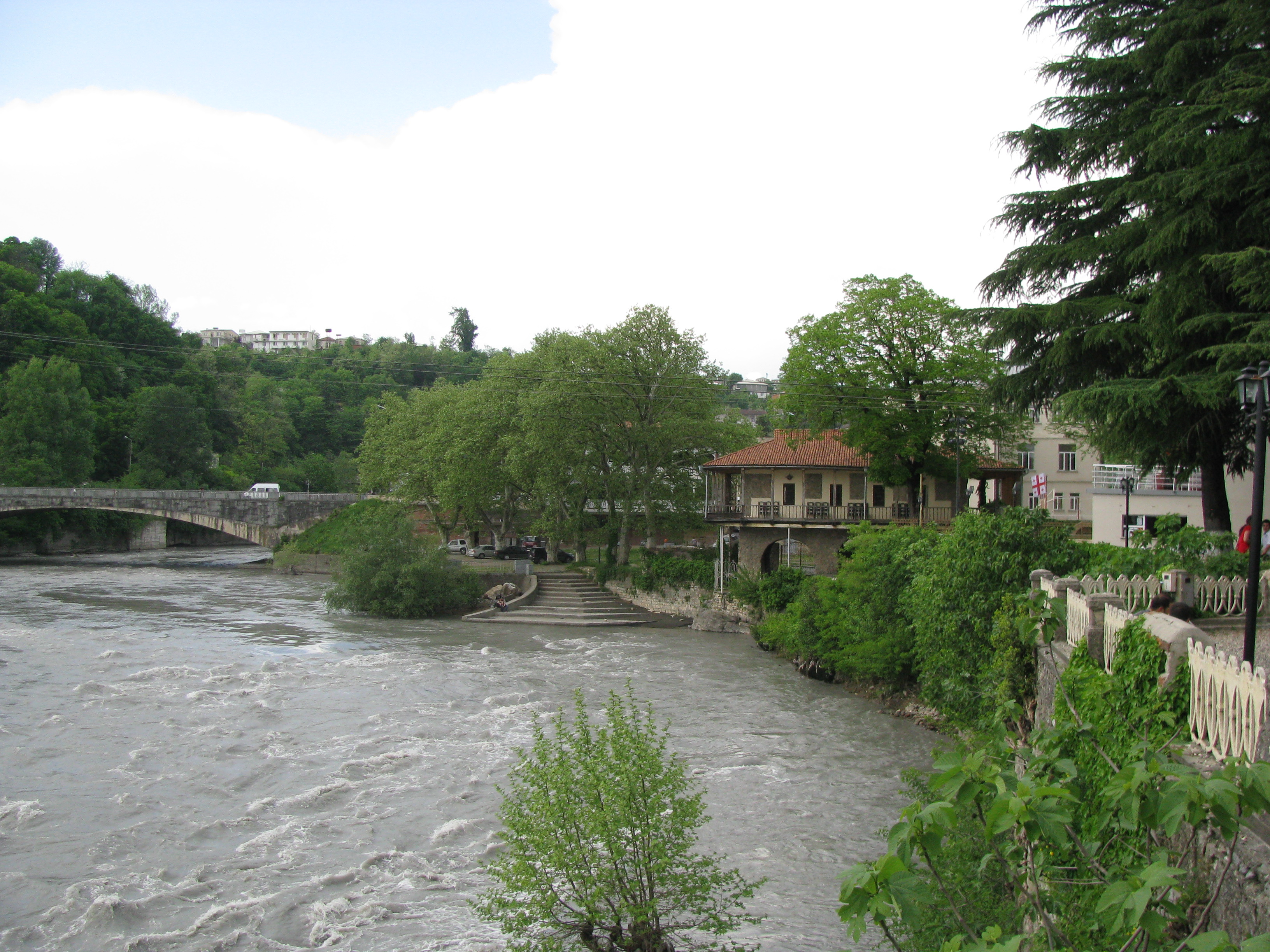
So since I’ve been living here in Kutaisi for almost three months, I thought I’d give you all a virtual tour of the city–or at least the downtown area, since Kutaisi is really more like a very big village with a city in the middle.  But that’s why I love it.

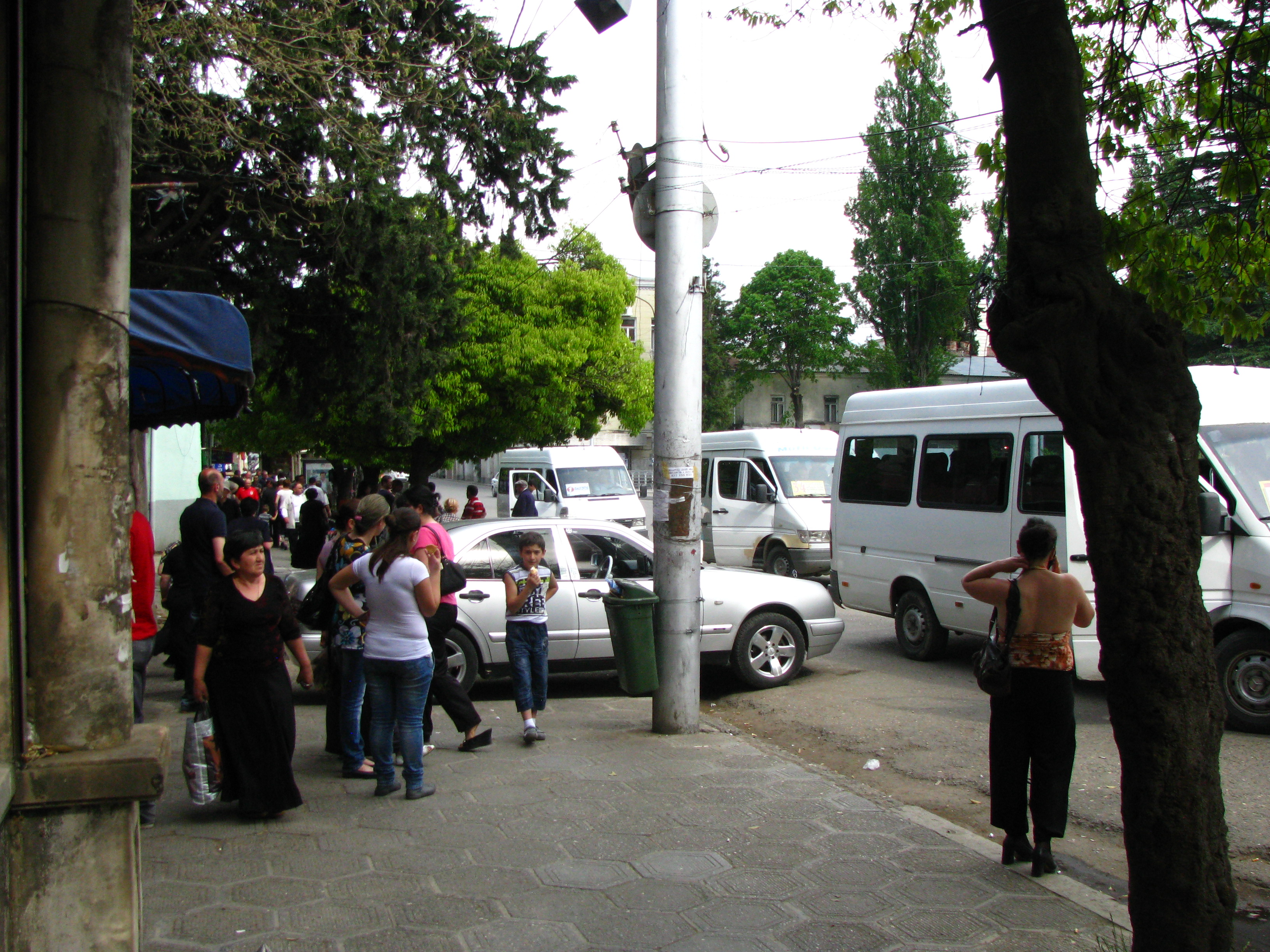
Tsitelikhidi, or Red Bridge Station.

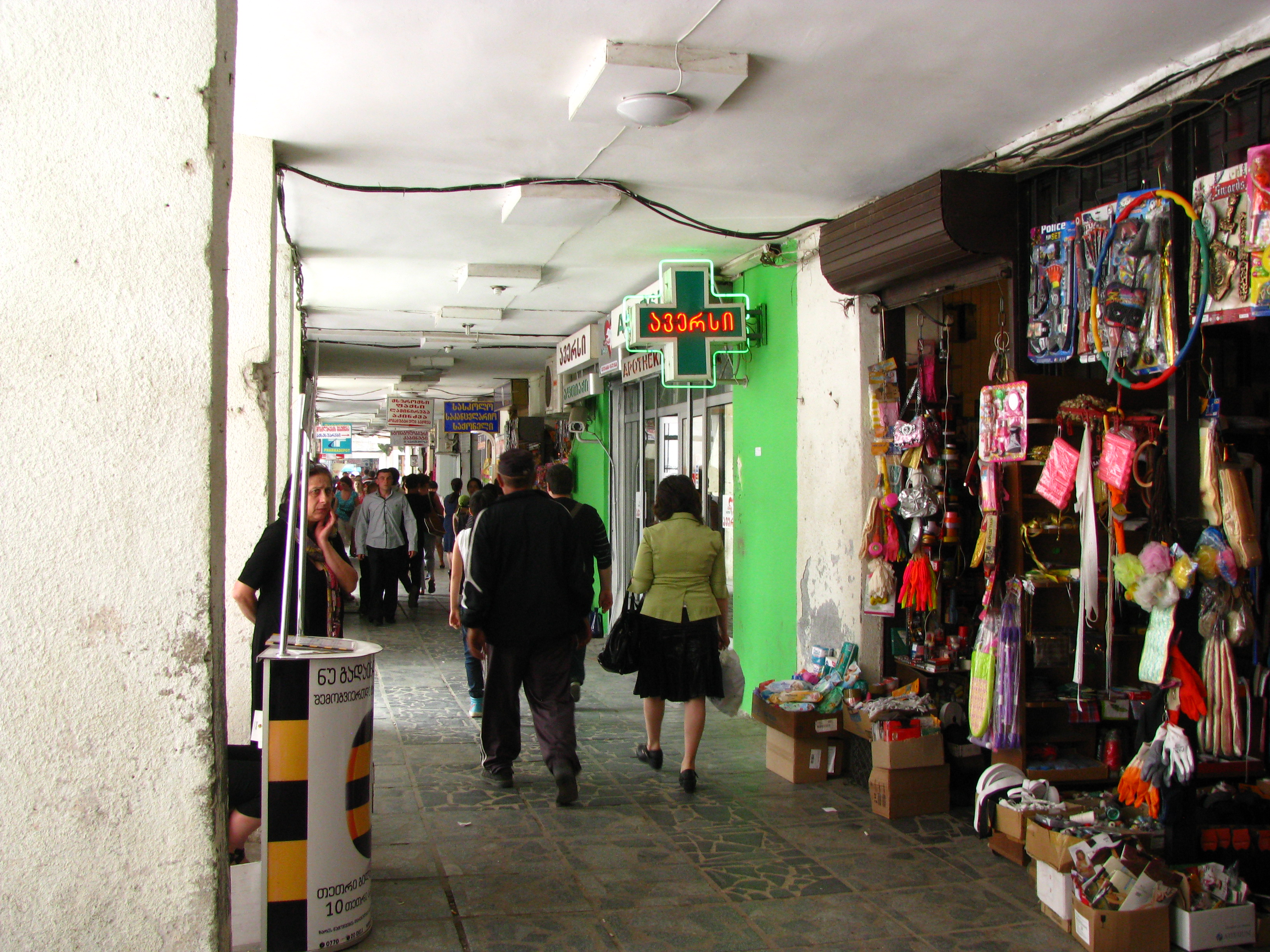
Our tour starts at the main marshrutka terminal downtown, Tsitelikhidi, or Red Bridge Station.  The place is a wonderfully chaotic mess of taxis, buses, and marshrutkas, while their drivers pass the time by smoking cigarettes and yelling at each other.  Old women wander around the crowds selling khatchapuri and lavash, while people are constantly coming and going.  Interestingly enough, this is also where you can find one of the largest concentrations of apothekas (pharmacies) in the city.

I bought an earwax removal kit from this apotheka, along with a bulb syringe obviously meant for babies. The pharmacist thought that was hilarious.
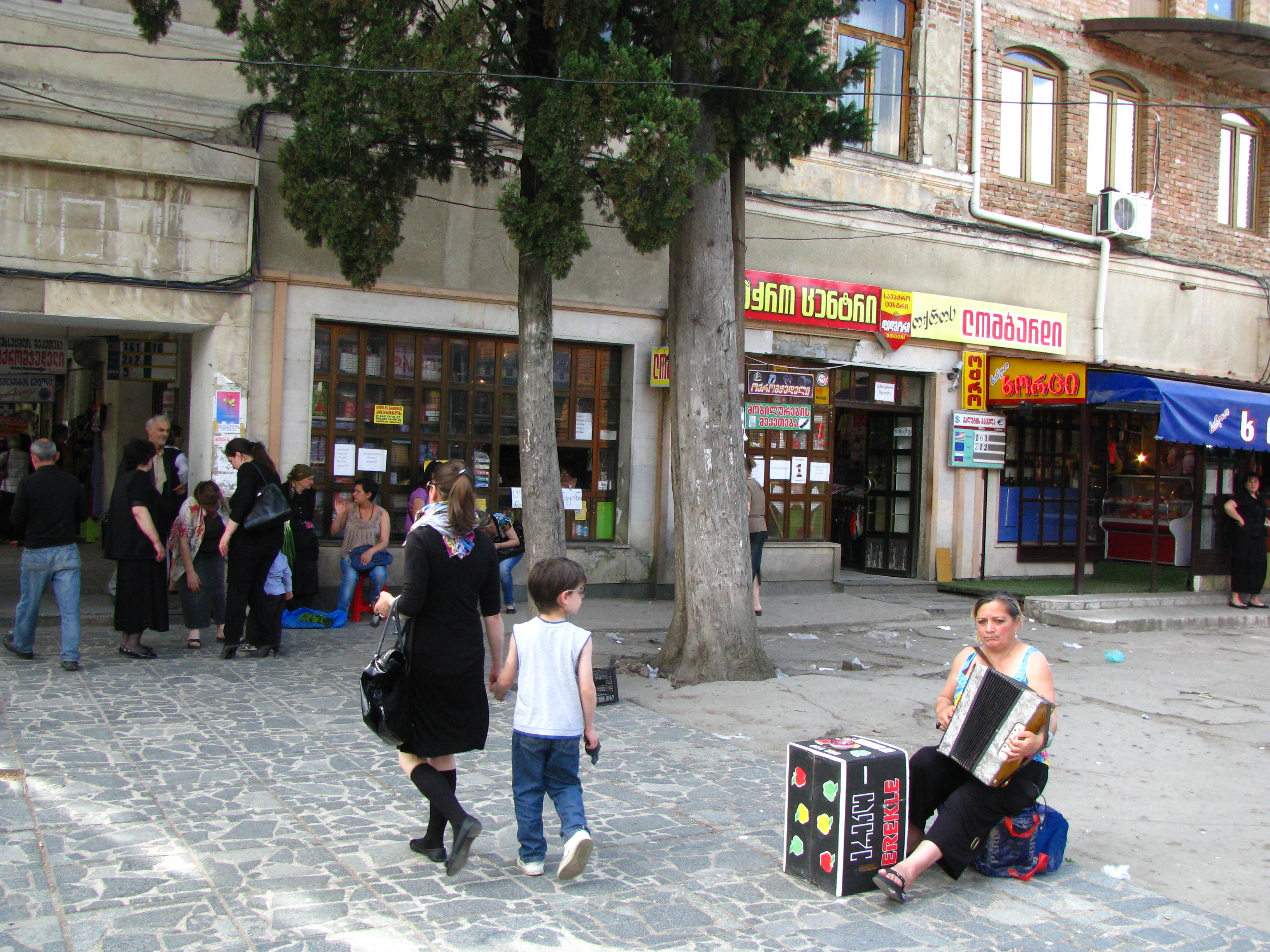
For street performers in Kutaisi, the accordion is the instrument of choice.

The sidewalk leading away from the station leads into a long narrow corridor typical of most Georgian street markets, with stalls and vendors packing every available space.  Here you can find cookies, ice cream, and cold drinks, both soft and hard; candles, religious icons, and other “souvenirs,” as the vendors like to call them; cheap plastic goods from China, wrapped in dusty plastic; freshly killed meat hanging from butcher’s windows; and all sorts of other random things.  But as busy as this place seems, it’s nothing compared to the main marketplace.

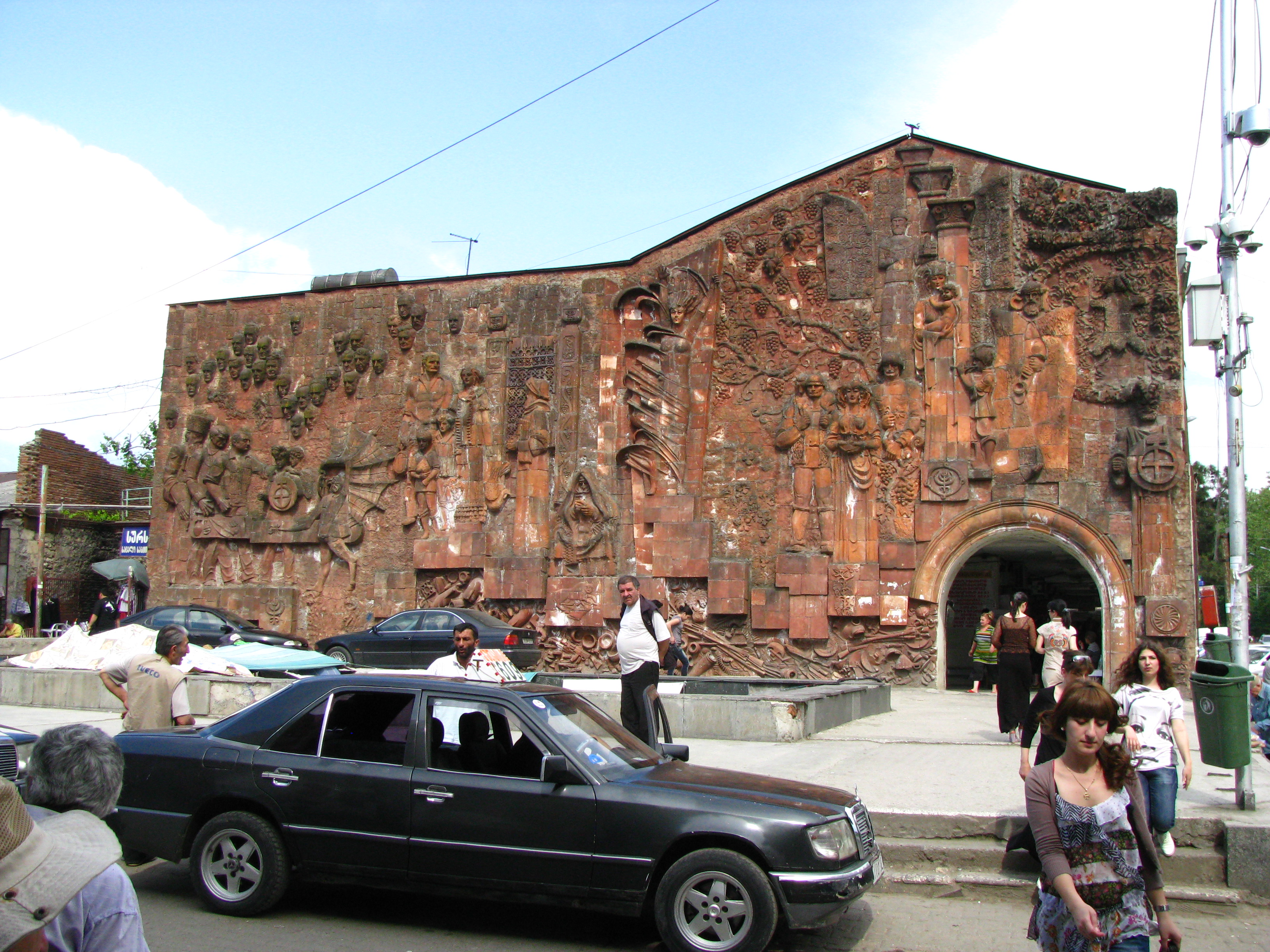
I have no idea what’s all on this frieze, but it looks pretty cool.  Also, bangs are very much in fashion.
This is actually a pretty good place to buy a belt.

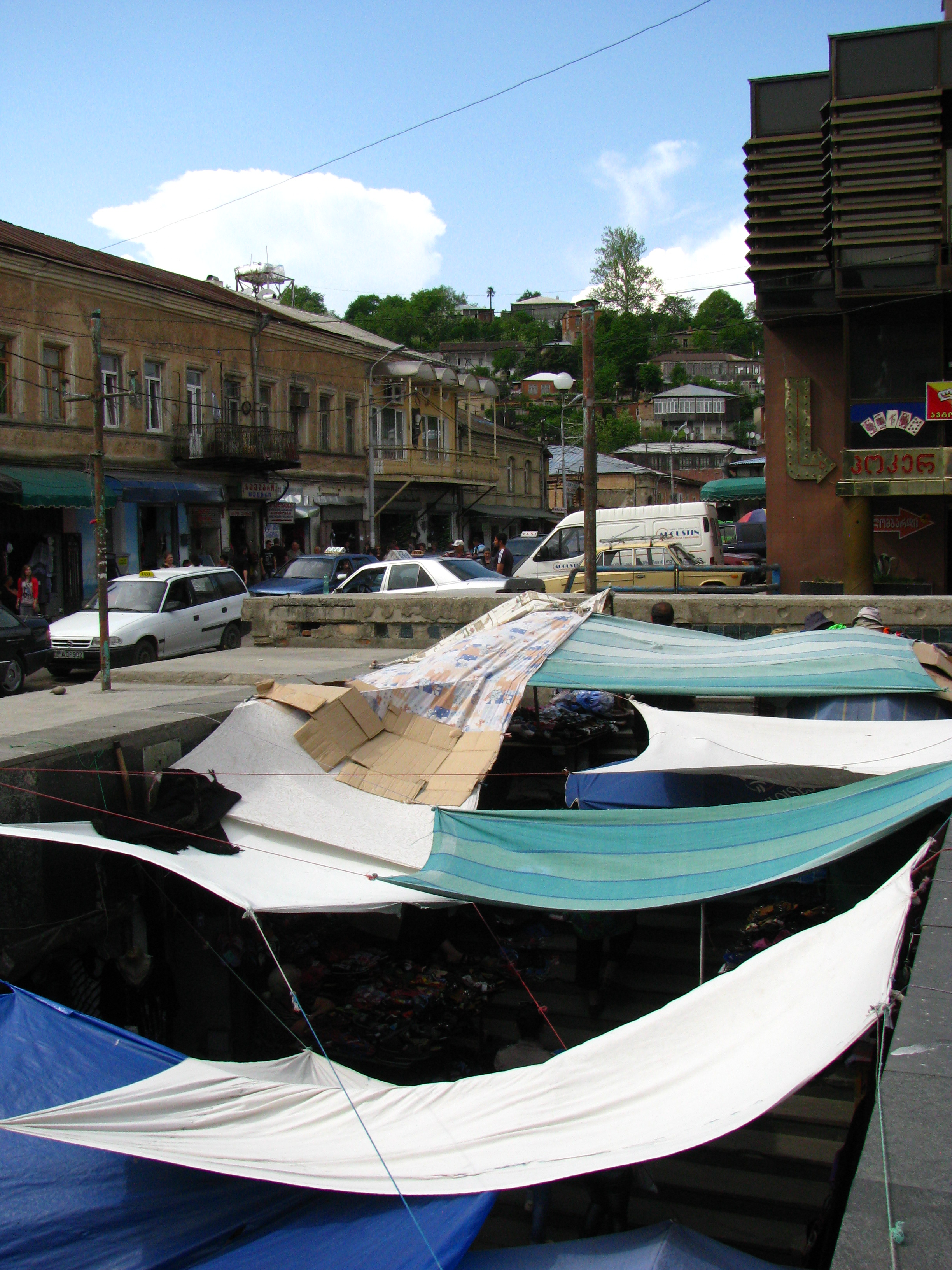
The corridor opens up at the end of the block, to a tunnel which leads underneath the main road (Rustaveli, named after the great medieval Georgian writer) to Mirzani restaurant on the far side.  At the mouth of the tunnel, tarps and blankets stretch haphazardly over vendors selling clothes, cheap shoes and cigarettes.  Further down the tunnel, you can find more clothes, belts, brassieres, more shoes, and all sorts of fabrics.

We continue past an old building with a giant frieze, presumably depicting scenes from the history of the city.  There’s a lot of history to choose from–Kutaisi was the capital of ancient Colchis, and a major regional center throughout the Middle Ages, when locally-born King David the Builder united all of Georgia, turning it into a “land between two seas.”

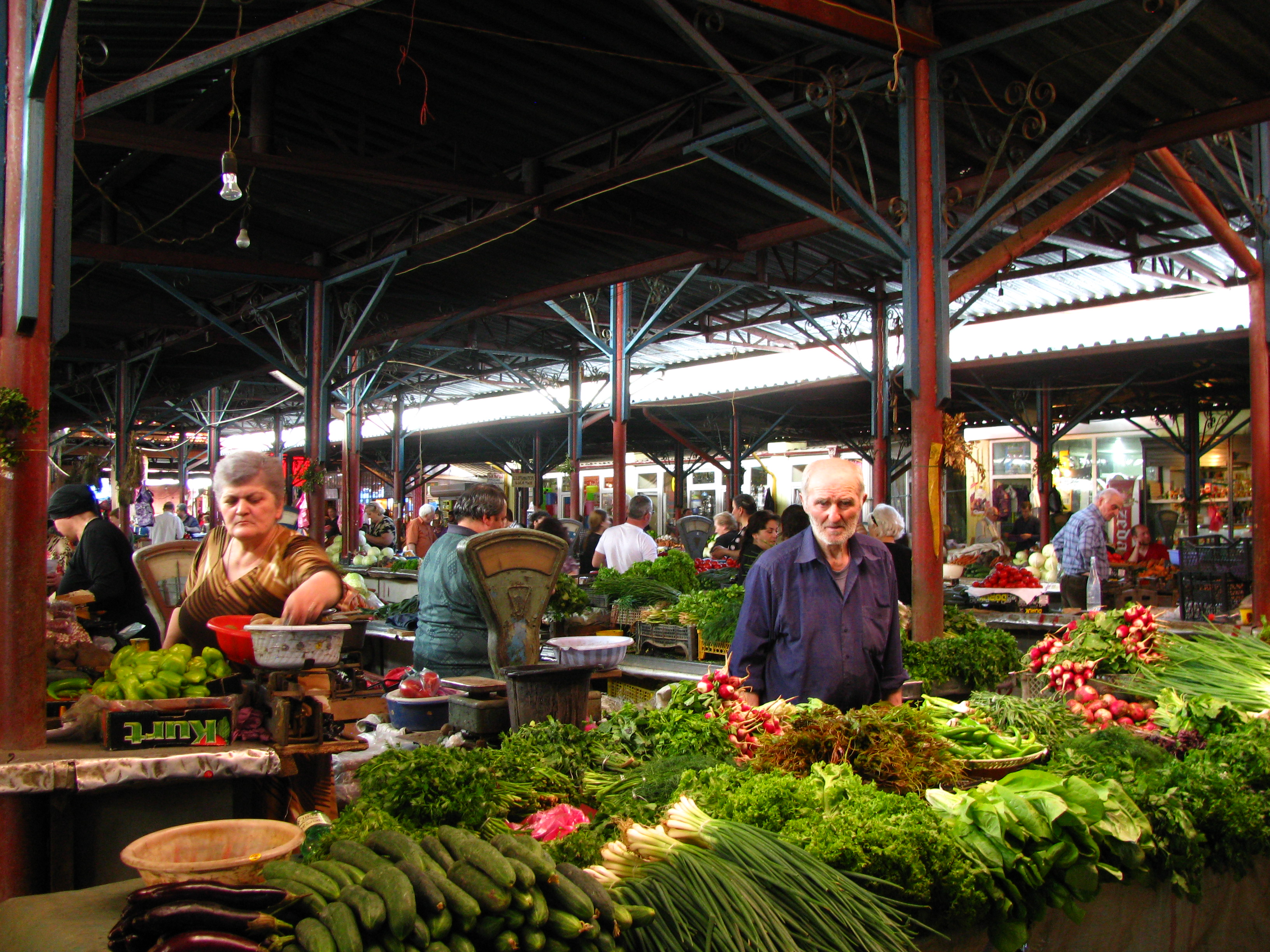
Alas, no hot peppers.
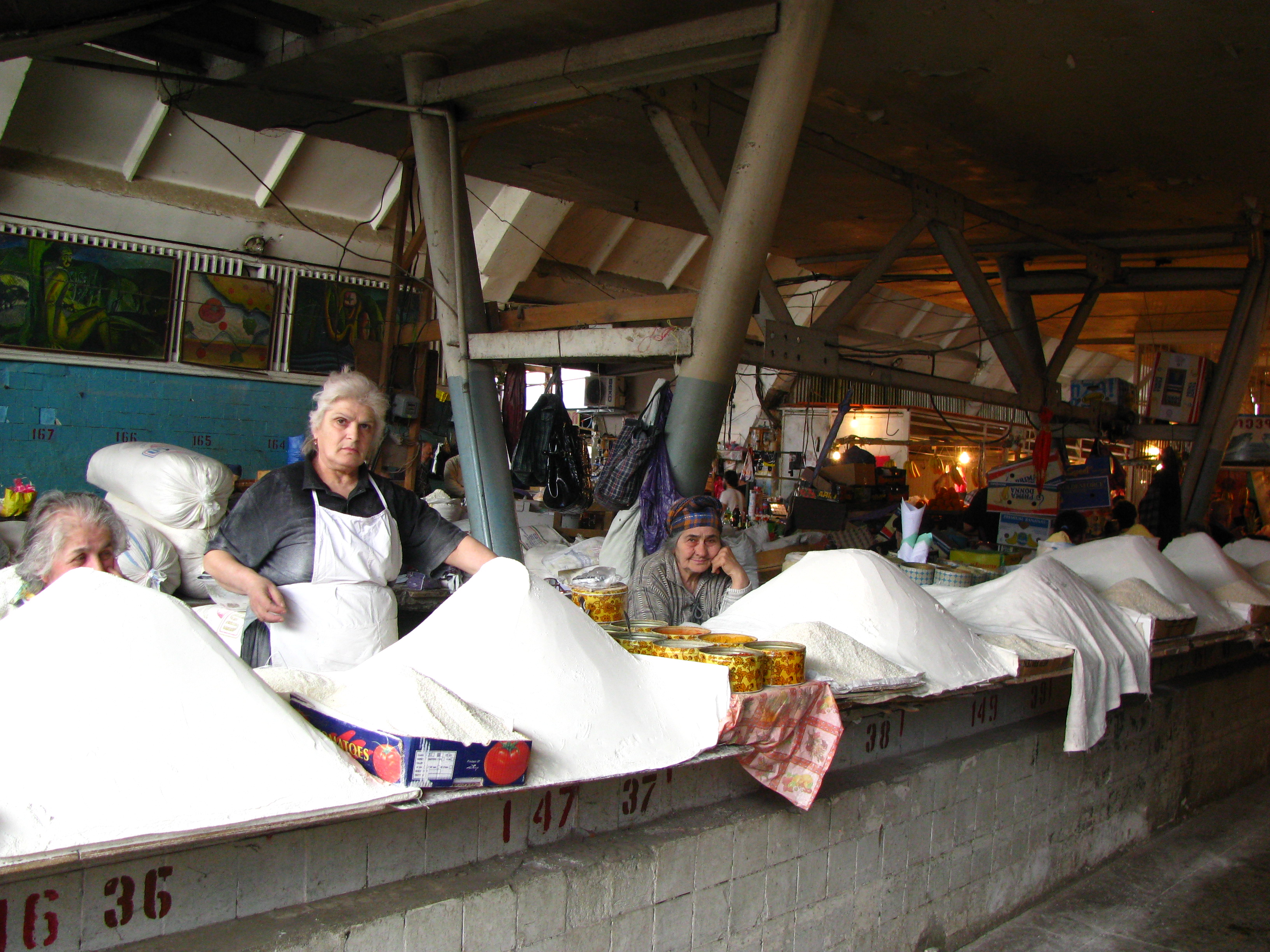
This is where you come to buy flour.
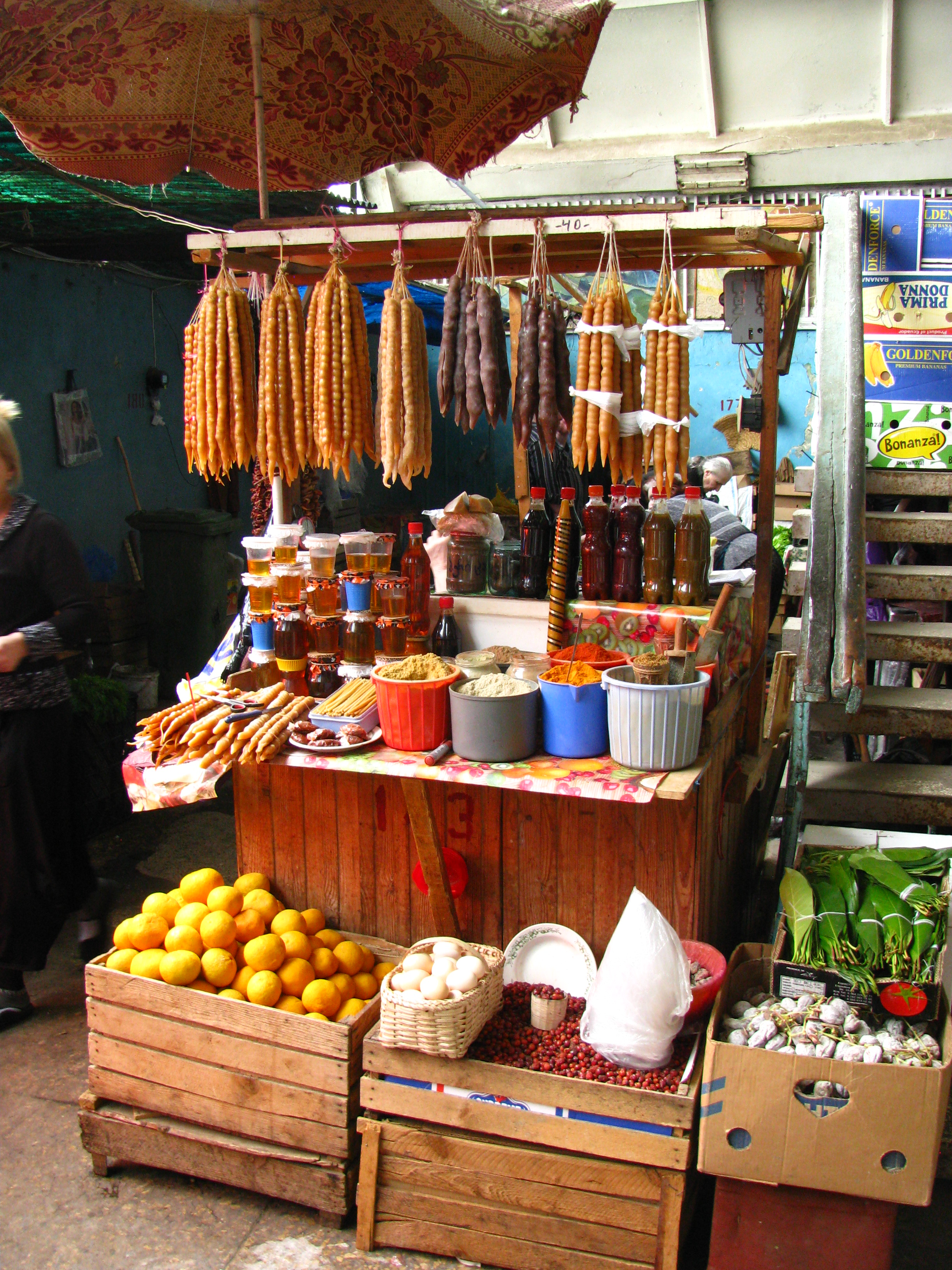
The candle-like stuff hanging from the top is churchkhela, strings of hazelnuts dipped in congealed grape extract. I assume the jars immediately beneath them contain wine.

Next, we take a left and promptly get lost in a giant bazaar.  Here, you can find all sorts of fruits and vegetables, beef and chicken, bread and cheese, wine and beer–basically, anything that you would usually get from a grocery store in the US.  Georgians have grocery stores too, but the bazaars are usually cheaper and fresher.  Plus, they’re a whole lot more fun.  I’ve heard that you can haggle with the vendors, though the prices are so low (1.5 GEL for a kilo of apples) that I’ve never felt a need.

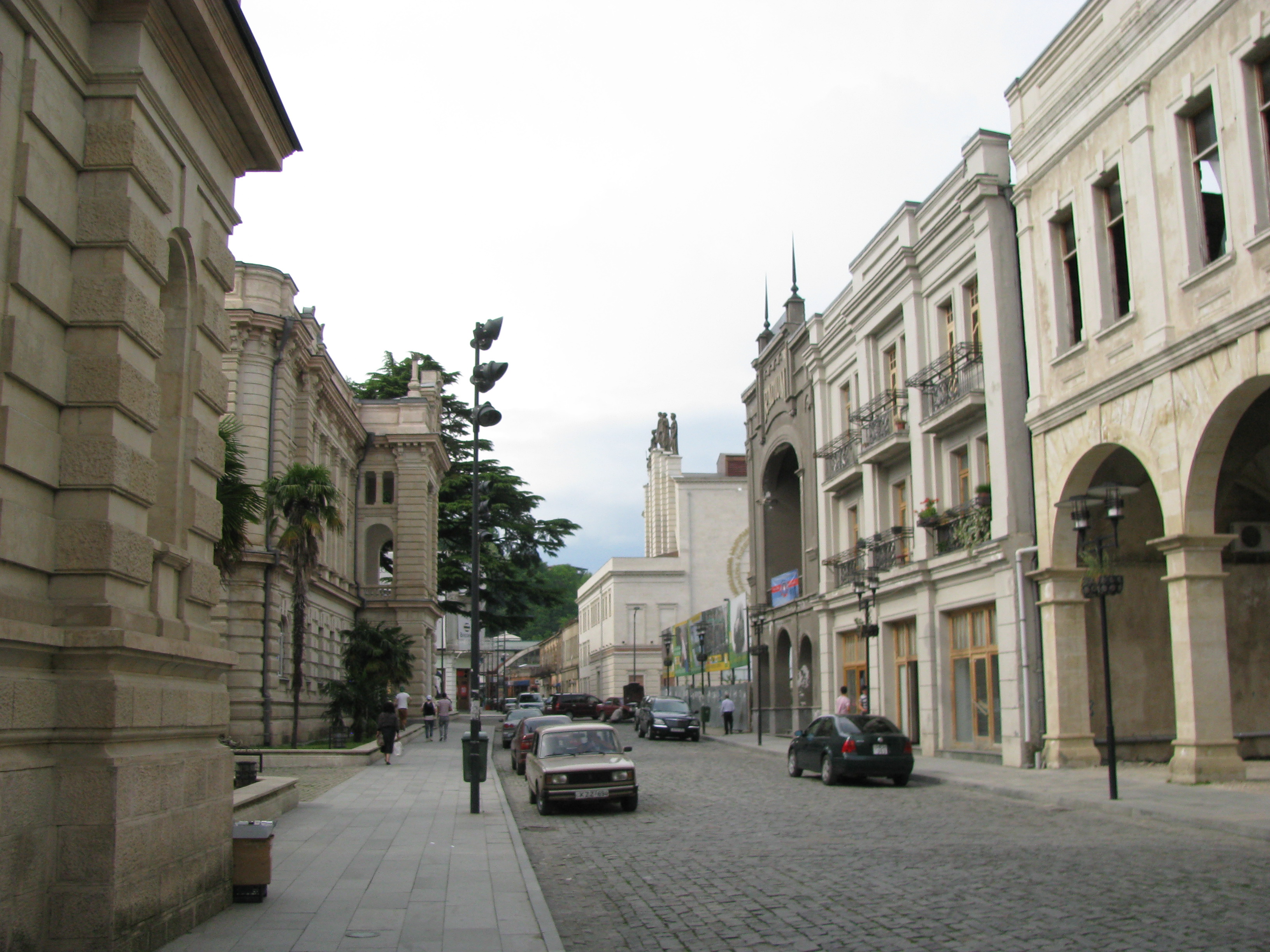
Rustaveli Avenue.
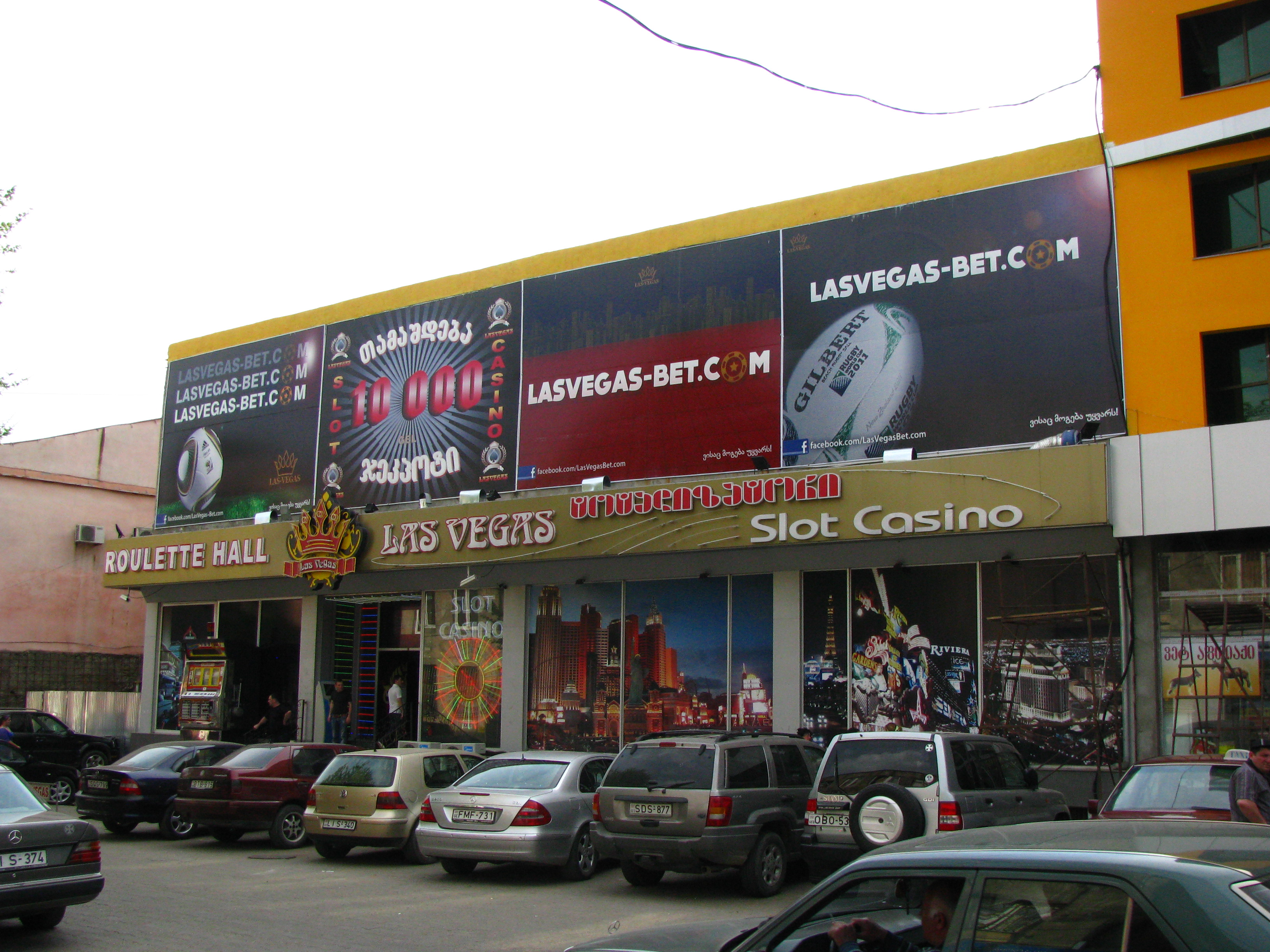
Las Vegas casino. Gambling is big in Georgia.
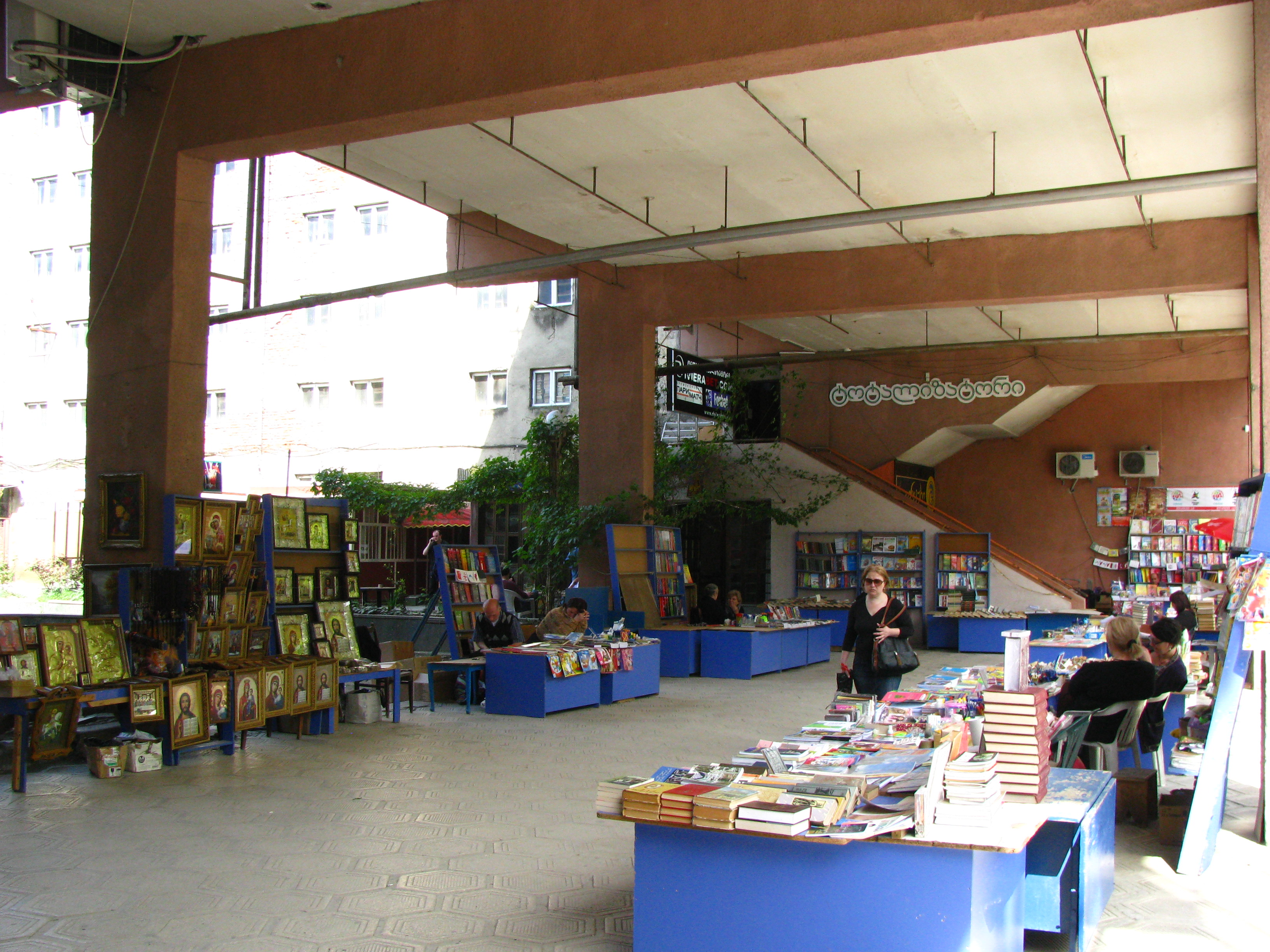
The book market. If I could read Georgian, this is where I would spend most of my time.

We spend a little bit of time wandering around before going to the main city park.  Heading up towards Jatchviskhidi, you can find all sorts of pawn shops, casinos, and money exchanging places, while near the library (at least, that’s what I think it is) there’s a mini-bazaar with all sorts of books.  Of course, that’s one of my favorite places to check out!

Along Rustaveli Avenue, however, the city takes on a pleasant European feel, with attractive cobblestone streets, wide boulevards, and Napoleonic architecture.  Here, you’ll find the opera house, the mayor’s mansion, and the central school (of 44 public schools citywide).

The view from just outside Medea Cafe.
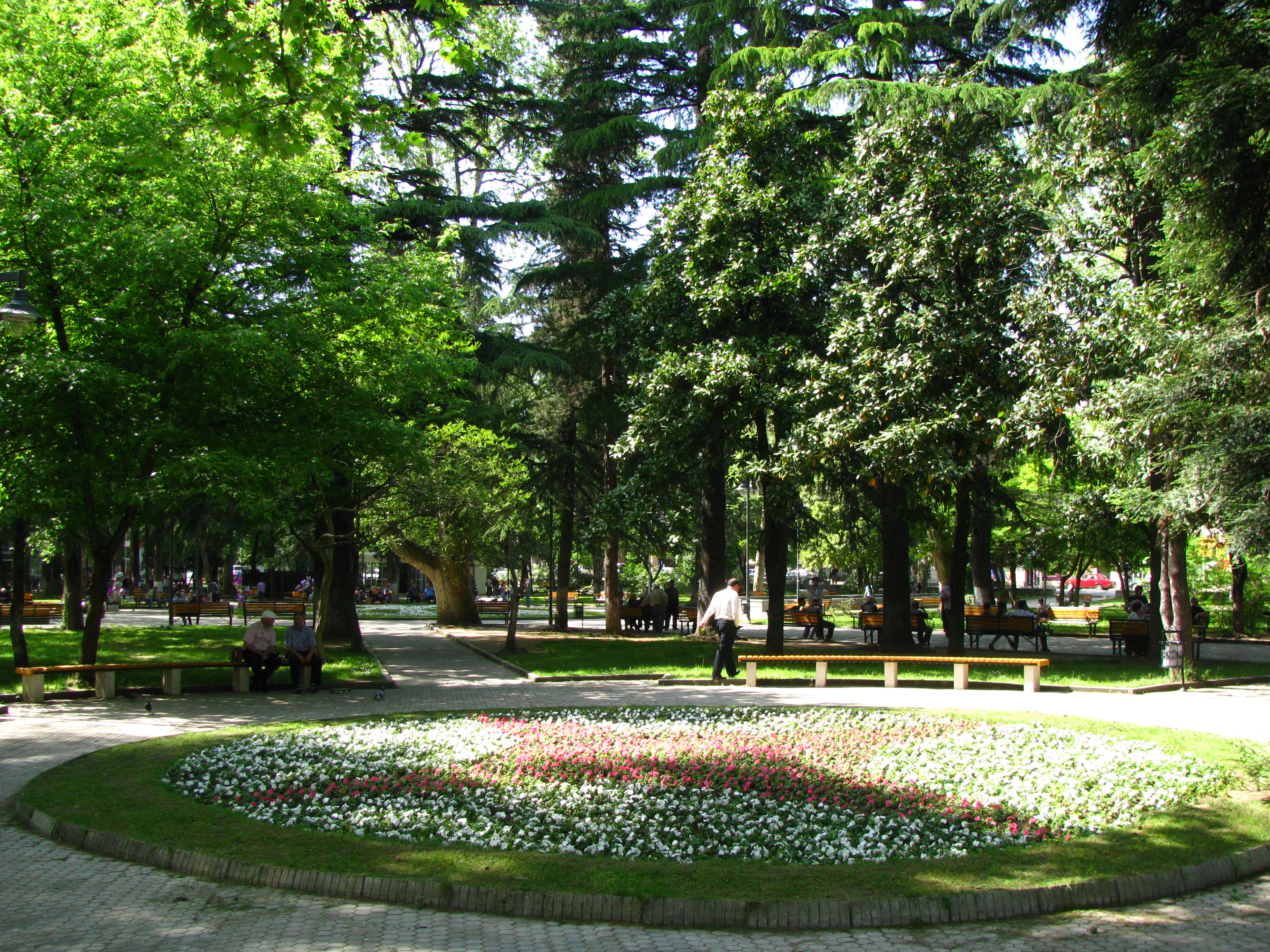
One of the many flower gardens in central park.
One thing Georgians (or at least, Kutaisians) know how to do right is their public parks.

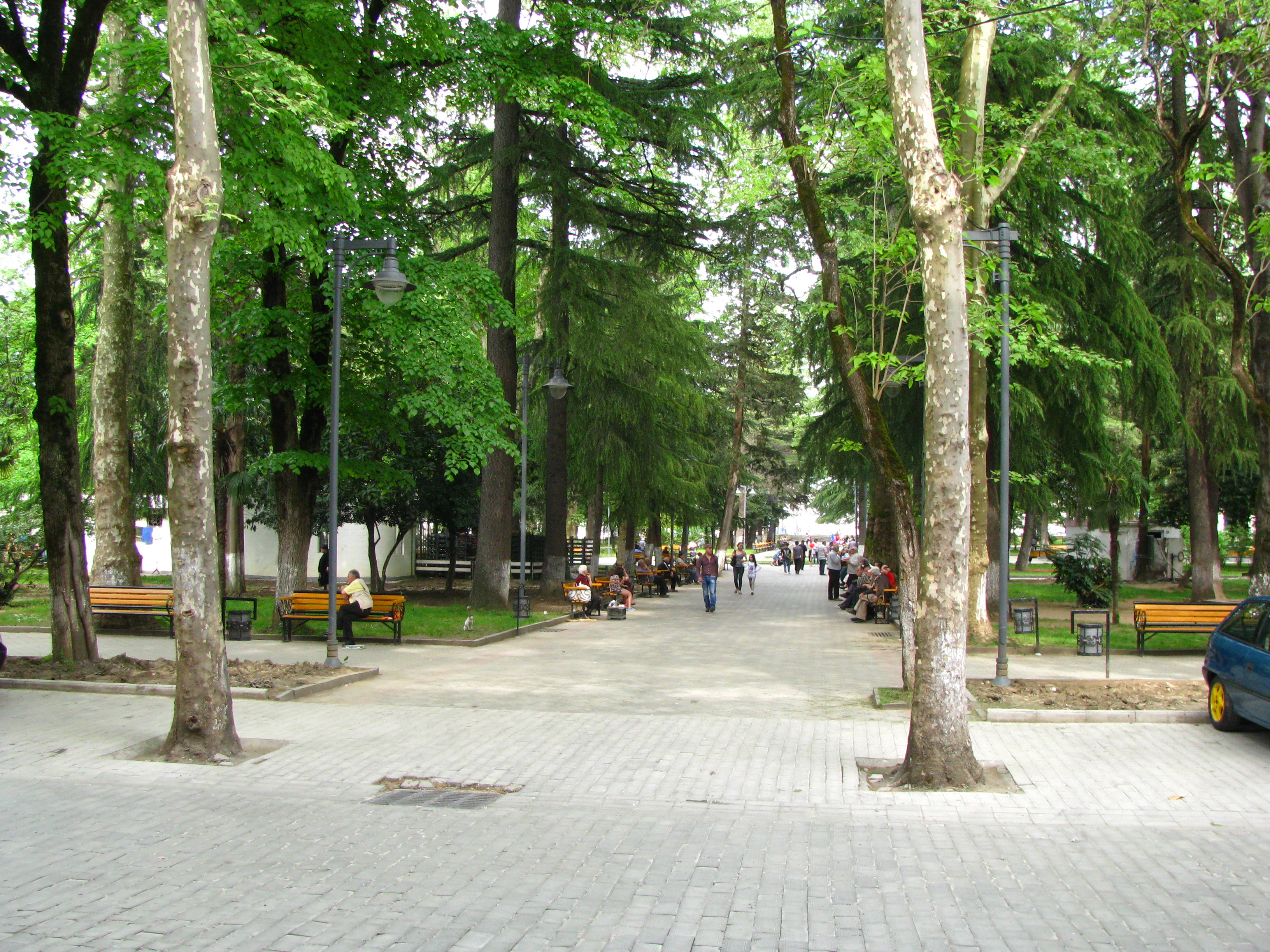
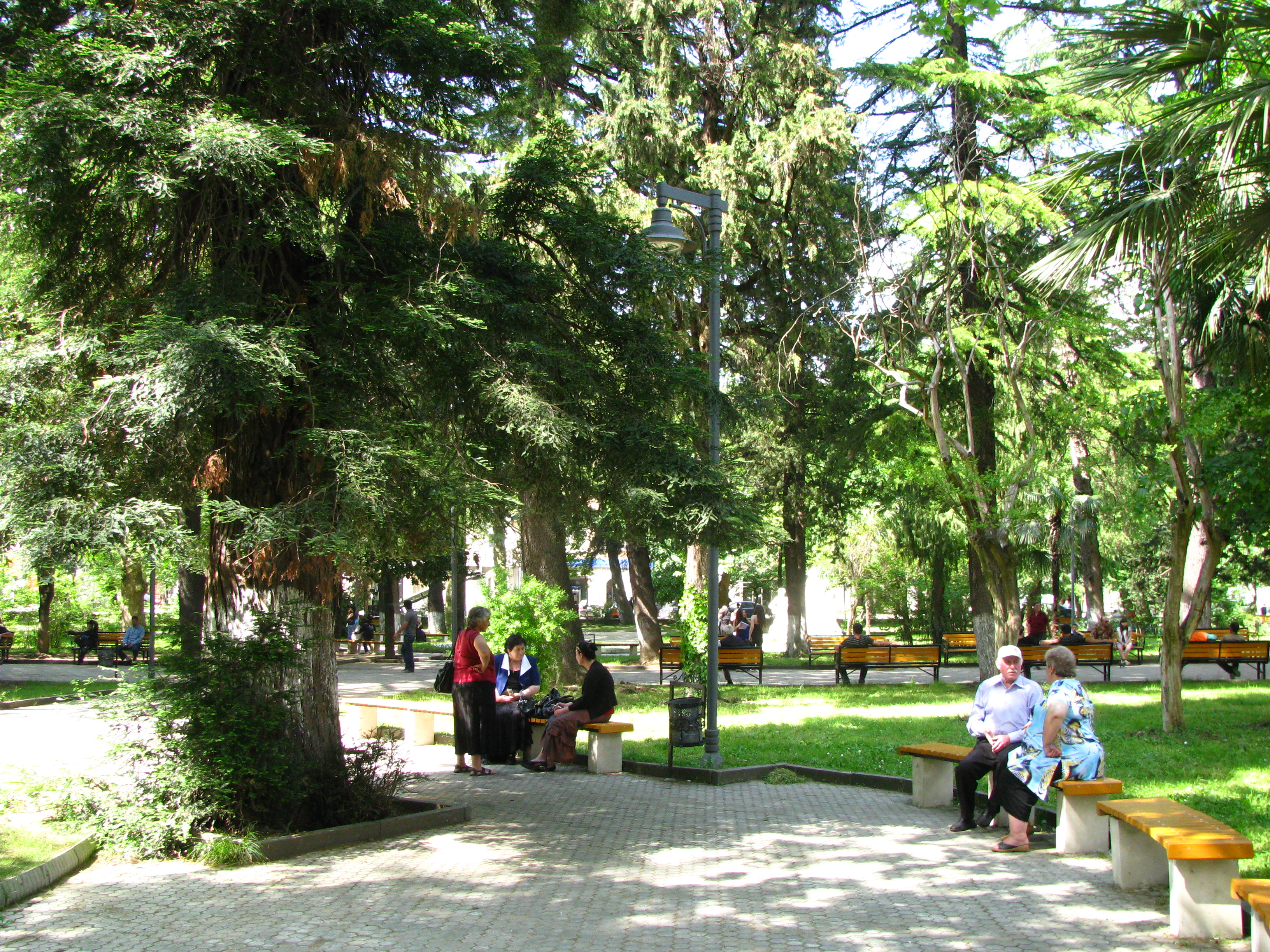
Next we come to Bulvari, the main central park of Kutaisi.  On a hot, muggy day, this is the perfect place to relax, with shady palm and pine trees, attractive public fountains, and plenty of benches to go around.  Vendors sell balloons, candy, and ice cream, while at the center, old men with cheap plastic cars take children for a ride around the main circle.

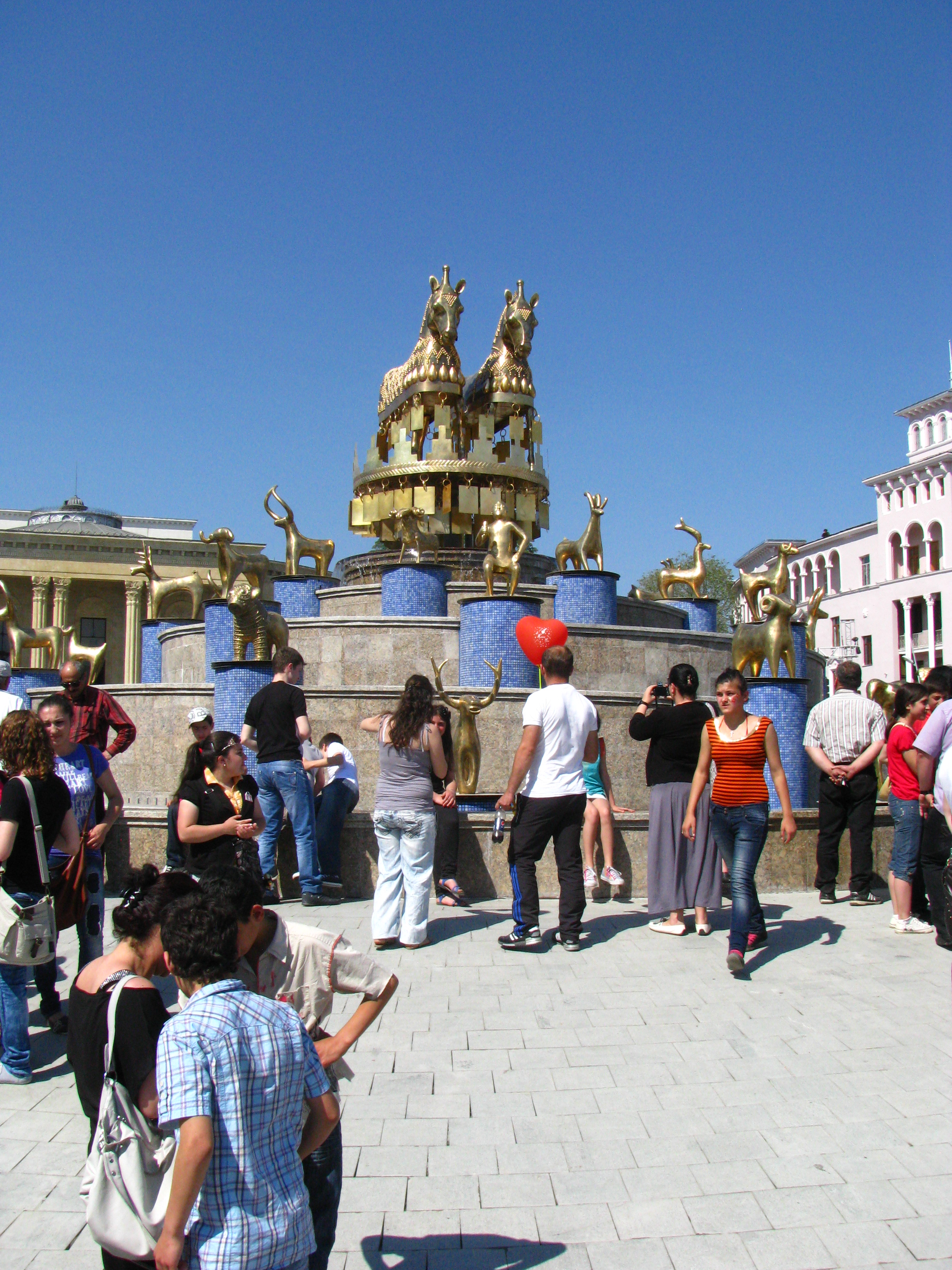
The new fountain at the main square. Some TLGers think it looks kind of tacky, but I think it’s a pretty good attempt to capture some of Kutaisi’s ancient heritage. There’s certainly plenty to choose from.

The main city square is on the other side of the park, with the theater on the left, the banking district on the right, and a giant fountain in the center depicting replicas of ancient Colchian artifacts found in Imereti province.  It’s one of the many interesting ways the city has been trying to reinvent itself since the end of the Soviet Union.  The statue of David the Builder that once graced this square now stands in front of the train station, at the end of the boulevard that bears the same king’s name.

You can see the back of Mirzani’s across the river. It’s probably the best restaurant in town.
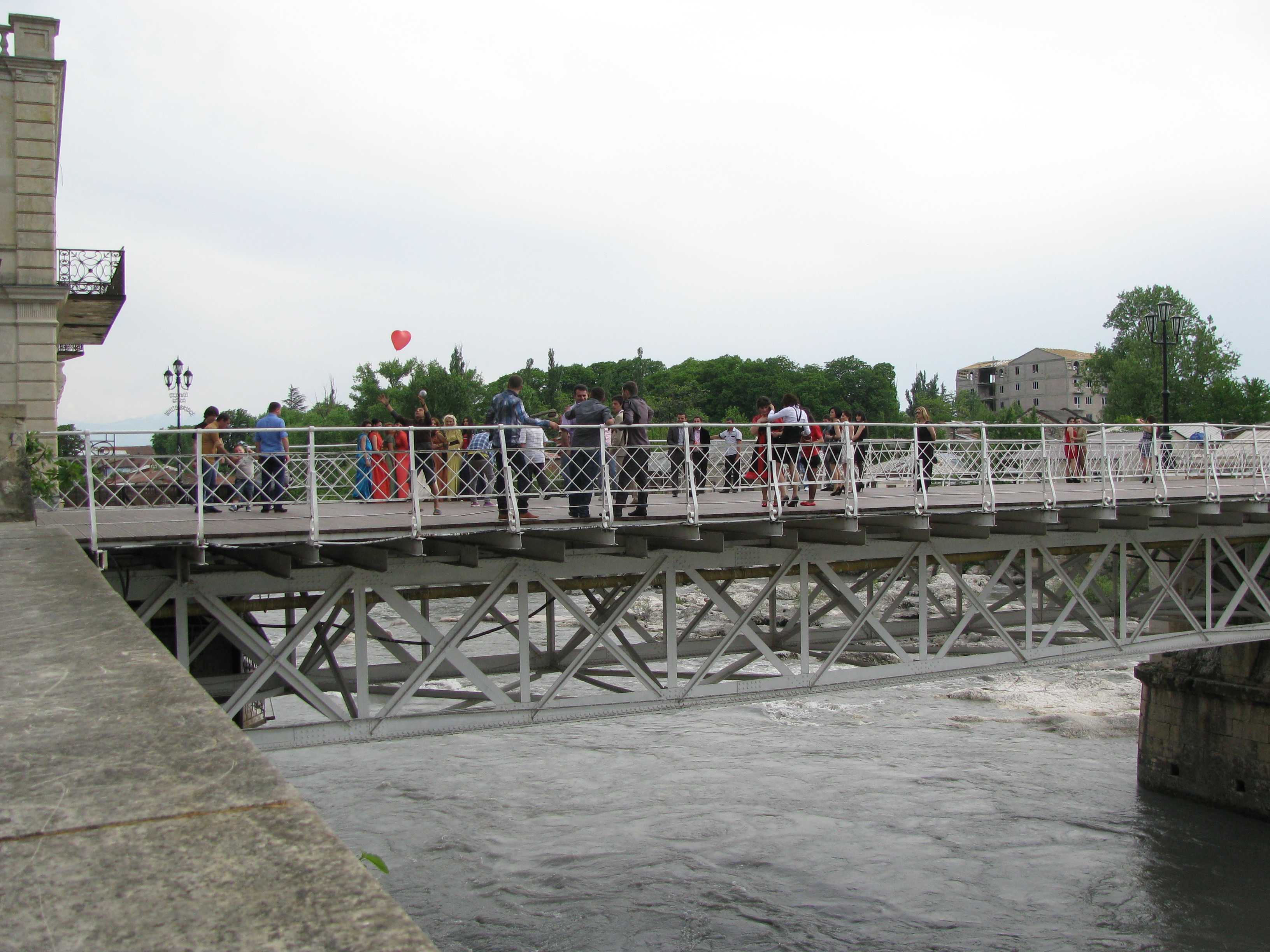
Tetrikhidi (White Bridge), with a wedding party posing for photos.
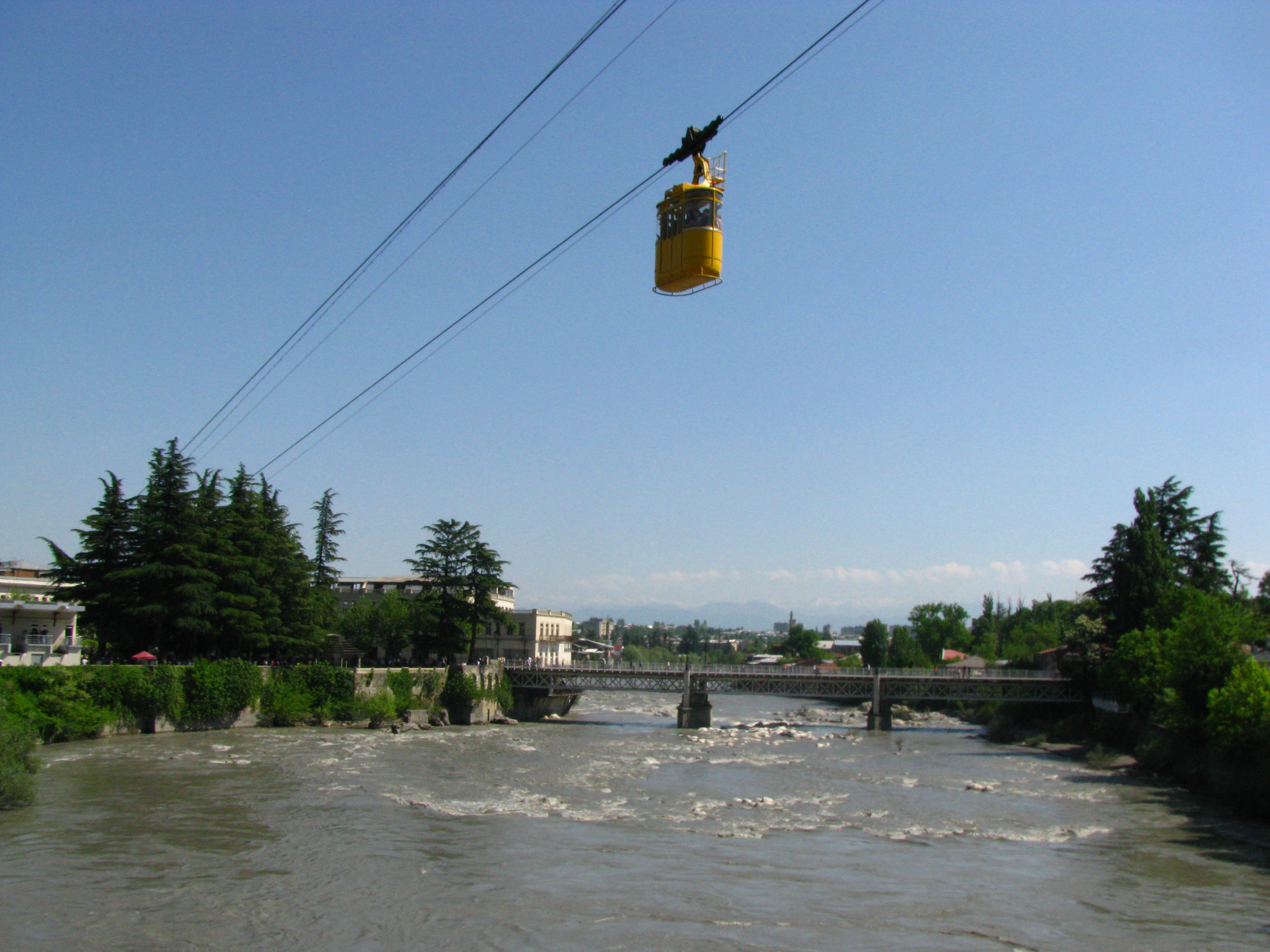
The Kutaisi gondola. I don’t know why, but Georgians seem to have a thing for gondolas.

Looping back around, we return to the Rioni river and the neighborhood immediately surrounding Tsitelikhidi.  There are actually three bridges here: Tsitelikhidi (Red Bridge), Rustaveliskhidi (Rustaveli Bridge), and Tetrikhidi (White Bridge), a pedestrian bridge next to another attractive garden.  From here, a gondola takes visitors over the river to an amusement park at the top of a hill.  On the weekends, wedding parties often stop here to take pictures, then speed around the city honking their horns and making noise.

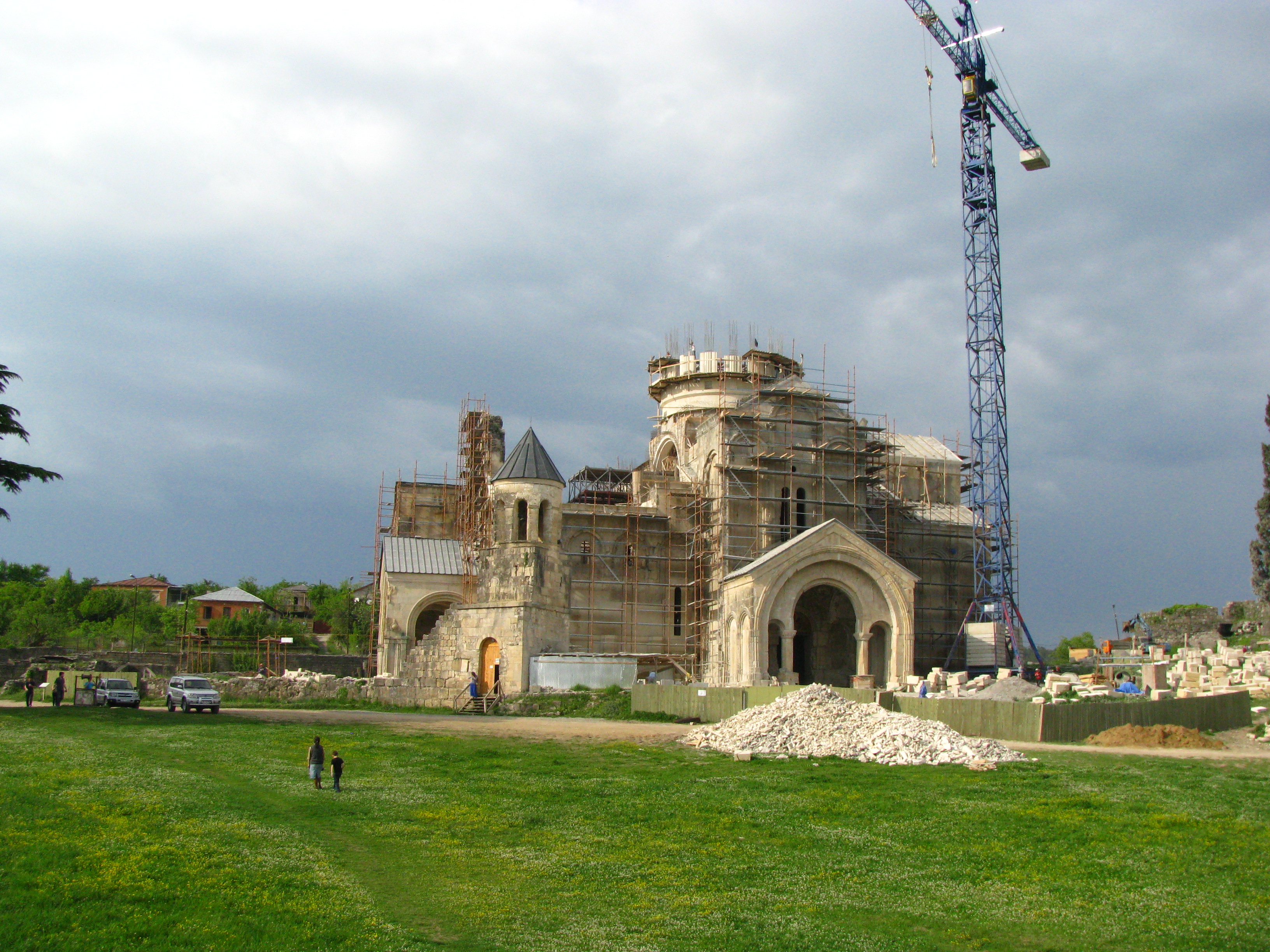
Bagrati Cathedral in the spring.
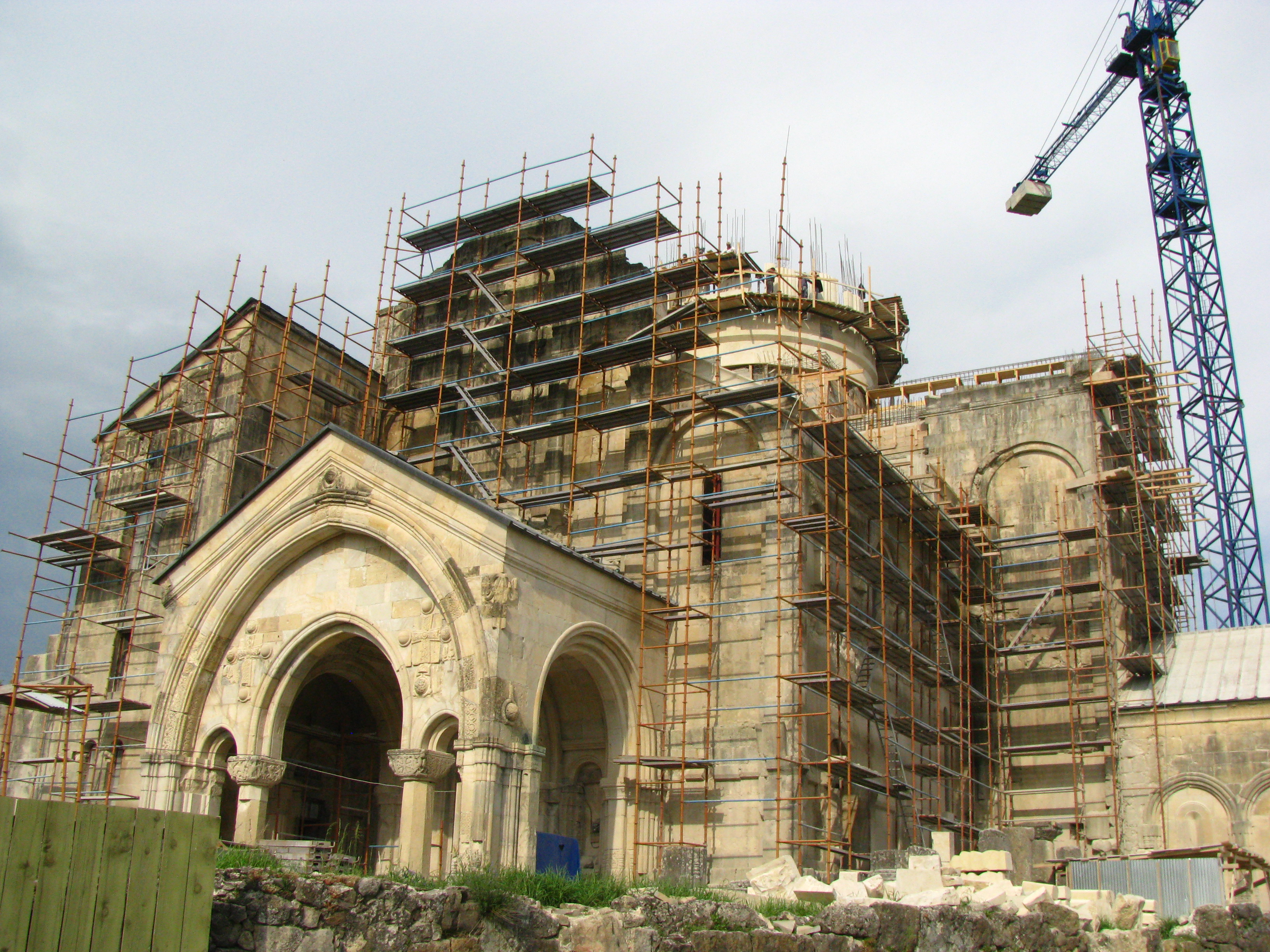
Close up of Bagrati. The reconstruction is actually progressing fairly rapidly.

Heading north, we pass through the markets again and cross over Jatchviskhidi (Chain Bridge) to the right bank of the Rioni.  After passing another curbside station–this one for marshrutkas heading to the northern villages–we climb a 200 step staircase and find ourselves at the foot of Bagrati Cathedral.

Bagrati is a thousand year-old Georgian Orthodox church, the largest and most important in the city.  After the Turks razed it in the 18th century, it lay in ruins for hundreds of years.  But now, with Georgia’s newly-won independence and the economic boom fueled by the IMF and other foreign investors, the historic cathedral is under reconstruction.  I probably won’t be here when it’s finished, but I definitely want to come back and see it when it is.

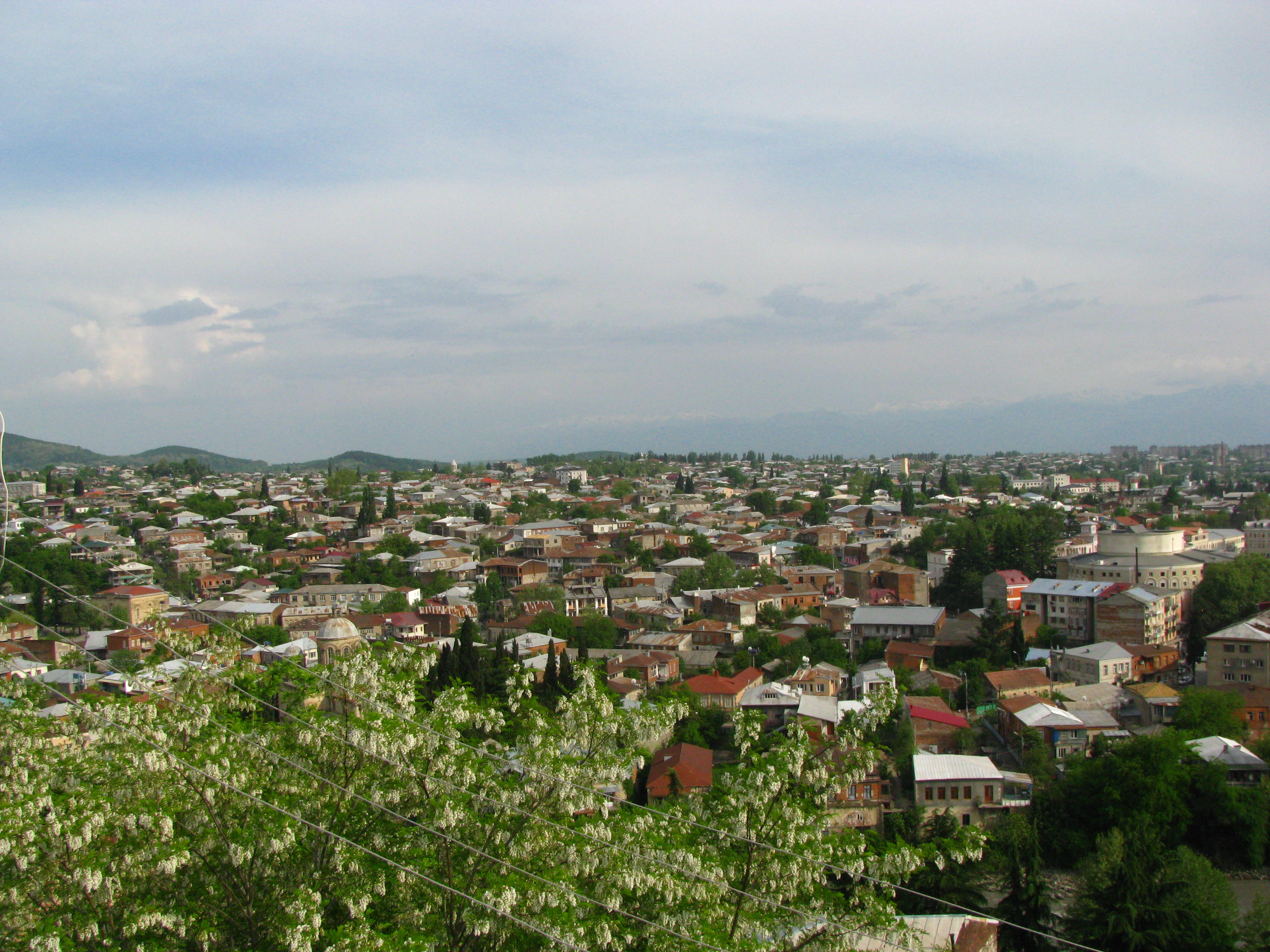
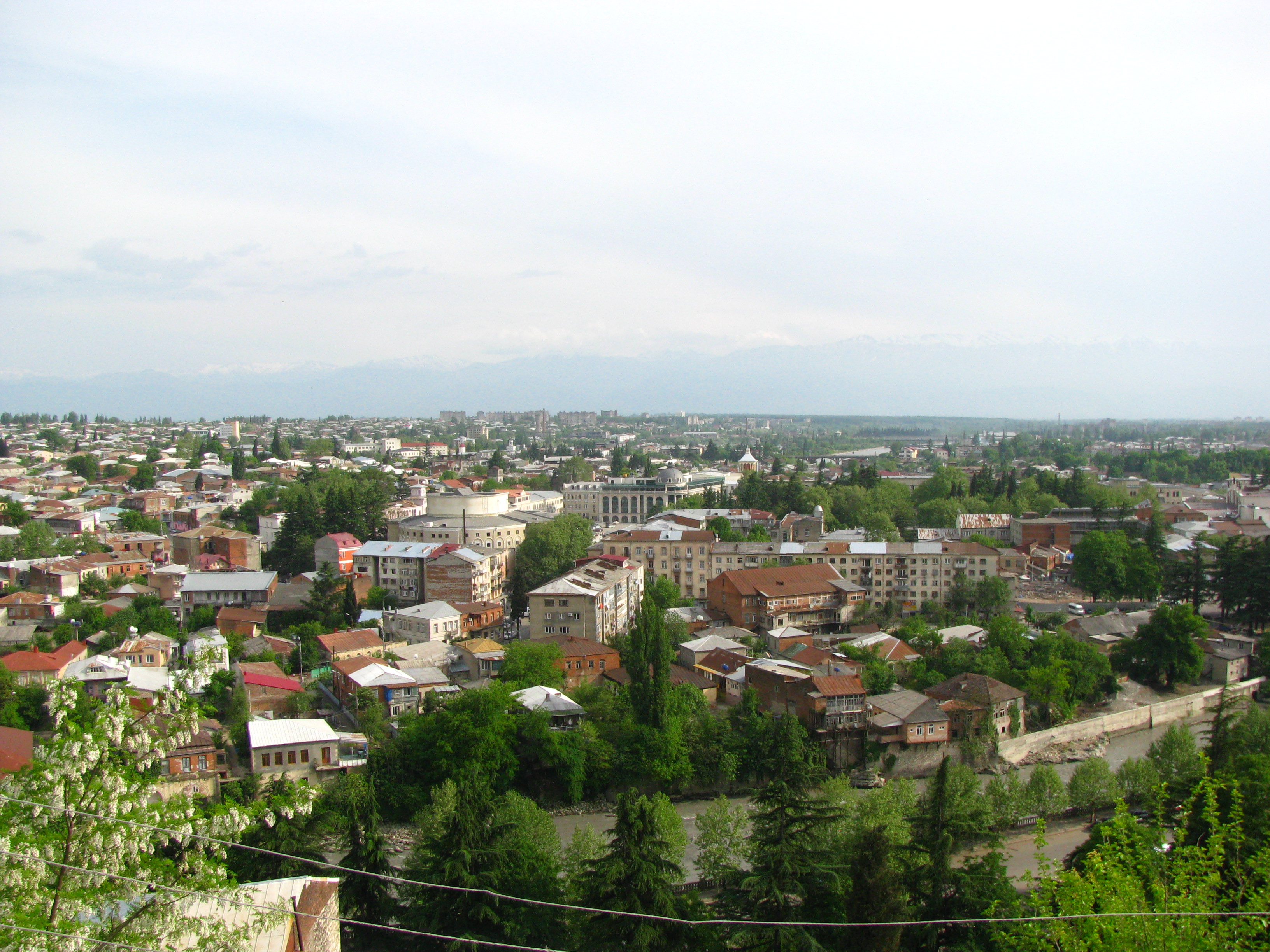
The view looking southeast.
The view looking southwest. The mountains in the distance are the Lesser Caucasus, about 4000 meters above the elevation of the city.
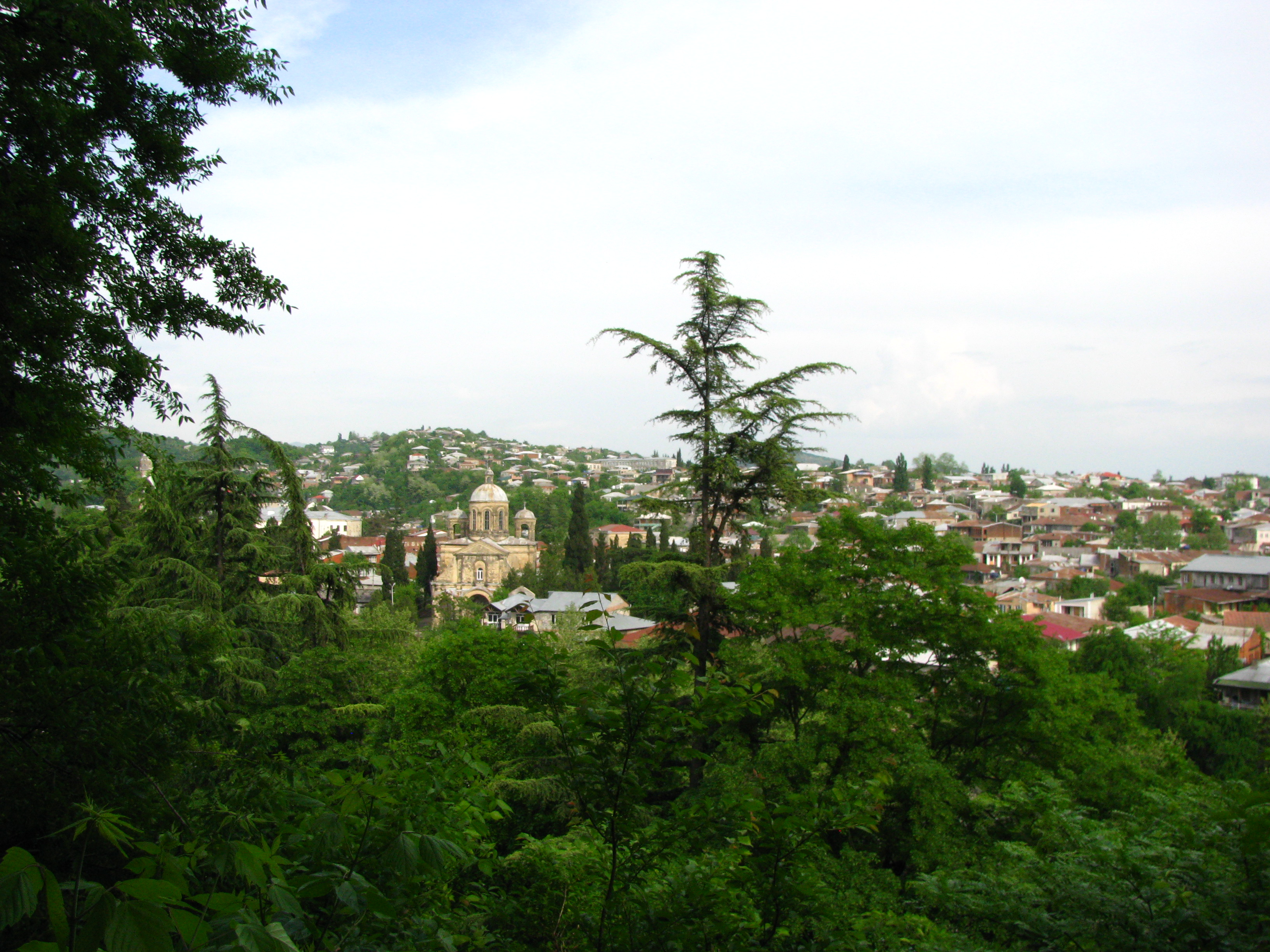
View from the steps leading up to Bagrati. Kutaisi has a lot of churches.

Bagrati Cathedral sits on an imposing hill with a magnificent view of the whole city.  Here, you get a sense of just how big Kutaisi really is.  It’s not a tall city, or a particularly busy city, but compared to the rest of Georgia outside of Tbilisi, it’s pretty huge.

Unlike Tbilisi, however, the city has had very little exposure to the West.  People still stop to stare curiously at foreigners, and hardly anyone speaks English.  It’s much quieter than Tbilisi, too, with fewer cars, more parks, and lots of gardens and orchards, even in the more crowded districts.  People live closer to the land, and travel often to the outlying villages where they still have friends and family.

Perhaps the best way to put it is that Kutaisi still possesses that sense of rustic Caucasian innocence that Tbilisi has since lost.  You can hear it in the way people laugh and see it in the way they kiss and are kissed by their children.  For a city that was legendary long before the maps showed America as a separate continent, that’s no small thing.

მე ♥ ქუთაისი


Trope Tuesday: Hoist By His Own Petard

One of the most satisfying ways to defeat the villain is to have his own nefarious scheme bring about his downfall.  In Hamlet, Shakespeare described this as “hoist by his own petard,” or blown up by his own bomb.  Basically, it’s a self-deposing villain whose evil plans have gone horribly right.

Not only is this a delicious form of death by irony, it’s also a satisfying way to show cosmic justice in action while allowing the heroes to keep their hands clean.  When done best, the villain keeps the tension notched up to eleven and only commits his fatal mistake after the heroes have made their last stand.  Bonus points if the petard takes the form of a minion who decides to switch sides.

Perhaps unsurprisingly, you’ll often find this trope in stories geared towards a younger audience, which generally try to avoid messy endings and shades of gray.  In some ways, it almost resembles a Disney Villain Death, in that the heroes often come out with clean hands and an unambiguously clear conscience.

However, this isn’t always the case–sometimes, it’s precisely because of the shades of gray that the villain’s plans become self-defeating.  Case in point, Pride and Kimblee from Fullmetal Alchemist: Brotherhood.  You’d think that both characters are totally evil–and perhaps they are–but that doesn’t stop the one from undermining the other at just the right moment.

When done right, this is an incredibly satisfying way to defeat a bad guy.  When done poorly, however, it undermines the villain altogether, or turns the story into just another Aesop.  As always, your mileage may vary, so when writing one of these stories it’s important to keep your audience in mind.

In my own books, it’s probably more common for this to happen to the heroes, which probably makes it a form of Two Rights Make A Wrong or Nice Job Breaking It, Hero.  I do enjoy hoisting the villains as well, though, and will almost certainly use this trope in the future.

Life in Georgia is like a game of backgammon

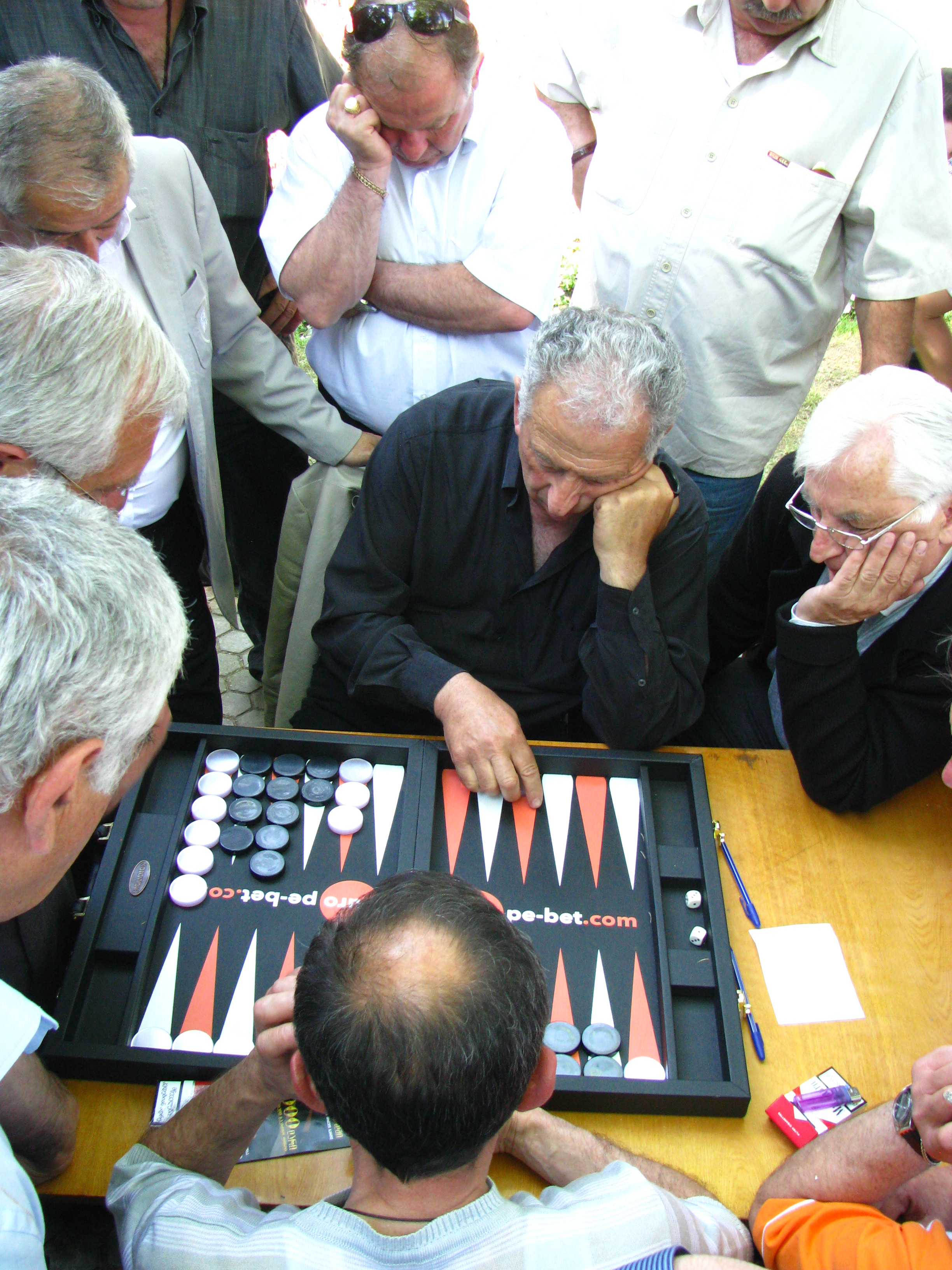
Just another game of high stakes backgammon.

Everywhere I go, I see people playing ნარდი (“nardi”), known in English as backgammon.  Men and women, children and the elderly–everyone knows how to play, and just about every family owns a backgammon set.  It’s popular everywhere in Georgia, but it’s especially popular here in Kutaisi, where it’s not uncommon to see clusters of old men playing on the side of the street.

I recently played in a nardi tournament at my school.  Long story short, I was massacred (I still want a rematch with the principal), but the experience got me thinking about how the game kind of parallels what life is like in Georgia.  As a foreigner, I’m sure I don’t have a complete picture, but it’s an interesting way to look at things, and I don’t think it’s completely off base.

So anyways, here’s my theory on how life in Georgia is like a game of backgammon:

1: Everything is driven by chance.

In backgammon, every turn starts with a roll of the dice.  Likewise, in Georgia, people tend to approach life like a game of chance.  Good things happen, bad things happen, but you’re never totally in control of your own destiny.  When your luck turns sour, the best thing you can do is just resign yourself to it until things get better.

One thing I’ve noticed about my host family is that they play the lottery almost every day.  Even when they aren’t playing, they usually tune in to see the results, probably just from force of habit.  I don’t know if every family is like this, but there are stands to buy lottery tickets in every major district of the city, and every kiosk sells them.

It’s not just the lottery, either–there are tons of casinos too.  In fact, Georgia is a very popular tourist destination for Israelis simply because of all the gambling.  That doesn’t mean that everyone in the country is a hardcore gambler, though–but if life is ultimately a game of chance, you might as well put a line or two in the water, right?

2: Skill is the ability to manipulate chance in your favor.

Even though backgammon is essentially a game of chance, there’s a lot of strategy to it too.  The key is to maximize your own options while limiting the options of your opponent.  It’s all about knowing when to move aggressively, and when to protect your own interests.

Likewise, even though Georgians put a lot of trust in luck, they also know that it’s better to make your own luck than to wait for luck to find you.  While my host family does spend a little bit on the lottery, they spend a lot more on physical improvements and their kids’ education.  My host dad works until 8pm every night, sometimes later.  They aren’t rich, but they’re taking advantage of opportunities their parents didn’t have, and making sure their children have more opportunities than they did.

3: No amount of skill can change the established pattern.

There’s not a whole lot of variation in backgammon.  Every game starts with the same setup, and follows the same general pattern: block your opponent while doing your best to advance.  Once your last piece passes your opponent’s last piece, it becomes a race to see who can get all their pieces home first.  Short of changing the rules, there’s really no way to break the game.

Likewise, life in Georgia is still very much about tradition.  If you were born in Kutaisi, you’ll probably die in Kutaisi.  If your parents are Orthodox, then that’s what you are, too.  If you’re a woman, you live under a certain set of restrictions and expectations.  Likewise, if you’re a man, there are certain things you’re expected to do to prove your manhood.

No matter how much Georgia changes to become part of the modern world, it’s an ancient country with a very, very long memory.  Most social norms aren’t going to change overnight, and some of them probably won’t change at all.  While this might seem incredibly stifling to us in the West, it does have its advantages, such as offering everyone a sense of identity and giving them a place where they know that they belong.

So that’s my theory.  I don’t know if this is why backgammon resonates so much with the people here, but it’s a fun way to look at it.  Now I just need to figure out which game is the most like life in the US.  Poker?  Monopoly?  Dungeons & Dragons?

Trope Tuesday: The Cavalry

Things look bleak: the Big Bad is on the verge of conquering the world, and the heroes have gathered for one last stand.  Just when it looks like all hope is lost, a horn sounds in the distance, and the cavalry arrive to save the day.  Whether a ragtag bunch of minor characters, an army of unlikely heroes, or the ultra-heroic Eagle Squadron, the timely reinforcements use their overwhelming force to crush the villains and save the day.

When done right, this trope can be one of the defining moments of greatness of the entire work.  When done wrong, however, it becomes little more than a Deus Ex Machina of the most unsatisfying kind.  How, then, can this moment be done right?

As with any Deus Ex, one of the keys is to adequately foreshadow the end.  This often takes the form of Gondor Calls For Aid, when the heroes petition the cavalry for assistance before going into battle. To make things interesting, the relationship between the two parties is often complicated and ambiguous, making it doubtable that the cavalry will actually show up.

However, I think it goes deeper than this.  In order for the arrival of the cavalry to be satisfying, it needs to not invalidate everything that the heroes have already gone through.  If the cavalry shows up after the heroes have defeated the Big Bad, and essentially rescue them from a heroic sacrifice, that’s satisfying.  If the heroes are still fighting the Big Bad and the cavalry comes out of nowhere to hand them an unearned victory, that’s cheap.

In English 318R, Brandon Sanderson often used the film versions of the Lord of the Rings Trilogy to illustrate this.  The Battle of Helm’s Deep was satisfying, because the entire premise was to hold out until the third day.  When Eomer arrived with the Rohirrim on the morning of the third day and swept away the Uruk-Hai, that didn’t invalidate King Theoden’s efforts because all he was trying to do was survive.

In the Battle of Minas Tirith, however, Aragorn’s arrival with the unbeatable army of the dead was kind of cheap, because the premise was to defeat the orcs, not to hold out for reinforcements.  Gondor could have just stood down and let the orc army capture the city, and they still would have won in the end.

The two genres where you’re most likely to see this trope are westerns (trope namer) and heroic fantasy. Just about every David Gemmell novel involves a cavalry moment of some kind, and I looove it.  It’s also quite common in military science fiction, too–basically, any story where war is a major part of the narrative.

The variations on this trope are also quite fascinating.  For example:

Easter in Trabzon

Orthodox Easter is April 15th, and in Georgia, most places take off four or five days for vacation.  In typical Georgian fashion, we didn’t know for sure how many days we had off until a couple of weeks before the break came up, but fortunately that was time enough to find out where some of the other TLGers in Kutaisi were going and tag along with them.

Our group consisted mostly of TLGers and embassy staff from Tbilisi, friends of my friends in Kutaisi who came out at the same time last year.  For 300 GEL (about $185 USD), we got a private marshrutka and tour guide for four days, 3- and 4-star hotels each night, breakfast and dinner, and tickets to some of the more interesting sights between Reza and Trabzon.  Multiple entry visas were $20 USD each, and the exchange rate in Turkey was quite favorable.

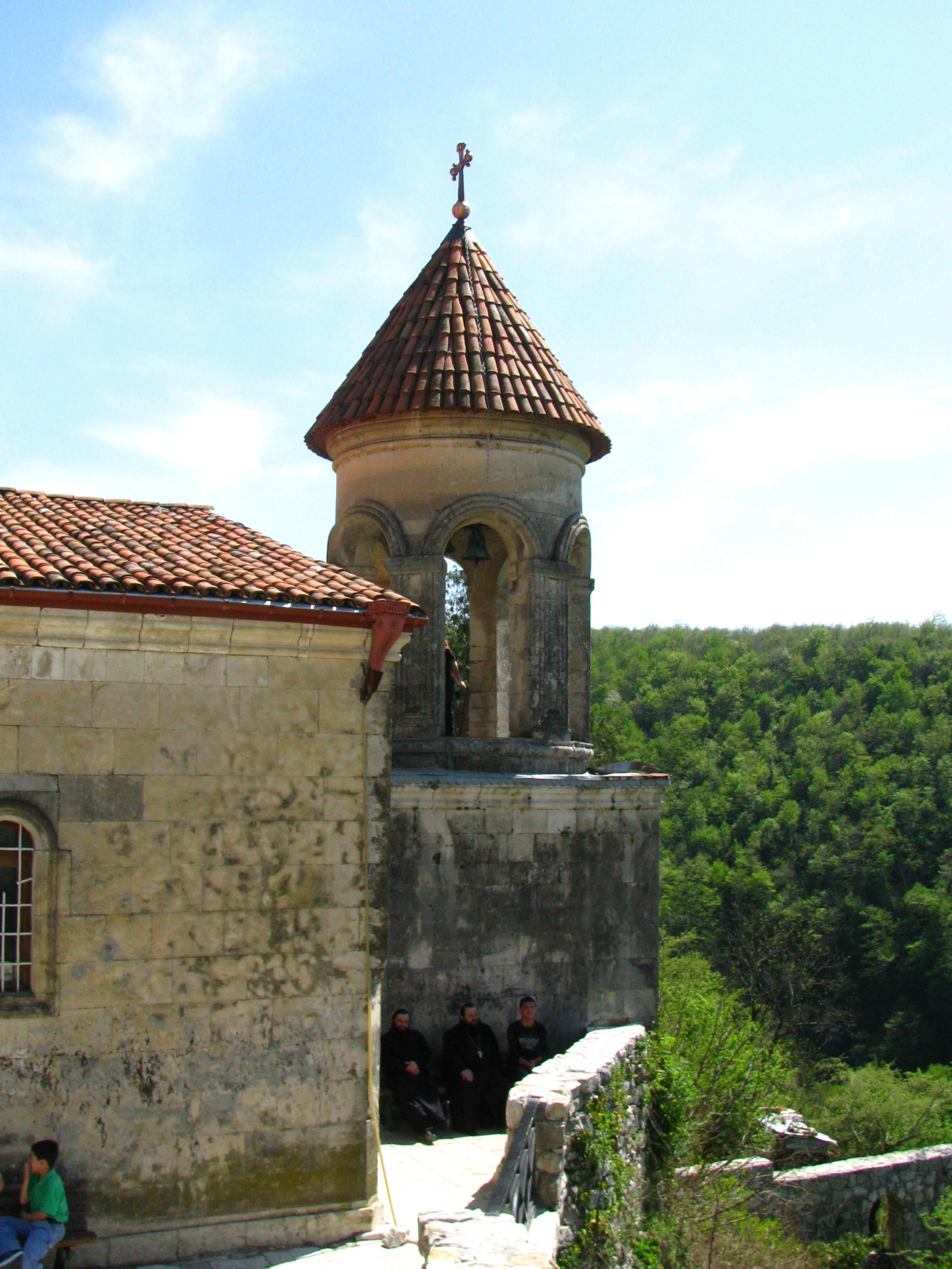
We met up at the McDonalds on Tchavtchavadze Street at noon and went up to see Motsameta Monastery.  In spite of the fact that it’s so close to Kutaisi, this was my first time going up there, and I must say I was quite impressed!  The monastery is situated on the top of an imposing cliff where the Tsqaltsiteli River makes a sharp bend.  The English translation of the river is “red water,” named for the two Christian martyrs who were executed on the site of the monastery by the Muslims shortly after their conquest of the region.

Some priests hanging out by the chapel on Easter Sunday.
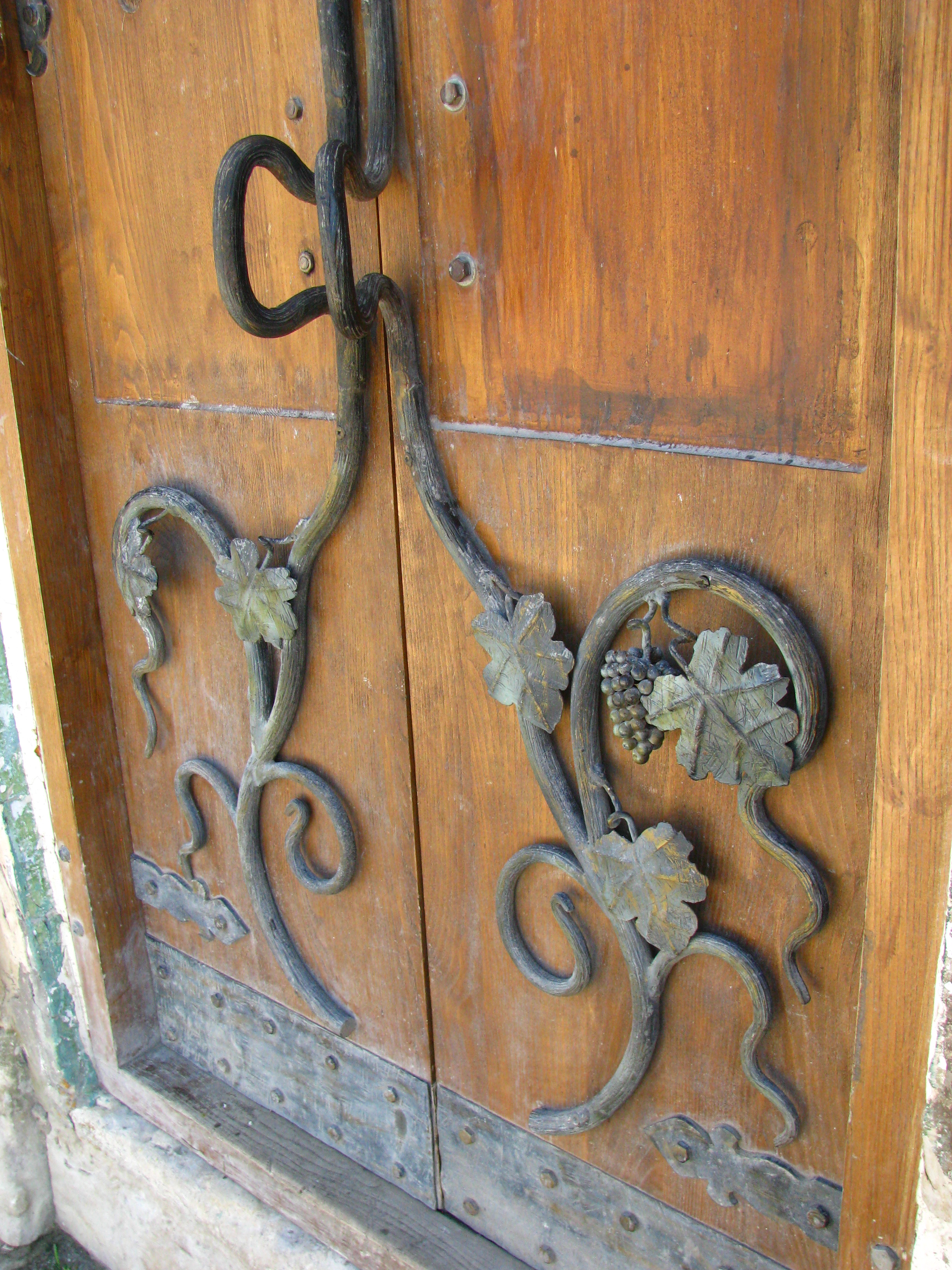
Detail on the door handles to the monastery chapel. Georgians take their grapes quite seriously.

I spent most of the vacation relaxing, so I didn’t take many spectacular photos.  But Motsameta was really fantastic–I’ll have to go back sometime to do it justice.  There’s a forest trail that goes between Motsameta and Gelati Monastery, where David the Builder is buried, and I’d like to hike that before I come back to the states.

Next, we drove down to Batumi on the Black Sea, where we spent some time wandering the Botanical Gardens.  It’s a really nice place, with trees and plants from all over the world right up against the seashore.  Very peaceful.  It’s pretty big, though–I walked for almost an hour along the main road without getting to the end.  And of course, there are many places along the way where you can stop and wander around for a while.

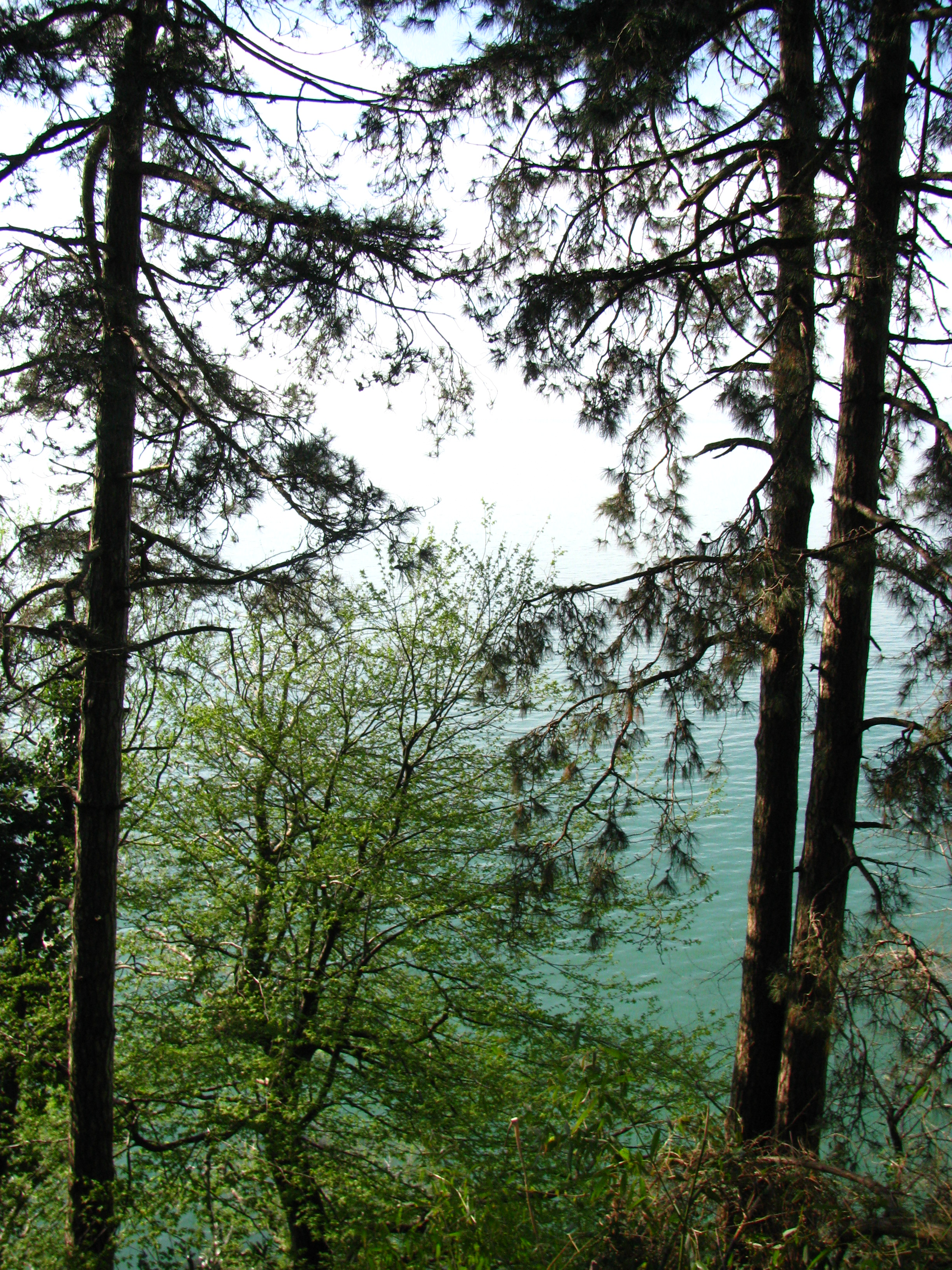
The Black Sea, visible through the trees of the Batumi Botanical Garden.
Some red and white rose bushes. There are tons of flowering plants in the gardens, so spring is a really great time to see the place.
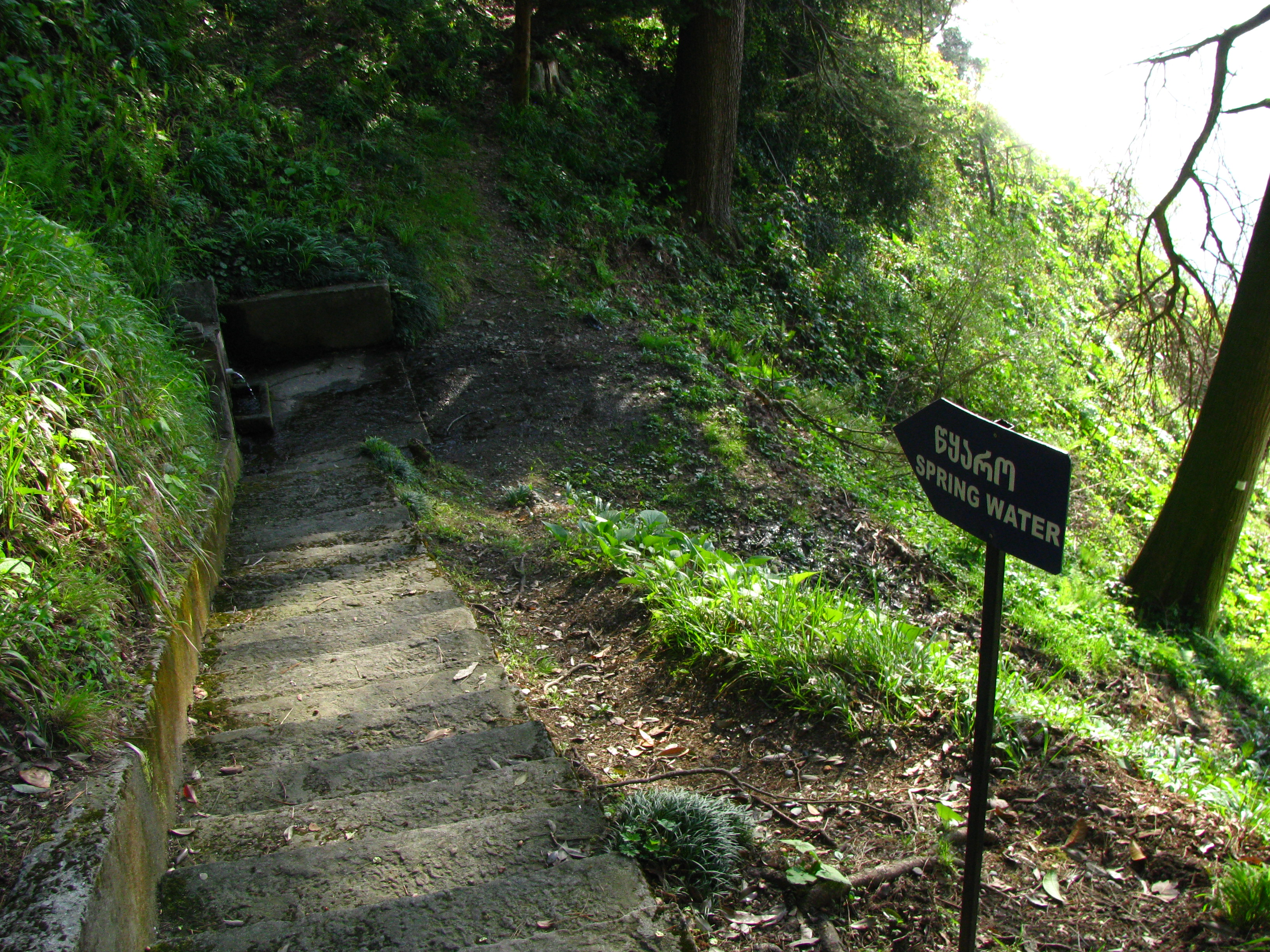
A small spring in the middle of the Batumi Botanical Gardens. There are springs like this scattered across Georgia.

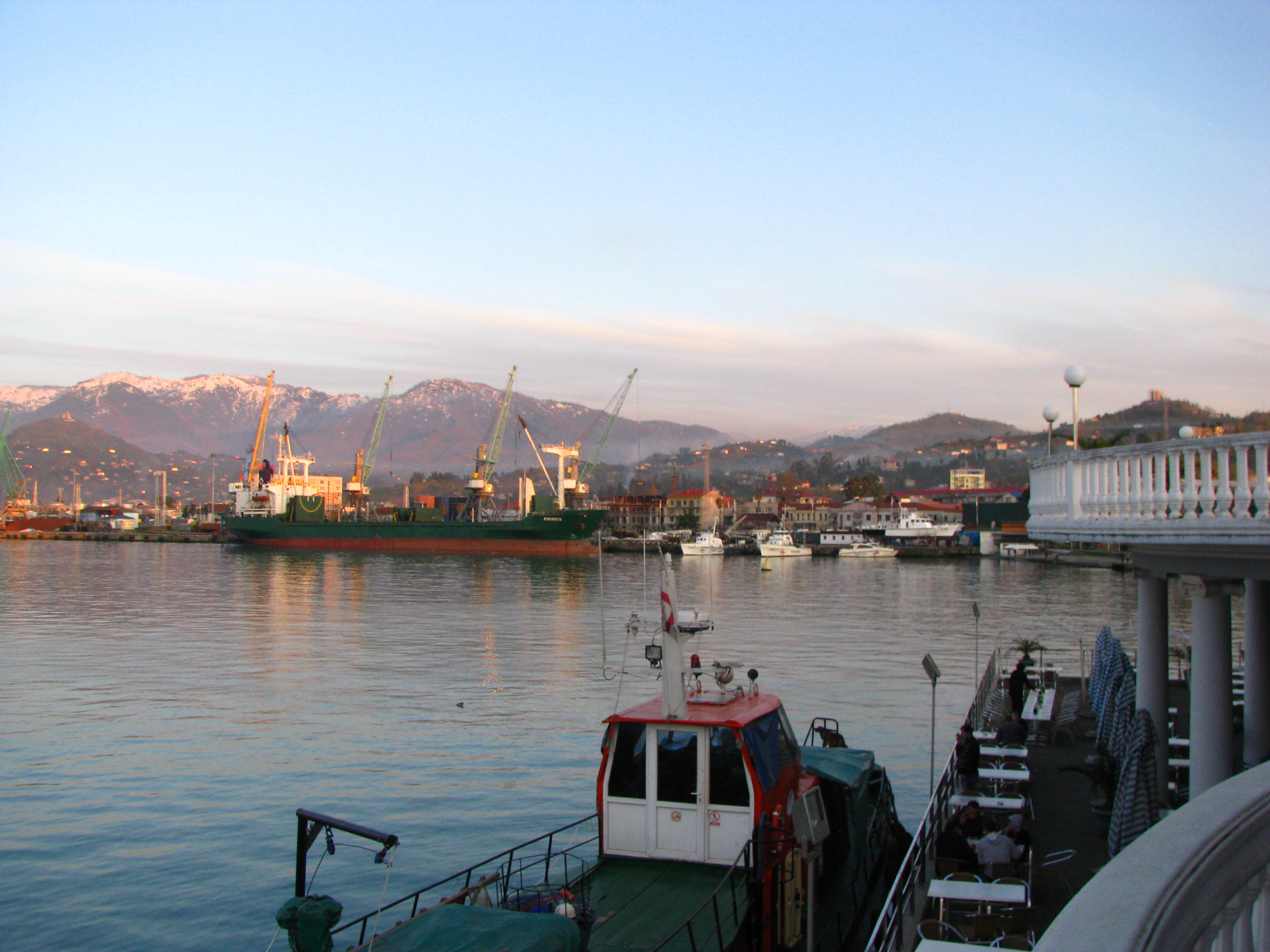
Batumi is an interesting place–not as big a city as Kutaisi, but with more money, hotels, casinos, and resorts.  It’s right on the Black Sea, but the snow-capped mountains of the Lesser Caucasus range are right behind it, so you’ve got a big mix of climates and landscapes all within a short drive.

Batumi, Adjara Republic, Georgia.

The other TLGers were impressed to see that the roads are actually paved–apparently, there’s been a lot of construction in the past year or so.  It’s not completely finished, but walking around downtown is quite pleasant.  We hunted for ice cream and eventually settled on a smoke-filled cafe on some random street corner.  Good times.

We spent the next morning crossing the border, a process that was surprisingly disorganized.  The system on the Georgian side was pretty straightforward, but on the Turkish side we had to wait on the curb for a long time, with giant eighteen-wheelers driving past us and the sun beating down.  It wasn’t too bad, though–definitely not worse than the Allenby crossing.

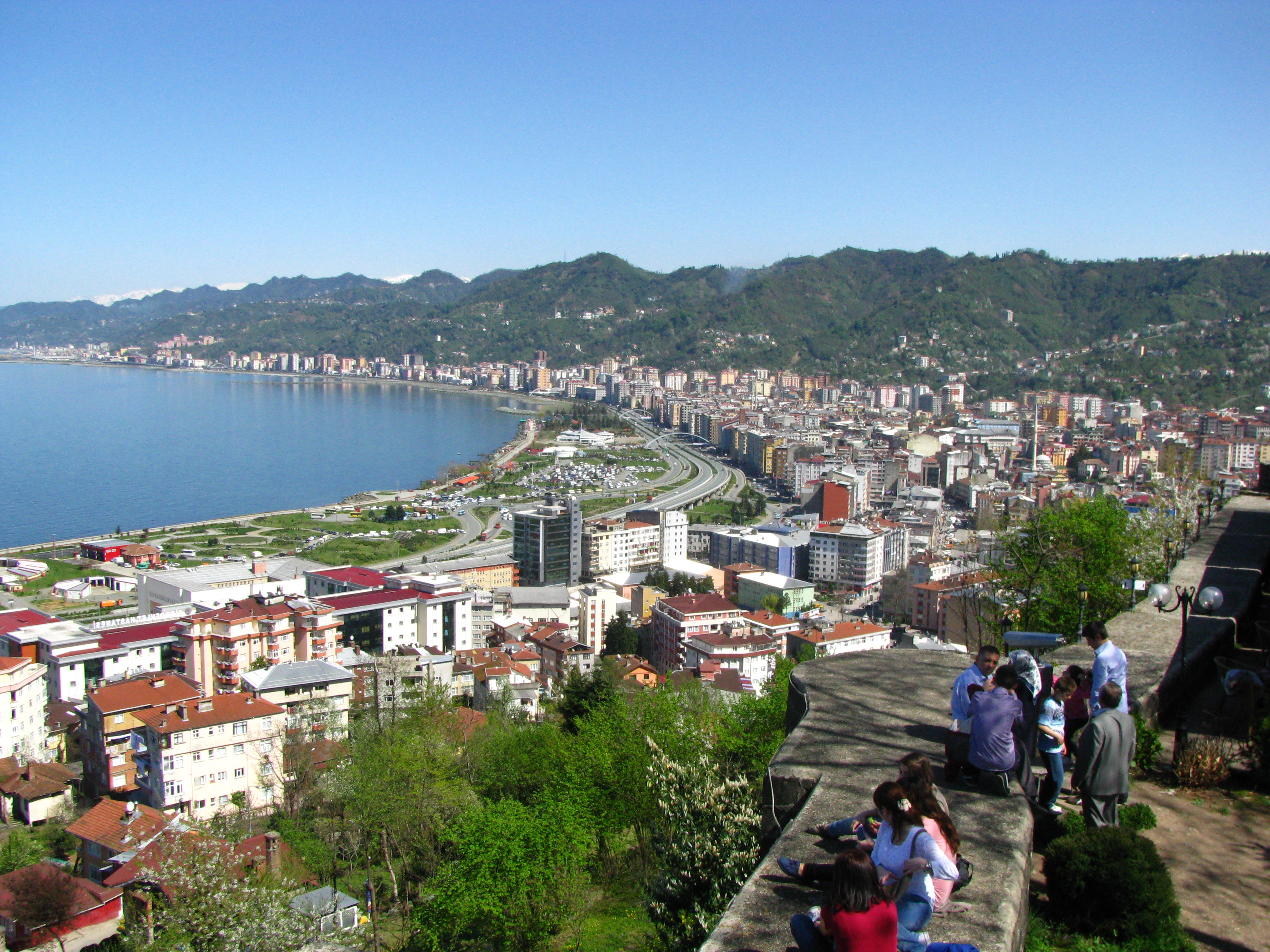
We drove for an hour, stopped in Reza for tea and lunch, then went on along the seashore to Trabzon.  In Reza, I stood at the edge of a garden overlooking the city when the call to prayer started up.  It brought back a lot of fond memories. 🙂 Turkey is definitely a Muslim country, with mosques everywhere, pencil minarets dotting the cityscape like steeples, and women dressed in colorful hijabs.

View of Rize from Rize Castle.
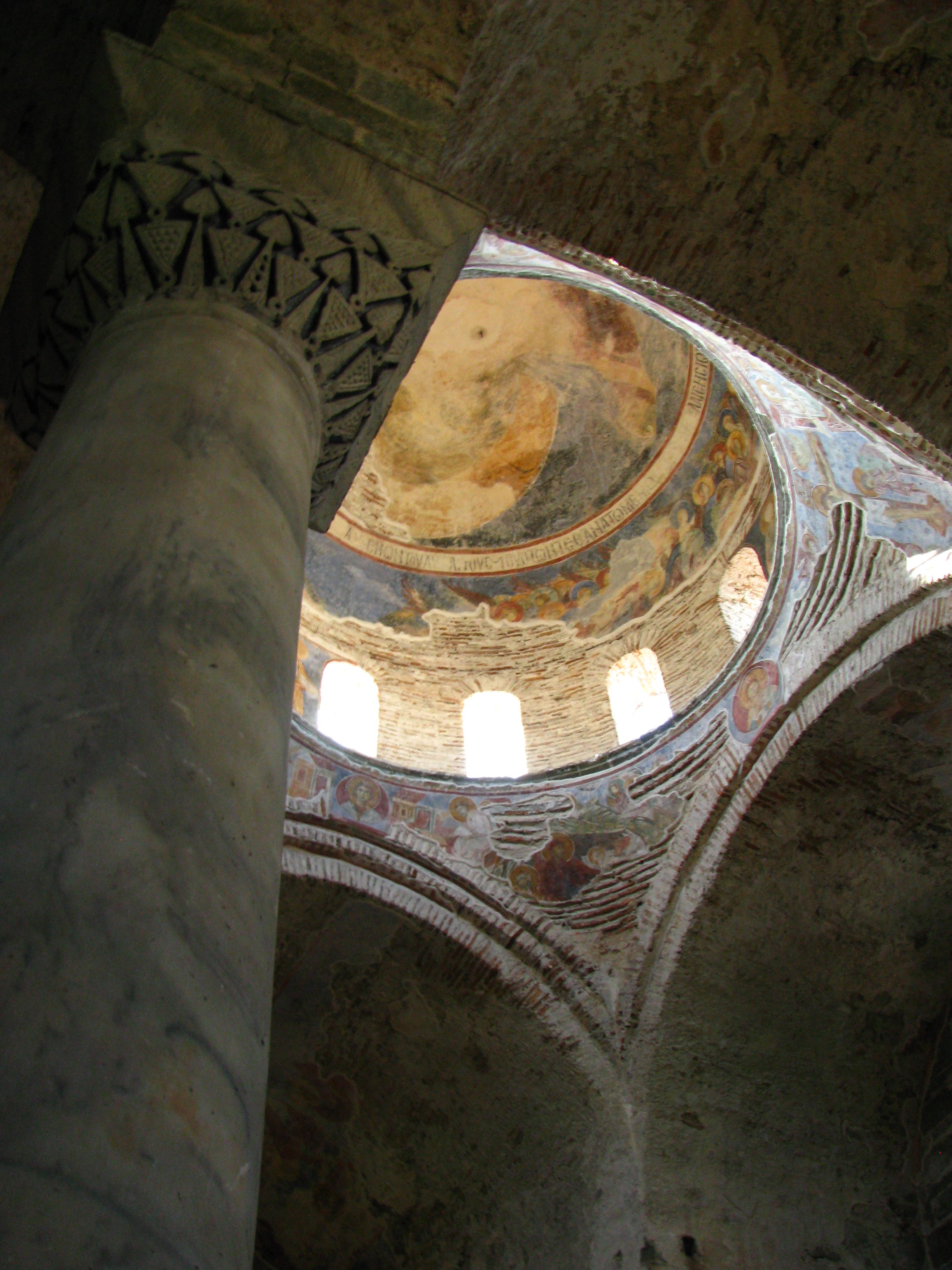
Interior of the Little Haggia Sophia at Trabzon. It’s a pretty modest sized basilica, now a “museum” which basically means it’s not used for religious services. It needs renovation.

Compared to Kutaisi, Trabzon is a large and well-developed city.  The downtown marketplace was packed, but the streets were well-paved, the shops were quite nice, there weren’t any beggars and basic amenities weren’t hard to find.  Almost no-one spoke English, which made communication difficult since I don’t speak any Turkish, but it was surprisingly easy to make friends.  We stopped for lunch at one place, and after a very difficult time trying to explain that we didn’t want any meat in our sandwiches (most of the girls in our group were vegetarian), the restaurant owner actually let us eat for free!

Some of the other volunteers had asked that we go to an American style mall, so we spent a few hours there before going to the hotel.  I must confess, I was bored out of my mind.  Nothing but clothes stores and Turkish fast food restaurants–it was identical to an American mall in almost every way.  I suppose that that’s why the others wanted to go there–after spending a year in Georgia, they probably craved someplace that feels like home.  But I’m not there yet, so that particular excursion was kind of boring.

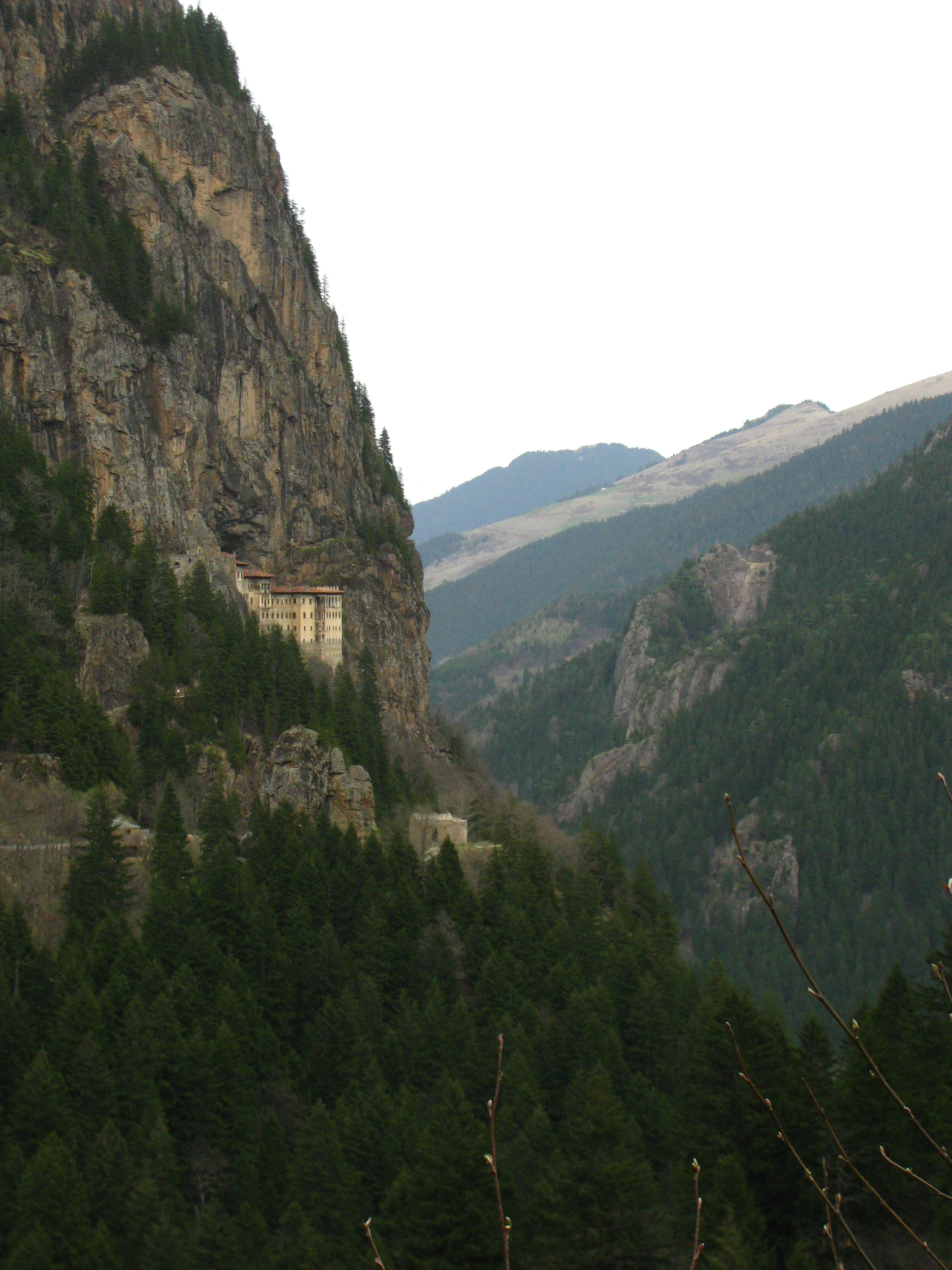
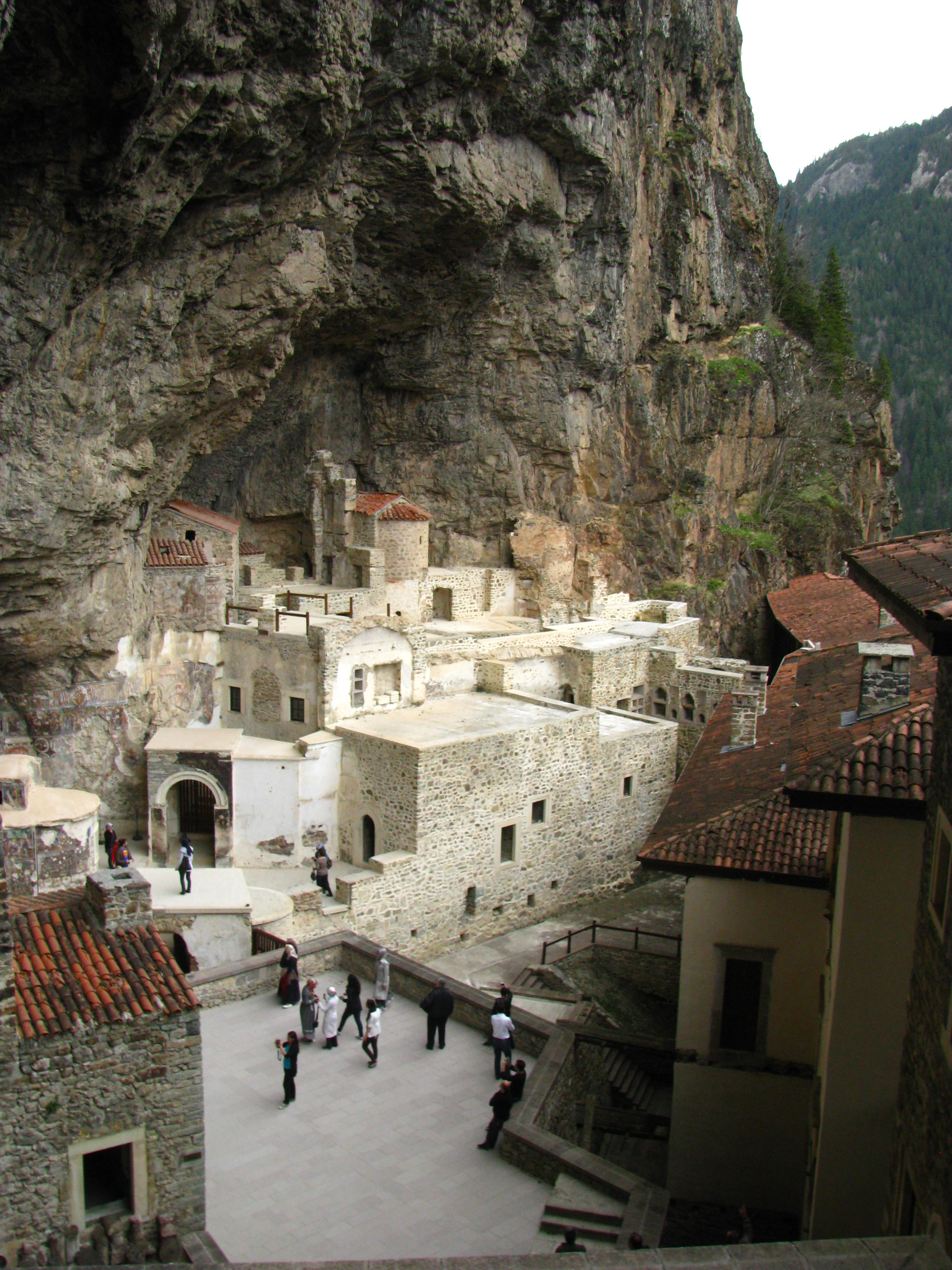
The next day, we went up to Sumela Monastery in the mountains, and from there to Lake Uzungol.  The monastery was quite cool, because it’s perched literally  on the side of a cliff, almost 500 meters above the valley floor.  Unfortunately, the friezes and other artwork was quite damaged,  so I didn’t feel compelled to take many pictures, but it was fun to hike up there and see the view.  A bunch of Turks laughed at the way I ran up the path, and the fountain at the top had some FREEZING cold mountain runoff.  It was a lot of fun.

Sumela Monastery from the top of the canyon. The surrounding countryside is absolutely gorgeous.
Inside the monastery complex itself. Many of the buildings are new additions, but there are some original structures.

At the lake, I bought a piece of Turkish silverware for my host mom that ended up being a huge hit.  A lot of the shops were really touristy, but it was fun anyway and the landscape was quite beautiful.  Reminded me a bit of Colorado.  We stayed in a mountain cabin and the bedsheets smelled like cigarettes, but otherwise it was quite comfortable.

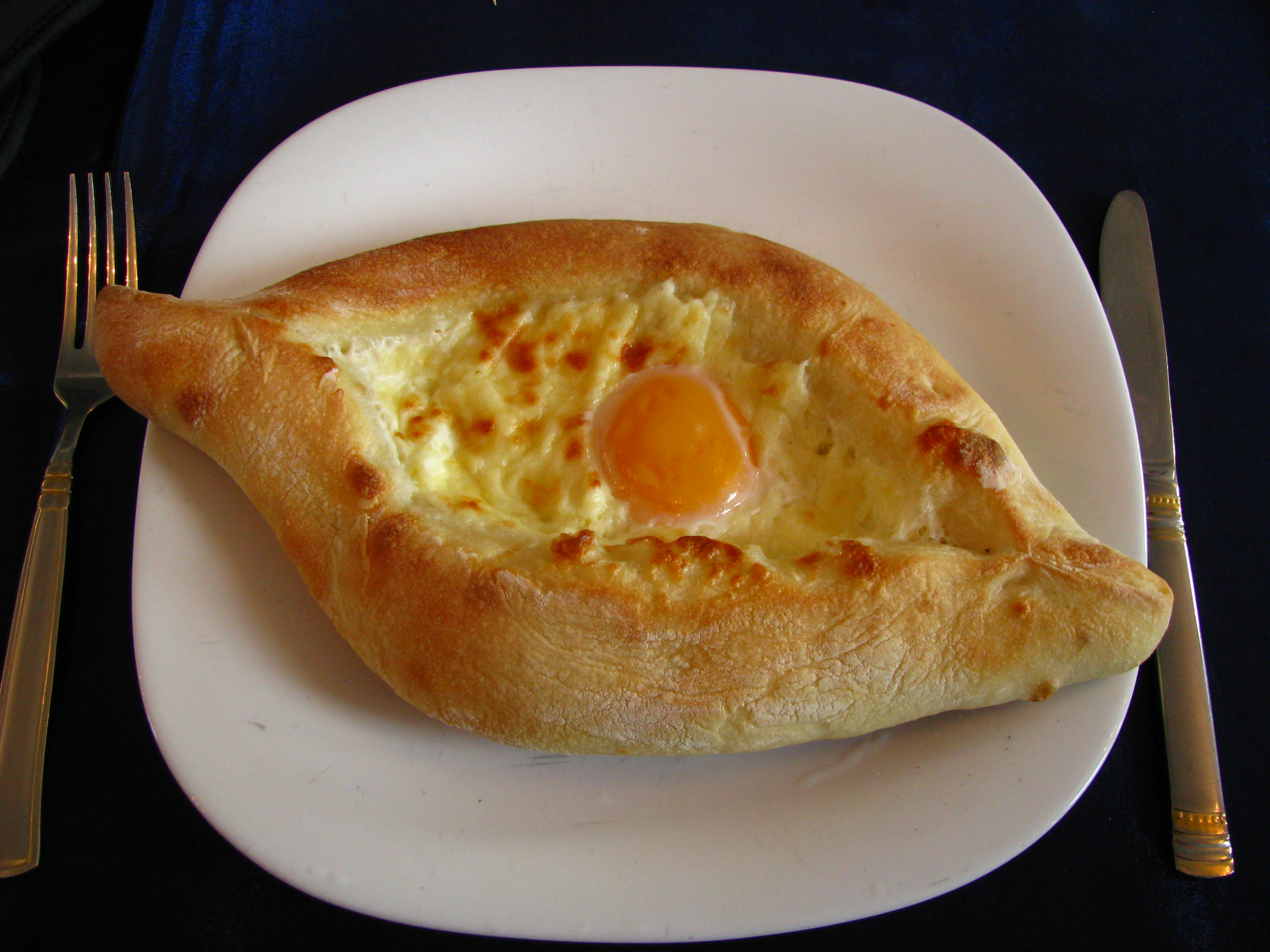
Adjaruli khatchapuri. If you eat this every day, you will have a short and happy life.

On the way back, we stopped in Batumi for dinner and had Adjaruli khatchapuri.  Khatchapuri is the main Georgian go-to food–it’s basically cheesy bread with a thick, doughy crust.  In Adjara, though, they take it a couple of steps further.

Immediately after taking the bread out of the oven, they crack an egg in the center, which gets cooked a little by the heat but otherwise remains raw.  They then take a huge slab of butter and plop it right in the center of the yolk, where it melts in and gets everywhere.  To eat it, you stir the egg around and work your way inward from the crust, dipping the bread in the molten gooey center.  Between the cheese, the egg, the butter, and the bread, you get a pretty heavy meal–delicious, but heavy.

After that, we took to the road again, talking about all sorts of stuff and having a generally good time.  Our tour guide was a great guy, and we had a lot of fun racking his brain.  The other lady from the company was quite delightful, and talked with me a lot about Racha, growing up in Kutaisi, her experiences living in the Persian Gulf, etc.  It was a long ride, but it went by pretty fast, and we pulled into Kutaisi around 9pm.

All in all, a fun, relaxing vacation, and a good chance to get out and see a little more in this part of the world.  Turkey was nice, but I have to admit, I felt a bit like I was coming home when we crossed the border back into Georgia.  It’s not as clean or developed, but it’s got a feel to it that isn’t quite like anything else.  I like it.

What’s your backup?

...have you?

So I just got back from Easter vacation in Turkey, at Trabzon and Lake Uzungöl.  It was pretty awesome–I’ll definitely be blogging about it in the next couple of days!  First, though, I wanted to share something interesting that happened on the way back.

While I was hanging out in Batumi with some other TLG volunteers eating Adjarian khatchapuri (an experience in itself), we got to talking about what we’re going to do with our lives after we get back to the States.  Most of them didn’t really want to think about it, which surprised me, so I asked why.

They told me they didn’t want to have to figure out the rest of their lives–that coming out to Georgia to teach English was a way of putting off those major life decisions.  Fair enough.  They then asked me if I’ve figured it out.   I said yes: that I want to be a full-time writer, and that I’m out here to see the world and get some cultural experience as I try to make that dream a reality.

One of the girls then asked what my backup was if that didn’t work out.  To be honest, I had no idea what to say.  My plan at this point is to just keep teaching and traveling until the dream becomes a reality.  Am I confident that it will?  Eventually, yeah–as long as I keep writing, which I certainly will.

I thought about it a bit on the way back, and realized that my mindset has shifted tremendously in the past few years.  When I was back in college, and to some extent for the first year after I graduated, I used to worry a lot about my “backup plan.” It was a way of addressing the fear of failure, of creating an illusion of safety by having a “fallback.”

I’m sure there are careers where that’s a good idea.  Generally, those are careers with definite paths, where if you don’t pass a certain number of checkpoints, you’re basically screwed.  With writing, though, there is no set path that everybody follows–especially now with ebooks and epublishing.  Because of this, it’s impossible to really fail–either you keep on trying until you make it, or for one reason or another you give up.

Ever since I graduated in 2010, I’ve been structuring my life in such a way that I can continue to pursue my writing.  Every job I’ve taken has just been a stepping stone, a bridge to allow me to keep pursuing this dream.  Have I made it yet?  No, but I haven’t given up yet either, so I haven’t had to fall back on my backup–whatever that would mean at this point.

From the outside, it probably looks like I’m being hopelessly responsible–that, or willfully oblivious to a hundred things I should be worried sick about.  However, I’m actually quite confident that I’m on the right path and things will work out–and that surprises me.  It’s like that moment when you realize you’re actually swimming, not just kicking and thrashing about the pool.

Worst case scenario, I fall head over heels in love with an awesome, wonderful girl, and after a few heady months filled with blissful romance, I wake up one morning and realize that I’m married.  If that happens, I might have to put my writing on hold for a while until I get things sorted out so that I can support both myself and my wife–but then again, with her help, I might be able to do twice as much, or even more.  Perhaps that will help my writing career even more than trying to go it alone.
So really, there is no back up plan or worst case scenario–just the future.  And as Georgians are so fond of saying, “no one can know what will happen in future.”
What a relief.
მოტაცება, or how to bag a wife–literally

მოტაცება (pronounced mot’atseba) is the Georgian word for bride kidnapping, as opposed to regular kidnapping, which takes a different word.  It’s an ancient practice in the Caucasus region that doesn’t happen as much as it used to, but still happens, especially in the rural areas.  Today, most Georgians condemn it, but there’s still a whole slew of lingering cultural subtexts that can be very difficult for a Westerner (like me) to understand and navigate.

The video clip at the top is from a Georgian comedy program (named,  aptly enough, “Comedy შაუ”), and does a pretty good job illustrating how mot’atseba works.  Of course, the genders have been reversed–50% of Georgian humor is cross-dressing, and the other 50% is cross-dressing with slapstick–but everything else is pretty accurate.  Like I said in a previous post, it’s like a weird game of capture-the-flag involving sex and arranged marriage, where the flag is the girl.

This is how it works: boy meets girl.  Boy decides to marry girl.  Boy gets his friends together and kidnaps the girl (with or without her consent), holding her captive overnight.  The next morning, boy contacts girl’s parents to ask for girl’s hand in marriage.

Since the girl has been held overnight, the implication is that she’s been raped (which may or may not be true).  Therefore, to avoid a scandal which could tarnish the family’s reputation, the parents will usually marry their daughter off as quickly as possible.  However, if the girl can escape, or the girl’s brothers can rescue her before nightfall, the crisis can be averted.

I first heard about mot’atseba from this post on Georgia On My Mind, back when I was looking into TLG about a year ago.  It disturbed me a little, but not enough to dissuade me from coming to Georgia.  A couple of weeks ago, however, I learned that that was how my host parents got married.

Here’s the thing, though: they both seem to remember it kind of fondly.  In fact, when my host mom saw the clip from Comedy შაუ, she couldn’t stop laughing.  Her mom lives with them now, and from time to time they go out to visit his family in the village, so it looks like everyone’s on pretty good terms.

So what the heck happened?

Here’s the story, as best as I can piece it together.  They were introduced by his sister, who was her coworker at the hospital.  After a month, he got together with some friends and took her without violence to his family’s house out in the village.  She was surprised and upset at first, of course, but her parents gave their consent, and so they were married the next day by a magistrate.  Now, they’ve got four kids–a huge family, by Georgian standards–and seem to be pretty happy together.

As a Westerner, it blows my mind that a strong, healthy family can come out of something as violent as an act of kidnapping.  Indeed, I have yet to be convinced that that’s a normal outcome. However, after asking around and doing some research, I’ve come to realize that mot’atseba isn’t a black and white issue: there are all sorts of cultural subtexts that make the issue much more complicated.

The key to understanding how all this works is the following proverb, which underscores the entire Georgian concept of gender roles and the differences between men and women:

If a woman says no, she means maybe.  If she says maybe, she means yes.  If she says yes, she is not a woman.

From this, two things follow:

1: Women are fickle, therefore men should be assertive.

As a man, I see this all the time.  All three of my co-teachers are women, and all of them constantly defer to me, even though they have far more professional experience than I do.  When I had some pretty serious differences over teaching methodologies with one of them, she suggested that I take over the next lesson and teach it without her interference, so that she could get a better idea that way.  This isn’t the case with the female volunteers–many of them complain about how hard it is to get anyone to take their suggestions seriously.

2: A woman can never say no.

If “no” is constantly interpreted as “maybe,” then it follows that no one (or at least, no man) is going to believe that a woman is even capable of saying “no.” This turns the whole concept of rape into a nebulous gray area, unlike the United States, where women have a lot more power at least in terms of the law.

This is not to say that in Georgian culture, women are doormats or property (even though that’s what some TLGers claim).  Women have a number of support networks, such as family, friends, and other women, and can use these networks to ward off unwanted attention.  When I asked my host sister if she’s worried that a mot’atseba would ever happen to her, she said no, because if it did, her three brothers would kick some serious ass.

On top of all this, Georgians have no real concept of casual dating.  If a girl and a guy are seeing each other, they’re either married or about to be married.  This shows up in the way they use Facebook and other social networks: instead of listing themselves as “in a relationship,” the girl will give her password to the guy she’s dating.  And they don’t just do it because the guy demands it–when my host sister was seeing someone, he asked her if she wanted to give her password to him, as if that was the natural next-step in their relationship.  From the way she told me, she seemed to be worried that she’d made a mistake by telling him no.  Of course, I told her she’d made the right decision!

Combine all of these together, and you should start to get a clearer picture of some of the subtext surrounding mot’atseba.

When I asked my first co-teacher about it, she said it was only an ancient practice and absolutely didn’t happen anymore.  When I brought up rape and asked if that was also a part of it, she was horrified and didn’t want to talk about it.  However, when I asked if it’s possible for a happy marriage to come of it, she kind of smiled a little and said that if the woman likes it, then why not?

My second co-teacher was much more straight with me.  Yes, it happens occasionally, though it was a lot more “fashionable” about twenty or thirty years ago.  No, it’s not romantic.  Yes, a lot of the marriages aren’t very happy, which is why so many of them end in divorce.  She told me that one of her friends from college was married through mot’atseba, and that she knows of at least one case in our school where an 8th grader was kidnapped and married.  However, under President Sakashvili, mot’atseba is now a serious crime, so it’s not as common as it used to be.

My third co-teacher’s answer was a lot sketchier.  The first time I asked about it was in passing, as she walked in on the conversation I was having with my first co-teacher.  When I asked her about rape, she laughed and said “well yes, of course it happens!” as if that wasn’t a big deal.  Later, however, she sat me down and said quite seriously that mot’atseba is a horrible thing, that it’s a criminal act, that it doesn’t happen anymore, etc etc.

However–and this was perhaps the most illuminating thing–she said that sometimes, when a guy and a girl are in love, but she’s being wishy-washy and non-committal, he’ll sweep her off her feet and carry her off.  In fact, that was what happened with her: her boyfriend wanted to marry her, but she kept putting it off, so one day he tricked her into getting in the car and told her “all right, enough is enough–we’re getting married this weekend.” And they did.

When I asked her if that was mot’atseba, she said no, but I think the subtext was similar.  A real man knows how to assert himself and take what he wants.  Since a real woman will never say yes, sometimes you just have to man up and tell her how it’s going to be.  And don’t worry if she says no at first–she only says that because she doesn’t really know what she wants yet.  She’ll come around eventually.

It sounds pretty horrible, but that seems to be how it works.  And really, there are gradations of it. Most Georgians will agree that it’s wrong for a guy to kidnap a girl he doesn’t know so that he can rape her and force her to marry him.  But if the guy and the girl know each other, and are already pretty serious (ie seeing each other at all), and he wants to speed things up–or, alternately, if she knows her parents would never say yes otherwise–that’s when everyone speaks of it with a wink and a nod.

And really, can we say that our culture’s problems are any less abhorrent?  What about teenage pregnancy?  Secret abortions?  Date rape?  At least with mot’atseba, the guy is trying to marry the girl, not just sleep with her and walk away.  If it’s just sex that the guy is after, there are a lot more easier ways to get it than risking a prison sentence.

So is it “wrong”?  I don’t know if it’s possible to say yes or no, except on a case by case basis.  My host sister knows a girl who was kidnapped at age 12 and had a baby the year after.  I’m pretty sure that’s wrong.  But when I told her what would happen to that guy in the states–that he would go on the registered sex offender list and spend the rest of his life ostracized and unable to find work–she thought that that was wrong too.  And as for my host parents, well, it seemed to work out well for them.

I don’t know.  But either way, it’s definitely an interesting anthropological experience.