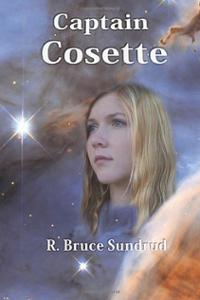
Captain Cosette by R. Bruce Sundrud

captain_cosetteSo I saw this book in my alsobots on Amazon a few months ago, and it looked interesting so I figured I’d give it a shot.  The cover is admittedly pretty bad, but it has two of my favorite things in the universe (space and girls), and besides, I’ll sample just about anything.  A few days later, I realized the sample folder on my Kindle was getting pretty big, so I decided to go through and clear some of it out.

Well, I ended up buying this one.  The beginning really hooked me, and the rest of the book did not disappoint.

Captain Cosette is basically a Cinderella story set in space, except instead of getting glass slippers and going to the dance, Cosette goes to war and becomes a knock-out starship pilot.  It’s military sci-fi with a lighter edge than Drake or Haldeman.  And it’s good.  I think I read from the 36% mark to the end without stopping.  Sundrud is really good at making you care about his characters and then putting them in peril.

One thing that I really enjoyed were all the pulpy Renee Chevalier books that Cosette always reads, which were really just tongue-in-cheek references to modern pop-culture phenomena like Twilight and Casablanca.  It broke the fourth wall at times, but I always found them hilarious, especially with some of the twists they add at the end.

Unlike some other sci-fi books that I’ve started recently and failed to finish, the science fictional elements here are not just window dressing–they really drive the plot.  I thought the teaching machine was particularly interesting, especially when it … well, I won’t give away any spoilers.  And of course, the lost colonies and border worlds were also fascinating.  Cosette comes from a backwards farming planet, and the way she thinks about things at first, you really get the sense that this has been her whole universe.  As she gradually comes to understand the geo- (astro?) politics of Union and Alliance, her awareness expands, and so does yours as the reader.  It’s very cool.

There are a couple of things I wish this book had done a little better.  The world is not nearly as immersive as I wanted it to be, and sometimes it feels like the characters are hurrying from place to place.  Also, sometimes the characters seemed to blend together a bit.  There was enough to differentiate them, but at times they sounded almost the same.  None of these issues took much away from my overall enjoyment of the book, however.  The story was solid.

So yeah, if you like the kind of stuff I like to write, you’re probably going to love this one.  At $2.99 for the ebook, you really can’t go wrong.  Even if you’re not a huge military sf fan, if you like Cinderella stories (and who doesn’t?), this one is definitely worth checking out.

Thoughts on writing advice generally

I’m working a swing shift job at a bakery outlet right now, loading and unloading trucks for the next day’s shipment.  It’s a great job because 1) the pay is higher than most warehouse jobs, 2) it’s only 20 hours a week, 3) I’m the only guy there, so there’s lots of autonomy, and 4) I can listen to music and podcasts while I work.

Anyway, I was listening to a panel from this year’s LTUE last night, and at one point I actually got so mad with the panelists that I almost swore.  In particular, there was one panelist who doesn’t really have any books out or any publication credits to speak of, but she was constantly (CONSTANTLY) chiming in with writing rules and writing advice, to the point where she started clashing with some of the big name authors on the panel.

The reason that made me angry is because I’ve been on the receiving end of a lot of bad advice.  Not just advice about the craft of writing, which might be good individually but in the aggregate tends to feed your inner editor and kill your creative drive.  I’ve heard a lot of really bad career advice, both from established professionals who have no clue how the industry is changing, and (more frequently) from unwashed newbies who spend more time promoting their last book than writing their next one.  It’s gotten to the point where whenever anyone starts to give advice, I just roll my eyes and skim over whatever it is they’re trying to say.

This is not to say that I think I know everything and that now I can stop learning.  I have no illusions about that.  Just this past week, for example there was an excellent thread on the KBoards about cover design, with several designers chipping in with their insights.  I admit, I skimmed a lot of the stuff the writers were saying, but the designers I stopped and paid attention to.  There’s still a lot I have to learn when it comes to covers, as well as hiring the right kind of artists to do the job.

When it comes to the craft of writing, I’ve found that the best way to learn is to read a lot of really good books and pay attention to the things the authors do.  For example, Louis McMaster Bujold has some really colorful ways to describe her characters’ mannerisms, such as having Lord Vorkosigan simultaneously smile at one character and frown at another.  Jane Austen is a master of giving the one or two details that you need to feel like you know exactly what kind of a person each character is.  David Drake can write action sequences that really make you feel like you’re there in the character’s head, and Orson Scott Card’s dialog is peerless.

And as for career advice, honestly, the best approach I’ve found is to just say “screw you all–I’m doing it my way!” The industry has changed so much in the past three years that no one–absolutely no one–knows anything.

Four years ago, I snubbed my nose at self-publishers and would have been horrified to learn I’d become one.  Two years ago, I hated the term “self-publishing” and avoided it like the plague, using terms like “indie publishing” instead.  Now, I don’t really care.  I’m reaching readers, growing a fan-base, and making money, and that’s all that really matters.

Everyone seems to have an opinion, but the only way to have an informed opinion is to actually go out there and find out what works for you.  So basically, I treat everyone’s advice with contempt unless they can demonstrate unequivocally that it’s worked for them.  Even then, I pick and choose what I adopt for myself, based on what sits best with my own personal philosophy.  In the end, I learn a lot more by rolling up my sleeves and getting my hands dirty than I do from following someone else.

All of this has combined to make me really loathe to give any advice.  At Leading Edge, I’ve taken recently to reading ARCs and writing book reviews, rather than writing out those scathing story critiques like I used to.  I rarely comment on blogs or message board communities, and when I do, I always feel like I have to include a disclaimer that this is my opinion, or this is what’s worked for me, or this has been my experience (and therefore may not apply generally).  Sometimes, I see writers who are so caught up in stupid myths that I want to reach out and help them, but even then, I feel like there’s something restraining me.

The point is, if/when I succeed in this business, it will be in spite of the advice I’ve received, not because of it.  I’ll consider almost anything, but whether I actually follow it … yeah, don’t hold your breath.

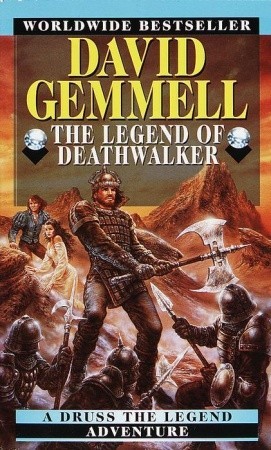
The Legend of Deathwalker by David Gemmell

legend_of_deathwalkerI’m not even going to try to write a synopsis of this story.  It’s just like all the other books in the Drenai series, which is why I love it so much.  Basically, this one gives the story behind the rise of Ulric, khan of the Nadir, and the origin of the Nadir people.  Interestingly enough, Druss the Legend plays a major role.

This was the last book in the Drenai Saga that I hadn’t read, so reading it was a very bittersweet experience.  On the one hand, this one is just as good as all the other books in the series, and made me want to revisit Legend and some of the others.  On the other hand, I knew that once I’d finished it, there wouldn’t be any more Drenai books left.  So I took it slow for the first half, but naturally I finished it at a breathless late-night sprint a day or two later.

I’ve been thinking a lot lately about why I love David Gemmell’s books so much.  There are many reasons, but I think the main reason is that his writing is honest.  He strips away all the incidental stuff and gets right at the heart of the stuff that matters.  He doesn’t pussyfoot around, either–if his characters do something despicable, he doesn’t make any excuses for them.  He tells it like it is.  This can make for a very brutal story, but it also makes for a very cathartic one.

The other reason I love his books so much is because he does such a good job depicting raw, unrepressed manhood–not the stupid stuff like driving big cars and eating meat, but manning up and facing your greatest fears.  It’s about friendship, and honor, and fighting with all of your strength for something you believe in.  It’s about all that raw, pent-up energy we all have, that animal urge that drives us to competitive sports and first person shooters, and channeling it for a heroic cause.

The craziest thing is that the fight itself is actually more important than whatever side the characters are fighting on.  In this book, Druss is actually fighting to help bring about the rise of the Nadir khan who later invades his homeland and kills him on the walls of Dros Delnoch.  None of that matters, though, because Druss doesn’t fight with malice.  For him, it’s all about fighting for something, not against something, and the battle itself is just as important as the victory.  I don’t think I can put it better than this:

“Can we win here?” Sieben asked, as the shaman’s image began to fade.

“Winning and losing are entirely dependent on what you are fighting for,” answered Shaoshad. “All men here could die, yet you could still win. Or all men could live and you could lose. Fare you well, poet.”

The best thing about David Gemmell’s books is the fact that none of the characters–not even the bad guys–are defined by their own evil.  The Nadir are supposed to be the evil chaotic race of the Drenai universe, but when you come to understand what they’re fighting for, their hopes and dreams for a better future, you can really see what’s good in them.  Likewise, the more civilized Gothir are kind of like the evil white men who want to put down the savages and keep them in their place, but there are good and honorable men among them too.

And yet, even though the two sides clash, and good men die on both sides, it somehow isn’t tragic.  That’s the crazy part.  It’s almost like you can feel the characters salute each other as they die in a good cause, the way Ulric gave Druss a proper funeral in Legend, even though the two were blood-sworn enemies.  In David Gemmell’s world, honor and courage are more important than life or money.  Everyone dies; dying well is more important than living without honor.

This book is incredible.  As I was reading it, I decided it was the best David Gemmell book I’ve ever read–which is something I do every time I read one of his books.  I feel like I’m a better man for having read them.  If he had written a hundred books in this series, I would happily read them all.  The fact that there are no more new ones deeply saddens me, but I know I’ll revisit these stories again in the future.

I need to read more. A lot more.

Recently, I’ve come to the conclusion that I need to read a lot more than I have been.  I’ve read a couple of books in the past few months, but to take things to the next level I feel like I should be reading at least one or two novels a week.

I came to this conclusion last week after visiting the Provo Library to pick up a copy of Gettysburg (the movie based on The Killer Angels) that was on hold for me.  Unfortunately, someone had misplaced it, but since I was there I took some time to browse the shelves.

Holy cow, it’s been a while since I was surrounded by actual physical books.  I get about 60% to 70% of my books nowadays on my kindle, so browsing through the shelves, I felt like a kid in a candy shop.  I picked up the last Drenai book that I haven’t yet read (finished it today, actually), a classic by Heinlein, and an Alliance-Union novel by C.J. Cherryh.

The thing about physical library books, though, is that if you don’t read and return them in time, they tend to cost you money.  LOTS of money.  I can’t tell you how much I’ve paid in library fines over the years–it seems like every time I go to check something out, I have to pay a couple of bucks.  What can I say–I’m not a very disciplined reader.  But this time, I figured I would actually go through and do it.  That’s why I limited myself to just three (or was it four?).

If you’re a writer, reading voraciously is essential.  Not only is it a great way to pick up new tricks, it’s absolutely vital in keeping your sense of story honed and sharp.  I wonder how much of what we call “writers block” would actually best be solved, not by just writing through it, but taking some time to just immerse yourself in a good book and recharge your creative batteries by filling your mind with story.

Another reason to read is that it helps to keep you from being stretched too thin by online distractions and obligations.  I picked up this tip from Jeff VanderMeer in his writing book, Booklife.  It’s a good one.  Basically, if you find yourself wasting too much time on the internet, cycling endlessly through your email, your facebook, your twitter, webcomics, message boards, blog aggregator, sales stats etc etc–the best way to break free of that addictive cycle is to sit down and read a book.

A couple of days later, I was at Leading Edge and noticed that they have a whole bunch of unread ARCs in their cabinet.  A couple of small publishers send them stuff every couple of months, and it tends to accumulate, especially in the summer when most of the students are gone.  Well, I ended up coming home with three of them, with a promise that I’d read and review a couple before the next issue goes out in June.

Not that I’m complaining–not at all.  In fact, I’m excited.  I’ve been doing a lot to rework my routine recently, mostly having to do with writing in the mornings and finding a good place outside of my apartment to get stuff done.  I find that it helps to take frequent breaks when writing, so if I can fill those with reading instead of useless internet browsing, I figure I’ll be in good shape.  I’ll let you know in a couple of weeks how that goes.

In the meantime, I’ve got to go, but you can expect another squeeing fanboy review of David Gemmell soon–as in, probably tomorrow.  I just finished the last remaining bok in the Drenai series that I hadn’t yet read, and holy crap, it is AMAZING.  It makes me want to go through and read the whole series all over again!  At the same time, I’m so sad that there aren’t any more of these books left anymoer–if Gemmell had written a hundred Drenai books, I would have read (and gone fanboy crazy over) every last one of them.  Sadly, that is not to be.  But maybe when my soul passes over to the Void, I can sit at his feet and hear them direct from the mouth of the master … okay I’d better end this before I go all fanboy again.  Later.

Hey! Are you an aspiring writer / artist / creative whatever?

If you are, you really really really need to check out this webcomic about the three jaguars.

It’s about the three main voices in every professional artist’s head, and how they bicker and play off of each other.  As someone whose been in the writing business for a few years, I can say that it’s absolutely spot on (and not just because they’re anthropomorphized jaguars).  Seriously, this webcomic needs to be like a primer for all creative types or something.

The thing I’ve learned the most by following this webcomic has to do with the marketing voice.  I’ve always had it in the back of my mind that marketing is evil.  And if you do it wrong, it really is.  But if you do it right, it’s actually pretty amazing:

…your goal in marketing is to create sustainable relationships with people who want you to succeed; in short, to seek patrons, rather than one-time customers. To do that, you can’t be focused on the money or the one-time sale. You want to inspire customer loyalty. You want people to be invested in your success. You want them to feel special … because they are.

A lot of the stuff I do, like keeping this blog, or putting Author’s Notes at the end of all my books, comes back to this idea of making meaningful connections with people.  I just never saw it as marketing.  But if marketing yourself is really about focusing on people rather than obsessing about sales, that’s totally something that I can do–something that I’m excited to do!

The character I can relate to the most is probably Business Manager.  It’s the entrepreneurial spirit I can trace back to my grandpa, who started his own oil company in West Texas and was successful enough to put all us grandkids through private school.  But Artist is definitely in there as well–it’s why I’m always jumping from project to project, driving my inner business manager crazy.

So yeah, if you’re a creative type, you’ll definitely want to check out this webcomic.  It’s written by the self-published author whose books briefly got pulled from Amazon during the Space Marine controversy (fortunately for all of us, she held out and won).  Lots of good stuff there–she really knows what she’s talking about.

In the meantime, let me leave you with this incredible piece of orchestral trance music.  It’s quite possibly the most epic thing I discovered last week.  The video is pretty good too.

Take care!

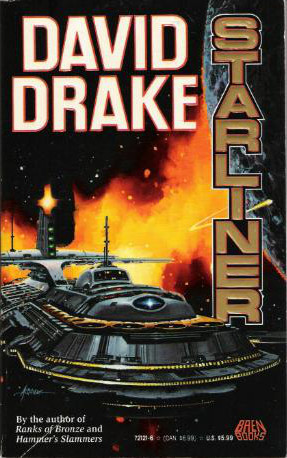
Starliner by David Drake

starlinerWelcome to the Empress of Earth, the finest luxury liner in all of settled space.  Whether you’re alien or human, first class or economy, there is a place on the ship for you.  Just watch out for those Grantholmers and Nevassans–those planets are about to go to war, but don’t worry, the Empress is strictly neutral territory.  The envoys from Earth will see to that.  And as for the rumors that one of those sides might try to hijack the ship, I’m sure the crew is capable enough to deal with such threats.  Even if they are unarmed…

I saw this book on my also-boughts on Amazon, so I decided to pick it up.  It was an enjoyable read.  David Drake is very good at showing competent characters dealing with all sorts of complicated problems, operating within a strict chain of command while sometimes bending the rules a bit to get the job done.

The book is really a series of small vignettes, all tied together through the main viewpoint character, Ran Colville.  There is an overarching storyline about the Empress’s role as a coveted pawn in a larger interstellar war, but that only really drives the story at the very end.  Really, it’s more of a slice-of-life story about the crew of the ship, punctuated by all of the strange and exotic stops along the way–and boy, are there plenty of those!

Even though the Empress is neutral, she’s a potentially valuable military asset that both sides in the Grantholm-Nevassan war want to capture.  To complicate matters further, some of the passengers are dignitaries from either side.  At one point, there’s a romance between the peacenik daughter of a Nevassan diplomat and the son of a Grantholmer nobleman who is honor-bound to fight in the war.  That subplot was a lot of fun.

As you can imagine, there’s plenty of violence.  And really, what would you expect from one of the world’s best military science fiction writers?  Drake does a really good job showing the adrenaline-soaked excitement of combat, as well as all the ugliness.  Even the mooks get a viewpoint from time to time, and when they die, it’s messy and traumatic.  For that reason, the violence feels very realistic, especially in how it affects the main characters.

Ran is something of a player, so there is a fair amount of explicit sex (including a bit of inter-species action).  Drake doesn’t mince words or shy away from the gritty details–he puts it all on the page as matter-of-factly as any other aspect of life.  The sex was brief enough that it didn’t really bother me that much, but Ran’s relationship toward one of his coworkers takes a turn at the end that seemed to come completely out of left-field.  I could understand why, for the purposes of the story, it had to happen, but the way it was handled I just didn’t buy it.

That was probably my biggest gripe.  If I had another, it would be that the story seems to meander a bit in the first two-thirds, but the world-building was interesting enough that it didn’t really bother me.  Overall, it was a fun, light read (well, light for military sf).  The ebook version is free on Amazon, so it’s definitely worth picking up.  If you haven’t read any David Drake yet, this isn’t a bad place to start.

Thoughts on making a living as a writer

As many of you know, my biggest life goal (besides obtaining a signed first-edition copy of David Gemmell’s Legend) is to make a living telling stories that I love.  Accomplishing that goal is no small task.  For the last five years, I’ve been focused on that goal like a hellfire missile, and as of right now it continues to elude me.

I’m getting closer, though.  I’ve got 14 ebooks out, hopefully 18 by the end of the summer, and they’re actually selling.  I won’t go too much into specifics, but my gross income is about 30% to 40% of what I’d need to cover all my expenses without another job.

Granted, I’m a young single guy with good health and no dependents, living on a shoestring budget in the cheapest housing in one of the cheapest states in the US, but that’s not an insignificant accomplishment.

Right now, I’m reinvesting all of that into the business, in order to boost sales and to avoid self-employment tax.  But if I have a difficult month and need something to fall back on, my books are generating a fair amount of passive income, and that income is growing.  If I keep doing what I’m doing, and things stay on more or less the same trajectory, I expect that I’ll be making enough to support myself in one or two years.

That’s actually a little better than the timetable I set a year ago, where I determined to go full-time by 2016.  Then again, I also set a goal to be married by then, and I have no idea how that will change things.  I suppose my spouse’s income would be able to supplement my own, but then there’s insurance and taxes and all sorts of other expenses that I can expect to go way up.

(At the same time, I have this wild dream of running off with my wife to some remote part of the world and spending a couple of years on some crazy-insane adventure, like trekking across Mongolia, or joining a Bedouin tribe, or couchsurfing across Europe.  The world is a very different place outside of the US, and the cost of living in much of the world is significantly lower.  Especially in the developing world, people know how to make do and be happy with much, much less.)

Even if I suffer a major setback, like an irreversible drop in sales or a technological shift that made my current business model obsolete, making a living is no longer a pie-in-the-sky sort of dream.  It’s within reach, and I think I have a pretty good idea how I’ll get there.

First of all, it’s probably not going to be a sudden, earth-shaking event.  It’s much more likely that I’ll ease into it gradually, first as a fallback for months when work is slow, and then as a way to pay off my bills while I keep a part-time job for spending money.  One day, I’ll wake up and realize that it’s been five or six weeks since I’ve done anything but write, and then I’ll open up my budget and realize that I’ve arrived.

As I get married and start a family, my expenses will no doubt rise, and I or my wife may have to take another job for a while to make ends meet.  Then again, if book sales continue to snowball with each new release, then we might be able to time it so that the kids start arriving just as the writing income really starts to take off.  Even then, book sales fluctuate so much from month to month that until we have a significant amount of money in savings, we’re always going to feel like we’re a couple of weeks away from having to find another job.

And then, with the writing bringing in a comfortable six-figure income, we might finally be able to afford a house.  It’s almost impossible to get a mortgage as a self-employed freelancer, so I fully expect to pay for most of the house up front.  Good thing I don’t want to live in a city.

Of course, it’s also possible that the writing will never bring in a six-figure income.  Science fiction is a relatively small genre, and the only stories I really care to tell are the ones that take place on other worlds.  But that’s okay–as long as I’m able to support myself and my family, I’ll be happy.  Anything above that, and it’s not about the money.  In fact, it’s really not about the money right now.

The point of all this is that I don’t expect there to be a moment where I’ve suddenly “arrived.” If anything, it’s just going to be a continuation of what I’m doing right now, scaled up to meet life’s changing demands.

And you know what?  I’m okay with that.

My resume might look a bit checkered, and job interviewers may raise their eyebrows when they see that I’m a college graduate, but these odd jobs give me a lot more flexibility than a stable “day job” with insurance and all that.  I like being able to take a week or two off to do nothing but write, even if the off-time is unintentional on my part.  I know how to be flexible, and I’m quite comfortable living a lifestyle where I don’t know where I’ll be getting my next paycheck.

And to friends and family who are concerned because I’m almost thirty and don’t have a full-time job … don’t be.  I’m following my dream, and my dream is within reach.  Everything else is just a stepping stone.  I have a career, I’ve taken full responsibility for it, and I’ve turned it into something profitable.  If making a living as a writer is a bit like making grizzly bear soup, I’ve already killed the bear.

In related news, I learned this week that I’ve been pirated in Japan.  I’m not sure whether to be flattered or alarmed, but since my books are 1) available from multiple retailers 2) relatively inexpensive, and 3) DRM-free (on all the sites that allow it, anyway), I’m not too concerned about it cutting into my income.  I am worried about people downloading my books from an unsafe site that might give them a virus or something, but people will be people and there’s not much I can do about that.

If anything, it’s just another sign that I’ve arrived–or rather, that I’m exactly where I’ve wanted to be all along, and it’s just a matter of making things work.

Z is for Zenith

pioneer_book_scifiHas space opera passed its zenith?

Sometimes, it certainly looks that way.  All the major stuff seems to be reprints of past series and reboots of decades-old franchises.  Star Trek, Star Wars, Stargate, Battlestar Galactica, Ender’s Game, Dune, Babylon 5–all the big names seem to have had their start at least a generation ago.  At any science fiction convention, you’re likely to see more gray-haired men than kids in their teens and twenties.  And if you go to a publishing conference, new adult, urban fantasy, and paranormal romance are ascendant.

I’ve noticed that people are using the term “science fiction” increasingly to describe stories that don’t have anything to do with space.  Dystopian, post-apocalyptic, steampunk, even time travel–all of these subgenres are certainly part of the fold, but they’re very different from the stories about starships and alien worlds.  And then you have all the markets for short fiction that have been forced out of business–and even a few larger publishers, like Night Shade Books which is now selling off all its assets (read: authors) to avoid bankruptcy.

I remember going to World Fantasy 2010 in Columbus, Ohio, and feeling dismayed at the complete lack of science fiction.  World Fantasy is (or was, at least) the premier professional conference for speculative fiction literature, but all of the attention was going to urban fantasy and steampunk.  On the freebie table where publishers often dumped ARCs and review copies of their books, the only space opera stuff I really saw were a couple of titles by Glen Cook and one other guy–and I watched that table hawkishly for the full three days of the conference.

Sometimes, it seems as if it would be so much better if I had grown up in the 80s.  That’s when science fiction really had its heyday.  But all through the 90s, the genre seems to have been on the decline, much like NASA and the US space program.

So is space-centered science fiction on the way out?  Have we passed the glory days, and it’s now just a long decline until it becomes an obscure niche, beloved by some, but enigmatic to others?

In spite of everything I said above, I actually don’t think so.  In fact, I think we’re on the cusp of a science fiction renaissance, and that sci-fi geeks like myself will look back twenty years from now and wish that they were born in our era.  Here’s why:

1) Scientific discoveries are transforming the way we see the universe.

The day I posted P is for Planets, NASA’s Kepler mission announced the discovery of three Earth-like worlds orbiting in the habitable zones of their stars.  The existence of alien Earths is not conjecture–it’s a confirmed fact.  As our ability to study these worlds improves, it’s only a matter of time, IMO, before we find a world that has life.

We’ve discovered the Higgs-Boson.  We’re unraveling the fundamental building blocks of the universe.  We’ve built telescopes to look back to the dawn of time itself, and we’re learning more about the cosmology of the universe every year.  Perhaps even more remarkably, we understand now how little it is that we actually know–that the entirety of the observable universe is only about 5% of it, and even that’s optimistic.

All of this will take time to trickle down to the popular consciousness, but with all the new discoveries that are happening, I think that’s already in the process of happening.  In particular, I think the recent discoveries in the realm of exoplanets and astrobiology are going to shake things up in a major way in the next five or ten years.

2) The privatization of space travel is paving the way for a rapid expansion into space.

The US space program has been plagued with funding problems since at least the end of the Cold War space race.  Since the space shuttle program was retired just last year, the only way for our astronauts to get into space is through the Russian Soyuz spacecraft at Baikonur.  If NASA had to put a man on the moon, they do not currently have the knowledge or technology necessary to do it.

In the private sector, though, it’s been a very different story.  SpaceX has had a number of successful launches recently, most notably sending the first unmanned resupply capsule up to the International Space Station.  And just a couple days ago, Virgin Galactic had the first successful test flight of its rocket-powered spacecraft.

It’s sad to see the space shuttle go, but there are a lot of reasons why the program was flawed and inefficient to begin with.  By handing things off to the private sector and turning space exploration into a viable business venture, we can hopefully overcome those inefficiencies and eventually make space accessible to the general public.

And then you have the organizations like Mars One that are looking even further ahead to the colonization of Mars.  There’s a groundswell of excitement for Martian colonization that is starting to get some real money behind it.  Will it go anywhere?  It’s hard to say right now, but even if it suffers another decade or two of setbacks, it’s getting public attention, especially from the younger generation.

3) Video games are bringing a fresh new look and feel to the genre.

Not all of the big sci-fi series hail from 70s and 80s.  Halo started up as recently as 2001, and it’s a multi-billion dollar franchise with games, books–even Legos.  In fact, there are lots of sci-fi video game franchises right now, many of them right on par with other classic space opera.  Just look at Starcraft, for example, or Mass Effect, or Eve Online and Sins of a Solar Empire.  The number of sci-fi games has been exploding.

In fact, this explosion has been happening for some time.  While literary science fiction may have suffered something of a decline back in the 90s, that was the heyday of games like Master of Orion and Sid Meier’s Alpha Centauri.  Flight simulators like Flight Commander and X-wing proliferated like crazy, while even some of the classic RPGs like Final Fantasy borrowed heavily from science fiction tropes.  And those are just a few of the games that I can list off the top of my head!

Whether or not literary sf is on the decline, a whole new generation has been introduced to the genre through the medium of video gaming.  This is not just a small niche audience playing this stuff, either–in the US at least, Halo is as mainstream as Monopoly or Settlers of Catan.  In fact, you could say that science fiction is more mainstream now than it ever has been, and a lot of that is due to sci-fi video games.

4) The e-publishing golden age is giving us thousands of new voices.

But what about the world of literary sf?  Are we in a decline?  Do people just not read science fiction anymore?  How bright is the future for science fiction literature?

Actually, this is the area where I’m the most optimistic of all.

The publishing industry is changing at the speed of light, much in the same way that the music industry changed about a decade ago.  Just as the MP3 revolution allowed all sorts of eclectic yet entrepreneurial artists to thrive without the oversight of record labels, the epublishing revolution is opening all sorts of doors for the enterprising author.  And while the changes are driving publishers (such as NSB) out of business, they are enabling authors who only sell in the mid-list range to make a respectable living.

At Worldcon 2011, Ginger Buchanan (senior editor at Tor) asserted that there has never been a runaway science fiction bestseller.  In the eyes of New York publishing, that may be true–but New York has a notorious record for missing the catch in pursuit of one big fish.  Because of epublishing, whole new genres like New Adult that publishers thought would never sell are now going mainstream.

And even the niches that stay niches are becoming quite lucrative for the authors who can build a decent following.  When author cuts out the middlemen and develops a direct relationship with the readership, it only takes a thousand true fans or so become a financial success.  As Kris Rusch pointed out so aptly, those numbers may bring only scorn from New York, but for the writers who actually produce the content, that’s a vein of pure gold.

I can’t tell you how many success stories I’ve heard from fellow sci-fi writers over on the Kindle Boards, who started just for the grocery money and ended up quitting their day jobs.  But as Hugh Howey pointed out, the runaway bestsellers are not the true story of the epublishing revolution–it’s the little guys who only sell a few hundred copies a month but are earning enough to support themselves writing what they love.

Indeed, we’re already starting to see an explosion of new science fiction, thanks largely to the ease of electronic self-publishing.  I’ve only read a few of them so far, but Nathan Lowell stands out among them, as well as my good friend Kindal Debenham.  These guys and so many others are bringing a fresh new voice to space opera, revitalizing the genre in ways that simply weren’t economical back in the days of Big Publishing.

So even if space opera as a literary genre isn’t quite large enough to go mainstream, it is large enough to support a wide range of new voices under the emerging business models.  And as the epublishing revolution continues to mature, I think we’re going to see a new golden age comparable to the era of the pulp adventure stories.

I’ve been publishing my own work since 2011, and I can attest that there’s never been a better time to be a writer.  I’m not quite making enough to go full-time yet, but at the rate things are going, it will only be a  year or two before I realize my dream of making a living telling stories that I love.  And if they’re the kind of stories that you love too, then that’s great news for all of us!

So has science fiction reached its zenith?  I don’t think so.  It went mainstream about a generation ago, which was definitely a huge moment, but for the last few decades it’s been in the process of branching out and rediscovering itself.  Right now, I think we’re on the verge of a wonderful new renaissance that is going to blow us all away.  As a lifelong reader and writer of science fiction, I certainly hope that’s the case.  And because of the reasons listed above, I sincerely believe that it is.
Some new writing resolutions

So I’ve been following Dean Wesley Smith’s blog pretty closely over the last few days, as he posts about his creative process for a novel he’s ghost writing.  It’s more than a little mind-boggling–he started literally with nothing, not even a working title, and yet he’s averaging between 5k-7k per day.  If he hasn’t already, he’ll probably finish it tonight.

I’m learning a lot from these posts, especially about the importance of switching off your internal critic and trusting your creative instincts.  Over the last couple of days, I’ve tried to do just that with the sword & planet novel I mentioned last week, and I can say that it really works!  By doing all I can to put words on the page and ignoring everything else, I’m averaging about a thousand words per day and the story is unfolding wonderfully.  It’s like a trust fall with my muse, where instead of failing miserably I’ve found she’s there to catch me.

All of this has made me think that I need to reorder my writing routine and make some resolutions in order to keep this momentum going.  If I can overcome some of my bad habits and replace them with good ones, I can be a lot more productive, and writing will be that much more fun.

So here’s what I’m going to do this week:

  • Start every day with writing.  Even if it’s only fifteen or twenty minutes, as soon as I get out of bed I’m going to sit down at the writing computer and pound out a few hundred words.
  • Write in lots of little chunks, rather than one or two large chunks.  In other words, don’t put off writing until the chores are done–put off the chores!
  • Shoot for 1000 words per hour or better.  If the pace starts to flag, switch projects if necessary, even if the other project is fanfic.
  • Go for at least one walk at some point in the day.  Walks do more to re-energize my creative energy than just about anything else.

Basically, I’m going to treat my work-in-progress as something fun, rather than work or a chore.  I’ll use a stopwatch to keep track of how many hours I write each day, but I won’t give myself a quota.

My writing process isn’t the same as Dean’s, and I’m not going to try to imitate his process, but I am going to pick out what I like about it and see what works.  Also, I’m going to focus a lot more on quantity than quality, with the understanding that treating everything as practice will likely improve both.

As for the A to Z blogging challenge, I’ve got two posts left, Y and Z.  I haven’t written them yet, but I’ve got a great idea for both of them.  Since writing takes precedence, though, I may not get to them until later in the day.  It also depends on whether the temp agency calls me up in the morning with a job–they’ve been doing that a lot recently.  Last week I was at a factory making toothbrushes for dogs (true story).  This week, I could be doing anything–or nothing, as the case may be.  I’d like a couple of days of nothing, just for a good chance to write.