My next impossible dream

If I keep doing what I’m doing, writing and publishing my books, and building a steadily growing readership, eventually I’m going to come into some money. My readership will reach a critical mass, one of my books will hit the market in just the right way, and I’ll find myself riding the rocket to career heights that were previously unthinkable. Writing is very much a feast or famine thing, and the feast years will come if I keep at it long enough.

When the money comes, I will invest it in something more stable, like a rental property. Provo is a college town with a high demand for student housing, so it shouldn’t be too hard to find a couple properties and improve them myself. The DIY aspect is crucial, because everything that comes next will build on it.

Once I’ve got a couple rental properties that are producing a steady income stream, I’ll use that money to buy some cheap land. This land will be deep in the mountains a couple of hours southeast of here, far enough to be in the middle of nowhere, but close enough to grow in value as the cities along the Wasatch Front expand. The land will be pretty much useless for anything except future development, which will actually make it fairly valuable in fifty or so years, so long as things go well.

If things don’t go well—if the economy collapses and the country falls apart, our runaway national debt catches up to us, a fascist tyrant comes to power, a war devastates us, cyber-terrorists take down the electical grid, or a massive pandemic breaks out—if any of these things happen, this property will be an ideal place for a bug out location. That’s important. When crap hits the fan, I want to be like the father in Farnham’s Freehold, with a cool-headed plan. I want to be able to rebuild civilization with my family if I have to.

Of course, in the event that things don’t get that bad, it will still be really great to have a vacation home way up in the mountains. This home will also double as a cabin for writing retreats and weekend getaways. When I die, my kids can either keep it in the family or sell it for a tidy profit, after all the improvements I intend to make.

The first year, I plan to build a small hangar shed and dig a well. I’ll install a thousand gallon tank, which I’ll use for storing water until I can build a proper cystern (at which point I’ll probably convert the tank into a septic tank). I’ll plant several fruit and nut trees, since the best time to plant a tree is twenty years ago (but the second best time is today). I’ll build a modular watering system and plant at least ten trees each year thereafter.

In either the first or second year, I’ll buy some heavy earthmoving equipment and keep it in the shed. I’ll use that equipment to start improving the property, laying the foundation for things to come.

The first thing will be a tiny house, maybe 200 or 300 square feet, with solar power, a composting toilet, a small water tower hooked up to the well, and another tower for cellular internet. This house will have a loft for mom and dad, roll-out cots for the kids, a living/kitchen/everything room, and shelves built into the walls for food storage. In a lot of ways, it will basically be the dream house I wrote about here.

There will be several garden plots, though they will probably lay fallow unless crap hits the fan and we have to move in permanently. If I can afford it, though, it would be really cool to set up some self-regulating aquaponics systems, with computer monitoring that can alert me remotely if anything goes wrong. The property will be close enough for a weekend visit, so it won’t be hard to make a trip up if I have to. However, the idea is to design it in such a way that it can be mothballed until needed.

When the tiny house is complete, my dream will be mostly realized. However, I don’t plan to stop there. With the skills I’ve learned from improving the rental properties, and with help from some of my contractor plans, I’ll use the heavy equipment to build a proper house. This house will be off-grid just like the tiny house, with solar powers, well-water and rainwater collection, a root cellar, a greenhouse, a couple of freezers full of game meat, etc. etc. It will be the ideal mountain cabin, serving not only as a bug out location, but as a place for weekend getaways, writing retreats, long family vacations, and perhaps even a retirement home.

I plan to be as self-sufficient as possible on this property. Everything will be designed with self-reliance in mind. Rainwater collection, greywater reclamation systems, solar power, a wood-fired oven and furnace—it will be rustic and self-sufficient, satisfying all of my family’s needs.

I don’t know how bad it’s going to be when crap hits the fan. There are some scenarios (Yellowstone caldera) that kill everyone pretty much instantly. Others are so long and drawn out that the sheltered elites may deny that it’s even happening (sounds like the Great Recession, eh?). Regardless, it will be good to have a castle that I can retreat to, along with my family.

That’s the dream right now: to make it big enough to get the ball rolling on this project. It’s going to take decades to reach full maturity, but even after just a few years, it will start to bear fruit.

And who knows what will happen in future? If you’d told me fifteen years ago that I’d be where I am today, writing for a living and selling books all over the world, I’d get all bug-eyed just thinking about it. A lot can happen in ten to fifteen years.

Whatever else happens, I’ll still be writing.

The Self-Sufficient Writer: Makers vs. Takers

There are two kinds of people in the world. No, not those who can count and those who can’t. No, not those with loaded guns and those who dig. Stay with me for a minute, because this is important. In fact, it may be the most important realization I’ve ever had.

We have a tendency to see the world in terms of haves and have-nots. This is because it’s so easy for us to see the difference. The haves tend to live in nice houses, drive nice cars, and have (hence the term “haves”) lots of nice stuff. The have-nots, on the other hand, tend to scrape the bottom of the barrel just to get by.

This distinction between haves and have-nots, while real and present, isn’t actually that useful. Why? Because it doesn’t get to the crux of the issue: it doesn’t explain why some people have and some people have-not.

Sometimes, a have-not is just a have going through a downturn or temporary setback. Sometimes, a have is just a have-not who won the jackpot and is spending himself back to poverty as fast as he can.

This doesn’t just apply to socioeconomics, by the way. A writer who “lacks talent” may just be the next Kevin J. Anderson writing his way through his first million words. A bestselling author may just be a one-hit wonder who hit the current zeitgeist in just the right way. This also applies to personal virtues and character traits: there are haves and have-nots of honesty, compassion, generosity, charisma, etc etc.

Ultimately, it doesn’t matter at any given moment who has and who has-not. What matters is what you—what anyone—chooses to do about it. And that’s where we get to the heart of the matter.

There are two kinds of people in this world: the makers and the takers. A maker, when presented with a narrow slice of the pie, immediately thinks “I should go make more pie,” while a taker grabs the knife and tries to re-slice everyone’s piece.

Makers recognize that there isn’t a fixed amount of wealth, or success, or happiness in the world. They don’t feel threatened by another person’s success because they know that it doesn’t take away from their own. They are confident in their ability to go out and create, knowing that their only limitation is their ability to innovate and solve problems.

Takers, on the other hand, are obsessed with fairness and equality. They view wealth as a finite resource that need to be redistributed in order for everyone to get their “fair share.” They are threatened by other people’s success and feel that it diminishes their own. This often leads them to sabotage their relationships, leading to things like gaslighting, manipulation, and abuse.

Makers believe in freedom; takers believe in control. Makers judge people by what they do; takers judge people by what they are. Makers pursue opportunity; takers try to shut other people out. Makers are pioneers and entrepreneurs; takers are parasites and thieves.

I’m deliberately oversimplifying this in order to show the two extremes. Of course, no one is 100% to one side or the other. There are areas in our lives where we are makers, and other areas where we are takers. Humans are complex variables that don’t fit neatly into any equation.

What isn’t gray is that making is a virtue and taking is a vice.

So what does this have to do with writing and self-sufficiency? In the age of indie publishing, just about everything.

The publishing industry today is full of both extremes. In the contract clauses of traditional publishing, we have some of the most eggregious rights grabs that have ever been penned. Non-competes, rights reversions, right of first refusal—it’s a minefield out there, littered with the bloody, dismembered limbs of broken dreams.

On the other end of the spectrum in indie publishing, there is a perfect confluence of opportunity for makers to do what they do best: make. In the indie world, you have no one but yourself to blame for your failures, but your successes are all your own. Yes, there are a lot of failures—but there are also a hell of a lot of successes.

In other words, publishing is the wild, wild west right now. And just as the west was notorious for robbers and bandits, it also saw some of the greatest pioneering the world has ever seen.

Do you want to be self-sufficient as a writer? Do you want to be able to live off of your writing through the good times and the bad?

Be a maker, not a taker.

When you see an author outselling you with a crappy-looking cover and a blurb/sample rife with grammar and spelling errors, don’t fall prey to jealousy. Don’t be petty about it. That book is not preventing people from reading yours. That author’s success does not diminish your own. Don’t try to take his success away from him; go and make success of your own.

When you’re talking shop with other writers and things get into an argument, don’t throw down the gauntlet by demanding that everyone share their sales numbers. Don’t turn it into a dick measuring contest. The only circumstance in which sales numbers prove one side right is a controlled A/B test, where everything else is constant except for the thing that you’re trying to test.

Again, it’s not about the haves and the have-nots. Just because another writer doesn’t currently have as much success as you doesn’t make them wrong. Be a maker: strive to learn from everyone.

Avoid your toxic writer “friends” who seek to diminish your success because you haven’t hit such and such bestseller list, or won such and such award. Don’t attach your emotional well-being as a writer to the opinions of other people. Hell, don’t attach your emotional well-being to anything that isn’t in your control. Be independent, not codependent. Cultivate self-sufficiency by making your own success.

Don’t obsess about book piracy. If your books are fairly priced, DRM free, and widely available, a pirated book is almost never a lost sale. Instead of playing whack-a-mole with takedown notices, focus that energy on finding new readers who are willing to pay for your books.

Don’t obsess over book reviews. Don’t try to control every little thing that people say about your books. Let readers freely and honestly express what they liked and didn’t like about your books, without any interference from you. And if it turns out you wrote a stinker, learn what you can from it and write a better one next time.

Be a maker, not a taker.

Only makers are truly self-sufficient. When the takers run out of haves to take from, they inevitably tear each other apart. If you’re in a writing group or online community where that is currently happening, don’t let yourself get caught up in that. Leave.

A maker is someone who can leave everything behind and start over with nothing. It’s never easy, but when it has to be done, you will always be better off for it. The self-sufficient writer recognizes this, and strives to live and writes in such a way that they can start over if they have to.

Being a maker is a choice. It is something that you can always control. Even as an indie writer, there are a lot of things you can’t control. You can’t control how well your books will sell. You can’t directly control how much success you experience, or how soon you will experience it.

You can’t always choose to be a have or a have-not. But you can always choose to be a maker instead of a taker.

Be a maker, not a taker.

The Self-Sufficient Writer (Index)

Why I stopped writing

This will probably come as a shock to most of you, but I’ve decided to give up writing. It was a good run while it lasted, but the time has come to pack it away with my other childhood dreams, like living on a houseboat or becoming a paleontologist.

Why did I give up writing? Because frankly, I just don’t have any new ideas anymore. Whenever I manage to come up with one, it turns out that someone else has already done it. Accidental marriage in space? Firefly. Trek across a desert planet? Dune. Colonizing an unexplored nebula? I don’t know off the top of my head, but I’m sure it’s been done before.

Even if I could come up with an original science fiction idea, I’d be woefully unqualified to write about it. I mean, I’ve never even been to space, much less piloted a starship or visited another planet. They say you’re supposed to write what you know, which pretty much limits me to stories about struggling writers.

Which would be perfect, if I were trying to break into literary fiction. But even there, it would never happen, not only because my politics are wrong, but because I’ve (gasp!) self-published. What was I thinking? The gatekeepers of publishing will never take me seriously again, and I have no chance of ever turning this writing habit into a career.

But even if none of that was an issue—even if I had great ideas and enough life experience to write them well, with the means to get my stories out to market, who am I kidding to think I can make money at this? There are MILLIONS of books published, and the best ones are all free! Why would someone pay to read one of my books when they could get Tolstoy or Dickens or Austen on Project Gutenburg for nothing? Even if they’re looking for something published recently, they can always go to the public library. And don’t get me started on book piracy!

Point is, it’s just stupid to think that this writing thing could ever go anywhere. It was fun while it lasted, but the time has come to close up shop and go into something practical, like sanitation or accounting. Science fiction is basically just talking squids in outer space, and I’m an adult now. It’s time to give up these escapist fantasies and start acting like one.

Besides, does anyone even read books these days?

Lights Out by Ted Koppel

About a year ago, while doing research for prepper-type stuff, I came across this interview of Ted Koppel, discussing his book Lights Out.

It piqued my interest, especially since Ted Koppel is not the kind of person I’d peg as much of a prepper/survivalist. The part about the Mormons sounded interesting too, so I reserved the book from my local library and checked it out.

I was not disappointed.

Lights Out is a fascinating examination of the possibility and ramifications of an attack on the US power grid, written by a veteran journalist with dozens of high-level connections across both the government and the private sector. It starts with a tour of the system’s vulnerabilities, quickly moves on to the government’s contingency plan (or lack thereof), then assesses the general preparedness of the rest of the country and what we could expect to happen if the power grid went down. Ted Koppel makes a compelling case that:

The infrastructure of the power grid is highly dependent on the internet.

This dependence has created a series of vulnerabilities that could destroy large portions of this infrastructure.

The private sector has failed to reliably safeguard against these vulnerabilities, mainly because the companies at the failure points have little incentive to develop the safeguards.

State and Federal agencies cannot impose sufficient safeguards because of lobbying efforts and privacy concerns.

Because most of the infrastructure is generations old and not standardized, it would take months or even years to replace key components in the event of a successful attack.

The Russians and the Chinese already have the capability to bring down our power grid, and with the proper expertise it is fully within the capability of rogue states like Iran or North Korea, or non-state actors like ISIS, to do so as well.

The Federal government fully expects an attack on our power grid in the mid to near future, but the various agencies do not have a clear plan for how to deal with such a contingency.

The general US populace is woefully unprepared for such an attack, except for certain communities such as the Mormons. They would not be able to provide for everyone, however, and would probably use force to defend themselves in the event of a collapse.

The only way our society could survive an attack is if everyone who can afford it would store three to six months of food, water, and emergency supplies. Otherwise, if the power grid went down, a collapse would be swift and catastrophic.

Freaky stuff. What was really freaky was the way that people who should have been taking more responsibility, such as the CEOs of major power companies or the directors of Federal agencies such as the DOD or DHS, all seemed content to pass the buck and give Ted Koppel the run-around. He described in detail some of his interviews, and the way in which various officials passed him off to one another like a hot potato.

And then he got to the Mormons.

I have to say, the chapters about the Mormons were some of the more fascinating parts of the book. Ted Koppel only expected to get a phone interview, but instead, Elder Henry B. Eyring flew him out to Utah and gave him a personal tour, including the welfare farms, the distribution centers, the canneries and home storage centers—they even found a local Utah family to cook him a food storage dinner! The gold-ticket treatment definitely impressed him, and that shines through in the book.

Of all the books about Mormons written by non-Mormons, I have to say that Lights Out gives one of the fairest treatments I’ve ever seen. Ted Koppel touches only lightly on church history and doctrine, but he makes it clear how these things tie into our emphasis on self-sufficiency and preparedness. While his impressions are quite favorable, he doesn’t shy away from asking the difficult questions, such as whether we would take up arms to defend our supplies if roving hordes threatened to take them from us by force. As he points out, there’s a great deal of constructive ambiguity from our leaders on that point.

If you’re as interested in potential doomsday scenarios as I am, or in emergency preparedness and self-sufficiency, this is a great book. It raises some frightening concerns without being too alarmist or devolving into sensationalism. For those who are concerned about this sort of thing but don’t have much experience with preppers or prepper culture, the book offers a fascinating look at this growing subculture and the motivations that drive it. Definitely worth a read!

#RIPTwitter

Two weeks ago, I decided that I was done with Twitter. This came after a long series of controversies, starting with gay conservative pundit Milo Yiannopoulos’s de-verification and culminating with Twitter’s Trust and Safety Council. For those of you unfamiliar with all of this Twitter-related internet drama, Sargon of Akkad does an excellent job explaining it:

I was originally going to blog about this a couple of weeks ago, but then Larry Correia came out and said that he had made the exact same decision, for much the same reasons I had. That surprised me, though, because Larry was one of the more active Twitter users I followed, with an impressively large following. To give that all up… wow.

Larry wrote:

You’ve probably heard about how Twitter is falling apart. Their stock price has been tanking.

Recently they created a Trust and Safety Council, to protect people from being triggered with hurtful dissenting ideas. Of course the council is made up of people like Anita Sarkesian, so you know how it is going to swing.

They’ve been unverifying conservatives, and outright banning conservative journalists. Then there were rumors of “shadow banning” where people would post, but their followers wouldn’t see it in their timelines. So it’s like you’re talking to a room that you think has 9,000 people in it, but when the lights come on you’ve been wasting time talking to an empty room.

In the last couple of months before I signed off, I saw this happening myself—not so much the shadow-banning, which is invisible by nature, but the fact that certain hashtags (like #GamerGate) fail to auto-complete. I also saw it in a double-standard applied to conservative Twitter users like Adam Baldwin, who had his account locked for tweeting that anti-GG people are unattractive, while around the same time a certain liberal journalist compared Ted Cruz to Hitler and received no disciplinary action whatsoever. Lots of little stuff like this, which over time builds up.

All of this probably sounds like a tempest in a teapot if you aren’t on Twitter. And yeah, it kind of is. In the last two weeks, I’ve learned that life is generally better without Twitter than it is with it. No more getting sucked into vapid tit-for-tat arguments in 140-character chunks. No more passive-aggressive blocking by people who are allergic to rational, intelligent debate. No more having to worry about being an obvious target for perpetually-offended SJW types who, in their constant efforts to outdo each other with their SJW virtue signaling, can spark an internet lynch mob faster than a California wildfire.

The one big thing that I miss about Twitter is the rapid way that news disseminates through the network. I can’t tell you how many major news stories I heard about through Twitter first—often while they were still unfolding. But if the #RIPTwitter controversy demonstrates anything, it’s that Twitter now has both the means and the motive to suppress major news stories that contradict their preferred political narrative. That puts them somewhere around Pravda as a source for news and information.

Am I going to delete my account the same way that I deleted my Facebook account? Probably not. I deleted my Facebook account because of privacy concerns and Facebook’s data mining. With Twitter, it’s more of an issue with the platform itself. I don’t need to delete my account to sign off and stop using it.

No more Facebook, no more Twitter… does this mean I’m no longer on any social media at all? Practically speaking, yes. For someone who makes their living on the internet, that may not be the smartest decision, but I do still have this blog, where I know I will never be un-verified or shadow-banned.

Blogging may seem like an old-fashioned relic of the late oughts or early teens, but I’ve always enjoyed it and have been doing it consistently (more or less) for the past ten years. That’s more than I can say for any social media site. For those of you who are active on social media, I do intend to keep the share links active on my blog posts and pages. However, the best place to find me online still is and always has been this blog.

Can you make a living writing short fiction?

This question has been on my mind for the last couple of weeks, ever since I made a couple of semi-pro story sales. From all of the classes and conventions I’ve attended, the answer has been no, but I’m starting to wonder if that hasn’t changed in the last few years.

First of all, it’s worth pointing out that short stories are not like longer books. In my experience (and I am not a master of the short form by any stretch), short stories do not sell as well in ebook form as longer books. That’s been corroborated anecdotally by virtually every indie writer I’ve spoken with.

At the same time, they aren’t like longer form books in the traditional sense either. I have three deal breakers when it comes to traditional publishing: no non-compete clauses, no ambiguous rights reversion, and no payments based on net. Short story markets typically only buy first publication rights with a 6-12 month exclusivity period, and pay by the word. That means that there’s no reason (unless you want to self-publish immediately) not to sell your short stories to a traditional market first.

(For the sake of argument, I’m going to assume that you’re not writing erotica. It’s a completely different market with its own idiosyncracies, which I’m going to ignore just because I don’t write it. But numerous indies have already proven that it is definitely possible to make a living writing short-form erotica.)

So let’s do a little back-of-the-envelope to see what a professional short-story writer can make.

According to SFWA, a short story is any piece of writing less than 7,500 words long. For the sake of argument, let’s say you average about 4,000 words per short story.

If you write one short story per month, you’ll have 12 by the end of the year. If you write two per month, you’ll have about 25. That comes to about 300 words per day.

If you buckle down and write one short story a week (only 600 words per day), you’ll have about 50 short stories by the end of the year. Raise that to two short stories per week, and that’s 100 short stories per year.

For the sake of argument, let’s say you’ve written 100 short stories. The next step is to put them on submission, using a database like The Submission Grinder to help you find markets. Here are the basic rules you’ll follow:

  1. Start at the top-paying markets and work your way down.
  2. Don’t submit to a market that pays less than $50 for your story.
  3. Don’t submit to markets that purchase full copyright (in other words, markets that won’t allow you to self-publish it after they buy it).

The professional markets pay upwards of $.06 per word. For a 4,000 word short story, that comes to $250 per sale. If we apply the Pareto principle to short story sales, only about 20% of our 100 stories will sell at this level (which is pathetically low for a professional short story writer, but let’s err on the conservative side). That comes to $5,000.

For the other 80 stories, let’s say you only manage to sell half of them at the minimum $50 rate—pathetic, I know, but we’re trying to be conservative. Forty stories at $50 each comes to $2,000. Together with the professional sales, that comes to a total of $7,000.

For reprint rights, let’s just apply the Pareto principle again to say that reprints account for about 20% of your income from traditional story sales, and original sales account for 80%. $7,000 divided by .8 is $8,750, which we’ll round down to $8,500 just to make the math easier.

So before you do any kind of self-publishing, you’ve got a positive balance of $8,500 just from writing and submitting those 100 stories. It’s not a lot, but it’s not insignificant either.

Now let’s say it takes about three years for you to make that $8,500, since it takes about two or three years to submit a story to all of the pro and semi-pro markets. That’s about $750 per quarter, or two professional sales, two or three semi-pro sales, and two or three reprint sales.

If I were going to self-publish short stories in order to make a living off of them, I would bundle and price them like this:

  • Singles for $.99 (ebook only).
  • Bundles of 3 for $2.99 (ebook only).
  • Collections of 10–12 for $6.99–$7.99, with paperback editions.

For the sake of argument, let’s ignore the $.99 singles. They only bring in 35¢ per sale, and you’re probably not going to release all of your short stories as singles. They can be useful for promotions, especially if you make them free from time to time, but they aren’t going to be moneymakers.

If you put all 100 stories into the $2.99 bundles, that comes to 33 (which we’ll round up to 35, just to make the math easier). The royalty rate on each of those sales is 70%, or $2. If you average only 8 sales each month of the $2.99 bundles, that comes to $560.

Looking at it another way, let’s apply the Pareto principle to say that 20% of those 35 bundles are selling a book a day. That’s 7 bundles making about $60 a month, or $420, and the rest are making $105, bringing the total each month to $525.

So for argument’s sake, let’s round down and say that you’re making $500 a month on your $2.99 bundles.

For the larger collections, let’s say you average only about 5 sales each per month, earning about $5 per sale. That’s $50 per collection, or $500 for 10 collections. Paperback sales may add to that, but let’s be conservative and just roll print sales into that number.

If it seems unusual to sell that much with self-published short stories, remember that each story published in a magazine serves as a de-facto advertisement for your self-published stories. With each new magazine publication, your name is put in front of hundreds or even thousands of short story readers, a portion of whom will search for you online and find your other work. Combine that with periodic free promotions on your singles, and it shouldn’t be too hard to build an audience.

So a typical month at these numbers would look something like this:

  • A pro-sale or a couple of semi-pro / reprints ($250)
  • About 250 sales of the $2.99 bundles ($500)
  • About 100 sales of the print/ebook collections ($500)

This is after only a year’s worth of work, writing 2 short stories per week or about 1.2k words per day. It might take a few years to get to this point, since it takes a few years to submit a short story to all of the markets, but if you can keep up this pace then by the time you’ve got 100 self-published short stories, this is probably what your career is going to look like.

And this is using conservative numbers. If you manage to sell half of those 100 stories to professional markets, the numbers go way up. Same if you have a couple of bundles that sell more than 1 copy per day. Same if you build a respectable email list that can push a couple hundred sales with each new release.

So is it possible to make a living writing short fiction? Well, let’s flip that question around and ask: is it possible to make a living writing short non-fiction? Of course it is—it’s called freelance writing. If anything, writing fiction gives us an advantage, because with fiction, the author is the brand.

These numbers look meager ($1,250 a month isn’t a great living), but remember, it’s only after 100 stories, or a year’s worth of work, writing at 1.2k words per day. If you can keep that up for several years, your income will scale up accordingly—especially on the self-publishing side.

Before the digital disruption of publishing, short fiction was dying a long, slow death. There weren’t a lot of paying markets for it, and self-publishing wasn’t a viable option. Now, there appears to be a renaissance of the short form. New pro and semi-pro markets are popping up all the time, ebooks and print on demand are opening up all sorts of new opportunities, and reader engagement has never been higher. That’s true of short fiction just as it’s true of the longer forms.

Is it easy to make a living writing short fiction? Hell no! It requires a tremendous amount of self-discipline, personal organization, and dedication. Even though 1.2k words/day isn’t a whole lot, headspace does become an issue with multiple stories. Above all else, you need to have an iron-thick skin when it comes to rejection. I’ve accrued over 150 rejections and only 4 semi-pro story sales over the course of my career.

But if you’re a prolific, hard-working writer with an efficient system for submitting, self-publishing, and marketing, then in theory at least it appears to be possible to make a living writing non-erotica short fiction.


I sold two short stories!

Fantastic news! I sold not one but two short stories this week!

“L’enfer, c’est la solitude” will appear in Perihelion in March or April. And sometime over the summer (probably in June), “The Curse of the Lifewalker” will appear in Sci Phi Journal.

Two semi-pro sales in one week is pretty fantastic, especially after garnering more than 175 rejections over the past two years. I’ve got a bunch more on submission, including several that I haven’t blogged about. I’m averaging about one short story per month, and new markets are popping up all the time, so I don’t expect this to be the last story sale announcement this year. May it be the first of many!

In other news, LTUE 2016 was fantastic. I’m debating whether to write a full blog post about that, because I didn’t take any pictures or tweet anything pithy about it. Still, I came out with a lot of takeaways, especially in terms of writing. The panels I participated on were a lot of fun too, geeking out about stuff like slower-than-light space travel and post-scarcity leisure societies. And it was also really great to see all of my old writing friends here in Utah.

Now I really want to do one of two things: attend another sci-fi convention, and write and submit more short stories!

My LTUE 2016 schedule

LTUEIt’s February, and that means it’s time for Life, the Universe, and Everything! From Thursday to Saturday this week, I’ll be at LTUE in Provo, Utah, my hometown sci-fi convention. If you get a chance to come and attend some panels, here is my schedule:

Thursday

Flashbacks: Yea or Nay?

An in-depth discussion about how to write an effective flashback, and when you should avoid flashbacks entirely.

12:00 pm – 1:00 pm

Know Your Publishing Options

4:00 pm – 5:00 pm

A discussion on how current publishing strategies differ from more conventional strategies, and how to decide which is best for you.

Friday

A Leisure Society

A look at what becomes of people when computers and robots are doing all the work.

4:00 pm – 5:00 pm

Saturday

Slower Than Light Space Travel

The limits of and possibilities for life in space without faster than light travel.

11:00 pm – 12:00 pm


George R.R. Martin may not be your bitch, but I am

Last week, George R.R. Martin surprised no one and disappointed everyone when he announced that The Winds of Winter would not come out before the next season of the Game of Thrones TV series that covers the events in that book. He apologized profusely to his fans, most of whom seemed to take it graciously, at least to his face. However, it spawned some heated discussions in the online communities that I frequent (most notably The Passive Voice) about the implicit contract between writers and reades.

This discussion is not new, even with regard to Mr. Martin. Way back in 2009, Neil Gaiman addressed this issue in a blog post where he stated quite memorably that “George R.R. Martin is not your bitch”:

People are not machines. Writers and artists aren’t machines.

You’re complaining about George doing other things than writing the books you want to read as if your buying the first book in the series was a contract with him: that you would pay over your ten dollars, and George for his part would spend every waking hour until the series was done, writing the rest of the books for you.

No such contract existed. You were paying your ten dollars for the book you were reading, and I assume that you enjoyed it because you want to know what happens next.

So that’s one end of the spectrum: that writing is an art, that it can’t be forced, that trying to force it is wrong, and that writers have no obligation to their readers to force anything. Readers should not stalk their favorite writers or tell them what they should or should not be doing to produce the next book. As Mr. Martin said in his latest post:

Unfortunately, the writing did not go as fast or as well as I would have liked. You can blame my travels or my blog posts or the distractions of other projects and the Cocteau and whatever, but maybe all that had an impact… you can blame my age, and maybe that had an impact too…but if truth be told, sometimes the writing goes well and sometimes it doesn’t, and that was true for me even when I was in my 20s.

On the other end of the spectrum, we have Larry Correia. Two days after Mr. Martin announced that The Winds of Winter would not be finished in time for the TV series, Mr. Correia announced his own plans for the year: which of his books are coming out, which books he plans to write, which project he’s going to collaborate on, and which conventions and events he will (or more notably, will not) be attending.

I don’t know whether he meant this as a dig at Mr. Martin specifically, but he included the following statement:

To all those sensitive artist types who whine about how they can’t rush art, and can’t get any writing done, oh, BS. Quit your crying, put your big girl panties on, and treat it like your job. Because it is a REAL JOB. And like all real jobs, if you don’t work then you shouldn’t GET PAID. So shut up, quit screwing around, and get back to work.

The part that really stood out to me, though, was his announcement that he would not be at DragonCon or GenCon this year:

I’m skipping DragonCon and GenCon this year, which pains me because I love those, but again, I’m trying to up the novel production, and all those cons in a row over the summer kick my butt.

I found it interesting because George R.R. Martin is well-known as a frequent convention attendee, to the point that by his own admission attending these conventions is his “way of life.” Larry Correia knows that his writing productivity takes a hit when he attends too many conventions, but George R.R. Martin either doesn’t know or has chosen to prioritize attending fannish events over his own writing.

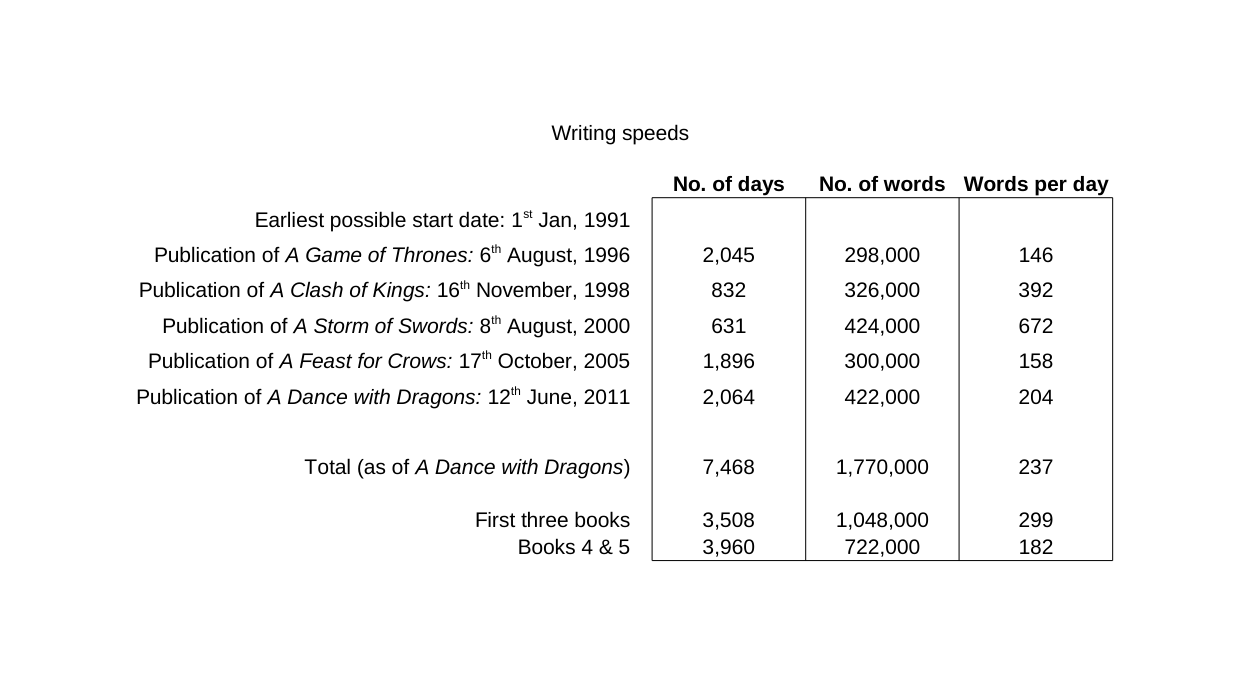
This made me curious about Mr. Martin’s writing productivity, so I did a little digging and found the following figures, calculated by his fans:

grrm_wordcount

Those numbers are rather stunning. He averaged only 200 words a day when writing A Dance with Dragons? Just for reference, this blog post is about seven hundred words so far, and I’m writing it while taking a break from my other writing (word count so far today: 1,100 words, and that’s a little low). Even if we allow for five drafts written at the same speed, five drafts still only comes to 1,000 words a day.

Now, I do think Mr. Gaiman makes a good point that it is neither healthy nor helpful to try and micromanage everything that a writer does. We can’t spend every waking hour working on the next book, and even if we did, it probably wouldn’t turn out as well, because refilling the creative well is an important part of the writing process. And I also have to admit that if you ran a similar calculation on my own books (especially the early ones), you would probably find some similarly embarrassing figures.

(Though to be fair to myself, I tend to have multiple irons in the fire at any given time, so a straight start date to publication date calculation doesn’t tell the whole story—and it probably doesn’t tell the whole story with George R.R. Martin as well. But still, even if those figures were twice as high, they would still be absurdly low for a working writer.)

When Mr. Gaiman and Mr. Martin say that the writing “comes when it comes” and there’s nothing they can do about it, I think they’re wrong. Dead wrong. Writing is an art, but it is also a craft. It can’t be forced, but it can be structured. Mr. Correia has evaluated how productively he writes and structured his convention-going plans accordingly. Has Mr. Martin?

I also think they’re dead wrong about the writer having no obligation to the reader. That’s total bunk. Reading is an act of collaboration between the writer and the reader: without readers, stories would never exist. They would just be markings on a page, or electrons on a drive, or at best ideas and daydreams in the writer’s head. If a tree falls in the forest, does it really make a sound? If a book is never opened, does it ever tell a story?

Part of this may be the difference in perspective between indie writers and traditionally published writers. In the traditional system, writers were paid an advance on royalties by their publishers. The contract also allowed for royalties, but those figures were set so low that most books never earned out their advance. Publishers made up for it by raising the advances for the writers they wanted to keep.

In contrast, indie writers live and die by their royalty checks. Had a good month? Congratulations, you can afford to eat. Had a bad month? Tsk, tsk. Better hurry up with that WIP of yours, because the longer it takes to publish it, the longer it takes for you to get paid.

But even for the fantastically successful writers who never have to worry about how they’ll pay their bills, I still believe that they have as much of an obligation to their readers as the rest of us. Without readers, we would not be able to do what we do. Without readers, it would be impossible to pursue writing as a career. We all want to live the dream, and the only way to do that is by treating our readers well.

So George R.R. Martin may not be your bitch, but I most certainly am. Writing is not something that happens only sometimes: it’s my job, and I do it every day. And as for accountability, I absolutely feel that I’m accountable to my readers. They are the whole reason I am able to do this in the first place. If that makes me their bitch, then so be it.