The Gulf Between the Generations (Blast from the Past: February 2012)

Here’s a post I originally wrote in 2012. Given how most political commentary tends to lose relevance over time, it’s remarkable when something from the past is even more relevant now than when it was written.

Not that this post is overly political: more just a series of observations, including some red flags that, at the time, were still on the distant horizon. In recent months, those flags have drawn much closer.

Such a crazy world we live in. Stay safe, and thanks for reading.


I just watched a fascinating interview with a 1960s White House intern who claimed to have an eighteen month affair with President John F. Kennedy. But the most interesting thing wasn’t the affair itself, but the way the President’s staff, the “fourth branch” of government (AKA the media), and the entire general public of 1960s America seemed more intent on keeping the secret than on facing the truth about JFK’s many affairs.

It seems that my parents’ generation had so much trust in their government that nobody would even raise the question—that to raise doubts about the integrity of the man who held the highest office in this country would itself be unconscionable. Rather than face the facts, the American public seemed unwilling to do anything that would shatter the gilded image of the man who led the free world. And that, quite frankly, is a mindset that I simply cannot understand.

In contrast, my own generation has very little trust in our government. We’ve been raised in an age of ambiguity, where the enemy doesn’t wear a uniform or pledge allegiance to a flag, but live quietly among us, until they strap a bomb to their bodies or turn a commercial airplane into a weapon of terror. Or at least, that’s the excuse our government gives us for an increasingly invasive security regime that infringes on our basic liberties, enables the military to hold us in detention indefinitely, and sends our soldiers overseas to fight increasingly senseless wars to “liberate” the people of oil-rich nations who don’t even want us there. As if that weren’t enough, the economic crash has taught us that all that stuff our parents taught us about equality and opportunity is really just a pack of lies—that the rich get bailouts while the rest of us foot the bill, and all that stuff about changing the world and being whatever you want to be… yeah. Lies, all of it.

My Dad had an interesting rebuttal to all this, though. He said that it wasn’t his generation that put the president on a pedestal—it was his generation that tore the pedestal down. During the 60s and 70s, the Vietnam era and the rise of the hippy movement, his generation fought back and made it acceptable for us to question the president, or to criticize the government, or to do all the things that we take for granted today. In fact, he said that we’re the ones who are backsliding into complacency, with our deafening echo chambers, our social media inanities, our reactive attachment to corporate brands and advertising, and our almost religious sense of entitlement.

I’m not totally convinced he’s right, but I do think there’s a fundamental gulf between these three generations. Our grandparents’ was the silent generation, where people were expected to keep to their own business and not rock the boat. Our parents’ generation was one of top-down media, where ABC, NBC, and CBS ruled the airwaves and told us all what to think, buy, and believe. Ours is a much more peer-to-peer generation, but I worry that we’re turning into a collection of mindless herds who are turning the culture wars into a messy riot where we abandon civil dialog and rational thinking for a much more destructive mob mentality that isn’t really building anything, but tearing it all down.

Sometimes, it gets so frustrating that it makes me yearn for the days of the frontier, when you could leave it all behind and reinvent yourself somewhere out in the west. That’s probably why I’m so drawn to science fiction, where space is the final frontier. There really are times when I wish I could go to the stars and escape to it all. Writing about that is the next best thing.

Maybe that’s why I feel so compelled to write Star Wanderers. It’s not all rosy, of course—space can be a cold, dark, and lonely place—but so can this world, when you’re lost and you don’t really know what you’re doing with your life.

I don’t know if I recognize anywhere as my own country anymore. Like Van Gogh, all I can say is the sight of the stars makes me dream.

Rethinking free

I recently read an interesting blog post on Dean Wesley Smith’s blog, about how, how not, and whether to make your books free. The conclusion he comes to is this:

Free is short time, limited supply, and never on the major bookstore shelves.

In other words, no permafree, no free pulsing, and no publishing free online content on sites like InstaFreebie unless it’s for a limited time.

Three or four years ago, I probably would have pushed back pretty hard against this advice. There are still points of it that I disagree with, such as the idea that giving anything away for free devalues all your other work. Perhaps that’s true for physical product, but for digital content I think there’s a solid argument to be made that the rules have changed.

That said, a lot has happened in the last three or four years. Permafree worked really great until about the middle of 2014, at which point I noticed that it was a lot harder to generate any kind of interest in my free books. I switched to a free pulsing strategy in 2015, which was a lot more effective at giving away free books, but that didn’t always translate into more sales.

In fact, there’s a passage from Dean’s blog that sums it up real well:

A customer walks through your door and you have a wall of twenty pies in glass cases, all the smaller short story pies in a case in the center, and some specials near the cash register.

And there on your wall are three pies that say, “Free.”

And a bunch of short stories that are “Free.”

The customer can take an entire pie for free or buy one. As a customer, what would you do? Duh. You take the free pie and leave.

And pretty soon your customers start to change. The only people who come through the door are people who only want the free stuff. They would never buy something under any circumstances, but you are giving your pies away for free, so they take one.

Pretty soon there would be lines out the door to get your free pies and you would make nothing. The free takers would crowd out and devalue the pies you are trying to sell.

Now, I don’t entirely agree with Dean here. My 90-day sales chart on Amazon shows a predictable uptick in sales every time I set a book free and send out an email to my list. Most of my subscribers signed up through InstaFreebie, which means they’re probably not quite fans yet (and probably signed up for a bunch of authors’ lists).

But my long-term data tends to agree with Dean. Back in 2012 and 2013, there was a very clear correlation between free downloads and royalties / paid sales. Then, in 2014, that correlation started to become fuzzy. Over the next several months, it got progressively fuzzier (even though I was giving away more books), until today there’s really no correlation at all.

Obviously, YMMV and I can only speak for my own books. But there have been a lot of major shifts in the ebook market over the last five years. Kindle Unlimited has had a huge impact on the effectiveness of permafree, or any kind of free book strategy for that matter.

Point is, it may be personally useful to rethink my free strategy. I’m not going to stop doing the free book thing altogether, since I do think there’s still value to it (if for no other reason than that little sales bump, plus the handful of “thank you!” responses I get from my email subscribers each month). But instead of free pulsing two books each month, usually including a first-in-series novel, it may be better to do a 99¢ novel and a free short story.

The two biggest mistakes I’ve made so far in my writing career have been 1. underpricing my books, and 2. unpublishing books that were still selling. (I still can’t believe how stupid I was) Holding onto a free books strategy that isn’t working could easily become a close third. I’m not going to throw the bus into reverse while it’s barrelling down the highway at 70 mph, but some experimentation and a course correction may be in order.

Writing is not a business

I recently read Rich Dad, Poor Dad by Robert Kiyosaki. It’s a fantastic book, not only because it gives you a basic education on financial literacy, but because it gives you a solid foundation for making money in general. It’s one of those books that really deserves its bestseller status.

About midway through reading it, I realized that I’ve been thinking all wrong about my writing. Everyone always says that if you want to write professionally, you should treat your writing as a business. But that’s not entirely correct.

Writing is not a business, it is an investment. Publishing is a business.

The basic argument of Rich Dad, Poor Dad goes like this: if you want to be wealthy, don’t work for money—make your money work for you. How? By owning more assets than liabilities. An asset is something that puts money in your pocket. A liability is something that takes it away.

When you write a book, you are creating an asset. A book is an intellectual property that generates money. Dean Wesley Smith compares it to a piece of pie in a magical bakery, where you can cut infinite pieces for your customers. With online publishing through ebooks and print-on-demand, that’s not a bad analogy.

If I were to cease all of my publishing activities right now, including all marketing and promotion whatsoever, my books would still generate income. It probably wouldn’t be a lot, but it would still be something. Even starting from zero, with a single book on Amazon under a totally unknown name, over time it will generate a small trickle of income.

A book is an asset. Writing is how you create that asset. Publishing is how you service that asset to make it more profitable.

As an indie writer, I am my own publisher. The business that I own is a publishing business, not a writing business. It’s a subtle but important distinction. I could still create books if I weren’t my own publisher, but at that point I’d be a contractor, not a small business owner.

Writers are not paid by the hour. As an indie, I’m still earning money on work I did ten years ago, and I fully expect to continue earning income on that work for the rest of my life. That’s because writing is an investment. Not a job. Not even a business. An investment.

Which is not to say that the publishing aspect—or in other words, the business aspect—is less important. Quite the contrary. A rental property is an asset, but it won’t make any money unless you find renters and take care of the upkeep. Similarly, a prime plot of farmland is an asset, but it won’t make any money unless you work it.

So how do you “work” your books? By publishing them, of course. Publishing is your business. This includes marketing, promotion, branding, and the like. Publishing is the business that makes your assets—your investments—profitable.


The implications of this are really interesting. For example, suppose you have a book that doesn’t sell very well, or that gets a bunch of negative reviews. Does that make you a failed writer? Does it spell doom for your career? It’s easy to think so if you think of writing as your business.

But when you think of writing as an investment, everyone changes. Got a book that tanked? That’s okay, it’s just that book. Every investor gets it wrong every once in a while. Learn from the mistake and pick a better investment next time.

If all your books are tanking, is that a sign that you’re just not cut out for this writing thing? Possibly… or it could just be that you need to work on your publishing. Even the richest farmland needs to be tilled, and fertilized, and watered properly. Perhaps you just need to learn how to market better, or brand your books better, or do a better job of finding and connecting with your readers.

On the flipside, suppose you have a book that used to do well, but now it isn’t selling as well as you would like. You’ve clearly done a good job of marketing it in the past, but what can you do now? Market it even harder? Or recognize that this is just a normal part of the investment cycle and go out to develop a new asset?

If writing is your business, then the success or failure of your books is a direct reflection of yourself as a writer. With that kind of mindset, it’s easy to fall into some traps. On the one extreme are those who believe that publishing well is secondary to writing a good book, and that therefore they should devote the bulk of their time and energy to writing. On the other extreme are those who seek validation so hard that they put all of their effort into the publishing aspect and neglect the writing. The truth is NOT somewhere in the middle, because both extremes grow out of a faulty premise: that writing is your business.

This is the Fugio cent. It was commissioned by the Continental Congress before the ratification of the Constitution, and designed by Benjamin Franklin. Fugio means “I fly,” referring to the sundial, which represents time. Taken with the inscription below, it is a reminder that we can all leave the world a better place by doing our best in whatever line of work we choose to pursue.

For many of us, writing is more than just a hobby, or a job, or even a career. It is a vocation. It is our calling. And yet, we live in a commercial world, where the price of a thing is often conflated with its value. How, then, can we best fulfill our calling as writers? By ignoring the demands of the market? By fancying that our books are simply unappreciated by those of inferior tastes? Or by losing sight of our calling for that lucre that will perish with us?

Benjamin Franklin’s message is that we can best fulfill our calling by pursuing excellence in every aspect of it. That includes the commercial aspect as well as the artistic, the practical as well as the spiritual. When we truly learn how to excel, we will see that there is no contradiction between the two sides.

Writing is our calling. Publishing is our business. Our books are investments, many of which may very well outlive us. By understanding this, I firmly believe that we can mind our business as well as Franklin admonished us, and truly fulfill our calling.

New short story!

Hey guys! Just a quick post today to let you know that I have a new short story out! It’s a fantasy short this time, set in the same universe as The Sword Keeper. With this latest one, I’m still on track to publish something new every month. Check it out!

Nothing Found

First impressions of Iowa

It’s flat, but not as flat as I was expecting.

There are lots and lots of pickup trucks. The ratio of pickup trucks to other vehicles is probably higher here than it is in Utah.

There’s definitely a lot of aggressive drivers, but they all tend to be aggressive in the same ways, so it’s not that bad. Very different from Utah Valley, which has some of the worst driving I’ve ever seen (and I’ve been around!)

Why don’t the roads have suicide lanes or shoulders? Seriously, it would make the driving so much better!

Okay, enough about driving…

The weather can get really windy. On the highway, I’m almost always fighting a headwind or riding a tailwind (so much for no more driving).

Twilight lasts FOREVER. This is definitely big sky country.

The people seem friendly enough. A little self-depreciating, but not overly so. One of the things I hear from them is how “uncultured” or “stuck in the old ways” Iowa is, but I see little free libraries all over the place here.

People tend to have rounder faces or more Irish complexions. Most everyone is white, though there are a fair number of Asians and Hispanics.

I’ll probably get in trouble for saying this, but the young women in Iowa aren’t quite as attractive as the young women in Utah. That’s a very high bar to hurdle, though, and of course there are exceptions.

I’m genuinely surprised how much Mormon stuff there is out here. I thought it was mostly just in Utah. There’s Winter Quarters, Nebraska, which of course has a large historical site, but there’s also a bunch of smaller historical sites in Iowa proper, connected with the Mormon trail. Haven’t even made it out to the east either, which is right next to Nauvoo.

That’s pretty much it for first impressions. I’m looking for part-time work, but haven’t found anything yet, though I have landed a couple of interviews. Hopefully something works out. In the meantime, I’m working hard to build my writing career, especially the publishing side of the equation. I’m not that far off from writing full-time again; I just need to build things up into a sustainable business. More on that some other time.


A fascinating journey of discovery

I had a really fascinating experience last year that has turned into something of a journey of discovery. It’s still ongoing, and I’m sure it will affect my writing in years to come.

It started with family history. Long time readers of this blog will know that I’ve been interested in family history for some time. My sister is a professional genealogist who specializes in Czech records (she keeps a blog here), and I got started by helping her.

In the United States, the census records are only useful to about 1850. Before that, you have to get into land records, probates and wills, and local courthouse type stuff to really go anywhere. But in the Czech lands, the Catholic Church has kept meticulous parish records going back to the 15th and 16th centuries. They’re handwritten in old German and totally unindexed, but the books are all digitized and available online.

As I worked on this research with my sister, I started to wonder: how far back can we push these lines? What are the limits?

The Czech lands were part of the Holy Roman Empire, under the Austrian Habsbugs. In the 15th century, the Hussite Wars shook things up quite a bit, and that’s about as far back as the Catholic parish records go. But the noble genealogies were very well kept, and go back quite a bit further. If one of your lines connects to the nobility (which is very possible, given how many bastard children were running around), you can push back really far.

But past the 8th century, things start to get sketchy. Most of the nobility in Europe are descended from the barbarian tribes who invaded the Roman Empire: the Goths, the Franks, the Vandals, etc. Same thing with the Slavs and the Byzantine Empire, though the Byzantines held out much better than the Western Roman Empire (it was the Turks, not the barbarians, who eventually did them in).

The trouble is that when these barbarians took over, they tried to establish their legitimacy by fabricating genealogies. Plenty of royal European lines go back all the way to Adam and Eve, but how reliable is that really? As rulers of Christian lands, of course they would try to connect themselves to famous characters from the Bible.

The Dark Ages might not be as dark as we think they are, but in terms of records and record-keeping, they certainly are. The largest and most civilized empire in the world had just collapsed, with barbarians running amok in the countryside and the Persians threatening the last vestiges of the empire in the east. Very few historians have documented this era, and it was a huge dark spot in my own understanding of the world.

So I set out to study it. I scoured Wikipedia, subscribed to the Western Civ podcast, and listened to the entire History of Rome by Mike Duncan (excellent podcast, by the way). The Roman Empire had dominated Europe right up to the early middle ages, and I wanted to learn why it had fallen.

That led to a journey of discovery all in itself. Roman history is a fascinating subject in its own right, and the four or five centuries from the Punic Wars through the reign of Marcus Aurelius are very well documented. Rome faced a lot of challenges, and even a few existential threats, but for more than a thousand years they dominated the known world.

So why did they fall?

The more I studied about the Romans, the heavier this question weighed on me. I learned about Diocletian and the Tetrarchy, the crisis of the third century, and Constantine the Great—a period of Roman history that was much less familiar to me. And then things started to click.

My Czech ancestors were serfs. They emmigrated to Texas shortly after the last vestiges of serfdom were abolished in 1848. Under serfdom, they were little better than slaves. The land they lived and worked on was owned by the Hukvaldy Estate, and they were bound to it by feudal law.

When Diocletian became Augustus, the Roman Empire was reeling from half a dozen existential crises, including an economic collapse. The money was so worthless, most of the empire had resorted to a barter economy. Diocletian established a system of exchange where people could pay their taxes with trade goods rather than money. However, the only way for that system to work was 1) for everyone to take the profession of their parents, and 2) for no one to move without Imperial permission. Otherwise, you might have too many pig farmers in one province and not enough blacksmiths in another.

In other words, the system of feudal serfdom that my ancestors labored under had its roots in the reforms of Diocletian. But it went much deeper than just one man. Diocletian reforms were necessary because the Roman economy had collapsed, and the economy had collapsed because for more than a hundred years, the Empire had been in massive debt, and had serviced its debts by devaluing its currency.

Sound familiar?

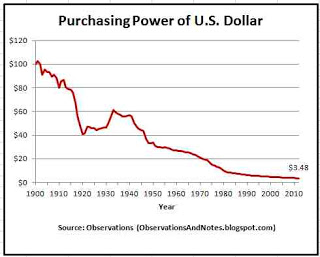
The Roman Empire fell because of deficit spending, government debt, and currency devaluation over the course of several generations. In 1913, the United States established the Federal Reserve, beginning our own process of currency devaluation. Our national debt has doubled every eight years since 2000, when the stock market peaked as measured in gold. Right now, our debt-to-GDP is 104%. One hundred four percent.

And that’s just our sovereign debt. Our household debt is north of $12 trillion, or another 73% of our GDP. The largest portion of that is student loans, which cannot be resolved through bankruptcy.

Seven out of ten Americans have less than $1,000 in savings.

Half of Americans would have to beg, borrow, or steal if slapped with an unexpected $400 expense.

Twenty percent of American households do not have a single person that is working.

Fully one-third of America is in debt collections, meaning that they have an unpaid debt more than 180 days past due.

Is it any wonder that the middle class is shrinking? We’re following the same path that Rome followed, except where they merely walked, we’re running headlong. With our modern communications, the pace of life is so fast that I suspect we’re completing the cycle in a fraction of the time.

And then you realize that what passes for money these days isn’t “money” at all, but government paper backed by government debt. What happens when we default? What happens when the credit markets freeze up and contagion spreads across the global economy? What happens when you wake up one morning, only to find that all the ATMs are down, the banks are all closed, and everyone’s accounts are all frozen?

So what started as an interest in family history took me down a rabbit hole where I learned all about how Rome fell, and how we’re following in the footsteps of Rome. It led to a keen interest in monetary policy and our global monetary system. It also gave me a new hobby: coin hunting.

The Romans devalued their currency by melting down the old gold and silver coins, and minting new ones mixed with copper. Over time, the melt value of the coins went down, and that’s exactly what’s happening to our US currency now.

Before 1965, dimes and quarters were made from 90% silver. After, they were made from copper with a thin nickel coating. Nickels have always been made from a 75/25 copper-nickel alloy, however, and pennies were all 95% copper until 1982. Right now, the melt value of a US penny is actually 1.8¢. At the height of the “jobless recovery” it was closer to 4¢.

Now, it’s illegal to melt down pennies because they are currently legal tender. However, as the currency continues to inflate, the penny will become even more worthless, eventually reaching the point where it doesn’t make sense to make anymore. Right now, the material cost alone of each zinc penny is 70% of the face value. Canada has already discontinued minting pennies, and we aren’t far behind.

I started dabbling in copper hoarding. But as I went through lots of pennies, I started coming across some really old ones. Which got me to wondering if maybe the numismatic value of some of these coins eventually might be more than their melt value. After all, when everyone’s melted down their copper pennies, a complete collection of Lincoln cents is going to be something special.

So I started building a collection of Lincoln cents. Then I got into state quarters, first as a cool Christmas gift for one of my nephews, then for myself. Then I got into Jefferson nickels, and started finding silver.

Right now, I have a complete set of Lincoln Memorial cents. They’re all from circulation, and some of them are pretty beat up, but there are a few really nice ones in there too. My wheat cents collection is much less complete, but the coolest piece is a 1909 VDB in very fine condition, with all the wheat berries still showing. That’s a $10-$15 penny that I found in a normal coin roll.

It’s a fun hobby, and it comes around full circle to what got me started down this rabbit hole in the first place. Each one of these coins is a small piece of history. That 1909 VDB is more than a hundred years old. I’ve got coins that my parents and grandparents would have used, and a penny for every year of my father’s and mother’s lives. With a bit of luck and a lot of patience, I’ll be able to find a penny for every year of my grandparents’ lives as well.

So yeah, it’s been a fascinating journey of discovery, and it’s still ongoing too. I just got started with Roosevelt dimes, and I’m catching up on Mike Duncan’s Revolutions podcast, which is just as interesting as his History of Rome. Turns out that the French Revolution also happened because of deficit spending and a runaway government debt. Surprise, surprise.

Life is a giant rabbit hole when you’re curious about everything!

Is it ever okay to punch a Nazi?

Is the current year between 1939 and 1945?

Are you currently on active duty in the armed forces of one of the Allied nations, or a member of a partisan resistance movement within Nazi occupied territory?

Is the Nazi whom you want to punch currently engaged in combat operations against you?

If you answered “no” to any of these questions, then the answer is:

No, you dumbass.

Guest Post by Timothy C. Ward

Hi guys! This is the penultimate week that the Sci-Fi StoryBundle is available, and I have a guest post today from Tim Ward, one of my fellow authors. His book Scavenger: Evolution is one of the bonus books, and it takes place in the universe of Hugh Howey’s Sand. To talk a little bit about that, here’s Tim:


My debut novel, Scavenger: Evolution was inspired by a time in publishing where “fan fiction” evolved into shared world fiction, and the weakening of a stigma that it would be lesser quality than the original source material. Kindle Worlds gained popularity through shared world stories set in famous works, with Hugh Howey’s Wool as one example.

I met Hugh through some podcast interviews I did for my first podcast, AudioTim. I loved his story of long term, overnight success, but more so, I loved his stories. Sand told the tale of a family adrift in a world covered in sand, where sand divers hunt for buried treasure and the lost city of Danvar.

In one scene, after a catastrophe, an unnamed sand diver is noted for scavenging in the rubble of a newly buried location. Knowing that Hugh allowed people to write in his Wool universe, I asked him if I could write a story in his Sand world even though it wasn’t yet open in Kindle Worlds. He gave me permission, and I took off with the idea of who this sand diver was and whom he was searching for.

The characters of Scavenger: Evolution became a former dive master, Rushing Stenson, and his wife Star, who lost their infant to a sand spill two years earlier. Their relationship never recovered, and the story starts with Rush as a custodian at a saloon, struggling with giving up on life and giving in to the temptations that surround him. He is offered a job that could give him the financial freedom to leave, and in the midst of his adventure, he will be forced to examine what life he could have with his wife if he decided to fight instead of giving up.

The story works as a stand alone, with really only the world and the starting point of the sand diving technology as the hooks that keep it in Hugh’s universe. I wrote a sequel, Scavenger: A.I. where I expand on my idea of what caused that portion of a future America to be covered in sand. Our heroes uncover the technological cause of the apocalypse, and then struggle to keep it contained before it makes them pawns in its resurrection.

Joe mentioned earlier posts on his blog that discuss TV tropes that inspired stories. In mine, I’d have to credit Stargate: SG-1 as a main influence in its story threads surrounding the replicators. The tone of my story is more along the lines of Alien, and its trope of terror in entering a lost civilization to discover ancient technology. Anyone who enjoys discovery, pulse pounding action, and a foundation of emotional turmoil between loved ones, should find a solid read in my Scavenger duology.

Scavenger: Evolution is the first book in the series, and is available as a bonus book in the Sci-fi Adventure Bundle.