Addicted to Outrage by Glenn Beck

I wasn’t always a fan of Glenn Beck. When I was in college back in the 00s, I thought he was a pompous blowhard—and I was probably right. We’ve both changed a lot since then. I started listening to his radio show podcast in 2017 at the urging of a friend, and to my utter shock I found him to be both reasonable and insightful. I’ve been listening ever since.

If you’re a regular listener to Glenn’s show, most of what you’ll find in this book is stuff you’ve already heard. That said, on the show you pick it up in bits and pieces, whereas here it’s all laid out in one place, without any filler or extraneous back and forth. Having done both, I would rather read this book and listen to his show only occasionally than listen to his show religiously and skip this book.

The thing I like most about Glenn is that he’s one of the few political pundits who have checked their pride in recent years. In Addicted to Outrage, he gives his story: how he went from being one of the most prominent and virulent right-wing commentators to acknowledging that he’s been wrong about some things and completely changing his approach. He lost a few of his old-time fans who preferred the screaming, ranting Beck, but gained an ability to understand and speak the language of those on the other side of the political divide.

The main thesis of this book is that outrage, especially social media outrage, has become an addiction very much like alcoholism, and that the steps for recovering for alcoholism apply equally as well for healing our modern outrage culture. Glenn brings up a lot of interesting points about how the outrage in our culture is increasing, how social media is designed specifically to foster a chemical addiction through repeated dopamine hits, and how it feeds into all of our worst impulses and does serious damage to our health, our relationships, and our ability to live together.

The most interesting part for me was where he talked about how our outrage culture and the news cycle is distracting us from the truly important stuff that’s going on right now, such as the development of AI, the rise of big tech monopolies, technological disruption and the looming unemployment crisis, and geopolitical challenges that threaten to drive our world into war. Again, this is all stuff that Glenn covers regularly in his radio show, but it’s useful to have it all in one place.

My biggest criticism of Glenn is that his obsession with all of the ways that things can go catastrophically wrong turns him into something of a doom pornographer at times. He generally keeps it classy, but classy doom porn is still doom porn. I don’t think we’re anywhere near a hostile artificial general intelligence sweeping the world with nanobots and turning us all into grey goo, for example. That said, his prediction track record is surprisingly good, so even with the doom and gloom it’s still worth listening to him. At least he doesn’t (usually) cross the line into fear mongering.

Glenn’s love of the Constitution definitely shines through this book. He spends a great deal of it going through the Declaration of Independence and the Bill of Rights, which I found to be insightful. In one of the more interesting chapters he talks about how we should neither whitewash our history nor condemn it, but acknowledge both the bad and the good and strive to live up to the aspirational deals set forth in our founding documents.

All in all, it was a good and insightful read. If you’ve never listened to Glenn, this book is actually a really good place to start.

Will A Song of Ice and Fire stand the test of time?

A while ago, I wrote a blog post titled Why I don’t like George R.R. Martin, in which I laid out some of the issues I had with the Song of Ice and Fire series, and why I decided not to read past the first book. That post has been getting a lot of traffic lately, probably because the last season of Game of Thrones is coming out and there’s a lot of hype right now about it.

At FanX a couple of weeks ago, I attended an interesting panel with Steve Grad from Pawn Stars on the do’s and don’ts of collecting. On that panel, he expressed some skepticism that Game of Thrones signatures and collectibles would hold their value over time. This made me wonder: will the books this TV series is based on stand the test of time?

Full disclosure: I have only read the first book, A Game of Thrones, and have not watched any episodes of the miniseries. I’ve watched a few of the more important scenes on YouTube and occasionally follow discussions about it on online forums. After reading the first book, I decided that this series was not the sort of thing I wanted to watch or read. See the blog post linked above.

People have been calling George R.R. Martin the American Tolkien for years now, but I’ve always been skeptical of that claim. Tolkien’s books are timeless because they are so archetypal, with the classic struggle of good vs. evil permeating every page. In contrast, Martin rejects the archtypes of good and evil for a nihilistic black-and-gray morality, where there are no heroes, only victimizers and victims.

Why, then, is A Song of Ice and Fire so popular? First of all, because the writing and storytelling really are top notch. For all my criticism of George R.R. Martin, I fully recognize that he is a master. But there are a lot of excellent, masterful books that never capture the public imagination quite like Game of Thrones and A Song of Ice and Fire. What, then, makes Martin’s work so different?

I believe it’s because George R.R. Martin has struck a nerve with the current zeitgeist, and scratches a uniquely contemporary itch in a way that none of the great works by the old masters can. What is that zeitgeist? It is spirit of a culture in the late stages of decadence, where wealth disparity, big government, endless wars, easy credit, runaway debt, moral decline, and corruption are the defining aspects of the age.

In a world where, in so many ways, we are shielded from the consequences of our own actions, morality becomes irrelevant and entertainment shifts to serve our basest, most carnal lusts. In such a world, we turn to nihilistic stories like Game of Thrones, which are saturated with sex and violence. They reinforce the view that good and evil don’t exist, that honor and integrity are for fools, and that wealth, power, and sexual indulgence are all ends in themselves. “Eat, drink, and be merry, for tomorrow we die, and it shall be well with us.”

At the same time, these stories satisfy a deep sense of self-loathing that arises out of the very nihilism that they celebrate. In those few moments when we are honest with ourselves, the decadence of our age profoundly disgusts us. As Haruki Murakami put it, “secretly everyone is waiting for the end of the world.” That is exactly what stories like Game of Thrones give us: gleeful destruction and total collapse, with blood, fire, ice, and steel. No one is safe. Anyone can die, even our most beloved characters. Winter is coming.

Every empire collapses, however, and every age of dedadence comes to an end. The very nihilistic elements that make stories like A Game of Thrones so appealing ultimately cause them to fall away and vanish, along with the culture itself. To stand the test of time, stories must be built upon archetypes that transcend the spirit of the age, rather than indulge it. Does George R.R. Martin do this? I don’t believe that he does.

A Song of Ice and Fire has an added disadvantage in that the TV series has overtaken the books. How many people will simply give up on the books after watching the season 8 finale? A Dance with Dragons averaged a 2.9-star rating on Amazon the year it came out, with thousands of reviews. It takes George R.R. Martin so long to write these books that it’s already become a meme, and his health isn’t all that great.

Personally, I think we’ve already reached peak George R.R. Martin. The season 8 finale will be an enormous affair, but after that the show’s popularity will steadily decline, and the books will not renew the public interest. I still think the books will do well compared to other books in the fantasy genre, but compared to previous installments, I think the Song of Ice and Fire series will go out with a loud and plaintive whimper.

A generation from now, when the current age of decadence is over and our children and grandchildren are rebuilding the world, I believe they will look at these books and scratch their heads—if they even bother to read them at all.

A history of memes, visualized

So this is mostly a just for fun video, but I find it interesting for a number of reasons. Some memes flare up and die, while others stay evergreen for (relatively) long periods of time, and others find new life and bounce back. What makes that happen?

I have absolutely no idea, but it’s fun to watch, and even a bit nostalgic at times. Enjoy!

Zero G by Dan Wells

I saw this a couple of months ago when it was free, and I recognized Dan Wells as the guy who wrote the I Am Not a Serial Killer books, so I decided to pick it up. Since Dan Wells tends to write mostly horror, I wasn’t sure how good his science fiction would be, but I was pleasantly surprised!

This was a really fun book. It’s definitely middle grade, so a lot of concepts familiar to veteran sci-fi readers get lengthy explanations, especially toward the beginning, which is great for younger readers but a little tedious for us old-timers. Once all the science is sufficiently explained, however, the story really gets going. The characters are delightful, especially Zero, who comes up with a bunch of clever ways to fight back against the pirates. Think Home Alone meets Gravity.

It’s a short book for an audiobook, but the production is really top rate, with a soundtrack and a cast of voice actors who really do a fantastic job. The production quality gets five stars easily. I picked it up as a free Audible Original, but I wouldn’t have regretted spending a credit on this.

Overall, a very fun book. This is the kind of story I’d want to share with my kids to introduce them to science fiction. Very clean and not too scary, but with just enough of a sense of danger to really draw you in. Well done!

Plans for My Personal Home Library

If everyone has a weird or quirky super power, mine is the ability to acquire books. Even when I was living out of a suitcase in a remote Caucasian village, or traipsing across the Middle East, I was constantly acquiring books.

With my marriage to Future Mrs. Vasicek coming up, I’ve decided to put this super power to use. Instead of acquiring books randomly, I’m approaching the task of building a personal library with goals and a plan. Part of that plan is to inventory all of the books that I own, with lists of books / ebooks / audiobooks that I want to acquire. Part of it is to find a place in my home where I can shelve them all, instead of keeping them in boxes or the closet. And another part is categorizing all of the books, with goals for each category.

Requirements

After putting some thought into it, here are my basic requirements:

  • The entire library must fit in a single room / device / server.
  • The only books that I’ll keep are ones that:
    • I want to read again,
    • I want to talk about with others, or
    • I want to share with my family.
  • Ebooks and audiobooks must be DRM-free and device agnostic.

A while ago, I did a blog post on the pros and cons between print books, ebooks, and audiobooks. That seems to be a pretty good set of criteria for determining which formats to collect my books in, or whether to collect a particular book in multiple formats.

Ideally, I want to set up my personal library in a shared space in my home, where I can host guests. Future Mrs. Vasicek and I are going to get a set of scriptures, kind of like the tradition of a family bible, and I want this to be the centerpiece of my personal library. Eventually, I also want to get a dedicated ereader (or set of ereaders) that lives in the library, as well as a portable hard drive for all of the audiobooks. I don’t want any of it to depend on the cloud.

Categories

So far, I’ve got eight categories, though I’m sure this will expand. They are:

  1. Science fiction & fantasy
  2. Other fiction
  3. LDS non-fiction
  4. Self-improvement
  5. Writing & publishing
  6. Arabic language
  7. History & current events
  8. Other non-fiction

I have a lot more fiction books than non-fiction (go figure). For now, I’m using Goodreads as a library inventory system, though I may want to find something better in the future. If you check out my Goodreads profile, you can probably see all of them.

I’m working to come up with goals and plans for each category. Here’s what I have so far:

Science Fiction & Fantasy

My main goal here is to collect the complete works of David Gemmell. He is my favorite fantasy writer of all time, and I’ve read all of the Drenai series and most of the Stones of Power and the Rigante series as well. I’m holding off on the Troy books, mostly because I want to savor them. He’s also got a few standalones and duologies, most of which I’ve read.

Other series that I want to collect in print are:

  • Louis McMaster Bujold’s Vorkosigan series
  • All of Heinlein’s juveniles
  • The Barsoom series by Edgar Rice Burroughs (Princess of Mars, etc)
  • Ursula K. Le Guin’s Hainish cycle
  • All of the books by my writer friends

There are also a bazillion trilogies that I either own or want to collect, but it’s not worth listing them all here. I’m sure this is going to be a very dynamic part of my personal library.

Other Fiction

My main goal for this section right now is to collect all of the Sackett books by Louis L’Amour. There are only two left, both of which I’ve requested on Paperback Swap. Now I get to read them all, without any interruption!

I also plan to focus on collecting Jeff Shaara, especially the Civil War books. I currently have The Killer Angels by his father, as well as Gods and Generals and The Last Full Measure. But before that, I need to read Rise to Rebellion and The Glorious Cause, which I also own (those ones cover the Revolutionary War). Depending on how much I enjoy those, I’ll decide whether to collect Shaara’s complete works.

LDS Non-fiction

There are a tone of authors that I want to collect in this section: Nibley, Givens, Gileadi, Groberg, and more. There are also a few key books that I need to acquire and read, mostly biographies and church histories.

One series that I’m really looking forward to is the four book SAINTS series published by the church. The first book was fantastic; I listened to the whole thing on the train, and it was really cool to pick out the people from my own family history and learn how they contributed to the rise of the church. The next book is going to cover the westward migration, and I have a bunch of ancestors who participated in that, including a few in the Willie handcart company. Really looking forward to it!

Here in Utah, it isn’t difficult to collect LDS non-fiction books. You can find most of the older titles in thrift stores, and there are lots of LDS bookstores to choose from. That said, I don’t have any concrete goals for this section yet. The biggest challenge will probably be in refining this section so that I only keep the best books (ha), since it would be very easy to let this section get cluttered with good but mediocre books. That seems to be the general trend.

Self-Improvement

The biggest thing I need to do in this section is reread How to Win Friends and Influence People, preferably once a year. Fantastic book.

I should also probably focus on marriage and relationship books, since y’know, I’m getting married. Personal finance is also huge: I’ve got Rich Dad, Poor Dad, and should probably collect all of Kiyosaki’s books. Stephen Covey is another huge one.

Beyond that, my cowriter Scott Bascom is really into self-improvement, so my plan for now is to build out this section based on his recommendations.

Writing & Publishing

There are a few classics that I need to re-acquire, such as Character and Viewpoint and On Writing. One classic that I will probably skip is Strunk & White’s Elements of Style (can’t stand that pretentious book). Other than that, the biggest thing is to stay current and focus on indie publishing. For that reason, I suspect that I’ll collect mostly ebooks in this section.

Arabic Language

My main goal here is to read The Book of Mormon (كتاب مورمون) in Arabic. I also have plans to study the Qur’an, though that’s not a priority at the moment.

Most of these books are ones that I acquired while studying Arabic in Jordan. I don’t think I’ll acquire many more anytime soon, though if an opportunity arises, I probably won’t turn it down. The big question in my mind is whether to expand this section to Arabic language & culture, since I do have a bunch of English books on the Middle East.

History & Current Events

My biggest goal for this section is to build a collection of monetary & financial books that together make a complete history of the United States. This subject is my current pet interest, much to Future Mrs. Vasicek’s chagrin. I also have plans for a coin collection / history that I’m currently writing, though that’s on the back burner for now.

Other than that, I plan to focus on book recommendations by Ben Shapiro and Glenn Beck.

Other non-fiction

No real goals yet for this section. At some point, I will probably spin off family histories as a separate category, since there are a lot of them in my family.

General Goals

The biggest thing I need to do is read every book that I own. I may be really good at acquiring books, but I’m not as good at actually reading them. Currently, I’ve read only about 20% of them.

When will I have them all read by? Ideally, the end of the year, but I doubt that’s going to happen. Then again, if I can keep my goal to read for an hour or two each night, a year might just be enough.

Since the library is constantly growing, though, I suspect this will be more of an aspirational goal, or a moving target. Even when I manage to hit it, it probably won’t take long before I acquire more books and have more reading to do again.

The next big goal is to find a place for all these books, which probably won’t happen until after Future Mrs. Vasicek and I are married. At which point, all of these plans may change, since she has a bunch of books too—but probably not too much. We’ve talked about it, and it shouldn’t be too hard to merge our books into one family library, if that is what we decide to do.

Aside from that, I’d like to get as many books signed and personalized as I can. Shouldn’t be too hard: just look up the guest list of any convention I’m attending, and bring the books along.


That’s basically the plan as it stands right now. With my quirky super power for acquiring books, it shouldn’t take long to build an epic personal/family library.

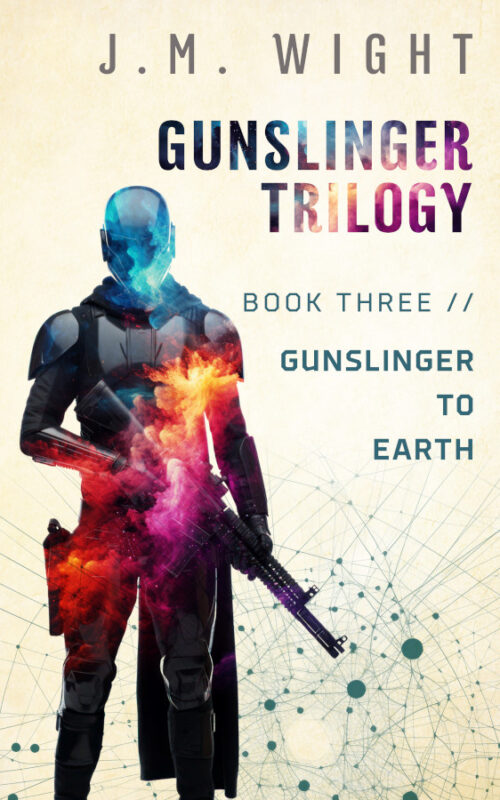
Gunslinger to Earth Now Available for Preorder!

Gunslinger to Earth

Gunslinger to Earth

$14.99eBook: $4.99Audiobook: $4.99 sale!

When the colonies went into revolt and my secret crush all but kidnapped me, I didn't know whether she was a patriot or a terrorist. Then the Earth was swallowed by an anomaly, and I realized that if I picked the wrong side, I would never see home again.

More info →

Back to Blogging

So my life is in well enough order now that I think I can get back to my goal of daily blogging. If I fall behind on writing again, I may duck out for a while, but for now it looks like we’re good.

The last couple of weeks have been a little crazy. Engagement photos, wedding invitations, and then there was FanX this weekend. Future Mrs. Vasicek is finishing up with school, with all exams last week and a group paper due today. But once that’s done, she’ll be working full-time over the summer, so it’s not like her work load is going to lighten all that much. Plus, we have the wedding in June.

In any case, the next couple of months are going to be a bit rocky, but there’s enough of a lull right now that I think I can get into the swing of daily blogging again. Hopefully I can keep it up for quite a while.