Stormrider by David Gemmell

I thoroughly enjoyed the Rigante series. It has everything that I’ve come to love about David Gemmell’s books: scarred but good-hearted people struggling to do the right thing in the face of great hardship and evil, some of which lies within. Every chapter is compelling and filled with conflict, and while you know that most of the characters are going to die, none of them is beyond redemption.

There were a lot of things in particular that I liked about this book. One of them was the early-modern feel and aesthetic to the world-building. A lot of fantasy worlds are locked in a perpetual state of medieval technology, with very little growth or development. In Stormrider, however, Gemmell advances the world of the Rigante a couple of steps up the tech tree, to a tech-level more on par with the 30 years war.

It’s not just window dressing, either, because the introduction of things like gunpowder has a direct effect on things like battle tactics and duels for honor, which directly affect the story. And yet, there’s still the same undercurrent of magic that made the other books in the series so great. The Sidh may have left the world, but their influence remains, and their magic has not yet faded completely.

My one big issue with the book had to do with the climactic battle leading up to the ending. It wasn’t exactly a deus ex machina, but in some ways it felt very much like it came out of left field and wrapped things up in a way that was just a bit too neat and tidy. That said, it wasn’t nearly as unsatisfying on a character-based level—on the contrary, it brought several of the character arcs full circle in a way that I thoroughly enjoyed. It just wasn’t as good as some of Gemmell’s other endings.

For that reason, I’m only giving this book four stars. However, a 4-star Gemmell book is like a 5-star book from anyone else. Stormrider may fall just short of the standard that Gemmell sets with his other books, but it still clears the bar for truly a truly great fantasy novel.
2019-08-29 Newsletter Author’s Note

This author’s note originally appeared in the August 29th edition of my author newsletter. To subscribe to my newsletter, click here.

I’ve recently been relistening to the History of Rome podcast by Mike Duncan. If you haven’t heard of it yet, you’re in for a treat. It’s about 180 episodes, each one about thirty minutes long, and it covers the legendary founding of Rome by Romulus and Remus to the dismantling of the western empire in 476. Great stuff.

Anyway, listening to the podcast again has given me all sorts of story ideas. 5th century Rome is basically a more interesting version of Game of Thrones, without the stupid ending (though I do have to admit, blasting the throne with dragon fire is much more awesome than sending the scepter and diadem to Constantinople). The schemes within schemes, plots within plots are rich with story potential, either for a grand fantasy epic or a sweeping space opera.

This isn’t a new thing, of course. Many sci-fi and fantasy authors have drawn inspiration from Roman history, including Asimov for his Foundation series and Frank Herbert for Dune. That’s partly because of how rich the history is, but it’s also because of how foundational Rome it is to our modern world. All of our institutions of government, law, and culture were built on the ashes of Rome, and the grand arc of Western Civilization traces an unbroken path from Augustus and Constantine to the present day.

I first became interested in Roman history by doing my own family history. My ancestry is a mixture of Czech, British, German, and Scandinavian origins, with lots of violent upheavals along the way (my British ancestors were basically the bad guys in The Last Kingdom). We know a lot about the Czech lines, where the records go back to the Battle of White Mountain after the protestants were expelled from the Czech lands. Beyond that, the records are scanty.

As I traced my lines back, I wanted to know how far it would be possible to trace them reliably. In the Czech lands, the cutoff is basically the Hussite wars. However, if you have royal ancestry (and most of us do, if you go back far enough—it was good to be the king), the records go back much further. Trouble is, most of the European genealogies get fantastical at some point, either connecting to ancient pagan gods or to the Bible.

Realistically, you can only trace European lines back to the 8th or 9th centuries with any reliability. Most of the royal families were founded by the descendants of the barbarian chieftains who had destroyed the Roman Empire, and to legitimize their rule, they traced all their bloodlines back to divinity. That was what I learned when I got into family history.

Of course, that answer led to even more questions. Why was there so much chaos after the fall of Rome? If the empire was so strong only a few centuries before, why did it fall? What caused all of the migrations, and why did the barbarians decide to invade the empire? Was the fall of Rome inevitable? Where were my ancestors when all of this was happening?

For the last three years, I’ve been on this personal journey of discovery, and it’s led to some very profound changes in my understanding of the world. It hasn’t ended yet, either. My big family history goal is to find all of my first generation American immigrant ancestors, which will probably take the rest of my lifetime to accomplish. In the meantime, it is fascinating to place my ancestors in the context of history and to think “when that big thing was happening, this is where my ancestors were.”

History is rich with stories, but it’s the personal connection that makes those stories relevant. That’s just as true for fiction as it is for history. Without the personal connection of characters just like us, or like we aspire to be, a book is just so many words on the page. It’s when we can see ourselves in the story that it begins to feel real and memorable.

I don’t know yet what kinds of stories I’ll write in the months and years ahead. It’ll take another year to finish the Genesis Earth Trilogy and the Twelfth Sword Trilogy, but after that, my writing schedule is wide open. Whatever I end up writing, however, I’m sure that the things I’m reading and learning about now will have an influence. So many ideas, so little time!

2019-08-08 Newsletter Author’s Note

This author’s note originally appeared in the August 8th edition of my email newsletter. To subscribe to my newsletter, click here.

A couple of days ago, Mrs. Vasicek and I had an old friend of hers over for dinner. This friend was visiting from out of state, and Mrs. Vasicek made it clear that politics was a subject which we would have to avoid, or at least tread very lightly. Among other things, I’d have to drop my tailgate to make sure it didn’t make a bad first impression.

(One of these days, I’ll have to share a photo of my tailgate. I despise political correctness in all of its forms, so my tailgate has become something of a monument to the first amendment. Frequently at stop lights, people will take out their phones to snap a picture.)

The dinner went really well, and we had good conversations well into the evening. Surprisingly enough, this wasn’t because we outright avoided politics, but because when the issues came up, we were able to find common ground in spite of our obvious differences. In this way, we were able to connect in a much more genuine way than if we had avoided those difficult subjects entirely.

One of the things we talked about was the destructive influence of social media outrage. Our friend told us how the relationship between her father and her sister has been destroyed, because Facebook is the only way that they can connect with each other. Those interactions have become so politically toxic that they’ve lost all of the love that they once had for each other.

That’s sad, but it’s becoming an all-too-common occurance here in the United States. Some people believe that we’re on the verge of a second civil war. I don’t know what the future holds, but if it’s anything like the first civil war, I know that there will be honorable people on both sides. That’s the tragedy. I have ancestors who fought on both sides of the American civil war, and when people ask which side I think was right, I answer “the American side.”

I’m fascinated by Robert E. Lee and his decision to fight for the Confederacy, when Lincoln himself offered him command of the Army of the Potomac. He opposed both slavery and secession, yet his conscience couldn’t allow him to stand at the head of an invading army. Neither could it allow him to stand by idly while his friends and family were slaughtered—not when he was in a position to make a difference.

Did he make the right choice? I don’t know. However, I do believe that he tried his best to do so. I try to keep that in mind when I talk with people across the political divide. No matter how much we may disagree, it’s refreshing to meet people who are sincerely striving to do what’s right as best as they know how.

In these troubled times, when the public discourse is rapidly deteriorating and outrage is the social currency of the day, it’s important to recognize the good in people, no matter which side they line up on.

2019-08-01 Newsletter Author’s Note

This author’s note originally appeared in the August 1st edition of my author newsletter. To subscribe to my newsletter, click here.

So Mrs. Vasicek is currently in Florence, Italy for a work conference that’s been going on all week. Am I jealous? Yeah, a little. Do I miss her? Yes, of course. Does she miss me? That’s what she tells me, though she’s also having a really good time touring the city and eating delicious Italian pizza and gelato. Am I jealous? Am I?

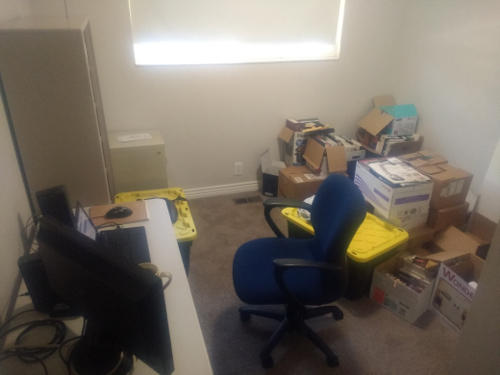
In any case, it’s been really quiet here in the Vasicek household with her gone. I’ve been taking advantage of that to get some household chores done. After we came back from the honeymoon, we went systematically through each room of the house to organize our stuff, and everything we didn’t have an immediate place for we dumped in the spare room until we could find a place for it to live. Just before she left, we finished going through all of it, so now I’ve turned the spare bedroom into my workplace:

2019-08-01 Joe's writing space

Here’s what it looks like right now. It’s not as messy as it seems. All of those cardboard boxes contain our books, which will have to remain in storage until we figure out where to shelve them. When two bookish people marry each other… you understand.

So yeah, it’s been quiet around here with Mrs. Vasicek gone. Quiet, and a little bit lonely. It reminds me of the time a few years ago when I was living alone without any roommates and got sick. I didn’t have any meaningful human contact for weeks on end, which was almost unbearable.

Writers tend to be introverts, but I’m actually an extrovert. Not the super bubbly kind who always greets everyone with a wide-eyed smile—I actually find it draining to meet new people, and prefer to keep to a small circle of close friends. But spending time with friends energizes me, while spending time alone drains me even more than being around people I don’t know.

Mrs. Vasicek is the opposite of me in that regard. She finds it draining to spend a lot of time with a close circle of friends, but gets energized when she’s in front of a large group, teaching or presenting or otherwise performing for them. She’s definitely an introvert, though, and tries to avoid unnecessary social interactions, especially when they might be awkward.

On our first date—which, incidentally, was at a bookstore (go figure)—I struck up a casual conversation with another person browsing the shelves. It’s the sort of thing that comes to me naturally, being an extrovert, but it really impressed her, enough to make her interested in a second date.

You don’t have to be alone to be lonely. That’s probably why I don’t do as well in large crowds of strangers. You also don’t have to be an extrovert: introverts can get lonely, too.

For extroverts, though, it’s either a virtuous or a vicious cycle. Spending time with people energizes you, which makes it easier to spend time with people, which energizes you, etc. On the flipside, spending time alone drains you, which makes it harder to have meaningful interactions with people, which drains you even more, etc.

All of this rambling probably makes me sound like I’m quietly losing my mind, but don’t worry: I’m actually just fine. My family was in town earlier this week, and I ran into an old college roommate just today and learned that he’s got a movie coming out in theaters next month. Awesome stuff!

So yeah, everything’s fine, but I do miss my wife a lot. She comes back in a couple of days, and I’m definitely looking forward to that.

“Lizzie-99XT” published in Serial Magazine!

It’s another week, and I have another short story out, this time in Serial Magazine! Here’s what the editor has to say about it:

We kick off ISSUE TWELVE with “Lizzie-99XT” by Joe Vasicek. This futuristic sci-fi tale follows a half-human, half-AI space pilot as she travels the galaxy to fight in an interplanetary war. She’s doing all she can to protect the lives down on Earth, but what type of life can this pilot truly have if most of it is spent lightyears away from those she loves?

“Lizzie-99XT” is a hard military SF piece about a starfighter pilot whose consciousness merges with the starfighter’s AI in order to fly it. She’s tasked with saving the world from a horde of alien invaders, but when battles are fought at near-light speeds, everything can change in an instant, and the home that she returns to may not be one that she recognizes.

Basically, it’s a cross between Neon Genesis Evangelion and Joe Haldeman’s The Forever War, except more uplifting. Probably. Also, it’s a short story, not a novel (or an anime series… yet). If that sounds intriguing, pick up a copy and read it today!

2019-07-25 Newsletter Author’s Note

This author’s note originally appeared in the July 25th edition of my author newsletter. To sign up for my newsletter, click here.

So Mrs. Vasicek has been sick with the flu for the past two weeks. She’s getting better, but we’ve both been less than productive, and any semblance of a daily routine has basically been shot. Turns out that having your wife around all day is a very distracting thing. Who would have thought?

All of this has got me thinking about habits and routines: how important they are, how to make them work, and how not to get discouraged. I’ve been self-employed basically since graduating from college nine years ago. I’ve worked a lot of side jobs, but nothing that I’d call a “day job,” at first because there weren’t any (graduating in a major recession is tough), and later on because I wanted to focus on my writing career—which so far, has been working out.

When you’re self-employed, you basically have to make your own daily routine, because there isn’t anyone else to make it for you. A lot of people struggle with this, especially after quitting their day jobs. If you aren’t careful, you’ll find yourself sitting on the floor in your underwear eating peanut butter straight from the jar (not that I have any experience with this, of course). But if you buckle down and push through that phase, you learn a few things.

First, you learn that even the best routines always fall apart at some point. It’s just the nature of the beast. The circumstances of life are always changing, which means that you’ve got to be constantly adapting to them. Hanging on doggedly to a favorite routine just for the routine’s sake is setting yourself up for failure. Goals are a mean to an end, not an end in themselves.

Second, guilt is not a very good positive motivator. It’s helpful to keep you from doing the things you shouldn’t be doing, but it’s a horrible way to get yourself to do the things you should. I’ve known a lot of writers who constantly beat themselves up for not meeting their writing goals, to the point where it’s practically a full-time job. For a while, I’ve been there myself. Not good.

The best way to make yourself more productive is to find ways to make it more enjoyable. Personally, I find that writing is most enjoyable when I’m immersed in the story that I’m trying to tell. Sometimes, the best way to get immersed is to take a break, and sometimes, the best way is just to sit down and write. It takes a while to figure out what works. I’m still trying to figure it out better.

Third, when making a new routine, make sure to keep your eye on the end goal. What good is eating an elephant one bite at a time if you’re eating the wrong elephant? That’s why, when your routine starts to fall apart, it may be better to rethink what you’re trying to accomplish and rebuild it from the ground up, even though it’s easier just to tweak it.

That’s where I’m at right now. I could just push my deadlines back a couple weeks and try to go back to how things were going, but there’s a lot of other business related stuff on my plate that I’ve been neglecting, and I get the impression that the best way to move forward with writing is to prioritize that other stuff and get it out of the way.

Rethinking the blog

It seems that I’m constantly in a state of retooling my writing career, moving from one area to the next a bit like construction projects at a university campus. And every time that I start to retool something else, the blog gets neglected.

Well, it’s time to retool the blog.

A couple of months ago, I tried blogging every day to see how that would work out. Long story short: it didn’t. I found that I either need to focus a ton of energy on the blog, to build a consistent readership, monetize it efficiently, and turn it into its own thing, or else I need to downsize it into something that won’t drain too much energy or resources from all the other things that I’m doing.

I don’t want to get rid of it entirely. I’ve been blogging since 2007, and while I haven’t been consistent about it all through that time, I’m invested enough in it that I don’t want to take it down. The nice thing about blogs, though, is that they wait for you. They’re kind of like hobbies, in that regard.

That makes sense, though, because up to this point I’ve treated this blog as more of a hobby than an actual job. And I’ve never fully integrated the blog itself into my writing/publishing workflow, which is why I’m struggling to justify it now.

When I started the blog in 2007, it was mainly a vehicle to keep in touch with my writing friends (who all had their own blogs too) and encourage each other. Then, when I started publishing, it turned into a platform-building tool—a way to brand myself as an author. But it was never much good for promoting my books.

Later, as my politics began to change, I made the mistake of bringing those politics onto this blog. Then social media began to become really toxic for me, and I decided to pull back. I deleted my Facebook and Twitter, and consciously pared back what I posted to this blog. But politics was what I was interested at the time, so paring that back to avoid damaging my author brand meant that I neglected the blog even more.

In the last two years, I’ve focused a lot more on my email newsletter. At first, it was just a way to notify my readers of new releases. Then, I started doing free and 99¢ sales regularly, and it turned into a way to alert my readers of those. Now, it’s a full-on newsletter, complete with a featured book, a writing update, an author’s note with some personal thoughts and reflections, links to any group promotions I have books in, and a parting quote.

So what’s the point of sharing writing updates and personal reflections here, on the blog, when I’m already doing it on my newsletter? I suppose the blog has two advantages:

  1. It’s a public-facing, searchable platform.
  2. It allows for comments and discussion.

I was talking about this with Mrs. Vasicek today, and she asked if there was any reason why I couldn’t repost the content from my newsletter onto the blog as well. There doesn’t seem to be any harm in it. I don’t think my readers are signing up for exclusive content so much as to keep in touch with my books and my writing. Besides, some readers just don’t do email lists.

Other than that, I’m not sure what I’ll use this blog for. I need to put some thought into it. But if I’m going to downsize it, I need to turn it into a side feature of my online platform, not the main vehicle for that platform itself. That means I need to restructure this site, turning into an author site with a blog on the side, rather than a blog with some book pages on the side.

I’m not going away, though. I’m just retooling. The newsletter will be my main vehicle for sharing updates from now on, though I may do a long-form blog post from time to time. I may also experiment with blogging some of my books, or doing a blog series with the aim of turning it into a book later. If there’s anything else you think might work well, be sure to let me know.

Post Memorial Day Update

I just got back from Iowa, visiting family. My nephew got baptized over the weekend, so we had a big family get-together, and Future Mrs. Vasicek came with me, so it was her first time spending any significant amount of time with my family.

Overall, it went very well, though the train was delayed for more than six hours in Denver on the way back, so we didn’t arrive home in Provo until nearly 4am. But Future Mrs. Vasicek didn’t break up with me on the train like my last girlfriend, so everything’s pretty good.

When you travel across the country by train, you kind of go into this fuzzy place where you’re not fully awake but never fully asleep either. For that reason, I didn’t get much writing done, since I didn’t trust myself to do good work while I was in that weird state of consciousness.

However, I did get a bunch of publishing stuff done, such as writing and sending out another email newsletter and typesetting Gunslinger to the Stars for print (Future Mrs. Vasicek helped with that as well). I also finished updating my 2019 business plan, and while I expect to keep making changes over the next few months, it’s now in a state that I can share with other people (like my Mom) and say “no, I don’t just sit around all day in my pajamas eating peanut butter straight from the jar.”

It may take a while before this blog gets regularly updated again. Tomorrow, Future Mrs. Vasicek and I are working on the house, so I can’t promise an update. I also really need to get back on track with my writing, which has fallen off a bit in the last few days. Also lots of wedding stuff going on… so much wedding stuff.

So that’s where things stand right now. Lots of stuff going on, all of it very good, but it’s definitely keeping me busy.

Sackett’s Land by Louis L’Amour

I first heard about Louis L’Amour’s Sackett series from a hiking buddy, and I’ve wanted to read them ever since. This is the first one, and it takes place in the late 1600s with the ancestor of the Sackett clan, Barnabas Sackett, as he discovers the untamed wilds of America while on the run from people back in England who want him dead.

Like most of Louis L’Amour’s books, this is a quick, fun read. Lots of action, and never a dull moment. I also really liked the 17th century slang and mannerisms of speech—it felt like L’Amour really hit it on the head.

But the book’s strengths are also the flipside of its weaknesses. There’s a lot of plot and conflict, a decent amount of setting, and a little bit of character… and that’s about it. The story moved a little too fast to create a sense of immersion, and I also found it lacking in emotional resonance. It was a fun read, but I probably won’t remember much of it.

That said, it was a really fun read, and definitely lays the foundation for a very interesting series. The parts that did resonate with me were the ones that reflected my own family history. Several of my ancestors came to Virginia and the Carolinas during the colonial era, and I can imagine that they felt very much like Barnabas Sackett when he saw the blue mountains for the first time and yearned to go beyond them.

Fun stuff, especially you’re into historical fiction and early Americana. I give it 3.5 stars.