I know that it’s been just a week since I said I would post less about politics and current events, but the events of the past week are so Earth-shattering that I really can’t hold back.
First, yesterday’s 200+ missile strike on Israel by Iran. For me, the scariest footage I’ve seen so far was this:
Obviously, Israel was not wiped off the map by Iran’s ballistic missile strike. In fact, from what I’ve heard most recently, the only casualties from that attack are one Palestinian in Judea/Samaria, and five Iranians when the missile they were prepping blew up on the launch pad. Wah wah sad trombone.
But it would be a very different story if any of those missiles had been tipped with a nuclear warhead.
So as we await Israel’s response to this unprecedented attack, I think it’s not to early to call the start of the Israel-Iran war. It’s been a long time coming, but I think it’s actually here, and I think it’s going to heat up a lot faster than most people think it will.
At this point, the two big questions on my mind are: 1) how many other countries are going to get dragged into this war, and 2) do the Iranian mullahs actually believe that they can win?
I’ll tackle the second question first. If the answer is “no,” then it means that the Iranians are being purely reactive, and this is Israel’s war to lose. And unlike the United States, which has a long track record of snatching defeat from the jaws of victory (especially under our current alleged president), the Israelis are clearly determined to win.
At the risk of waxing dangerously optimistic, I think there’s a very good chance that this is the case. The Hezbollah exploding pagers was an incredible operation that caught everyone by surprise, and the way the Israelis followed it up with the assassination of Hezbollah’s top dog Hassan Nasrallah was a massive blow that has the potential to completely reshape the Middle East. And now, with their assault on southern Lebanon, Israel has effectively eliminated Hezbollah as an existential threat to their nation, just as they have eliminated Hamas with the Gazan war.
Of course, given the nature of the escalation, the Iranians were forced to respond, and not just by shooting off a bunch of missiles into the desert for show, the way they did when Trump killed Qasam Soleimani. But such a response is guaranteed to escalate the conflict even further, to the point where Israel is now likely to take out Iran’s entire nuclear program, and possibly their oil wells too. They clearly have the capacity to do so.
Will the unpopular Islamist regime survive such a dramatic escalation? What if Mossad also assassinates a few of their mullahs, or the Ayatollah himself? Do the mullahs really think they can win?
What if they actually do?
What if they aren’t just purely reacting to events as they unfold, but are purposefully shaping events according to some script which we have yet to see? What if they want Israel to escalate, so as to drag other countries into the conflict?
I forget where I saw this statistic, but something like 70% of Iran’s oil production goes to China. If Iran’s energy sector is effectively taken offline by an Israeli strike, how will China respond? Does that make them more or less likely to launch an invasion of Taiwan, or to become more aggressive in the South China Sea?
Iran is also supplying Russia with most of their offensive drones, which the Russians have put to quite effective use in their war with Ukraine. If Israel takes out Iran’s drone production, or threatens to take it out, how will Putin respond? Will he come to Iran’s aid, the way he came to Bashir Al-Assad’s aid in the Syrian civil war? Will he expand the Russo-Ukraine war? Will he go nuclear?
If the Israel-Iran war is confined to a regional war, Israel will probably win and become a regional hegemon—and thanks to Biden’s and Obama’s catastrophic mishandling of foreign policy, the United States’ influence in the region has been and will continue to be seriously diminished. But with an Iranian defeat, the Abraham Accords are likely to become the framework for reshaping the entire region. The two-state solution to the Israeli-Palestinian conflict will be discarded, and most of the Palestinians will probably be relocated as Israel gradualy absorbs Gaza, Judea, and Samaria. Some of them may become Israelis, but most will not.
Iran’s best chance to win this war is to draw in as many other countries as it can, especially Russia and China. Will they do so? Can they do so? Do they believe they can do so? I think this question is the key.
But here’s one question I do believe that I can answer: is this the beginning of the Battle of Armageddon—the prophesied end-times conflict that will precede the second coming of Christ? No, I don’t believe that it is, for the following reasons: 1) the Jews have not yet built the third temple, 2) the Latter-day Saints have not yet built the New Jerusalem in Missouri, and 3) the world is not yet united in war against Israel. This war may be the dress rehearsal for Armageddon, and depending on the outcome, we may only be a decade or two away from it, but I don’t think this is the big event.
Not yet, in any case. As we’ve seen over the last week, the situation can change very quickly.
One of the things about AI-assisted writing that has really surprised me is how resistant other writers can be to the very idea of using AI in their creative writing process. Here in Utah valley, there’s a large enough writing community that we occasionally get together for an informal meetup over lunch, and every time I’ve brought up the subject, I could almost see the fists come up. At one of our local writing conventions, Writer’s Cantina, I was on a panel about AI-assisted writing… and there were maybe only four people in the audience (and one of them was my wife!)
It’s a shame, because I really do think that generative AI is going to transform the way we write everything, from emails and reports to blog posts, long-form essays, and yes, even fiction. It’s only a matter of time. AI is gradually being worked into the apps and programs we all use to write, and as people become more comfortable with it in other aspects of their lives, they’re going to start using it to write fiction—and that’s okay! Almost all of the resistance is based on ignorance and fear, not a clear-eyed understanding of how these AI tools actually work.
As someone who remembers the days when “self-published” was very much a dirty word—in fact, many people considered it the kiss of death to ever having a professional writing career—it very much feels like we’re repeating the whole tradpub vs. indie wars of the early 2010s, just over the issue of AI-assisted writing. The biggest difference is that the internet is 10x more toxic than it used to be, probably because of how polarized and partisan our world has become in general. But other than that, it’s like we’re only a year or two away from an AI-assisted author having a massive breakout and proving that you can write with AI and be a success, the way Amanda Hocking proved that you can self-publish and be a success.
So why should writers consider writing a novel with AI? One of the things I hear a lot from other writers is “I enjoy the writing process too much to ever consider using an AI to help me write.” Which is fine, I guess, if you’re writing just for yourself and maybe your own family. But if writing is your career, or something you hope to turn into a career, why wouldn’t you want to experiment with AI-assisted writing? After all, if you refuse to even experiment with it, how can you possibly know that it won’t improve your process in some way? And if it can improve your process and give you a competitive edge, isn’t that reason enough to try?
Here is what I’ve found after a year and a half of experimenting with AI-assisted writing:
In the old days, it would take me anywhere from six months to several years to write a novel. Now, I can write a novel-length work in about 1-3 months.
Before, I would hit a patch of writer’s block in the middle of almost every project, leading to weeks (and sometimes months) of agonizing frustration and crippling self-doubt. Now, because of AI, I can step back far enough to see the forest from the trees and identify all of the major story issues before they become creative blocks—and generate a rough draft in about a week.
Before, whenever I would come up with a great new story idea while in the middle of another project, I would have to suppress my enthusiasm for that idea or risk having it derail everything I was working on. Now, I finish my projects fast enough that that generally isn’t a problem—and even if it is, it only takes a day or two of chasing that idea to satisfy the creative itch, and either trunk the idea entirely or turn it into a new project to work on later.
Before, my biggest limitation was my ability to turn ideas into words. Now, with a few clicks, I can generate all the words I could possibly need, and the biggest limiting factor is my ability to stay true to my own creative vision.
It’s a completely different paradigm, with a totally new skillset and a very long (and at times somewhat steep) learning curve—and that’s probably the real reason why most writers are so reluctant to experiment with it. But is it really worth it? The only way to find out is to make the leap. For the last 18 months, I’ve been making that leap, and even though I have yet to feel like I’ve mastered AI-assisted writing, I’ve already seen enough to believe that it is.
I’ve kept this blog for almost twenty years. During that time, there have been busy seasons and there have been slow seasons, but it’s never really gone away, and I don’t think it ever will. That’s good, because since I don’t do social media anymore, this is my only online public-facing platform.
With that in mind, I think I need to make a better effort to plan out what I post here, since whenever I fail to do that, I tend to default to weird political theories and speculation about current events—neither of which is probably very interesting to any of my current (or future) readers. For a while, I was posting my year-by-year take on the Hugo Awards, and that was pretty good, but I’ve reached a point where I have too many books to read to be able to do those posts weekly. I still plan to do them, but it’s going to be a bit sporadic for the forseeable future.
When it comes to writing, the thing that I’m focused the most on right now is working AI into my creative writing process. In fact, one of the reasons I’m in such a slow season with this blog is because I’ve been so focused on doing that, and I’m not sure how to share it. At some point in the future, though, I would like to publish a non-fiction book about writing with AI-assistance, so it might be useful to start breaking down the concepts and turning those into blog posts. So that’s something I’ll probably start doing.
I’d also like to share some excerpts from the stuff I’m currently working on, especially the AI-assisted stuff. I think you’ll be surprised at how good its getting, and I could really use the feedback to help make it even better. So that’s also something I’d like to start posting regularly.
Here’s what I’m thinking: on Tuesdays, I’ll post an excerpt from the AI draft of one of my current WIPs, and on Wednesdays I’ll post a little about what I’m doing with AI and how I’m incorporating it into my creative process. Saturdays will be for posts about books I’ve read or am currently reading. Beyond that, I’ll occasionally post a funny meme or an interesting video just for fun, and MAYBE post something about current events or weird political theories, but it won’t be the majority of the content I post here.
Several years ago, I wrote a blog post about the Ezra’s Eagle prophecy, which has somehow become the #2 search result for that term on Google. As a result, I’ve been getting hundreds of views on that blog post every week—and whenever Glenn Beck or some other conservative media commentator discusses the apocryphal prophecy, I get thousands of views.
I’m not an expert on the prophecy, and the only reason I blogged about it was because, as a fiction writer, I found it intriguing. For that reason, I’ve edited the original blog post to link to Michael B. Rush’s website and YouTube channel, since he’s the guy who first “discovered” this prophecy, or first discovered the interpretation that applies to our current political situation.
I’ve since come to the conclusion that most of Rush’s work is not true, especially the stuff he has to say about the lost ten tribes. But Ezra’s Eagle is still intriguing, because the events of the last couple of months suggest that the prophecy is still in play.
But first, it’s worth taking a more critical look at it:
I think this YouTuber makes some very good points, and his other videos about the end-times and Latter-day Saint eschatology are very well researched and present a solid position for where we currently stand and what still needs to happen before Christ returns in power and glory to inaugurate His millennial reign. However, I do think he gets a couple of things wrong here:
First, President Trump did not fill out his first term. He was de facto removed from office after the events of January 6th, as evidenced by the deletion of his Twitter account and the fact that General Milley reached out to his counterpart in the CCP to declare that he would not obey an order from the president to launch a nuclear attack on China. Yes, Trump was a “lame duck” president at the time, but he still had two weeks left in his term, during which he was de facto no longer the president.
Second, I think we can make a solid case that Joe Biden has been de facto removed from power. With all of the media attention on Trump and Harris, not a lot of people are talking about this, but Biden has basically been on “vacation” ever since he (or more likely, someone on his staff) issued the letter announcing that he was withdrawing from the election. In fact, it appears that the letter itself was part of a coup to remove him from power. His presidential schedule has basically been empty since then. So with all of that going on in addition to his obvious dimentia, can we really say that he’s still the de facto president? I think not.
By my reckoning, Trump and Biden both fit the criteria for the first two short feathers of the second wing, and Biden was indeed “sooner away than the first.” (2 Esdras 11:27). So if the events of the next few months were to play out according to the Ezra’s Eagle prophecy, what would that look like?
Please bear in mind that I am a science fiction writer, not a professional scriptorian or political commentator. I have no special knowledge, and I literally make up stories for a living. So please don’t take this scenario as a prediction of future events, or (God forbid) as any sort of encouragement to violence. Instead, think of it as a rough outline for a political thriller that follows Ezra’s Eagle—and if you want to turn my outline into an actual book, feel free to write it. It should make for a very entertaining piece of fiction, and nothing more.
But anyways, if I were writing a novel that follows the timeline of Ezra’s Eagle, here is how it would play out:
The prophecy makes it clear that each feather corresponds to a particular king or ruler. Trump was the first short feather of the second wing. If Biden is the second short feather, then there are still two more short feathers who have to have their time before the three eagle heads wake up, and it appears from verse 28 that these other two feathers are candidates in an election that is cut short. Unfortunately, since Trump has already had his time, I don’t think he’s one of those feathers. Therefore, for the prophecy to be fulfilled, I think he needs to be removed.
Here’s how I see it playing out: in the next couple of weeks, there is a second assassination attempt on Trump, which actually succeeds. As his running mate, J.D. Vance becomes the name on the top of the Republican ticket. Tensions reach a boiling point, and a lot of people expect the Right to react with political violence after Trump’s death, but that doesn’t actually happen at this time. Instead, Vance gets a huge surge of popularity, and it appears that he will win the election in a landslide.
This is what triggers the waking of the three Eagle heads.
2. The 2024 election is canceled and Janet Yellen becomes interim president
I still think Janet Yellen is the most likely candidate for the first eagle head, because of her connections with the Federal Reserve and her current position in the Treasury. In this scenario, Trump’s assassination fails to result in the sort of violent right-wing backlash that the deep state needs to construct the political narrative for a plausible Harris victory (with a “fortified” election, of course), so instead, they orchestrate an economic meltdown and a currency collapse. This is something they were already planning to do, in order to usher in their central bank digital currency (which is also the mark of the beast), but they have to accelerate those plans by a couple of years, and also take power directly in order to ensure a smooth transition.
We already see signs of the beginning of an economic collapse, or a “hard landing” as the financial wonks like to put it. The 2-year and 10-year US Treasuries have been inverted for the last two years, but they just uninverted a few days ago. Every time this has happened in the past, we get a recession, and with the current fragile state of the global economy and the financial system, a recession could easily turn into a total collapse.
3. The United States goes to war in a major escalation of global armed conflict
I’m not going to try to predict which flashpoint explodes first, or how the opening moves of the next global war play out. Personally, I think we’re already in the opening phases of WWIII, but there are a lot of ways that conflict could escalate: for example, a US/Israeli attack on Iran, or an Iranian attack on Israel, or an expansion of the Russo-Ukraine war to Poland and/or the Baltics, or a Chinese invasion of Taiwan… you get the picture. Point is, there is a major escalation of global war, potentially including tactical (though not strategic) nuclear weapons, and the US is at the heart of it.
The Ezra’s Eagle prophecy is clear that the first eagle head dies of some sort of illness. The most likely fulfillment of this is that we get a second pandemic, much worse than covid-19 and likely also from a human-engineered virus of some kind. It may start with a second lab leak, but given the state of the world at this point in the timeline, I think it’s more likely to be an actual bioweapon, deployed with the purpose of destroying our country.
5. The United States falls into a civil war, and the deep state breaks up
After Janet Yellen dies, the deep state breaks into competing factions, and the US breaks into a hot war, during which the other two eagle heads (ie Janet Yellen’s successors) kill each other. I have no idea who the other two members of this deep state triumvirate might be, so I’m not going to speculate. But in this scenario, they come out of the shadows after Yellen’s death and drive the country into a civil war.
6. A new election is held, but ultimately fails to restore the United States
The other proponents of the Ezra’s Eagle prophecy think that the last two feathers are connected with the Antichrist, but I reject this interpretation because I don’t believe that the prophecies about the Antichrist are talking about a single charismatic leader. Instead, I think these two last feathers are a remnant of the deep state that tries to put the country back together after the civil war. It could be two presidential candidates who are never seated, or it could be two actual presidents who fail to serve out their full terms.
7. The Church of Jesus Christ of Latter-day Saints steps into the post-civil war power vacuum as a political entity and establishes a new government within the territory of the former United States
This is also where Daniel’s prophecy about the stone cut out of the mountain without hands begins to have a political fulfillment, and when the Latter-day prophecies about the establishment of Zion in the Kansas City area of Missouri begin to be fulfilled. It’s also where the Ezra’s Eagle prophecy ends.
Once again, this is not how I think events will actually play out. Rather, if I were writing a novel about Ezra’s Eagle and the 2024 US presidential election, this is how I would write it. I’m not a theologian or a political pundit: I’m just a guy who makes up stories and publishes them as science fiction. And ultimately, I think Ezra’s Eagle is more fiction than fact.
There’s this clip from Tucker Carlson that’s going around right-wing alternative media right now, from a guest who made the claim that Winston Churchill was the true villain of WWII. The best (ie least hysterical) analysis of this claim that I’ve heard is probably from Michael Knowles, which you can see here:
I have to be honest, though: while most of the stories like this that make the rounds on the internet turn out to be cheap ragebait, I think that this claim deserves some actual reflection, especially when you consider the following:
World War I and World War II were essentially two phases of the same global conflict.
The main reason Hitler came to power in Germany was because of the total German defeat in WWI, which only happened because the US entered the war.
The US only entered the war because of the sinking of the RMS Lusitania by a German U-boat and the deaths of nearly a hundred US citizens on board (never mind that it turned out the Lusitania was gunrunning at the time, and therefore a legitimate military target, but that’s another story).
Winston Churchill was the First Lord of the Admiralty at the time, and deliberately withdrew the Lusitania’s destroyer escort knowing that U-boats were operating in the vicinity, because he (correctly) calculated that the sinking of the Lusitania would bring the US into the war. (For more on this, read chapter 12 of The Creature from Jekyll Island by G. Edward Griffin, which lays out the whole story.)
Of course, while this does throw some pretty serious shade on Winston Churchill, taken alone it’s not sufficient to make him the “true villain” of the period. For that, you have to accept a couple of other arguments, namely:
The true purpose of WWI was to tear down the existing global order (especially the Concert of Europe) and clear the ground for the rise of a global socialist movement, led by the British deep state and central bankers. The Fabian Society was especially involved in this process, and a rough sketch of their blueprint for the global order they hoped to create can be found in Brave New World by Aldous Huxley.
The Bolshevik movement was funded by the British deep state and central bankers. Once again, you can read about this in The Creature From Jekyll Island, as well as None Dare Call It Conspiracy by Gary Allen. The Bolshevik revolution was not a true uprising of the Russian people: it was a globalist coup that hijacked the true revolution, which occured in 1907.
In similar fashion, Adolf Hitler was a creation of the British deep state, who only became the villain after he threw off his leash and went rogue. Which is not to say that he wasn’t evil, only that he was, at least initially, a British puppet.
After WWI, the British deep state recolonized the United States by creating their own deep state across the pond, which is more or less under the control of British Intelligence. In fact, you can draw a straight line from the British socialist movement of the early 20th century to our current American deep state, through the Fabian Society, the Roundtable Group, and the Council on Foreign Relations.
This also gets into Ezra’s Eagle, because the first feather (according to Michael B. Rush’s interpretation) is Herbert Hoover, a founding member of the CFR.
So if you accept most of that, it’s actually not that crazy to entertain the idea that Winston Churchill was the “true villain” of WWII, given how he was clearly an agent of the British deep state during the most crucial decades of the 20th century.
Personally, I don’t think he was the “true villain” any more than I think he was the “true hero” of the war. He was a complicated character from a complicated time. And as tempting as it is to simplify WWII as an epic fight between the “good guy” Allies and the “bad guy” Axis, that narrative has run its course and is no longer a useful way of understanding the world. Most wars are bad guy vs. bad guy, at least in the top leadership, with the little people on both sides doing most of the actually fighting and dying.
2. The FBI and DHS will continue to stonewall the investigation into the assassination attempt until something even more explosive dominates the news cycle.
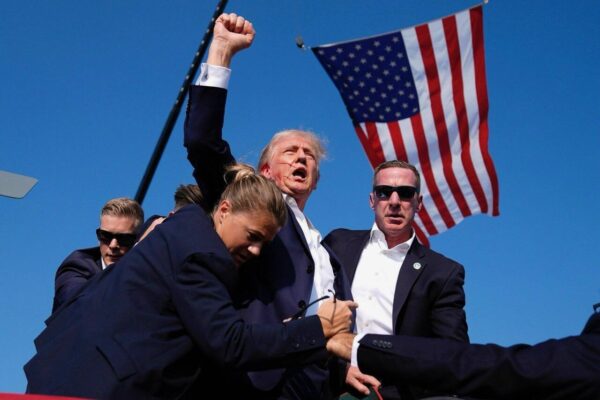
Remember how former President Trump was shot in the head at a rally in Pennsylvania? No, it wasn’t just a dream, though I wouldn’t blame you for thinking so, based on how deeply the story has been buried by now. After all, when was the last time you saw a mainstream media outlet publish this iconic photo:
As for stonewalling the investigation, the FBI and DHS have actually done much worse. Within a week of the failed assassination attempt, they hosed down the roof of the AGR building, dismantled all of the stands, cleaned up the crime scene, dismissed all of the law enforcement officers present without interviewing any of them, and cremated the would-be assassin’s body without conducting an autopsy. In short, they have not only stonewalled the investigation, but have done everything they can to prevent one from taking place.
And we still have no word on why a smartphone belonging to a member of the shooter’s household was present at an FBI office in Washington DC just months before the shooting.
This whole thing stinks to high heaven, which is probably why the mainstream media is doing everything they can to memory hole it. Fortunately, there are still some folks in the alternative media who are doing good work to make sure they don’t succeed. In particular, I highly recommend Chris Martenson, who has been running a thorough citizen’s investigation using the information that is open source. At this point, he’s leaning very heavily toward the LIHOP hypothesis (ie they let it happen on purpose).
4. The Democrats will nominate Harris for President.
By this point, the coronation of Kamala Harris should be official. Without winning a single primary vote in either 2020 or 2024, she has been elected selected to be the Democrat Party’s nominee… for the sake of “our democracy.” Some pigs are more equal than others, I guess.
This may be hard to remember, but at the time I made this prediction, it wasn’t at all clear that Harris would be the nominee. Three days had passed since Biden had (allegedly) issued his letter, announcing that he was withdrawing from the election—much to the surprise of his campaign staff. In a second letter, he had endorsed Kamala Harris as the nominee, but the Obamas had notably NOT endorsed her at this point, and the ultimate outcome of the DNC coup was still in doubt.
By now, of course, the party has locked ranks, with the propaganda wing mainstream media working 24/7 to manufacture consent and portray Kamala Harris as some sort of messianic figure. Which also means that it’s been over a month since Harris has given an actual press conference or answered any unscripted questions.
Just remember: whenever they say “our democracy,” they’re talking about THEIR democracy, not yours. As with pigs, some decmoracies are more equal than others.
So the Daily Wire recently put out an interesting article about the current trend of chronically single young adults who want to get married but have had zero luck, especially with today’s online dating scene. From what I can tell, online dating is like a post-apocalyptic wasteland right now—which is a huge problem, because ever since the pandemic, online dating has come to replace almost every other form of getting out there and finding prospective romantic partners.
So since I graduated from the online dating scene after a period of chronic singlehood, and am now happily married, I thought I was qualified to share some of my thoughts on the subjects in the comments on the article. And since I thought some of my readers here might find it interesting, I’ve decided to cross-post my comment. Here it is:
I was chronically single until I met my wife at age 34. We met online and got married just before the pandemic. Some thoughts:
1. It sucks to be rejected, but if marriage is really what you’re looking for, you’ve got to embrace the suck. You’ll never find “the one” if you’re trying to please everyone. Know what you’re looking for, and when you write up your dating profile, share the things about you that will drive everyone else away. My profile had an explicit declaration of faith, because that was what I was looking for–and I found my wife on the third or fourth match, in part because that declaration was explicit enough to drive everyone else away.
2. The only way to stop wasting time is to embrace Jordan Peterson’s 8th rule of life. You grew up in an online world where almost everything you saw was a lie. Embrace total honesty, no matter how much it hurts. On our second date, I asked my future wife what she wanted to do with her life. She embraced total honesty and told me she wanted to be a wife and a mother more than anything else, even though she had no idea how I would respond to that. We were married less than a year later.
3. Have enough faith to trust God’s timing. My wife and I were actually enrolled in the same college class a decade before we met online. If we had dated each other then, it wouldn’t have worked out. We both needed to grow a bit first (quite a bit, in my case). Everything in this world has been prepared in the wisdom of Him who knows all things. Do your part to bring your life in line with Him, and all things will work together for your good.
4. Stop making everything about yourself. Selfishness is the root cause of every divorce, which also makes it one of the biggest deterrents to marriage and relationships. You grew up in an age of unbridled narcissism, exploited by Big Tech and social media to leverage your loneliness for corporate profits. When you think you may have found the right one (and you’re not in a codependent or abusive relationship), make it all about them. He who seeks his life shall lose it, and he who loses his life, for God’s sake, shall find it. I will never forget the impression I received when I first held my daughter: “this is her story now, not yours.”
It seems like most of the internet is talking about the hilariously bad breakdancing performance given by Australia at the Paris Olympics. Apparently, the “athlete” in question is actually a university professor named Rachael Gunn who specializes in breakdancing studies, or some such nonsense, and the main reasons she got the nod to compete are 1) the Australian breakdancing scene is woefully small, 2) she’s (allegedly) an LGBTQ+ woman, with all the right political opinions, and 3) her husband was on the committe that made the decision to qualify her. Taking advantage of those three factors, she’s apparently made a name for herself in Australia, even winning some local competitions—because who would dare criticize such a stunning and brave LGBTQ+ woman? So of course, she went on to compete on the international scene… and made such a mockery of herself and her sport that the judges awarded her straight zeroes, and the Olympics committee pulled breakdancing from the 2028 Los Angelos Olympics. Wah wah.
While this story is rightly hilarious, and proves the eternal truth that wokeness ruins everything, I can’t help but notice the parallels between the state of Australian breakdancing, that someone so inept and untalented could leverage a “studies” degree to dominate it, and the current state of science fiction. Specifically, this is the comment that made me think about this, which is worth reading in full:
So I looked into this. I thought maybe I should feel sorry for the woman, athletes can choke, and maybe it was cruel for people to be making fun of her. Alternatively, I thought it may be possible she was led up the garden path, told she was good break dancer when she wasn’t, and… https://t.co/YQHA0K05wr
Rachael represents so much of what is totally lecherous about cultural studies academics. Pick a subject area that will be under-studied in your context, so you can rise through the ranks quickly (how many break dancing academics will there be in Australia?), and wreak absolute havoc in lives of the people you want to study. There is no limit to the sheer disrespect they will dole out, purely for self-advancement.
Now, I don’t think science fiction was ruined in quite the same way, ie by being dominated and colonized by academia through “studies” degrees. Science fiction was probably too large to be overtaken that way. However, the pattern is still similar, and from what I can tell, it goes something like this:
Step 1: Take over the institutions in the field that are primarily responsible for determining and evaluating excellence.
In Australia, the breakdancing field was small enough that academia was able to dominate and (for lack of a better word) colonize it, becoming the arbiters of excellence within that art. It certainly helped that the professor who had carved out this academic niche for herself was married to one of the judges in the committee that was tasked with determining excellence. This created an incestuous (and ultimately nepotistic) relationship between academia and the judging panels.
In science fiction, something similar happened with SFWA and the Hugo and Nebula awards. I’ve written before about how SFWA ruined science fiction, so I won’t repeat all that here. But the basic gist of it is this: as science fiction became more established, the organizations and publications that talked about science fiction became more authoritative on the subject of the genre than the actual writers themselves. Because of this, achieving recognition for excellence became less about creating works of actual merit, and more about gaining the approval of the people who had built their careers talking about science fiction, rather than actually creating it. And the best way to gain their approval was to join those institutions yourself, rising up in the pecking order until everyone else was beneath you.
This basically describes the career trajectories of John Scalzi and Mary Robinette Kowal, two insanely woke authors who leveraged their tenure as SFWA president for award nominations. Both of them seem to have spent at least as much time and effort talking about science fiction as they have in actually creating it: Scalzi through his blog, which he leveraged to get his first book deal, and MRK through both her blog and the Writing Excuses podcast.
Step 2: Purge those institutions until they are ideologically pure.
This step is critical. So long as the instutitions are focused on merit, the only way to climb the ranks is by creating something of merit. But once the institution has become ideologically possessed, with all of those who reject the dominant ideology being purged from positions of power, then merit no longer matters, and the way to the top becomes clear. Those who are the most ideologically pure, as demonstrated by their virtue signalling, will rise to the top. This has the added benefit of quelling all merit-based criticism, since those beneath you fear having their own ideological purity called into question.
From what I can tell, this is how Rachael Gunn rose to prominence in the Australian breakdancing scene. After all, once academia had colonized the field, who would dare question the merits of such a stunning and brave LGBTQ+ woman? In a similar manner, Scalzi and MRK rose to the top of SFWA by virtue signaling their own ideological purity and intersectional victimhood status, squelching any criticism by labeling their critics racist, sexist, bigots, homophobic, etc.
Step 3: Redefine excellence in your own image.
In the Australian breakdancing scene, this was accomplished through the combination of Rachael Gunn’s academic work and her husband’s position in the committee that qualified the Olympic competitors. And while it probably isn’t quite so blatantly nepotistic in the science fiction world, the pattern still holds true when you look at what the Hugos and Nebulas have become. This was what the Sad Puppies controversy was actually about, and because the Puppies lost, the Hugo and Nebula awards have been insufferably woke ever since:
Step 4: Use the captured institutions to purge the field of potential rivals.
The final step in this projection is to squash all of those people who represent a threat to your domination, because they have merit and you do not. Ignoring her perhaps overly generous assessment of Australian breakdancing, this is what Hannah Berrelli is talking about when she mentions all the “hundreds of Australian athletes who will have dedicated their entire lives to athletic excellence” whose blood, sweat, and tears were overshadowed and rendered irrelevant by Rachael Gunn’s Olympic stunt.
In science fiction, we see this in the fact that David Weber has never been nominated for a Hugo or a Nebula, or that Jim Butcher’s sole Hugo nomination lost to No Award. Both of these men are far better writers than the majority of award-winning authors, especially in our current era. You could make a solid argument that Dan Simmons or Orson Scott Card were superior, but Scalzi? Jemisin? Kingfisher?
And what about all of the new and relatively unknown authors? At least Weber and Butcher already have large followings, which they have rightfully earned through their merit. But when merit is no longer the determining factor in recognizing excellence within the field, what chance do talented up-and-coming authors have if they aren’t willing to play the ideological purity games? Answer: not a hell of a lot.
So while you laugh at how ridiculous Australia’s breakdancing performance was at the Olympics, understand that the same dynamic has been playing out in modern science fiction for years. And honestly, the results are no less ridiculous.