Every age fraught with discord and danger seems to spawn a leader meant only for that age, a political giant whose absence, in retrospect, seems inconceivable when the history of that age is written. —Dan Simmons, The Fall of Hyperion.
Category: Uncategorized
How I Hacked My ADHD to Read 5-15 Books Every Month
For a long time, I wanted to read more books. Year after year, I would set a reading goal, only to fail miserably.
I have a mild case of ADHD, which makes it very difficult to focus exclusively on a monotonous task for longer than about fifteen minutes (or alternately, makes it difficult to notice anything else when I’m in a state of hyperfocus). Because most novels take around 8-10 hours to read, it was usually my ADHD that made it difficult to finish any of them.
Then on year, I set a resolution to read or DNF (“did not finish”) every novel that has ever won a Hugo or a Nebula award. I knew that it would be difficult, so I went in with a plan. Long story short, the plan worked out amazingly well, and by the end of the year I had read (or DNFed) nearly 150 books.
But I didn’t stop there. After accomplishing the reading goal, I kept up with the same plan, tweaking it here and there until it became the main process by which I read books. And it still works amazingly well, as you can see from my current stats for this year:
- January: 11 books read, 6 DNFed
- February: 8 books read, 2 DNFed
- March: 15 books read, 6 DNFed
- April: 6 books read, 6 DNFed
- May: 10 books read, 5 DNFed
So how does it work? Basically, by hacking my ADHD to turn it into an asset instead of a liability. Here is what I do:
1. Read lots of books simultaneously
This is the main principle that drives my reading process. Instead of trying to work against my ADHD and force myself to focus on the same book all the time, I keep a pile of books that I’m currently reading, and cycle through them. Whenever I get bored of my current book, I put it down and allow myself to become distracted with the next book. In this way, even though I’m constantly getting distracted, I’m also constantly reading, since the distractions are just other books.
If you don’t have ADHD, this might sound like it’s a little maddening—and for normal people, it probably is. But one of the nice things I’ve found about ADHD is that it really expands my capacity to hold multiple thoughts or ideas in my head at the same time. Yes, my mind is constantly bouncing around between all of them, but because I have enough room to hold them all, it’s actually not that hard to read, say, a dozen books simultaneously and remember what’s going on in each of them. I just have to make sure that I don’t let too much time slip by between the last time I pick it up.
Which leads to…
2. Keep a spreadsheet to measure daily progress
Because ADHD can really hamper my executive function, I try to simplify and automate as much as I can. For reading, that means tracking my progress on a spreadsheet, so that I don’t need to keep any of that in my head. Instead, when the time comes to restack my currently-reading pile, I just check the spreadsheet and stack them in the order that it tells me.
As an added bonus, seeing the numbers on the spreadsheet go up over time gives me a lot of motivation to keep reading. And when I’m in a place of low motivation, the spreadsheet helps me to pull back and reorder things, putting the short, easy books at the top and pulling the hard, longer books out of what I’m currently reading, to pick up later. Because it’s all tracked, when the time comes to pick up a book again after setting it aside for a few months, the spreadsheet helps me to do that quickly.
3. Have dedicated reading time
Another huge thing that helps with the executive function issue is keeping to a routine that includes some reading time, so that I don’t have to think about reading—I just do it. Personally, I’ve found that the best time for this is at night, shortly after putting the kids to bed. I’ll usually read through about half a dozen books before I become sleepy enough that it’s time to turn off the light.
I’ll admit, I’m not always great about keeping to this routine, but thankfully it’s the sort of thing that you can pick up easily after missing for a couple of days. It also helps that my wife usually likes to read in bed with me at the same time.
4. Start a new book almost every day
The thing I’ve found with ADHD is that it really makes me crave novelty. So whenever I feel like my reading habits are flagging, one thing that usually helps is to pick up a new book and put it on the top of the pile. After reading the first ten or so pages of a new book, that’s usually enough to put me into reading mode, and then I’ll devour the rest of the pile.
5. DNF early and often
Of course, if I’m starting a new book almost every day, that’s a recipe for getting buried in books really quickly! So to counteract that, and give myself room to experience more novelty in my reading life, I don’t force myself to finish every book that I start. In fact, there are some months where it seems I DNF more books than I finish! But that’s okay, because it makes room for the really good books. And honestly, there are so many books in the world that it just doesn’t make sense to spend a lot of time on the mediocre or terrible ones.
So that’s how I do it. How about you? What are some hacks that you’ve found that help to read more books?
Should men still pursue traditional publishers, or is that a waste of time?
A fascinating interview and discussion.
Fantasy from A to Z: G is for Gemmell
I love Robert E. Howard and J.R.R. Tolkien, but my favorite fantasy writer of all time is David Gemmell.
David Gemmell had a rough life. He was born and raised in a lower-class region of the UK to a single mother and an absent father. According to his bio, he was kicked out of school for setting up a “gambling syndicate” on the playground, whatever that’s supposed to mean, and eventually came to support himself by becoming a bouncer. Looking for something a little more stable, he eventually became a writer for the local newspaper, though from what I understand he was ultimately fired from that job as well.
His fiction writing career began when he went to get some nagging ache checked out by a doctor, and learned that he had terminal cancer. They estimated that he had only months to live, and scheduled a follow-up visit about two weeks later to find out exactly how much time he had left. Stunned, he decided to chase his childhood dream of writing a fantasy novel, and Legend was the result.
Legend is an absolute masterpiece, not because the prose is perfect or the story is totally original or the worldbuilding is super deep, but because it has so much heart. It poses a question that Gemmell found extremely urgent: what is it that makes life worth living? And then, unlike many more flowery and pretentious novels, it answers the question with raw, direct honesty: the thing that makes life worth living is to give it up for a worthy cause.
The story follows a cast of unlikely characters who are all drawn to a hopeless siege that everyone knows will ultimately result in defeat. The Khan has united the tribes and amassed an army of half a million soldiers, but to invade the southern kingdom he must lead them through a narrow pass that is held by an ancient fortress. However, the fortress is woefully understaffed, with only ten thousand defenders, most of whom are untrained farmers. Everyone who goes to fight there knows that they will die.
The story is about why they decide to fight anyway. There’s the proud daughter of the ailing duke commanding the fortress, who fights to preserve her family’s honor. There’s the cowardly berserker who never really wanted to get drawn into the siege, but stays to protect the girl. There’s the Temple of the Thirty, an ancient order of warrior monks who train relentlessly in the martial arts so that when the time comes to fight in the defining conflict of the age, they are ready to fight for the good, the true, and the beautiful. And there is Druss the Legend, an aging warrior who has wandered the land and single-handedly turned the tides of battles, but now fears growing old and senile, and desires more than anything else to go out of this life on his own two feet with his battle-ax in hand.
David Gemmell wrote this novel in the two weeks between his first appointment with the doctor and the second. But when he went back in, the oncologist informed him that the first test was actually a false positive, and that he had no cancer at all. Stunned for a second time, Gemmell took a critical look at the novel he’d written and stuffed it in his trunk, convinced that it wasn’t very good. After all, who was he to think that he could write a novel?
The story would have ended there, except that a friend of his found out about it, asked to read it, and was so impressed by it that he urged David Gemmell to send it off to a publisher. After a lot of nagging, Gemmell eventually decided to humor his friend, and the book became a massive bestseller over in the UK. David Gemmell went on to write some two dozen fantasy novels, all of them in the same vein as Legend, and they are absolutely fantastic.
I still remember the sinking feeling in my heart when I read the last book in the Drenai Saga, and realized that there wouldn’t be any more. And I also remember the way my mind was blown when I realized that all of Gemmell’s novels are interconnected in an interdimensional “cosmere” of sorts, with a handful of recurring characters who travel across worlds. Yes, he was doing the Sanderson Cosmere thing before Brandon Sanderson published his first book (and unlike Sanderson, he kept it as a genuine easter egg and never advertised it).
I’ve collected nearly all of Gemmell’s books, including the crime thrillers he originally published under a secret pen name, and both of the graphic novels that go for a couple hundred bucks. Most of his books I own in mass-market paperback, though I still hope to acquire a signed first-edition hardback copy of Legend. But I’m still dragging my feet to read them all, because it really is an awful feeling when you get to the end of your favorite author’s ouvre and realize that’s all there will ever be.
David Gemmell died in the 00s, in the same way that I hope to die: sitting at his keyboard, writing the last book in his final book series. His wife later finished it. From what I understand, he actually did die of cancer, so maybe there was something to that original mis-diagnosis that kick-started his writing career. Can you imagine how different things would be if that had never happened? I don’t even want to think about it. David Gemmell’s books are amazing, and the world is so much richer because of them. If David Gemmell’s books are new to you, you’re in for a real treat!
Just for fun: If I snap my fingers…
My wife cannot stop laughing every time she sees this video.
“What is a year?”
A year? What is a year? All time is relative. One day may be a lifetime, a year can be forever. It is not the number of days, but what goes into those days. —Louis L’Amour, The Warrior’s Path.
How I Would Vote Now: 1990 Hugo Awards (Best Novel)
The Nominees
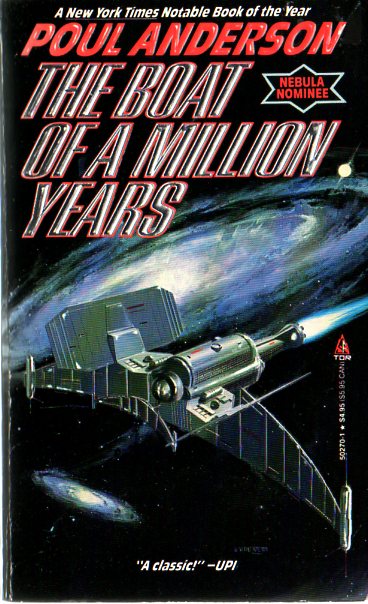
The Boat of a Million Years by Poul Anderson

Prentice Alvin by Orson Scott Card
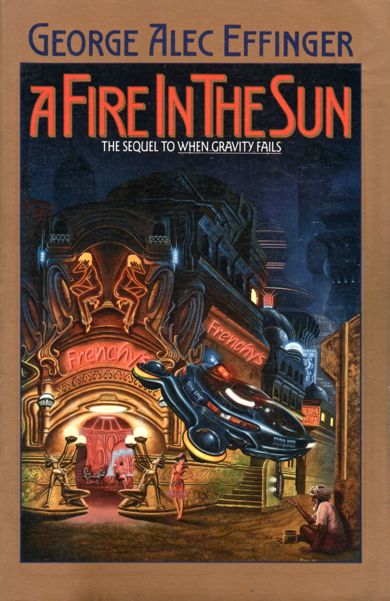
A Fire in the Sun by George Alec Effinger
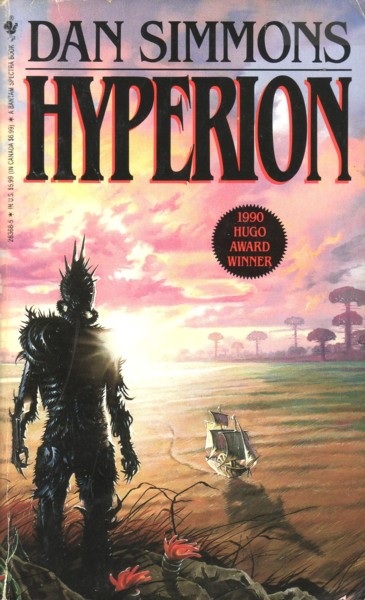
Hyperion by Dan Simmons

Grass by Sheri S. Tepper
The Actual Results
- Hyperion by Dan Simmons
- A Fire in the Sun by George Alec Effinger
- Prentice Alvin by Orson Scott Card
- The Boat of a Million Years by Poul Anderson
- Grass by Sheri S. Tepper
How I Would Vote Now
- Hyperion by Dan Simmons
- No Award
- Prentice Alvin by Orson Scott Card
- The Boat of a Million Years by Poul Anderson
Explanation
Hyperion is, in my opinion, the best novel to ever win a Hugo Award. Absolute top S tier, no question. IMHO, the top three Hugo award-winning novels are Hyperion by Dan Simmons, Ender’s Game by Orson Scott Card, and Dune by Frank Herbert, in that order. Dune is probably the most perfect science fiction novel ever written, but Hyperion and Ender’s Game surpass it because even though they have some minor flaws, there was something about them that I connected with on a deep emotional and intellectual level, more than almost any other book.
For Hyperion, that was the story about the father whose daughter is chosen by the Shrike to age backwards, so that with each new day, she gets younger, losing a day’s worth of memories and becoming progressively dependent on her parents. That part of the book just absolutely wrecked me. After weeping profusely for about an hour, I went onto Amazon and bought all the other books in the series, because I absolutely had to know what happened to this guy. Just incredible. Very few books have made me feel anything so deeply and profoundly as that.
As for the other books on this year’s ballot, I wasn’t too impressed with them. But two of them I’d be willing to vote affirmatively for, though I’d still rank them below No Award. I enjoyed the first two books of Orson Scott Card’s Alvin Maker series, and would probably enjoy the third book, but I refuse to read it until he finishes the damned series. Seriously—I was four years old when the first book was published, and he still hasn’t finished the damned series! What the heck?
Poul Anderson writes the kind of sprawling galactic space opera that is right up my wheelhouse, but for some odd reason, I have never been able to finish anything he’s written. I’m not sure why. Either he spends way too much time exploring or describing some aspect of his world that utterly does not interest me, or he glosses over the parts that are crucial to understand in order to make sense, and for whatever reason I just can’t make sense of them. Also, his characters are all very forgettable. I tried The Boat of a Million Years, and found it to be less bad than his earlier books, but I still couldn’t follow it. So I’ve come to the conclusion that Poul Anderson is just one of those authors I’m going to have to skip.
The last two books I rejected after my AI assistant Orion screened them for me. According to the AI, both of them have lots of explicit content (sex, language, violence) and woke themes.
Here is what Orion said about A Fire in the Sun:
🔞 Explicit Content
- Violence & Body Horror
- Graphic and brutal: victims sometimes brutally gutted, including dismembered prostitutes and child victims .
- Prison-style brutality and organized crime violence permeate the story.
- Language
- Widespread use of profanity—especially the F-word—fits the harsh, noirish setting .
- Sexual Content
- Includes depictions of prostitution and sexual violence; explicit sexual content is not graphic, but the tone is decidedly adult and uncompromising .
- Body modifications include gender-swapping and personality modules, adding mature and cyberpunk themes.
✊ Social Themes & “Woke” Elements
- Identity & Selfhood
- Use of “moddies” and “daddies” to modify gender, mood, or skills raises themes around engineered identity and societal roles.
Sorry (not sorry), but I am not going to read a book that has explicit violence against children and characters who change gender. Either one of those things is enough to make me DNF, but combined together with all of the other explicit sex and language makes me never want to touch this book, or this author.
And here is what Orion said about Grass:
“Woke” Elements: Tepper’s work often explores feminist themes, and Grass is no exception. The novel critiques patriarchy, religious dogmatism, and humanity’s environmental exploitation. These themes align with progressive ideals and are deeply woven into the narrative. Tepper’s exploration of gender roles and societal hierarchies may be considered overt, depending on the reader’s perspective.
“Patriarchy,” “feminism,” “environmental explotation,” “religious dogmatism,” “gender goles,” “social heirarchies…” hey, I just got a bingo! So yeah, I’m not gonna read that one—or at least, you’re gonna have to make a really solid case in order to change my mind.
Interesting discussion of the ideal roles and partnership of husband and wife
I’ve been watching a lot of Malcolm & Simone Collins’s videos lately. They are a pair of super odd ducks, but they are both super intelligent and have some very unexpected insights into our world. On some issues (particularly the issue of Mormon fertility) I think they are off-track, but on others I think they are spot on, and earlier than most of the rest of the culture. They also love trolling crazy leftists—in fact, it’s how they built up their channel.
This is the best one I’ve listened to so far. You should ignore the clickbaity title, because what it’s really about is the way that men and women complement each other as husbands and wives, especially in our current post-industrial world where the corporate 9-5 job is becoming a thing of the past. I particularly enjoyed how Malcolm compares the role of husband and wife to the characters in the game Shovel Knight. Very geeky, and also very insightful. Worth a listen.
Just for fun: Retroflow 1985
So the YouTube algorithm recently recommended this channel to me called Retroflow 1985. It’s a guy in Germany who puts out these synthwave music videos, with AI-generated artwork (and probably AI-generated music) that feels like it could have come out of the 1980s (hence the term “synthwave”).
I’m not a huge synthwave fan, but I do like this guy’s stuff. More than that, though, I’m fascinated by the fact that he’s put out something like 250 videos since he started his channel six months ago. In fact, he puts out something like 3-5 videos per day, so that the algorithm is constantly recommended new ones to me. Most of them only have a couple of hundred views, but a handful have more than a thousand. As of right now, he has <2k subscribers.
As a fellow creative who is also dabbling with AI, I am really interested to see how this strategy works for him, and where he (or she, I suppose) goes from here. Because we do live in an age where the algorithms determine a lot about what art & entertainment we are exposed to, and how we consume it—and it appears that in many domains (including books, to some extent) you have to churn out a lot of content in order to feed the algorithm.
Or maybe this guy isn’t human at all, but an AI agent creating and publishing this stuff? In which case, it will be even more interesting to see what he/she/it comes up with…
Fantasy from A to Z: D is for Dragons
If you were expecting a post about dragons, I hate to disappoint you. but that’s not what this is going to be. I think dragons are fine, and there are lots of fantasy books with dragons that I’ve enjoyed (Jane Yolen’s Dragon’s Blood comes to mind, as does The Hobbit, which is, after all, a classic for a reason), but I’ve never read a dragon book that made me go crazy for dragons.
(And yes, I’ve read the Dragonriders of Pern books by Anne McAffrey, or at least the first two books. I can appreciate how other people like them, but frankly, the dragons are just way too OP for me. I mean, come on: not only can they teleport anywhere on the planet, but they can also travel through time? That’s just too much.)
Rather, I want to explore the idea of “here be dragons”—specifically, how it was that before the modern age, every civilization’s map of the world had a huge part of it that was dark and unexplored. Until that period ended, I don’t think it was possible for the modern fantasy genre to emerge.
Some people think that fantasy is an old genre, with roots that go back at least as far as the Roman Empire (some lists include The Golden Ass by Apuleius as the first fantasy book) and possibly much longer. But I think that fantasy is a much more modern genre, and as such has much more in common with science fiction than it does with the ancient myths and legends from which the genre often draws inspiration.
It all comes back to this idea of “here be dragons.” Until the modern age, it wasn’t possible to write fantasy fiction because for all anyone knew, there might actually be dragons, or hobbits, or elves, or dwarves, or unicorns in some unexplored part of the world. Indeed, the medieval world was full of fanciful stories that many people actually believed, such as the mythical tales of Prester John that motivated so many crusaders, or the rumors that prima nocta had been forced upon the people just over the next mountain range (as far as we can tell, prima nocta was never actually practiced, but almost all European cultures thought that it had been enforced somewhere else).
If you went back in time and tried to write a fantasy novel for these people, they probably would have read it the way we read some of our more elaborate and creative conspiracy theories today. Part of the reason we enjoy fantasy is because we know that it’s fictional. The suspension of disbelief allows us to enjoy the story without constantly asking ourselves “wait—is this real?” or excitedly shouting “nuh-uh—no way!” Instead, we can just cozy up in our reading nook and let the story carry us away to another world, knowing that it only exists in our head.
The modern era began with the fall of the Roman Byzantine Empire and the Age of Exploration in the 14th century. It wasn’t until the late 19th century, though, that the Europeans had fully explored the world, filling in those parts of the world map that said (in one way or another) “here be dragons.” It’s not a coincidence that proto-fantasy writers like Lord Dunsaney and William Morris came onto the scene at this time. At first, people didn’t know what to make of these mythologies and adventure tales set in fictional worlds, but they paved the way for later writers like Howard and Tolkien to forge the fantasy genre as we know it today.
Science fiction and fantasy may seem like opposites, but they are really more like two sides of the same coin. Both are essentially modern genres, but where science fiction broadly looks to the future, fantasy looks to the past. Indeed, a large part of fantasy’s appeal is this sense of nostalgic longing that it gives us for a world that never actually was. Tolkien was a master of this. Howard was too, though he was a little more explicit about it in his worldbuilding: his Hyborian Age is supposed to be set in our own world, many thousands of years ago in the prehistoric era, as evidenced by the maps he drew up, and the way his Picts carry through all of his stories, including the Roman-era tales of Bran Mak Morn.
All of this is to say that while we read fantasy for very different reasons than why we read science fiction, we read both genres as children of the modern age, and the genres would make very little sense to us otherwise. If you took Lord of the Rings back in a time machine to the middle ages, it wouldn’t give them that nostalgic sense of yearning for a simpler time. Frankly, it would probably leave most of them feeling confused (and wondering why there’s a distinct lack of religion—even though, to our modern sensibilities, Lord of the Rings has lots of subtle Christian symbolism).
Every book is a product of the culture that created it, and as such, modern fantasy has far more in common with its brother genre science fiction than with its great-great grandfathers: pagan mythology, Christian allegory, epic poetry, etc. Fantasy certainly draws from all of these, but until the world was fully mapped—until “here be dragons” had been fully excised from our understanding of the world—the fantasy genre as we know and love it today was still gestating in the womb.