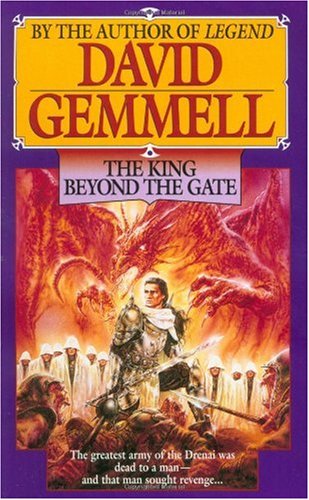
The King Beyond the Gate by David Gemmell

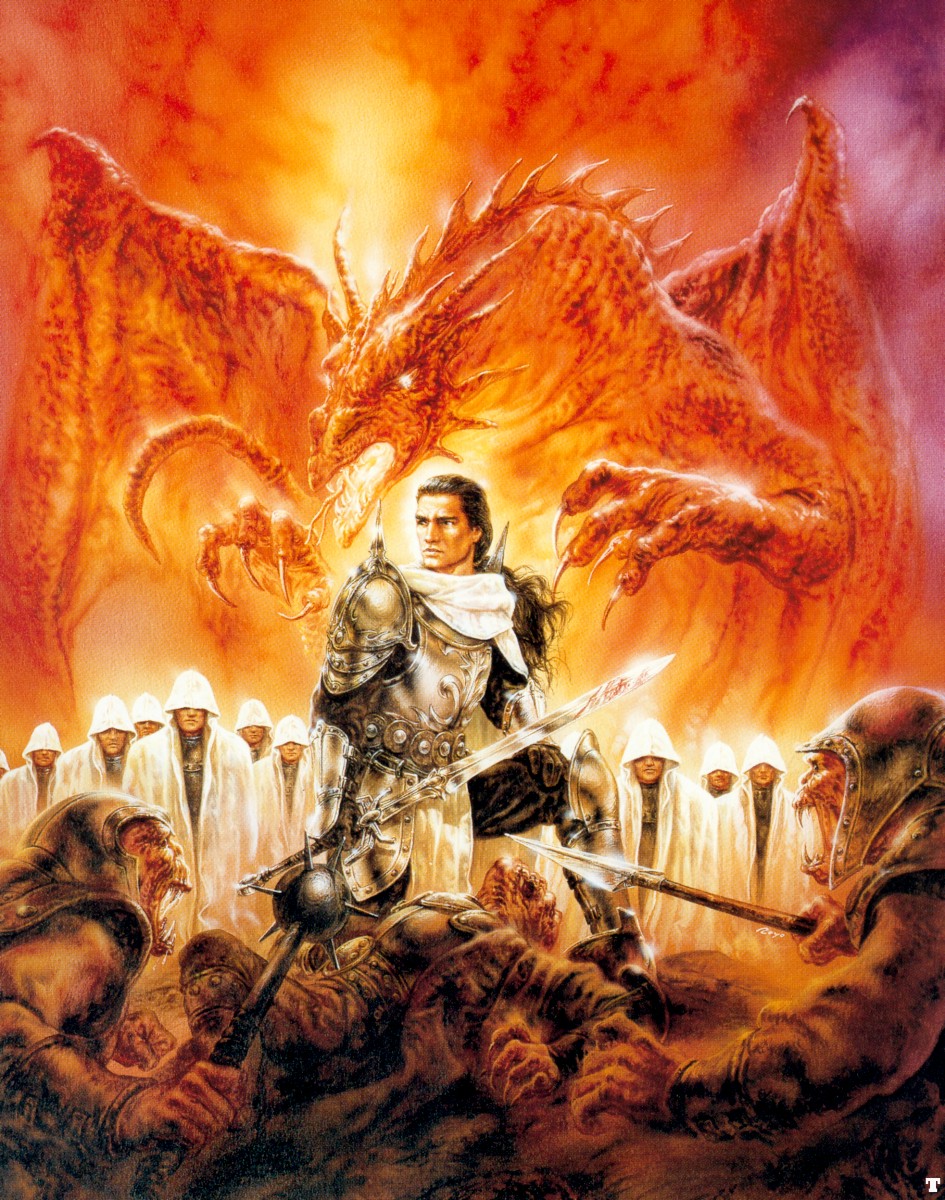
Tenaka Khan was a child of two nations and an outsider to both.  Half Nadir, half Drenai, the only home he ever knew was in the ranks of the Dragon, the elite fighting forces of the Drenai.  But now, a mad dictator rules the land, and the Dragon has been destroyed.

With all his friends dead at the hand of the evil Drenai emperor, Tenaka has only one desire: to steal into the palace and assassinate him.  Along the way, however, he makes a number of friends, all of whom seek the same thing, but all for different reasons.  As they join forces with the Skoda rebels, Tenaka realizes that he not only has something to die for–he has something to live for.

But in order to defeat the mad emperor, the rebels must fight the Joinings–terrible creatures made from man and beast, who slaughtered the Dragon years before.  Only the Nadir can save them–but the Nadir want nothing more than to ravage the Drenai.

If  you’ve read my review of David Gemmell’s Legend, you know why I love his books.  This one was no less incredible.  Parts of it were just as poignant as anything in Legend, and the ending, while bittersweet, was no less satisfying.

It’s really fascinating to me, because Gemmell’s books are not particularly flowery or well written.  His descriptions are sparse, his prose is unassuming, his characters, while distinguished from each other, sound more or less the same, and his viewpoint is often inconsistent.  But in terms of raw storytelling, his books are unequaled by anything else I’ve ever read.

He makes me fall in love with his characters: I cheer for them when they rise to the heroic deeds that circumstances demand of them, I cry when they fall short of what they could have been, and I weep when they give their lives in the service of something greater than themselves, which is almost invariably the case.

My favorite part of any David Gemmell book has got to be the order of warrior priests known as the Thirty.  They don’t show up in every book, but they show up in many of them, and they always share the same characteristics.  The warrior priests are dedicated to the Source (Gemmell’s equivalent of God in his Drenai universe), and have the supernatural abilities to speak telepathically, put thoughts into others’ minds, shield their comrades from the magic of the Chaos brethren, and leave their bodies to fly across the world and do battle in other dimensions beyond the grave.

The way the order is run is absolutely fascinating.  One person is the mouth, the other the ears, the other the heart, etc.  The most unlikely characters always fill the particular roles–but always for good reason.  They fight to defend the innocent and pure, but more than that, they always have some great destiny to perform–a destiny that invariably pits them against the forces of Chaos in some great, decisive battle.  In that battle, all of them invariably die, except for the weakest among them, who goes out to found the next order of the Thirty.

I don’t know about you, but this kind of stuff, just makes me want to jump up and down.  This is fantasy at its best–good versus evil, warriors facing death, and the most unlikely heroes rising to the level of greatness that war and honor demand of them.  Throw in a little magic, a brotherhood of evil sorcerers bent on crushing all that is good in the world, and terrible monsters the likes of which exist only in nightmares, and I am so there, man–I am so there.

In short, this book was nothing less than awesome.  If you love any book by David Gemmell, I think you’ll enjoy this one.  It’s got everything you could possibly expect from heroic fantasy, and more.

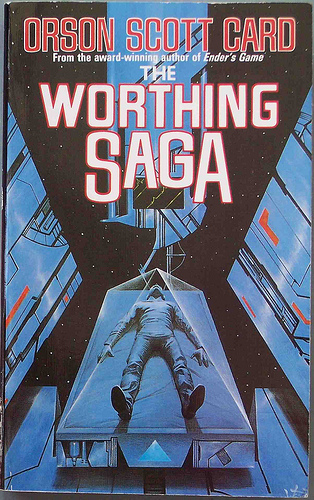
The Worthing Saga by Orson Scott Card

Somec: the miracle drug that allowed the rich and well connected to sleep through the centuries and postpone death almost indefinitely.  While the masses continued to live out their lives in normal time, the social elite watched over centuries as their investments multiplied, and their kingdoms grew into empires…

…and ultimately crumbled.

Thousands of years have passed.  Somec is unknown, except to the one man who saved humanity from its own corruption.  He has slept through the eons to find out if his last gambit brought about the peaceful and benevolent society that he hoped to leave behind.

But as he awakens from his slumber, he finds himself in a universe infinitely stranger than he could have imagined–among a people who revere him as their god.

I’ve heard that Orson Scott Card considers this book his best work, and I’d have to say, I agree with him.  Right up until the ending, it’s at least as good–if not better–than Ender’s Game, his most famous book.

The book unfolds magically from the first page, drawing you in to this beautiful, fantastical world.  The characters have depth and feeling, especially the ones from ages long past, whose stories are powerful and haunting.

I absolutely loved this book–right up to the end, which had a twist that caught me off guard, and not in a good way.

Story-wise, the ending was great.  It was a beautifully foreshadowed twist, right on the order of Ender’s Game and Speaker for the Dead.  Thematically, however, I had a hard time not feeling that it undermined everything that had come before.  I can’t get into details because I don’t want to give spoilers, but the last couple of pages jolted me out of the book and left me saying: “Huh?  How is that right?” I eventually warmed up to it, but it took a while.

Still, I’d definitely give the book five stars, or at least four and a half.  Everything about it is monumentally amazing.  The characters, the worldbuilding, the sense of wonder, the thought-provoking questions and issues it raises, and just the sheer joy of the experience of reading it.  This is a book that I can get lost in, and not just once.

As a side note, the book includes the short novel The Worthing Chronicles, as well as several short stories that take place in the same universe.  The short stories were all quite good, but personally I preferred the novel by itself.  Perhaps it’s because the epic scope came through so much better in the novel than in the stories, or because the stories didn’t allow me to spend much time with any of the characters.  Your mileage may vary, of course.

Interestingly, The Worthing Chronicles is a retelling of Hot Sleep, Orson Scott Card’s first novel.  As a writer, I find it interesting that Card revisited his first novel in this way–to basically rewrite it, keeping all the major events but telling it from the point of view of someone who meets the main character of the first (Worthing) much later in his life.  I haven’t read Hot Sleep, so I can’t compare the two, but The Worthing Chronicles turned out amazingly well.

Will I ever attempt something like this?  Not sure–but it’s interesting to think about.

Yet another reason why I love Quark

For those of you who may not know, quark is BYU’s science fiction and fantasy club.  I had the good fortune of being one of the club’s vice presidents for two years while I was a student, and I still keep in touch with a ton of friends from that group.

One of the funnest things about quark is the online werewolf games–currently, I’m GMing a round based on Interstella 5555.  Recently, Jerle and I decided to put together a database of all 49 rounds that we’ve played over the years, compiling player stats, setting up rankings, and other such nerdy things.

While I was going across some of the older threads, I came across this amazingly hilarious premise for round fourteen:

In the year 1815 Napoleon conquered Russia.
In 1817 he conquered China.
By 1830 he was the ruler of continental Europe, Asia, and parts of Africa that were interesting.
In 1834 he invaded Antarctica and defeated the United Federation of Penguins and Polar Bears.
His successor sent ships to conquer America and England, and succeeded, but not without a fight.

The year is 2015.
The entire world speaks either French or English, or, more likely, some mixture of two.
A great scientist has invented a Time Machine.
The only hope for penguins and polar bears is to infiltrate high-security research facility in New Paris, use the device to go back in time and present a plush toy of a penguin to young Napoleon. A rogue rebel Greenpeace group assists the penguins/polar bears.

The research facility is guarded by an elite team of 15 highly-trained frenchpeople. Through great ingenuity Greenpeace was able to replace three of them with its agents. Those three must kill everyone else and use the time machine.

There is also a rumor that one of the elite guardsmen has been replaced by a clown.

Playing:
Avulsion 7
Baggins 17
Beatobur 13
Cardasin 20
Child 10
Daen 17
Drek 5
Fezzik 11
HER0 0
Jerle 13
RamenSensei 1
SilverStorm 19
Sunstarr12 16
Thundershorts 12
Turin_Turanbar 0

3 Greenpeace members, 1 DGSE detective, 1 team medic, 1 clown.
And 9 FRENCHPEOPLE!

RULES

NIGHT.

Awaiting requests.

Hehehe…these are sooo my people!

I’m so happy…

…because I checked out five of the Drenai books by David Gemmell from the library this week, and I’m going to read them all by the end of the month.  I’m already in the middle of The King Beyond the Gate, and it is awesome.

Holy crap, I love the Thirty!  If/when I ever write fantasy, I am definitely including an order of elite warrior priests like those guys!  And the way the Nadir sometimes end up fighting for the good guys, with the interesting twists in their culture that make them more than just the evil rampaging hordes–man, I love that.

I’m also happy because the Provo Library had a used book sale today, and I picked up a ton of new books!  Here’s the list:

The Wayfarer Redemption by Sara Douglass,
Starman by Sara Douglass,
The Princess Bride by William Goldman,
The Eye of the World by Robert Jordan,
A song for Arbonne by Guy Gavriel Kay,
Abhorsen by Garth Nix,
The Man with the Iron Heart by Harry Turtledove,
Terraforming Earth by Jack Williamson,
A Bridge of Years by Robert Charles Wilson,
Bios by Robert Charles Wilson,
Serpent Catch by Dave Wolverton (his second novel!),
Looking for the Mahdi by N. Lee Wood,
Warhorse by Timothy Zahn, and
Changeling by Roger Zelazny.

Oh, and a gift book for my mom.  All for $7. 🙂

So after I get off my Gemmell binge, which book(s) should I read next?

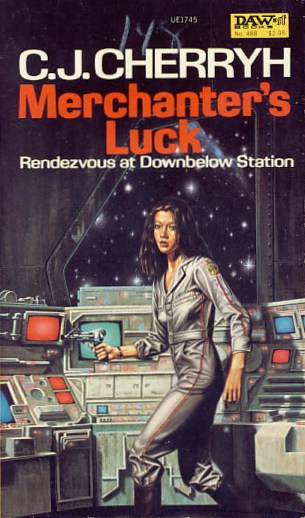
Merchanter’s Luck by C. J. Cherryh

He was a down and out merchanter, the captain, crew, and sole proprietor of a run-down bucket of bolts spacecraft.  She was a daughter of one of the finest starfaring clans, with seven hundred cousins standing between her and the one thing she wanted more than anything else: command of a starship.

They met at Pell during the height of the Company War–the key strategic point on the border between Union and Earth.  Their fateful meeting would affect not only the outcome of the war, but the course of their own lives–for the starship Lucy of Wyatt’s Combine was not at all what she seemed to be.

Before I review this book, I need to issue a disclaimer: you probably aren’t going to enjoy it very much unless you’ve already read Downbelow Station.  Cherryh isn’t the best at easing her readers into her worlds, and without the background on Union, Alliance, and the Company War, you’ll probably be hopelessly lost.

That said, I absolutely loved this book.

The premise is so awesome.  Space adventure hardcore, with a beautiful love story set amidst an epic interstellar war, where alliances are constantly broken and no one can be trusted…oh man, I LOVED this book!

While the premise seems pretty standard, C. J. Cherryh transcends the well-worn tropes and cliches of her genre by intimately developing her characters and working their motivations into the story until they are the ones driving the plot, and not the other way around.

Every character is unique, and though they act in ways that may seem strange to our modern sensibilities, there are always reasons for everything they do, cultural or otherwise.  As windows into their far-future spacefaring culture, they give the reader a wonderful view of Cherryh’s unique and marvelously constructed universe.

The thing that surprised me the most, however, was the sharp contrast between this book and Downbelow Station. While Downbelow Station traces the epic arc of the Company War through the viewpoints of a large cast of characters, much like Tolkien or Dune, Merchanter’s Luck focuses more on the characters themselves, in much the same way as David Gemmell or Ursula K. Le Guin.  In other words, while Downbelow Station is comparable to “high” or epic fantasy, Merchanter’s Luck would fall closer to “low” fantasy or sword & sorcery.

The interesting self-realization I took from the book was that I’m much more interested in the intimately personal stories than the sweeping epic tale of the Rise and Fall of cultures and civilizations.  I suppose that’s why I’m more of a David Gemmell nut than a Tolkien fanatic, and perhaps why I’m more into space opera and military sf than epic fantasy.  In all of my novels, the focus is always on the individual characters and their personal conflicts, and whenever I get sidetracked and focus too much on the overworld story, it always falls apart. 

Merchanter’s Luck definitely doesn’t get sidetracked, and that’s why I loved it so much.  I fell in love with the characters almost from the very first page–from the blurb on the back cover, even.  And most of all, I fell hopelessly in love with the starship Lucy:

You know you’re doing science fiction right when your readers bemoan the fact that they weren’t born in the 26th century, when they could command their own spaceship.  C. J. Cherryh is an amazing writer, and if I had the chance, I would teleport into her Union-Alliance universe in a heartbeat.

If you love well-crafted far-future worlds and stories about the people that live in them, check out Downbelow Station (or really, just the first chapter–that’s all you need for a solid grounding) and read this book!

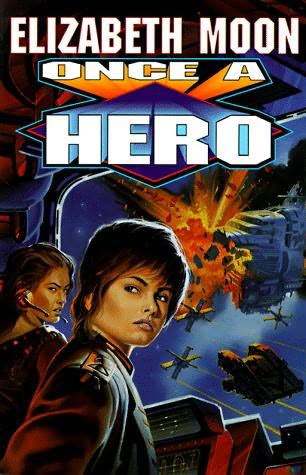
Once a Hero by Elizabeth Moon

Esmay Suiza never asked to be a hero.  All she wanted was to leave her dysfunctional home and join the navy.  But after surviving a mutiny and leading her spaceship to a most unlikely victory, everyone seems to be showering her with unwanted attention–or worse, examining her files for signs of command potential.

No, all she wants is to disappear–and now that her family has offered her a generous inheritance on her home world of Altiplano, she finds herself tempted to leave the stars behind and settle down for a while.

Little does she know, her family has hidden secrets from her–secrets from her past, which have the power to undo and destroy her.  Unfortunately, being a hero has a price–and the trauma of combat has already unearthed things from her subconscious than she cannot keep buried any longer.

This was my first time reading Elizabeth Moon, and I enjoyed it quite a bit.  Moon is extremely good at portraying a complex, believable military culture; she was a Lieutenant in the Marines, and definitely knows how to do military SF right.

My favorite part of the book was the descriptions of Altiplano, and Esmay’s experience returning to her homeworld of Altiplano.  Elizabeth Moon does an excellent job of creating a captivating world and transporting the reader there.  I fell in love with Altiplano almost instantly–not only with the planet itself, but the culture and the people, the whole society.  Excellent job.

Elizabeth Moon also does an excellent job developing her characters and giving them believable internal conflicts.  The way she portrays Esmay’s PTSD is quite striking, and very interesting.  Her struggles feel very real, and important too.  I think this novel helped me to better understand those who suffer from similar traumatic experiences, and that was very meaningful.

Storywise, however, I had a few minor issues, most of them having to do with the plot.  Things dragged a bit in the middle; when Esmay left her homeworld, I lost a sense of progression and felt that she was just wandering around.

When the antagonists came in–basically, a hostile army trying to capture her ship–I felt that Esmay solved her problems too easily, without any real try-fail cycles.  It gave me the sense that Esmay was some kind of superhero girl–not quite a Mary Sue, but toeing the line.

And Esmay’s love interest…I didn’t really get into him at all.  He seemed like a stereotypical damsel in distress, except with the sexes reversed.  I heard once that in good romance stories, the girl readers want to be the female protagonist, and the guy readers want to be the male protagonist.  Yeah…call me a chauvinist, but I never really wanted to be that guy.

I hate to be too critical, though, because Elizabeth Moon’s writing is quite good.  She has an excellent grasp of character, and her ability to transport her readers to another time and place more than makes up for her shortcomings with plot and story structure.  Also, I get the sense that this isn’t her best work.

In any case, if you’re a fan of military SF, you’ll probably enjoy this book.  I enjoyed it, and I will certainly be reading more Elizabeth Moon in the future.

I don’t ask for much…

My future wife can do WHATEVER she wants–drag me up to Alaska or Antarctica to get married, make us move in next door to her parents, force me to hold down a real job until the writing takes off…

…I just ask that they play this song at our wedding.

“The Class That Wouldn’t Die” is up!

Just a heads up: the latest issue of Mormon Artist magazine is out, and my article about BYU’s “class that wouldn’t die” is in it! What’s more, Orson Scott Card himself commented on it.  Squeeeee!!!

If you’d like to read the full article, you can find it hereMormon Artist is published online for free, so be sure to check out the rest of the issue too.

A huge thanks to all the people who helped me out with the research–and an apology to those I should have gotten to, but ran out of time and space to include them.  My goal in writing this was to collect as many oral histories and primary sources as I could find, and put it in a context where the people who were there could tell the story themselves.  I hope I’ve done that without making too many factual errors, but if I have, please let me know.

Also, I would like to personally thank everyone who was a part of Xenobia and the class that wouldn’t die–the people who started LTUE, Leading Edge, and Quark, which have become the bedrock of BYU’s thriving sf&f community.  Thank you so much–all of this stuff has greatly impacted my life, helping me to connect with like-minded friends and to grow tremendously as a writer.  We really do stand on the shoulders of everyone who’s come before, so thank you!

Squeeeeeee!!!!!

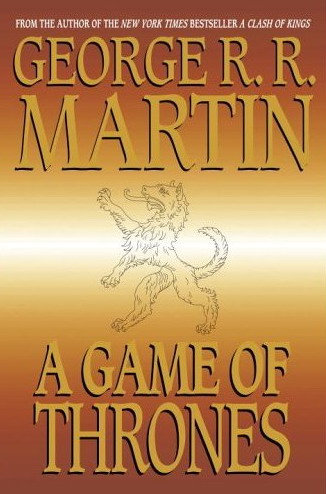
A Game of Thrones by George R. R. Martin

Almost twenty years have passed since the fall of the Targaryen dynasty–twenty years since the last of the dragons was seen in the Land of the Seven Kingdoms.  Now, the libertine Robert Baratheon sits on the Iron Throne, blind to the conspiracies and secret combinations that surround him.

In this dangerous time, Ser Jon Arryn, the King’s Hand, dies of mysterious causes.  Most of the realm accepts the official story that the death was natural, but when Arryn’s wife Lysa sends a letter to her sister, Catelyn and her husband Ser Eddard Stark immediately suspect that the death was orchestrated by the Lannisters.  Only one thing remains: to travel to King’s Landing and uncover the proof.  Soon, King Robert calls on Ser Eddard to become his new Hand, giving them the perfect opportunity to do this.

Little does Ser Eddard know, the intrigue goes much deeper than any of them realize.  For the Lannisters are gathering an army, and Queen Cersei and her brother, Ser Jaime, harbor a secret that would tear the realm apart.  Meanwhile, the last of the Targaryens bears a child prophesied to rule the world, while far to the North, an ancient evil bides its time, waiting to sweep the seven kingdoms with horror the likes of which has not been seen in a thousand years.

Winter is coming–and the people of the Seven Kingdoms are ill prepared to face it.

Everyone seems to be talking about George R. R. Martin’s Song of Ice and Fire series these days–next to The Wheel of Time, it’s probably the biggest epic fantasy line of the last ten or fifteen years.  Martin is well known for killing off his characters and writing in shades of gray, so I thought it would be good to give this series a try.

As soon as I picked up the book, I was hooked.  Martin knows how to craft a beautiful, engrossing fantasy world.  In order to leave no doubt on that point, observe:

Yeah, that pretty much sums up what Martin did with his Land of the Seven Kingdoms. It’s an awesome fantasy world, and I found myself lost in it from the first page.

I must admit, however, after hearing so much about the Song of Ice and Fire series, I was surprised at how few characters died in this book. That’s not to say everyone survived–in fact, Martin killed my favorite character, which made me feel HORRIBLE–but I was expecting there to be more. However, this is the first book in the series, so I assume that the really crazy stuff happens later.

While overall I loved A Game of Thrones, I admit I did have a few misgivings about the book. Martin really does write in shades of gray, and while that makes the story unpredictable and surprising, it also makes things very dark and austere. Martin seems to have no interest in redeeming his characters, and when any of them try to be noble, he cuts them down at every turn.

Personally, I don’t care for that. Flawed characters may be more relateable, but seriously flawed characters (or characters with no interest in overcoming their flaws) turn me off. In this way, Martin is practically the antithesis of David Gemmell; whereas Gemmell makes you love his characters despite their flaws, Martin keeps you reading in spite of the fact that you hate all his characters.

How does he do it? By creating a beautiful, wondrous world. By crafting a masterful story full of intricate twists and turns. By making you hate some of the characters so #%$^! much that you have to stick around and see how they die. It’s all entertaining and extremely engrossing, but at the end of it all, I didn’t come away with any real love for Martin’s characters–except perhaps for a couple of Eddard’s kids, who are still young enough to be somewhat innocent.

I suppose it’s all a part of this new non-conciliatory movement in fantasy. Don’t get me wrong; A Game of Thrones is an EXCELLENT book, but it’s very…non-conciliatory. If that’s your thing, more power to you, but I personally prefer stories about redemption, where romance still lives and even the most unlikely character can be a True Hero, if only for a few fleeting, glorious moments.

Another excerpt from Genesis Earth

I made a lot of progress on the latest draft of my novel Genesis Earth last week, and figured it was time to post another excerpt.  This one comes from chapter 4, when Michael and Terra arrive at the star system they’ve been sent to explore.

A slightly truncated version of this excerpt won first place in the 2009 Mayhew short story contest at BYU.  I’ve made a few minor edits since then, mostly for clarification, but nothing too major.  Enjoy!

They say that cryofreeze is the closest thing to death short of actually dying.  I believe it.

First, you strip off your clothes and lower yourself down into the coffin-shaped cryo chamber.  The glass seals shut above you, and a cold, green mist fills the narrow space, penetrating your naked skin.  The mist contains chemicals that freeze your cells properly, so that they don’t crack or break when you thaw out–but it has a nauseous smell to it, and makes you feel sticky.  Your skin starts to change from pink to white to light blue, slow enough not to notice right away, but quick enough to catch if you know what to look for.

As the chemicals continue their work, you start to shiver.  Just before the cold becomes unbearable, sleeping gas seeps in through the top valves of the chamber.  You pass out, too stiff to peacefully fall asleep.  The rapid freezing process–where your heart and lungs cease their natural functions–happens while you’re unconscious.

They say that you don’t dream when you’re in cryo, but that’s a lie–they just don’t know how to explain it.  Neither do I, but I can say something about the experience.  The lines between the senses and your own thoughts blur together, until reality itself becomes utterly unrecognizable.  Imperceptible images flash across your awareness, beyond your ability to process them.

Maybe that’s what nothing itself feels like; after all, is it really possible to comprehend non-existence without thinking of it in terms of space and time?  I don’t know–I just know that I don’t want to go back there.

By the time you regain consciousness, the thawing process has already run most of its course.  The flashes and images become brighter and more perceptible.  You have a sort of falling sensation, during which you become aware of your body.

Painfully aware.

When you open your eyes, you’ve got a splitting headache and a nauseous stomach.  Every time you move, another muscle  cramps up on you.  If you aren’t careful, you empty your bowels right there in the chamber.

The glass hisses open, the chamber tilts up to a forty five degree angle, and your limp body slides down the cold metal back until you find yourself sitting on your ankles.  Your breath feels like fire in your lungs, and even though steam envelopes your body from all sides, you feel deathly cold.  Too weak to stand up, you fall forward onto your hands and knees instead.

The vomiting is the worst.  Forty year old bile splatters cold across the floor, followed by a good ten minutes of dry heaving.  Each convulsion is so painful, it makes you feel as if you’re coughing up your own stomach.  After you’re finished, you want to do nothing but lie on the ground–in your vomit or to the side, it doesn’t really matter–and cry.

But all that passes with time. After lying on the floor for what seems like hours, your body starts to take strength.  The headaches die down, and the cramps slowly diminish.  When you open your eyes again, the stars fade away like some kind of ebbing soda fizz, revealing the unfamiliar room in which you have awakened.  You bend your fingers, lift your arms, and slowly drag yourself away from that god-awful place.

After that, what is there to do?  Wash up, get dressed in your vacuum wrapped forty year old clothes, and clean up the mess.

My stomach throbbed as I walked onto the bridge, but I ignored the pain.  My aching body could wait; I had more important things to do.

The instruments showed that we had arrived nearly thirty light hours out from the central star, just outside the orbit of the fourth planet in the system.  An unfamiliar starfield shone through the windows, dimmed somewhat by the presence of EB-175 even though the star was still far away.  A quick review of the automated ship’s log showed that no significant objects had come anywhere close to the ship in the last two months.  Nothing had been sent to intercept us.

I blinked and reread the log, just to make sure.  If there was intelligent alien life, maybe they were waiting, watching us from a distance.  Or maybe the log was wrong.

My bodily needs eventually overcame my scientific obsession, however.  I stood up from my seat on the bridge and made my way to the ship’s tiny mess hall where I could find something to satisfy my cramping stomach.

I felt sick and disoriented for nearly an hour.  In that time, I ate some meal and fruit drink, but not much else.  It felt eerie to be alone on the ship, but I didn’t want to thaw Terra until I had recovered my strength.

After an hour, I was ready.  At least, I thought I was.

Terra didn’t look human–she looked like a giant doll, a pale, lifeless marionette.  Her skin was a whitish-blue, while her other features–fingernails, toenails, lips, nipples–stood out in high contrast shades of black and purple.  Her hair was darker than I remembered, as if the cryofreeze had sucked the color out of that, too.  The glass of the chamber was cold to the touch, and the expansion of her frozen bodily fluids made her body look slightly bloated.  I felt like a voyeur staring at her, but the sight was so morbidly fascinating that I could hardly turn away.

Eventually, however, I got myself together and started the thawing process.  A hissing sound came from within the chamber, and a greenish mist washed over her.  Gradually, almost imperceptibly, redness and color began to return to her skin.  Her body deflated as the temperature in the chamber rose and her bodily fluids began to melt.  A robotic arm with two suction cups fastened onto her chest and twitched as a series of quick electric shocks restarted her heart.

I periodically glanced down at the control screen, monitoring the various measures of her status.  My legs felt stiff, and my hands trembled–I’d never run through this procedure before, and I barely knew what I was doing.  The process was supposed to be fully automated, but cryonics is an imperfect science, and problems frequently arise.

About ten minutes in, I noticed something unusual.  Little blue splotches were forming on Terra’s skin at the extremities on her hands and feet.  After half a minute, they started showing up on her thighs and torso.  I frowned; that didn’t seem right.  I adjusted the heating pattern inside the chamber, but the blotches didn’t go away.  Instead, the bleeping from the computer that marked her heartbeat started drifting into an unpredictable pattern.

With sweaty palms, I accelerated the thawing process.  The uneven heating was probably causing blockages in her veins and arteries.  I’d need to break those up soon, if her heart, brain, and lungs were to fully revive their functions.  She could only last so long on the machine–

Without warning, the bleeping turned into a constant monotone.

I glanced down and cried out in shock.  The line showing her heartbeat had flatlined–according to the machine, she was clinically dead.

I frantically keyed in a series of commands on my console.  The robotic arm reattached the suction cups to Terra’s chest and reapplied the electric shocks.  To my relief, her heart started beating again, but weaker and more erratic than before.  A second later, the warning indicators on half the instruments blinked on.  My heart skipped a beat as they flashed in rhythmic chorus.  This was serious–very serious.

“Please, no,” I said, face paling.  There was no-one on the ship to hear me, though; I was alone.

Within seconds, I figured out what the problem was.  Micro-cramps in her muscles were causing uneven heating, cutting off the arteries and capillaries in various parts of her body.  Her heart hadn’t recovered sufficiently to break the blockages, so they were spreading.

My hands trembled so much I doubted my fingers could type a coherent sentence.  In spite of that, I worked as quickly as I could to counteract the complications, maintaining constant periodic shocks to her heart and significantly increasing the heat on her upper torso.  With any luck, her blood would warm up enough to relax the contracted muscles and break the blockages.    Still, most the indicators remained in the red–the electric shocks were simply unsustainable.  I waited as long as I thought I could, then crossed my fingers and shut them off.  Her heart kept pumping, but the beat soon drifted back into unpredictability.

I glanced up at the cryo chamber and caught my breath.  Her arms, legs, and chest twitched and convulsed at utter random, undulating in a slow motion seizure.  She had no control of her body.  Chills ran down my neck and arms.

She needed more than the machines could give her.  I pulled out a syringe from the medical cabinet and nervously fumbled through nearly four dozen canisters of liquid drugs.  The wrong injection could kill her, but if I didn’t give her something right away, she didn’t have a chance.  I grabbed the formula that I thought would best relax her muscles and filled the syringe.

A few of the indicators were moving out of the red when I returned, but the situation was still serious.  A brainwave scan showed that her body was operating 85% autonomously from the machines and that she had regained partial consciousness.  I waited until the indicator reached 95% and cracked open the glass.

Steam poured out of the chamber and splashed across the ceiling, while the sound of violent coughing came from within.  Terra half slid, half fell to the ground.  I rushed forward and caught her before she hit the floor, and she responded by vomiting on the front of my shirt.

Despite the heat of the steam, her skin felt cold, and her vomit even colder.  I held her off to one side and patted her back to help her force it out.  She stopped twitching and coughed a couple of times, but quickly grew weak in my arms.

“Come on, Terra!” I pleaded.  Her breathing was too ragged for her to respond.

There wasn’t any time to lose.  I pulled out the syringe and balled my fingers around it into a fist.  It was built for a fast, emergency injection–the kind that could be jammed into someone’s leg.  I brought it down on her right thigh.  Her blotchy-blue skin rippled a little, and the fluid went in almost immediately.

A couple of seconds passed before the medicine took any effect.  When it did, her whole body went stiff, and her eyes opened wide, revealing dilated pupils.  Before I could react, she started convulsing violently, as if she were going into a seizure.  I set her on the floor as gently as I could and held onto her head to make sure that she didn’t injure herself.

After about fifteen seconds, her body went limp again.  I put two fingers up to her neck and felt for a pulse.  To my relief, it was steady and strong.  I sighed and practically collapsed.

As if in response, her chest heaved and she started vomiting again.  I scrambled to my knees and turned her onto her side.  How much stuff did she have in there–hadn’t she followed the 24 hour no food rule?  No time to worry about that–just help her get it out without choking on the stuff.

She vomited and coughed until snot dripped down her face and the hoarse sound of her dry heaving filled the room.  She was still too weak to sit up, so I supported her as best I could until she stopped.  Sobs of pain slowly replaced the retching.

“Are you all right?” I asked.

What a stupid thing to say!

She looked up and gave me an icy glare.  Tears and snot mingled on her cheeks. “No!” she shouted, then went back to coughing.

I held her until she began to quiet down.  With the worst of it gone, relief came slowly to my nervous body.  Her skin was getting warmer and her heartbeat was steady now.  After forty years on the threshold of death, she was alive again.

Alive and completely naked.  My cheeks flushed, and I set her on the floor.

“Can you stand up yet?” I asked.

“Not…yet,” she groaned. “Cramps…everywhere.”

I grabbed a towel on the side of the control panel and hastily draped it over her.  She reached up with a hand and weakly held onto it.  I waited until her breathing became less labored before asking her again.

“How about now?”

She clenched her teeth and nodded.

I stood up and took her by one hand, pulling her gently to her feet.  She bent her knees carefully as she sat up, still holding onto the towel.  When she was standing up, she let go of my hand and reached out for the wall.  The towel fell off of one side, but she didn’t make any attempt to fix it.  She still seemed fairly incoherent.

“What’s…our…status?” she asked.

“Everything is going well.  We’re about two light hours out from the system.”

“Good,” she groaned, slowly wrapping the towel back around her.  I almost reached out a hand to help, but hesitated.

“D–do you need help?” I stammered.

“No, thanks, I think I’ve got it.” She glanced up at me, then down at my chest and grinned. “Sorry about your shirt.”

“What?” I looked down and saw the vomit. “Oh, that.  Don’t worry about it.”

She nodded weakly and closed her eyes.

“Are you sure you don’t need help?” I asked.

“I don’t…think so.  Getting…better.” She staggered away from the wall and nearly fell over. “So…cold…”

She had stopped shivering.  That was a bad sign.

“Here,” I said, taking her hand. “Follow me.”

If she wasn’t shivering, her body wasn’t generating enough heat yet and she was at serious risk for hypothermia.  The best way to counteract that was to immerse her in warm water.  I led her down the hall and into the narrow, cylindrical shower unit in the bathroom.  She nearly passed out on the way there, and I practically carried her the last half of the way.  The towel fell off in the hallway, making things only more awkward for me, but that was no longer important.

I leaned her up against the smooth wall of the unit, and she slid down to her knees.  Her skin was sickly pale, her arms limp, and she mumbled incoherently as her head flopped back against the wall, hair partially covering her face.

I bit my lip and reached around the side to activate the water.  Should I turn the heat up to full, or would that give her system too much shock?  My heart pounded in my chest–no time to waste.  I set the temperature to low-warm and hit the activate button.

Jets of lukewarm water shot out from all sides, drenching my already soiled shirt and running out into the room.  Rivulets ran down Terra’s face and pale skin, but she didn’t move.

“Come on,” I said, ignoring the water soaking my clothes as I knelt down and put my hands on her shoulder. “Terra, are you alright?  Terra!”

I pressed my fingers against her neck and found a pulse.  Her body shuddered and she coughed.  Nothing else to do but give her some space and let the shower do its work.

My heart still pounding, I stepped out of the unit and shut the door.  My shirt was soaking wet, and Terra’s watery vomit ran down my legs and pooled on the floor.  As I stood there dripping, Terra stumbled noisily to her feet, teeth chattering.  The diffuse glass began to steam up, indicating that she’d turned up the heat on her own.

She was recovering.

“Your clothes are outside,” I said as I pulled out the vacuum sealed bags and put them on a shelf next to the door.

“Okay,” she groaned.

“Are you okay?  Do you need any more help?”

“No…thanks,” she muttered.  I left the room.

When I reached the hallway, I leaned against the wall and promptly collapsed in exhaustion.  A puddle of grimy water formed around me on the floor, but I no longer cared.  I sat there by myself for a long time.