Practice Writing AI-Assisted Stories

For an elective pottery class at a large university, the instructor told his students at the beginning of the semester that they could choose to be graded on the quality of their final piece, or the quantity of pieces they produced. But they had to decide right then, in the first week of the class, and couldn’t change their decision after.

About half of the students chose to be graded on the quality of their final piece. They were confident that they could produce a high quality piece if they worked on it hard enough, and could probably save some time too. The other half chose quantity over quality: they figured that was the safest course, since even if they never learned how to excel at pottery, at least they would still get an A for putting in their hours.

Those who were graded on quality focused all of their time and energy on producing their final project. Those who were graded on quantity churned out pieces as quickly as they could, without focusing too much on any one piece.

At the end of the semester, a funny thing happened: the final projects of those students who chose quality over quantity were actually inferior to the last few pieces of the students who had chosen quantity over quality. By practicing on multiple pieces and putting in the tedious hours that the other students had hoped to avoid, they had paradoxically learned how to produce higher quality work—even though that wasn’t what they had been focused on.

I’ve been experimenting a lot with AI-assisted writing recently, mostly with ChatGPT, but I just started using Sudowrite as well. Contrary to popular belief, these are difficult tools to master, with a learning curve that starts off fairly shallow but ramps up to be dauntingly steep fairly quickly. This summer, I plan to write a novel with these tools, but because I have much to learn—and literally no one to teach me, since the technology is so new that we are all pioneers—I have decided to start with short stories instead.

My goal for this week is to produce ten AI-assisted short stories, at least up to the rough draft stage. So far, I’ve produced four, which is actually more than I expected to have at this point. Yes, they’re rough—each of them will have to pass through what I call the “human filter” before they’re ready to put out into the world: the choppier the AI version, the harder the work in the human filter stage—but they are still recognizeable as stories.

But just like the kids in the pottery class who chose quantity over quality, I’m not going to try to make any of them perfect—at least, not right now. My goal right now is just to get them done. Later, I’ll do my best to perfect them.

Along the way, I’m keeping notes on things that work and things that don’t. It’s getting to be a pretty big list, and I’m sure it will get much bigger as I go. At some point, I may share it as a blog post.

I’ll also be experimenting with different story generation methods, such as:

  • Starting with ChatGPT from scratch and moving to Sudowrite for refinement,
  • Starting from scratch with Sudowrite,
  • Starting with the Mythulu cards and using those as inspiration for AI guidance,
  • Writing a “seed” of a couple hundred words or so and seeing where the AI models take it, or
  • “Seeding” both the beginning and ending, and using the AI models to fill in the middle.

I’ll probably come up with some other combinations, but those are pretty good to start with.

When the whole thing is over, and all of these stories have been passed through the “human filter” and polished enough that I feel that they’re ready to send out into the world, I’ll probably put them all together into a short story collection and release that directly, rather than releasing them individually as short story singles. I may do that later, but with how quickly I can put out these stories (and how few of the traditional markets are willing to publish them), there’s really no reason to wait.

Anyhow, that’s my thinking at the moment. But I may be getting ahead of myself, since I’ve only written four stories so far. Ask me where things are on Saturday, after I’ve written all ten.

Where have I been?

So it’s been almost two weeks since I last posted anything, including any of the half-dozen or so short stories I’ve listened to that I feel are worth sharing. What’s going on?

We did just have a new baby less than two months ago, though that’s not been as disruptive to everything as I expected. My productivity actually went up after he was born, partially because of all the AI-assisted writing I’ve been doing, and partially because I’ve been working on the final revisions for Children of the Starry Sea, which are easier in some ways than writing the initial draft.

But I do think it’s the revisions that have thrown off my blogging, as well as the total lack of a routine. We’re gradually getting back into one, now that the new baby’s rhythms are becoming more consistent. As my current WIP project winds down—which is no small thing, since this is the longest novel I’ve written since I started publishing—I find myself in that weird between-projects state, where I don’t have any firm direction to guide my progress. Combine that with the total lack of routine that comes from having a new baby, and balls are going to get dropped.

Aside from this blog, though, I haven’t dropped too many balls. I’m still on track to write three novels this year, and should be able to pick up the next one without too much of a delay (since this is going to be an experimental AI-assisted novel, though, I may take a week or two to write a few short stories just to familiarize myself with the AI tools). And Children of the Starry Sea has actually turned out pretty well, in my (albeit limited) estimation.

So today I’m going to send this story out to my editor, moving it into the publishing queue. It’s already up for preorder on Amazon and the other sites that allow for assetless preorders. Then I’ll try to schedule a few blog posts catching up on those short stories I feel are worth recommending.

…and now the toddler just woke up, so I have to go. Another day in paradise, right?

Prepping for a new novel project

I am so far behind on so many things right now. My in-laws went to Idaho for the week, so all of the childcare has fallen on us while they’re gone, and we’ve just been swamped. I know that there are amazing parents out there who can watch five kids at a time, by themselves, without breaking a sweat, but we haven’t leveled up that far yet, and our newborn and three year-old are really kicking our butts.

It probably didn’t help that I started a new AI-assisted short story about a week ago and became really engrossed in that for a while. It all started when I prompted ChatGPT to write a story about Conan the Barbarian in the style of Robert E. Howard. Let me tell you, if you want to get ChatGPT to break its own content guidelines in a totally awesome way, that is the way to do it! It gave me this awesome fight scene, and then this part about a slave girl, and then it got super steamy… and then I decided to delete it and start over.

So I started a new chat, with the prompt “Let’s write a fantasy adventure story in the style of Robert E. Howard,” and immediately it launched into a pretty good fight scene. Here is what it gave me:

The sky was blood-red as the setting sun cast its final rays across the desolate landscape of the wasteland. The cracked earth was parched, and the air was thick with dust and despair. In the midst of this barren terrain stood a lone figure, clad in tattered armor, with a sword sheathed at his side. His name was Roderick, a seasoned warrior who had seen many battles in his days.

Roderick had been on a quest to find the lost city of Xulthar, rumored to hold unimaginable riches and ancient secrets. But the journey had been treacherous, and he had faced countless obstacles along the way. His companions had fallen one by one, leaving him to brave the dangers of the wasteland alone.

As night fell and the moon rose, Roderick sought shelter in the ruins of an ancient temple. Its crumbling walls were adorned with faded symbols of a long-forgotten civilization, and its dark interior was filled with an eerie silence. Roderick’s senses were on high alert as he made his way through the labyrinthine corridors, his sword ready in his hand.

But he was not alone.

A guttural growl echoed through the air, and Roderick whirled around to see a pair of glowing red eyes staring at him from the darkness. A monstrous creature, half-human, half-beast, lunged at him with razor-sharp claws. Roderick swung his sword with all his might, but the creature was fast and agile, evading his strikes with unnatural speed.

The battle was fierce and brutal, as Roderick clashed with the creature in a deadly dance of steel and blood. His muscles strained, and his heart pounded with adrenaline as he fought with every ounce of his skill and strength. The creature was relentless, its claws slashing through the air with deadly precision, but Roderick’s sword found its mark, slicing through flesh and bone.

Finally, with a final swing, Roderick delivered a crushing blow to the creature, sending it crashing to the ground. Its red eyes faded, and its grotesque form transformed into that of a man, clad in ragged clothes.

As Roderick caught his breath, he looked down at the fallen man, who was gasping for breath, his eyes filled with fear and confusion. Roderick recognized him as a lost traveler who had succumbed to the dark magic of the wasteland, transforming into a monster. He had seen this before, a dark sorcery that twisted the minds and bodies of those who dared to venture too far into the forbidden lands.

Roderick’s heart went out to the fallen man, and he knelt down beside him. With his last breath, the man begged for forgiveness, his human form returning briefly before he passed away. Roderick closed the man’s eyes, offering a silent prayer for his soul.

With a heavy heart, Roderick continued his journey, pushing deeper into the heart of the wasteland. He knew he was close to finding Xulthar, and he could feel the pull of its ancient power growing stronger with each step he took. But he also knew that the dangers ahead would be even greater, and he would need all his skill and courage to overcome them.

As he pressed on, Roderick encountered more of the twisted creatures that lurked in the wasteland. He battled monstrous beasts and encountered treacherous traps, but he never wavered in his determination. He was a warrior forged in the fires of battle, and he would not be deterred.

Finally, after days of relentless pursuit, Roderick stood at the entrance of a massive stone gate adorned with intricate runes. This was it, the entrance to Xulthar. He could feel

Not too bad. A little rough around the edges, much like everything ChatGPT gives you at first, but I decided to work with it. I prompted the model to give me the story all the way from start to finish, and then, instead of simply copy-pasting, I decided to manually transcribe it myself, adding and editing as I went.

One thing led to another, and pretty soon I was 4k words into a short story that was taking on a life of its own. It bore only a loose resemblance to the material ChatGPT gave me, at least in terms of overall story structure. Over the next few days, I tried forking the conversation at a few points, copying what I’d written to see what ChatGPT came up with next, but it wasn’t keeping up very well, and I found myself using less and less of what it was giving me.

At the same time, the story was quickly turning into a novelette, and from there into a novella. In fact, it was ballooning so quickly that I realized I was neglecting my novel WIP, Children of the Starry Sea. So I decided to set the story aside for a while…

…except then it occured to me that I’m going to need a new novel WIP in May, and the one I had planned (Return of the Starborn Son) isn’t really outlined yet. I’ve been trying to outline it while finishing the revisions for Children of the Starry Sea, but haven’t made much progress on it, and it’s going to be a big one—possibly longer than Children when it’s done.

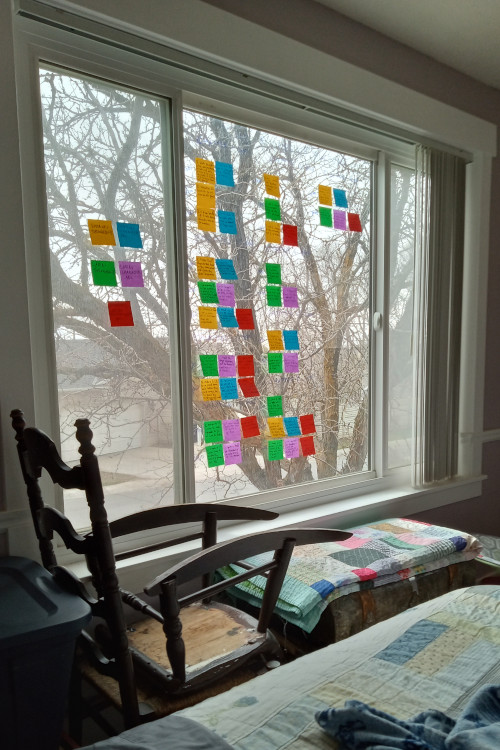
So I thought to myself, why not turn this story into my next novel WIP and work on outlining that instead of Return of the Starborn Son? With post-it notes and a dry erase marker (and some help from my toddler, who decided which color post-it notes to hand to me), I put together a basic story outline, which should come out to about 40k words when it’s done. As you can see, I used the window of my home office to put it all together, which was fun. 40k words is pretty short for a novel, just barely crossing the line over what SFWA considers a novella, but for a Conan-style sword & sorcery fantasy, it should be perfect.

I’ve also decided to make this an AI-assisted novel, using ChatGPT of course but also trying out Sudowrite, which looks like a much more useful AI writing tool. Getting ChatGPT to help you write anything longer than about 4k words is like trying to write on a whiteboard with boxing gloves on your hands. It’s going to be experimental, but I think I can turn it into something publishable in the next three or four months. It should be a fascinating learning experience either way.