The Riches of Xulthar: Chapter 2

Roderick

The hot sun beat mercilessly upon the three adventurers as they rode through the barren wash toward the sun-baked desert beyond. Nearly a week had passed since leaving the last town on the edge of the desert wastes, and Roderick’s friends were beginning to grow restless.

“Gods above,” Andrej murmured, “what I wouldn’t give for a jug of Kevonan wine right now!”

“Forget the wine,” said Jura. “Where are we supposed to find water in this waste? And what about grazing for our horses?”

“The next oasis is less than a day’s journey ahead of us,” said Roderick, though he knew that grazing was going to be a problem. Perhaps they should have traded their horses for camels.

“To hell with this!” said Andrej. “Rod, this quest is a fool’s errand. We’ll die of thirst before we find the lost city of Xulthar.”

“Or on the way back,” Jura concurred.

Roderick clenched his teeth. He knew that his friends had grown disillusioned, but he had hoped that their loyalty would outweigh their doubts. Regardless, this state of affairs could not be allowed to continue.

“So be it,” he told them firmly. “If you both want to turn back now, then go ahead. But I will not turn back, even if it means that I must walk through the gates of Xulthar alone.”

He spurred his horse forward, leaving Andrej and Jura to exchange looks of resignation before hurrying after him.

“Rod—wait!” Jura called out. “We’re coming!”

Andrej swore. “Will you slow down and wait for us? Gods above!”

Roderick pulled up his horse short and turned around to face his two friends, his eyes narrowed.

“The time of decision is now,” he said grimly. “Will you come with me to Xulthar, or will you turn around?”

“Peace, Rod, peace,” said Andrej, panting from thirst as he wiped his brow. “I meant no offense.”

“And none was taken,” Roderick said quickly. “Come, let us go. The horses grow hungry, and we are all in need of water and rest.”

As they rode on, the desert heat grew increasingly intense, and the parched ground of the unwatered plain turned to sand that shifted beneath the horse’s hooves. By midday, however, they reached the oasis that Roderick had spoken of: a small pool of brackish water surrounded by withered palm trees.

They dismounted and drank deeply from the pool, feeling the water wash away their fatigue. But as they prepared to settle in the shade until the cool of dusk, a strange sensation began to overcome them.

At first, it was little more than a feeling of lethargy—nothing unexpected, given the rigors of the day’s ride. But it quickly intensified into something much more. Wave after wave of vertigo and dizziness assailed them, making them stagger and swoon. Roderick stumbled and fell to his knees.

“What in the name of the gods is happening?” Jura cried, as if from a great distance.

Andrej’s face went slack, his eyes rolling back and his tongue lolling. “I… I don’t know,” he muttered before collapsing.

Roderick tried to stand but his limbs felt like lead weights. As he gazed out upon the oasis, the palm trees seemed to swirl around him like a whirlpool, their trunks twisting in impossible ways.

Then everything went black.

Roderick

When Roderick awoke, he found himself lying on his back, the hot midday sun beating on his face. The oasis was gone, as were his friends, the horses, and their supplies. All that he had now were his sword and the things on his immediate person.

He groaned and sat up, rubbing his eyes. Had it all been a hallucination? The oasis, his companions, and the strange spell that had come over them? But no—he remembered it all now. And as his memory returned, a shudder ran down his spine.

He stood on unsteady legs and scanned the desert, searching for any sign of Andrej and Jura. He called out their names, but his voice was weak and hoarse, and scorching wastes seemed to deaden every sound.

Panic began to rise like a serpent within his gut, but Roderick ignored it and set out in what he hoped was the direction of the oasis. Using the mountains on the horizon as landmarks, he trudged across the sandy, sun-baked desert.

After what felt like hours, Roderick spotted a figure in the distance. He drew closer and saw that it was Jura, lying motionless on the ground.

“Jura!” he called, rushing to his friend’s side. Relief mixed with fear as he searched for any sign of life. Fortunately, Jura was only unconscious. As Roderick checked him over for injury, his eyes fluttered open. Roderick helped him to sit up.

“What happened?” Jura groaned.

“I don’t know,” said Roderick, shaking his head. “One moment we were at the oasis, and the next, we were here.”

Jura rubbed his head. “Where’s Andrej?”

“I haven’t found him yet,” said Roderick, scanning the horizon. “We have to keep moving. We won’t last long in this blasted heat.”

Jura nodded weakly, and Roderick helped him to his feet. They stumbled forward, searching for any sign of their missing companion.

As they walked, Roderick couldn’t shake the uneasy feeling that something in these wastes was watching them. He glanced over his shoulder, but there was nothing behind them except the earth and endless sky. Still, the sensation persisted, and he knew that they were not alone.

The hot afternoon sun had already begun its descent when they finally found Andrej. He was standing still, staring off as if dazed.

“Andrej!” Roderick called out to him. He didn’t respond.

Roderick and Jura approached him with caution. Men possessed by sorcery had been known to wander in a dazed and trancelike state, lashing out at friends until they finally came again to themselves. And indeed, Andrej looked like one possessed. His clothes were covered in dust and sand, and his skin was dry and parched from dehydration.

At length, Roderick stepped forward and gently placed his hand on Andrej’s shoulder. He startled, but did not lash out.

“What happened?” Andrej croaked, his eyes blinking rapidly as if he’d just awoken from a deep sleep. “Where are we?”

Roderick shook his head. “We must have fallen under some sort of witchcraft or dark sorcery,” he told his confused friend. “It began when we partook of the water at the oasis. We all blacked out shortly afterward. I do not know how long each of us wandered, but when I awoke, both of you were gone.”

Jura nodded slowly, stroking his beard as if in thought. “I remember a strange feeling,” he told them, “as if something was trying to take over my mind.”

“I don’t remember a thing,” Andrej said softly, his once-merry voice full of bewilderment and fear. “It’s as if my mind and memory both went blank.”

Roderick and Jura exchanged worried glances. “Come,” said Roderick. “Let us go.”

“Where?” asked Jura. “To the oasis?”

“Where else?”

“No,” said Andrej, his eyes wide with terror. “If we go back, that same power will possess us. Who knows what will happen to us then?”

Roderick drew a deep breath of the hot, dusty air and gazed off at the barren horizon. “We have no choice. We need our horses and supplies if we are to cross this barren wasteland, and for good or for ill, we left them at the oasis. It is the only place of water for miles—surely they must have wandered back there, or else remained while we were under the throes of that strange spell.”

“We should have abandoned our quest and turned back days ago,” Andrej moaned. “We should not have come out here.”

“It’s too late for thoughts like that,” Roderick said grimly. “Now come, let us go before we all perish of thirst.”

The trio trudged through the sand, their feet growing heavier with each step. The sun was halfway from its zenith when they finally spotted a faint shimmer in the distance. At first, Roderick feared it was only a mirage, but as they drew closer, its shimmering form solidified into something real, not just a thing imagined by their dazed and frenzied minds.

Sure enough, it was the oasis. Their horses were still there, grazing peacefully on the sparse grass and drinking from the muddy water. Whatever dark magic had possessed the three friends, it had left their animals unmolested. Indeed, the whole scene appeared just as they had left it, as if nothing fey had happened at all.

“I’m so thirsty,” Andrej moaned. He knelt down to drink, but Roderick gripped his shoulder and stopped him.

“Wait,” he commanded, his voice urgent. “We cannot drink from this water yet. Remember what befell us the last time?”

“Yes,” said Jura, eying their surroundings with dread. “Who knows what will become of us if we drink from these waters again?”

“But I’m so thirsty,” Andrej protested weakly.

“We all are,” said Roderick, sensing again that something was watching them. “Let us test the waters first. One of us will drink, and the others will wait to see…”

His voice trailed off as a strange mist began to billow from the surface of the tepid pool. It began to swirl and thicken, until a strikingly beautiful nymph emerged from the water. Her long, dark hair cascaded over her slender, naked form, and her eyes glowed with sinister intent.

Roderick, Andrej, and Jura instinctively drew their weapons. She smiled, sensing their fear.

“Welcome, travelers,” she cooed in a sultry-sweet voice. “I am the undine nymph who guards these waters. What brings you to my oasis?”

“We mean no trespass,” Roderick said in an attempt to pacify her. “We ask only to fill our waterskins, and then we will be on our way.”

“Ah, but why leave so soon?” the nymph purred. “I could offer you so much more than just water.”

Andrej and Jura’s eyes suddenly began to glaze over, their jaws slackening and their tongues lolling like dogs. Their hold on their swords loosened, and with a pair of loud clangs, they dropped their weapons onto the stony ground. Roderick watched in horror as they began to walk aimlessly, mumbling in strange tongues. Once again, they wandered out into the desert sands.

Roderick tightened his grip on his sword as he turned again to the nymph. Her magic pulsed in waves around him, whispering promises of power and pleasure. But he refused to succumb. His heart beat with wild abandon, and his forehead beaded with sweat as he mentally prepared for the fight of his life.

The nymph laughed, and the sound was as dark and dangerous as a thunderstorm racing over the thirsty desert. “Oh, brave little warrior,” she crooned, “you think your measly sword can save you from my power?”

“I will not stand idly by while you harm my friends.”

“Harm them? I was just playing with them. I have no intention of harming them, unless you give me a reason to.” The undine nymph tilted her head, her eyes narrowing slightly. “But with you, I sense something different.”

Roderick frowned. “What do you mean?”

The nymph glided nonchalantly over the surface of the water, moving toward the animals who grazed on unperturbed. “Unlike your wretched friends, you are a man of integrity and honor.” She pulled a strand of hair behind one ear and gave him a sensuous smile.

“They may not be the best of men, but they are still my friends,” said Roderick. “Please, fair nymph—release them from your spell.”

The nymph’s smile widened playfully, and she sat nearby him on the edge of the pool, her long and slender legs stretched out to one side. “Very well. I will release your friends if you give me one very simple thing in return.”

Roderick slowly lowered his sword. He doubted it would be of much use against the magical water nymph anyway. “What do you require?” he asked at length.

“A kiss,” she said, mischief sparkling in her eyes.

“A kiss? What sort of a kiss?”

“A kiss of passion,” she answered, looking deep into his eyes. “One that would make me tingle down to my bones.”

She laughed, and the sound was like the gurgling of a crystal clear spring in the mountains. Even so, he sensed that it would be a terrible mistake to give in to her seductive demands. Many a traveler had been led on to his death by the nymph’s illusive mirages, and he sensed that beneath her playful demeanor lurked a terrible, deadly mischief.

“And if I refuse?” he asked.

The nymph’s smile turned into a scowl. “Then you can die of thirst with your friends in the desert!”

“My apologies,” Roderick said quickly. “I mean no offense, fair undine.”

Her smile returned, though strained. “Don’t push your luck,” she said sulkily. “There is no other water in this desert, but mine.”

“Why must you ask for a kiss?” he asked, trying to stall. “If you can cast a spell over my mind, can you not simply take it?”

She smirked and rose gracefully to her feet, flaunting her slender body in a most seductive manner. Remembering the wench at the tavern, Roderick knew that Andrej and Jura would not have hesitated to give in to her demands. But though a part of him yearned to surrender to her deadly embrace, for his friends’ sake he resisted the urge to succumb to the sensual temptation she presented.

“Because a kiss is nothing if it is not freely given,” she told him, her eyes never leaving him.

Roderick sheathed his sword and reached for the pouch of money at his belt. “Perhaps we can come to some other arrangement. I can offer you coin—”

“The coin of Xulthar? You and I both know that it is cursed.”

“I have other coin,” he said lamely. But his pouch had lightened considerably since the start of their travels, to the point where he began to wonder if the pouch itself was cursed. With trembling fingers, he counted three silver pieces and—

The nymph turned away and sighed. “Coin is so… transactional. So impersonal. Not like a kiss.” She wet her lips and eyed him eagerly. “A kiss is always personal, not at all like the cold metal flecks you carry on your belt.”

Roderick’s hand instinctively went to the pendant under his shirt. Suddenly, he realized that he had something much more personal to offer. His breath caught in his throat at the thought, but he did not seem to have any other choice.

“What about this?” he asked, pulling it out to show her. The pendant was a silver locket that contained a lock of his mother’s hair. This he quickly removed, knowing that any piece of a person’s body could be used to gain sorcerous influence over them.

The nymph stepped forward to examine it. “I would rather have the kiss,” she said sulkily, “but a gift freely given is a gift freely offered. Very well.”

She took the silver locket from his hands and tossed her hair over her shoulder. With her hips swaying sensuously, she descended into the pool.

“Wait,” said Roderick, suddenly remembering Andrej and Jura. “What about my friends?”

“Go and find them yourself. And don’t you dare come back to this oasis with them. I won’t be so generous with you next time.”

With that, she disappeared into the muddy shallows.

Roderick

Roderick emerged from the oasis feeling both relieved and unsettled. The horses were fed and watered, and he had escaped with his faculties intact, but now he was alone in the midst of a vast and unforgiving desert. Somewhere out there were his friends, still suffering from the deadly undine’s spell. He knew that he had to find them soon, for night came swiftly in the deep desert, and the sun already hung low in the cloudless sky.

He searched diligently for any sign of Andrej and Jura, but the desert wastes were empty. Panic rose within his chest, and he spurred the horses onward, pushing them from a trot to a gallop. The wild and untamed lands of the deep desert were cruel and unforgiving, where even the most experienced traveler could easily perish.

Just when he was ready to give up hope, he found them huddled under the shade of a rocky outcropping. He called out eagerly, but they barely looked up at him as he approached.

“You’re alive,” Andrej observed dryly as Roderick dismounted. “We thought the undine nymph had taken you.”

“Aye,” said Roderick. “She nearly did. Are you all right?”

“What happened?” Jura asked, ignoring his question.

“Never mind that,” Andrej snapped, rising to his feet on unsteady legs. “Did you bring any water?”

Roderick’s heart fell. “Nay,” he answered dismally. “When the fey undine released me, I departed as swiftly as I could. I dared not fill the waterskins, for fear that she would…”

But Andrej was already at the horses, fumbling through their supplies. He untied one of the waterskins and pressed it to his lips.

“Water!” he said, drinking eagerly. “We’re saved!”

To Roderick’s great astonishment, the waterskins were all full, nearly bursting with clear, clean water, as pure as if it had been drawn from a mountain spring.

“When did this happen?” he wondered aloud. In his eagerness to find his friends, he had not even thought to stop and drink.

“Who cares?” Jura asked, laughing as he drank his fill.

The undine nymph, Roderick realized. She must have filled them with her magic, granting him a parting gift.

For a time, he feared that her spell was over these waters just the same as over the oasis pool. But Andrej’s and Jura’s eyes did not glaze over, and Roderick’s thirst soon overrode his caution. Nothing had ever tasted so pure or so sweet.

“And now,” said Andrej, wiping his mouth, “tell us your sordid tale.”

Roderick told them about the nymph and her sensuous request: how she had bargained with him for a deadly kiss, refusing Roderick’s coin as she flaunted herself before him. But before he could tell them how he escaped, they began to grow angry.

“You nearly abandoned us for a woman?” Andrej spat, his eyes flashing with rage.

“I didn’t abandon you,” Roderick protested. “Did I not just save you from dying of thirst?”

“After cavorting with that hussie nymph through the hottest part of the day. Don’t tell us you fell for her tricks, Rod. They’re known to be deceitful creatures, using their beauty to lure men to their deaths.”

Roderick bristled at Andrej’s words. “If I had, I would not be alive now—and neither would you.”

“We mean no offense, Rod,” Jura said quickly. “But surely you must see now that it was a mistake to come this far. After all, if we cannot trust the oases, how can we hope to survive in the desert, much less find the ruins of Xulthar?”

“Is this it, then? Are you going to abandon me?”

“Only if you don’t come with us,” said Andrej. He climbed wearily up onto his horse, and Jura did the same.

Roderick drew a sharp breath of the hot, dusty air. “So be it,” he said grimly. “If that is how it is to be, then I will continue this quest alone.”

“Your horse will die out there,” Jura pointed out. “Outside of the oases, there’s no grazing for—”

“Then take him. I’ll continue on foot.”

Jura frowned. “But Rod, what about you? On foot, you won’t last more than a couple of days.”

Roderick ignored him as he took the waterskin and several days’ worth of supplies. His anger was so fresh that he didn’t trust himself to speak civilly with his friends—though he had to admit, they were right about the horse. It would be a shame to let the beast perish with him in the wilderness.

“Don’t be a fool, Rod,” Andrej said sharply. “Come back with us.”

“Nay,” grunted Roderick. “My destiny lies in the desert.”

“Or your death, more likely.”

“Then so be it,” he said angrily, throwing the bags over his shoulder. He looked Jura and Andrej each in the eye. “Go back to your drink, and your women. I have no more appetite for either.”

“But what about your friends?” Jura asked.

“Friends,” said Roderick, spitting in disgust. “If you were my friends, you would understand why I must seek the ruins of Xulthar—why I cannot bear to live another day without confronting the truth behind my family’s fall. But if honor truly matters nothing to you, farewell!”

Andrej regarded him coolly for several moments before turning away. “Come, Jura. Let us leave this fool to his fate.”

“But Andrej—”

Without waiting, Andrej spurred his horse to a trot. He did not look back.

“I am sorry, Rod,” Jura said sadly. “I wish it hadn’t ended this way.”

“Go,” Roderick whispered, turning away.

Jura nodded and followed after Andrej. Roderick watched them until they were barely larger than specks on the horizon. Then they crested a hill, and were gone.

The words of the old crone suddenly came to him: If you do not allow yourself to be swayed or tempted away, then fate will provide all that you need. Those words made him laugh with bitter mirth. If the old woman’s prophecy were true, then why had he just lost his horse? On foot in this barren wilderness, he was already as good as dead. And yet, death was preferable to admitting defeat and returning in dishonor. For good or for ill, his fate now lay in the forbidding desert.

<< Chapter 1 << The Riches of Xulthar >> Chapter 3 >>

The Riches of Xulthar: Chapter 1 (AI Draft)

Roderick

“I know why you seek the lost city of Xulthar,” the old crone said as she peered over the top of her crystal ball. “But the riches hidden therein will bring you nothing but evil and sorrow.”

Roderick the Young of House Valtan stood up straight with his shoulders back, his sharp eyes scanning the old crone from head to toe. His broad hand unconsciously brushed the hilt of his sword; it was a weapon that had seen more than its fair share of use. Unlike most nobles, his boots were worn and caked with dust, his face lined with the sun and wind of the open road—a testament to the hard times that had fallen on his house. But Roderick was not one to let the whims of fate define him.

“What do you mean, old woman? Speak your prophecy.”

The haggard old fortune teller wore faded and tattered robes, with a threadbare shawl that seemed as old and gray as she was. Clearly, no false and flattering sibyl was she. Roderick had sought her out for that very reason, foregoing all of the more popular soothsayers with their smooth words and their gilded tongues. With all that he had lost, he had no appetite for their lies.

The crone’s eyes pierced through Roderick’s soul like needles, her voice a deathly hiss that sent shivers coursing through his veins.

“Behold! I see a city of endless riches and unimaginable treasures, watched over by an infernal force of dark magic. You must face this terror, Roderick of House Valtan, and uncover the reason for your family’s demise. But know this – the path ahead is littered with danger, for even if you succeed in defeating the evil power, it will not restore your house to its former glory or bring you the honor you seek.

Her words stabbed him like a dagger to the heart. Honor was indeed the object of his quest, and the riches of Xulthar were merely a means to that end. The fact that the sibyl had divined as much spoke to her clairvoyance, since by all outward appearances, he was simply another young adventurer seeking his fortune. But even if the riches of Xulthar were cursed, he could not back down now; he had come too far and sacrificed too much.

“But will I defeat that dark power, and restore my family’s honor?” Roderick asked.

The sibyl clucked her tongue. “The future is not set in stone, young lord. You, not I, have the power to shape your own destiny.”

Roderick scowled impatiently. “I did not come into your tent to hear platitudes, old woman. Look into your crystal ball and tell me what will be if I defeat this dark sorceror and seize the riches of Xulthar for my own.”

The crone’s eyes glinted in the dim light of her tent as she glared into the depths of her crystal ball. “I see naught but a life of suffering and misery for you, my lord. Xulthar’s riches are cursed beyond your wildest dreams. If you dare step foot on this path, it will come at an immense cost, even if you emerge from it victorious.”

“But if I do not take this journey, then my family will never reclaim its lost honor and our house will be erased from existence forever.”

“As you have spoken, young lord.”

Roderick grunted. “Better to meet a cursed but honorable end than to take the coward’s path. If this is to be my destiny, I will not turn from it.”

The old crone nodded solemnly, her aged and wrinkled face softening with sympathy. “Beware, young lord! The evil that lurks within the ruins of Xulthar is so great that even I cannot foresee how your fate is intertwined with it. Your bravery is admirable, but the path that you choose will have consequences beyond your own life. Indeed, it may affect the fate of our entire world.”

“Then I will choose this path,” Roderick said grimly, “even if it brings me naught but sorrow.”

He adjusted his sword belt and turned to leave. As soon as his back was turned, the ball began to glow anew.

“There is something else,” the old crone prophesied, her gaze fixated on the vision within the crystal ball. “I see a young woman, beautiful and fair…”

But Roderick had already stepped out of her tent, his mind consumed with brooding thoughts.

Roderick

The tavern was as dark and smokey as the hot afternoon sky was bright and clear. Roderick narrowed his eyes as he adjusted his sword belt and peered at the long wooden tables, which were mostly unoccupied at this hour. A short raven-haired wench was washing down the table nearest to him, the hem of her billowing dress stained almost black with ash and spilled food and drink. She stood up straight as Roderick entered.

“Milord,” she said with a respectful curtsy.

He ignored her for the moment as his eyes scanned the room. Three scrawny chickens were roasting on a spit over the coals in the fireplace, while behind the bar, a fat, balding barkeep mindlessly cleaned pewter mugs. A warm breeze blew through the unshuttered windows, only marginally cooling the air.

For a moment, Roderick thought he had made a mistake. Then his ears caught the sound of laughter, and in the far corner, he found what he had sought.

“My friends,” he muttered, grunting as he pointed to the far table. The tavern wench nodded and smiled as he passed her without another word.

“Rod!” said Andrej, slapping him heartily on the back as Roderick took the seat next to him on the bench. “It’s good to see you, friend. Care for a drink?”

Roderick raised an eyebrow. “At this early hour?”

“Why not?” Jura said merrily across the table. “Andrej is paying!”

“There you are mistaken,” Andrej retorted with a mischevious smile. “Our beloved Lord Valtan is subsidizing our libations on this auspicious occasion, since he it was who called us to this council. Forsooth?”

Roderick sighed heavily. “Just as long as you don’t get drunk.”

“It may be too late for that, Lord,” Jura said with a trinkle in his eye. He held out his mug, and the wench hurried over with a pitcher of ale.

“Enough of that!” Roderick snapped. “I didn’t call you here to celebrate the occasion. I called you here to make plans.”

The tavern wench stopped pouring, and at a sharp glance from Roderick she scurried back behind the bar. Andrej clucked his tongue.

“You always have such a serious demeanor, Rod,” Andrej said, taking a swig of ale. “Can’t we just enjoy each other’s company for once?”

Roderick scowled. “This is not a social visit, Andrej. We are here to discuss our… pending expedition.”

“You mean our quest for the lost city of Xulthar?”

“Not so loud!” Roderick snapped, glancing around the room. But Andrej and Jura just laughed.

Roderick’s frown deepened. “This is no laughing matter. Xulthar is a place of great danger. We must approach it with caution and a clear head.”

“Of course, of course,” Jura said with a wave of his hand. “But we’ve been planning this for months. We know what we’re doing.”

“Maybe,” Roderick said, “but we must stay focused. We cannot let the promise of riches cloud our better judgement.”

“But that’s the whole point, isn’t it?” Andrej said, grinning. “We’re doing this for the gold.”

Roderick’s eyes narrowed. “It’s not just about the gold for me. It’s about my father, and restoring my family’s honor.”

“Well, that’s all well and good,” Jura said with a shrug, “but I’m in it for the gold.”

Roderick shook his head. “You’re missing the point. This is not just a treasure hunt. Xulthar is not just some abandoned city. It is a place of great power and danger. We must be careful.”

“Relax, Rod,” Andrej said, clapping him on the back. “We’ll be careful. But we’ll also have a good time.”

Roderick sighed. His companions were not taking the expedition seriously enough. They didn’t understand the gravity of the situation. But he had to make them understand.

“Listen to me,” Roderick said, leaning in close. “In Xulthar, we will face not only physical challenges but also those of the mind and soul. The treasure we seek is cursed, and it will corrupt anyone who seeks to possess it. We must be vigilant and resist its lure.”

Andrej and Jura looked at each other and then burst out laughing. The sound of their merriment was like a dagger to Roderick’s heart.

“You think this is funny? Xulthar is no laughing matter. It is said that the city fell to an evil and sorcerous power, which slaughtered all of its inhabitants in a single day. That power still holds sway over the treasure contained within the ruins, and it destroys those who fall to it. Their bodies are possessed by demons, their minds reduced to nothing more than an addling soup.”

The laughter died down as they listened to him speak, but Roderick could sense that they still didn’t fully believe him.

“Look, Rod,” Andrej said, placing a hand on Roderick’s shoulder, “we know you’re worried, but we’re not a bunch of greenhorns. We’ve been on plenty of dangerous expeditions before. We can handle ourselves.”

“We’ll be careful,” Jura added. “And besides, even if there is a curse, we’ll just have to make sure we have the right magical protections.”

Roderick sighed again, feeling the weight of the responsibility on his shoulders. He had to make sure that his companions understood the danger they were about to face.

“We’ll need to be prepared,” Roderick said, pacing back and forth. “Xulthar is hidden in the deep desert, and no one has ever returned from there. The journey will be long and arduous, and we’ll have to be prepared for anything.”

He looked at Andrej and Jura expectantly. They nodded in agreement.

“We’ll need supplies,” Andrej said, taking charge. “Food, water, weapons…all sorts of things.”

Jura chimed in as well. “And spells! We can’t forget about magical protection.”

Roderick nodded in agreement. This was all true, but there was something else they were forgetting about – something far more important than any physical preparation.

“But most importantly,” he said gravely, “we must protect ourselves from the temptations of the cursed treasure we seek.”

The two adventurers stared at him in surprise. “What do you mean?” Andrej asked with a furrowed brow.

“The curse of Xulthar is not just a physical danger,” Roderick explained. “It is a corrupting force that preys on our darkest desires and weaknesses. We must be vigilant against its influence, or else we risk falling to its power.”

Jura crossed his arms, looking skeptical. “And how do we protect ourselves from that? Do we just avoid the treasure altogether?”

Roderick shook his head. “No, we cannot simply ignore the treasure. It is our goal, after all. But we must be strong of will and clear of purpose. We cannot let our greed or ambition overpower us. We must remember why we are on this journey and what we hope to achieve with the treasure.”

There was a moment of silence as Andrej and Jura considered what Roderick had said. Then Andrej spoke up, a note of determination in his voice.

“I understand what you’re saying, Rod. And I promise you, I won’t let the curse get to me. I’m here to help you restore your family’s honor and get rich in the process.”

Jura nodded in agreement. “Me too. I’m not going to let some curse steer me off course.”

“Very well,” Roderick said, finally relenting. “But we must be cautious. We don’t know what we’ll face in that cursed city. We’ll need to rely on each other and be prepared for anything.”

Andrej and Jura nodded in agreement, and they all raised their mugs in a toast.

“To Xulthar,” Andrej said with a grin.

“To the treasure we’ll claim,” Jura added, clinking his mug against Andrej’s.

“And to glory and honor we’ll win,” Roderick said, feeling a sense of dread wash over him. Though his friends seemed confident in their plans, Roderick couldn’t help but worry they weren’t taking this dangerous journey seriously enough. What if something happened to them out there? Would they abandon him, or stand by him in the face of adversity? He only hoped he could trust his companions when it came time to confront the power of Xulthar’s curse.

The Riches of Xulthar: Chapter 1

Roderick

“I know why you seek the lost city of Xulthar,” the old crone said as she peered over the top of her crystal ball. “But the riches you find there shall bring you naught but evil and sorrow.”

Roderick the Young of House Valtan rolled his shoulders back as his sharp eyes scanned the fortune teller from head to toe. His broad hand unconsciously brushed the hilt of his sword, which had seen more use than most of its kind. Unlike most of the noble born these days, his boots were worn and caked with dust, his arms bronzed, his face lined and weathered from the wind of the open road—a testament to the hard times that had befallen his house. But Roderick was not one to let the whims of fate define him.

“What do you mean, old woman? Speak your prophecy.”

The robes of the haggard old sibyl were faded and tattered, and over them she wore a threadbare shawl as old and gray as herself. A woman of her profession could easily amass a small fortune spinning false and flattering tales—all the more so for the curse that multiplied the coin of liars and cheats, and shrank it for honest men. Indeed, this very soothsayer could be putting on a sham, her wealth discreetly hidden beneath a facade of beggary and dearth.

But Roderick did not think so. He had carefully watched the old crone for several days, searching for any sign of deceit. Now, inside her tent, he had even more opportunity to scrutinize her. Everything he saw convinced him that she was, indeed, an honest prophetess, for only an honest one could be this poor.

“You bear little resemblance to the other young adventurers who seek the riches of Xulthar,” the old crone cackled. “Unlike those other fools who greedily seek the city, you are a man of honor in an honorless world—a soul cast adrift by the cruel winds of fate, through no failing of your own. Your father—”

“If I wanted honeyed words, I would have gone to one of the popular soothsayers with their silk tents and their gilded tongues. Do not try to butter me up, old hag—I have no appetite for obsequious lies.”

“Old hag?” the woman shrieked. “Your uncouth tongue will bring you no favors, young lord—though you did not need to seek me out to learn that. No, I perceive you have come to learn whether your efforts to restore your family’s honor will meet with success, or failure.”

“Aye,” said Roderick, inwardly pleased that the sibyl had divined the true nature of his quest. Still, he brooded impatiently as she peered into her crystal ball.

“Behold!” she began, her voice a deathly hiss that sent shivers coursing through his veins. “I see a city of unimaginable riches and treasure, guarded by an infernal force of the darkest sorcery. You will face this dark force, young Roderick of House Valtan, and uncover the truth behind your family’s demise.”

“And will I defeat it?” he asked, his blood running cold.

The old crone paused until the silence was nearly palpable. “If you do,” she answered at length, “it will not restore your house to its former glory, nor right the wrongs that you and your family have suffered.”

Her prophecy stabbed him like a dagger to the heart. Honor and duty compelled him to do all within his power to restore his family’s house, and nothing short of the riches of Xulthar would enable him to accomplish that now. To hear the sibyl prophesy that his quest would come to naught was almost enough to crush him.

“Will I fail, then?” he asked softly, refusing to give in to despair.

The sibyl clucked her tongue. “The future is not set in stone, young lord. You, not I, have the power to shape your own destiny.”

Roderick scowled. “I did not come into your tent to hear platitudes, old woman. Scry into your stone and tell me what will be if I defeat this dark sorcerer and seize the riches of Xulthar for my own.”

The crone’s eyes glinted in the dim candlelight as she stared once again into the depths of her crystal ball. “I see naught but a life of suffering and misery for you, my lord. Xulthar’s riches are cursed beyond measure. If you do not turn from this path, you will pay an immense cost for it, even if you prove victorious.”

“But if I do not take this path, then my house will never be restored and my family’s honor will be disgraced forever.”

“As you say, young lord.”

“And even if the cause of my house is truly hopeless,” he continued, hardly hearing her, “then for honor’s sake alone, I must avenge our fall.”

To that, the old crone said nothing.

“I must seek the city of Xulthar,” Roderick argued, clenching his calloused fist. “I have come too far and sacrificed too much to take the coward’s path and turn from my destiny. Tell me, woman, what must I do to prepare? What must I take with me to defeat the dark power that resides in the ruins of Xulthar?”

The sibyl consulted her stone. “You must remain true to your cause,” she counseled. “If you do not allow yourself to be swayed or tempted away, then fate will provide all that you need to defeat that dark power.”

“But even if I defeat it, the honor and wealth of my house will not be restored?”

The old crone nodded solemnly, her aged and wrinkled face softening with sympathy. “Beware, young lord! The evil that lurks within the ruins of Xulthar is so great that even I cannot foresee how your fate is intertwined with it. All I know is that defeating that great evil will not bring you the honor that you seek, nor will it restore your house to its former glory.”

Roderick grunted in grim resignation, and his eyes narrowed and hardened with resolve. “It is better to meet a star-crossed end with sword in hand than to take the coward’s path. If this is to be my destiny, I will not turn from it.”

He adjusted his scabbard and turned to leave. As soon as his back was turned, the crystal began to glow anew.

“There is something else,” the old crone prophesied, her gaze fixated on the vision within the ball. “I see a young woman, slender and fair…”

But Roderick had already stepped out of her sun-faded tent, his mind consumed with dark and brooding thoughts.

Roderick

The tavern was as dark and smokey as the hot afternoon sky was bright and clear. Roderick narrowed his eyes as he peered at the long, wooden tables, which were mostly unoccupied at this hour. A raven-haired wench was scrubbing the table nearest to him, her apron stained black with spilled food and drink. She stood as Roderick approached her.

“Milord,” she greeted him with a curtsy.

He ignored her for the moment as he scanned the hall. Three scrawny chickens were roasting on a spit over the coals in the fireplace, while behind the bar, a fat, balding barkeep mindlessly cleaned pewter mugs. A warm breeze blew through the unshuttered windows, only marginally cooling the air. Then his ears caught the sound of laughter, and in the far corner, he found the party he sought.

“My friends,” he muttered, pointing to the two men. The tavern wench nodded and smiled, and he passed her without another word.

“Rod!” said Andrej, slapping Roderick heartily on the back. “It’s good to see you, friend. Care for a drink?”

Roderick raised an eyebrow. “At this early hour?”

“Why not?” Jura said merrily from across the table. “Andrej is paying!”

“There, you are mistaken,” Andrej retorted with a mischievous smile. “Our beloved Lord Valtan is subsidizing our libations on this occasion, since it was he who called us to this council.”

Roderick suppressed a chuckle. He could always count on his old friends from the guard to lift his spirits. Andrej was tall and dashing, with long golden locks and a carefully trimmed mustache and goatee. As the youngest son of a successful yeoman, he sought his fortune by the sword, since he had no hope of an inheritance. Jura was about a head shorter than him, and more of a brawler than a swordsman, but his blue eyes shone with rare intelligence. His grin, half-hidden by his short, black beard, always made Roderick wonder if he knew more than he let on.

“Just as long as you don’t get drunk,” said Roderick. “We have important matters to discuss.”

“Ah,” said Jura with a twinkle in his eyes. “It may be too late for that, Lord.” He held out his mug, and the wench hurriedly refill it.

“‘Important matters,’ you say?” Andrej asked, leaning forward. “My dear friend, you do yourself a disservice if you think anything in this world is more important than good friends, good drink, and good women.” He smiled at the wench and held out his mug to her, and when she had finished filling it, he spanked her soundly, making her giggle.

Roderick drew a sharp breath. “Leave the girl alone.”

“Why?” Andrej laughed. “She enjoys it—don’t you, lass?”

“That depends on the size of your money pouch, milord,” she said slyly, tickling his chin.

“Ah, but which pouch?” Jura asked with a twinkle in his eye. “The one that carries his coin, or the one that carries the family jewels?”

As his friends enjoyed another merry laugh, Roderick’s hand instinctively went to the pouch of coins on his belt. He frowned—had it grown noticeably lighter since his visit with the old sibyl? He silently counted them with his fingers, and sure enough, the curse had wrought its work.

He pulled the wench aside and gave her a hard look. “My friends and I have matters to discuss,” he told her. She smiled nervously and scurried back to the bar.

“Ah, Rod,” said Jura, taking a swig of his ale. “Why are you always so somber? Can we not simply enjoy each other’s company for a while?”

Roderick scowled. “I did not call you here to drink me into the poorhouse. We are here to discuss our… pending expedition.”

“You mean our quest for the lost city of Xulthar?”

“Not so loud!” Roderick snapped, glancing anxiously around the room. But Jura and Andrej just laughed.

“Ah, Rod,” said Andrej, slapping him on the back once again. “We cannot ‘drink you into the poorhouse,’ because you are already there. Aren’t we all?”

“Indeed,” said Jura. “That is, until we find the riches of Xulthar.”

The old crone’s words came back to Roderick, about the riches of Xulthar bringing him naught but evil and sorrow. His scowl deepened, and he turned away.

“Some things are more important than riches.”

“You are correct, my lord,” Andrej said with a flourish. “But the wonderful thing about riches is that they can buy all of the truly important things. Like friends—”

“And drink,” Jura interjected.

“—and women,” Andrej finished. They laughed uproariously and saluted each other with their mugs high in the air.

“This is no laughing matter,” said Roderick, unamused. “Xulthar is a place of dark sorcery and grave danger. We must be cautious and keep our heads clear if we are to succeed.”

“Of course, of course,” Jura said dismissively. “But we have been planning this adventure for months, and all of the supplies have been procured.”

“And right now,” Andrej added, “we are enjoying our last libations before the dry and dreary desert makes teetotalers of us all!”

Andrej’s hedonistic merriment failed to warm Roderick’s heart. His apprehensions about the coming adventure and the words of the old sibyl still weighed too heavily on him. If he had no hope of success, even in victory, how could he ask his friends to join him?

“Are both of you sure you wish to accompany me?” he asked.

Andrej and Jura looked at him as if he had grown a third arm. “Of course, Rod,” said Jura. “Why would we turn around now?”

“Because of how lightly you seem to take this. Does it not disturb you that no one has returned from Xulthar alive?”

“My dear and dismal friend,” Andrej said cheerily, “why should such things bother us, when the same can be said of life itself? We all must take our dance with death, and in the end, the reaper always gets his due.”

“Aye,” said Jura, lifting his mug. “Better to face death on your feet, with a sword in your hand and friends at your side, and the prospect of boundless wealth if you survive.”

Roderick grunted in agreement, though he still couldn’t help but feel that his companions were taking things too lightly. Then again, the honor and future of their house was not at stake, as it was for him.

“That is good,” said Roderick, “but for me, it is not merely a question of treasure. It is a matter of honor.”

“Of honor?” said Andrej, raising an eyebrow. “What is ‘honor,’ if not the fleeting judgment of fools? Honor, ha! I would rather be shamed forever, and have my coffers full, than have all the honors and glory of the realm, and be penniless.”

“Aye,” Jura heartily concurred. “Honor is all well and good, but gold is all I’m after.”

“How can you say such things?” Roderick asked, suddenly animated with righteous vehemence. “Honor is not merely a title that a king or a prince bestows. It is something that burns within you—the star that guides your soul through the darkest night, the compass that directs you through the bleakest waste. I would rather lose everything else that I own, before I lose my honor!”

Andrej and Jura paused to look at each other. When they turned to Roderick again, their eyes were uncharacteristically sad.

“Rod,” said Andrej softly, “do you not remember the horror of the plague years? How many men of honor perished alongside the mean and contemptible alike?”

“Or how so many wicked men prospered at the expense of the weak and innocent?”

“I have not forgotten,” Roderick said somberly, remembering the old sibyl’s words: you are a man of honor in an honorless world—a soul cast adrift by the cruel winds of fate.

Andrej took a long drink and wiped his mouth with the back of his hand. “I mean no offense, friend. But after all that I have seen, both in the guard and out of it, I have learned through sad experience that honor counts for little in this world.”

“So it does,” said Roderick. “But that does not mean it should not count for us.”

Jura eyed him curiously. “Well, one thing I will admit is that honor is no cheaper than life in this world. Better to die for honor’s sake than to live for nothing at all.”

And what if there is no cause in this godforsaken world worth dying for? Roderick could not help but silently wonder. He scowled again as he leaned over the wooden tabletop, brooding over his troubled thoughts.

Andrej sensed his growing melancholy and slapped him on the back. “Come now! Why should we trouble ourselves with such somber speech when our mugs are full, our horses are laden, and the greatest treasure in the world awaits the conclusion of our quest?”

“Hear, hear!” Jura concurred, taking a drink of his own.

Roderick forced a smile, but did not feel it. Still, for his friends, he cast aside his darker musings and focused on matters at hand.

“Let us talk of what we will face at Xulthar,” he said, leaning in close. “The city is guarded by a dark and sorcerous power, which we must defeat if we are to win the treasure. We will face not only physical challenges, but tests of our mind and soul.”

“Yes, yes,” Andrej said dismissively. “We all know that Xulthar is the seat of some upstart sorcerer.”

“It is said that all of the city’s inhabitants were slaughtered in a single day,” Roderick continued, ignoring him. “That power must still hold sway over the treasure, and will corrupt us just as surely as the coin of Xulthar—perhaps even more so. We must be vigilant and resist its allure.”

“Rod,” said Jura, “we know what we are up against. There are no greenhorns here.”

“Aye,” said Andrej, taking another swig of his ale. “We’ve been on plenty of dangerous ventures before. We can handle ourselves just fine.”

Roderick sighed again, feeling the weight of all his apprehensions pressing upon him. The words of the sibyl troubled him as well, but he did not feel that he could share that with his friends. More likely than not, they would simply mock him.

“Very well,” he said at length, “but we must be strong of will and clear of purpose. Our primary object is to defeat the forces of evil that infest the city and curse its treasure. Only then can we claim Xulthar’s riches for our own.”

There was a moment of silence as Andrej and Jura considered his words. Andrej spoke up, his voice suddenly filled with resolve.

“I understand, Rod. And I promise, I won’t let the curse of Xulthar get to me. Right, Jura?”

“Right,” said Jura, nodding.

Andrej turned back to Roderick and smiled. “You say that this quest is a matter of honor for you? Very well, then—let it be a matter of honor for us all. To restore your family’s name, we will ride with you to the cursed city and face whatever fate awaits us there.”

“Aye,” said Jura heartily. “And become the richest men in all the land.”

Andrej grinned and lifted his mug. “To Xulthar!”

“To Xulthar,” said Jura, clinking his mug against Andrej’s.

“To Xulthar,” Roderick muttered. But though his friends seemed confident, Roderick could not shake the feeling that they were on their way off to their doom.

<< Prologue << The Riches of Xulthar >> Chapter 2 >>

The Riches of Xulthar: Prologue (AI Draft)

Long had the plague years ravaged the land, decimating every household and filling the ground with the dead. Crops rotted unharvested in the fields, entire towns were wiped clean of inhabitants, and the cities swelled with panicked migrants fleeing the spectre of death, only to spread the shadow of the reaper.

No kingdom or principality was left untouched. The mightiest empires fell as famine followed pestilence, with war harrying the heels of both. The highest priests of the old gods cursed them bitterly and died, while their acolytes despaired that the Creator had abandoned His creation to the forces of chaos. A thousand altars ran red with the blood of human sacrifice, all to no avail.

The despair deepened as the days passed, until it seemed that all of creation was in chaos. War raged across continents, as nations sought to defend their crumbling borders against invasion. Kings, once thought invincible, were humbled by their mortality and forced to admit defeat. The common people watched on helplessly as their homes were burned to the ground, their meager wealth plundered and their families broken up and scattered to the winds. Driven by desperation, many of them joined the hordes of invaders until the plague claimed them, too.

The old religions failed to offer any answers or solace, and out of desperation many turned to new gods—gods from far-off lands who promised protection from a wrathful deity. But still the plague remained, bringing death and ruin on its wake.

The rains refused to fall in their season, and once fertile fields turned to dust as the deserts reclaimed their own. Even after the plague had run its course, the wealthy and the poor continued to suffer alike. For a time, all trade ceased, as the few survivors hoarded their dwindling supplies and guarded them fiercely against any who dared approach.

But the plague years did not last forever. After the destruction had run its course, the pestilence relented, and slowly, life began to return to the land. The survivors banded together, pooling their resources and working together to rebuild what plague, and famine, and war had destroyed. Cautiously, they began to rebuild their homes and towns, reclaiming the dark corners of the world from death’s insidious grasp. New outbreaks of the plague claimed many of them, but those who survived continued the work of rebuilding.

Eventually, the need for commerce overwhelmed the fear of death. The merchants began to venture out once again, risking their lives on the dangerous roads in search of profit. Unfortunately, the plague had made coin scarce, and those who needed the trade goods the most were the ones least able to pay. Some merchants turned to barter, but this proved unwieldy and difficult, especially since the soldiers needed to guard the caravans demanded payment in gold. Those few merchants who traveled without guard quickly fell prey to the many bandits and highwaymen who now infested the land.

It was during these challenging times that the coin of Xulthar first began to circulate. Thought for centuries to have fallen into ruin, the lost city of Xulthar seemed to have risen from the ashes, its treasury filled with gold and silver. The merchants whispered rumors about the rise of a sorceror, a powerful mage who had discovered the secrets of Xulthar and had unlocked its riches. Some said he was a demon in human form, others that he was a man so wise and powerful that he could tame the very desert and make it blossom as the rose. But all agreed that the coin of Xulthar was sound.

For Xulthar had been a great and legendary city before its fall, renowned for its opulence and power. It had been a city of sorcerers and scholars, merchants and artisans, ruled by a council of wise and just elders. The city’s wealth had come not only from its trade routes, but also from its mines, which were said to hold rare gems and precious metals. With the fall of Xulthar nearly a century ago, the world had lost not only a great civilization, but also such treasures as the world had never seen.

The coin of Xulthar quickly gained acceptance among merchants and traders as standard currency. It became a symbol of stability during a time of chaos, though no one knew exactly how it had begun to circulate, and not one of those few who ventured in search of the fabled lost city ever returned. Still, the steady flow of trade brought wealth and prosperity to all who traded with Xulthar’s coin, enabling the survivors of the plague years to rebuild.

But as the coin of Xulthar spread across the land, it began to have a strange effect upon those who used it. Farmers and tradesmen who obtained the coin through honest enterprise, and who saved it against a time of need, found that their wealth diminished over time, insomuch that they could not hold onto it. Whereas greedy princes, unscrupulous merchants, and others who obtained their treasure by corruption and graft, found that their hordes grew unexpectedly, as if the sorcerous coin had multiplied.

To those who had eyes to see and ears to hear, it soon became clear that the coin of Xulthar was cursed. And yet, few there were who dared to point this out. For the need of the coin was still great, and those who profited most by the curse were chiefly the kings and princes of the people, those of power and high birth.

And so, as the plague years slowly came to a close, a much more subtle and insidious scourge spread throughout the land. For by some dark sorcery that few understood or even recognized, the cursed coin of Xulthar corrupted the souls of those who coveted it and magnified the dark desires that already existed within their hearts. It was as if the coin had a mind of its own, twisting the souls of those who used it toward madness and destruction.

The Riches of Xulthar: Prologue

Long had the plague years ravaged the land. No household was left unscathed by it, no graveyard was left unfilled. Crops rotted unharvested in the fields, while towns and villages lay devoid of inhabitants. At first, the cities swelled with migrants fleeing the specter of death, only to fall as the fleeing refugees spread the shadow of the reaper further across the land.

No kingdom escaped the devastation, and no principality emerged unspotted from the plague. The mightiest empires fell into ruin as famine followed pestilence, with the dogs of war harrying the heels of both. The high priests cursed the old gods bitterly as they died, their acolytes despairing of salvation or relief. A thousand altars ran red with rivers of blood, both of human and of animal sacrifice. But it was all to no avail.

As days turned to months and months turned to years, it seemed that all of creation had been thrown into utter chaos. War raged across entire continents as nations sought to defend their crumbling borders from the hordes of hungry invaders. Kings were humbled, emperors were brought low, and the mighty were mocked as if valor were but a bad jest. The common people watched helplessly as their homes were burned to the ground, their meager wealth plundered and their children enslaved. Driven to desperation, many of them took up arms and joined the invading hordes until scourge or sword claimed them.

The rains refused to fall in their season, and the once fertile fields that lay fallow for lack of labor now turned to dust as the deserts reclaimed their own. Lands that had been settled for longer than living memory now became as barren as the wastes. As empty towns and abandoned cities turned to crumbling ruin, the cultivated lands reverted to desolate wilderness, devoid of culture and civilization.

The old religions could not offer comfort or solace, and thus passed away with the old order. So also it was with the schools of the philosophers and the circles of the wizards and sorcerers. Even the merchants failed to ply their trade, and for a time, all commerce and intercourse ceased. The few survivors hoarded their dwindling supplies and guarded them fiercely against any who dared approach.

But the plague years did not continue forever. After the destruction and chaos had run its fated course, the pestilence finally relented, and slowly, life returned to the land. The survivors banded together, pooling their meager resources and working together to rebuild their world. Cautiously, they returned to the wreckage of their homes and villages, reclaiming the darkened ruins. New outbreaks of the plague claimed many of them, but these were mostly local, for the survivors were sufficiently hardened to dampen its spread.

As the villages were resettled and the towns were rebuilt, the demand for trade goods grew tremendously. Once again, merchants began to venture out across the shattered land, risking their lives on bandit-infested roads in search of profit. Unfortunately, the death of commerce had made coin scarce, and those who needed the trade goods the most were the ones least able to pay. Some merchants turned to barter, but this proved unwieldy since the soldiers who guarded their caravans demanded their payment in gold. Those few who foolishly traveled without guard swiftly fell prey to bandits and thieves.

It was during these challenging times that the coin of Xulthar first appeared. Centuries before, the ruined city of Xulthar had once been the center of culture for the entire civilized world. Legend held that its treasuries had overflowed with gold and silver, gems and jewels, and treasures of every kind. Before the plague years, many dismissed these stories as fanciful tales, but as the coin of Xulthar circulated freely, interest in the legendary city was renewed.

The merchants whispered of the rise of a dark and powerful sorcerer who had discovered the secrets of Xulthar and claimed its incredible treasure for his own. Some said that he was a demon in human form, while others claimed he was a man who could tame the very desert and make it blossom as the rose. For according to the legends, Xulthar had been one of the greatest cities of the world: a city of sorcerers and scholars, of merchants and artisans, of powerful princes and opulent patricians. The city’s wealth had come not only from its auspicious location amidst the most important trade routes, but also from its rich and abundant mines, full of rare gems and precious metals. But the people of Xulthar had delved too deep, or else their wizards had unlocked some great and tremendous evil, for according to the legends, the city had fallen in a single day.

In spite of these legends (or indeed, perhaps because of them), the coin of Xulthar became a symbol of stability in a time of chaos, though no one knew exactly how it had begun to circulate. Many bold adventurers set out to find the lost city, but not one of them ever returned. Still, few were willing to complain, as the steady flow of trade brought wealth and prosperity to all who accepted it. Without the coin of Xulthar, the survivors of the plague years would have found it far more difficult to rebuild.

But as the coin of Xulthar spread across the land, it began to have a strange effect upon those who held it. Farmers and tradesmen who obtained their wealth through hard work and honest enterprise found that it slowly fled them, insomuch that they could save a single coin for fear of losing it. On the other hand, greedy princes, unscrupulous merchants, and others who made their fortunes through corruption graft found that their riches grew with the counting of it, as if the sorcerous coin multiplied like rabbits within their unseen vaults.

To those who dared to see things as they really were, it soon became clear that the coin of Xulthar was cursed. And yet, few dared to point this out, for those who profited the most by the curse were chiefly those of power and high birth. The brave and honest souls who spoke out about the curse soon found themselves exiled in disgrace, their lands seized, their titles revoked, and their wealth confiscated.

And so, as the plague years came to a close, a much more subtle and insidious scourge began to spread throughout the land. For by some dark sorcery that few understand or recognized, the cursed coin of Xulthar corrupted the souls of all who sought it and magnified the dark desires that lurked within the human heart. It was as if the coin had a mind of its own, twisting the souls of those who bought and sold with it—though toward what dark and devious end, not even the wise and prudent could tell.

The Riches of Xulthar >> Chapter 1 >>

Some major news about my first AI-assisted novel

The Riches of Xulthar is now complete! I’m sending it out to my editor this afternoon, and if all goes well, it will be available in all formats by the end of September.

In the meantime, I have decided to post the entire thing chapter by chapter on my blog. I’ll be posting the final, unedited version, as well as my AI-assisted draft which I wrote/generated with Sudowrite. It was about 60/40 generated/written, so I can’t say how much of it was purely AI, but if you plug it into an AI text detector you should be able to get a pretty good idea.

My process for writing this novel was as follows:

ChatGPT: The whole thing started out by playing with ChatGPT, with the prompt “let’s write a fantasy adventure story in the style of Robert E. Howard.” I thought it would turn out to be a pretty straightforward short story, but it quickly ballooned into something else. I still kept playing with it, but mostly to get the framework of the overall story.

Outlining: Once I had a general idea for the story, I spent a couple of weeks outlining the whole thing, as if I were outlining one of my regular novels. Besides a chapter/scene map and a list of all the throughlines with their associated plot points, I also filled out character sheets for the main characters, with a little bit of help from ChatGPT.

Sudowrite: I used Sudowrite to write/generate the first draft. This was about 60/40 human written to AI generated. Basically, I would write a few hundred words, generate a few hundred words, and either keep it, tweak it, or throw it out and write something else. Rinse and repeat.

Humanizing: Once I had a decent rough draft, I passed it through the “human filter” by rewriting it into a new document, with the AI-assisted draft on my other screen. No copy-pasting, though there were sections where I basically wrote it out almost exactly how it appeared in the rough draft. However, I also made some pretty substantial changes, even expanding the rough draft into new scenes and chapters. This phase took the most work.

Revising: After the humanizing phase was done, I went through a normal revision draft, the way I do with all of my novels. I got some feedback from my writing group for the prologue and first chapter, but otherwise didn’t get any reader feedback, mainly because the process was so accelerated that I doubt anyone could have gotten it back to me in time. More on that later.

Polishing: For the final polishing draft, I went through and cut a straight 10% off of the whole novel, scene by scene. No major story changes for this phase: just sharpening up the prose and making it as clean and tight as possible.

Without using AI, it takes me anywhere from 6 to 18 months to write a novel, sometimes much more. But from start to finish, The Riches of Xulthar only took me three months—and the first of that was mostly just figuring out what to do with all of this content that I’d produced while playing around with ChatGPT. I didn’t start using Sudowrite to generate the actual first draft until the second week of May, and here we are in the second week of July, and the entire thing is finished.

I am very eager to hear what you guys think of this book, which is why I’m posting both the final unedited draft and the AI draft on my blog. I’ll be posting a new chapter every week, the final draft version on Thursday, and the AI draft version on Saturday. I hope you enjoy it!

The Sudowrite draft of The Riches of Xulthar is finished!

It only took about a month, but it would have been much faster if I’d used Story Engine. Honestly, I probably could have generated the text in a week if I’d used that tool, or perhaps even an afternoon. Instead, I outlined the project myself, wrote the first couple of paragraphs for each individual scene, and wrote / generated the rest.

Most of what I used Sudowrite for was on a sentence and paragraph level for this draft. Typically, I would write a bit, get to a point where I wasn’t sure what to write next, generate some text, and then either 1) use it as-is, 2) use it, but run it through a couple of rewrite filters first, 3) use it, but tweak it myself, or 4) throw it out entirely and keep writing. Because the AI didn’t have an outline to work with, it often took the story off in weird and non-useful directions, but there were a couple of times where it surprised me in a good way, and I decided to keep it in.

One of the things I found was that Sudowrite is terrible for magic systems, world-building, character arcs, foreshadowing, unresolved sexual tension, or anything else that happens on a macroscopic scale, especially if that story element changes over the course of the novel. For example, he AI engine wanted every scene involving both my male and female leads to culminate in the climax of their romantic subplot. Likewise, it was very difficult to get the AI to hit the right beats for their character growth; that was something where I really had to babysit it.

But for those microscopic, word / sentence / paragraph level story elements, I was pleasantly surprised with how Sudowrite performed. It felt a bit like I was riding in the front of a tandem bicycle, instead of writing alone. When I hit stretches that required a lot of uphill effort, I could rely on the AI engine to do most of the work while I steered. Of course, riding a tandem is no fun unless both people are pedaling, so I still had to do my part, but the hills and the rocky parts felt a lot easier, which was nice.

This Sudowrite draft isn’t anywhere near publishable, but that wasn’t what I was going for. Instead, the goal was to get it good enough to use as a starting point to rewrite the entire thing myself. Rough drafts are pretty hard for me, but rewriting and revising comes much easier after I have something to work with. Even if I end up throwing out every word, I expect that I can power through this “humanized” draft in a fraction of the time it would take me to write the novel from scratch. I may even finish it this week!

But perhaps the area where the Sudowrite draft did the most was with helping me to be productive even when my attention was being pulled in multiple directions by small children. A significant chunk of this book was written in the BYU Library’s family study room, with one eye on my three year-old daughter as she played with the other kids. Even after I had to step in to referee a bit, or to take her for a snack or a potty break, the AI tools enabled me to jump right back in and keep writing.

The amount of focus it takes to write with AI tools is much, much less than what it takes to write without them. At least, that has been my experience. Granted, my goal with this draft was not to make it publishable, but to make it good enough for the next phase, which is more like 95% human effort and 5% AI, as opposed to 40% human effort and 60% AI, which I used for this draft.

But I doubt there are any AI tools right now that can get a book into a published state with minimal human effort. In general, I’ve found that these AI-assisted writing tools are great for getting a book from terrible to passable, but not as useful for getting a book from passable to genuinely good—and as for getting a book from good to genuinely great, you can forget it with our current set of AI tools. Much better to rely on human efforts for that.

To use another analogy, it’s kind of like using a two stage rocket to get to orbit, where the booster rocket is the Sudowrite draft and the second stage rocket is the humanized draft. The booster won’t get you to orbit on its own, but it will get you through max Q and send you high enough that the second stage can finish the job. And since you’re going up in two stages instead of just one, it doesn’t take nearly as much fuel to get there.

Another advantage of doing it this way is that the final draft will be almost 100% human-written. There’s no copying or pasting in the humanized draft—every sentence and every word is typed out by hand, and while some of it may come verbatim from the Sudowrite draft, most of it is going to be changed in some way, sometimes quite substantially. For example, today I “humanized” a scene that was about 750 words in the Sudowrite draft, but ended up at around 1500 words.

What I’ll probably do is pick a few scenes from this novel and post the before and after, to show how substantially it’s changed. But even the Sudowrite draft isn’t totally AI generated, at least with the way I’ve been using these tools. Like I said above, it’s much closer to 60/40.

The Sudowrite draft of The Riches of Xulthar clocks in at about 33.2k words. That still falls short of the 40k word minimum threshold for a novel, but it will get longer with the next draft, and I expect it to end up somewhere between 40k and 45k words. With luck, I’ll finish the humanized draft by the end of this week, and the revisions before the end of this month.

Riches of Xulthar update

So it’s the 25th of the month, which is also the 25th day of the billing period for Sudowrite, and used up all of my AI words. The Riches of Xulthar, my first AI-assisted novel, is currently a little over 27k, which means I have 13k words to go (I’m shooting for the minimum novel word count for this project, though I’ll probably go 1-2k over).

I could buy some extra AI words to round out the month, but I’m going to just wait until the next billing period on June 1st. That means no more generative AI writing, but there’s still a lot of work to be done, not only for this project, but for all those practice short stories that I wrote with Sudowrite at the beginning of the month.

I’ve been vacillating between whether The Riches of Xulthar is any good, and whether I ought to just trunk it. Part of the problem may be that I got caught up in Laria’s story, which isn’t very typical for the sword & sorcery genre.

But more than that, the writing process has just been really choppy: it started as a short story attempt with ChatGPT, with the prompt “let’s write a fantasy adventure story in the style of Robert E. Howard.” But it quickly morphed into something much longer than a short story—and because ChatGPT has a short memory, I started running into problems because of that.

My early attempts to “humanize” it by typing out (not copy-pasting) the AI output into a separate document made it even messier, since I kept trying to feed those humanized bits back into ChatGPT. When it started to feel like I was wrestling with the AI to pull the story in the right direction, that was when I needed to try another AI writing tool.

Sudowrite has been great in some ways, and a struggle in others. Most of the struggle is to be expected, given that the program has quite a steep learning curve, but it does make me wonder if this first novel is any good. Most of the time, I feel like the best I can do is to get it about 80% there, and finish the rest of it myself.

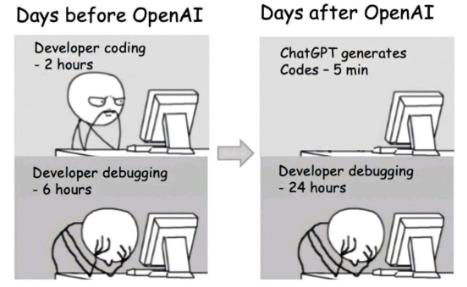
And that may be the best I can do with these AI tools at all. Most of the time, it feels like I’m only getting it 50% or 60% finished, so getting it 80% of the way to a publishable quality book may actually be optimistic. It may turn out that AI-assisted writing is a lot like the coder meme above.

So for this next week, I’m going to set the AI writing aside and focus on the “debugging” phase, which I’m calling the “human filter.” It involves retyping the story word for word into a new document, and tweaking or revising it along the way. It will be interesting to see how that goes.

More early thoughts on AI-assisted writing

It’s become something of a cliche that true writers write because they can’t not write, but as with so many other stereotypes and cliches, there’s a kernel of truth in it. I’ve been writing on and off since the 8th grade, and even during periods of my life when I wasn’t able to focus on writing, the writing itch would still come for me, and I would have to sit down and sketch out something, even if I never did anything with it.

Over the years, I’ve gotten pretty good at telling whether I’ve done enough to satisfy that creative urge that drives me to write, and whether that urge has been left unsatisfied. Yesterday, I realized that something felt off because that creative urge had not been satisfied—which is strange, because after only two weeks of working on this AI-assisted novel project, I’m already halfway done with the first draft. Indeed, yesterday I “wrote” (if that’s the right word for it) a little over 4.5k AI-assisted words.

Now, this should go without saying, but the point of writing professionally is not how good the creative process makes you feel, but how well and how quickly you produce a quality finished product. But I do think there’s a correlation between the two: that you are more likely to create a quality finished work the better your creative process satisfies your creative urges.

In the last three months of writing with AI, I’ve had some writing days that were better than almost any I’ve had in years. I’ve also had some very meh days, which is to be expected… but what isn’t so expected is this feeling of being creatively unsatisfied, which I usually don’t feel unless it’s been two or three weeks since I’ve done any writing. Something weird is going on.

How much of this feeling of creative dissatisfaction is due to the fact that I’m outsourcing a significant portion of the creative work to an AI, and how much of it is simply to be expected from trying to master a new and unfamiliar skill, which has kept me from satisfying that urge in the same way as I have in the past? At this point, it’s difficult to say. Probably a little of both.

Having worked on this for a while now, though, I think that the writers (and other creative types) who are going to succeed the most with AI-assisted creative work are the ones who figure out how to integrate the human element of their process with the AI element of their process, such that each one complements and enhances the other. Right now, everyone’s talking about how AI will replace us, but that’s really the wrong way to think about it if you want to learn how to master these tools.

I suspect that the way to master AI-assisted writing is not to try to get the AI to “do the hard stuff,” or replace some aspect of the creative process, but to integrate it within your creative process such that it enhances and magnifies your own, very human efforts. For that reason, I’m changing the way that I count my daily words so that I no longer make a distinction between words that I “write” myself, and words that the AI “writes” or generates, because the AI can’t generate words unless I give it enough to work with. Often, that means that I write a little, then generate a little, then tweak what the AI generates and write a little more. When the process is working well, it’s very difficult to say which parts were purely AI “written,” and which parts were purely human “written.”

But it’s still going to take a while to figure out exactly how to integrate AI into my writing process. As I continue to do that, I’m going to pay close attention to how it satisfies—or fails to satisfy—my creative urge to write, not because that is the end goal, but because I suspect that if my creative urge is not being satisfied, the AI-assisted stuff that I’m producing probably isn’t very good. It may not be very good even if my creative urges are satisfied, but if something about the process is missing, then something about the final product probably is missing as well.

Anyhow, those are some more of my random thoughts as I continue to experiment with AI-assisted writing. I was hoping to finish the rough/AI draft of The Riches of Xulthar before the end of the month, but I’m almost out of AI words for this billing cycle, so I’ll probably move on to the “humanizing” phase for what I’ve already written, which is where I retype the AI-generated stuff in order to pass it through what I like to call “the human filter.” Hopefully that helps to give the story a little more of my personal voice and style, and not read like something that could have been AI generated by anyone. But I’m still working out and experimenting with that part of the process, just like all the others.

Practice Writing AI-Assisted Stories

For an elective pottery class at a large university, the instructor told his students at the beginning of the semester that they could choose to be graded on the quality of their final piece, or the quantity of pieces they produced. But they had to decide right then, in the first week of the class, and couldn’t change their decision after.

About half of the students chose to be graded on the quality of their final piece. They were confident that they could produce a high quality piece if they worked on it hard enough, and could probably save some time too. The other half chose quantity over quality: they figured that was the safest course, since even if they never learned how to excel at pottery, at least they would still get an A for putting in their hours.

Those who were graded on quality focused all of their time and energy on producing their final project. Those who were graded on quantity churned out pieces as quickly as they could, without focusing too much on any one piece.

At the end of the semester, a funny thing happened: the final projects of those students who chose quality over quantity were actually inferior to the last few pieces of the students who had chosen quantity over quality. By practicing on multiple pieces and putting in the tedious hours that the other students had hoped to avoid, they had paradoxically learned how to produce higher quality work—even though that wasn’t what they had been focused on.

I’ve been experimenting a lot with AI-assisted writing recently, mostly with ChatGPT, but I just started using Sudowrite as well. Contrary to popular belief, these are difficult tools to master, with a learning curve that starts off fairly shallow but ramps up to be dauntingly steep fairly quickly. This summer, I plan to write a novel with these tools, but because I have much to learn—and literally no one to teach me, since the technology is so new that we are all pioneers—I have decided to start with short stories instead.

My goal for this week is to produce ten AI-assisted short stories, at least up to the rough draft stage. So far, I’ve produced four, which is actually more than I expected to have at this point. Yes, they’re rough—each of them will have to pass through what I call the “human filter” before they’re ready to put out into the world: the choppier the AI version, the harder the work in the human filter stage—but they are still recognizeable as stories.

But just like the kids in the pottery class who chose quantity over quality, I’m not going to try to make any of them perfect—at least, not right now. My goal right now is just to get them done. Later, I’ll do my best to perfect them.

Along the way, I’m keeping notes on things that work and things that don’t. It’s getting to be a pretty big list, and I’m sure it will get much bigger as I go. At some point, I may share it as a blog post.

I’ll also be experimenting with different story generation methods, such as:

  • Starting with ChatGPT from scratch and moving to Sudowrite for refinement,
  • Starting from scratch with Sudowrite,
  • Starting with the Mythulu cards and using those as inspiration for AI guidance,
  • Writing a “seed” of a couple hundred words or so and seeing where the AI models take it, or
  • “Seeding” both the beginning and ending, and using the AI models to fill in the middle.

I’ll probably come up with some other combinations, but those are pretty good to start with.

When the whole thing is over, and all of these stories have been passed through the “human filter” and polished enough that I feel that they’re ready to send out into the world, I’ll probably put them all together into a short story collection and release that directly, rather than releasing them individually as short story singles. I may do that later, but with how quickly I can put out these stories (and how few of the traditional markets are willing to publish them), there’s really no reason to wait.

Anyhow, that’s my thinking at the moment. But I may be getting ahead of myself, since I’ve only written four stories so far. Ask me where things are on Saturday, after I’ve written all ten.