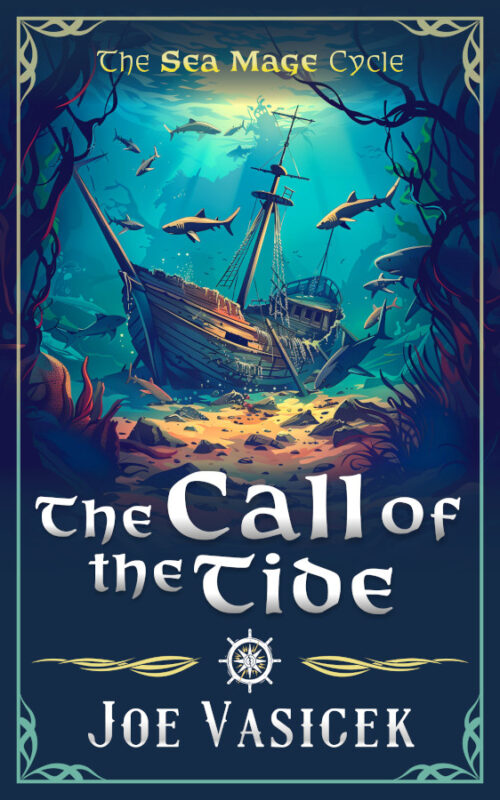
The Temptation of Power in The Call of the Tide

What would you do if the sea itself answered your command? If you could still storms, command ships, and crush your enemies with a single word—would you trust yourself to stop? The Call of the Tide is built around that question: not whether power exists, but whether the human heart can survive holding it.

At its core, this maritime epic fantasy asks a timeless question familiar to readers of artifact-driven fantasy like The Lord of the Rings: Is power something you wield—or something that slowly begins to wield you?

Where the Idea Came From

I’ve always been fascinated by stories where the very thing that makes a hero extraordinary is also what threatens to unmake him. Sea legends, pirate lore, and epic fantasy artifacts all circle the same idea: control over nature feels like freedom, but it can become domination in disguise. I wanted to write a story about a young sea mage offered the ultimate prize—command of wind and wave—and ask a simple “what if”: What if the greatest act of heroism isn’t using power well, but refusing it entirely?

How the Temptation of Power Shapes the Story

From the beginning of The Call of the Tide, power arrives not as brute force but as validation. Samuel has spent his life misunderstood and underestimated. When the Tidecaller’s Amulet offers him mastery over the ocean, it doesn’t just promise strength—it promises identity. It tells him he was meant for more. That subtle appeal is what makes the temptation dangerous.

As the story unfolds across privateer decks, naval commissions, and shadowed cult conspiracies, every major conflict circles back to the same pressure point: Will Samuel use the power available to him to secure victory quickly—or will he accept the slower, harder path of trust, loyalty, and restraint? The amulet can solve problems. It can silence enemies. It can ensure survival. But each time Samuel leans toward it, he risks becoming less himself and more a vessel for something colder and more absolute.

The true battle of the book isn’t fought only on the sea. It’s fought in moments of humiliation, captivity, and fear—when power feels like the only way to regain control. In the climax, Samuel must confront the ultimate realization that victory at any cost is not victory at all. The story becomes not just a tale of sea magic and naval adventure, but a moral test: is it better to rule through force, or to remain human?

What the Temptation of Power Says About Us

Power rarely tempts us with cruelty. It tempts us with relief. It whispers that if we just had more influence, more control, more authority, we could fix what hurts and silence what threatens us. The Call of the Tide explores that universal pull—the desire to stop feeling small, exposed, or powerless—and suggests that the line between protection and domination is thinner than we think. True strength may not lie in mastering the storm, but in mastering ourselves.

For readers who enjoy epic fantasy about moral choices, sea magic, artifact corruption arcs, and character-driven coming-of-age stories, this theme is at the heart of the journey.

Why This Theme Matters to Me

When I wrote The Call of the Tide, I was thinking a lot about what it means to grow into responsibility without losing your soul. Power, whether it’s talent, authority, or influence, always comes with a quiet test attached. I care about stories where ordinary people are offered something extraordinary—and have to decide what kind of person they will become when no one can force their hand. That question still feels real to me, and I hope it feels real to readers too.

Where to Get the Book

Related Posts and Pages

Explore the series index for The Sea Mage Cycle.

Return to the book page for The Call of the Tide.

Is The Call of the Tide for You?

If you want swashbuckling nautical fantasy with pirates/privateers, sea magic, and a dangerous magical artifact, The Call of the Tide delivers a brisk, first-person adventure full of shipboard tension, ocean-set set pieces, and clear stakes. It’s the kind of story where the wind itself can be weaponized, loyalty is tested at sea, and the next wave might bring a friend… or a cultist longboat.

What Kind of Reader Will Love The Call of the Tide?

If you love…

  • Pirate fantasy / nautical adventure with ships, reefs, storms, and high-seas chases
  • A mage-on-a-ship setup (windcasting, wards, magical concealment, ocean-diving magic)
  • Cursed artifacts and dark magic—especially a relic being hunted in pieces
  • Found-family crews and captain/crew loyalty, with a pragmatic “we survive together” vibe
  • Lightly pulpy, forward-moving fantasy that aims for fun and momentum (rather than grimdark despair)

…then The Call of the Tide is probably your kind of story.

What You’ll Find Inside

The Call of the Tide follows Samuel Cox, a sea mage who signs on with Captain Leona Black aboard the Ebony Eagle, as they chase (and try to end) the threat of the Tidecaller’s Amulet—all while enemies with dark sorcery close in across open water. Expect a tense, adventurous emotional ride—confidence and fear in the same breath, banter under pressure, and “hold fast” camaraderie—told in a first-person voice with action-forward pacing (ambushes, fog runs, magical duels, and desperate escapes).

What Makes The Call of the Tide Different

Fans of classic swashbuckling adventures (the Pirates of the Caribbean flavor of momentum, danger, and spectacle) will recognize the shipboard energy, but The Call of the Tide leans harder into “working magic” at sea—using wind and concealment as practical tools in battle, escape, and navigation. Where many pirate fantasies focus mainly on treasure hunts and rival captains, this one adds a sharper edge of artifact-driven urgency and cult-level menace, including an enemy who can hide behind authority and “respectability.”

What You Won’t Find

You won’t find grimdark nihilism here—the tone aims for adventure and forward motion, even when things get dangerous. And while there’s betrayal and violence (it’s pirates vs. dark sorcery), this isn’t written as a misery-tour; it’s written to keep you turning pages through the next escape, the next duel, the next reveal.

Why I Think You Might Love The Call of the Tide

In the author’s note, I talk candidly about writing the Sea Mage Cycle as a hands-on experiment in AI-assisted creative process, learning what works, rebuilding the workflow, and intentionally prioritizing fun—especially with a fast-moving first-person approach. If you like stories that feel made with enthusiasm—where the author is clearly chasing wonder, momentum, and the joy of adventure—then I think this one will hit the spot.

Where to Get the Book

Related Posts and Pages

Explore the series index for The Sea Mage Cycle.

Return to the book page for The Call of the Tide.

Fantasy from A to Z: J is for Jesters

Fantasy, for all its dragons and destiny, is often a very serious genre. Life and death, good and evil, wars and rumors of wars—these are just a few of the more serious subjects we often find in fantasy. But a good story needs to strike a variety of notes beside the somber ones. The darker the tale, the more important the laughter becomes.

Soldiers have known this for ages. Marines are famous for their gallows humor—twisted, irreverent, often completely inappropriate jokes that somehow manage to be hilarious precisely because of how bleak the surrounding circumstances are. In war, laughter can be a survival mechanism, a pressure valve, and a glue that bonds brothers together. If you can laugh with someone in the trenches, you’re probably going to trust them when the bullets start flying.

Fantasy, like war, often deals with high stakes and harsh realities. Armies march. Cities burn. Heroes fall. The world trembles on the edge of the abyss. But if the characters never laugh—if they can’t crack a smile even once—then something essential has been lost. Without humor, darkness becomes unbearable. With it, we can find the strength to endure.

Terry Pratchett understood this. His Discworld novels are farcical, yes, but they are also deeply wise. He made fun of everything—kings, wizards, police, journalists, Death himself—but always with a nod to the things that make us human. As a result, his stories are full of heart, even when they deal with some surprisingly dark and existential subjects—such as Death himself.

In fantasy, humor can take many forms. Sometimes it’s wordplay or irony. Sometimes it’s a running gag or a sarcastic sidekick. Sometimes, it’s directed primarily at the reader, such as William Goldman’s masterful narration of The Princess Bride. Other times, it flows from the characters in their interactions with each other. With Terry Pratchett, it often was both.

It can be done poorly, of course. In fact, humor is often one of the hardest things to pull off well. Few people take their craft more seriously than comedians (which itself is kind of hilarious, if you stop to think about it). To further complicate matters, the humorous elements in a good fantasy novel are often subtle and invisible, burning off just enough tension to let the story breathe. Anything more than that is liable to pull the reader out of the story, by drawing too much attention to the joke.

It can be a difficult thing to balance. But when it’s done well, it can make for a very entertaining tale. And when balanced with all the other elements of a good story, humor can make the emotional highs higher and the emotional lows lower. Which makes it a very powerful thing.

I don’t know how good I am at writing humor, but I try to sprinkle in enough of it to make my stories entertaining. My humor is often situational: for example, in The Call of the Tide, Samuel is a mage who can only exercise magic by never cutting his hair. That led to some mildly hilarious situations, such as birds trying to nest on his head at the most awkward of times. I also try to let it flow from the characters themselves. In Bloodfire Legacy, Corin often speaks with a sarcastic edge that flows from his experience growing up on the streets. This makes him a good foil for the somber ghost of Lord Arion, who was murdered in the first chapter of the book and now haunts him.

There’s a time to take things seriously, but there’s also a time to laugh and lighten up. And ultimately, if a story doesn’t entertain you, it’s not going to do much else. The best fantasy books have an element of humor, even if it’s subtle. After all, laughter is one of the most essential things that makes us human.

Five things I did at work last week

  • I generated a 153k word rough AI draft of a fantasy novel.
  • I ran a free promotion for my title The Call of the Tide.
  • I wrote and scheduled two email newsletters.
  • I finished updating my paperbacks. They are all now available on my online store.
  • I decided which book I plan to write and submit for the Ark Press America 2076 contest.








