Quick update and Star Wanderers cover previews

First off, I’m happy to say that Stars of Blood and Glory is coming along quite nicely.  I’m currently finishing up with the last couple of chapters, and should have the first draft done by the middle of next week.  Hopefully by then I’ll know if and when I’m starting my TEFL job overseas, but I’m sure I’ll have it finished before then.

This first draft is pretty rough, so I’m sure it’ll be a while before it’s up and ready for you to read.  For some reason, this draft is extremely short–I doubt it’ll be much longer than 80,000 words.  I don’t know if that means my writing has gotten tighter since Bringing Stella Home, or if I’ve unintentionally left too much out.  I’ll probably let it simmer for a few months, do a quick revision, and send it out to some first readers, just like I’ve done for Heart of the Nebula.

In the meantime, I’m getting really excited to pick up work again on Star Wanderers. I’ve been workshopping part II in Kindal’s writing group, just to get some reactions.  I’ll probably revise that part while I’m writing parts III and IV, getting it ready for publication after I hear back from Writers of the Future according to the serial model I outlined previously.

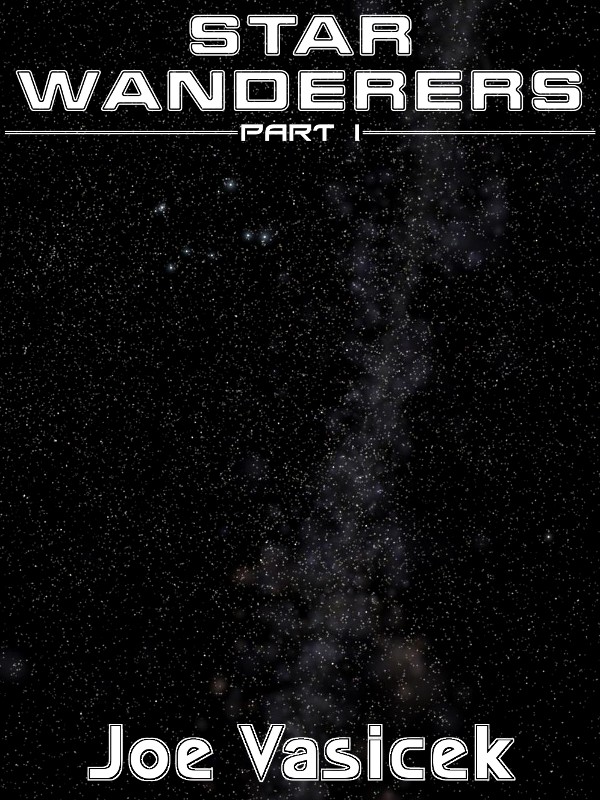
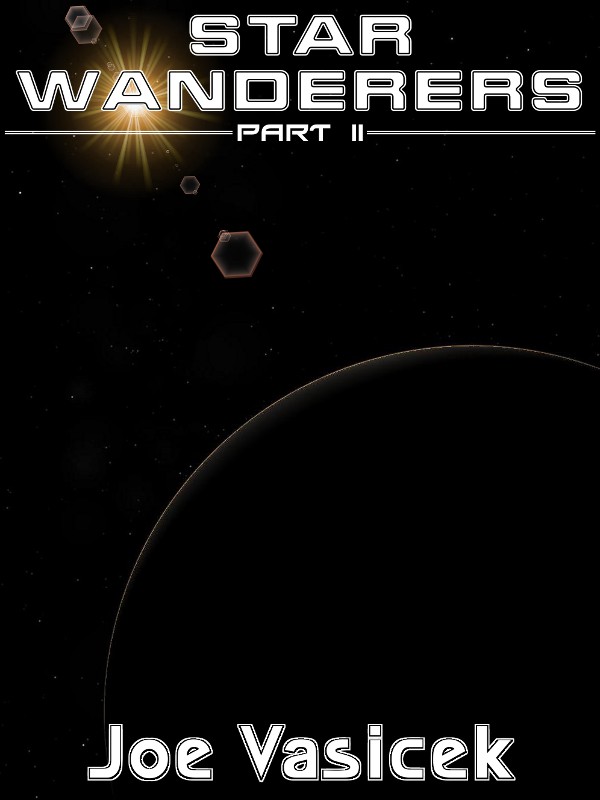
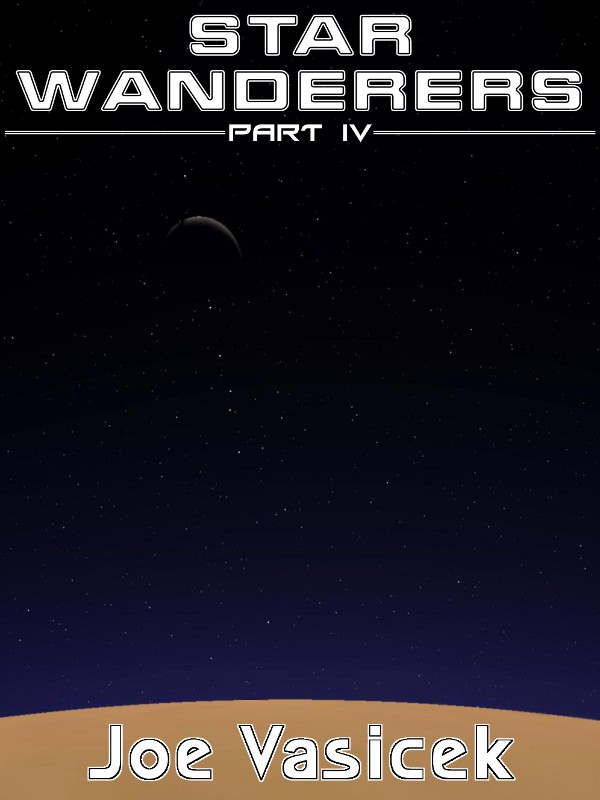
I’m so excited, in fact, that I went ahead and made some mock-ups for the cover art!

Pretty cool, huh?  These make me sooo happy. 🙂

I’m not quite sure if this is the right design, though.  Star Wanderers is very much a science fiction romance, and while these covers definitely scream “science fiction!” they don’t really seem to say “romance!”

My original idea was to use these as backgrounds and commission an artist to do some character portraits from the waist up, using one portrait each for the foreground.  But then again, that might make the covers a bit too complicated.  I can always redo the first one to get rid of the planet, keeping the galaxy–the other ones probably wouldn’t be so bad with a character in the middle.  But then again…

I don’t know.  What do you guys think?  If you saw one of these covers while browsing for ebooks, what kind of impression would it give you, and would you be interested in checking it out?

(By the way, I made the covers with Celestia.  Coolest.  Space simulation.  Ever.)

EDIT: I decided to redo the first cover; the planet wasn’t quite doing it for me.  I’m not sure if that means I should redo the cover for the third part, since that one is a heck of a lot more colorful than the others…hmm.  We’ll have to see.

What I’ve been up to recently

I thought it would be a good idea to do a quick post explaining what I’ve been up to the past month or so, since a lot of things have changed and I’m sure they will be changing a lot more in the future.  So, here’s what’s up:

As you may or may not know, I decided about four or five months ago to leave the USA to teach English abroad.  For the past few little while, I’ve been applying for a program to teach English to elementary school kids in Georgia.  I had the interview over Skype just yesterday, and I think it went pretty well!  I should hear back in the next couple of days, so fingers crossed on that.

If they decide to hire me, I’ll leave in three weeks and stay until at least mid-June.  At that point, I’ll either sign up for another semester or go somewhere else, either the Middle East or Eastern Europe. The pay isn’t great, but it seems like a good cultural experience, and I’m a lot more interested in the Caucasus than I am in East Asia (no offense to Asians).

Ever since I graduated in 2010, I’ve been looking for a fulfilling career that I can balance with my writing aspirations.  I learned pretty quick that that simply doesn’t exist in Washington DC; either you sacrifice everything for your career, including your family, or you end up trapped in an office pushing papers all day.  In Utah, I bounced around a lot of temporary jobs while struggling to make ends meet, but I never found anything more permanent that seemed to strike a balance.

I hope that teaching English will help me to find that balance, and from what I’ve heard from some of my former expat friends, I’m optimistic that it will.  Perhaps more importantly, it will probably enrich my writing by exposing me to new peoples and cultures.  Desert Stars was certainly enriched by the time I spent in Jordan; without having lived in that culture, I don’t think I would have been able to write it.  Besides, English is something I’m good at, and so is teaching–so why not capitalize on the skills I already have?  It certainly sounds better than wasting my 20s in a warehouse.

So that’s the plan: launch a TEFL career and spend at least the next three to five years abroad.  At least.  I might not get married until my 30s–or who knows, I might find someone out there and go native–but this is something I want to do as a career, not just as temporary filler before I figure out what I want to do with my life.  I’m through with filler.  Whether it takes one year or ten for my writing career to take off, I’m going to get out and do something useful and worthwhile.

That’s the plan, anyway.  And of course, I’ll always keep writing.

Right now, I’m finishing up Stars of Blood and Glory; I’m on chapter 15, with only three more and an epilogue after that, so I should finish that well before I leave.  After that, the next big project is Star Wanderers, which is already about halfway finished.  I’ll probably take some time off and work on polishing part II, then release parts I and II sometime in the spring–unless by some weird fluke it wins Writers of the Future.  I’ll know in February.

And after that?  Well, I’m thinking it’s almost time to pick up Edenfall again, but I can’t say for sure. Probably, though–I definitely want to finish that one before the end of the year, and preferably get it published.  After Stars of Blood and Glory, I’ll probably take a break from the McCoy continuity in the Gaia Nova universe, though I may pick up something from Jeremiah’s timeline in Star Wanderers.  I really want to do a parallel novel from Noemi’s point of view–maybe that’s the one I’ll do in seven days, just to hit that resolution.  Everything has to be ready fist, though, and right now it isn’t.

So much is changing–I have no idea where I’ll be in the next six months, creatively or physically. But right now, I’m just enjoying a relaxing time with my parents and getting ready for the next big transition.  Life is good.

Writing log results

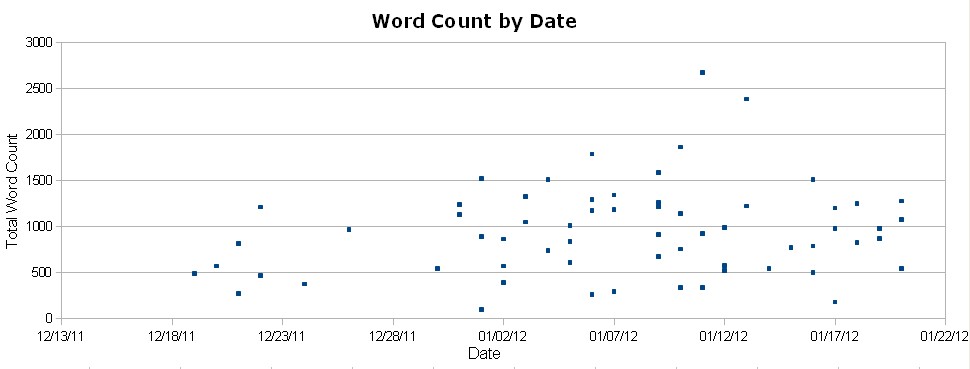
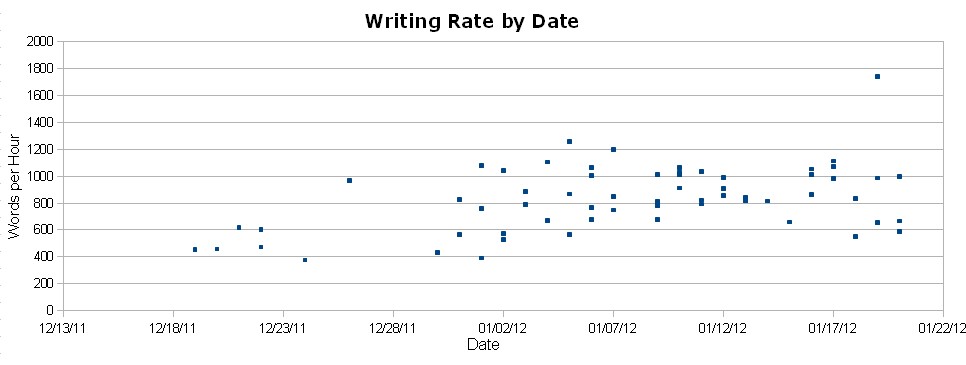
For the last month or so, I’ve been keeping track of my daily writing habits to look for patterns that might give me some insight on how to improve my creative process.  I’ve amassed somewhere around 65 data points, and I think the results are clear enough to notice some trends.

Just some preliminary background information: for most of this time, I’ve either been on vacation or at my parents’ house, waiting to start an English teaching job in another country.  I haven’t had school or a full-time job, so my schedule has been pretty open and flexible.  Also, the numbers track progress on the first drafts for Star Wanderers and Stars of Blood and Glory, and do not count revisions of any kind.

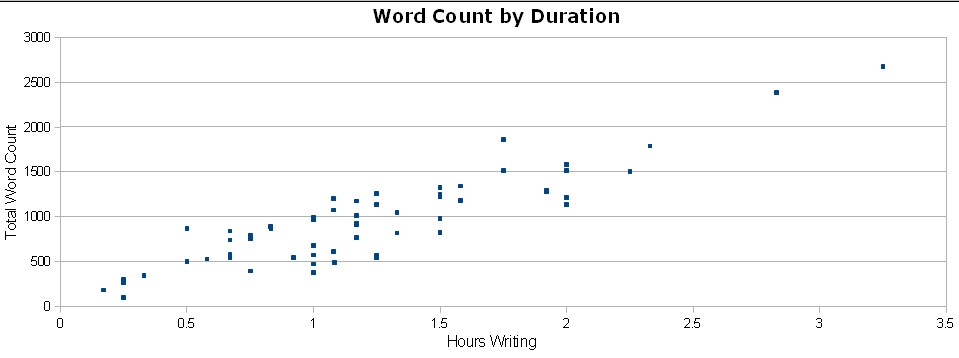
Here are the results:

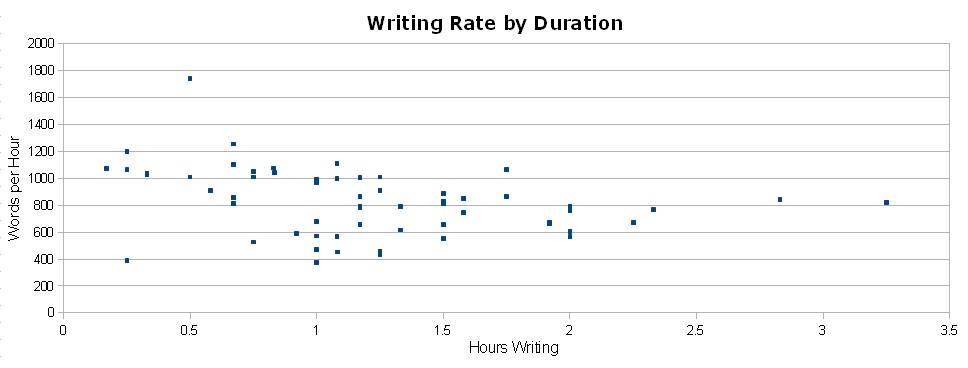
The first graph plots word count by duration spent writing.  As you can see, there’s a definite trend: the longer I write, the more I tend to write.  No surprises there.  Most writing sessions are somewhere between 45 and 90 minutes, or 500 and 1,500 words.

The second graph plots the average writing rate (in words per hour) per session by hours spent writing, and it’s a little bit murkier.  In writing sessions of less than 45 minutes, I tend to average a little over 1000 words/hour, but things get murkier between 45 and 90 minutes, and after 90 minutes, I tend to be around 600 and 800 words/hour.

The overall trend appears to be down–that is, the longer I write, the slower I tend to write–but there appears to be a counter-trend, too, where if I start off slow I can increase the pace by writing for a longer amount of time.  Is that true, or is that simply a sharper downward trend line?

I think it’s a genuine counter-trend, and here’s why:

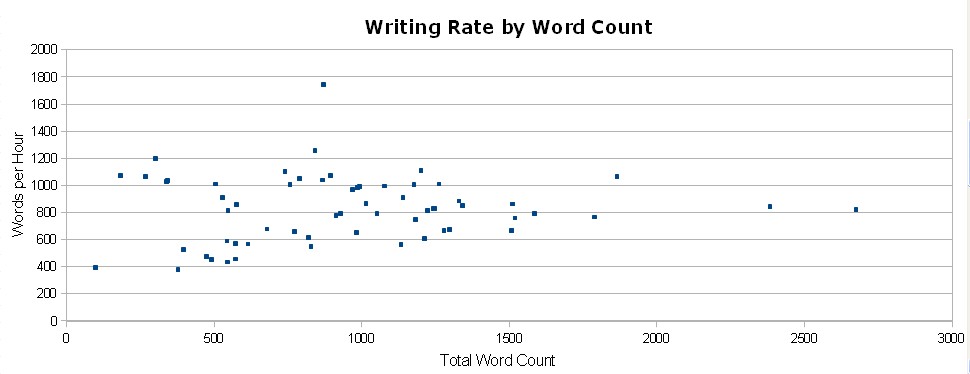
This graph shows writing rate plotted against word count, and it pretty clearly shows two trend lines: one starting at 1,000 to 1,200 words/hour and going slightly down, the other starting at 400 to 600 words and going up.  At about 1,500 total words, they converge at around 800 words/hour and appear to remain flat, though there isn’t really enough data to be able to say.

What I think this shows is that I have two different writing styles.  The first is to start off slow and gradually write my way into the story, picking up the pace but never really going over 800 words/hour.  The other is to start off at a sprint of 1,200 words/hour or so, but to slowly drop off to 800 words/hour at around 90 minutes or 1,500 words.

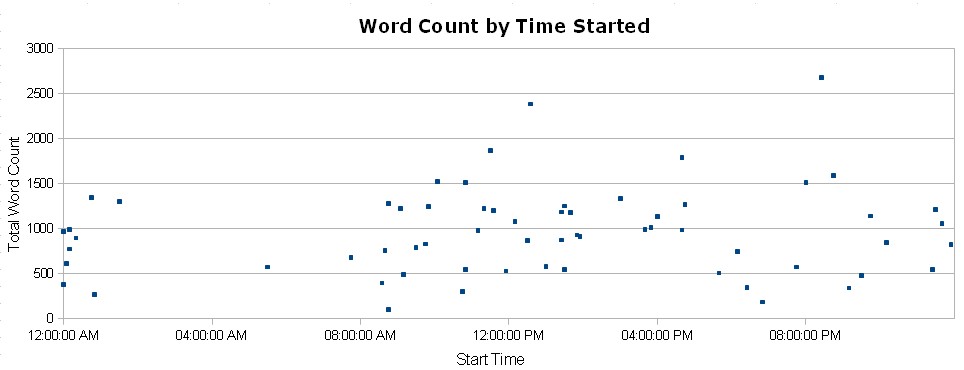
The next graph plots the total word count of each writing session by the time of day in which I started the session.  Interestingly, there is no trend; the points are all over the map.  This tells me that there is no “best time” for me to write.  Other time-related factors might influence how much I can write, but time of day itself does not.

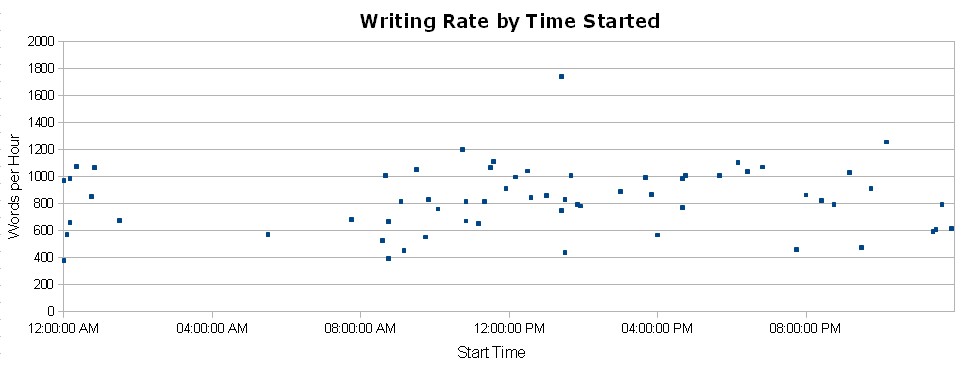
A quick glance at the next graph confirms this.  It plots writing rate by time of day, and the results are much the same as the graph for word count.  I tend to write at a more consistent pace in the afternoon–around 1,000 words/hour–but really, there is no consistent trend.

This tells me that my first session of the day tends to be slow and gradual, but that once I’ve written myself into the story, the writing comes a lot faster.  In other words, if I wake up early and hit the ground running, I tend to write more and write faster throughout the day.  If I get lazy and sleep in, the whole day tends to be shot.

The last two graphs plot word count and writing rate by date.  Before January 3rd or so, I was either spending time with family or on the road / traveling cross-country by train.  Even so, there wasn’t a whole lot of variation, though my writing rate converged around 800-1,000 words/hour for a while before fluctuating again.

What this tells me is that stability and momentum tend to lead to more consistency in my writing habits.  If I’m constantly on the road, it becomes more challenging to keep up the pace.  Even so, as long as I can find make at least 45 to 90 minutes to write, I can pound out about the same number of words per session.

So in conclusion, it seems that the best way to improve my writing habits and streamline my creative process would be to:

  1. Get up early and start the day writing.
  2. Write in short, condensed sessions of 45 to 90 minutes each, with periodic breaks in between.
  3. Don’t worry about time of day when planning time to write; just do it whenever time can be made available.

However, unless I can get to the point where I’m regularly averaging +1,000 words after two hours, it’s going to be really hard to put in 10k words or more per day.  At 800 words/hour, it takes 12.5 hours to hit 10k, and after about four or five sessions at 1,000 words/hour, the well starts to dry up.

A much more practical goal, for now at least, would be to shoot for a consistent 5k words per day.  The week before last, I hit about 5.5k on Monday, a little less than 4k on Tuesday and Wednesday, and back around 2.5k for Thursday, Friday, and Saturday.  My running 7-day total for the entire week was above 20k, which is pretty good, but if I could get to stay between 25k and 30k for some time, that would be an accomplishment.

I haven’t totally given up on hitting a 10k/day average, but at this point, it seems that I need to set some stepping stones first.  5k/day seems like a much better goal for now–especially since I don’t know how things are going to change once I’m traveling again.  But at least I have a better idea of how my own process works.  I expect I’ll be writing a lot more in the weeks and months to come!

plot vs. PLOT and an interesting serial publishing idea

Back in English 318 at BYU, Brandon Sanderson used to tell us that there was a big difference between “little-p plot” and “big-p Plot.” The first applies mostly to chapters and scenes, which he said he could teach us.  The second refers to the overall story structure, which he couldn’t teach in a classroom setting and said we’d have to discover on our own.

I’ve been thinking a lot about this recently, because it seems that my books are starting to fall into a recognizable pattern–and that pattern has some interesting potential for serials and other alternate forms of publication.  Each book is divided into 3-4 parts, each part is divided into 3-6 chapters (typically 5), and each chapter is divided into 3-5 scenes.  Here’s how it works:

Chapter 1: Setup for the basic story arc.  Introduction of the characters and setting, the prominent theme or premise, and a little foreshadowing of the coming conflict.
Chapter 2: The inciting incident, a discovery or event that starts the plot rolling and puts the characters in motion and conflict.
Chapter 3: Complications arise, the problem gets worse, the first attempt at a solution fails, generally leaving the characters at a loss.
Chapter 4: Setup for the resolution.  The characters discover or build something that will help them to settle the conflict.  They stop reacting and start to be more assertive.
Chapter 5: The resolution.  The characters either succeed or fail, but the arc comes to a close either way.  The story question is answered, the thematic elements come full circle, and the story either closes or moves on to the next part.

Basically, it’s the 3-act format divided into five chapters.  When I wrote Heart of the Nebula, all four parts fell into this pattern, and now that I’m writing Star Wanderers, I’m finding myself  falling into the exact same pattern again.  Stars of Blood and Glory is a little bit different; there are three parts instead of four, and each part is divided into six chapters instead of five.  But still, it’s all very structured.

In short, Brandon was right.  It took me a few books to really learn “big-p Plot,” but now that I’ve found a story structure that works for me, it’s starting to come quite naturally.

The cool thing about this particular structure is that it’s very conducive to serialization.  Each chapter is between maybe 3,000 to 5,000 words, so each complete sub-arc is between about 15,000 to 25,000.  That’s the length of a short novella, and it takes me only a month or two to write (sometimes three, depending on how much revision it needs).

The only reason I haven’t done more with serialization up to this point is because I’ve found that sharing my work while it’s still unfinished tends to throw a wrench in my creative process.  The idea of publishing a work in progress on a chapter-by-chapter basis scares me, because if one of the story arcs has a flawed beginning, I wouldn’t be able to fix it.

However, by following a five-chapter arc format (with bits and pieces here and there to hint at a larger overarching structure), I can see myself publishing a novel or epic in a serial format.  It would be something like the Perry Rhodan series, which follows an arc structure of 25 to 100 issues (each a small novella) per cycle.

So here’s how I’m thinking of doing it:

  1. Publish the first installment and price it at free while writing the second one.
  2. Publish the second installment and price it at free, raise the price of the first installment to $.99 and write the third one.
  3. Publish the third installment and price it at free, raise the price of the second installment to $.99 and write the fourth one.
  4. Publish the fourth installment for $.99, drop the price of the first installment to free and publish the completed novel for $2.99.

So what do you think?  Does it seem like a good way to publish a book?  It gives the reader a reason to keep coming back, and rewards those who got in early by charging them less for the completed work.  By selling the novel in shorter chunks, I would be able to put more work out and hopefully gain more visibility, especially by making a portion of it free at any given time.

I’m seriously thinking about publishing Star Wanderers this way, once I hear back from Writers of the Future.  I’ve already finished the rough draft for the second part; it probably needs a good revision or two before it’s ready, but since it’s shorter, it shouldn’t take more than a few weeks to get feedback from some first readers and finish the next draft.  And if the third part is already finished by then…

So many awesome possibilities! 🙂 What do you think?

What French Women Know About Love, Sex, and Other Matters of the Heart and Mind by Debra Olliver

I have a confession to make: when I was at my sister Kate’s for Christmas, I saw this book on her shelf and stole borrowed it without permission.  I finished it just yesterday, and at the risk of embarrassing myself, I’m going to review it as my second book of this year.

This book presents a fascinating perspective on French lifestyle, attitudes, and culture.  Even though it’s geared more for women than for men, I enjoyed it in the same way I enjoyed Twilight–as an interesting anthropological experience.

It goes beyond that, though.  The picture Ollivier paints of French culture is fascinating in and of itself, if nothing else for the contrasts she points out between us (Americans) and them.  According to Ollivier, the key difference is that the French have a deep understanding of “the brevity of time and the immediacy of pleasure.” Ollivier follows this philosophy out to its logical conclusions to show that everything in French culture is an outgrowth of this–and it makes sense.

For a non-fiction book, the writing itself is quite entertaining, with constant pop culture references and a playful, humorous style.  It was a delight to read, and fairly easy as well.

However, I did get the feeling that it was a little too enthusiastic and non-critical to present a comprehensive or truly accurate picture of French culture.  Between the lines, Ollivier seems to be saying that if we Anglos would just be a little bit more like our “French sisters,” most of our problems (like our obsession with marriage, our frustrations with perfection, and our general lack of passion) would be solved.

I take issue with this: as much as we have to learn from the French, their culture has a lot of issues as well.  For example, I personally believe that Laïcité is fundamentally incompatible with a multicultural society, and leads to de facto state repression of legitimate religious expression in the public sphere (such as the wearing of the headscarf).

Also, whenever Ollivier described American culture, I always felt as if she was describing something completely alien to my own experience.  There might be a good reason for this, considering how for the past six years I’ve lived in Utah Valley, a bastion of Mormon culture so unlike the rest of the American mainstream.  However, it might also be that Ollivier exaggerates the worst excesses of this continent in order to more sharply contrast the subject matter of her book.

As a writer, though, I found this book inspiring–particularly as a writer of science fiction.  In my novels, I’m constantly inventing new cultures to populate the many worlds in my science fictional multiverse.  This book, with its clear and entertaining analysis of some very real-world cultural differences, gave me an excellent world-building prototype and a whole plethora (oh how I hate that word) bunch of new ideas for ways to enrich my stories.  In fact, this book gave me just what I needed to get through the block that had kept me from writing Star Wanderers, so if nothing else, there’s that.

So yeah, if you’re interested in world cultures or world-building cultures of your own, it’s worth your time to check out this book.  It’s perhaps not the most thorough or comprehensive book, but it is entertaining, and fairly insightful as well.  I mean, hey, if a science fiction geek like me enjoyed it, it’s got to be doing something right.

Torn between projects and some new thoughts on the creative process

So I have a confession to make: a couple of days ago, when I was in something of a rough spot with my current novel, Stars of Blood and Glory, I had this overwhelming urge to go back and revisit Star Wanderers.  In two days, I went through everything I’d written up to the point where I’d gotten stuck, and something just clicked.  All of a sudden, I knew exactly where to take the story.

So today, I sat down and wrote the next scene…and man, it was hot!  The words were flying, the characters were leaping off the page (and almost into the sack with each other–almost, but not quite)–it was awesome!  The flame for this project has definitely been rekindled, and I’m really enthusiastic to get it rolling again.

Trouble is, I’m already working on Stars of Blood and Glory–and making some good progress on that one as well.  In fact, I’m still quite excited about it.  I’ve got all the twists planned out, the characters are really coming alive, and while the manuscript is still pretty rough, none of the problems are too serious to stop the creative process.

But sometimes…well, sometimes I feel like I’ve been writing so fast on this one, that the story hasn’t had time to really percolate.  I’ll have the next few scenes planned out, but I just won’t want to write them–not because I’m lazy, I don’t think, but because it hasn’t really clicked yet in my mind.

This is something I’m slowly coming to grips with.  The creative writing process isn’t something you  can completely capture with metrics (like daily/weekly word counts, hours worked, writing rates etc). There’s a whole lot of mental-space work that, on the outside, looks a whole lot like procrastination or laziness–and can easily degenerate into that, if you aren’t careful.  However, these mental activities are absolutely crucial, because they serve to refill the creative well.  Without them, writing becomes painfully difficult, and the quality of the stuff you do manage to put out tends to suffer.

That’s what I’m starting to notice, in any case.  I’ve found it somewhat helpful to go on a long walk each day, like maybe for an hour or more, but I wonder if it might also be helpful to have multiple projects to fall back on, so that even if I’ve got to refill the well for one of my projects, I can still be actively creating.

Because it’s more complicated than just outlining the next chapters.  The best scenes to write are the ones that go off in their own direction, without any planning (or perhaps minimal planning) on my part.  Discovery writing is definitely a part of my process.  To make that happen, however, I have to get a real feel for what’s happened up to that point, and think through all the implications of their possible choices.  If I do it right, something I haven’t considered comes to mind, and it helps the scene to come to life enough for me to write through it.

So yeah.  For Star Wanderers, the ideas have been percolating since a conversation I had with my brother in law and former roommate over Christmas break.  For Stars of Blood and Glory, I feel almost as if I’m going too fast to percolate–or that at least I need to take a little time off here or there.  And the real trouble is that I’m probably going to be going overseas in a couple of weeks–which means that all the free time I enjoy right now is probably going to become extremely scarce in the near future.

So I’m going to do my best to finish Stars of Blood and Glory before the end of the month, but if I’m not getting enough prewriting in to do the story justice, I’m not going to push it.  And when I’m not working on that one, I’ll work on Star Wanderers, since I’m really in love with this project (seriously, very much in love) and it’s not in my heart to put it off any longer.  I just hope that it doesn’t get in the way…

Anyhow, if I’m going to pound out another 4k to 5k tomorrow, I’d better get to bed.  I’ll leave you with this:

Man, I need to get this girl to do the soundtrack for my life. Either that, or my next book, which pretty much amounts to the same thing. 😛

G’night!

Climbing the 10k mountain

Many Bothans died to bring you this.

I recently read an amazing blog post by Rachel Aaron, in which she explains how she went from writing about 2k words per day (about what I’m doing) to routinely breaking 10k.

This is something I really want to do with my own writing.  As I noted a couple of weeks ago, I need to pick up the pace if I’m going to keep up with my professional goals.  If I could go from 2k to 10k, and make 10k the standard…holy cow, that’s a 500% jump in productivity.  Who wouldn’t want that?

From Rachel’s blog:

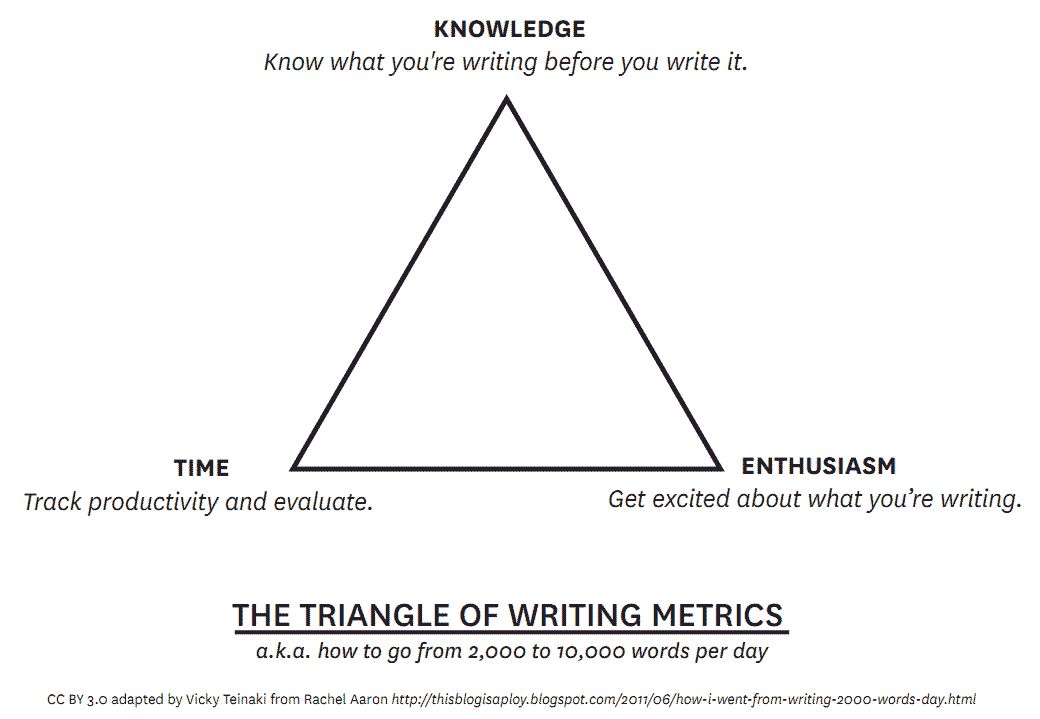
Drastically increasing your words per day is actually pretty easy, all it takes is a shift in perspective and the ability to be honest with yourself (which is the hardest part). Because I’m a giant nerd, I ended up creating a metric, a triangle with three core requirements: Knowledge, Time, and Enthusiasm. Any one of these can noticeably boost your daily output, but all three together can turn you into a word machine. I never start writing these days unless I can hit all three.

The point that I probably need to work on the most is time: I tend to start off the day slow, checking Facebook and blogs and other stuff before getting into the writing, then write for a little while before running off and doing some chore or allowing myself to get distracted again.  Sometimes, I don’t really buckle down until a couple of hours before I should go to bed, and that’s bad.

But really, I think the main obstacle is just thinking that writing is difficult.  If everything comes together in the right way, there really isn’t any reason why 5k or 6k or even 10k should be too difficult–and yet we naturally think that if 2k is hard, anything more should be that much harder.

I’m in a weird state of limbo right now between moving and preparing to go overseas, but I’m going to start a daily writing log so that I can figure out what time of day is most productive.  You can’t wait for life to settle down before you get to work; you have to roll with what you’re given.  Also, I’m going to put a lot more effort into outlining and planning, so that I don’t get hung up by research when I should be writing.  Even discovery writers need a little bit of time to ponder things before putting words to the page.

Also, after considerable thought and effort, I’ve decided to put Star Wanderers on the back burner again.  I finished the novelette last week and submitted it to Writers of the Future; I think it’s quite good, and stands a good chance of finding a home in one of the short markets.  But the full length novel, for various reasons, just isn’t coming to me.  I don’t know if it’s because I lack the life experience to write it, or because I’m too close to it to see what’s broken, but regardless of the reason, I need the break.

I’m not sure whether to do Edenfall or Stars of Blood and Glory next, but I’m leaning towards Stars of Blood and Glory.  This is a novel set in the Gaia Nova universe, with characters from Desert Stars, Bringing Stella Home, and Heart of the Nebula.  I’ve been itching to write it since this summer, but never got around to it because other projects got in the way.  Well, hopefully now that will change.

I know from emails and other correspondence that some of you are really looking forward to Edenfall, but don’t worry, I’ll get around to it soon.  In order to do it justice, I feel I need to reread Genesis Earth and immerse myself in some Carl Sagan, but right now I’m still running on a sci fi adventure trip.  If I can implement some of these metrics and push my daily word count upwards of 10k, it shouldn’t be long before Edenfall gets my attention again.  My goal is to finish it before the end of the year, so there’s a very good chance it’ll be published sometime in late 2012.

As for Star Wanderers, I’ll shop the novelette around after I hear back from Writers of the Future.  I think it has a good chance at winning the quarter, but of course I can’t count on it.  At this point in my career, I should probably be playing both the traditional markets as well as the indie field.

That’s just about it.  Now, if you’ll excuse me, I need to write…

Am I swamped, or am I lazy?

This post might get a little emo, so I apologize in advance.

I feel like I have so much on my plate right now, and yet when I look back at what I’ve accomplished each day, I wonder if I couldn’t have been more productive.  I’m moving out of my apartment on the 21st, so that’s the deadline for pretty much everything, and here’s what I’ve got to do before then:

  • Run through the copy edits for Desert Stars and rewrite the epilogue.
  • Get the cover art and publish Desert Stars.
  • Write the epilogue for Journey to Jordan and publish it.
  • Finish Star Wanderers and submit to Writers of the Future.
  • Do a guest post for Slava Heretz.
  • Finish the application for the TLG program.
  • Get rid of all my remaining books.
  • Figure out electronic W2 and other forms for taxes (before leaving in January).
  • Write up the “About My Books” page on blog.
  • Do a couple of recap posts on the travel blog.
  • Pack and ship my desktop computer.
  • Pack all my remaining stuff.
  • Get post office to forward all mail to home address.
  • Clean apartment for move-out inspection.
  • Find suitable traveler’s insurance.
  • Go clothes shopping.
  • Half a dozen other things that I’m sure I’ve forgotten.

In other words, this is not the time to be playing minecraft.

And yet, taken individually, most of these tasks are not all that difficult.  A lot of them are just mindless chores associated with moving, and the other ones, while requiring hard work, are pretty straightforward.  So am I really swamped, or am I just disorganized and lazy?

This is something I’ve struggled with since graduating last year.  When I was in school, I was constantly busy, but I was also constantly producing.  Even though my writing suffered a bit when I was swamped, I still found time to write three novels (Ashes of the Starry Sea, Genesis Earth, and Bringing Stella Home) and hold down a student job.  For the last year, I haven’t had any school and most of the time I haven’t had a job, and yet my productivity doesn’t seem to have improved.

Part of it has to do with structuring time and organizing myself.  In the past year, I’ve learned that a routine isn’t something you should hang onto doggedly, but something you need to constantly reinvent.  And yet, when I’m staying up until 2am-3am and not getting up until 8am-9am, I can’t help but feel that something’s off.  The whole moving limbo thing certainly doesn’t help, but hey, the work’s still got to be done.

Maybe it’s just deer in the headlights syndrome.  I’ll try making a checklist of everything I want to accomplish in the next two weeks and go for it.  In the meantime, I’m going to get out of this apartment and take a walk, because if I don’t, I’m going to go insane.

Also, as a token of gratitude for putting up with my babbling, here’s something cool I made the other day:

See you around!

Managing excitement and an idea for an epic fantasy novel

After getting about 40% through Star Wanderers 1.0, I hit a wall and decided to put the project on the back burner for now.  The beginning part, which I’m hoping to shop around as a novelette, has some issues with it and those are keeping me from making any real progress in the rest of the story.

I wish I could just wave my hand and pretend as if I’ve already fixed those problems, but my creative process just doesn’t work like that.  I guess I’m more of a discovery writer in that way, because I can only build on stuff that I’ve already written.  I have to figure out my characters as I write, otherwise they just fall flat.

It’s discouraging, because I feel like I don’t have enough control or discipline over my creative process.  Other writers seem to be able to pick up a project and finish it, even when that project is commissioned by someone else (editors, franchise owners, etc).  But with me, if I can’t get excited about a project, I can’t finish it.

Fortunately, even if I can’t always control which project I’m excited about, I always seem to be excited about something.  After finishing the last revision for Desert Stars, I felt this unusually strong urge to work on Into the Nebulous Deep (which, after the last post, I’ve tentatively decided to rename Heart of the Nebula).  I totally didn’t see that coming, but I’m glad that it did, because that project is getting due for its first major revision.  It’ll probably be a quick one, just to fix some major known issues before sending it off to first readers.

As for new projects, I’m not quite sure what to pick up next.  I’ve got a feeling I could give Edenfall another shot, though it’s dubious at this point, and I still have a bit of lingering excitement over the untitled Gaia Nova novel that involves Roman, Danica, Rina, and Stella’s son.

At the same time, though, I have a really cool idea for a fantasy novel involving magic swords.  The idea is that the swords are actual characters, with the ability to think, feel, remember, and communicate with those who wield them.  They can only be wielded by those whose minds have been melded to them, however, kind of like the Dragonriders of Pern.

As the swords get passed down from generation to generation, they pass on their skills and memories, so that those who wield them become legendary warriors.  However, all but one of the swords goes insane, turning their wielders to evil.  The one sword that remains has refused to take on a new master, even though war and destruction sweeps the land.  A prophecy states that the one who wields this sword will eventually defeat the evil of the others, but when the good sword finally does take on a new owner, it ends up being a farmgirl / tavern wench (I haven’t really decided).

I don’t have a lot of experience writing fantasy, but this story is starting to really excite me.  If I can combine it with a few other ideas and read some good fantasy novels to get into that mood, I think I can make some good progress on it.

So yeah–I have plenty of projects to work on, so things aren’t that bad.  I just need to find one that I can really get into for the next couple of months; if I keep bouncing around from project to project without finishing any of them, that’ll be bad.

Decisions suck, writing is awesome

Whew!  I just finished revising through almost 9k words in Desert Stars.  I’ve only got three more chapters and an epilogue to go, and man, I am so excited about this story!  I have no doubt it’s my best work yet.

Of course, I might be biased. 😉

Star Wanderers is also coming along very well.  I’ve only got a few more scenes to write/revise before it’s ready to send off to the next round of first readers.  Part of me wants to send it off to Writers of the Future right now (and according to Dean’s sage advice, that’s probably what I should do), but I want to get some feedback first just to make sure there isn’t something I’ve missed that would make it better.  If all goes well, I’ll probably send it off by the end of the month.

This is the best part of writing process: finishing up a project that you know is good.  This is one reason why I love rewriting so much.  If I could do this all day, every day, and get paid enough for my work to make ends meet, I’d be living the dream.

Until then, however, I’ve got to figure out another way to make ends meet.  One option I’m considering very seriously is selling my contract and driving across the country this Thanksgiving to spend a month or two with my parents before going overseas.  My mom was the one who suggested it, and I have to admit it makes a lot of sense; if I’m going to go abroad to teach English anyways, why not spend some time back home?

If this is something I need to do, I’m going to have to make the decision very soon, possibly before the end of next week–and if you know me, you know that I’m terrible at making decisions.  However, I have been thinking about it enough to make a couple of lists, and this is what I’ve come up with so far:

Reasons to go to abroad:

  • To start a new career.
  • To have adventures.
  • To experience another culture.
  • To gain TEFL experience.
  • To support myself as I write.
  • To have a change.
  • To see the world.
  • To have something to write about.

Reasons to stay in Utah:

  • To get married.
  • To focus on writing.
  • To pursue a graduate degree.
  • To stay in a predominantly Mormon community.

I decided to list only the positive reasons for making either decision, and not to consider any of the creeping doubts or fears (and there are many!).  So let’s break it down:

To start a new career: This seems prudent, especially if it takes a while for my books to really take off.  Specifically, a TEFL career seems like something I could juggle with my writing career, and it would certainly offer a lot more satisfaction than a grunt day job.

To have adventures: Perhaps not the most responsible reason, but hey, you’ve got to remember to have fun.

To experience another culture: One of the perks of traveling, for sure.  It would probably improve my writing considerably as well, though culture shock and distance from family would certainly pose a challenge.

To gain TEFL experience: In other words, to find out if teaching English as a foreign language is something I want to build a career around, or whether I’m just not suited for it.  This is why I’d want to do the TLG program first, before heading off somewhere like Cairo or Amman.  And if it doesn’t work out…well, at least I’d know.  Right now, I don’t.

To support myself as I write: This is huge.  I hear that most TEFL jobs only take up about 20 hours per week, and that if you’re living in a local apartment, it’s not hard to make time to write.  In the past two years, I haven’t had any success balancing writing with full-time work, and working part time probably wouldn’t earn me enough to support myself here in the states.

To have a change: Not quite as tangible a reason, but important nonetheless.  I can’t quite explain it, but if I stay where I am now, in my current life situation…it’s just not going to work out.

To see the world: I could probably lump this under “to have adventures.”

To have something to write about: Also huge.  My experiences in Jordan and the Middle East were a huge inspiration for Desert Stars, and if I’d never gone over there, the novel wouldn’t be nearly as rich.  Who knows what else my imagination would produce if I spent some time traveling the world?

Now, for the other side:

To get married: Honestly, this is more of a negative reason than a positive reason.  I’ve already decided that I’m only going to marry someone who’s a practicing Mormon, and since Utah is predominantly Mormon, I’m worried that if I leave Utah, I won’t be able to find someone.

Trouble is…I’ve been here for almost six years, and still haven’t found anyone.  I could probably put more effort into dating, but the truth is probably that finding a marriage partner is more about your mindset than where you physically live.

Besides, I could always spend a year or two abroad and come back.  I’d be pushing thirty and well beyond “menace to society” status, but at least I wouldn’t be a loser who spent all his twenties in Utah.

To focus on writing: This was why I decided last year not to go teach English in Korea.  The ebook revolution was just getting started, and I felt that I needed to stay in the states to learn how the market was changing and focus on building my indie writing career.

Now, however, I feel like I’m high enough on the learning curve that I can afford to work on other things.  Besides, with the current state of the economy, I don’t think I’m going to find balance if I stay in the states.

To pursue a graduate degree: I’ve largely ruled this one out.  I don’t see how an English degree would help me at this point, and I don’t currently have any career aspirations that would justify pursuing an advanced degree.  The only reason I’d go back to school is to postpone facing the real world, and that’s probably the worst reason I could possibly have.

To stay in a predominantly Mormon community: Kind of the opposite of “see the world” and “experience another culture,” and it gets at the very heart of the matter.  Would it be better to establish myself among people who are more like me and share my values, or should I venture out of the “bubble” and see what else is out there?  I have a much stronger support group here in Utah than I’d probably have as a global nomad, but do I really need it?  Am I independent enough to strike out and bloom wherever I’m planted?

I don’t know.  My thinking is so muddled with doubts and second thoughts that this whole exercise has probably been futile.  If I had to make a decision RIGHT THIS SECOND, however, I’d probably choose to go.

If nothing else, it would give me a good two months of writing time. 🙂