G is for Gravity

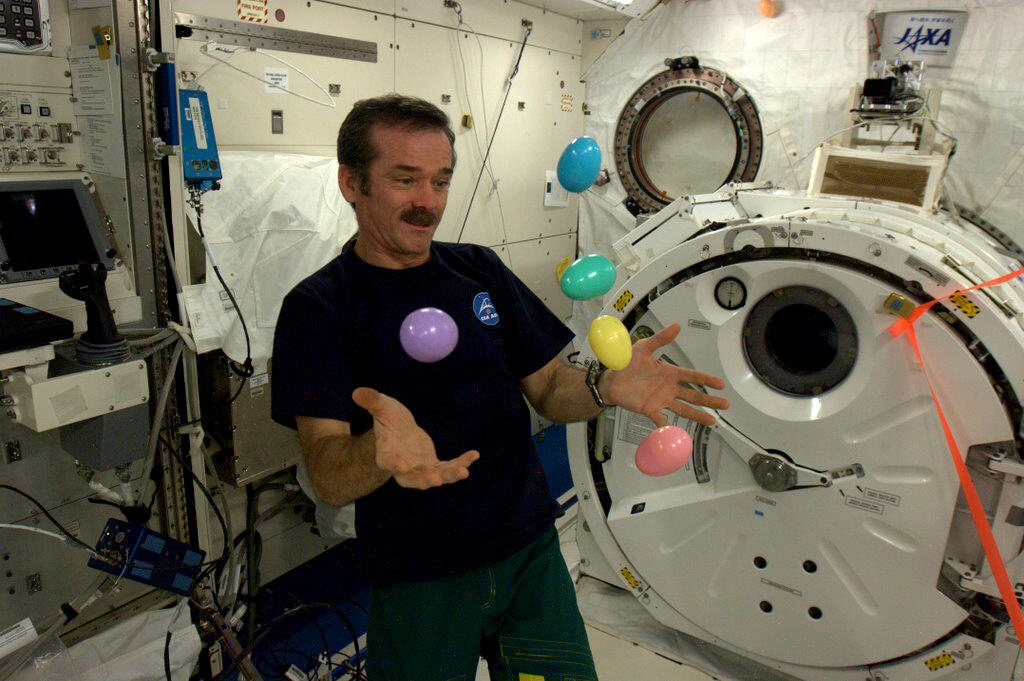
cmdr_hadfield_juggling
Commander Hadfield planning a zero-g easter egg hunt earlier this month on the ISS.

Possibly one of the most defining aspects of space is the sensation of free fall.  Of course, gravity exists in space, the same as it does everywhere else in the universe (probably), but in space we feel its effects differently because we aren’t close enough to a body of sufficient mass to feel a strong pull.  That, and our spaceship itself is also in free fall, so if that’s our frame of reference we feel no weight because there’s nothing for weight to push back on … but that’s a concept probably best left for O is for Orbit.

The thing is, as fun as weightlessness can be, in the long-term it can have some negative health effects, such as deterioration of bone and muscles, weakening of the immune system, etc.  The effects of micro gravity on human fertility are not very well-studied, but there’s some speculation that conception and gestation would be impossible, since embryos need gravity in order to implant properly.  Humans are adapted to live on the surface of Earth, and that means living with a constant 10 m/s2 or so of gravitational acceleration.

For future space colonies and spacefaring civilizations, this means we need to find a way to simulate the effects of gravity in a micro-gravity environment.  There are a few common ways to deal with this problem:

  • Artificial GravityApplied phlebotinum that creates a field within which the gravity is normal.  A necessary weasel hand wave that you’ll see most often in soft sci-fi and space opera, where the plot and characters are more important than the science.
  • Centrifugal GravityThe illusion of gravity created by spinning a can-like spaceship or space station in a circle, pressing the humans against the inside wall.  You’ll see this in both hard and soft sci-fi.  Scale it up, and you get Ringworld Planets.
  • Powerful Starship DriveIf your starship drive is powerful enough, it can accelerate you at 10 m/s2, effectively creating the sensation of gravity.  Your starship will be like a flying skyscraper, where “down” is in the direction of the engines.  At this rate of acceleration, you should reach 99.9% the speed of light in about a year, which opens up all sorts of possibilities for relativistic space travel (provided you have a sufficiently massive energy source to sustain that reaction).  Just be sure to give yourself the same amount of time to decelerate, otherwise bad things may happen.
  • Baby PlanetAn asteroid no larger than a small asteroid that still, for some reason, has normal Earth-like gravity.  Think Le Petit Prince.  Not nearly as common as the other three, but the existence of gravitational waves means that it may be possible (or at least plausible) to create gravity generators that work this way.
  • Roll with itYeah, so everything is weightless in space.  So what?  Deal.

Another problem related to gravity is rapid deceleration.  Unless you don’t mind splattering everyone in your starship all over the walls and ceilings, you can’t go from zero to near-light speeds (or vice versa) without some way to counteract the sharp change in momentum.  Space opera and soft sci-fi gets around this by using inertial dampers–basically, magical devices that give the starship a nice, soft ride (unless you want the bridge to explode, of course).  As you might expect, stories on the harder side of sci-fi tend to play around with this a lot more.

My first exposure to artificial gravity came when I read a comic book version of The Norby Chronicles by Isaac Asimov.  The characters had a device that would basically allow them to levitate, and I thought that was so cool.  It wasn’t until I read the Corellia Trilogy by Roger Allen McBride that I realized that every starship in the Star Wars universe had a machine that could manipulate gravity like this.  At one point, the artificial gravity generators on one of the ships failed.  My mind was blown, and I’ve never looked at gravity the same since.

I tend to write stories where the characters and plot are more central than the science, so I’ll often just fall back on the standard artificial gravity field like most space opera.  During combat maneuvers, though, things get a bit more tricky, with dampers on the bridge that mitigate (but don’t erase) the worst effects of rapid deceleration, and special coffin-like chambers for the crew below decks to keep them from getting splattered.  In my Star Wanderers series, I also use centrifugal gravity for the larger space stations, since I figure the energy costs of artificial gravity tend to scale up.

In short, science fiction stories that address the problem of gravity in a real and thoughtful way tend to be a lot more believable and immersive, even if the solution to the problem is basically magic.  As with anything in science fiction, there are so many imaginative ways of dealing with the problem that it’s actually more of an opportunity than anything else.
F is for Faster Than Light

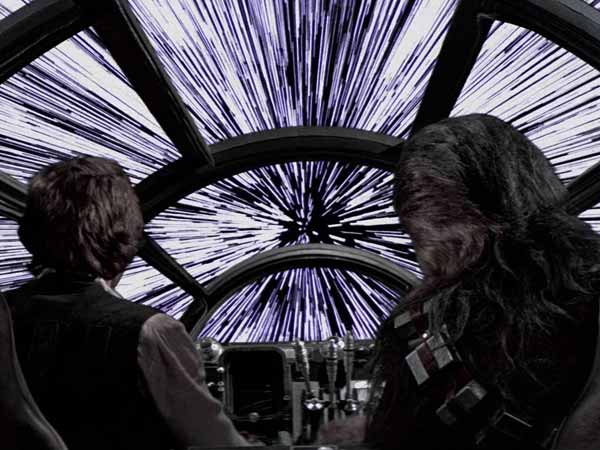
falcon_startrailsRemember that moment in Star Wars when the Millennium Falcon went into hyperspace?  When Harrison Ford shouted “go strap yourselves in, I’m going to make the jump to light speed,” and the sky lit up as the stars streaked by?  That was my first introduction to faster-than-light (FTL) travel, and I haven’t looked back since.

FTL is a major recurring trope in space opera, and not just because of how cool it is.  If you’re going to have a galactic empire, you need some way to get around that empire–or at least some way to transmit information without too much difficulty.  The distance between star systems is measured not in miles or kilometers, but light years–that is, the distance that a particle of light can travel in one year.  Considering how the nearest star to Earth, Proxima Centauri, is ~4.24 ly away, you can see the need for some sort of magical technology to bridge the distance.

FTL travel comes in four basic flavors:

  • Warp Drives — The ship breaks the speed of light as easily as our modern fighter jets break the speed of sound.  Impossible to justify, except through hand-waving.  The most prominent example of this is Star Trek.
  • Jump Drives — The ship disappears from its current position and reappears somewhere else.  Also requires hand-waving, but is at least a little easier to justify.  Battlestar Galactica is a good example of this, as is Schlock Mercenary.
  • Hyperspace Drives — The ship enters an alternate dimension which allows it to travel faster through our own.  The alternate dimension is called ____space, usually “hyper” but also “quasi,” “x,” etc.  Star Wars is the classic example, though Star Control II took things a step further by having a hyperspace dimension within hyperspace.
  • Wormgate Network — The ship (or maybe just the passengers) enters a portal which transports it to a portal somewhere else.  A network of these portals allows travel throughout the galaxy.  Stargate and Babylon 5 use this method.

An alternate way to do it is to make FTL travel impossible, but hold the galactic empire together through FTL communication.  This technology, known as the ansible, features prominently in Ursula K. Le Guin’s books and the Ender’s Game universe.  It has some really interesting implications: for example, even though planets can communicate instantaneously with each other, it takes almost 40 or 50 years to go from one to another, but at near-light speeds, it feels as if only a few months have gone by.  Thus, if you’re going to travel to another world, you have to leave everything behind, including your family and loved ones.  By traveling from world to world, you can skip entire generations, spreading your natural lifespan across thousands of years of normal time.

In writing FTL, one thing you have to be really careful about is to keep in mind ways in which the system can be abused.  For example, if jump drive technology makes it possible to instantaneously transport anything anywhere in the universe, then you can bet that someone is going to send a bomb into the White House (or whatever the equivalent is in your fictional universe).  Thus, the invention of unrestricted jump drive technology will lead to a very short and brutal war.

This actually happened in Schlock Mercenary, and the solution was Terraport Area Denial (TAD) zones, or broad areas of space where a force field prevents anyone from either jumping in or out.  Thus, anyone who wants to visit a planet in a TAD zone has to jump to the edge of the field and travel the rest of the way at sublight speeds.

FTL isn’t always appropriate for a science fiction story.  If the story is supposed to lean more toward hard sf, then it’s probably better to stick with our current understanding of the rules of physics, which state that nothing can travel faster than the speed of light.  Still, with things like quantum entanglement and other recent discoveries, if you know the science well enough, even the speed of light might not be an upper limit.  But for the rest of us mortals, FTL is basically just magic–a sufficiently explained magic, perhaps, but magic nonetheless.

Personally, I’m a fan of the jump drive form of FTL.  That’s the one I use the most in my own books.  The cost is that the further distance you try to jump, the harder it is to pinpoint exactly where you’ll end up.  To overcome this, you can use jump beacons to draw out anyone trying to jump into your particular sector and have them exit jumpspace next to the beacon.  This comes in handy in combat, when the enemy tries to jump a nuke onto your ship.

In the later Gaia Nova books, FTL is facilitated by jump stations spread out in a line across space, with reactors powerful enough to jump ships rapidly to the next point along the line.  In the earlier Star Wanderers books, that technology hasn’t been invented yet, so there’s still an Outworld frontier.

It gets kind of complicated, but it’s lots and lots of fun to world build.  For example, how does a particular change in the FTL tech alter the galactic balance of power?  When settlers try to colonize a new system, what do they establish first–starlanes, jump beacons, Lagrange outposts, or what? As with any magic, changing one thing affects everything else, which also affects everything else, which … yeah, you get the picture.

E is for Empire

terran_empireAlmost every far future science fiction story has a galactic empire of some kind.  From Dune to Foundation, from Star Wars to Firefly, there’s always someone trying to rule the galaxy, often in a way that makes life difficult for the protagonists.

Why?  Rule of drama, of course, but also because it gives the story a truly epic scope.  Just as the classics such as Homer’s Iliad and Tolstoy’s War and Peace are as much about entire civilizations as they are about the people characters within them, so it is with science fiction, especially space opera.  Combine that with science fiction’s forward-thinking nature, and you have the potential for some truly amazing stories about humanity’s destiny among the stars.

But why empire?  Because even if we make it out to the stars, we’ll probably still take with us all of the baggage that makes us human.  Science fiction may be forward looking, but history repeats itself, and you can’t have a clear view of the future without understanding and acknowledging the past.

Not all galactic empires are evil, but most of them are.  We shouldn’t have to look further than the real-world history of Imperialism to see why.  Oppression, exploitation, slavery, genocide–all of these have been done in the name of Empire, and many more evils besides.  Even benevolent hegemonic powers (such as, I would argue, the United States of America) often end up doing great harm, either through action or inaction.

Of course, all of this makes for some really great stories.  When Asimov wrote his Foundation series, he quite literally based it on The History of the Decline and Fall of the Roman Empire by Edward Gibbon.  When Frank Herbert wrote Dune, he drew extensively from his background as an orientalist and based the overworld story on the Muslim conquests of the 7th and 8th centuries.  Star Wars is based loosely on the collapse of the Roman Republic, and Firefly echoes many of the old Western tales of former Confederate soldiers heading west after the US Civil War.

It’s worth pointing out that the Galactic Empire is by no means the only form of political organization in space opera.  There are actually several, including:

  • The FederationA loose organization of stars and planets that usually exists to foster cooperation and mutual peace between galactic civilizations.  Rarely evil, but can be crippled by red tape.
  • The RepublicA more centralized version of the Federation, typically.  Exercises more control over its citizens, but not in an oppressive way.  Usually features some form of representative government.
  • The AllianceA team of political underdogs united to overthrow the Empire and establish a more just form of government in its place.  If they win, they usually become the Republic or the Federation.
  • The KingdomA smaller government within the larger political system, often struggling for survival against more powerful forces. Not always democratic, but is often good, at least to its own citizens.
  • The Hegemonic EmpireLike the Empire, but rules primarily through soft power, ie co-opting their enemies rather than crushing them.  May overlap with the Republic or the Federation.
  • The People’s Republic of TyrannyThe Empire pretending to be the Federation.
  • The Vestigial EmpireWhat the Empire becomes when it’s been defeated but not yet destroyed.  Still oppressive and evil, but rules a smaller territory and struggles for relevance and survival.
  • The RemnantAn element from the Alliance that’s gone rogue.  The war may be over, but these guys are still fighting it, even if they’ve lost sight of what they’re fighting for.
  • The HordeA highly aggressive and expansionist warlord state.  By far the most violent and brutal of any political organization, it seeks to conquer and subjugate the entire galaxy.

As a political science major, all these forms of government really fascinate me.  I’ve played with quite a few of them, especially the Horde (Bringing Stella Home), the Empire (Desert Stars), the Hegemonic Empire (Star Wanderers), the Kingdom (Stars of Blood and Glory), and the Remnant (also Stars of Blood and Glory).  You can definitely expect to see me play with them again in the future.

New book teaser — what do you guys think?

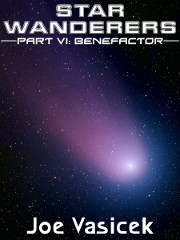
SW-VI Benefactor (thumb)I’m getting ready to publish Star Wanderers: Dreamweaver over the weekend, but first I need to finalize the teaser / book description for Benefactor so that I can include it in the back.  Here’s what I’ve got so far:

IN A COLD AND LONELY UNIVERSE, A SIMPLE ACT OF GRACE CAN RESONATE ACROSS WORLDS.

Jakob is entrapped in a life he never made for himself. A one-time starfarer, now he struggles to provide for his family of starbound refugees. With the recent Imperial takeover of Oriana Station and the worsening economic situation, it’s only a matter of time before they’re forced to move on—again.

To make matters worse, his wife’s resentment has been growing ever since he sent their two sons away to seek their fortunes across the stars. She claims that he stole them from her, when all he wanted was to give them a chance at a better life. Without her support, it’s not clear how long the family can hold together.

When a young man and woman with an unusual story show up from his wife’s home world, he agrees to take them in, if for no other reason than that they remind of his sons. They soon become part of the family, though this adds even more to the burden he can barely carry on his own.

An outworlder is nothing if not fiercely independent, and Jakob is no exception. He’ll sacrifice everything before he asks for help—even if the only other way out lies through an open airlock.

What do you think?  Does it sound interesting?  What works, and what do you think needs to be cut?

Also, a quick update on the situation with Star Wanderers and Smashwords.  I’ve discovered that the updating problems aren’t just restricted to iTunes, but all of the sites that I distribute to through Smashwords (Sony, Diesel, and Barnes & Noble (for Outworlder)).  We haven’t been able to get the books fixed, so I’ve decided to pull them all and republish.

What this means is that the first four Star Wanderers novellas will be temporarily unavailable from these sites, probably for a week or two.  If you got your copy from Smashwords, you should still be able to access it there–the books have been updating just fine on Smashwords, it’s only with the other retailers that I’ve been having problems.  For Dreamweaver, there shouldn’t be any problems though (I hope).

Thanks for your patience while I get this mess sorted out!

An apology to my iTunes readers

Star Wanderers I (thumb)Star Wanderers II (thumb)Star Wanderers III (thumb)Star Wanderers IV (thumb)

If you’re one of my readers on iTunes, I want to apologize because my Star Wanderers novellas will be temporarily unavailable there for the next month or so.

I’ve noticed several errors with the way my books are listed there, most notably with the titles and book descriptions.  I distribute to iTunes via Smashwords, which can be notorious for errors like these.  In the last six months, they’ve done a lot to fix these problems, but for some reason my Star Wanderers books aren’t updating properly so I’ve decided to de-list them from iTunes in order to make sure that the new versions go through.

Sorry if this causes any inconvenience.  If you’ve purchased or downloaded a previous copy from iTunes and want the latest one, just email me your receipt at joseph[dot]vasicek[at]gmail[dot]com and I’ll send you the latest version.  To my knowledge, the errors are just with the title, description, and back-matter, not the actual text, but I’ll be happy to send you an updated copy anyway.

Star Wanderers: Dreamweaver will still go through to iTunes when I publish it in the next couple of weeks, even if the previous books in the series aren’t up by then.  Hopefully, this one will go through without any problems.  Smashwords has done a lot to streamline their distribution process, so I think it will be fine.

Thanks for your patience while I get this worked out!

SFR Brigade Presents STAR WANDERERS: OUTWORLDER

Star Wanderers I (thumb)To my regular blog readers: I recently joined an online community for readers and writers of science fiction romance called Science Fiction Romance Brigade.  Since a lot of my books fall under this sub-genre, I figured it would be good to connect with that community a little better.  If you’ve enjoyed my Star Wanderers novellas, then check out some of the other authors in the SFR Brigade–they seem to be doing some similar stuff.

To any new visitors: welcome!  I hope you enjoy your time here.  I’m a self-published indie writer with thirteen ebooks out so far, and a lot more on the way.  I’ve been writing ever since I read A Wrinkle In Time back in 2nd grade, and sf romance is definitely one of my favorite sandboxes to play in.

For this week’s SFR Brigade Presents feature, I’m sharing an excerpt from the first chapter of Star Wanderers: Outworlder, the first novelette in my Star Wanderers series.  The setup: Jeremiah is a young single starship pilot who arrives at a space station on the Outworld frontier hoping to make some trades.  The station master ushers Jeremiah into his family’s quarters, where he explains that a famine is ravaging the system and everyone on the station is probably going to die.  He then claps his hands, and his five daughters line up on the other side of the room.

*  *  *  *  *

“Choose!” Master Korha bellowed. Apparently defeated, his wife collapsed to the floor in tears.

Jeremiah tugged at the collar of his jumpsuit, sweat forming at the back of his neck. “What? Choose?”

“Yes yes—choose quickly, you take, you go!”

“But this is crazy; how can I—”

“If not take, will die. Choose!”

Jeremiah turned back nervously to the girls. The three youngest ones stared at him in absolute terror. The two oldest ones weren’t quite so frightened, but avoided meeting his gaze directly. They wore their long hair down with glistening sequined headbands across their foreheads, and the innocent looks on their faces cried out to him.

Should I take them both? If they were going to die otherwise, it seemed like the right thing to do—but he didn’t know if he could afford to take even one extra passenger on his ship. And besides, the whole situation had an eerily awkward feel to it, as if he were trading in people, not goods.

“You like? You like?” Master Korha asked, ambling to his side. He pulled the two girls forward to give Jeremiah a better look.

*  *  *  *  *

If you want to read the rest, you can pick up a free ebook copy on Amazon, Barnes & Noble, Kobo, Smashwords, or any of the other major ebook sites.

And if you’ve already read Outworlder, then I’m happy to say that Star Wanderers: Dreamweaver, the parallel novella from Noemi’s point of view, is currently on schedule to come out in the beginning of April!  As always, newsletter subscribers will get a coupon code to download the book for free when it’s released.  I’m just finishing up with the revisions now, and am really excited to get this story up!

That just about does it for now.  Thanks for stopping by, and I hope to see you again soon!

Trope Tuesday: It Has Been an Honor

If there ever was a phrase that invoked manly tears, it’s this one.

It has been an honor” is pretty much the go-to catch phrase for any Heroic Sacrifice or Bolivian Army Ending.  It’s often a precursor to a Crowning Moment of Awesome, and as far as last words go, it ranks right up there with “I die free,” “I die as myself,” and “I regret nothing.” Expect to hear it a lot from blood knights, members of the proud warrior race, or anyone who belongs to a martyrdom culture.

Occasionally, you’ll hear a villain say this when he acknowledges the hero as a worthy opponent.  In such cases, the villain may evolve into a friendly enemy or a fire-forged friend. Or, if the trope is played straight, they just die.

One time you won’t hear this phrase is when someone is trying to play More Hero than Thou.  In that case, two or more good guys in a friendly rivalry basically argue over who has to bite the bullet, so the honor becomes a point of competition between them.

In my opinion, the heart and soul of this trope is the idea that some things are worth dying for.  Obviously, a character facing death is not going to say this unless he values his honor more than his life.  What exactly constitutes “honor” may be up for debate (with the potential for some unfortunate implications, especially in real-life martyrdom cultures like Japan), but the core element here is that the hero is fully willing to give up his life for something greater than himself.  Bonus points if he starts out as a coward and this trope marks the conclusion of his growth arc.

While this phrase often leads to a death of some kind, that isn’t always the case.  The cavalry can still show up to save them, or one of the characters can ultimately survive (either the one who says this phrase, or the one to whom it is said).  The important thing, though, is that the characters face death in a meaningful way.  Without that, this phrase doesn’t have nearly as much power.

In my own work, this trope tends to pop up a lot, especially in the more military sci-fi books in the Gaia Nova series.  It shows up multiple times in Stars of Blood and Glory, and also in Bringing Stella Home, though more in a posthumous way than anything else.  I suppose you could also say it happens in Star Wanderers: Homeworld, if you use a broader interpretation.

But either way, I’m definitely a big fan of this trope.  Expect to see it many more times in my own work in the future.

As a final note, it’s worth pointing out that the bandmaster’s violin from the real-life Titanic has recently been recovered and confirmed genuine.  It’s now on display in Belfast, less than two miles from where the Titanic was built.

Random thoughts on creativity and a cover preview

I’ve noticed that I tend to go through at least two revisions on most of my stories.  The first one generally identifies the problems in the rough draft and eliminates them, while the second one adds anything that’s missing and smooths the story over so that it works as a whole.  They both use different parts of my brain: one critical, the other creative.  Since both are important, I can’t easily skip either of them, and combining them into one mega-revision doesn’t really work because it’s hard to switch from one mode to the other.

I’m currently in the second revision for Star Wanderers: Dreamweaver, and it’s coming along really well so far.  Now that I’m in creative mode, it’s a lot easier to add stuff that was missing from the first draft and tidy up some other parts that seem a little disjointed.  With luck, this revision should be finished in a day or two.  It’s really only one chapter that needs the bulk of the work–according to my first readers, everything else is pretty good.  Far be it from me to fix something that isn’t broken.

###

The other day, an old friend of mine emailed me with a question about the world building / plotting process I followed for Star Wanderers.  I wrote a fairly lengthy response, and while most of it was a more detailed explanation of the stuff I’ve already included in the various author’s notes, I came up with some advice that surprised me:

If I had to give any advice, I’d say that the most important thing is to just feed your creativity.  You can’t force your imagination, just like you can’t get any more golden eggs by killing the goose that lays them.  However, you can organize your life and your environment in such a way that bursts of creativity are longer and more frequent.  A huge and important part of it is learning to turn off your internal critic, especially on the rough draft.  Sometimes, if I spend too much time thinking about writing, it paralyzes me so that I can’t actually write–but if I trick myself into opening my WIP without really thinking about it, then ten minutes later I’m plugging away and the ideas are flowing.  And just as bad habits can be very harmful, good habits can be very helpful.

I think a lot of us creative types tend to force ourselves a little too much, especially when we’re first getting started.  We want to be productive, we want to have something that we can show for ourselves in order to feel validated, especially with so many people raising eyebrows at our dreams and creative pursuits.  But productivity goals, while important, are really only a means to an end–and they’re not even the most important means most of the time.

If you want your work to ring with authenticity, or to reflect the truth and beauty you see in the universe, you have to be in touch with that kind of stuff.  And once you get back in touch with the stuff that drove you to create in the first place, there’s nothing that you want to do more.

This morning, I wrote for three hours in one sitting, and I wasn’t tempted by any distractions at all.  I only produced about 1.3k words, but they were good words that added both to the story and my understanding of the story.  I got back in touch with the spark that drove me to write it in the first place, and hopefully that spark will carry through to the readers.  I think that it will.

So yeah–it’s not about productivity goals, or reworking our creative process to be more like someone else’s, or any number of other writerly insecurities.  It’s all about story, and everything that drives us to tell them.

###

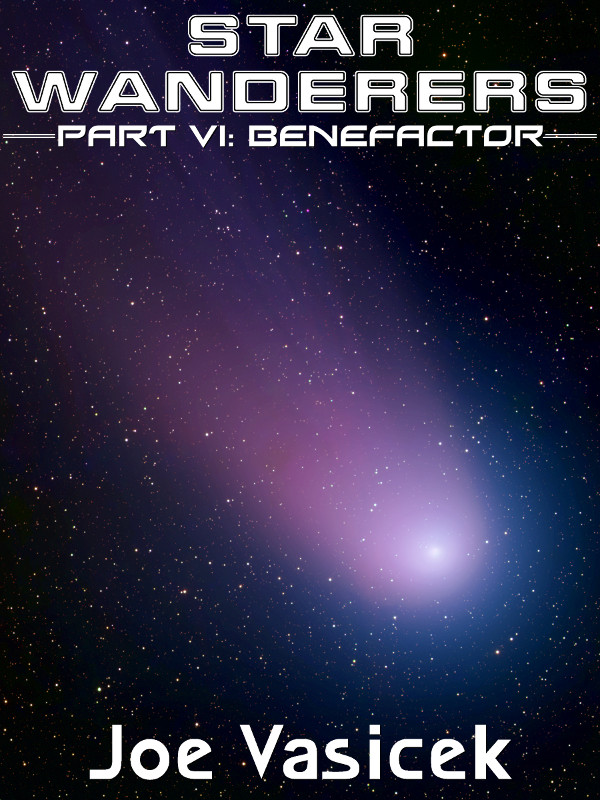
All right, if you’re still reading (or even if you cheated and skipped ahead), I have a treat for you.  I just found the AWESOMEST image for the cover of Star Wanderers: Benefactor, which I hope to finish up later this week after finalizing the revisions for Dreamweaver.  Here’s the cover:

SW-VI Benefactor (cover)

Pretty cool, eh? I <3 NASA. 😀

The picture is of Comet C/2001 Q4 (NEAT), taken by the WIYN 0.9-meter telescope at Kitt Peak National Observatory near Tucson, Arizona.  It was taken on 7 May 2004, and covers an area roughly five times the size of the moon.  As with all NASA images, it’s in the public domain.

The inspiration actually came from comet PANSTARRS, which is visible in the sky right now.  I tried to catch a glimpse of it tonight from the Y Mountain trail head, but there were too many clouds on the horizon to see it clearly.  Hopefully, the skies will be clearer tomorrow.

In related news, comet ISON later this year is expected to put on a really incredible show.  Astronomers think that for a brief time, it may even shine brighter than the moon, making it visible even during the day!  If that happens, it’s going to be AWESOME.  Mark it on your calendars for November–it’s going to be great!

That’s just about it for now.  I’d better get back to forming those good habits I mentioned earlier–like actually getting to bed at a reasonable hour. Later!

Unstuck again

For the past few weeks, I’ve been kind of stuck on chapter 3 in Star Wanderers: Benefactor.  This one is a parallel novella to Fidelity, from Jakob’s point of view.  It’s been a lot of fun to write so far–Jakob struggles with a lot of the same issues I do, like self-reliance and independence vs. accepting help from others–but there was this one scene that just kind of knocked the momentum out of it for me.

Well, I started out the day by rereading Fidelity.  Actually, I started reading it yesterday right as I was falling asleep, and had some really weird dreams that I’ve since forgotten.  After rereading Fidelity, I went to the Provo Library to write, and everything just sort of clicked.  Finished the chapter today, and if all goes well, I’ll finish the first draft sometime this week or next.

I think the thing that was blocking me was that I wasn’t as familiar with the story I was writing parallel to.  Which is funny, because Benefactor has very little overlap with Fidelity, even in terms of plotting.  This is Jakob’s story, and it’s very different from Jeremiah’s or Noemi’s.  Even so, the nagging feeling that I was missing something really slowed me down.  When you’re in a dark, empty room and can’t see anything, you’re not going to run across it even if you know there isn’t anything to trip on.

###

Just recently, I added some new book teasers to the back matter of the Star Wanderers ebooks.  They look a little like this:

If you enjoyed Star Wanderers: Outworlder, be sure to check out Part II: Fidelity!

Star Wanderers II (thumb)

IS FIDELITY WORTH THE PRICE OF FREEDOM? CAN LOVE TAKE ROOT BEYOND THE STARS?

Oriana Station: a bustling frontier settlement between the Outworlds and the Coreward Stars. A popular port-of-call for free traders and independent starfarers alike—and the latest target in the aggressively expansionist plans of the Gaian Empire.

Life was simple for Jeremiah and Noemi before they arrived. Though neither of them speak the same language, they’ve reached an understanding that goes beyond words. But when the colonial authorities make them into second-class citizens of a fractured empire, even that might not be enough.

Their newfound friends in the immigrant community can only do so much. With Noemi and her people depending on him, Jeremiah must find a way back to the Outworlds—before they lose everything that they came for.

Each one has a teaser for the next one in the series, including Homeworld (for the as-yet unpublished Dreamweaver).  Ideally, I’d like to put out a new Star Wanderers novella every month or two, but time things so that I can have the teaser for the next one ready before publishing the one previous.

So far, the Star Wanderers series has been selling a lot better than anything else I’ve published.  That’s great, because I really enjoy writing in this universe!  The short novella length is perfect for exploring one or two characters in-depth over the course of a much more intimate story than you usually see in a novel.  The really cool thing, though, is that the more I write in this universe, the more characters and storylines unfold.  It’s like watching a flower bloom, where each individual petal is a single story.

Anyhow.  I’m really excited to keep writing in this series.  Some of the stories I have kicking around in my head:

  • A parallel novella to Sacrifice, primarily in Mariya’s point of view but also perhaps with a bit of Noemi.  Basically, something exploring the subtext behind the polygamy that drove most of the conflict in Sacrifice.
  • A parallel novella to Homeworld, from both Lucca’s and Mariya’s points of view.  Basically, an adventure romance that actually shows the final battle between Captain Helena and the colonists.  In Homeworld, it didn’t make sense to show that battle since the story was about Jeremiah and Noemi, and both of them were plugged into a simulator at the time.  But my first readers really want to read a story about the battle itself, so that’s one story I definitely have to write.
  • A story from Master Korha’s point of view, showing the gradual collapse of Megiddo Station and the buildup to his decision to give his daughters away.  This one is going to be more tragic, or at the very least, bittersweet.  But hey, I kinda like bittersweet endings.
  • A story from Samson’s point of view.  Actually, I’ve already got this one plotted and ready to go.  The only trouble is, well, it’s Samson.  With his ethical slut mentality, whatever I write, my family is going to be scandalized by it (and I might be, too, when my kids are old enough to read it).  Don’t worry, though–I’ll get around to it eventually.  This isn’t a story that I can just walk away from.
  • Something from Jakob’s sons’ point of view, Isaac and Aaron.  Except … I can’t really say much about this, because Benefactor isn’t out yet. o.0
  • At some point, I’d like to write a full-length novel from the point of view of Jeremiah and Noemi’s kids.  I don’t have a plot or anything else figured out for this one, but I’d really like to revisit their world again through their kids’ eyes.  I even have a title: Children of the Starry Sea.  But yeah, that’s probably not going to come out for another couple of years or so.

So yeah, those are some of the things kicking around in my mind.  Once I finish the parallel novellas to Fidelity, Sacrifice, and Homeworld, anything is free game really.  Is there any story in particular that you guys would like to see?  Now’s the time to drop-kick my imagination–once it gets fixated on something, it won’t give me any rest until a story comes out the other end.

And that’s enough for now.  Tomorrow, I promise, I’ll do a Trope Tuesday post.  I’ve got a job interview in the morning and probably won’t have work for the rest of the day, so while that kind of puts a cramp on my wallet, it means you’re more likely to get a blog post.  In the meantime, I’d better get some sleep.

Later!

Well, that was a quick revision

SW-V Dreamweaver (thumb)First of all, sorry for forgetting to do a Trope Tuesday post (again!).  I guess I’m really flaky about doing those.  Oh well–better to be flaky about blogging than flaky about writing, right?

In fact, the reason I didn’t write-up the post was because I was busy doing a 2.0 revision pass for Star Wanderers: Dreamweaver.  This is the novella that retells the events of Outworlder, but from Noemi’s point of view.  I hadn’t looked at it in the eight months since I wrote it, but sometime over the summer I gave it to Laura to alpha read, and she just got back with her comments a couple of days ago.

Well.  Reading through those comments was simultaneously the most excruciating and most invigorating thing I’ve been through in a while.  I’ve changed a lot since I wrote the first draft, and a lot of things about it are horribly embarrassing, but the story … the story is actually pretty solid.  Oh, some of Noemi’s motivations weren’t close enough to the page, and some other elements needed a bit of pruning, but the structure, the bones–it all seems to be there.

So, long story short: I got Laura’s comments on Monday, and finished the revisions today.  TODAY.  Of course, it still needs to be proofread, and I’d like to send the new version out to some other first readers … but I don’t anticipate making any major, earth-shattering changes to the story.  In fact, I could publish it tomorrow, and most of you would probably love it.

So far, my Star Wanderers books are selling much better than any of my other titles.  They’re also much shorter, which means that I can put them out a lot faster–or should, at least.  I probably angst over them more than I should, trying to make everything perfect.  But I’ve got the extended series planned out to Part X, and I’ve already written half of Part VI.  Some of those might get moved up or down, depending on demand, but the more I write in this universe, the more stories present themselves.  And hey, if that’s what you want to read, I’ll be more than happy to write more of them.

If all goes well, Dreamweaver will be out in the first half of April, perhaps as early as the end of March.  As always, newsletter subscribers will get a two-week coupon code to download the book for free on Smashwords.  This also provides access to all future editions, in all ebook formats, completely DRM free.  If you enjoy it, I hope you’ll review it or tell a friend about it.  I’m not sure how I’ll end up pricing it, but I don’t anticipate going higher than $2.99.

In the meantime, here’s something to leave you with: an awesome remix of Jewel by Solarstone & Clare Stagg.  Man, I love Solarstone’s work.  I picked up his newest album, Pure, over the summer, and have been pulling songs from it for book soundtracks ever since.

Night! 🙂