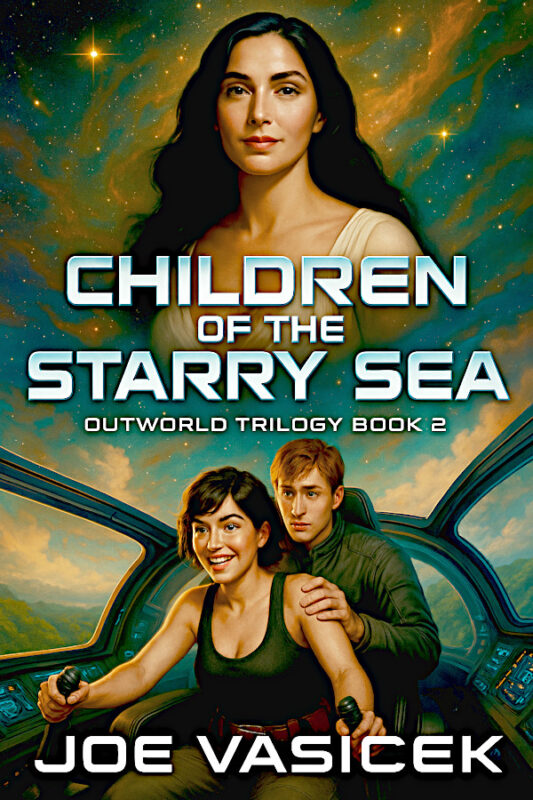
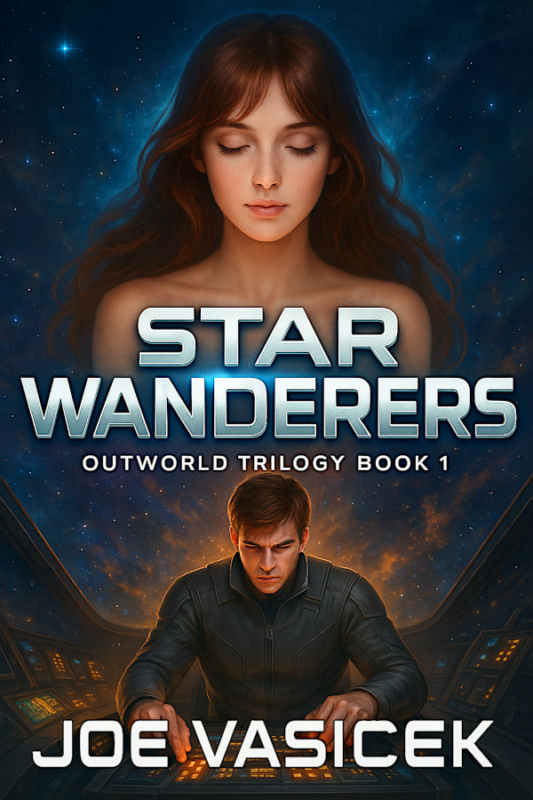
Here is an excerpt from my forthcoming novel, Children of the Starry Sea. It’s a direct sequel to Star Wanderers and the second book in what is going to be a trilogy. It’s also the longest book I’ve written since I started publishing more than ten years ago.
The rough draft is already finished, and the first revision draft is almost finished. I’m going to do another two revision passes over the next month, one to fix any remaining story issues, and another to trim the word count by about 10%. After that, it’s off to the editor!
Here is the first chapter.
Worry and Bliss
Isaiah
Isaiah snuck carefully through the empty halls of New Jezreel, avoiding the main thoroughfare even though the planetside colony was mostly asleep at this hour. The atrium was still mostly dark, though the dawn was starting to lighten the perpetually overcast sky outside. In less than an hour, the daylights would come on, illuminating the darkened hallways.
He slowed as he reached the turnoff for the colony’s main hangar, then stopped to check the terminal beside the door, glancing nervously over his shoulder. The screen glowed in the darkness, and his fingers moved with urgency as he used his pilot’s clearance to unlock one of the landspeeders. If anyone had been in the colony’s flight control tower, they surely would have cancelled his request almost immediately. But the terminal took his ID at face value and cleared him without any question.
The sound of footsteps in the hallway turned his blood to ice. Even though they were still distant, he hurriedly exited the menu and slipped into the shadows. The screen continued to glow, however, illuminating the hall so brightly it made him cringe. It was glaringly obvious that someone had been using it, and if security happened to pass by, then—
“Boo!” came a young woman’s voice, making him jump.
“Salome!” he whispered fiercely. “Is that you?”
“Of course it’s me, silly! Who else did you think it was?”
He peered down the darkened hallway, but it was empty. There was no one else there but them. He sighed in relief.
“For a second there, I thought you were security.”
She giggled. “That’s hilarious. Did you think I was going to detain you?”
“No, but I’m sure they won’t be happy when they find out what we’ve done.”
“You worry too much. Did you get the landspeeder?”
“Yeah,” he said, palming the door open. As soon as they were on the other side, he palmed it shut, not taking his chances. Thankfully, the terminal screen went dim again just before the doors closed.
Salome was already halfway to the landspeeders, and he had to run to catch up to her. The colony’s main hangar was wide and cavernous, with a domed ceiling almost twenty meters high in the center. The lights were dim and reddish, but he and Salome were certainly showing up on the surveillance cameras, and if anyone from security was watching—
“Which one?” Salome asked, stopping at the row of landspeeders parked along the back wall. These ones were small, barely large enough to fit two people, but the engines were at least as long as Isaiah was tall, and much larger. At one time, their hulls had been bright and sleek, but years of long use had dulled them and given them dozens of dents and dings.
“Uh, just a sec,” said Isaiah, double-checking his wrist console. “There—that one.”
Salome’s eyes lit up as she ran to the one Isaiah had pointed out. Even in the dim lights, she was positively gorgeous. Her short black hair bobbed loosely around her shoulders, and her curvy, athletic figure stole Isaiah’s breath just like the landspeeder had stolen hers. But it was her eager enthusiasm for life that captured his heart more than anything else. Whenever he was around her, he felt that he could die happy if she only gave him a smile. And whenever he wasn’t around her, it felt like there was an emptiness in his life that she fit perfectly.
“Nice!” said Salome, brushing her fingertips admiringly against the hull. “Both engines are in really good shape. You chose a good one.”
Her praise all but melted Isaiah into a puddle. She slipped into the pilot’s seat and gave him a funny look.
“Well, don’t just stand there, silly! Don’t you want to take this bunny for a ride?”
You, or the speeder? his adolescent mind wondered. Blood rushed to his cheeks at the thought, but she didn’t seem to notice as he scrambled to the seat behind her. The glass dome slid into place overhead, and the engines began to rumble as Salome cycled them up.
“Do we have our breathing masks?” he asked as he rummaged through the tiny cockpit compartment that held their supplies.
“Sure,” Salome said absently. Her hands flew deftly across the controls, bringing them to life.
“There,” said Isaiah, finding two masks. “Filters are good, backup oxygen tanks are both full. We’ve only got two emergency flares, though. I don’t know why the last crew didn’t replenish them.”
“It’s all right,” said Salome. “We’re only going out for a joyride, not traversing half the planet.”
“But what about the pirate colony? If they catch us, then—”
“They’re not going to catch us,” she said, laughing dismissively. “They’re on the other side of the world, and besides, your dad has got eyes on them from orbit. Stop worrying!”
Isaiah took a deep breath. She was probably right—no, she was almost certainly right—but still, that “almost” held the potential for a whole world of hurt. The pirate colony had cut off communications nearly eighteen months ago, and no one knew exactly what they were up to, though thankfully, they didn’t have ground-to-orbit capabilities. Yet.
The first settlers had defeated and exiled the pirates to the wilderness just before Isaiah had been born, but his father, the station master of the colony’s main orbital, had always believed that they could come back at any moment. He watched them vigilantly from Zarmina Station, using the spy satellites they’d obtained from the Outworld Joint Defense Fleet.
But Salome clearly wasn’t worried—and besides, it was all out of their hands anyway. Let the administrators worry about the pirates. Right now, he was sharing a cozy cockpit with the most beautiful girl in a dozen parsecs, perhaps even the whole galaxy, and she was happy to have him there. How could life possibly get any better than that?
The engines rumbled, and the hoverjets lifted the speeder off the floor. Isaiah hastily scrolled through menus until he found the command to open the hangar airlock. He authorized it with his pilot’s ID, and the giant doors slid slowly open, like the vertical maw of an enormous beast. Salome gently brought them into the airlock, stopping where a large painted square marked the temporary parking area for incoming and outgoing craft. The massive doors closed slowly behind them.
“Here goes nothing!” Salome said excitedly as the outside doors cracked open. The overcast sky was just starting to turn blue-gray with the morning light, and the jungle trees stood out starkly in silhouette. She revved the engine impatiently, and Isaiah fought back the urge to tell her to wait until the doors were fully open.
As soon as they were, she whooped and gunned the engines, and the speeder leaped forward like a wild animal escaping its cage. Isaiah’s butt clenched as they cleared the partially opened doors with barely a meter to spare on either side. Then they nosed up over the treetops, and New Jezreel was suddenly behind them, with nothing but scattered settlements and wilderness up ahead.
“Yes!” said Salome, laughing as they sent ripples over the leafy jungle canopy like waves in their wake. They were a little too low for Isaiah’s comfort, but he put that out of his mind.
“What’s the plan?” he asked. “Where are we going?”
“Where do you want to go?” she asked back.
He took a deep breath. Somewhere we can talk, he thought but did not say. Joyriding was fun and all, but he didn’t want to spend all of his short time with her doing that.
“Up the canyon,” he said, pointing to the cliffs that rose sharply from the jungle about a dozen kilometers away.
“You got it!” she said, then whooped again as she accelerated hard enough to throw him against his seat. He took a deep breath before forcing himself to let go of his apprehensions—and not just the ones about the ride.
Salome
There was nothing Salome loved quite so much as the roar of a powerful engine behind her and a wide open world beckoning up ahead. Isaiah had opted for the canyon, and it was a good choice. She’d only been up there twice, and one of those times had been in a slow-moving zeppelin, so it didn’t really count.
“Hold on tight!” she said as the jungle gave way to the cliffs and the rocky gullies. She followed the nearly vertical rock face until it flattened out just before the river. Using one hand to flare the speeder’s airbrakes, she rolled hard to the right and used the sudden wind resistance to pitch the nose in the direction she wanted to turn. Her vision darkened as the engines checked her momentum, nearly making her black out.
“Look out!” Isaiah screamed. She’d underestimated the rate of their sudden altitude drop, and the broad surface of the river was rushing up toward them like a shimmering blacktop. She leveled off just as they struck the surface, and the force of the impact on the landspeeder’s flat underbelly was enough to knock the wind out of her lungs.
The hoverjets squealed in protest as the spray of water splashed across the domed cockpit window, and for a brief, heart-stopping moment, she feared that she’d submerged them. Thankfully, though, the speeder leaped back up into the air, water streaming in rivulets across the hull as they sped down the river, riding it like a road.
A heady rush of adrenaline made Salome laugh. These were the moments she lived for—the liberating thrills that she could never quite get under the manmade ceilings and artificial lights of New Jezreel.
“Holy crap, Salome!” Isaiah yelled. “Did you just wreck the speeder?”
“She’s still flying, isn’t she?”
“Yeah, but if any of the jets got flooded, we could have a—”
“They’re fine,” Salome insisted, though she checked the screen on her left just to be sure. The front right hoverjet had a minor warning indicator, but it didn’t sound too bad. From her work in the colony’s mechanic shop, she could tell if an engine was having problems almost before the diagnostics had finished running. She hadn’t flown them much outside of the holovid simulations, but she knew them inside and out, and could build one from scratch if she had to.
When Isaiah had asked her if she wanted to take one out for a spin, it was all that she could do in that moment not to throw her arms around him and squee. Not that she had any particular feelings for him—they’d been friends ever since childhood, mostly because of how close their parents were, and while things had changed after his family had moved up to Zarmina Station, they hadn’t changed like that. No, Isaiah was just a very good friend—especially with how he’d helped her take this landspeeder out for a ride. That was really awesome of him.
The speeder kicked up a massive spray of water as they skimmed over the mostly still surface. As they turned around a bend, Salome saw whitecaps up ahead, so she raised their altitude a couple of meters and gripped the flight controls with both hands.
“Waterfall up ahead!” said Isaiah, pointing to it over her shoulder.
“I see it,” said Salome. “Hang on!”
She skirted a couple of large boulders and drove straight toward the churning wall of water. At the last moment, she nosed up hard and gripped the throttle with one hand. Once they were vertical, she killed it. The speeder didn’t have any wings, so it went into a wonderfully thrilling backflip, its forward momentum carrying them up over the edge of the falls. This time, Salome timed the maneuver perfectly—all those hundreds of hours on the holovid simulators had really paid off. When the speeder righted itself and the hoverjets re-engaged, they blasted over the water without touching the surface. She throttled up the engines and whooped.
“I think I’m going to be sick,” Isaiah moaned.
“You’ll be fine,” Salome told him, though she eased up on the altitude controls to give them a bit more clearance. Hopefully that would make their ride a bit smoother. As much fun as she was having right now, it wouldn’t be worth it if she made Isaiah miserable.
Up ahead, the river narrowed into a sharp bend, and the slope on either side grew higher and steeper. In the early morning light, it was darker in the narrow defile, but the overcast sky cast enough diffuse light to fly by—barely. On the edge of her vision, a couple of floating algae pads drifted lazily above the jungle like miniature zeppelins. She’d have to keep an eye out for those in the canyon.
The jungle by the river was still as thick as down in the valley, but as the rapids increased, the number of large rocks and boulders did as well. Out of the corner of her eye, she even saw places where rock falls from the mountains had ripped out the old growth not too long ago. The slopes were mostly scree, but they soon rose to jagged, towering cliffs on either side. Salome considered leaving the river to head up one of the gullies and see how long the speeder could find purchase on those slopes, but for Isaiah’s sake she decided against it.
Then they hit the rapids. The river narrowed dramatically, the water churning over the countless boulders and smashed tree trunks as it had at the base of the waterfall. It took all of Salome’s concentration to keep from crashing, as the walls of both cliff and jungle closed in on either side. The shadows were deeper than she’d expected, there was no space to turn around.
The next several minutes passed in mere moments as every particle of her attention was focused on getting them through without killing them both in a spectacular crash. There was a rhythm to it that caught her in a trance—one that she hoped would never end.
Intuitively, she sensed that they were coming to another wall. She nosed up sharply before the waterfall came into view, and without thinking, she went into a barrel roll. Just before they stalled, almost a hundred meters above the canyon floor, she glimpsed a floating algae pad out the corner of her eye and brought the hoverjets around to push off of it. The maneuver gave her just enough forward momentum to clear the edge of the waterfall, kicking up a frightening amount of spray in the process. But the hoverjets held, the engines came to life again, and they blasted out from the waterfall’s edge over a wide mountain lake.
Salome became aware of someone screaming, and realized that it was her. She throttled down and flared the airbrakes, bringing the speeder to a gentle crawl.
“That was incredible!” she said, grinning from ear to ear as she turned around to see how Isaiah was doing.
“Yeah,” he said, his face pale and his arms shaking.
The cliffs weren’t quite so high this far up into the mountains, and the lake was wide and flat enough that it reflected the cloudy sky like a mirror. The sight all around them was incredible. A few lone trees were scattered here and there, but the beaches were mostly gravel and scree, rising sharply to the jagged ridge that surrounded them. On one side, a large cloud was spilling over onto the water, or perhaps rising off of it—it was difficult to tell. Then, through a sudden break in the clouds, the early morning sun shone in all its brilliant glory.
“Whoa,” said Salome, captivated by the natural beauty of the scene. A gaggle of enormous raptor-beasts chose that moment to take off from the farther shore, briefly eclipsing the sun before disappearing into another cloudbank.
“We’re—we’re alive,” said Isaiah, as if realizing it for the first time in his life. Salome, too, felt a strange new awareness sweep over her.
“You only live once,” she told him, laughing. “Come on. Where do you want to go next?”
He paused for a moment. Then, in a voice that was almost shy, he asked: “Can we stop and just talk for a while?”
“Sure.”
She nosed the speeder over to where an algae pad had deflated, over by the water’s edge. It provided a nice platform to park the speeder, as well as a soft place to climb out and maybe stretch their legs.
“Got your mask?” she asked as the speeder powered down.
“Uh, yeah, but—”
She cracked open the cockpit seal with one hand while holding her mask to her mouth with the other. Isaiah yelped in surprise as he scrambled to put his mask on. The air that flooded in was thick, humid, and surprisingly warm, though not quite as heavy as down in the valley. As the glass slid open, Salome finished strapping on her mask and climbed out.
The atmosphere was thick with oxygen—almost too much, really—but the carbon dioxide was even more concentrated, and needed to be scrubbed by the masks. There were other poisonous gases too, though this was more of a problem in the valleys than it was in the mountains. Thankfully, a halfway-decent filtration system was all they needed to breathe the native air.
Salome jumped down to the soft algae below and stretched, arcing her back. Isaiah soon jumped down next to her.
“It sure is beautiful up here, isn’t it?”
“Yeah,” she said, walking over to the edge of the water. She found a nice place and sat down with her legs stretched out. Isaiah hesitated, so she motioned for him to join her.
Isaiah
Isaiah’s knees still shook from the crazy joyride. He was grateful that they were sitting on the soft, deflated algae pad, though the masks were an annoying obstacle. He wanted to see Salome’s face, not just her eyes, though of course those were gorgeous. More than that, though, he wanted her to see his face—to really and truly be able to listen to what he had to tell her. He sighed.
“My dad’s been bringing up the whole star wandering thing,” he began. “Keeps telling me that I’m almost as old as he was when he became a star wanderer.”
“Ah,” Salome said knowingly. “So that’s what’s been on your mind.”
Not quite, he wanted to say. But if Salome rejected him, what would he do then? His father would expect him to leave on the Ariadne, never to return. That was the time-honored tradition of the Outworlds, and his father was a staunch traditionalist. But even if they did become a couple, would his father accept that as a reason to let him stay?
“It’s not that I’m scared of leaving,” he lied—or rather, stretched the truth. “Just… leaving forever? Never coming back? Doesn’t that seem a bit… extreme?”
“Yeah,” said Salome, leaning back on her hands with her slender legs crossed. “It’s a stupid tradition. Times are changing. In another generation or two, the Outworlds won’t even need star wanderers to keep from becoming too isolated.”
“I can understand why my father holds on so tightly to the old ways. If he hadn’t left home, he would have never my mother. That’s probably why he wants me to become a star wanderer.”
“But is that really what you want?” Salome asked.
Their eyes met, and Isaiah’s heart all but stopped. Was she asking him to stay for her? Perhaps, underneath that mask, she was waiting for him to confess that he didn’t want to leave her, that she was all he ever—
But then, she shrugged and glanced back out over the lake again. His shoulders slumped.
“Not really, no,” he told her honestly. “There’s just—there’s so much here to stay for. And it’s not like inbreeding is a problem. Right?”
“Of course not,” Salome said absently. The way she sat, with her back arched and her shoulders pulled back, really brought out all of her feminine curves. He always felt a little embarrassed when his thoughts started sliding in that direction, but at the same time, he couldn’t help but feel drawn to her.
It was amazing how much she’d changed since his family had moved up to Zarmina Station. Before, she was still just a childhood playmate that he got to visit whenever their mothers got together, which was almost every day. Now, he only got to see her whenever his work as a shuttle pilot brought him planetside, but those frequent absences had made her transformation over the last couple of years all the more incredible. She was no longer the precocious little girl who used to chase him around the underground parks and gardens, but a stunning young woman who had almost reached her prime.
“Have you ever thought about leaving for the stars?” he asked, surprising them both.
She gave him a funny look. “You mean, become a female star wanderer?”
“Or some other kind of starfarer,” he added quickly. “There are lots of people who travel the stars who aren’t just following the old ways.”
“Not in the Far Outworlds—at least, not yet. Out here, you’re either a star wanderer or a member of the Outworld Joint Defense Fleet—and I sure as hell am not leaving home for that.”
“So what about being a female star wanderer, then?”
She thought about it for a moment, then shrugged. “I don’t know. It sounds like it would get kind of lonely.”
Not if we left together, Isaiah thought, his heart pounding eagerly.
“Still,” she added, “it would be an adventure. Perhaps even the adventure of the lifetime. My dad doesn’t talk about his star wandering days much, but I can tell sometimes that he misses it.”
“Yeah,” said Isaiah. “My dad too.”
“Do you ever wonder if you’ve got a brother or sister out there?”
He frowned. “What do you mean?”
“Like, if your dad had a starchild or two before he settled down with your mom. Star wanderers do that sometimes, you know.”
“Not my dad.”
“Are you sure?”
Hot blood rushed to Isaiah’s cheeks. Why were they even talking about this? In just a few hours, he’d be back up in orbit, facing his father, with Salome down on New Jezreel where he wouldn’t be able to talk with her for a while—not in person, anyway.
“I can’t imagine him doing something like that. It’s certainly not the kind of thing that I would do.”
“Why not?”
“Are you kidding? You think I’d really, uh, knock a girl up and, um…”
“Stars, Isaiah—are you blushing?”
She laughed, making him blush even deeper. Even so, her laugh wasn’t hurtful or unkind.
“Sorry,” she said, blushing a little herself. “I guess I never thought we’d be talking about this kind of thing.”
“Do you think your dad ever had a starchild?”
“Honestly, it wouldn’t surprise me. And if I became a starfarer, I might get the chance to meet them. After all, it’s a small universe outside of the Coreward Stars.”
They sat in silence for several moments. A thick cloud rolled over the lake, obscuring the highest peaks. Isaiah had the sensation that the algae pad was floating high up in the sky, drifting away with them to wherever the wind would carry it.
“At least it’s not like you have to leave tomorrow,” said Salome. “Some star wanderers don’t leave until they’re well into their twenties.”
“Try telling that to my father,” he muttered.
She gave him a funny look again. “Well, why don’t you?”
“Are you kidding?”
“No, I’m not.”
Isaiah shook his head. “You don’t understand. All my life, this thing has been hanging over my head. When I was born, it was already decided that I would leave home and become a star wanderer, just like my father.”
“That’s stupid. In another generation, those traditions are going to be dead anyway, so why should you be forced to keep them?”
“So you want me to stay?” he asked, his breath catching in his throat.
“If that’s what you want,” she said, looking back out over the water. “It’s your life, after all. You’re the one who has to decide what’s right for you.”
And what about us? he thought but did not say. He wasn’t sure he was ready to ask about that yet.
“I don’t know,” he said uncertainly. “My father would be so disappointed in me.”
“So what?”
He frowned. “Don’t you care what your parents think of you?”
“Well, yes, but—oh, I don’t know! Why do these traditions have to be so hard? It’s always the firstborn son—why not take volunteers instead, or only send out people who actually want to go?”
“Would you go in my place if you could?”
“Yes!” she answered immediately. “I mean, probably. Sure. Why not?”
Does that mean you would you go with me, too?
Of course, he didn’t actually ask her, since the very thought was absurd. The Ariadne was built for a crew of exactly one, and besides, Salome didn’t have the neural implants necessary to plug into the dream simulators. That had been a point of controversy among the first settlers, with some, like Isaiah’s parents, opting to implant all of their children, while others, like Mariya’s parents, opting their children out of it. In the cramped quarters of a starship like the Ariadne, the simulations were absolutely necessary to maintain your mental health. But on a habitable world like Zarmina, the dream worlds were a luxury, not a necessity.
Still, Isaiah’s parents had made some very long voyages together on the Ariadne, so it wasn’t impossible to take another person along. And so long as they both had each other, how much did it really matter that Salome didn’t have the implants and couldn’t plug into the simulations? Even with the implants, his father had struggled with loneliness until he’d met his mother. If wandering the stars together had worked so well for them, then perhaps…
No, he told himself, snapping back to the present. The last thing he needed was to lose himself in a daydream about his crush when Salome was right here.
“All right,” he said aloud. “I’ll talk with my father about it.”
“Good!” said Salome, smiling at him—though unfortunately, all he could see of her smile was in her eyes. Still, it was more than enough to take his breath away.
Should I ask her? he wondered. It sounds almost like she wants me to stay. And if that’s true…
“Isaiah? Is something wrong?”
He took a deep breath. “Salome—if I did stay, would you…”
“Would I what?” she asked curiously as his voice trailed off.
“Never mind,” he said quickly, deciding not to press the issue. “Let’s get back to New Jezreel before they think we’ve stolen this thing.”
She laughed as she climbed up the ladder back into the cockpit. “You worry too much, Isaiah!”
Perhaps I do, he thought cheerfully.
Salome
As the speeder lifted off, sending ripples across the mirror-like surface of the lake, Salome couldn’t help but feel that her friendship with Isaiah had changed in some significant but unknown way. That bothered her more than she cared to admit. She’d been looking forward to the ride back down the canyon, but now there was too much on her mind to fully enjoy it.
Still, she was glad that Isaiah trusted her enough to spill his guts to her like that. He really was a great friend—not at all like some of the other boys, who only seemed to want one thing from her. As if she would put herself out so easily. No, she was much choosier than that, which probably meant that she was going to end up with a star wanderer, since none of the other boys in the colony were all that impressive.
But right now, she didn’t care about any of that. She was too young to think about settling down and starting a family of her own. Besides, there were so many other things she wanted to do with her life, like fly across the planet on a landspeeder, or parachute jump from space, or build her own balloon house and circumnavigate the globe in that. Her dreams might sound crazy to some, but her father had once had dreams even crazier than her own, and if he’d never followed them, he never would have met her mother or come to Zarmina. Besides, what did she care if other people thought she was crazy?
She brought the speeder out over the water, tracing a wide arc back toward the outlet that led to the waterfall. Instead of following the river, however, she climbed over the rocks to the ridgeline that circled the lake. The clouds had briefly dissipated, at least on this part of the ridge, giving them a spectacular view of the mountains that sourrounded New Jezreel and the nearby settlements. The sky was still overcast, but the air itself was clear enough that they could see all the way out to the vast, world-encircling ocean more than fifty kilometers away.
“Wow,” said Isaiah. “You can see everything from here!”
That’s not even close to true, Salome thought silently. As incredible as the view was from here, it was only a tiny fraction of Zarmina’s grandeur—and an even smaller fraction of the Outworlds. Even if she lived a hundred lifetimes, she would never be able to see it all.
Could she become a star wanderer? The idea was so crazy that it made even her craziest dreams seem small by comparison. And yet, when she’d told Isaiah that she would go in his place if she could, she hadn’t been lying. A part of her even envied him for the chance to be a star wanderer and to see other worlds.
She nudged the flight stick, sending the speeder down the slope at a shallow angle. The jungle canopy was thick enough for the hoverjets to find purchase, as long as they kept to the more thickly forested parts. For Isaiah’s sake, she would take them down at a much more relaxing pace, enjoying the thrill of the view rather than the thrill of the ride.
“Hey,” said Isaiah from the seat behind her. “What was that?”
“What was what?” she asked, not bothering to look.
“That small break in the trees we just passed. It looked like there was smoke coming up through it—like from a gas-powered generator or something.”
“A generator?”
“Yeah. You think someone might be camping up here? We’re about a dozen klicks out from the outlying settlements, but science and exploration parties still come out this way, right?”
Salome laughed and shook her head. “Don’t be silly, Isaiah. Those teams don’t use gas-powered generators.”
“But the pirates do. Do you think—”
“No,” she said firmly, still piloting the speeder down the slope at a decent clip. “What you saw was probably just a cloud whisp. The pirates aren’t even on this continent, let alone this jungle. Let it go.”
“But—”
“I said, let it go,” she told him, then sighed. Whatever else was true, Isaiah always worried too much.