The Loss of Innocence in Edenfall

Edenfall is a young adult first contact science fiction story about a paradise that doesn’t fall to invasion, but awakens to adulthood. Set on an isolated colony world, it blends coming-of-age, alien-world survival, and military first contact, telling a story where the shock isn’t meeting the unknown—it’s realizing that humanity is the unknown.

All of us are born innocent, but none of us can grow up and stay that way. What happens when innocence is shattered by forces beyond our control? Can lost innocence ever be reclaimed—or does the very act of reclaiming it make it something else?

These were my thoughts as I wrote Edenfall. From those seeds grew a story about childhood, family, first contact, coming of age, and the tragedy of how confronting evil forces us to grow up.

Where the Idea Came From

After I wrote Genesis Earth, I knew I wanted to turn it into a trilogy someday. I also knew that Michael and Terra’s idyllic paradise would not remain isolated forever. So I began to ask myself: what would happen when their children—raised entirely outside of human civilization—encounter humanity for the first time, with all of its violence, possessiveness, flaws, and messiness?

As the ideas came together, I realized that I was writing a different kind of first contact story—not a story of discovery, but a first contact science fiction story of intrusion and loss, told through the eyes of a girl who never knew humanity included armies, geopolitics, militarization, or hidden agendas. In other words, I was writing a story about the loss of innocence.

How the Loss of Innocence Shapes the Story

In Edenfall, every choice Estee makes is a response to the forces that ultimately shatter her world. The adults think in terms of strategies, secrets, and keeping their family safe, but Estee and her siblings have no concept of these things. Instead, the children ask themselves things like: why do we have to go away? What are my parents trying to hide? Who are these people, and why do Mommy and Daddy fear them?

Estee’s journey is not merely one of survival, but the collapse of everything she thinks she knows. By the time things get violent, her world has already ended, because contact itself changed the rules of innocence. That tension—between wonder and dread, belonging and displacement—drives every emotional beat of the book.

What the Loss of Innocence Says About Us

We live in a world where children inherit consequences they did not choose for themselves. Edenfall reflects the quiet tragedy of that handoff: that sometimes the most precarious moment in life is not the arrival of the monsters, but the arrival of adults who aren’t immediate members of our family.

All of us lose our innocence at some point in our lives—and once it is lost, we can never gain it back. That is the tragedy of growing up. But even though we cannot reclaim our innocence, we can become pure again—and purity is stronger and more resilient than innocence. As Estee struggles with the trauma of betrayal and violence, she ultimately learns this lesson as well.

Why This Theme Matters to Me

For many years, I tried to write this book but found it just wouldn’t come. Then I became a father, and suddenly everything just clicked. I think a large part of that had to do with this theme of the tragedy of innocence lost, and the importance of family to guide and protect us through that. This was something I couldn’t fully understand until I had gained that life experience, and I think it made the book much richer as a result.

n the end, Edenfall became a young adult science fiction story about first contact, not as a moment of discovery, but as a moment of collision. It is a coming-of-age novel where paradise is not lost through rebellion or choice, but through the arrival of the wider human world—with all of its fear, power, and politics. In many ways, Edenfall is a first contact story where the aliens are us, and growing up means realizing that the universe is bigger, darker, and far more complicated than childhood ever prepared us for.

Where to Get the Book

Related Posts and Pages

Explore the series index for the Genesis Earth Trilogy.

Visit the book page for Genesis Earth for more details.
Find out if Edenfall is for you.

See all of my books in series order.

Is Edenfall for You?

Edenfall continues the Genesis Earth Trilogy through the eyes of sixteen-year-old Estee Anderson, a girl raised in isolation on a mysterious alien world. Character-driven and emotionally grounded, it explores innocence, family bonds, and self-discovery under rising danger. Like the first book, it favors quiet depth over spectacle—only this time, the world is larger, the threats are sharper, and childhood ends faster.

What Kind of Reader Will Love Edenfall?

Edenfall is for readers who want hope-filled science fiction where wonder comes with consequences, and survival depends on courage, loyalty, and family. It is especially for readers who:

  • Love character-driven science fiction with emotional stakes and family at its core.
  • Enjoy exploration of alien worlds, survival, and first contact that feels personal rather than technobabble-heavy.
  • Appreciate worldbuilding that leans on atmosphere and mystery rather than dense scientific exposition.
  • Enjoy stories where children are real people—not plot devices: capable, flawed, curious, and heroic.

In other words, Edenfall is for readers who want science fiction that feels personal before it feels cosmic, with characters of quiet courage who rely on their family as they face the world. Like Genesis Earth, it’s a coming of age story of self-discovery, but with stronger family bonds.

What You’ll Find Inside

Edenfall begins when a military expedition arrives to investigate the anomaly that Estee’s parents were sent to explore. When one of the generals decides to take over and make the planet his own personal fiefdom, Estee must learn who she can trust in order to face the rising threat to her family, even as she grapples with trauma and loss of innocence.

In Edenfall, readers will find:

  • A young protagonist in isolation (Estee) who must navigate danger with wits, courage, and instinct.
  • A slow-burn planetary mystery involving ancient alien megastructures, lost history, and hidden data.
  • A human-versus-human first contact with catastrophic misunderstanding.
  • Nuanced moral ambiguity—leaders driven by fear, idealism, or ambition; soldiers who follow orders but question them.
  • Strong family themes: parental sacrifice, sibling bonds, and the pain of leaving childhood behind.
  • A lush, “wild-world” setting filled with dangerous fauna, hidden canyons, ancient ruins, and an ancient megastructure (the space elevator) stretching into the sky.

What Makes Edenfall Different

There is no chosen one, no prophecy, no love triangle, and no convenient mentorship arc. There are no precocious prodigies or destiny-driven heroes—just an unprepared girl trying to survive the collision between her family and the dangers of a world she doesn’t understand. The first contact story is human on human, told from both points of view, with all of the accompanying messiness and misunderstanding. The result is an intimate story that feels mythic, human, and fresh.

What You Won’t Find

This is not a book for readers who want love triangles or steamy romantic elements. There is no explicit sexualization, and the romance is very low-key and slow-build. It also avoids graphic violence and heavy militaristic fetishization. While there is some violence and some of the characters die, the tone ultimately leans toward resilience, curiosity, and hope rather than gritty cynicism. This is hope-forward science fiction, not despair-driven dystopia.

Why I Think You Might Love Edenfall

It took me more than ten years to finish this book. Ultimately, it wasn’t until I had a child of my own that I was finally able to write it. The experience of becoming a father and having my own family made it possible for me to write about family bonds with the sort of emotional depth that Edenfall required.

If you loved the characters, the heart, and the driving sense of wonder in Genesis Earth, I think you will enjoy Edenfall even more!

Where to Get Edenfall

Related Posts and Pages

Explore the series index for the Genesis Earth Trilogy.

Visit the book page for Genesis Earth for more details.
Ponder the loss of innocence in Edenfall.

See all of my books in series order.

Why books written by mothers are better than books written by childless women

I never know which posts of mine China Mike Glyer is going to pick up for his pixel scroll, or whatever he calls the daily bucket of chum that he feeds the folks over at File 770 (the ones who aren’t Chinese bots, anyway). I’ve written at much greater length about my 2022 reading resolution here, and my insights and impressions gained through the experience here and here, but for some reason the post he decided to pick up was the last one. Perhaps he thought that it would be better at ginning up outrage than the other posts? But if that were the case, surely he would have picked up the one before that instead. It was practically written for ginning up outrage among the File 770 crowd (or at least the ones who aren’t Chinese bots).

So when I got the pingback last night, I glanced over the post over at File 770 and saw this comment from Cora Buhlert:

I have to admit that whether or not writers have children is not a characteristic I pay the slightest bit of attention to. Never mind that it is difficult to tell, because even today, not every writer chooses to talk about their family or private life.

But I guess that Joe Vasicek is the sort of person for whom people without children, particularly women without children, are by definition evil.

Cora is an indie writer from Germany that I used to interact with a lot on the KBoards Writer’s Cafe, and some other indie author hangouts. She’s earned the ire of Larry Correia a couple of times, and she has a bad tendency to straw man any opinions or perspectives that challenge her worldview. On one thread, we went back and forth over whether Hitler was a creation of the political right or the political left. I tried to explain that “left” and “right” mean different things in the US than they do in Europe, but it was like trying to have a discussion with a brick wall.

So it doesn’t surprise me in the least that she’s completely mischaracterized me in the comment above. I do not believe that childless women are evil—if I did, I would not have served in the bishopric of a mid-singles ward (a mid-singles ward is a Latter-day Saints congregation of unmarried and divorced people in their 30s and 40s. I was the ward clerk—basically, the guy who handled all the finances and other paperwork for the congregation). My faith teaches me that people are not evil, but are all children of God, no matter who they are born to or what their life choices may be.

In fact, my interest in the parental status of the Hugo and Nebula winning authors has nothing to do with religion or morality, and everything to do with life experience. I didn’t get married until almost a decade after I had started to write professionally, and the experience of becoming a father was so completely lifechanging that it’s transformed my writing as well: what I choose (and don’t choose) to write about, who I choose (and don’t choose) to write for, as well as the themes and ideas that I explore in my books.

You can see this transformation if you read my Genesis Earth Trilogy. Genesis Earth was my first novel, but it wasn’t until almost nine years later—after I’d met my wife and was engaged to be married—that I felt I had the life experience necessary to write the sequel, Edenfall. And the final book, The Stars of Redemption, was not the sort of thing I was capable of writing until after I had become a father and knew what it was like to help bring a child into the world.

When my daughter was born, the very first thought that came into my mind was “this is her story now, not yours.” We all like to say that we’re the hero of our own story, and in a very basic way, that’s true. But when you become a parent (assuming that you’re a responsible parent, and not a scumbag), you’re no longer living just for yourself, but for your children. “He who findeth his life shall lose it: and he that loseth his life for my sake shall find it.”

Having a child changes your perspective on everything. Among other things, you have a much deeper and more personal investment in the future, since you know that your child will inherit that world. Your perspective on your own family history changes too, as you have become a link in the generations, not merely a byproduct of it. Life becomes a lot harder, but it also becomes more meaningful. Things that took up a great deal of your time and attention when you were single suddenly become trivial, and other things that didn’t make much sense to you about people before suddenly click into place.

So that was why, when I decided to read all of the Hugo and Nebula winning novels, I was curious about the parental status of the authors. I wanted to know if the experience of being a parent had affected the quality of their writing, since I know it’s affected mine. And honestly, it’s not that hard to look up: almost all of these authors have Wikipedia pages with a section about their personal lives. Obviously, the details about their children are sparse, but the only thing I cared about was whether or not they had any.

(As a side note, there were other stats that I decided to track, such as the age of the author when they won the award. That hasn’t seemed to have impacted my taste, except that I have not enjoyed a single award-winning novel by an author who was in their 20s at the time that they won. The only exception was Isaac Asimov with the retro-Hugo for The Mule (Foundation and Empire), but that wasn’t awarded until after he was dead. There are also three authors whose age I was unable to determine from a quick internet search: Michael Swanwick, Sarah Pinsker, and Charlie Jane Anders.)

(As another side note, I’ll be the first to admit that I may have made some errors in my research. For example, if a five-minute internet search on an author didn’t tell me anything about their kids, I assumed they didn’t have any. It’s entirely possible that they just prefer to keep that information private. Also, I didn’t bother to look up when they had their children, so it’s possible that they were still childless at the time they won the award.)

Why should I be interested in this sort of thing? Why look at things like an author’s age, gender, or parental status?

Two reasons. The first is that I wanted to do a deep dive on the Hugos and the Nebulas, the two awards which represent themselves as representing the very best of the science fiction genre. Since that is the genre that I write, I want to understand not just the kind of books that win these awards, but the kind of authors who win them. The goal is to have a deeper understanding of the genre, and to look for trends and movements within it.

Second, and more importantly, I want to have a better understanding of my own reading tastes. All of this is subjective, of course, since the act of reading is always a collaboration between the reader and the writer. I’m sure that some of the books I think are terrible are considered by others to be the best in the world, and vice versa. My goal is to look for patterns that will tell me whether I’m likely to enjoy a book (or an author), so that I can find the best books more efficiently. I don’t do this for all of the books that I read, but since the Hugo and Nebula winning books are supposed to be the very best, I figured it was worth it to do a deeper analysis—especially since my goal is to read all of them.

The thing that surprises me is that it isn’t parental status that matters, but gender + parental status. I can think of a couple of reasons why this would be the case. The most obvious is that it’s easier for me to empathize with a childless man, since that was me for such a long time. And I do think that’s a major part of it.

But I also think that there’s something specifically about being a mother—or deliberately choosing not to be one—that’s also a factor. And yes, I’m talking about biological essentialism. I mean, I’m not a biologist, but I know that I will never be able to be a mother—that’s a life experience that I will never be able to have. Conversely, I will never be able to deny my potential motherhood, an equally major life decision. Both of those experiences are bound to have a major impact on an author’s writing, either way.

I also think this factor is what lies at the heart of Roe v. Wade, the worst decided Supreme Court case since Dred Scott v. Sanford. Certainly the cultural impact of that decision has profoundly influenced how our society views children and motherhood. It’s also why I am sooo looking forward to Matt Walsh’s documentary What Is a Woman? coming out in two weeks:

With all of this in mind, I find it fascinating that every Hugo Award for best novel after 2015 (the year that the Sad Puppies had their high water mark) was won, as far as I can tell, by a childless woman. It would be interesting to see if that trend extends to nominees, or to the other categories like best short story, best novelette, and best novella. Maybe I’ll look that up sometime.

And now that I’ve referenced Roe v. Wade, I’m sure that Cora Buhlert (if she’s reading this) is saying to herself: “yup, he just thinks that all childless women are evil.” And to the extent that File 770 is read by humans and not bots, they’re no doubt picking and choosing those parts of this post that confirm their prejudices (if China Mike Glyer even has the balls to cross link to a post that includes that trailer—do it, China Mike! I dare you!)

But I don’t really care either way, because now I have a much better understanding of my own personal reading tastes, and how they contrast with the Hugo/Nebula crowd. For me, the best books are those that are written by authors who have had the life experience of being a mother, and the worst books are by those who have chosen to deny themselves that path. Apparently, the Hugo/Nebula crowd takes the opposite view. Good to know.

P is for Parenthood

I’m currently in the process of writing the second edition of my newsletter exclusive, Science Fiction from A to Z, adding a bunch of new chapters and rewriting all of the old ones. For a blog post this week, I thought I’d share one of the new chapters. Let me know what you think!


I was going to make this section “P is for Pulp,” rounding out “G is for Golden Age,” “N is for New Wave,” “D is for Dark Age,” and “I is for Indie.” But I have to admit, I’m not as familiar with the pulp era of science fiction as I would like to be. I’ve read all of Robert E. Howard’s Conan and Solomon Kane stories, and Edgar Rice Burroughs’s A Princess of Mars (though not the rest of the Barsoom series, unfortunately. It’s on my TBR!) but that’s pretty much it. From what I understand, Jules Verne, H.G. Wells, and (of course) Mary Shelley all preceded this era, and I’m a little more familiar with them, but all I know about the pulp era is what I’ve heard from other sources, and I’d rather not regurgitate that without first exploring it myself.

Instead, I want to write about a major influence on every writer that gets almost no play whatsoever in public treatment of their work, but is arguably the single most important aspect of their lives: parenthood.

Becoming a parent really changes you. When I held my first child in my arms for the first time, a distinct thought came into my mind, almost like a voice: “this is her story now.” They say that we’re all the hero of our own story, and to a certain extent that’s true, but anyone who has brought a child into the world (or adopted a child as their own) has a much more complex and nuanced understanding and perspective. Even a terrible, abusive parent has still experienced what it’s like to become a link between the generations. That experience reshapes everything you do and are in ways that are impossible to appreciate until you’ve had it for yourself.

There is a subtle but distinct difference between books written by authors who have experienced parenthood vs. authors who are childless. I wasn’t as conscious of it until I became a parent myself, but even back in my days as a bachelor, I think I could still sense it, even though I didn’t know what it was. I suspect it’s why I’m a huge fan of David Gemmell, but not of George R.R. Martin, even though on the surface, they write the same kind of book. Both of them write dark and gritty fantasy, both of them are known for killing off major characters and doing horrible things to the ones who survive, and both of them are written quite well—in fact, on an artistic level, Martin is probably superior. But where Martin tends to obsess over themes of victimhood and victimization, Gemmell focuses more on heroism and what makes a hero. Gemmell had two children; Martin (so far as I can tell) has none.

In 2022, I made a new year’s resolution to read or DNF every novel that has won either a Hugo or a Nebula award. To prep for this resolution, I made a spreadsheet of all the novels, along with other pertinent information that interested me, such as each author’s gender, their approximate age when they won the award, and whether or not they have any children. I found some very interesting patterns. There were 110 novels in all, and fifty of them were written by authors who were childless (or at least did not have any mention of children in their author bios and/or Wikipedia entries). After 2015 and 2016 respectively, every Hugo and Nebula award-winning novelist (not counting the Retro-Hugos) has been childless—more specifically, childless women in their 40s and 50s, with one exception who is transgender (Charlie Jane Anders), one exception who is in her thirties (Arkady Martine), and one whose age I cannot determine (Sarah Pinsker). But all three of them are still childless, at least according to the internet.

Now, this is not to say that not having children makes you a terrible writer. In fact, it may actually make you a better writer, since you have more time and energy to devote to learning and improving the craft. But whether for good or ill, I do think that it gives you a handicap in terms of life experience. That handicap is going to influence both the subjects you choose to write about, and how you choose to write about them. I say this not just from my experience as a reader, but as a writer.

My wife and I married a little late, and by the time we had our first child, I’d already been writing professionally for about ten years. Up until that point, the reader I’d had in my mind was basically a younger version of myself. Bringing Stella Home is not a YA book, but a lot of my Amazon reviews assume that it is, probably because I was in college when I wrote it and was writing the sort of book that I wish I’d discovered back when I was in high school and reading things like Ender’s Game and Dune. After I’d experienced the real world and become sufficiently red-pilled, I wrote books like Gunslinger to the Stars for my naive college self. But since becoming a parent, my perspective has begun to change, and I find myself writing less for myself and more for my daughter—or rather, the kind of person I expect my daughter to grow up to be. I’m a lot more conscious of certain kinds of content, and while that doesn’t mean that I shy away from it, I do find myself asking: “What am I really trying to say here? What purpose does this really serve?”

The Genesis Earth Trilogy is a good example of this evolution in my own work. The first book, Genesis Earth, was my first published novel, and really was written for a young adult version of myself, which is why I chose to categorize it as YA science fiction. The whole story revolves around two young scientists on a mission to an alien planet, and how they come to discover just as much about each other as the planet they’ve been sent to explore. It took me ten years to write the next book, Edenfall, not because I didn’t know what would happen next, but because I didn’t feel like I was ready to write it. Then I got married, and that was the experience I needed to break through the block and finish the book—and it went in a much different direction than it would have, if I had written it while I was still single. But the conclusion to the trilogy, The Stars of Redemption, was the book that I wrote after my daughter was born, and that experience had a very profound impact not just on the story itself, but on the characters, the thematic elements, and the way the last book brought everything together from the first book to a meaningful conclusion. I know for a fact that I would not have been capable of writing such a book without the experience of becoming a father.

2019-09-26 Newsletter Author’s Note

This author’s note originally appeared in the September 26th edition of my author newsletter. To subscribe to my newsletter, click here.

So for this newsletter’s author’s note, I thought I’d do a roundup of all the magazines that have published my short stories in the last six months. There’s a surprisingly large number of them. They’re all great publications, so if any of them look interesting, feel free to give them your support and pick up a copy or two.

(As a side note, I’ve found that some email clients break my hyperlinks if I have too many of them in one email. I’m going to put the links in anyway, but if they’re broken for you, please let me know.)

First, my story “The Janus Anomaly” appeared in Kasma Magazine in May. It’s still up on the website, if you want to read it. They did a great illustration for it too!

The story is about a science officer on a scout ship that encounters an alien anomaly, and she can’t tell if she’s losing her mind or if she’s the only sane one while everyone else is crazy. Also, the story takes place in the same universe as the Gunslinger Trilogy.

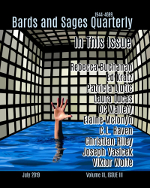
Second, my story “The Gettysburg Paradox” appeared in the July issue of Bards and Sages Quarterly. The ebook copy of the magazine is available on most ebookstores, and you can find the link here.

The story is about a time traveling tourist at the Battle of Gettysburg who learns that almost all of the combatants are (not so secretly) time travelers themselves. In their efforts to reshape the world, they’ve all converged on this one turning point in history, making it the largest battle ever fought on American soil.

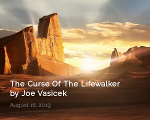
Third, my story “The Curse of the Lifewalker” appeared on The New Accelerator just last month. This is my third story that the good folks at TNA have picked up, and they publish new stories weekly with a very reasonable subscription model to their site.

The story takes place in Utah Valley a couple of hundred years after the apocalypse. Humanity has been afflicted with a blight that shortens all of our lifespans to 25 years, but the main character is one of the few people who is immune. But because of how things have changed in the intervening centuries, his immunity turns out to be more of a curse than a blessing, as he gradually becomes an outsider in his own community.

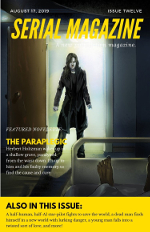
Fourth, my story “Lizzie-99XT” appeared in last month’s issue of Serial Magazine. The digital copy of the magazine is $2.99, and the print copy is $4.99. There are a bunch of other stories in this issue, and all of them are about life and death decisions.

Next month, I have a couple more stories coming out. “Starchild” will appear as a reprint in Bards and Sages Quarterly, and “The Infiltrator,” a never before published story, will appear in the anthology Not Far From Roswell. So be sure to keep an eye out for those!

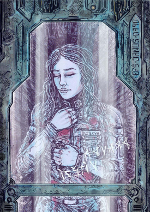
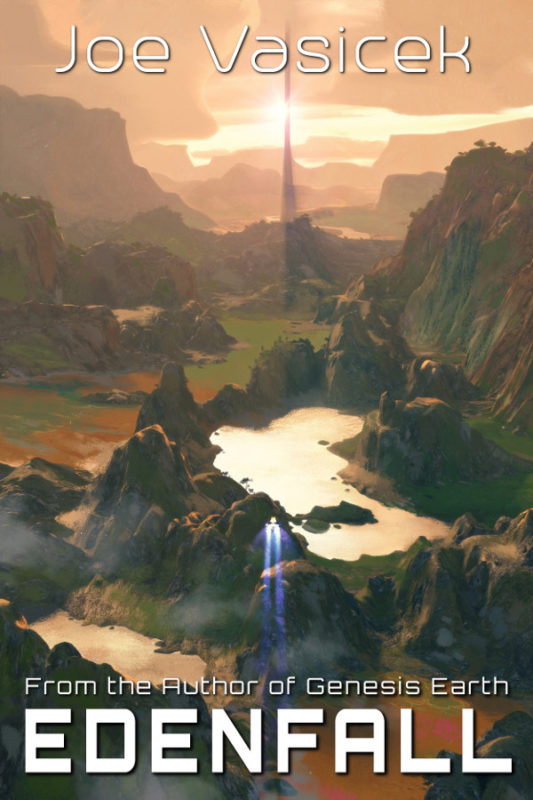
Finally, here is the cover art for Edenfall. Check it out!

I’m very happy with how it turned out. The illustration is by Hideyoshi, aka Lorenz Ruwwe, who did the cover art for Genesis Earth. I still have to go through the edits, but that shouldn’t take longer than a week, and the ebook will be up for preorder shortly after. The release date will be in December.

Edenfall cover reveal!

Last week in my author newsletter, I revealed the cover art for my next big novel release, Edenfall. This is the sequel to Genesis Earth and the second book in that trilogy.

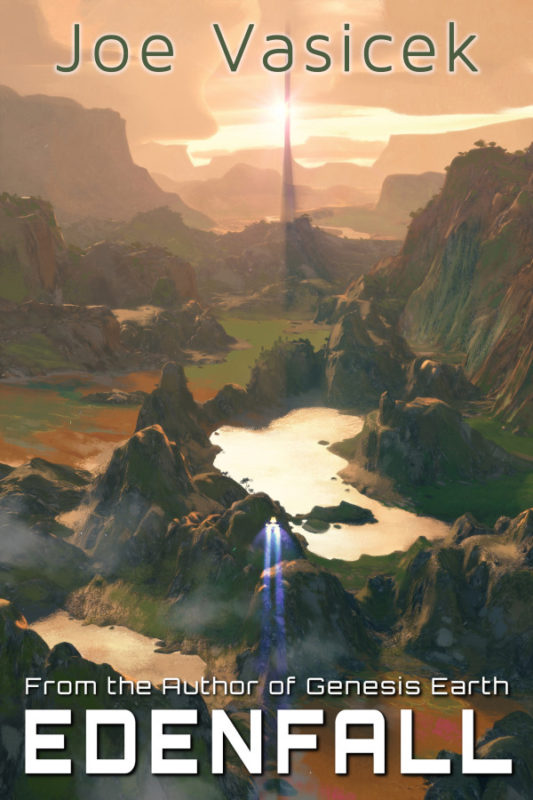
Without any further ado, here is the cover!

The art is by Lorenz Ruwwe, aka Hideyoshi. I’m really happy with how it turned out. He did the art for Genesis Earth, so I’m really glad I was able to get him for this one too.

Edenfall will be up for preorder soon. To keep up with all of my new releases, as well as writing updates, special offers, book recommendations, and other cool stuff, be sure to sign up for my author newsletter! I’ve scaled back my blogging, so that’s the best way to keep up with me now.

I’m married now!

So last week Future Mrs. Vasicek and I got married! It’s been really amazing so far. Amazing, and surreal. This is the first I’ve been on a computer since the 11th. We honeymooned in a cabin up in the Tetons, about a dozen miles from the edge of civilization, and it feels odd to be back, not the least because I’ve moved into her house now, which is now our house… an actual house. Like, with a yard and stuff. It’s pretty rad.

The reception was amazing, too. I should probably post pictures, seeing as we had a dunk tank in the end. Yes, Mrs. Vasicek got dunked in her actual wedding dress. She didn’t want the guests to get bored during the reception, so we had a dunk tank, and a bounce house, and an ice cream bar, and a live band that was really amazing. I’ve never seen so many people dancing at a wedding reception. The floor was packed.

So we’re married now, which means going through all of our stuff, figuring what to keep and where it should go. That process will probably continue for the next couple of months. I’m also learning a bunch of interesting new things about her, like the fact that she has a pen collection of probably more than 100 pens! Good thing she married a writer.

In any case, it’s going to take a couple of weeks to ease back into writing again. My plan as of now is to spend the rest of June outlining my next WIP, The Stars of Redemption, which will complete the Genesis Earth trilogy. Lots and lots of publishing stuff to do, too, including new print editions of all of my books. Expect to see those in the very near future.

To get back into the swing of things, I will do my best to regularly update this blog. I also plan to send out a newsletter before the end of the week, with a sweet deal for my subscribers.

So much stuff happening. It’s surreal. I’m married to a woman who is perfect for me in every sort of weird, quirky way imaginable. If you’d told me a year ago that this was where I’d be, I wouldn’t have dared believe it. It’s amazing. It’s beautiful. Everything is beautiful. When people cut me off on the road, I don’t even care. My wife gets off work in an hour and ten minutes, and I can hardly wait to see her again. Being a newlywed is the most amazing drug ever.

WIP excerpt: Edenfall

It’s been a while since I did one of these, so I thought I’d share a quick excerpt from my current WIP. This one is from chapter 2, where Khalil Al-Marikh is introduced. He and Estee are the two major viewpoint characters of this book.

This excerpt hasn’t been edited yet, so any typos or other mistakes will be fixed before I publish the book.

Paradise Found

Lieutenant Khalil Ibn Yusef Al-Marikh tapped his earpiece with one hand and held onto his seat with the other as the lightly armored rover bounced on the uneven, rocky ground. His driver, Private Andre Cernovich, seemed to be in a great hurry to arrive without even knowing their destination. That, or Cernovich was simply joyriding.

“Sergeant Peters, this is Khalil. What do you have for me?”

“We’ve found what looks to be the scientists’ expedition compound two klicks out from the space elevator. Our heat sensors show that it’s inhabited. What do you want us to do?”

On the display screen just below the windshield, a green dot blinked to show the sergeant’s. Corporal Cernovich swerved and headed in that direction.

“Are they armed?” Khalil asked.

“Not from what we can tell. Though they may be armed with bows and arrows like those natives who shot at us on the way in.”

Khalil remembered the look on their shuttle pilot’s face as the arrows had clattered against the cockpit window. His men had proceeded through the brush with caution, though thankfully, the natives hadn’t shown up since.

“Hold your ground and wait for us to join you. We’re about five minutes out.”

“Copy, Kali. We’ll establish a perimeter and await your arrival.”

The connection cut out. Khalil focused his attention forward as the roar of the rover’s engines not quite managed to drown out the sound of the native wildlife. The ground, though rocky like his Martian homeworld, was covered in high grass and patches of thick brush. The mountains, which had appeared red from orbit, weren’t yet visible in the pre-dawn twilight.

There was no denying the alienness of this world. From the large double moons and the strange constellations to the thick, musty scent of the air, the inescapable sense of otherness seemed to permeate everything. It set Khalil on edge almost as much as Cernovich’s driving.

The rover hit an unusually large bump, and the resulting bounce nearly flung his gunner, Private Vance, into the air. A chorus of angry profanity was the predictable result.

“Dammit, Andre, you drive worse than my drunk grandma!”

“Stay frosty,” Khalil ordered, scanning the horizon with his heat sensors. The wheels of the rover cut through the grass like a hot knife through butter, and the dry, dusty air blasted Khalil’s face. The landscape was so full of life, it was difficult to tell which targets were harmless and which posed a potential threat.

As they rounded a large rocky outcropping, a swarm of enormous insects took to the air. Vance immediately opened fire. The crack of laser fire mingled with a shout of surprise, which gave way to whoops of victory as dozens of the bugs exploded in a shower of splattered guts.

“Hold your fire,” Khalil ordered. “It’s just the native wildlife.”

“Damn, Kali. Did you see the size of those things?”

“Get used to it, private.”

He glanced up at the trigger-happy teenage marine. Khalil was barely eighteen Terran years himself, which still put him ahead of most of the soldiers under his command. Any older, and the forty years of crysostasis they’d undertook to get here would have significantly reduced his probability of surviving the voyage. Even the main force, which was still on the outskirts of the system, was staffed almost exclusively by teenagers.

Unlike most of them, though, Khalil had never had the luxury of a childhood. His parents were refugees twice over: first from Iraq, and then from Earth. Khalil had never been to his family’s ancestral homeland, but he did have memories of their Syriac Orthodox Church in Los Angelos burning as the Sharia police looked on.

He drew a sharp breath and put such thoughts from his mind, refocusing on the mission.

“There, Cernovich,” he said, pointing to a spot on the map near Sergeant Peters’s current positon. “Drop us off there.”

“Got it.”

A few minutes later, Cernovich brought the rover to a stop behind a small hill. Khalil checked his rifle and dismounted with Vance and Cernovich. Tensions were high, but none of them said a word as they took up positions in the waist-deep grass and prepared to move out. Khalil checked his earpiece.

“Are you there, Lieutenant?”

Sergeant Peters’s voice sounded uncannily loud in Khalil’s ear, now that they’d left the rover. Even the buzzing of the native insects seemed quieter.

“We’re here, Peters. Where are the others?”

“Spread out to the east of the target, with a good overlook position on the right. Hold your position; we’ll come to you.”

“I copy.”

A few moments later, Sergeant Peters materialized from the shadows with Specialists Mikhailov and Martinek. Green and black streaks of face paint covered their faces, making effective camouflage in the high grass. Peters was the taller one.

“What have we got?” Khalil asked quietly.

“It’s the scientists, all right. The dome gives it away. Gilbert and Baier are in position on our right flanks, with Matheson on our left and Ahiga on the far side of the compound.”

“Good work,” Khalil praised his noncom. “Got a vantage point?”

“Right this way.”

He followed his sergeant into the high grass, switching his goggles from infrared to heat signatures. Almost immediately, he could make out the rest of the platoon. They had spread out over a distance of almost a hundred yards, some of them prone, others creeping forward.

Up ahead, on the other side of the rise, he made out structures. Most of them were made of clay and native mud, and still radiated traces of heat from the previous day. A couple of them were dome-shaped, though, and clearly not made from native material.

“How long have you been monitoring this compound?” Khalil asked quietly.

“Only since we arrived. Should we wait until daylight, or move in now?”

Khalil looked skyward, as if to seek out their eyes in orbit. If they’d deployed their probes first instead of sending out the marines, his men might have had advance notice of this compound. Then again, with a mysterious alien structure towering above what appeared to be an otherwise virgin planet, he couldn’t blame his superior officers for wanting to establish a beachhead first. Speed, not stealth, was their chief advantage now.

“Move in,” he said softly. Peters nodded and made a quick cutting motion with his hand. All around them, the marines moved quietly forward as they began to converge on the compound.

A quick update

If life had a crazy-meter, the needle on mine would be somewhere in the yellow green right now and trending toward the red.

Next week, Future Mrs. Vasicek and I will be traveling to Iowa for my nephew’s baptism. It’s going to be a big family affair. Future Mrs. Vasicek has met everyone already, minus some of the nieces and nephews, but this will be the first time that we’re all in the same place together. Should be fun, but also very busy.

Next month, we’re getting married, and that’s a whole other source of craziness right there. Good craziness, but craziness all the same. Things are coming together one thing at a time, but there’s still a bunch of stuff to figure out, and a bunch of unknown unknowns as well. It will probably take at least a couple of months after we’re married before everything fully shakes out.

As far as writing goes, I’m making slow but steady progress on Edenfall, and should still finish it before the wedding. I’ll share more details on that in the email newsletter that I plan to send out this week, but the short version is that I seem to be over the hump and making good progress. That’s where I’m putting most of my energy, so if the blog falls off for a while, don’t worry—I’m still here.

As for the publishing side of things, I’m figuring out how to get all my books out in print, which was something I thought I’d figured out back in January until I learned just how crappy KDP Paperback really is. That said, it’s the best option for the present time, so I’m trying to figure out how to work within those limitations and design covers that their POD printers won’t mangle too badly. Still, it’s going to be a while.

An area where I’ve really dropped the ball is short stories. It’s been months since I wrote the last one, and I need to put a bunch out on submission again too. Also, marketing is an area that I need to do better in. I’m experimenting a bit with AMS ads, but it is so freakishly complicated that I hardly know where to begin.

But reading is an area that I really need to do better. I try to spend an hour or two each night reading, but the last couple of weeks that hasn’t happened at all. My TBR list is about three shelves long right now, and that’s just the print books. That’s definitely an oversight that needs to be rectified.

At the same time, I’m well on my way toward collecting all of the works of David Gemmell, mostly through Paperback Swap. If everyone has a superpower, mine is the ability to acquire books, so Paperback Swap is a really fantastic way to leverage that. The Neverending Story is my favorite book, but David Gemmell is my favorite author, so I definitely want to have all of his books in my personal library.

That’s pretty much it. Still need to figure out cover work for Edenfall. Still need to assemble my first readers and get stuff figured out for that. All of these are good problems, though. Hopefully, I’ll be trading up for better problems in the very near future.