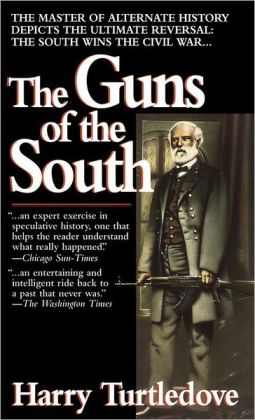
The Guns of the South by Harry Turtledove

As those of you who’ve read my short story “The Gettysburg Paradox” know, I’m a huge fan of both the US Civil War and time travel stories. Harry Turtledove’s The Guns of the South is, quite possibly, the best combination of the two.

The novel starts just a few weeks after Gettysburg. The Army of Northern Virginia is in disarray, and a defeated Robert E. Lee has been forced to face the truth that the Confederacy has no real hope of winning the war. Then a bunch of time travelers in strangely mottled uniforms show up out of nowhere and supply his army with strange new guns called AK-47s.

Immediately, the tides of war change. Lee soundly defeats Grant at the Battle of Wilderness and presses on to Washington DC, which falls overnight. Triumphant, the South immediately sets about the peace negotiations with their northern neighbor, and prepares for a presidential election which Lee is expected to win. But disagreements about the fate of the new American nation soon arise between Lee and his benefactors, sparking a conflict that is truly out of time.

There’s so much to love about this book. Turtledove’s attention to detail is meticulous, not just in the obvious major ones, but in the little ones that have a disproportionate impact. For example, Lee appreciates the killing power of the  AK-47s, but what impresses him even more are the MREs that the time travelers carry. When the gunmakers in Richmond pick apart the AK-47 in an effort to replicate it, it’s really fascinating to get their take on its functions. It really does read like a bunch of 19th century denizens puzzling over technology that they barely understand.

But what really got to me were the characters. Having read The Killer Angels and Jeff Shaara’s prequel and sequel to that great novel, Robert E. Lee felt like exactly the same character, just in a different book. His genteel sense of propriety, his calm but unshakeable sense of honor, his love of his men and respect for his enemy—it really was the same guy. And the decisions he makes after the war is over, while truly radical, are also eminently believable.

It’s not just Lee, either. Lincoln, Soward, Longstreet, Forrest—all of them feel very much like the people they really were, inhabiting an alternate reality. Turtledove’s research into their characters and personalities was meticulous. And it wasn’t just the big names, either, as all of the 19th century characters, including a prostitute who pretended to be a man in order to join the infantry, are based on real people who actually lived.

Fantastic book—a must-read for anyone with an interest in time travel or the US civil war. Whether those interests intersect for you or not, you’ll thoroughly enjoy this book.

Trying out some pop ups

I just set up a pop up with a subscribe form for my email newsletter. It should only pop up once every two weeks, and only on the first page you visit. If you think it’s too intrusive or have strong opinions on the matter, let me know.

I’ll be experimenting with a few things in the near future, including pop ups. I may also change the layout here to the new WordPress Twenty-Nineteen theme. It looks interesting. Again, if you have opinions, I’d appreciate your feedback!

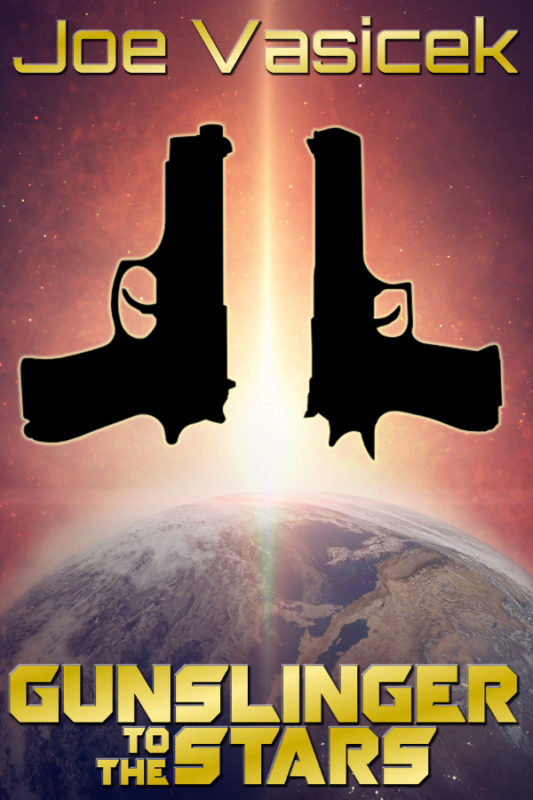
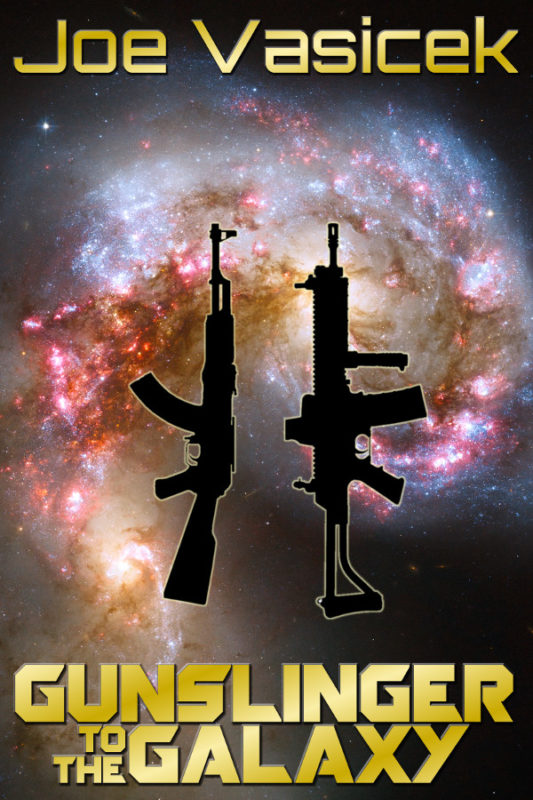
Gunslinger to the Stars is 99¢ all month!

To celebrate the release of the second book in the Gunslingers Trilogy, Gunslinger to the Stars is going to be 99¢ all month! Now is a great time to check out these books, if you haven’t already. The third book in the trilogy should be coming out early next year!


Not long from now, in our own Milky Way…

Sam Kletchka here, freelance gunslinger and interstellar privateer. This, my friends, is how I went from being stranded in the armpit of the galaxy to the luckiest human in the galaxy.

New plans for the blog

I’ve been revising my business plan lately, codifying a lot of things I’ve tried over the past year into a coherent, unified strategy. It feels like I have all the pieces now for a successful writing career, but I just need to figure out how they all fit together. That’s the goal.

One of those pieces is this blog, which has unfortunately fallen into a state of chronic neglect. I haven’t abandoned it entirely, of course, but I haven’t been focused as much on it as perhaps I should have. Instead of using it to support all the other things I’m doing, I’ve treated it more as a thing unto itself, which makes it a distraction instead of an essential part of what I do.

That’s going to change soon, because I think I’ve figured out how this blog fits in with everything else. But that also means that I’m going to make quite a few changes.

First, I’m going to post a lot more book reviews. Ideally, I’d like to post one every week. I’ve read a bunch of really good books over the last month, so once I sit down to review them I should have enough content for the next several weeks. In this way, my blog can reinforce my reading goal (50 novels per year) while also sharing something of immediate value to my readers.

Second, I’m going to experiment with pop-ups on my blog pages to get more email subscribers. I know, I know, everyone hates those things, but they do work, believe it or not. My email list is the centerpiece of my marketing plan, and if this blog is going to be more than a thing unto itself, I have to integrate it into that plan.

I’ll do my best to keep the subscription forms from being too intrusive, like having them only pop-up after you’ve scrolled to the bottom of the page, or only have them pop up on the first page you visit.

Third, I’m going to be a lot better about posting whenever I have a sale, a new release, or a featured book. I already have book pages for all of my titles, and it’s not difficult to post the links in the sidebar, or embed them in a blog post.

Fourth, I’m going to be a lot better about posting updates on WIPs, publishing projects, and other things that I’ve been up to. I already include those updates in my newsletter, but I could do a lot better at putting them here.

I want this blog to be both a platform for connecting with my existing fanbase as well as a vehicle for gaining new fans. So that’s what the content here is going to be geared toward. I’ll still include my personal reflections on various subjects from time to time, and I’ll probably put a few more blog series together, but I’m going to be more careful about keeping my readers in mind.

This isn’t a writing blog anymore—indeed, it hasn’t been a writing blog for the past several years—but I’m not going to put too many restrictions on what I blog about either. We’ll just have to see how it unfolds. As for the more controversial stuff like politics, I’m not going to hide from it, but I’m not going to wear it on my sleeve either. As much as you love it when authors of escapist fiction rant at you like your batshit crazy uncle on Facebook, it would seem that niche has already been filled many times over. </ snark>

There’s a bunch of other stuff I’d like to try out, but let’s stick to this for now. Book reviews, more frequent updates, and better integration with the email list. It’s going to be a great new year!

Yes, I still exist

Wow, it’s been more than a month since the last time I posted on this blog? This needs to be rectified, and by more than a solitary post.

It’s been a bumpy few weeks. Not rocky, but not smooth either. Between working unpredictable odd jobs and unexpectedly finding myself in a romantic relationship, it’s been difficult to get into a productive writing and publishing routine—hence, the less frequent posting on this blog.

That said, I’ve seen a marked increase in book sales recently, which is encouraging. Getting a couple of Bookbub featured deals definitely helps. By my calculations, I have about six months of expenses in my business savings, which includes things like Bookbub deals and convention costs. The goal, though, is still to build my email list, and that’s proceeding a lot slower than I would like. I need to find new and better ways to get my books in front of the readers who will love them.

Writing-wise, things are proceeding at a slow but steady pace. I’ve put Queen of the Falconstar on the back burner for the time being, to work on Gunslinger to Earth. If all goes well, I should be finished with that WIP by mid-January, and release it in April. That will complete the Gunslingers trilogy!

I think it might be cool to release a few excerpts in audio as well as on this blog. What do you guys think? Record a few MP3s of my own narration, release them as downloads. Or maybe put them up on YouTube. It’s a bit ironic, because Gunslinger to Earth is a first-person book from Jane Carter’s perspective, but still, I think I can pull it off. It will also be good practice for audiobook narration, which I hope to do more of in the following year.

In other news, I’ve decided to hold off on self-publishing any more of my short stories until I’ve sold the first publication rights. Up until now, I’ve been fitting them into my publishing schedule for the months when I don’t have a novel release. But I think that holding off to publish them traditionally, even with a market that pays semi-pro rates, is better than self-publishing them just for the sake of having something to release.

Don’t get me wrong: I still want to self-publish my short stories, I just want to sell them to a magazine first. In the short term, this means that I won’t have as many things to fill out my publishing schedule. In the long-term, it means that I need to write more short stories now in order to have more content to submit to the magazines, and ultimately to fill out my publishing schedule later.

So my goal from now on is to write at least one short story a month, on top of my regular WIP schedule. Some of these will be in the same universe as my novels, much like Starchild or Jane Carter of Earth. I’ll probably self-publish those first, to promote my new releases. But the other stories will stay on submission until they sell, preferably at professional rates.

I really need to up my short game. Speaking of which, Larry Correia just released the cover art for his second short story collection, and it is hilariously badass, much like Larry himself. I love the fact that his wife is in it too.

Looking ahead, I hope to get back into a semi-regular blogging routine, with more book reviews. I’ve read quite a few books recently, and it would be good to share a few reading recommendations. And I’m still writing regularly. Just because I’ve neglected the blog doesn’t mean I’m neglecting everything else.

That just about does it for now. Take care, and thanks for reading!

My New Writing Process (or why I don’t believe in pantsing anymore)

For the longest time, I thought I was a “discovery writer.” That is to say, I believed there were two kinds of writers—pantsers vs. plotters—and that I was very much a pantser. It was what I was comfortable with. It was what I defaulted to when I sat down to write. It was the style of writing that for me, produced the best books.

Or so I thought.

Ten years later, I come to a realization: my writing process needs work. In order to keep writing at a professional level, I need to produce more books, and to do that, I need to write cleaner first drafts. Discovery writing was great for short stories or novellas, but my novels always seemed to hit a block somewhere in the messy middle. If I want to put out a new book each month, that’s not something I can afford.

Around this time, I read The Seven Habits of Highly Effective People. The second habit, “begin with the end in mind,” challenged everything I thought I knew about writing. According to Stephen Covey, everything is created twice: first in the mind, then in reality. To achieve maximum effectiveness in your work, make sure you have a clear plan.

“But wait!” I said. “I’m a pantser—a discovery writer. I don’t do outlines. That’s for plotters.”

And then I thought about it.

What if the whole “pantser vs. plotter” dichotomy is wrong? What if you have to master both skills to really be a masterful writer? Sure, there are plenty of successful writers who never do, but would they be more effective if they did?

What if it’s a bit like talent? People believe that you need talent to be successful, when in reality, talent is just a starting point. A writer who works hard to improve their craft will always overtake a talented writer who doesn’t. And yet, this myth of talent persists, mainly because people can’t see (or don’t want to see) all the hard work that goes alongside it.

This is the conclusion I’ve come to: that when it comes to professional writing, there are no “pantsers” or “plotters.” There are only different forms of outlining. It may be as simple as a one-paragraph sketch, or it may be as complex as a two-hundred page story bible. There are as many outlining methods as there are writers, and many writers tweak their methods with each book in an effort to improve their process.

“Discovery writing” was what came easy to me, but to achieve my full potential, I had to embrace the stuff that was hard. And that meant learning to make an effective outline.

The Old Writing Process

Here’s how I used to write a book:

I’d get a bunch of ideas and do nothing with them. Nothing at all. I told myself I was just letting them stew in the back of my mind, but really it was just an excuse to not do any outlining.

Eventually, the muse would hit me over the head, and an idea would become so compelling that I couldn’t not write about it. At this point, I’d come up with an opening scene and a premise for the rest of the book. I’d also have a vague idea of how the story was going to end, but I wouldn’t pursue it at all, for fear that too much planning would “ruin” it.

All of the other ideas would start to come together, but without an outline to show how they were all connected, I would lose sight of it almost immediately. After writing the first couple of chapters, I soon found myself in the thick of the forest, with only the vaguest idea of where I was going. Soon, I’d lose sight of the forest for the trees. I’d hit a block and try to push my way through, only to find that I was lost.

At this point, I’d set the unfinished WIP aside for a few months, to approach it with “fresh eyes.” It was basically a failed draft. When I felt ready to pick it up again, I would start all over from the beginning, recycling all the stuff that seemed to work and cutting out the stuff that didn’t.

If things went well, I’d push through that block and write the next few chapters… until I came to another block, and had to set it aside again.

If things did not go well, I’d hit the same block only to find that I couldn’t push through it. Something was broken that was fundamental to the story itself. If I was lucky, I’d catch onto that fact soon enough not to lose too much writing time. But more often than not, I’d spent weeks and months agonizing over it, and beating myself up for being a horrible writer.

This would go on for years. My pile of unfinished WIPs grew increasingly larger as I bounced from one failed draft to the next. Usually on the third or fourth attempt, though, I’d push all the way to the ending—not quite the ending I first had in mind, but one that still worked. Kind of sort of.

Then came the revisions.

I’d set the book aside again, usually for a few months. When I was confident I could approach it with “fresh eyes,” I’d pick it up again, only to realize that it suuuuuucked. A little bit angry with myself for writing such a crappy book, I’d go at it with an axe. Characters, subplots, and chapters would all get cut out.

After mauling my WIP to pieces, I’d stitch it back together, usually with the scenes in different order. Then I’d set it aside for a few months again. Rinse and repeat.

Eventually, it would reach a point where it didn’t suck. The ideas would finally come together in some approximation of the way I’d originally envisioned—or would have envisioned, if I’d made the effort beforehand to do so. I’d send it out to my beleagured beta readers (some of whom I’d dragged through multiple drafts), make a few final tweaks, and then start the publication process.

By now, several months would have passed since I’d published anything. If I was lucky, I’d get a couple dozen preorders and sell a few dozen more in the first month. If not, I’d release it to a chorus of crickets.

The New Writing Process

Anything worth creating is worth creating twice.

The first creation starts with a rough outline of the plot. According to Dramatica theory, a complete plot has four throughlines:

  • The Objective Throughline is the basic overview; the general’s view. It’s what you tell people when they ask “what’s your story about?”
  • The Main Character Throughline is the story as experienced by the primary character through whom the readers insert themselves into the story—basically, the character that all the kids fight to be. “I’m Belle!” No, I’m Belle!” “No, you can be Gaston.” “But I don’t want to be Gaston!”
  • The Impact Character Throughline is the story as experienced by the foil or counterpoint to the main character, who creates most of the tension that drives the story forward. “Fine, then, you can be the Beast.” “Okay, but next time, I get to be Belle!”
  • The Relationship Throughline is like the objective throughline, but focused on just the relationship between the main character and the impact character. As both characters change and grow, the best way to show that is often through the changes in their relationship.
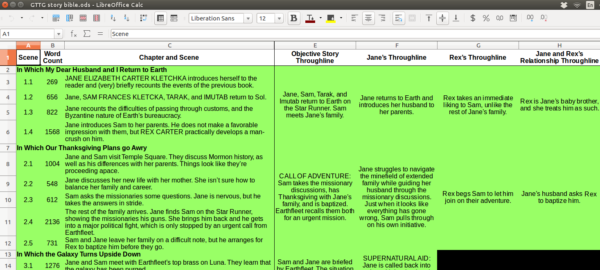
Once I’ve figured out the throughlines, I match them up in a spreadsheet to form chapters. Each chapter breaks down into three or more scenes, which serve to advance the throughlines. The scenes also work together to create a beginning, middle, and end for each chapter.

At this point, with the main plot of the book fully outlined, I start to add subplots. These can be romantic, tragic, or just an opportunity for one of the minor characters to shine. I may also add a background storyline with stuff going on behind the scenes that never makes the page, just to keep track of what’s going on.

Where the plot points for the throughlines correspond to whole chapters, the plot points for the subplots correspond to the scene level. A subplot may start or end in the middle of the book, or lay dormant for several chapters. I try to make each scene do double-duty, but add new ones as necessary.

For each of the major characters, I also write up a character sheet. This lists all of the specific details that tend to get mixed up in a rough draft, like hair color, eye color, height, weight, etc. It also gives me a chance to do a deep dive into who this character is and what makes them tick. Besides things like religion, education, occupation level, etc, I also include things like family relations, backstory, strengths and weaknesses, handicaps, etc.

Beyond that, I may draw up a sheet for conflict alignments, or to list all the story tropes that I want to include in the story. It really depends on the book.
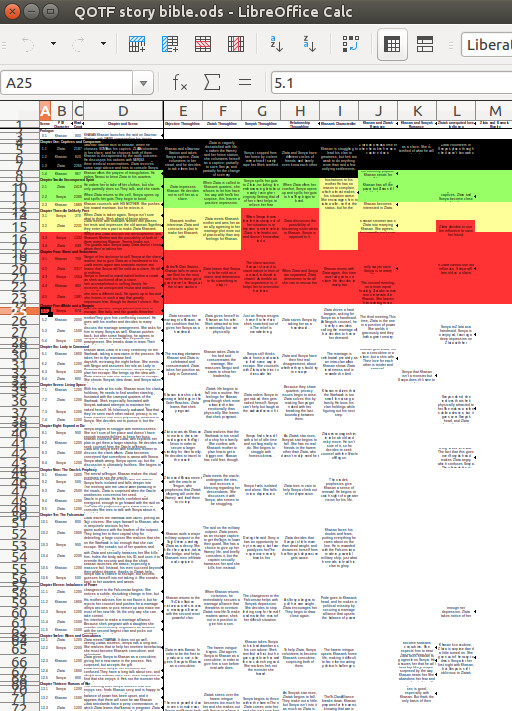
Lately, I’ve been experimenting with a process for revising my WIP as I’m drafting it. I keep a sheet for revision notes and color each scene and plot point for which draft phase it’s currently in: red for first draft, yellow for first revision pass, green for second revision pass, and black for final draft.

After fixing all the major issues, usually on the first or second pass, I set a goal to cut 10% of the words in the scene. Usually I end up cutting closer to 20%. This improves the quality of the writing and helps to make it much tighter.

I’m still experimenting a lot with my outlining techniques, trying out new things and refining the things I’ve previously tried. A year from now, I’m sure it will look much different. But the two major parts that do work quite well are the plot outline and the character sheets. Everything else builds on top of that.

And the really cool part is that it actually works. From June to August, I started a full-time job, moved twice, and experienced a family emergency, and I still managed to finish a novel through all of that, largely thanks to this outline. No writing blocks. No failed drafts. Just 600 words a day, no matter what else was going on, and by the end of it, I had a publishable novel.

I think this book will help me to write longer books, too. That’s what I’m working on next. If all goes according to plan, Queen of the Falconstar will be my longest book yet—not by very much, but still a good 10k words longer than Bringing Stella Home, which is currently my longest book. The things I’m learning now will help me to write more epic fantasy, like the next two books in the Twelfth Sword Trilogy. That’s the goal at least.

If there’s nothing else I’d like you to take from this post, it’s this: don’t be afraid to try new things. Don’t put yourself into a corner by saying things like “I’m a discover writer,” or “I’m not really an outliner.” Try it! You learn a lot more from your failures than you do from you successes.
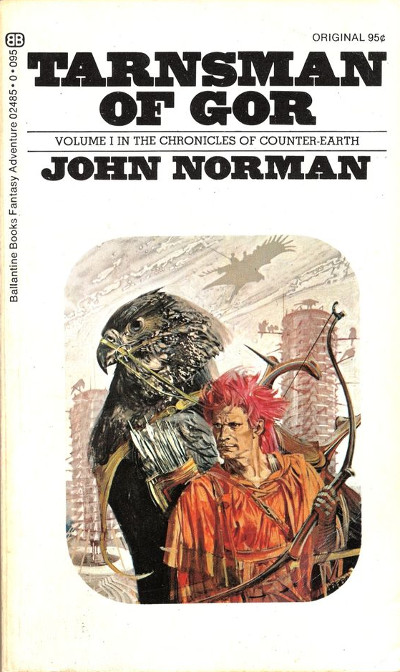
Tarnsman of Gor by John Norman

I’ve been meaning to read this book for a while, since I heard that it’s a classic of the Sword and Planet subgenre and I’ve really liked the other Sword and Planet books that I’ve read. (Princess of Mars, The Dying Earth, etc. Come to think of it, I haven’t done a review of Princess of Mars yet, so that’s as good a reason as any to reread it!)

Besides the association with Sword and Planet, the Gor books have also spawned a subculture of BDSM, and for good reason. On Gor, slavery is not only normalized, it’s romanticized. A typical marriage ceremony consists of the groom binding up his bride, carrying her off on a giant bird, and throwing off her clothes to “show her people what had been the fate of [such and such girl].”

I don’t swing that way, but I thought I’d give the first book a try. I’d heard that the bondage fetishism doesn’t take over until the fifth or sixth book, and while it’s definitely there in Tarnsman of Gor, it wasn’t enough to make me put the book down.

As a swashbuckling action-adventure tale, I thought this book was pretty good. There definitely was no shortage of action, and while the plot twists were fairly predictable, they were also enjoyable and interesting. It’s a fun, if brutal book.

There were a lot of lengthy info-dumps, though, which wouldn’t have been so bad except that I had problems with the world. In general, it felt like the author had come up with a really cool world but not sufficiently thought it through. For example, if humans aren’t the apex predator on Gor, how are there so many human cities? If the caste system is maintained by deliberately sharing false information with the lower castes, how is that system long-term stable if the caste isn’t something you’re born into?

The general impression I got was that this world is a brutal, savage place where everyone is broken in some way, a lot like Mad Max. The thing is, I’m not sure that that’s what the author was going for.

That may just be an artifact of the time this book was written, though. A lot of older books that invented the tropes now seem stiff and wooden—not because they weren’t innovative for their time, but because we’ve seen those tropes so many times that we already know what to expect. Tarnsman of Gor was written back in the sixties, before role playing games and chihuahua-killing fantasy tomes had made world-building so important. Back then, it probably was enough to say “here’s a really cool world” without first thinking about all the ways to break it.

Again, that wouldn’t be so bad if all this book attempted to be was a swashbuckling adventure on another world. But at several key points, the narrator steps back from the story to explain some aspect of the world that was only tangentially related to the plot.

All in all, I give this book three stars. It’s worth reading if it interests you, but it’s not a must-read.