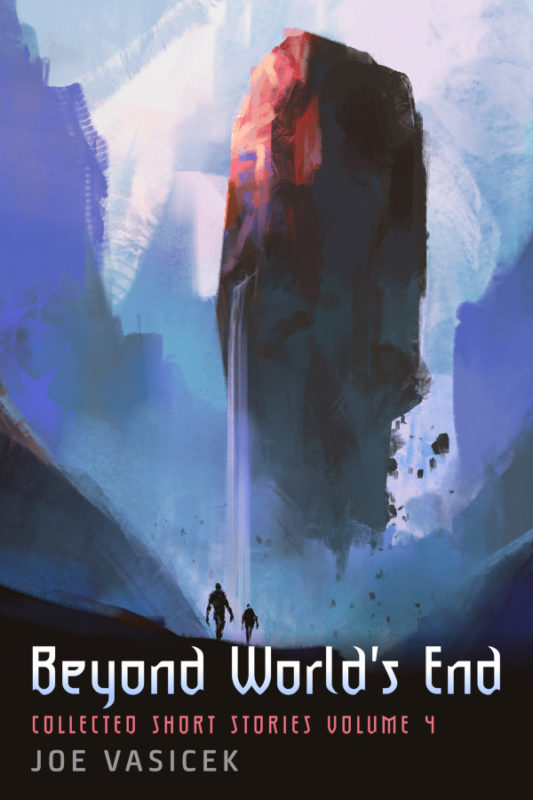
Now available for pre-order: Beyond World’s End (Collected Short Stories #4)

Beyond World’s End

Beyond World’s End

Eleven short stories and a poem that show us what comes after the end of all we know.

This is the fourth volume of the collected short stories of Joe Vasicek. It includes:

The Manchurian Paradox
A Fatal Rebirth
The Final Turning
The New Covenant
Hearken and Behold (by J.M. Wight)
The End of Elysium
The Promise of King Washington
Lord of the Slaves
The Other Side of Reality
Schrödinger's Diaper
Two Hours Ago
Welcome to Our Crazy Family

Order Now!
About the Book
Eleven short stories and a poem that show us what comes after the end of all we know. This is the fourth volume of the collected short stories of Joe Vasicek. It includes: The Manchurian Paradox We have met our timeline’s enemy and he is us. A Fatal Rebirth Nothing in this world should live forever—not even civilization itself. The Final Turning This is how the world ends: not with a bang, but with a whimper—thanks to me. The New Covenant To restore a fallen America, an ancient and terrible covenant must be renewed. Hearken and Behold (by J.M. Wight) “Hearken, oh ye hypocrites, and behold the desolation that is already come upon you!” The End of Elysium For the promise of paradise, the last civilization will surrender to the apocalypse. The Promise of King Washington When the aliens came, it wasn’t a military invasion: it was an economic one. (Again, Hazardous Imaginings, December 2020) Lord of the Slaves “Everyone secretly wants to be a slave. Those who deny it simply haven’t found the right master.” The Other Side of Reality What if your future self came back to give you advice, and all it did was confuse you? Schrödinger’s Diaper “Stays clean and dry until you’re free to change it!” …except not quite. (Bards and Sages Quarterly, April 2022) Two Hours Ago A time machine without paradoxes, so long as it’s not abused. Welcome to Our Crazy Family Two genderqueer lesbians and a tranny have a rebellious daughter who does the unthinkable and decides to marry a Christian.
Details
Authors: Joe Vasicek, J.M. Wight
Series: Collected Short Stories, Book 4
Genres: Collections & Anthologies, Collections & Anthologies, Fantasy, FICTION, Political, Religious, Science Fiction, Short Stories (single author)
Tag: 2022 Release
Publisher: Joe Vasicek
Publication Year: May 2022
Length: Collection
eBook Price: $4.99
Joe Vasicek

Joe Vasicek fell in love with science fiction and fantasy when he read The Neverending Story as a child. He is the author of more than twenty books, including Genesis Earth, Gunslinger to the Stars, The Sword Keeper, and the Sons of the Starfarers series. As a young man, he studied Arabic at Brigham Young University and traveled across the Middle East and the Caucasus Mountains. He lives in Utah with his wife and two apple trees.

Some of the links in the page above are "affiliate links." This means if you click on the link and purchase the item, I will receive an affiliate commission. You will not receive any additional charge. As an Amazon Associate I earn from qualifying purchases.

Thinking about getting back on Twitter

So now that the world’s richest African-American—who has done more to save the world from the evil sun monster than everyone at COP 25 put together—has now bought Twitter and promised to bring back free speech to the platform, I am seriously considering whether I ought to make a new Twitter account and become active on social media again.

I deleted my Twitter account back in 2016, before the elections, and blogged about it (in less than 140 characters, of course) by saying “life is better without it.” And that’s true. Life is so much better without a Twitter addiction, and that’s the one thing that makes me reticent to get back on the platform.

There is no doubt that our current incarnation of Twitter, before the Elon Musk takeover, is a toxic dumpster fire of outrage and stupidity. But it is also the public square. Life without social media is a lot healthier in a lot of ways, but it does turn you into something of a hermit as far as the internet goes.

The thing is, I’m not very optimistic about Musk’s makeover of Twitter doing much to change the toxicity of the platform, because I think that toxicity has less to do with politics (though that certainly is a factor) and more to do with the dangers of social media addiction itself. In other words, I think our toxic politics is a symptom of social media toxicity, not a cause. The first half of The Social Dilemma really got this right, though the second half was mostly just bad propaganda about the threat of “misinformation” to “our democracy.”

So before I get back on Twitter again, I need to come up with some personal rules in order to keep it from becoming addictive, unhealthy, or toxic to my author brand. Back in 2010, Douglas Rushkoff came up with a sort of ten commandments for digital media, and that seems like a good place to start. His ten commandments are:

  1. Do not be always on
  2. Live in person
  3. You may always choose none of the above
  4. You are never completely right
  5. One size does not fit all
  6. Be yourself
  7. Do not sell your friends
  8. Tell the truth
  9. Share, don’t steal
  10. Program or be programmed

I probably ought to reread the book where he explains all of these commandments. It’s a quick read, with some good theory and a lot of practical wisdom. It is over a decade old, though, so I’m sure there’s a lot of stuff we’ve learned since then. Some of these rules probably don’t go far enough, while other may go too far.

In any case, I’m not going to get back onto Twitter until I have a plan, because the last thing I want is to get addicted to all of the toxic outrage and watch as my career (and possibly life) implodes because of it.

What personal rules do you follow when using social media?

Why I won’t be publishing “The New Covenant” as a free short story single

For short stories, I typically self-publish them first as free ebooks, until I have enough of them to bundle together in a collection. I’ve found that this is a great way to give new readers a taste of my writing and engage my already existing fans. It also helps to market the collections, which is great.

Last week, I was going to publish “The New Covenant,” a post-apocalyptic short story about a theocratic republic in the post-collapse United States that is holding a public execution of four abortionists. The main character is the bishop/mayor tasked with conducting the public execution. While the story doesn’t come down morally or politically on one side or another, he is a sympathetic character, and the execution does indeed take place.

As you can imagine, this is a very politically charged story, perhaps even more than “The Promise of King Washington” which starts out with vultures flying over hundreds of gallows lining the Capitol Mall in Washington DC. Politics has really become a minefield these days, and aside from the authors like Larry Correia who have picked a side and made that a major part of their author brand, it’s very difficult to write about politics or current events without turning everyone off.

Before the war in Ukraine, I used to be able to do that. During the 2020 election, I would share my thoughts in my newsletter, and get emails from fans that said “I totally agree with you, and that’s why I’m voting for Biden!” right alongside other emails that said “I’m so glad you get it! Trump-Pence 2020!” My basic approach was to engage in regular self-reflection, sincerely listen to opposing points of view, avoid outright partisanship, and assume that the person I was writing for was a good, honest person who disagreed with me. And until the war in Ukraine, that seemed to work.

But since the Russian invasion of Ukraine, something has really changed. About a month ago, I wrote an email with some of my then-current thoughts on the conflict, as well as some of my predictions for what will come next, and while I got a few friendly emails, I also noticed a lot of drive-by one-stars and upvotes for one-star reviews on Amazon. I suspect that that newsletter turned off some people, and a small fraction of them decided to take it out on me by one-starring a bunch of my books.

It may also have been something I mentioned on this blog. I haven’t publicly shared my reflections on the Ukraine war, but I have been pretty open about the fact that I’m reading through all of the Hugo and Nebula award-winning books this year, and have reflected rather candidly on that. Since this blog is public, it’s much more likely to attract attention from potential outrage mobs than my email newsletter, and ever since the Sad Puppies, fandom has been downright toxic with outrage mobs of every stripe. So the one-star bombers may have come from there.

Of course, it may also be that the quality of my stories is declining. But I don’t think it’s primarily that, because this is a new pattern of behavior that I haven’t seen before.

My general feeling is that the war in Ukraine has been pouring gasoline on every internet flame war, and that as bad as the partisan divide was in 2021, it’s getting much worse. Which means that it is rapidly becoming impossible to talk about politics or current events without taking a side, making the approach that I’ve taken up to this point untenable. A future historical narrative is being constructed before our eyes, and the stakes are nothing less than the fate of the world.

Of course, that also means that it’s never been more important to bridge the partisan divide. But that isn’t something I can do just by posting my musings and reflections. Every battle needs to be chosen deliberately and with care, and in most cases, the winning move is probably going to be not to play.

I am not ashamed of “The New Covenant.” I think it is one of the timelier and more thoughtful things I have written. But it’s also very political, and not a very good introduction to the rest of my books. I do still plan to publish it, but as part of my fourth short story collection, Beyond World’s End, and not as a free single. And moving forward, I’m going to be more careful about which short story singles I do publish. I’m not going to self-censor what I write, but I am going to be more careful about what I publish.

Spring Shorts 2022 Story #1: “Blight of Empire”

Finished the first short story of the writing challenge that I’m calling Spring Shorts 2022, which is to write 12 short stories before Memorial Day. This one is titled “Blight of Empire,” and it takes place in the distant future, where the galaxy is full of failed terraforming projects and a massive galactic empire rules almost everything. I used the Mythulu cards with this one, and here are the cards I drew:

  • AMPHIBIOUS: Adapted to live in two distinctly different environments. Likes to live on the threshold. (Draw +2 Habitat)
    • CAVE: Isolated biome that would survive even if the sun died. Represents impressive adaptability and unnecessary paranoia.
    • TERRAFORMED: Repurposed to support a specific, narrow spectrum of life. Can be forced, or part of natural biome evolution.
  • FESTERING: Open wound that has become infected and resists healing. Threatens the whole entity.
  • FIRE: Symbolizes passion. Has a dual nature. On one side, brings protection, healing, sanitation. On the other, destruction.
  • GODPARENT: Legally responsible for a child if parents die or are incapacitated. Named at birth and expected to participate in child’s life from the beginning.
  • INVENTOR: The one who pays the price to elevate their people. Graced with curiosity and unusual resilience to disappointment.
  • HUMID: Something is infused into the air and the levels fluctuate. Draw 1 Element to decide what’s floating around. (Draw +1 Element)
    • FUNGUS: More potent than plants, with all the same variations–edible, poisonous, medicine, entheogen. Overall, a tool for removing festering excess.

I had to draw the cards a couple of times before I came up with a good story idea. From now on, I’m going to go through each of the six decks, drawing the top three and choosing the one that seems most interesting. If I need to pick another card from that deck, it’ll be from the other two.

This story ended up going in a completely different direction than I thought it would, which was interesting. A lot of discovery writing with this one, which was a good change of pace. For the last month, I think I’ve been trying to write unsuccessfully through a general drought of creativity, but these short story exercises are helping to stimulate my creative mind again. Just need to make sure to keep filling the well.

Other than that, things have been kind of crazy around here. We have a long-term plumbing problem that just flared up again, and half the house’s plumbing is unusable. Unfortunately, that includes the washing machine, and our baby is in the middle of potty training. My wife has an uncle who works as a maintenance guy at BYU, and he’s been a huge help, but each day has been a different plumbing adventure. Later this week, we’re going to remove a section of cast iron pipe and run a snake up through it backwards, and maybe a shop vac too. I just hope the sewer pipe hasn’t been leaking under the foundation (knock on wood).

On the publishing front, I was planning to release a short story this week, but that got pushed back due to all this craziness. I do have my fourth short story collection up for preorder, though, so that’s something. Also ran a massive promo last week for Bringing Stella Home, which I recently relaunched with a new cover.

I think I’m going to keep using the Mythulu cards for this Spring Shorts 2022 writing challenge. In fact, I’m going to try to use all of the cards, just for the fun of it. That means that none of the cards I used for this story will show up again. I’ve already drawn a few base stories, and come up with some intriguing combinations. Very excited to write, if all this other life stuff will just calm down!

A reading hack for the ADHD-addled brain

I’ve got a mild case of ADHD. As a kid, I took ritalin from grade 3 through about grade 8, and as an adult, I occasionally self-medicate with caffeine (usually in the form of soft drinks, since I don’t drink coffee or tea). I can function all right without treating it, but I am more prone to getting distracted when I don’t. But leaving it untreated also makes it easier for me to make interesting connections between seemingly unrelated subjects, which improves my creativity, so it’s more of a trade-off between being more productive vs. being able to make leaps of logic and switch between subjects more easily.

In terms of reading, ADHD makes it very difficult for me to finish long books, unless I’m hooked all of the way through, which is rare. I’ll often start books but drift away from them without either finishing them or making the conscious decision not to finish them. Over time, this makes me less enthusiastic about reading, since I’ve got a huge pile of unfinished books behind me that I can’t easily get back into, because I’ve forgotten what was happening in them.

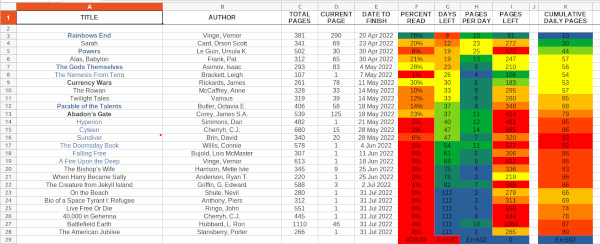
Well, I recently found a new reading technique (or rather, a new reading accountability technique) that helps me to hack my ADHD to read more, not less. It starts with keeping a reading log on a separate spreadsheet, with columns to track total pages, pages already read, and the date to finish reading, among other things.

Most importantly, it has a column for “cumulative daily pages,” which is just the sum of all the pages you have left to read up to a certain date, divided by the number of days left. In the spreadsheet above, the formula is “=(SUM(C$3:C[current row]-SUM(D$3:D[current row]))/G[current row]”.

What the cumulative daily pages tells you is how many pages you have to read each day, not just of the given book, but of all the books before it, in order to finish that book by the given date. So in the screenshot above, if I want to finish Sundiver by May 28th, I need to read 93 pages per day across any of the books listed above it. I can read all 93 of those pages in Sundiver and still stay on goal, or I can read 93 pages of Cyteen instead, or I can spread them out by reading 7-8 pages of each of the 14 books with a “due” date before May 28th. Or any other combination.

Changing the “due” date also changes the cumulative daily pages, so I can also bring that number down by extending the deadline and reordering the books in descending order by “due” date. I’ve also color coded the pertinent columns using conditional formatting, but that’s just for personal convenience. The redder a number is, the more I need to bring it down (or up, in the case of percent read). For daily cumulative pages, I like to keep the half-dozen books with the soonest “due” date pretty low, so that I don’t have to focus on them exclusively.

And that’s where the ADHD hack comes in. Because instead of trying to read just one book from start to finish, the reading log allows me to skip from book to book without losing track of which ones I still have to read. That way, when one book begins to feel like a slog, I read to the end of the chapter and skip to the next book. My ADHD-addled brain says “Oh look! Something new!” and I get excited about reading again. And I don’t fall into the trap of feeling like I’m not making any progress, because I can see it all there on the spreadsheet.

Of course, the big danger is that when I think back on what I’ve read, I’ll remember an epic tale about how rabbits colonized Mars and uplifted dolphins while the dark lord raised the cauldronborn and killed vampires for the government. In space. But hey, at least I’m reading lots of books now!

Slight Change of Direction

I’m currently a little over 54k words into the rough draft of Children of the Starry Sea, the sequel to Star Wanderers and second book in the Outworld Trilogy. Most of my novels fall somewhere between 40k and 80k words, so if this was a typical WIP, I would be pretty close to finishing it. However, I expect that this novel will turn out to be somewhere north of 140k in the final draft, and the rough draft is already shaping up to be at least 160k. So I’ve still got a long way to go before this one is finished.

I was hoping to release this book by the end of the year, but I also want to release book 2 and book 3 within two months of each other, with book 3 already set up for preorder by the time I release book 2. That seems to be the best way to launch the later books in a trilogy, especially in conjunction with a price promotion on the first book. Launching book 2 without book 3 anywhere in sight, it’s much more difficult to make a splash. So I don’t want to publish Children of the Starry Sea until at least the rough draft of book 3 (which doesn’t even have a title yet, let alone an outline) is done.

So with all of that in mind, I’m looking at my publishing schedule for the rest of the year, and without Children of the Starry Sea and the yet unnamed book 3, it looks pretty sparse. I’ve got my fourth short story collection coming out in May, another short story later this month, two short stories sometime in the summer, a J.M. Wight short story that I’m workshopping through my writing group this month, and two more J.M. Wight projects that I haven’t even written yet. And that’s it.

I would like to publish at least one new title every month, preferably two if they’re both short. Also, I would like to have enough short stories in production so that I can keep them on submission for a while, preferably at least six months.

At this point, it seems that the best solution to this problem is to take some time off from my WIP to write short stories, fill up the publishing schedule from now to the end of the year, and go back to writing Children of the Starry Sea and its untitled sequel. To do that, I need to write ten short stories in addition to the two unfinished J.M. Wight works. One of those is going to be a novella, so I’ll probably have to take an extra couple of weeks for that, but I should be able to write about two short stories per week.

So my new goal is to write a dozen stories between now and Memorial Day. That will be more than enough to fill up the publishing schedule through the end of the year, especially if I have enough stories to bundle into another short story collection (which I almost certainly will). It’ll also give me something to blog about, which should be fun.

I wish I were the kind of writer who could write five secret novels on top of everything else I’m doing. Heck, I wish I were the kind of writer who could write three or four novels a year, instead of just one or two. Perhaps in time I’ll get to that point, but for now all I can do is strive to make incremental improvements, and I do think that writing more short stories will help me to be a better writer. And I’m not putting Children of the Starry Sea completely aside, just on the back burner for now. Hopefully that helps me to finish it faster when I do make it my primary WIP again.

Reading Resolution Update: March

My 2022 reading resolution: Read or DNF every novel that has won a Hugo or a Nebula award, and acquire all the good ones.

So March is usually the time where people get tired of their new year’s resolutions and either give them up entirely or put them on the back burner for a while. But at this point, I’m a little more than halfway through achieving this one, so I will definitely keep pressing on since I don’t think it will take the whole year to accomplish it. In fact, I may actually expand it to include all of the short stories, novellas, and novelettes. I’ve already filled out the spreadsheet (with a huge thanks to the Internet Speculative Fiction Database, which also lists all of the collections and anthologies where each story can be found).

With that said, my enthusiasm for reading all of these books is starting to flag, and I’m not pushing on as vigorously as I did back in January. There have been a lot of DNFs… a lot of DNFs. But now, I’m starting to get to the books that aren’t obvious DNFs, which is frustrating, because when you get more than halfway through a 600 page book before you realize it isn’t worth finishing, that really does take the fun out of reading, at least in the short term.

But it has been very eye-opening to see what kinds of books tend to win Hugos and Nebulas. I’ve noticed some interesting patterns that have given me real insight into the people who vote in these awards, which consists of the old guard in fandom for the Hugos, and members of SFWA (mostly professional authors) for the Nebulas.

One book in particular I found really eye-opening in this regard, and that was They’d Rather Be Right by Mark Clifton and Frank Riley. Mark Clifton was a science fiction short story writer who was fairly prolific, but died tragically about ten years after They’d Rather Be Right came out in 1955. Frank Riley was a newspaper man who dabbled a little bit in mystery short stories but only ever co-wrote this one novel.

They’d Rather Be Right is a notoriously difficult book to get your hands on. An abridged version with the title The Forever Machine is on sale on Amazon somewhere north of $100, and neither version was available at either my local library or the Harold B. Lee Library at BYU, and that’s unusual because the HBLL’s science fiction and fantasy collection is one of the best in the country. I eventually bought a used version of They’d Rather Be Right on Amazon from a third-party seller for $10: it was an old library copy from a small town in Arizona, and I think the seller was the actual library.

In reading about this book, I discovered that it’s been widely panned as the “worst book to win a Hugo.” However, after reading it, I can definitely say it is not the worst book. It’s not the best book either, but it is far from the worst, and I enjoyed it enough to put it on the “books worth keeping” list. So why is it considered the worst Hugo-winning book, and why has it been forgotten so thoroughly?

My working theory is that They’d Rather Be Right isn’t actually bad, it’s just heretical. Science fiction has always skewed toward the political left, and this book thoroughly ridicules some deeply held left-wing beliefs of its day. For example, it goes out of its way to ridicule scientists as a class, and makes it seem ludicrous that they have any business deciding on how the rest of society should be governed. It also pokes fun at some of Sigmund Freud’s ideas, which is notable because so many of the Hugo and Nebula winning novels of the 60s and 70s are so thoroughly Freudian.

So what happened, I believe, is that after the Hugos became a regular feature of Worldcon (They’d Rather Be Right was only the 2nd novel to ever win a Hugo), the influencers and kingmakers within fandom decided that this one won on a fluke, and did everything they could to suppress it. And perhaps it really was a fluke, since the Hugo Awards weren’t yet established, and Worldcon itself was only a little more than a decade old.

Because here’s the thing: the Hugos and the Nebulas have always been radically left-wing. Science fiction in general has always leaned hard to the left, and those of us who consider ourselves right-wingers have always been a despised minority to most of the rest of fandom. That didn’t start in the 50s either: if anything, it started with the Futurians, as Donald Wollheim himself (founder of DAW Books) said that science fiction “should actively work for the realization of the scientific world-state as the only genuine justification for their activities and existence.” The Futurians were the ones who founded both Worldcon and SFWA, as well as several other establishment institutions in the SF&F field.

But I think it started before the Futurians, because it makes a lot of sense that science fiction would attract left-wingers more than it would right-wingers. Left-wingers are the kind of people who think that traditions should be thrown out and new ideas should be implemented, whereas right-wingers are the kind of people who think that new ideas should be treated cautiously, and traditions should be upheld.

There’s a cycle that happens about every 50 to 100 years, and it goes like this: someone comes up with a Beautiful Idea that almost everyone on the left becomes enamored of. They pore over this idea, ponder it, debate it amongst themselves, and spill copious amounts of ink over it, mostly in the form of academic discourses and thesis papers.

Gradually, this idea matures into a General Theory, and the left constructs a whole worldview around it. But at this point, it starts to come into conflict with reality—not in a catastrophic way at first, but definitely in a way that causes some uncomfortable cognitive dissonance. But because the Beautiful Idea was so beautiful, none of the theory’s proponents really want to give it up, so they start to build a bulwark of apologia to explain the theory’s inconsistencies and contradictions.

After a while, though, that isn’t enough, and reality begins to intrude in ways that simply cannot be ignored. At this point, the General Theory morphs into an Ugly Ideology, possessing all of its followers and driving them into incredible pathologies. Groupthink and doublespeak become de rigueur, and hypocrisy infects everyone. Values like diversity, curiosity, open inquiry, freedom of speech, and intellectual honesty are all thrown out, as nothing is more important than promoting the ideology. Right and wrong cease to matter as well: the only thing that matters is power.

Eventually, reality intrudes in such a way that the entire edifice comes crumbling down, completely discrediting the Beautiful Idea and everyone who ever believed in it. But if the Ugly Ideology persists for too long, it culminates in a reign of terror, with guillotines, gas chambers, firing squads, holocausts, and genocides.

Fortunately, there are people who drop out at every stage of this cycle: “That’s a Beautiful Idea, but it’s still flawed.” “I like the General Theory, but I don’t think it explains everything.” “I am a true believer in this Ugly Ideology, but I’m not going to pull the trigger on those people.” And if enough people drop out, the pendulum swings back, the left goes into retreat, and culture and politics swing back to the right again… until someone discovers (or rediscovers) a Beautiful Idea.

In the 60s and 70s, the left was in the early stages of the Ugly Ideology phase of this cycle. Not surprisingly, the science fiction of that time was pretty terrible. Then the Reagan era happened, the Soviet Union collapsed, the Cold War ended, and left was thrown on the back foot for a generation. During this time (the 80s and 90s), the award-winning science fiction was actually pretty good.

But that was also the time when the ideas that underpin critical race theory began to take root—the “Beatiful Ideas” that gave us, among other things, Defund the Police, the George Floyd riots, the epidemic of smash-and-grab robberies, and the ongoing collapse of leftist-run cities like Chicago and San Francisco. In science fiction, this culminated in the sad and rabid puppies, at which point the Hugos and Nebulas became total garbage again, because the left-leaning fandom had become so ideologically possessed.

So anyways, that’s my take on it. I really did enjoy They’d Rather Be Right, and not just for the insights into fandom. In any case, here are all of the other Hugo and Nebula winning books I read or DNFed in March:

Books that I read and plan to or have already acquired:

  • They’d Rather Be Right by Mark Clifton and Frank Riley (1955 Hugo)

Books that I read and don’t plan to acquire:

  • The City & The City by China Mieville (2010 Hugo)

Books that I did not finish:

  • Stranger in a Strange Land by Robert A. Heinlein (1962 Hugo)
  • To Your Scattered Bodies Go by Philip Jose Farmer (1972 Hugo)
  • Where Late the Sweet Birds Sang by Kate Wilhelm (1977 Hugo)
  • The Snow Queen by Joan D. Vinge (1981 Hugo)
  • The Yiddish Policeman’s Union by Michael Chabon (2008 Hugo and Nebula)