The Riches of Xulthar: Prologue (AI Draft)

Long had the plague years ravaged the land, decimating every household and filling the ground with the dead. Crops rotted unharvested in the fields, entire towns were wiped clean of inhabitants, and the cities swelled with panicked migrants fleeing the spectre of death, only to spread the shadow of the reaper.

No kingdom or principality was left untouched. The mightiest empires fell as famine followed pestilence, with war harrying the heels of both. The highest priests of the old gods cursed them bitterly and died, while their acolytes despaired that the Creator had abandoned His creation to the forces of chaos. A thousand altars ran red with the blood of human sacrifice, all to no avail.

The despair deepened as the days passed, until it seemed that all of creation was in chaos. War raged across continents, as nations sought to defend their crumbling borders against invasion. Kings, once thought invincible, were humbled by their mortality and forced to admit defeat. The common people watched on helplessly as their homes were burned to the ground, their meager wealth plundered and their families broken up and scattered to the winds. Driven by desperation, many of them joined the hordes of invaders until the plague claimed them, too.

The old religions failed to offer any answers or solace, and out of desperation many turned to new gods—gods from far-off lands who promised protection from a wrathful deity. But still the plague remained, bringing death and ruin on its wake.

The rains refused to fall in their season, and once fertile fields turned to dust as the deserts reclaimed their own. Even after the plague had run its course, the wealthy and the poor continued to suffer alike. For a time, all trade ceased, as the few survivors hoarded their dwindling supplies and guarded them fiercely against any who dared approach.

But the plague years did not last forever. After the destruction had run its course, the pestilence relented, and slowly, life began to return to the land. The survivors banded together, pooling their resources and working together to rebuild what plague, and famine, and war had destroyed. Cautiously, they began to rebuild their homes and towns, reclaiming the dark corners of the world from death’s insidious grasp. New outbreaks of the plague claimed many of them, but those who survived continued the work of rebuilding.

Eventually, the need for commerce overwhelmed the fear of death. The merchants began to venture out once again, risking their lives on the dangerous roads in search of profit. Unfortunately, the plague had made coin scarce, and those who needed the trade goods the most were the ones least able to pay. Some merchants turned to barter, but this proved unwieldy and difficult, especially since the soldiers needed to guard the caravans demanded payment in gold. Those few merchants who traveled without guard quickly fell prey to the many bandits and highwaymen who now infested the land.

It was during these challenging times that the coin of Xulthar first began to circulate. Thought for centuries to have fallen into ruin, the lost city of Xulthar seemed to have risen from the ashes, its treasury filled with gold and silver. The merchants whispered rumors about the rise of a sorceror, a powerful mage who had discovered the secrets of Xulthar and had unlocked its riches. Some said he was a demon in human form, others that he was a man so wise and powerful that he could tame the very desert and make it blossom as the rose. But all agreed that the coin of Xulthar was sound.

For Xulthar had been a great and legendary city before its fall, renowned for its opulence and power. It had been a city of sorcerers and scholars, merchants and artisans, ruled by a council of wise and just elders. The city’s wealth had come not only from its trade routes, but also from its mines, which were said to hold rare gems and precious metals. With the fall of Xulthar nearly a century ago, the world had lost not only a great civilization, but also such treasures as the world had never seen.

The coin of Xulthar quickly gained acceptance among merchants and traders as standard currency. It became a symbol of stability during a time of chaos, though no one knew exactly how it had begun to circulate, and not one of those few who ventured in search of the fabled lost city ever returned. Still, the steady flow of trade brought wealth and prosperity to all who traded with Xulthar’s coin, enabling the survivors of the plague years to rebuild.

But as the coin of Xulthar spread across the land, it began to have a strange effect upon those who used it. Farmers and tradesmen who obtained the coin through honest enterprise, and who saved it against a time of need, found that their wealth diminished over time, insomuch that they could not hold onto it. Whereas greedy princes, unscrupulous merchants, and others who obtained their treasure by corruption and graft, found that their hordes grew unexpectedly, as if the sorcerous coin had multiplied.

To those who had eyes to see and ears to hear, it soon became clear that the coin of Xulthar was cursed. And yet, few there were who dared to point this out. For the need of the coin was still great, and those who profited most by the curse were chiefly the kings and princes of the people, those of power and high birth.

And so, as the plague years slowly came to a close, a much more subtle and insidious scourge spread throughout the land. For by some dark sorcery that few understood or even recognized, the cursed coin of Xulthar corrupted the souls of those who coveted it and magnified the dark desires that already existed within their hearts. It was as if the coin had a mind of its own, twisting the souls of those who used it toward madness and destruction.

The Riches of Xulthar: Prologue

Long had the plague years ravaged the land. No household was left unscathed by it, no graveyard was left unfilled. Crops rotted unharvested in the fields, while towns and villages lay devoid of inhabitants. At first, the cities swelled with migrants fleeing the specter of death, only to fall as the fleeing refugees spread the shadow of the reaper further across the land.

No kingdom escaped the devastation, and no principality emerged unspotted from the plague. The mightiest empires fell into ruin as famine followed pestilence, with the dogs of war harrying the heels of both. The high priests cursed the old gods bitterly as they died, their acolytes despairing of salvation or relief. A thousand altars ran red with rivers of blood, both of human and of animal sacrifice. But it was all to no avail.

As days turned to months and months turned to years, it seemed that all of creation had been thrown into utter chaos. War raged across entire continents as nations sought to defend their crumbling borders from the hordes of hungry invaders. Kings were humbled, emperors were brought low, and the mighty were mocked as if valor were but a bad jest. The common people watched helplessly as their homes were burned to the ground, their meager wealth plundered and their children enslaved. Driven to desperation, many of them took up arms and joined the invading hordes until scourge or sword claimed them.

The rains refused to fall in their season, and the once fertile fields that lay fallow for lack of labor now turned to dust as the deserts reclaimed their own. Lands that had been settled for longer than living memory now became as barren as the wastes. As empty towns and abandoned cities turned to crumbling ruin, the cultivated lands reverted to desolate wilderness, devoid of culture and civilization.

The old religions could not offer comfort or solace, and thus passed away with the old order. So also it was with the schools of the philosophers and the circles of the wizards and sorcerers. Even the merchants failed to ply their trade, and for a time, all commerce and intercourse ceased. The few survivors hoarded their dwindling supplies and guarded them fiercely against any who dared approach.

But the plague years did not continue forever. After the destruction and chaos had run its fated course, the pestilence finally relented, and slowly, life returned to the land. The survivors banded together, pooling their meager resources and working together to rebuild their world. Cautiously, they returned to the wreckage of their homes and villages, reclaiming the darkened ruins. New outbreaks of the plague claimed many of them, but these were mostly local, for the survivors were sufficiently hardened to dampen its spread.

As the villages were resettled and the towns were rebuilt, the demand for trade goods grew tremendously. Once again, merchants began to venture out across the shattered land, risking their lives on bandit-infested roads in search of profit. Unfortunately, the death of commerce had made coin scarce, and those who needed the trade goods the most were the ones least able to pay. Some merchants turned to barter, but this proved unwieldy since the soldiers who guarded their caravans demanded their payment in gold. Those few who foolishly traveled without guard swiftly fell prey to bandits and thieves.

It was during these challenging times that the coin of Xulthar first appeared. Centuries before, the ruined city of Xulthar had once been the center of culture for the entire civilized world. Legend held that its treasuries had overflowed with gold and silver, gems and jewels, and treasures of every kind. Before the plague years, many dismissed these stories as fanciful tales, but as the coin of Xulthar circulated freely, interest in the legendary city was renewed.

The merchants whispered of the rise of a dark and powerful sorcerer who had discovered the secrets of Xulthar and claimed its incredible treasure for his own. Some said that he was a demon in human form, while others claimed he was a man who could tame the very desert and make it blossom as the rose. For according to the legends, Xulthar had been one of the greatest cities of the world: a city of sorcerers and scholars, of merchants and artisans, of powerful princes and opulent patricians. The city’s wealth had come not only from its auspicious location amidst the most important trade routes, but also from its rich and abundant mines, full of rare gems and precious metals. But the people of Xulthar had delved too deep, or else their wizards had unlocked some great and tremendous evil, for according to the legends, the city had fallen in a single day.

In spite of these legends (or indeed, perhaps because of them), the coin of Xulthar became a symbol of stability in a time of chaos, though no one knew exactly how it had begun to circulate. Many bold adventurers set out to find the lost city, but not one of them ever returned. Still, few were willing to complain, as the steady flow of trade brought wealth and prosperity to all who accepted it. Without the coin of Xulthar, the survivors of the plague years would have found it far more difficult to rebuild.

But as the coin of Xulthar spread across the land, it began to have a strange effect upon those who held it. Farmers and tradesmen who obtained their wealth through hard work and honest enterprise found that it slowly fled them, insomuch that they could save a single coin for fear of losing it. On the other hand, greedy princes, unscrupulous merchants, and others who made their fortunes through corruption graft found that their riches grew with the counting of it, as if the sorcerous coin multiplied like rabbits within their unseen vaults.

To those who dared to see things as they really were, it soon became clear that the coin of Xulthar was cursed. And yet, few dared to point this out, for those who profited the most by the curse were chiefly those of power and high birth. The brave and honest souls who spoke out about the curse soon found themselves exiled in disgrace, their lands seized, their titles revoked, and their wealth confiscated.

And so, as the plague years came to a close, a much more subtle and insidious scourge began to spread throughout the land. For by some dark sorcery that few understand or recognized, the cursed coin of Xulthar corrupted the souls of all who sought it and magnified the dark desires that lurked within the human heart. It was as if the coin had a mind of its own, twisting the souls of those who bought and sold with it—though toward what dark and devious end, not even the wise and prudent could tell.

The Riches of Xulthar >> Chapter 1 >>

Some major news about my first AI-assisted novel

The Riches of Xulthar is now complete! I’m sending it out to my editor this afternoon, and if all goes well, it will be available in all formats by the end of September.

In the meantime, I have decided to post the entire thing chapter by chapter on my blog. I’ll be posting the final, unedited version, as well as my AI-assisted draft which I wrote/generated with Sudowrite. It was about 60/40 generated/written, so I can’t say how much of it was purely AI, but if you plug it into an AI text detector you should be able to get a pretty good idea.

My process for writing this novel was as follows:

ChatGPT: The whole thing started out by playing with ChatGPT, with the prompt “let’s write a fantasy adventure story in the style of Robert E. Howard.” I thought it would turn out to be a pretty straightforward short story, but it quickly ballooned into something else. I still kept playing with it, but mostly to get the framework of the overall story.

Outlining: Once I had a general idea for the story, I spent a couple of weeks outlining the whole thing, as if I were outlining one of my regular novels. Besides a chapter/scene map and a list of all the throughlines with their associated plot points, I also filled out character sheets for the main characters, with a little bit of help from ChatGPT.

Sudowrite: I used Sudowrite to write/generate the first draft. This was about 60/40 human written to AI generated. Basically, I would write a few hundred words, generate a few hundred words, and either keep it, tweak it, or throw it out and write something else. Rinse and repeat.

Humanizing: Once I had a decent rough draft, I passed it through the “human filter” by rewriting it into a new document, with the AI-assisted draft on my other screen. No copy-pasting, though there were sections where I basically wrote it out almost exactly how it appeared in the rough draft. However, I also made some pretty substantial changes, even expanding the rough draft into new scenes and chapters. This phase took the most work.

Revising: After the humanizing phase was done, I went through a normal revision draft, the way I do with all of my novels. I got some feedback from my writing group for the prologue and first chapter, but otherwise didn’t get any reader feedback, mainly because the process was so accelerated that I doubt anyone could have gotten it back to me in time. More on that later.

Polishing: For the final polishing draft, I went through and cut a straight 10% off of the whole novel, scene by scene. No major story changes for this phase: just sharpening up the prose and making it as clean and tight as possible.

Without using AI, it takes me anywhere from 6 to 18 months to write a novel, sometimes much more. But from start to finish, The Riches of Xulthar only took me three months—and the first of that was mostly just figuring out what to do with all of this content that I’d produced while playing around with ChatGPT. I didn’t start using Sudowrite to generate the actual first draft until the second week of May, and here we are in the second week of July, and the entire thing is finished.

I am very eager to hear what you guys think of this book, which is why I’m posting both the final unedited draft and the AI draft on my blog. I’ll be posting a new chapter every week, the final draft version on Thursday, and the AI draft version on Saturday. I hope you enjoy it!

The Sudowrite draft of The Riches of Xulthar is finished!

It only took about a month, but it would have been much faster if I’d used Story Engine. Honestly, I probably could have generated the text in a week if I’d used that tool, or perhaps even an afternoon. Instead, I outlined the project myself, wrote the first couple of paragraphs for each individual scene, and wrote / generated the rest.

Most of what I used Sudowrite for was on a sentence and paragraph level for this draft. Typically, I would write a bit, get to a point where I wasn’t sure what to write next, generate some text, and then either 1) use it as-is, 2) use it, but run it through a couple of rewrite filters first, 3) use it, but tweak it myself, or 4) throw it out entirely and keep writing. Because the AI didn’t have an outline to work with, it often took the story off in weird and non-useful directions, but there were a couple of times where it surprised me in a good way, and I decided to keep it in.

One of the things I found was that Sudowrite is terrible for magic systems, world-building, character arcs, foreshadowing, unresolved sexual tension, or anything else that happens on a macroscopic scale, especially if that story element changes over the course of the novel. For example, he AI engine wanted every scene involving both my male and female leads to culminate in the climax of their romantic subplot. Likewise, it was very difficult to get the AI to hit the right beats for their character growth; that was something where I really had to babysit it.

But for those microscopic, word / sentence / paragraph level story elements, I was pleasantly surprised with how Sudowrite performed. It felt a bit like I was riding in the front of a tandem bicycle, instead of writing alone. When I hit stretches that required a lot of uphill effort, I could rely on the AI engine to do most of the work while I steered. Of course, riding a tandem is no fun unless both people are pedaling, so I still had to do my part, but the hills and the rocky parts felt a lot easier, which was nice.

This Sudowrite draft isn’t anywhere near publishable, but that wasn’t what I was going for. Instead, the goal was to get it good enough to use as a starting point to rewrite the entire thing myself. Rough drafts are pretty hard for me, but rewriting and revising comes much easier after I have something to work with. Even if I end up throwing out every word, I expect that I can power through this “humanized” draft in a fraction of the time it would take me to write the novel from scratch. I may even finish it this week!

But perhaps the area where the Sudowrite draft did the most was with helping me to be productive even when my attention was being pulled in multiple directions by small children. A significant chunk of this book was written in the BYU Library’s family study room, with one eye on my three year-old daughter as she played with the other kids. Even after I had to step in to referee a bit, or to take her for a snack or a potty break, the AI tools enabled me to jump right back in and keep writing.

The amount of focus it takes to write with AI tools is much, much less than what it takes to write without them. At least, that has been my experience. Granted, my goal with this draft was not to make it publishable, but to make it good enough for the next phase, which is more like 95% human effort and 5% AI, as opposed to 40% human effort and 60% AI, which I used for this draft.

But I doubt there are any AI tools right now that can get a book into a published state with minimal human effort. In general, I’ve found that these AI-assisted writing tools are great for getting a book from terrible to passable, but not as useful for getting a book from passable to genuinely good—and as for getting a book from good to genuinely great, you can forget it with our current set of AI tools. Much better to rely on human efforts for that.

To use another analogy, it’s kind of like using a two stage rocket to get to orbit, where the booster rocket is the Sudowrite draft and the second stage rocket is the humanized draft. The booster won’t get you to orbit on its own, but it will get you through max Q and send you high enough that the second stage can finish the job. And since you’re going up in two stages instead of just one, it doesn’t take nearly as much fuel to get there.

Another advantage of doing it this way is that the final draft will be almost 100% human-written. There’s no copying or pasting in the humanized draft—every sentence and every word is typed out by hand, and while some of it may come verbatim from the Sudowrite draft, most of it is going to be changed in some way, sometimes quite substantially. For example, today I “humanized” a scene that was about 750 words in the Sudowrite draft, but ended up at around 1500 words.

What I’ll probably do is pick a few scenes from this novel and post the before and after, to show how substantially it’s changed. But even the Sudowrite draft isn’t totally AI generated, at least with the way I’ve been using these tools. Like I said above, it’s much closer to 60/40.

The Sudowrite draft of The Riches of Xulthar clocks in at about 33.2k words. That still falls short of the 40k word minimum threshold for a novel, but it will get longer with the next draft, and I expect it to end up somewhere between 40k and 45k words. With luck, I’ll finish the humanized draft by the end of this week, and the revisions before the end of this month.

A letter to Christina Paxson, President of Brown University

President Christina Paxson,

I am sending this email to you because your voice mailbox is full, no doubt from listeners (such as myself) of popular conservative commentator Matt Walsh who gave us your (publicly listed) number and email address and encouraged us to reach out to you. Lest you think that this email constitutes harassment, I am a father of two young children who is actively researching our long-term education options and considering whether or not to encourage them to attend a university such as your own. I myself attended the Williston Northampton School in Easthampton, MA, and many of my high school classmates went on to attend Brown.

It has come to my attention that a PhD student and member of your university community named Sarah Celeste Griffith has, for several months, been calling for the vigilante execution of Matt Walsh at his home. This is an explicit call for violence that, to my knowledge, is not protected by even the most liberal (in the non-political sense) interpretation of the first amendment, and yet your university has not taken any action to censure or discipline this student.

Based on the fact that this has been happening for several months, I can only conclude that your administration tacitly supports explicit and illegal calls for violence against Matt Walsh and his family. Is this correct, or is there more to this story (such as the incompetence of your own administration and staff) of which we are unaware? Now that Brown’s support of this student’s illegal and lawbreaking behavior has been made public, will you take actions to discipline or expel this student? Or is such violence and political intolerance exemplary of the values of a Brown University education—values that I, as a parent of young and intelligent children, can expect Brown University to instill in them, should I send them to Brown?

Thank you for your time,

Joe Vasicek

In Defense of Black & White Morality

I was born in 1984, and for most of my life, stories with black and white morality—in other words, stories about the struggle between good and evil, with good guys who are good and bad buys who are bad—have been considered unfashionable and out of style. This is especially true of fantasy, where grimdark has been the ascendant subgenre for basically the past two decades. The Lord of the Rings movies gave us somewhat of a respite from this, but the popularity of George R.R. Martin’s Game of Thrones seems to have turned everything darker and grittier, to the point where I just don’t enjoy reading most new fantasy anymore.

I remember going to conventions like World Fantasy 2009 and talking with other aspiring writers, most of whom could not stop gushing about this George R.R. Martin guy and how he was subverting reader expectations in new and innovative ways. So I picked up a copy of Game of Thrones, and after finishing it, I thought: “yeah, the writing was pretty good, and the story did have a lot of unexpected twists… but I hated literally every character in this book who was still alive by the end of it.”

Looking back, it seems like the greatest reader expectation that GRRM subverted was the expectation that he would finish the damned books. Then again, the books only really took off after the TV series got big, and I suspect that the real reason the TV series got so big was because of all the porn sorry, the sexposition that the writers threw in. (Sex + exposition = sexposition. Seriously, the term was coined because of Game of Thrones.)

So for at least the last three decades (Game of Thrones came out in 1996), grimdark fantasy has been in style, with its morally ambiguous characters and its gray-on-grey or gray-on-black morality. Meanwhile, stories that are unambiguously about the struggle between good and evil have been considered trite, passé, or otherwise out of style. We live in a modern, complex world, and stories with such black-and-white conflicts are far too simplistic and unsophisticated to speak to our times.

That’s a load of horse shit, and here’s why.

But first, because we live in the stupidest of all possible timelines, I need to preface this discussion by stating what should be obvious to anyone capable of free and independent thought: namely, that talking about morality in terms of “black” and “white” has not a damned thing to do with anyone’s race. Seriously. It is not racist in any way to use “black” to symbolize evil and “white” to symbolize good, and the term “black and white morality” is not an example of white supremacy or whatever. Frankly, only a racist would think that it is.

But if you’ve only recently recovered from the insane left-wing cult that dominates every aspect of our society right now, and terms like “black” and “white” still trigger you, perhaps it will help to keep these two images in the forefront of your mind as we talk about morality in terms of black and white:

Now, on to something of actual substance.

The biggest complaint against black and white morality is that it divides all of the characters into black hats and white hats. In other words, all the bad guys are unambiguously bad, and all the good guys are unambiguously good, with no room in the middle for moral ambiguity or complex ethical dilemmas. So in other words, the spectrum of morality in your story looks something like this:

Now, while that may work for a certain kind of story, I will concede that it’s usually a sign of poor writing. This is especially true of epic fantasy, where complex worldbuilding and an expansive cast of characters is typical for the genre. Black hats and white hats might work for a twenty minute episode of a classic western, but not for a multi-book epic fantasy series.

However, when black and white morality is done well, it looks a lot more like this:

Notice that every shade of gray is contained within the spectrum. Indeed, allowing for the extremes of good and evil is the only way to hit every shade of morality and have it mean anything at all.

Think of Lord of the Rings. Yes, there are purely evil characters like Sauron, and purely good characters like Gandalf, but in between those two extremes there is a lot of moral ambiguity. For example, you have Boromir, who falls to the temptation of the ring but redeems himself with his sacrifice; Gollum, who ultimately rejects the last remnants of good that is in him, but still ends up serving the good in the end; Sam, who isn’t particularly noble or heroic, but bears the ring without succumbing to its temptation because of the power of friendship; Faramir, a noble and heroic figure who nevertheless knows his own limits and recognizes that the ring will corrupt him if he takes it; etc etc. Even the hero of the story, Frodo nine-fingers, succumbs to temptation in the end, and only succeeds in his quest by a brilliant subversion of the reader’s expectations.

Now, let’s contrast (pun intended) black and white morality with gray and grey morality, which TV Tropes defines as “Two opposing sides are neither completely ‘good’ nor completely ‘evil’.” Here is what that looks like when it’s done poorly:

…and here is what that looks like when it’s done well:

Does anything about those two images stand out to you? Because the thing that stands out to me is that they look almost identical—which means, as a newbie writer, it’s much easier to get away with a badly written gray-and-grey story than a badly written black-and-white story. Little wonder that all those aspiring writers at World Fantasy 2009 were gushing about George R.R. Martin.

Of course, since there’s only so much of this morally gray soup that readers can stand, two other sub-tropes of graying morality have emerged to satisfy the readers’ unfulfilled needs: black-and-gray morality, which TV Tropes defines as “Vile villain, flawed hero,” and white-and-gray morality, where “the best is Incorruptible Pure Pureness, and the worst is an Anti-Villain.”

Representing both of those visually, here is what black-and-gray morality looks like:

…and here is what white-and-gray morality looks like.

Much more satisfying than the nihilistic, soul-sucking soup that is gray-on-grey morality, but taken individually, neither one truly represents the full spectrum of moral complexity. The only way to include every shade of gray within your story is to do black-and-white morality, and to do it well.

Also, do you notice how the gray on the right side of the black-and-gray spectrum looks a lot darker than the gray on the left side of the white-and-gray spectrum? Those are both identical shades of 50% gray, but they appear darker or lighter than they actually are, simply by association with only one of the extremes.

Likewise, even if a black-and-gray or white-and-gray story is done well, it will still feel like it’s totally black or white. And if you read a white-and-gray story for the contrast reading after a black-and-gray story, the effect will be more similar to reading a badly written black-and-white story, regardless of the quality of either one.

To get the full spectrum of morality, with all of its finer nuances and shades of gray, you must include both extremes of good and evil. Remember, here is what that looks like:

Which is why it’s a load of horse shit to say that black and white morality is “unsophisticated” or “simplistic.” Done poorly, perhaps that’s true—but you can say that of any book done poorly. Done well, though, a black-and-white tale of good and evil is more satisfying and complete than any other kind of tale is capable of being, even if done well.

“But Joe!” some of you may be saying right now. “What about blue-and-orange morality? What about that most bizarre of moral codes that is neither good nor evil, lawful nor chaotic, but bacon and necktie? What does that look like, represented visually?”

Fine. Here’s your blue-and-orange morality, which TV Tropes defines as “morality that’s bizarre, unconventional and distorted by human standards”:

He who takes the bacon path shall be with dinner blessed,
But he who takes the necktie path shall be for dinner dressed.

And here’s a poem by ChatGPT to explain the finer nuances of it:

In bacon’s sizzling embrace, flavors shall dance and sing,
A feast for the senses, a delightful offering.
Juicy and savory, its aroma fills the air,
Blessed is the one who follows the bacon’s dare.

Yet the necktie path, with elegance and grace,
Leads one to adornment, a refined embrace.
In formal attire, he walks the path of class,
Dressed for the occasion, ready to raise a glass.

For bacon nourishes the soul, brings joy and delight,
A savory indulgence, a culinary highlight.
While the necktie adorns, a symbol of esteem,
Preparing for gatherings, where memories gleam.

So choose your path wisely, with heart and desire,
Whether blessed with bacon or dressed to inspire.
For in the journey’s choice, a tale shall unfold,
Of dinners blessed or dressed, both stories worth being told.

Short-form vs. long-form fantasy

For the last month, I’ve been doing a lot of research into the fantasy genre, rereading all of the original Conan the Barbarian stories by Robert E. Howard and a bunch of the other ones too, by authors like L. Sprague De Camp, Lin Carter, Bjorn Nyberg, Robert Jordan, etc. I’ve also been reading a lot of epic fantasy, like the Wheel of Time series by Robert Jordan and the Stormlight Archive by Brandon Sanderson. And I’ve also read some essays on the genre, most notably “The Critics, the Monsters, and the Fantasists” by Ursula K. Le Guin, and “The Making of the American Fantasy Genre” by David Hartwell. Oh, and opening a bunch of chats with ChatGPT, though those are of limited usefulness (for some reason, ChatGPT hallucinates like crazy when you ask it to recommend any noblebright fantasy that isn’t more than two or three decades old).

From what I’ve gathered, there are basically two camps or schools within secondary-world fantasy: the heroic / sword & sorcery camp, based off of Howard’s Conan the Barbarian, and the epic fantasy camp, based off of Tolkien’s Lord of the Rings. According to David Hartwell, those are the only two franchises to achieve breakout success: everything else has either achieved only moderate commercial success in its time before petering out, or gained only a niche audience. Apart from Conan, the fantasy genre as a whole didn’t really take off until Terry Brooks immitated Tolkien with his Shannara series, thus launching a wave of Tolkienesque epic fantasy in the 70s and 80s that morphed into Grimdark in the 90s, 00s, and 10s.

So for a while, I was looking into all the various tropes and archetypes that make Conan and LOTR tick, and trying to use those to differentiate the two. But lately, I’ve been wondering if maybe I’ve been overthinking all of this, and the real difference between the two is that Tolkien mastered long-form fantasy, and Howard mastered short-form fantasy. In other words, what if the defining difference between the two camps doesn’t have to do with tropes so much as with the length of the actual story?

I suspect that short-form fantasy is poised to make a resurgence, especially with all of the challenges associated with writing and selling long-form fantasy in the 2020s. Larry Correia is right: Rothfuss and Martin have ruined the epic fantasy field for new authors by failing to finish their series in a reasonable timeframe. Unless you are independently wealthy or already have a large and loyal following of readers, it just doesn’t make commercial sense to write a lengthy series of +200k-word fantasy epics. Better to write shortier, punchier 40k-word novels instead, especially if you can churn them out every other month or so. That seems to be the model that works best for indies, at least in adjacent genres like urban fantasy and paranormal.

Anyway, that’s my current thinking on the subject. What’s your take on it?

Would you read an AI-written novel?

That is the question, more or less, that I posed in subject header of my last email newsletter. The goal was to be a bit provocative, of course, but I did genuinely want to hear from my subscribers on this topic, and in the author’s note I shared a lot more of my thoughts on the subject of AI-assisted writing.

So far, I’ve gotten about half a dozen responses—a lot less than I was expecting, honestly—but the responses I have gotten have been overwhelmingly negative. As in, “no way in HELL will I ever read an AI-written novel, and if you ever outsource your writing to an AI, I will never buy any of your books again!”

…which is awkward, because I’m currently working on an AI-assisted novel, with plans to write several more.

From this and other experiences, it’s become clear to me that there is a small but extremely vocal segment of the population that has strong and vitriolic opinions about AI. There’s probably a much larger but less vocal segment that thinks AI is terrible (though not terrible enough to shout about it from the rooftops), and another large segment that is AI-curious but doesn’t really have a strong opinion one way or another. At this point, the people like my wife who are proponents of AI are practically the lone voices in the wilderness, at least as far as the culture is concerned.

When it comes to books and reading, I suspect that people skew much, much harder to the “AI is so evil!” side of the spectrum than the “AI is so awesome!” side. This is especially true of science fiction and fantasy, since (1) most SF writers are actually luddites in real life, (2) SFWA is a vitriolic echo chamber of the most luddite of them all, and (3) readers of SF&F tend to skew older, tend to be higher educated, and tend to be higher earners than the general population—meaning that they have more to lose with the AI revolution than they have to gain.

But here’s the thing: as an indie author who has been struggling for the last twelve years to build a successful writing career, and has barely been able to keep it going for most of that time, AI-assisted writing represents either a potential game-changer that can help me achieve the kind of success that has eluded me for years, or else it represents an existential threat that will snatch those dreams of a writing career completely out of my reach. There really is no middle ground—at least, not in the long term.

In the old days, there were six major publishers, dozens of reputable small presses, several regional distribution networks, and thousands of local bookstores, where most readers went to buy their books. To have a writing career, you needed to get picked up by a publisher, who would usually give you five or six books to grow into an audience, at which point you were pretty well set up for the future.

Of course, any number of things could happen to torpedo your career, and very few bestselling authors (let alone authors generally) made enough to live comfortably off of their writing alone, but the hardest part of breaking in was breaking out of the slushpile and getting a publishing deal. At that point, you could expect a certain degree of career stability, at least for a few years.

Under this system, it was entirely possible for a genre-specific magazine like Locus to track all of the SF&F books that had been published in the last year. Places like Writer’s Market were able to track all of the publishers, and many readers could—and did—subscribe to all the SF&F short story magazines, and read all the stories. Among writers, there was still a lot of competition, but most of it took place in the slushpile, not after publication.

I’ll be honest: I never actually experienced this system, because it died a couple of decades before my first story was ever published (“Decision LZ1527,” Leading Edge Magazine December 2009). The only things I know about it are what I’ve been able to piece together from Brandon Sanderson’s writing class, Kris Rush and Dean Wesley Smith’s blogs, several now-defunct podcasts like Adventures in Sci-Fi Publishing, Locus Magazine itself, and various conferences and conventions that I’ve attended over the years, including Worldcon and World Fantasy. I’ve definitely done my homework on the subject, though admittedly, it can be difficult sometimes to separate the myth from reality.

From what I can tell, the old publishing system (which was really more of a 50-year aberration, when you look at how things were set up in the pulp era and before—but I digress) began to fall apart when the big box stores like Borders and Barnes & Noble began to take over from all the mom-and-pop indie bookstores. This led to a distributor collapse, since the big box stores only wanted to deal with one or two national distributors. Publishers responded by downsizing their marketing departments, since now they only had to sell to one or two distributors, which in turn led them to drop a lot of authors with small, regional followings in favor of the big name authors with big, national followings. Pretty soon, most of the major publishers were following a blockbuster model, where if your first book didn’t hit big, they dropped you. Then the global financial crisis happened, a bunch of editors got fired and decided to hang out their shingles as literary agents, and pretty soon the only way to get published was to go through an agent first, then make it through the slushpile, then have a national bestselling first novel… and if you couldn’t do that, tough luck.

That was the state of the industry when I first started indie publishing back in 2011. The rise of Amazon kindle and the epublishing revolution gave us an alternative to the soul-crushing, dream-killing system that traditional publishing had become. A lot of us jumped on the chance to “go indie,” becoming our own publishers and digitally publishing our own books.

…except then, Amazon launched Kindle Unlimited and gobbled up most of the market share, making it so you basically had to go through Amazon if you wanted to have a career. Which meant that your career was beholden to the whims of the Amazon algorithm, which favored new books over old books and books in KU over books that weren’t. Also, if anything you wrote fell under the Seattle-based Amazon’s definition of “hate speech,” you could fuggedaboutit. And then, Amazon launched Amazon Ads, which turned indie publishing into a pay-to-play game, where you either had to roll over most of your profits into advertising, or see your books languish with a ranking of 100,000 or higher.

By the end of the 10s, “going indie” was less about being truly independent and more about constantly trying to please the Amazon gods. That meant rapid-releasing, spending a lot on ads, publishing in KU, and writing to trends like reverse harem or werewolf dragon shifter pirates. Those of us who didn’t play that game soon found that we were voices in the wilderness, who were barely able to eke out a meager existence by publishing something new every month.

Now, it is impossible to keep up with everything coming out in your genre. Something like 2-3 million new books are published on Amazon every year, and the bottom third of those never sell a single copy. The competition has moved out of the slushpile and onto the internet, and while lots of great stuff is getting published, the stuff that gets pushed to the top is typically the stuff that aligns with the agendas of the people who control the aglorithms—and in areas outside of the publishing industry, this agenda involves things like drag queen story hour, pride paraphernalia for toddlers, medical assistance in dying, mask mandates and vaccine passports… the list goes on and on.

Which brings us to where we stand today, with generative AI poised to revolutionize the publishing industry yet again. Like it or not, AI is going to change everything—we can already see the wave beginning to swell. The only question is whether we, as authors are going to catch this next wave, or be crushed by it.

It could very well be that this wave is actually a tsunami. That is the pessimistic scenario. If it is, then all of us writers are toast, because the readers of the future will all be amateur prompt engineers who just tell an AI to write what they want to read. A handful of big-name authors will hang on for a generation or two, just on the strength of their brand, and a very small cottage industry will emerge for authentically human-written books, but it will mostly be for hobbyists, like crocheting and perler beads.

If the pessimists are right, then there’s nothing we as writers can do except roll over and die, maybe after vainly shaking our fists at the sky for a little while. That’s what most of the folks over at SFWA are doing right now. But having worked with some of these generative AI tools for several months now, I don’t think the pessimistic scenario is going to play out.

Instead, I think that most readers are going to find that the kind of books they want to read are not the kind of books that they can generate easily themselves. A lot of amateur prompt engineers will have fun with it, just like lots of fans have fun with fanfiction right now. A handful of these prompt engineers will get good enough to generate the kind of books they want to read, and will turn into writers, but that’s not going to be most readers.

Meanwhile, writers will divide into two camps: those who embrace AI-assisted writing, and those who reject it. Except for a few big-name authors who already have a big readership, those who reject AI-assisted writing will find that they cannot write fast enough to keep up with all of the AI generated books and stories that are going to flood the market—not a flood of crappy books, but a flood of passably fair to genuinely great books, as AI technology continues to get better.

Those authors who do embrace AI-assisted writing will find that the AI tools are surprisingly difficult to master, and require a complete retooling of their writing process in order to use them effectively—but after they do, they will find that these AI tools are incredible force multipliers that allow them to write significantly more, and write significantly better. They will be able to rapid release without burning out, and will thus find much more success in building their readership, since publishing a new book is the best way to market all of your old books.

But since (to my knowledge) no one has yet mastered these AI tools, for the next few months/years, most of the AI-assisted stuff that gets published is going to be pretty bad. The whole world is now on a curve, and when we reach the top of it, we will begin to see some really great stuff come out from those authors who are putting in the time and effort right now to truly master these AI tools, and to integrate them into their creative process.

This is why I personally am very excited about AI-assisted writing: because in a world where millions of books are published every year, discoverability is my biggest challenge, and the solution to the discoverability problem ultimately comes down to being more prolific. That is why I try to publish at least one thing every month, usually a free short story… but if I could publish a $2.99 novel every month, that would be so much better. By myself, I don’t write fast enough to do that—but with an AI, I probably could. And it’s not like the discoverability problem is going away—in fact, I expect it to become even more challenging, with tens of millions of books getting published each year as AI-assisted writing becomes mainstream.

Ultimately, though, I think that the key to a successful writing career in a post-AI world is going to involve building a community of fans around your books and your writing. Among other things, fannish communities help to humanize and personalize the connection readers feel with their favorite authors, which is probably why so many readers answered “NO!” to my initial question. The concept of a purely AI-written book probably feels just as threatening to those pessimistic authors as it does to those readers who love that human connection they feel with their favorite authors and fan communities.

But the fundamental reason I’m optimistic about this is because I don’t think there is, or ever will be, a book that is written purely with AI. Even if the author is more of a prompt engineer than a writer, there’s still got to be human involvement somewhere in the process. And if that person is also an experienced writer, who has successfully written several novels of their own, they’re going to be able to leverage that experience in a way that a pure prompt engineer can’t.

So it may turn out that the writers who are best positioned to succeed in the coming years are the ones who cut their teeth in the old world, before the AI revolution, because very few writers in the future are going to have the confidence and experience that comes from writing a novel entirely without AI. Thus, all of those writers who already have a few novels under their belt, and who take the time to truly master these AI tools and integrate them into their process, may be in the best position of all. That’s the optimistic scenario, and that’s the one I’m currently betting on, which is why I’m doing everything I can to master these AI tools.

Riches of Xulthar update

So it’s the 25th of the month, which is also the 25th day of the billing period for Sudowrite, and used up all of my AI words. The Riches of Xulthar, my first AI-assisted novel, is currently a little over 27k, which means I have 13k words to go (I’m shooting for the minimum novel word count for this project, though I’ll probably go 1-2k over).

I could buy some extra AI words to round out the month, but I’m going to just wait until the next billing period on June 1st. That means no more generative AI writing, but there’s still a lot of work to be done, not only for this project, but for all those practice short stories that I wrote with Sudowrite at the beginning of the month.

I’ve been vacillating between whether The Riches of Xulthar is any good, and whether I ought to just trunk it. Part of the problem may be that I got caught up in Laria’s story, which isn’t very typical for the sword & sorcery genre.

But more than that, the writing process has just been really choppy: it started as a short story attempt with ChatGPT, with the prompt “let’s write a fantasy adventure story in the style of Robert E. Howard.” But it quickly morphed into something much longer than a short story—and because ChatGPT has a short memory, I started running into problems because of that.

My early attempts to “humanize” it by typing out (not copy-pasting) the AI output into a separate document made it even messier, since I kept trying to feed those humanized bits back into ChatGPT. When it started to feel like I was wrestling with the AI to pull the story in the right direction, that was when I needed to try another AI writing tool.

Sudowrite has been great in some ways, and a struggle in others. Most of the struggle is to be expected, given that the program has quite a steep learning curve, but it does make me wonder if this first novel is any good. Most of the time, I feel like the best I can do is to get it about 80% there, and finish the rest of it myself.

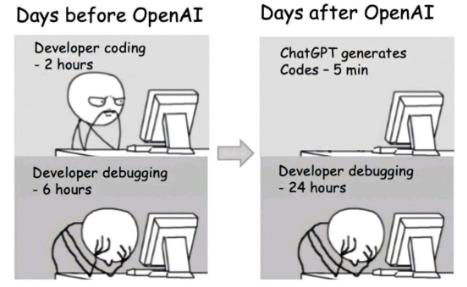
And that may be the best I can do with these AI tools at all. Most of the time, it feels like I’m only getting it 50% or 60% finished, so getting it 80% of the way to a publishable quality book may actually be optimistic. It may turn out that AI-assisted writing is a lot like the coder meme above.

So for this next week, I’m going to set the AI writing aside and focus on the “debugging” phase, which I’m calling the “human filter.” It involves retyping the story word for word into a new document, and tweaking or revising it along the way. It will be interesting to see how that goes.