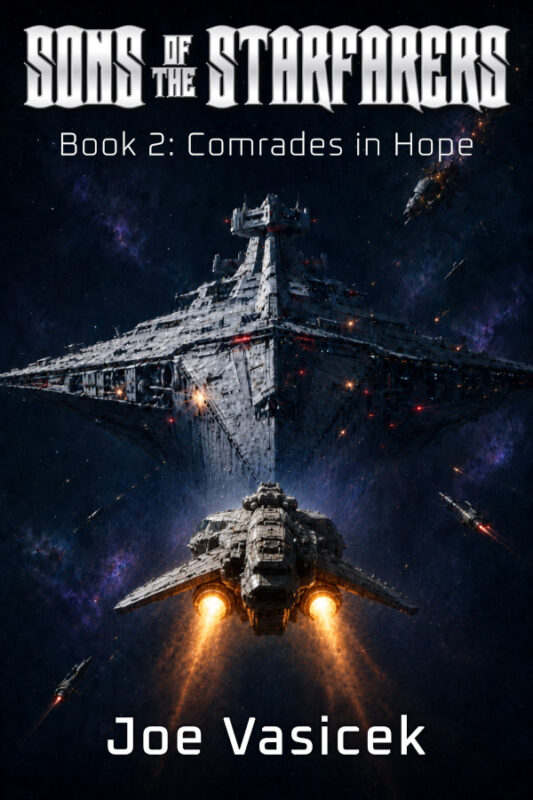
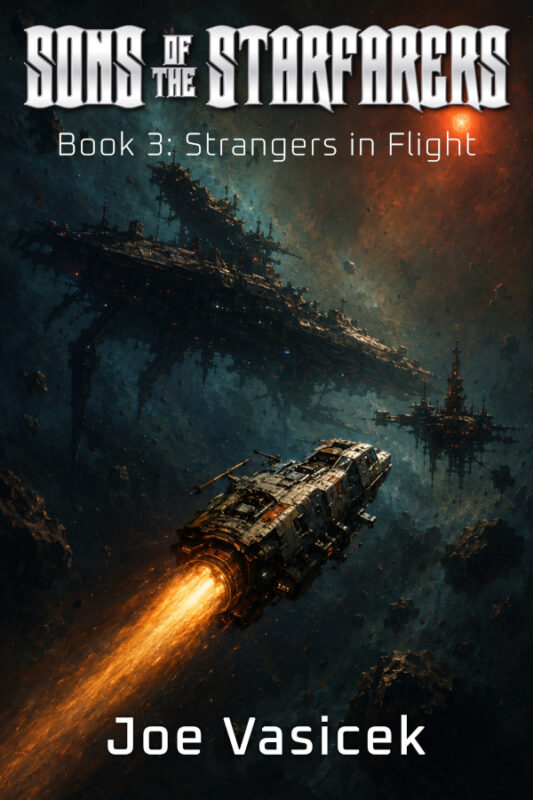
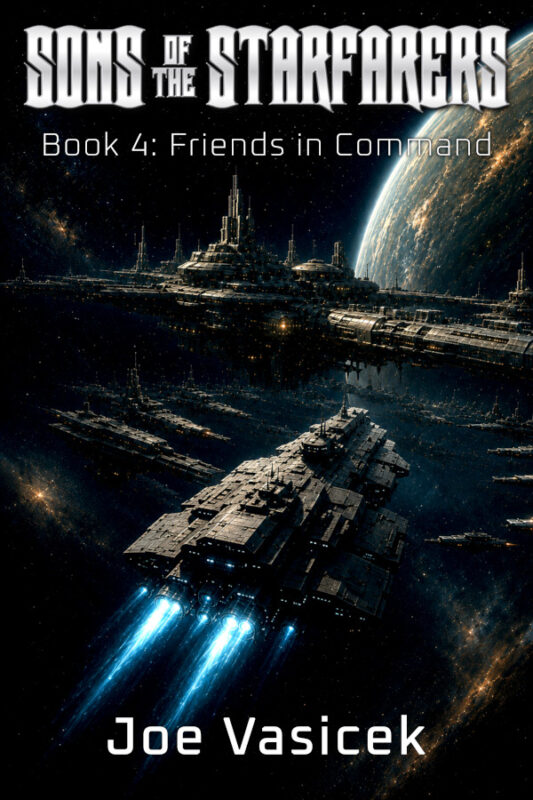
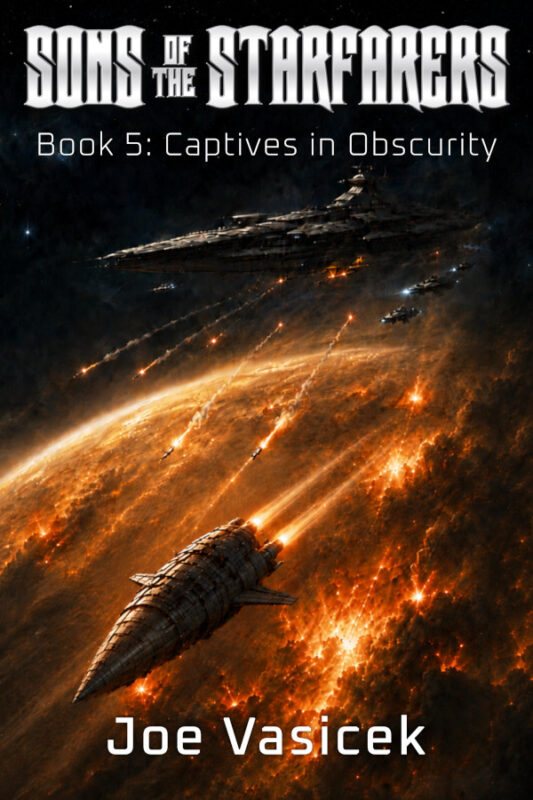
There are many fates worse than death.
In spite of this, it is always good to be alive.
Joe Vasicek is the author of more than twenty science fiction books, including the Star Wanderers and Sons of the Starfarers series. As a young man, he studied Arabic and traveled across the Middle East and the Caucasus. He claims Utah as his home.
There are many fates worse than death.
In spite of this, it is always good to be alive.
TL:DW; It’s all just porn, and this is why we can’t have nice things.
This YouTuber has some very strong opinions. I don’t agree with all of her videos, but her arguments are always solid, so it’s always interesting to hear what she has to say.
On this issue, though, I agree with her almost completely. Almost all romantasy is porn, and its meteoric rise is a plague on fantasy books and literature.
If you were expecting a post on unicorns or other mythical beasts, I hate to disappoint you again, but that’s not what this is going to be. Instead, I want to write a bit about that most mythical of all human creatures: the full-time fiction writer.
Okay, perhaps we’re not that mythical. After all, Brandon Sanderson estimates that of all his students over the years, perhaps as many as 10% of the ones who set out to become full-time writers actually make that dream into a reality. I sometimes wonder: would Brandon count me as one of those 10%? Should he? The answer to that is… complicated.
One of the first questions I get whenever I tell people that I’m a writer is “oh, wow—how is that working out for you?” Which is really a roundabout way of asking how much money I make, and whether I’ve been able to turn it into a full-time career. I am not (yet) a major bestselling author, and the closest thing I’ve had to a breakout thus far has been my (now unpublished) Star Wanderers novella series, which managed (mostly by accident) to hit the algorithms correctly back when a permafree first-in-series with lots of direct sequels was the best path to success. Then the publishing landscape changed, the algorithms shifted to favor pay-to-play advertising, and my books got left behind.
I will admit that if it weren’t for my wife’s income, I wouldn’t be able to pursue writing full-time. As a family, we’re following a path very similar to my Scandinavian ancestors, where the wife tends the farm while the husband goes off a-viking. In other words, my wife has the stable, traditional career that provides our family with some degree of security, while I have the more risky career that has the potential to catapult us into transformative levels of wealth and prosperity. We’re doing just fine, but it does sometimes feel like my Viking ship has yet to land ashore.
Because here’s the thing: something like 90% of the money in book publishing (after the booksellers and publishers and other middlemen take their often-exorbitant cuts) goes to less than 1% of the writers who actually make any money (and something like 30% of kindle books never sell a single copy).
For every Brandon Sanderson, there are thousands—perhaps hundreds of thousands—of published authors who write on nights and weekends while holding down a day job to pay the bills. My writing contributes enough to the family budget to justify pursuing it, but if I were still single, I would need at least a part-time job.
Indie publishing has created a lot of opportunity for authors to make a career out of their writing, and there are many successful indies who are making a decent living at it. At the same time, indie publishing has also massively exploded the number of books that are published, so the proportion of full-time to still-aspiring authors is probably about the same (and may have actually tilted the other way).
In recent years, it has very much turned into a zero-sum pay-to-play game, especially with advertising. From what I can tell, most authors lose money on advertising, and most of those who are making money are spending upwards of $10,000 each month to make $11,000. The elite few who learn how to successfully game the algorithms to blow up their books often put their writing on the backburner to launch their own companies or provide publishing services, leveraging their expertise to make a lot more than they otherwise would.
The algorithms are changing books in some very strange ways. If J.R.R. Tolkien or Roger Zelazny or Robert E. Howard were writing today, would they be able to make it in today’s publishing environment?
Howard’s Conan stories would either have to be a lot sexier, or else would have to include the sort of tables and character stats you find in LitRPG. His covers would also be a lot more anime, and show a ridiculous amount of cleavage (which he actually might not have had a problem with, judging from some of the old Weird Tales covers).
Zelazny’s Chronicles of Amber would all be far too short to make it in Kindle Unlimited—to make it in that game, you have to have super long books that max out on page reads, in order to maximize advertising ROI so that you can outbid your competitors. And if you aren’t winning the pay-to-play advertising game, your KU books will sink like rocks. Also, Zelazny took way too much time between books. Gotta work on that rapid release strategy, Roger.
As for Tolkien… hoo boy, there’s an author who did everything wrong. Decades and decades spent polishing his magnum opus, with a short prequel novel that falls squarely in the children’s category (totally different genre) as the only other fantasy book published in his lifetime. I suppose he could have serialized Lord of the Rings, except nothing really happened in episode 1: A Long-Expected Party. Certainly not anything that would adequately foreshadow all the dark and epic battles to come. Perhaps if he followed a first-in-series permafree strategy, and just gave away Fellowship of the Ring for free… and then made The Hobbit his reader magnet for signing up for his email list… maybe that could have worked? After all, there’s always BookBub…
I jest, of course. Each of these authors’ books became classics, not because of their marketing strategy, but because they hit the cultural zeitgeist in exactly the right way. But is it possible for an author to do that today without also getting a boost from the algorithms? Or do the algorithms have more power to shape our culture than anything else? Those are disturbing questions, and I honestly do not know the answer.
And then there’s the question of AI, which is massively disrupting all of the creative fields. In the interest of full disclosure, I am actually quite sanguine about generative AI, and have already been working to incorporate it into my creative process. I’m not a fan of AI slop, but I don’t feel particularly threatened by it. I decided a long time ago that if AI ever became good enough to write an entertaining book, it still would never be able to write a Joe Vasicek book. That’s insulated me from most of the doom porn out there.
Right now, there is a HUGE fight happening between authors like me who are embracing AI, and authors who treat it all as anathema, and have vowed to never use any sort of AI in any of their books (except Grammarly, of course, because… reasons. And Microsoft Word. And…) Frankly, it reminds me of the big debate between indie and traditionally published authors, back before self-publishing had lost its stigma. The biggest difference is that the level of online outrage has been ramped up to 11, mostly as a result of the social media algorithms (which weren’t as robust or as powerful back in the early 2010s). I suspect that we will ultimately settle on a “hybrid” approach, much like we did with publishing, but the sheer level of vitriol has made me wonder about that.
On the reader end of things, though, it seems like most readers don’t really care if a book was written with or without AI assistance, so long as it’s actually a good book. Which means that there is a real opportunity for authors who 1) know how to tell great stories, 2) have already found and honed their voice, and 3) know how to strike the right balance between the AI and the human elements.
Which describes my own position almost perfectly. Over the last fifteen years, I’ve read, written, and published enough books that I have a pretty good handle on what makes a great story. I’ve also honed my voice well enough that I can write in it quite comfortably. And as for the balance between AI and human writing, I’ve been working hard on that since ChatGPT burst onto the scene in 2022. Half a dozen books and about a million words later, I’ve learned quite a lot about how to best strike that balance.
Will AI replace authors entirely, making this particular unicorn extinct? I don’t think so. But AI may radically change our concept of what “books,” or “writers,” or “writing” really are. A long time ago, I realized that even if AI became good enough to write a decent book, it would never be able to write a Joe Vasicek book. Only I can do that. Whether or not that’s worth something is up to the readers to decide.
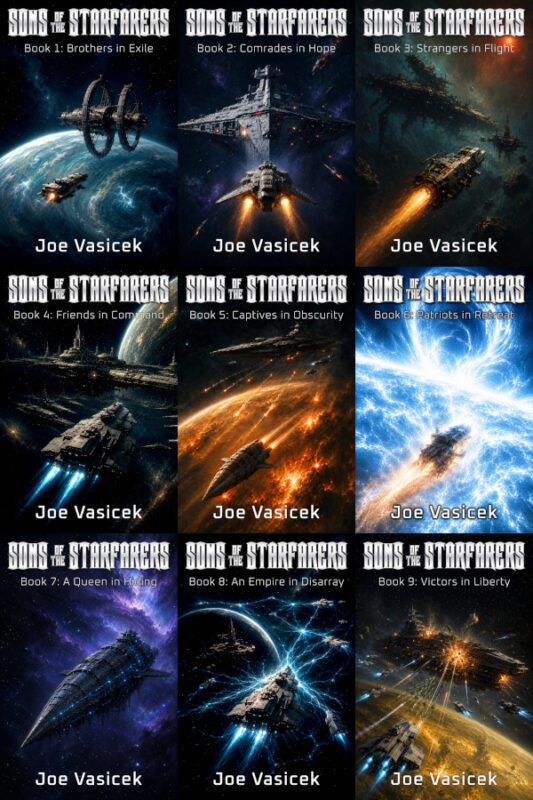
This book has been permafree for a while now, but I’m currently running a promotion on it, so it’s worth posting it here. If you like science fiction and you haven’t read many of my books yet, this is a great place to start!
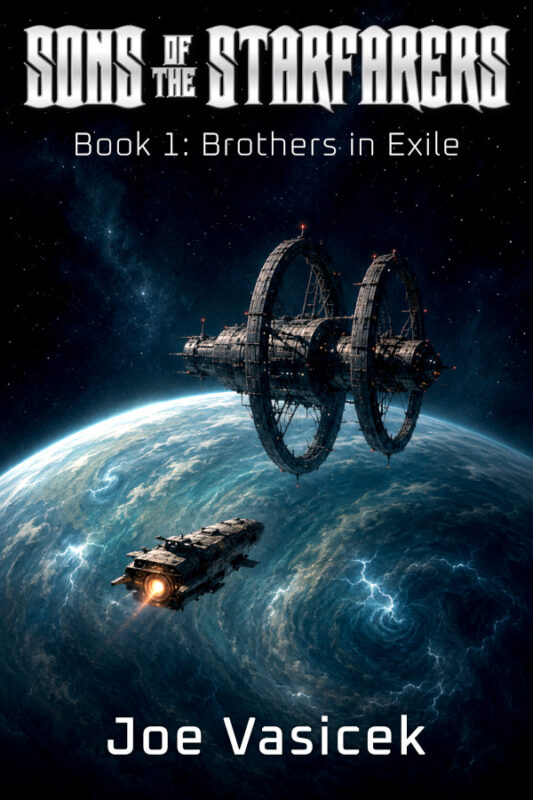
Isaac and Aaron are nothing if not survivors. Their homeworld lost and their people scattered, all they have left is each other. Then, in the Far Outworlds, they find a dead colony with a beautiful young woman frozen in cryostasis. She is also a survivor—and she needs their help.










We’ve moved everything back over to our Orem house, but now we’re in the middle of settling in and unpacking. The kids are still getting used to things, though they’re doing surprisingly well sleeping in the same room. Our oldest daughter has had a couple of melt-downs (she has always been the emotional one), but I think she likes the new home, even if she isn’t quite used to it yet. As for our two year-old son, he’s been doing quite well, especially when we can get him to take a nap.
The yard needs sooo much work. Our sprinklers broke down, so we never watered anything this year. The lawn is quite literally dead. Of course, this presents us with an opportunity to reshape it, which we plan to do. Lots more garden space, a couple of fruit trees, some tree guilds and permaculture—we definitely have plans. But it will start with a heavy watering, once the weather cools down a little, and then a spread of some nitrogen-fixing clover. That should lay a good foundation for all the other things we want to do.
Hopefully things settle into something of a routine this next few weeks. Once they do, I think I’ll get back into writing. But since we’ve moved enough that I’ve got my home computer up and running, I should be able to blog more frequently and keep up with publishing/marketing tasks. My wife also finished the rough draft of her dissertation, so she’s making good progress on that.
So that’s what we’ve been up to. Not much more to say other than that it’s good to be home.
J.R.R. Tolkien is to fantasy literature what George Washington is to the United States of America. In a very real and a very deep sense, he is the father of modern fantasy. His accomplishments are truly remarkable, and though it may have become fashionable in recent years to downplay his contributions to the genre, we all owe him an incalculable debt.
Lots of knowledgeable people have written about how Tolkien has shaped modern fantasy, so I’ll focus instead on my own personal experience with his books. I first read The Hobbit when I was in middle/high school, around the time I made my first novel writing attempt. I’d already read a lot of Margaret Weis and Tracy Hickman, as well as some middle grade dragon fantasy, but mostly I was into science fiction. However, since the book I was writing was fantasy, I figured I should read some of the classics to understand what I was getting into.
I never finished writing that novel. My reach exceeded my grasp at the time, and I gave up in frustration, lamenting how inadequate my writing skills were at the time. But I don’t think it was too much of a problem that I was comparing my own amateur writing with Tolkien’s. Indeed, it was Tolkien that helped me to climb out of that writing funk, which lasted a little longer than a year. After finishing The Hobbit, I moved on to The Lord of the Rings, and was immediately drawn into the story. It took me the better part of a year to finish it, but I was enthralled from the first page to the last, and spent hours studying the maps (the edition I read had some extra-large fold out copies) and imagining what Middle Earth must be like.
My favorite character in The Lord of the Rings was Faramir. In the movies, he briefly gives into the temptation of the ring, but that isn’t true of the books. Indeed, one of the things that defines his character is that when Frodo and Sam fall into his custody, he has every opportunity to seize the ring from them, but has the wisdom and strength of character to let the ringbearer go. As the oldest child in my family, my father drilled it into me that I needed to set a good example for my younger sisters, so I really resonated with Faramir’s strength of character (even though Faramir is technically the younger brother, growing up in the shadow of Boromir and always feeling like he had to measure up—and that is one aspect of his character that the movies showed very well). Also, I really enjoyed the love story between Faramir and Eowyn. The moment at the end, where they’re holding hands as they watch the fall of Mordor when the ring is destroyed, is one that I really love.
But my favorite part of the book by far is the ride of the Rohirrim. Such an epic moment! The forces of Mordor have all descended upon Minas Tirith, the white city, and are poised to utterly destroy it. The first ring of walls has fallen (if I remember correctly, that’s both in the movie and the book), and Denethor has lit his pyre, totally giving up to despair, and the ringwraiths have descended on their monstrous mounts… and then, the horns of Rohan sound, and the cavalry arrives, contrary to all of the work of the adversary to ensure that Rohan would not come. This is one scene from the books that the movies absolutely do justice to. I love that scene so much, reading it and watching it. So epic!
While I was reading The Lord of the Rings for the first time, it was announced that they were going to turn the whole trilogy into a series of movies. The first movie, The Fellowship of the Ring, came out a few months after I finished reading the books, and I absolutely loved it! From the opening moment of the film to the credits at the end, it was clear that Peter Jackson had a deep and abiding love for the original source material, and it shone through really well. Of course, he made some changes, such as giving Arwen a more prominent place in the story and dramatizing the last alliance of men and elves to set up the backstory, but I think all of those changes made the story translate much better into film. And the visual spectacle and sheer attention to detail in the films was absolutely stunning. The original Lord of the Rings movie trilogy is an absolute masterpiece, one that I doubt Hollywood is even capable of replicating today.
While waiting for the second movie to come out, I read The Lord of the Rings again, and found it just as good on a reread as a first read. That’s something that can be really hard to pull off, and a mark of a really good book. Some people have read The Lord of the Rings forty or more times, and while I haven’t read it quite that much, I am currently on my third reading, and will probably read it a fourth time with my daughter when she is old enough to appreciate it—which probably won’t be that long, because she is literally reading everything she can get her hands on, whether it’s on her reading level or not.
In any case, after rereading The Lord of the Rings, I decided to tackle The Silmarillion, which is a lot more dense and difficult than any of the other books. In fact, The Silmarillion reads kind of like Middle Earth’s equivalent of the Bible. But I loved it. In fact, it quickly became my favorite of Tolkien’s books. The depth that it gave to everything else I’d read was truly amazing. I also really loved the mystical elements, and the subtle Christian symbolism and cosmology.
For the next year or so, I was really into Tolkien. I got a copy of the Tolkien bestiary and pored over it constantly, and also read a bunch of the extra histories and atlases that Tolkien scholars have written. I also read the Lost Tales, though I didn’t think it was as good as The Silmarillion (really, it was just an expanded and slightly more disjointed version of that book). I watched the old animated movie version of Lord of the Rings, and found it to be hilariously bad (though I did appreciate how Peter Jackson cribbed the part where the Ringwraiths attack the sleeping hobbits in Bree). I also followed all of the updates on the movie’s official website (this was before fan wikis were a thing).
I left on my mission before the last movie came out, so I never saw it in theaters. That was a major sacrifice. But I remember when it came out, because the soundtrack circulated all over the mission (as missionaries, there were strict rules on the music we could listen to, but soundtracks fell into a gray area). The last song, “Into the West,” by Annie Lennox, is perhaps the most perfect musical encapsulation of all of Tolkien’s work. Such a great song! It was in my head for months afterward—and indeed, it lived rent-free in my wife’s head for the next two decades. One of the first things I did upon coming home from my mission was watch The Return of the King, extended version, along with the extended versions of all of the other movies.
I never really got into any of the Tolkien-esque fantasy clones, such as Terry Brook’s Shannara series or the other epic fantasy books that were basically cheap knock-offs of Tolkien. There’s a really solid argument to be made that where Tolkien created the modern fantasy genre, his publishers ruined it by pushing all of their writers to follow a rigid formula based on Tolkien’s work. I don’t necessarily agree with that argument, but I think it makes some good points. Thus, for several decades, epic fantasy was either extremely derivative of Tolkien (such as Terry Brooks), or was deliberately trying to subvert Tolkien (such as Donaldson, or G.R.R. Martin, or Brandon Sanderson’s Mistborn Era I). It hasn’t been until the last decade or so that fantasy has begun to climb out of Tolkien’s shadow.
And yet, even though I can appreciate the need to get out from Tolkien’s shadow, I still prefer to read fantasy that stands upon his shoulders. Without a doubt, he is the greatest giant in the field, even several decades after his passing. David Gemmell may be my favorite fantasy writer, but I don’t think I’ve ever become as immersed in a fantasy world as I have when I was at the height of my love for Tolkien. Even his non-Middle Earth books were delightful, such as Farmer Giles of Ham and Sir Gawain and the Green Knight. I haven’t read his translation of Beowulf yet, but I did read the epic Arthurian poem that he started and never finished—and boy, do I wish he’d finished it! I’m a real sucker for some good Saxon-style kennings and alliteration.
So that has been my own personal experience with Tolkien. Without a doubt, he’s been a major influence on my own work—so much, in fact, that his influence is probably invisible to me. It’s almost like the water we swim in, and I think that’s great. There’s plenty of room for originality, of course, but we all stand on the shoulders of giants—and Tolkien’s shoulders are the highest and the broadest shoulders in the genre. His work and his imagination have truly blessed this world.
Check out these multi-author group promotions! I’ve got a few books and stories floating around in them, and a lot of other great SF&F indie authors do too.

We’re moving this week, so the posts are going to be a bit sparse. I’m not going on hiatus, but I probably won’t post much else for the next week.
We moved from Orem to Provo (the next town over) when my in-laws left for their mission. They were going to be gone for 18 months, and they didn’t want to deal with the hassle of renting out their house, so they let us house-sit for them while we rented out our house.
That was back in 2022. They moved back in 2023, but offered to let us stay while my wife was getting her PhD (though the real reason was probably to spend more time with the grandkids). The arrangement worked out really well for us, but my wife is finishing up her dissertation and starting a new job, so it’s time to move back to our old house.
If all goes well, we should be living in the new house by the end of this week. It will probably take at least another week to move all of our stuff over, and maybe the rest of the month to get settled down, but the big stuff is all going in the next couple of days.
I’ll still try to write a little whenever I can, but the move is going to take priority. And since the writing takes priority over the blog, the blogging will be a bit sporadic for a while. I did my best to schedule some posts over the road trip to Canada, but I wasn’t able to write and schedule them all through the move. But if you leave a comment, I’ll still see it though, and do my best to respond.
Brandon Sanderson is, without a doubt, the most popular fantasy writer currently living and writing today. He is also one of the classiest and most gracious authors you will ever meet, in any genre. I’ve also got a personal connection to him, from taking his writing class at BYU.
Brandon decided to become a writer when he was very young. The way he explains it, the bug really bit him when he read Dragonsbane by Barbara Hambly. Depression runs in his family, and growing up, he always felt emotionally monotone and distant—until he read that book. From then on, he became obsessed with fantasy, both with reading and with writing it.
The way I heard Brandon explain it, that emotional monotone has been both a personal struggle and a great asset. It’s part of the reason he’s able to write so much, since where other writers tend to have huge emotional swings that affect their ability to write, Brandon is able to just sit down and do the work, day after day after day. It’s also part of what gives him an even keel that makes him such a gracious and generous person. Where other writers tend to get worked up on social media or join outrage mobs, Brandon avoids all of that. I don’t think I’ve ever seen or heard of him becoming outraged about anything.
Brandon was one of the last major authors to break into book publishing before the indie revolution began turning everything upside down. He broke in by researching agents and editors, attending all the important conferences, and networking with everyone who’s anyone in the genre. He also wrote a lot of really good books—as well as a lot of crappy ones. I believe that Elantris, his debut novel, was actually the sixth novel he wrote, and Mistborn: The Final Empire was something like the 13th. He landed his agent, Joshua Bilmes, from attending World Fantasy, and his agent eventually got him his publisher, Moshe, at Tor.
Elantris and Mistborn were good, but not immediate bestsellers. In fact, Brandon was on track to be an average mid-list fantasy author with a relatively unremarkable career, until Robert Jordan died, leaving the Wheel of Time unfinished. By that point, a lot of readers felt frustrated with the series and used his death as an opportunity to write scathing screeds about how it had gone off of the rails and grown far too bloated and large. But Brandon was much more classy and gracious than that, and wrote a tribute to the man instead, praising his work and the impact it had had on his life. When Robert Jordan’s widow read Brandon’s post, she decided that he was the one who should finish the Wheel of Time.
Personally, I’m not a huge Wheel of Time fan. I read the first three books and enjoyed them, but I got lost midway through the fourth book. My wife read them all and feels like the series is overrated, and I generally trust her judgment. But I can appreciate how a lot of people really love the series—and really, there is a lot to love. Just because it isn’t to my personal taste doesn’t mean that it isn’t good.
My friends who are Wheel of Time fans tell me that Brandon not only finished the series—he rescued it. Apparently, the last three books rejuvenated the series, wrapping things up in an incredibly satisfying way. Of course, Brandon would defer and say that it wasn’t his genius that turned the series around, but Robert Jordan’s original vision and the detailed notes and outlines that Brandon followed. But there’s no denying that Brandon really stuck the landing.
It was around this point in the story that I met Brandon. I was a student at BYU at the time, and I had an opportunity to take his writing class. From the time when I was eight, I had wanted to be a writer, but I didn’t think I would ever turn it into a career. Brandon’s writing class changed all that, and helped me to see that I could pursue writing as a career. He also taught me the nuts and bolts of writing fiction, vastly improving my writing skills. I had started several novels in high school, but never finished anything until I took his class. And while my first finished novel was a disaster that I promptly locked in the trunk, my second novel attempt (which I started writing in Brandon’s class) ultimately became my debut, Genesis Earth.
(As a side note, my wife was also in that ‘08 class with Brandon Sanderson, though we didn’t actually meet each other until almost a decade later when we matched on Mutual. She also started a writing group with her college roommate, who won the Writers of the Future and married into Brandon Sanderson’s writing group. Our writing group has also got one of Brandon’s college roommates.)
Brandon’s success with Wheel of Time was what catapulted Brandon from a midlist author to a bestselling phenomenon. But even then, if he wrote at the same slow pace as most other fantasy authors, he would have forever been known as “the guy who finished Wheel of Time.” Instead, he became famous for writing and publishing massive +300k word doorstopper tomes at an unprecedented rate, leading fans to joke about his writing super powers. Then the pandemic happened, and he wrote four “secret” novels with all of the extra time he had from not traveling anywhere. The fans went crazy, and his kickstarter blew everything out of the water.
I haven’t read all of Brandon’s books. I really loved the Mistborn era I books, and the first Stormlight Archive book was good, but my favorite is Emperor’s Soul, because I think that Brandon is at his best when he writes shorter novels rather than the massive +300k word doorstopper tomes. In my experience, Brandon is a 3-star author who writes 5-star endings. His writing tends to meander, especially in the early middle, but around the 3/4ths mark there’s usually a twist that brings things together, and the conflict escalates consistently until it builds into a really satisfying ending.
Brandon is also known for his hard magic systems, which have become a signature trait of his books. Some readers feel that clearly explaining the rules of magic defeats the sense of wonder that a fantasy novel should have, but that’s not been my experience with his books. When I read a Brandon Sanderson novel, I feel almost like I’m reading a video game. Knowing the ins and outs of the magic helps me to see the possibilities for the characters to use it, and Brandon is usually really good at adding an unexpected twist, exploiting the rules of magic in a surprising yet inevitable way. This creates its own sense of wonder that really adds to his books.
Brandon also is known for how all of his books are tied together into the same transdimensional “cosmere” multiverse, though I actually think this is the least remarkable thing that makes his books so distinctive. For one thing, he’s not the first one to do it—David Gemmell also discretely linked all of his books, which blew my mind when I discovered that particular easter egg. For another thing, Brandon has turned his cosmere from a delightfully hidden easter egg and nod to the fans to the grand key that you must possess in order to understand and appreciate his later books. As a result, the cosmere is becoming an obstacle to new readers, even as his most ardent fans all swoon over the cosmere connections.
I think Brandon’s ultimate goal is to turn his books into a massive cinematic universe, kind of like the MCU. From what I understand, he was really close to signing a Hollywood deal, but it fell through at the last minute, leaving him back at square one (I don’t know all the details, though Jon Del Arroz did some interesting reporting on that). This is also probably why his books have become more woke in recent years.
I’ve already written at length about that subject, so I won’t belabor the point here. But I really do feel that this represents a betrayal of his more conservative fans, many of whom turned to Brandon precisely because his books tend to be free of all of the gratuitous language and sexual content of most modern fantasy. Also, one of Brandon’s really great strengths during the gamergate and puppygate fannish controversies of the 2010s was his strict neutrality. While the culture wars were raging all around them, he continued to be his classy and gracious self, refraining from picking sides or wading into the mudfest. With the LGBTQ romantic subplot in Wind and Truth, that appears to have changed.
I hope he turns away from all of that. What the world really needs right now are books that transcend the whole woke vs. anti-woke divide, bringing us together and healing the artificial (and in many cases subversive) divisions that pit us against each other. Maybe Brandon will surprise me, and accomplish exactly that, just from the left side of the aisle. But as of Wind and Truth, I can’t help but wonder if we’ve reached peak Sanderson. Only time will tell.
Regardless, I will always be grateful to Brandon Sanderson for the things he taught me, and for all of his graciousness and generosity that he showed in his writing class. Without that experience, I probably would have pursued a different career, and not written nearly so many books. I also probably would not have married my wife, since one of the big things that drew her to me was my love and dedication to my writing craft.
The Iron Marshall by Louis L’Amour
Surprise, Kill, Vanish by Annie Jacobsen
The Affinities by Robert Charles Wilson
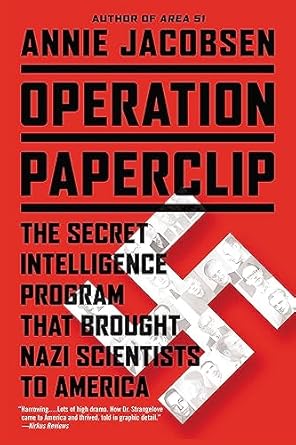
Operation Paperclip by Annie Jacobsen
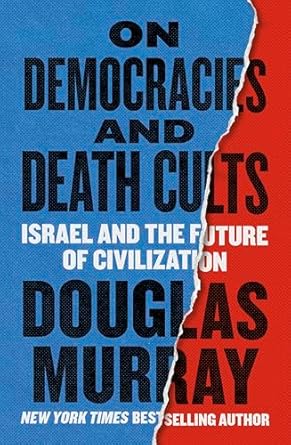
On Democracies and Death Cults by Douglas Murray
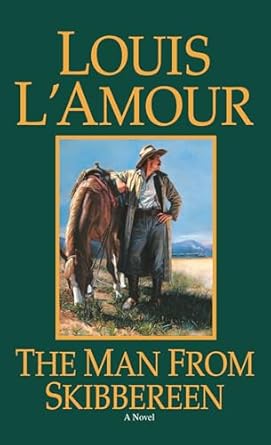
The Man from Skibbereen by Louis L’Amour

Writing for Impact by Bill Birchard
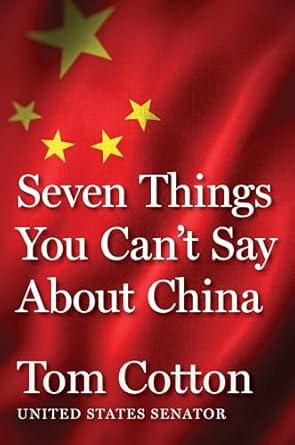
Seven Things You Can’t Say About China by Tom Cotton
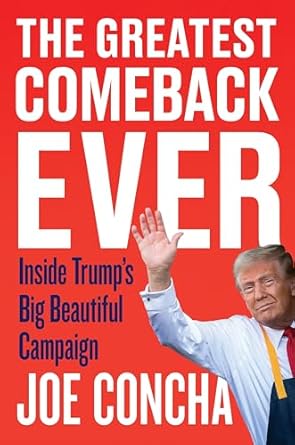
The Greatest Comeback Ever by Joe Concha